Stanza · Audio guide
Saghmosavank Audio Guide
A place to remember. A story to take with you.
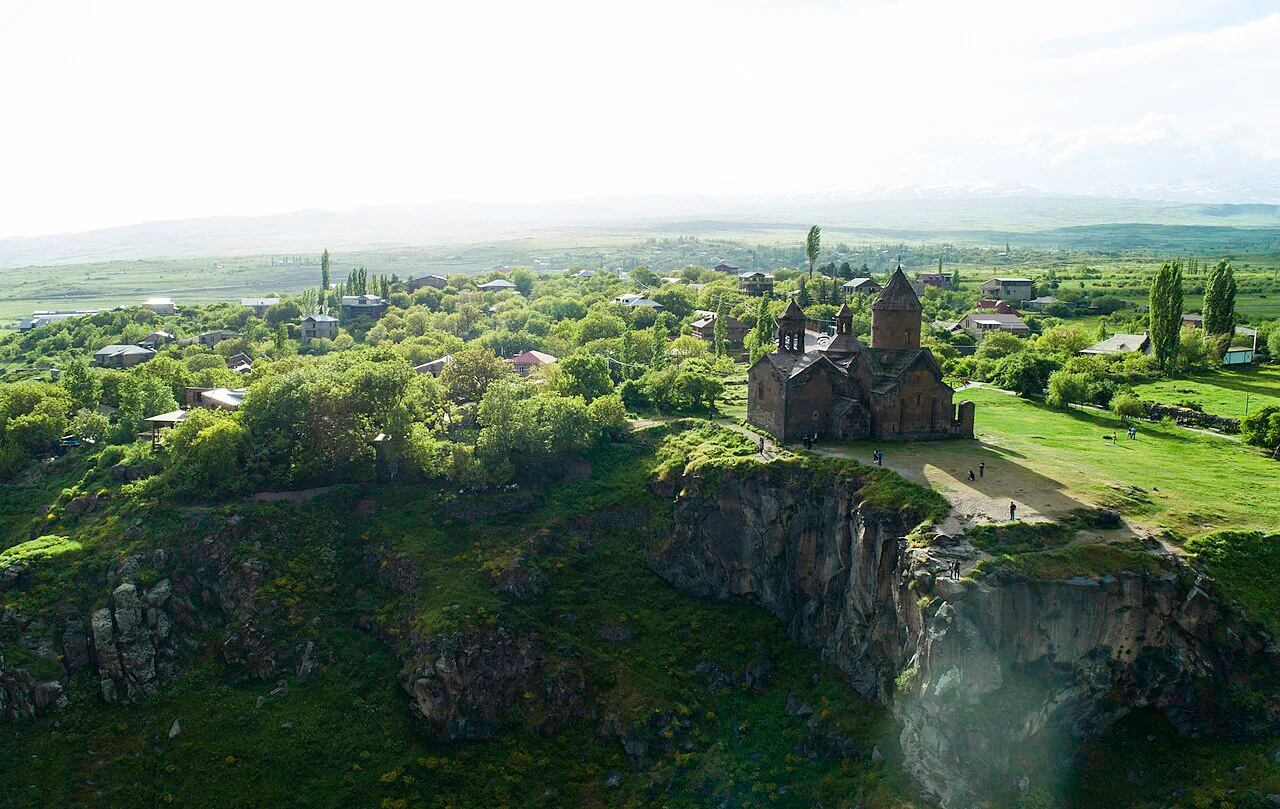
Saghmosavank is a 13th-century Armenian monastic complex located in the village of Saghmosavan. It is a cultural heritage monument of Armenia situated atop the precipitous gorge carved by the Kasagh river.
Download Stanza, then search for “Saghmosavank”.
About the tour
One guide. Your kind of visit.
Saghmosavank is a 13th-century Armenian monastic complex located in the village of Saghmosavan. It is a cultural heritage monument of Armenia situated atop the precipitous gorge carved by the Kasagh river.
Ready when you are.
- 01Get the free Stanza app.
iOS & Android
- 02Find your guide.
“Saghmosavank”
- 03Download before you go.
Works offline
Audio guide / 7 narrated stops
Inside the guide
Get to know a few of the stories before you go. Open a stop to read more.
01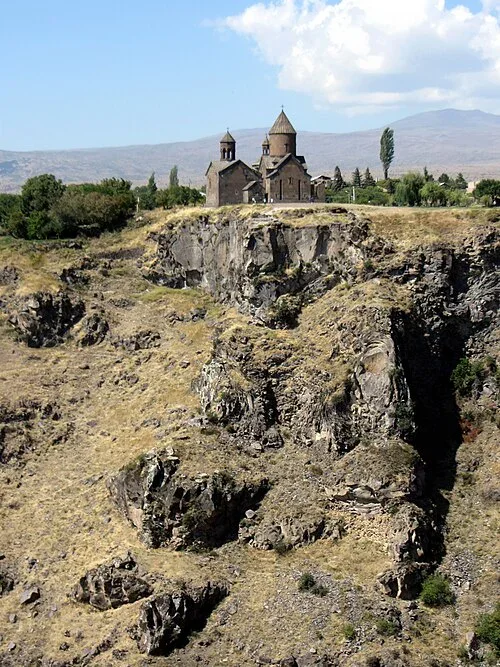 Monastery Approach and Kasagh Gorge Viewpoint
Saghmosavank on the Kasagh Gorge Rim
Welcome to Saghmosavank, a thirteenth-century monastery in Armenia's Aragatsotn Province. The name means the Monastery of the Psalms, and the place earned it. The complex sits directly on the rim of the gorge cut by the Kasagh river, and psalm singing here was renowned for its acoustics, ringing out from the cliff edge. Legend says Gregory the Illuminator found a retreat for prayer here in the fourth century, and taught monks to chant psalms. Five kilometres south stands Hovhannavank, its sister monastery. Together the two silhouettes rise sharp against the mountains below Mount Aragats. The gorge below the walls had residents of its own. Hermits dwelt in the canyon caves, and in troubled times the monastery's manuscripts were hidden in those same cliffside shelters. In 1912 a priest searching one cave found a written list of the monastery's manuscripts. It bore the inscription of Prince Vache the First Vachutyan and counted one hundred and fifteen books.
Photo: Armen Manukov · CC BY-SA 4.0
02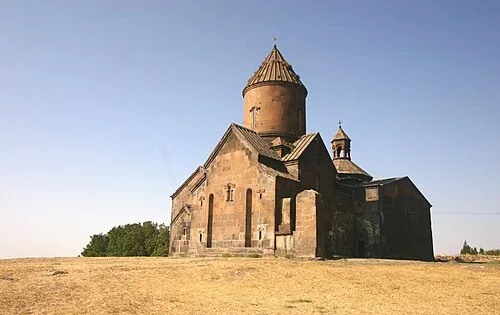 Monastery Approach and Kasagh Gorge Viewpoint
Church of Saint Zion (Surb Sion)
The tall church with the steep conical roof is Saint Zion, the principal church of Saghmosavank. Prince Vache Vachutyan and his wife Mamakhatun began it in 1215. The work was finished by 1221. From outside it reads as a plain rectangle, but inside it is cross-shaped under a central dome. Two-storey annexes fill all four corners of the building. The Armenian sources name its architect as Momik. Above the walls rises the cylindrical drum, crowned by that pointed conical cap. Triangular niches cut into the masonry catch the light and keep the walls from looking flat. Its close relative is the Church of Karapet at Hovhannavank, five kilometres south. The same princely house raised both in the same years, two silhouettes of one patronage. Both belong to the same type, a cross-winged domed structure with corner annexes on two floors. The deep space under the dome dominates each interior, and that dominance shows outside too, in the way the roof mass towers over the walls.
retlaw snellac · CC BY 2.0
03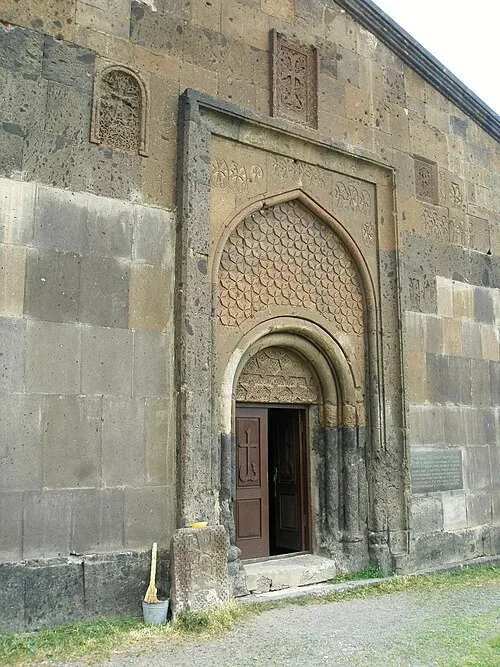 The Gavit and Western Portal
The Western Portal of the Gavit
The great carved doorway leads into the gavit, the monastery's entry hall. Prince Vache Vachutyan built it in the first quarter of the thirteenth century, the same patron who raised Saint Zion. In an Armenian monastery the gavit was the threshold, the communal hall every visitor crossed before reaching the inner churches. The portal shows what that threshold meant. Its tall arch frames a tympanum covered in dense ornament, and the wooden door sits deep within rings of carved stonework. Set into the ashlar wall beside the arch are khachkars, the carved cross-stones of Armenian devotion, built into the masonry itself. Here devotion was part of the architecture, not ornament hung upon it. Through this doorway passed mourners and worshippers, princes and monks, into the hall beyond.
Listen in the appPhoto: Liveon001 · CC BY-SA 3.0
04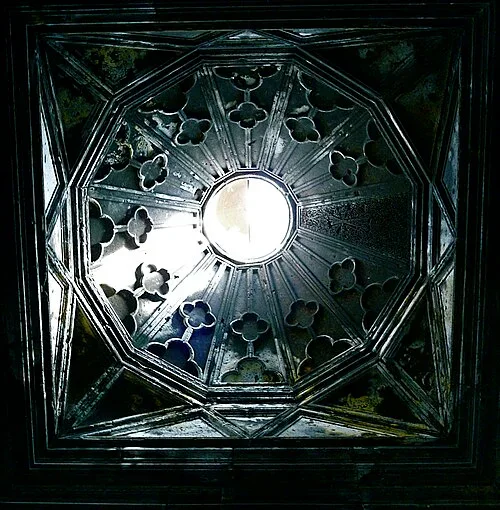 The Gavit and Western Portal
Under the Gavit Lantern
The eye climbs a square bay to an octagon, and from there to the carved ring of the cupola. Around the central opening runs rich stone carving, floral motifs and crosses radiating outward like petals. The opening itself is no accident of ruin. Over the roof of this hall stands a six-columned stone rotunda, and it did two jobs at once. It served as a belfry, lifting the call to prayer above the monastery. And it served as a lightwell, letting daylight fall through the aperture into a hall that would otherwise sit in gloom. Halls of this kind were the social heart of an Armenian monastery, a narthex where the community gathered before entering the church. It was under this carved lantern that those gatherings met, in light that came straight down from the sky.
Listen in the appRita Willaert · CC BY 2.0
05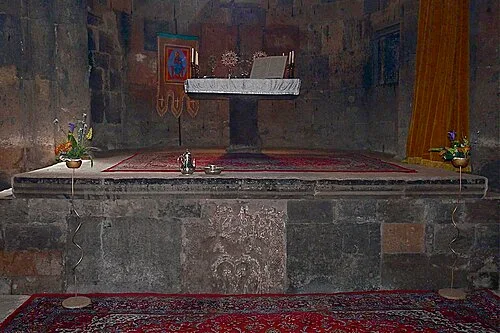 Church of Saint Zion (Surb Sion)
The Altar of Saint Zion
The stone altar of Saint Zion stands on its raised dais, dressed with cloth, candles and flowers. Worship continues here in the Armenian Apostolic tradition, the purpose the church was raised for. The altar sits at the eastern end, where Armenian churches place it, and the rugs before it mark the space of the liturgy. Here the story is the worship itself, still carried out under the dome the prince built.
Listen in the appRita Willaert · CC BY 2.0
06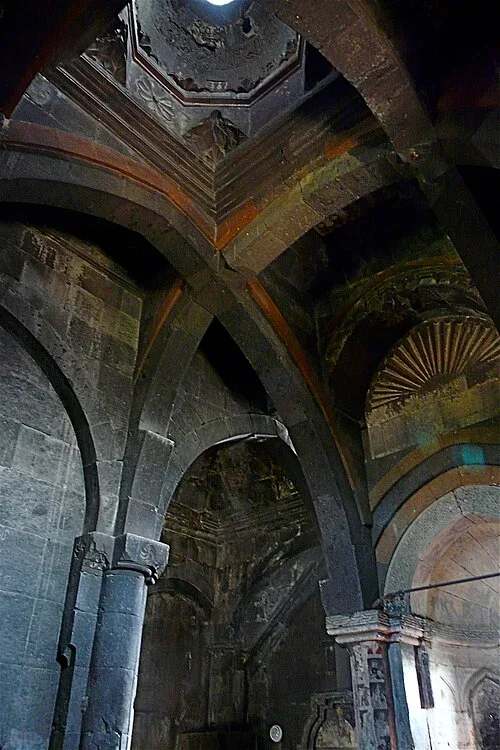 The Polychrome Scriptorium (Matenadaran)
The Book House (Matenadaran)
The vaulted arches of this hall belong to the book house, the monastery's scriptorium and library. Bands of reddish stone run through the dark masonry, giving the vaults their striking colour. Prince Kurt Vachutyan built it in 1255 together with his wife Khorishah. They raised it in memory of their daughter Mamakhatun, who died young. A house of learning, built as a memorial to a lost child. Its plan is unusual even among Armenian buildings, a square hall without columns, with an altar at the eastern end and a rare two-storey sacristy in the south-eastern corner. Deep niches were cut into the south wall for storing manuscripts. In the thirteenth century the collection counted about one hundred and twenty hand-copied books, and copying went on here into the seventeenth century. The historian Vardan Areveltsi founded a school at the monastery, where manuscripts were copied and taught. Two doors open from the book house, one to the gavit and one to the small Church of Saint Astvatsatsin, which can be entered only through this hall. On the southern facade a carved haloed figure carries the inscription Mkrtich vardapet, perhaps the architect, perhaps the carver of its reliefs.
Listen in the appRita Willaert · CC BY 2.0
07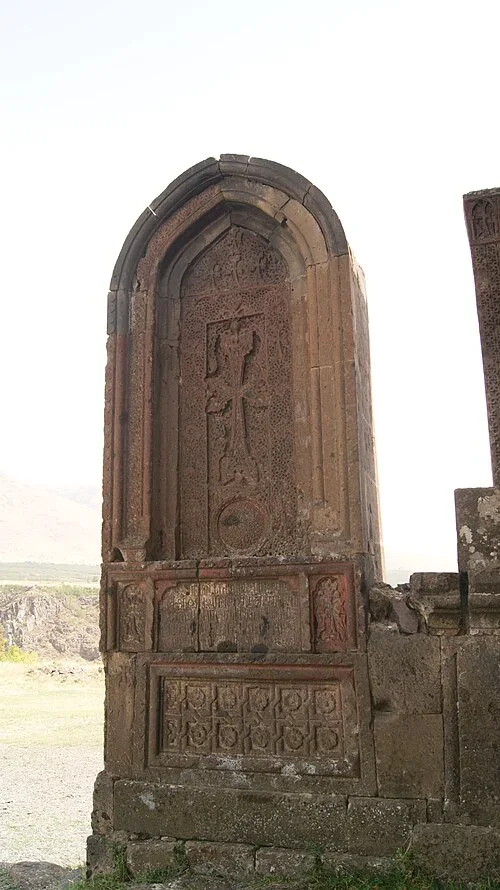 Northern Cemetery and Medieval Khachkars
Khachkars of the Northern Cemetery
The tall stone with the arched top is a khachkar, a carved Armenian cross-stone, and it stands among the commemorative stones north of the churches. Below the cross runs a band of rosettes, and traces of pigment still cling to the carving. These stones were once coloured, not left bare. Khachkars stand across the monastery grounds, some set into walls, some raised on pedestals. The northern side holds the extensive cemetery, beside the ruins of the monks' residential buildings. This is the human record of the place. A single princely family, the Vachutyans, and their monks poured forty years of building into prayer, learning and the written word at a canyon's edge. Stones like this one kept their names and their faith alive. The monastery outlasted hard centuries. Restorations came in 1890, and a fundamental renovation ran from 1998 to 2000. But the last word belongs to the people, not the repairs. The princes, the architects, the copyists and the monks who sang psalms at the cliff edge left their names in the stone, and the stone still carries them.
Listen in the appPhoto: Armineaghayan · CC BY-SA 4.0
Saghmosavank
Frequently asked questions
How much does the guide cost?
Free app download. Listed guide price: $0.99. Guide price shown in the app. Audio guide only. Venue admission is separate.
Can I listen without internet?
Yes. Download the guide’s audio, images, and maps in the app before your visit. Your downloaded content is then available offline.
Can I listen in my language?
This audio guide is available in 15 languages, including English.
Do I need to follow a schedule?
No. This is a self-guided experience. Choose your stops, pause whenever you like, and return to a story at your own pace.
At your own pace
Explore Saghmosavank.
Download Stanza, then search for “Saghmosavank”.
Free app download · Guide price shown in the app
Keep exploring
Nearby audio guides
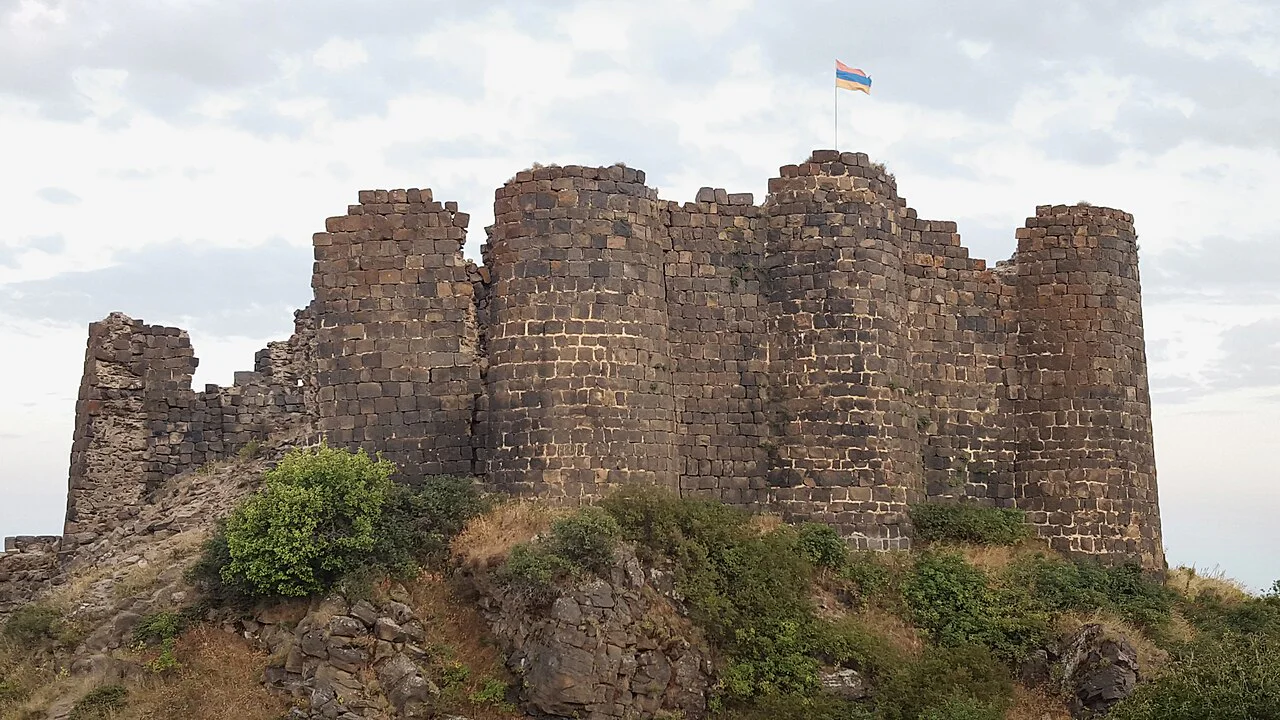
Byurakan · 14 km
Amberd
Content & sources
Yerevantsi · CC BY-SA 4.0
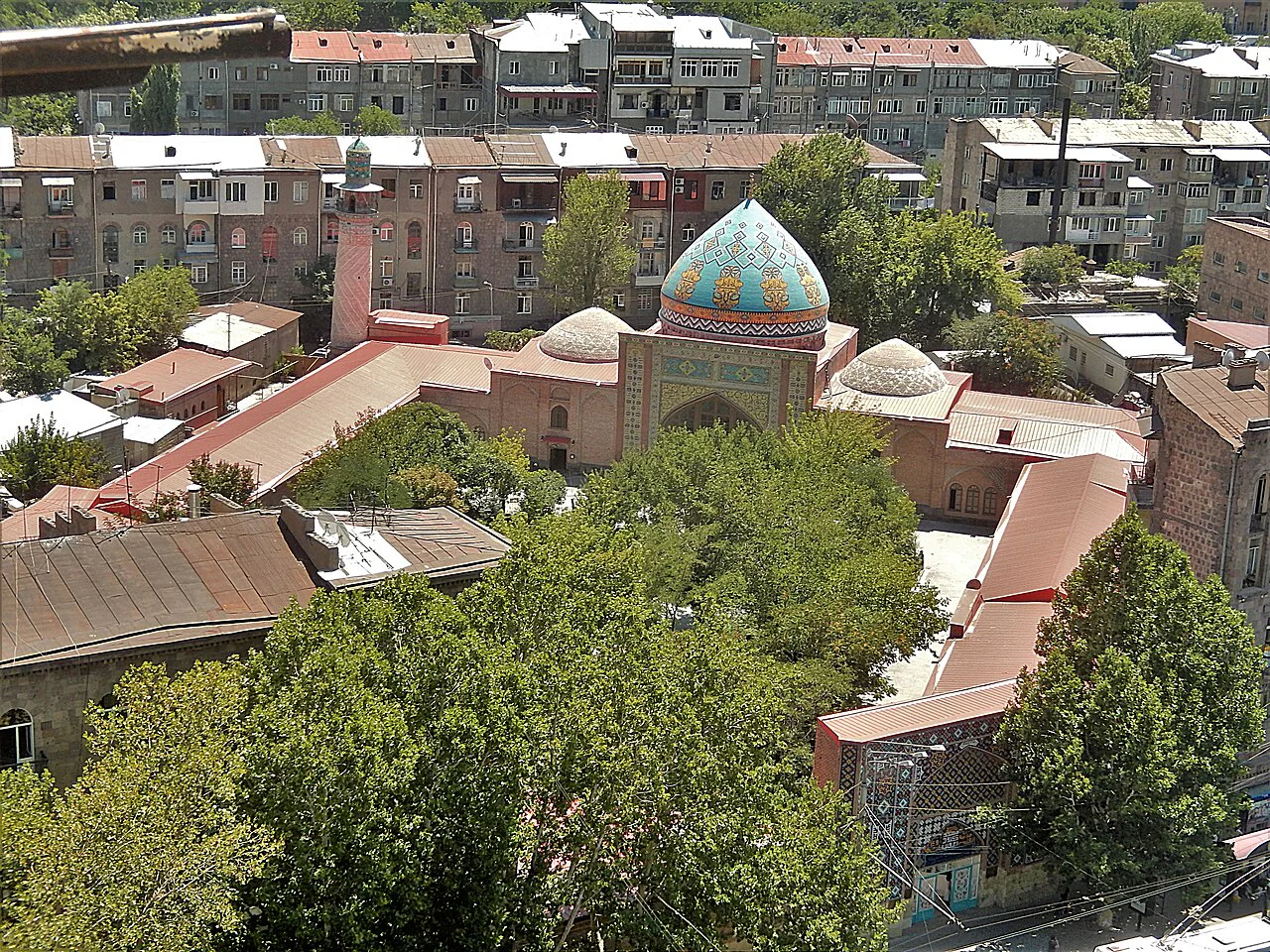
Yerevan · 24 km
Blue Mosque, Yerevan
Content & sources
Armineaghayan · CC BY-SA 4.0
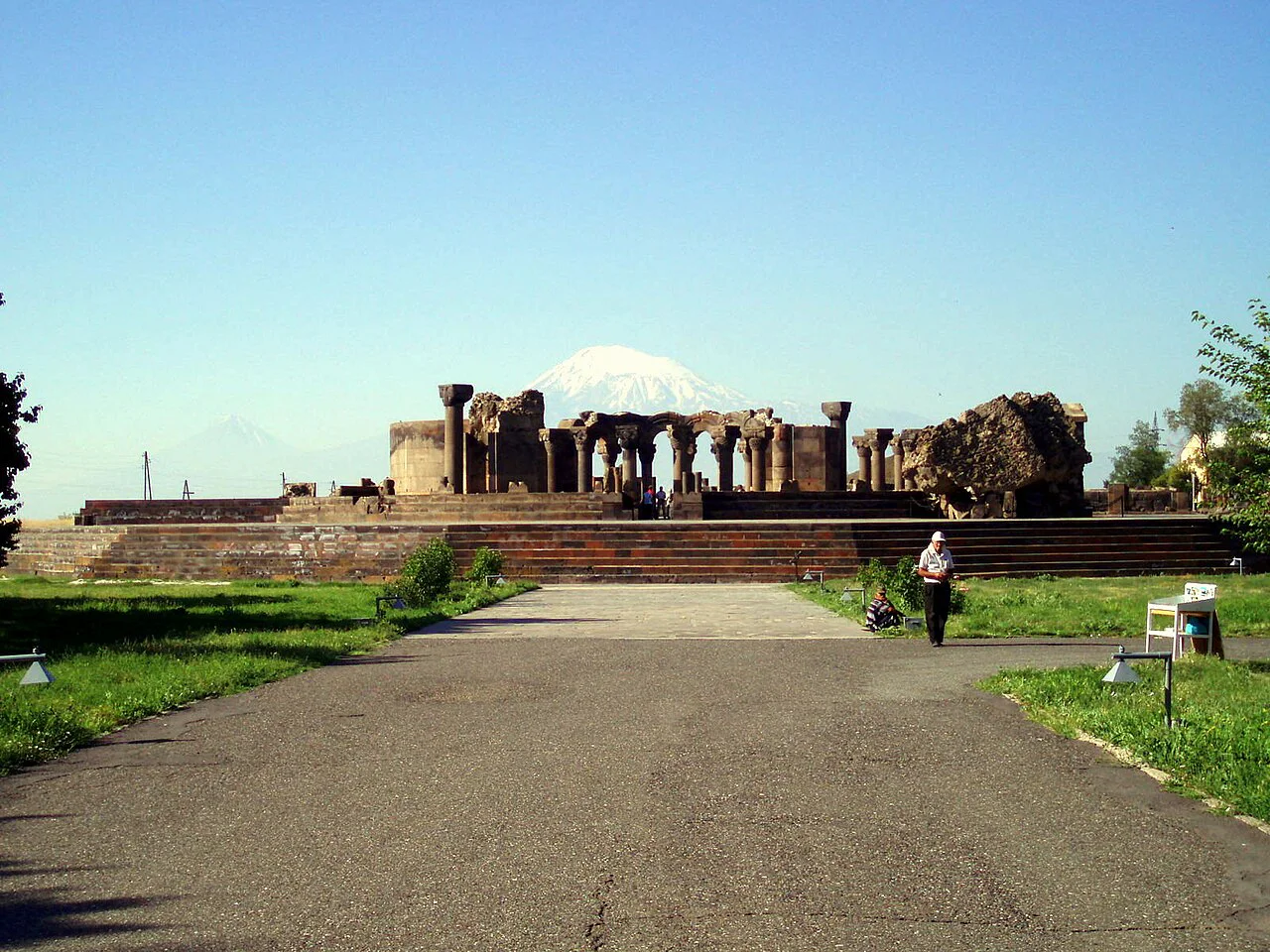
Vagharshapat · 25 km
Zvartnots Cathedral
Content & sources
DAVID HOLT · CC BY-SA 2.0
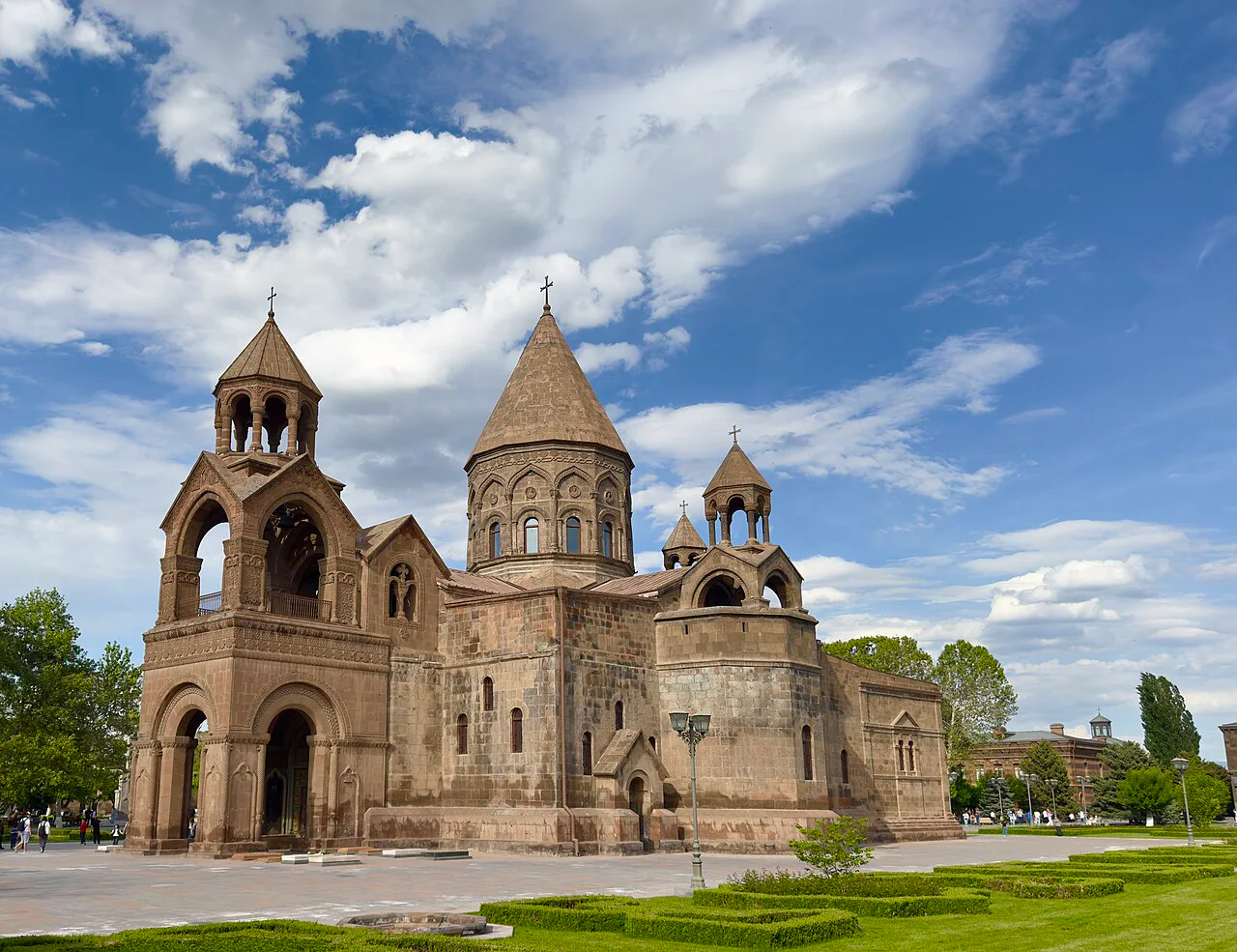
Vagharshapat · 26 km
Etchmiadzin Cathedral
Content & sources
Photo: Well-read MountainMan · CC BY-SA 4.0