Stanza · Audio guide
Etchmiadzin Cathedral Audio Guide
A place to remember. A story to take with you.
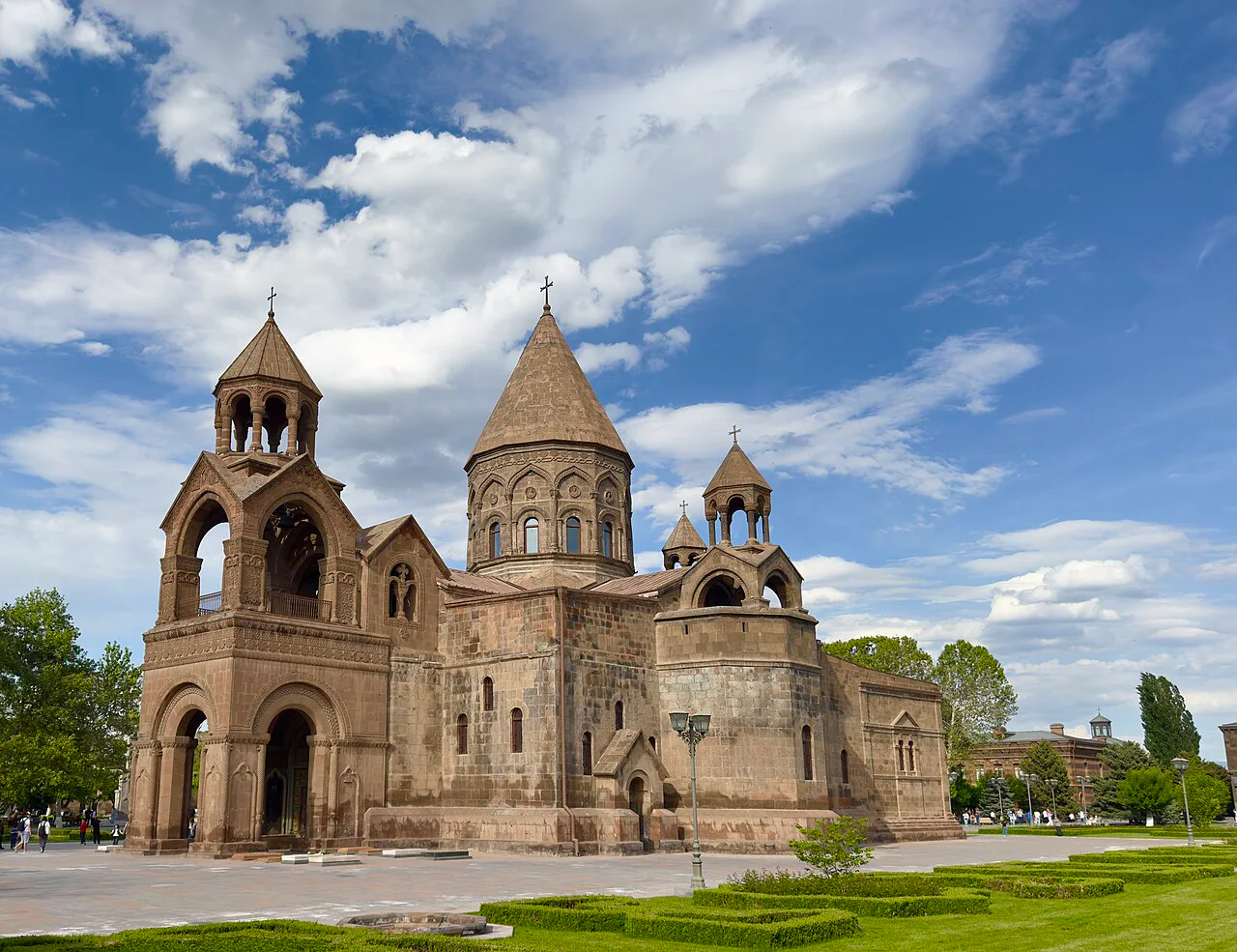
Etchmiadzin Cathedral is the mother church of the Armenian Apostolic Church. It is considered the first cathedral built in ancient Armenia and is often regarded as the oldest cathedral in the world.
Download Stanza, then search for “Etchmiadzin Cathedral”.
About the tour
One guide. Your kind of visit.
Etchmiadzin Cathedral is the mother church of the Armenian Apostolic Church. It is considered the first cathedral built in ancient Armenia and is often regarded as the oldest cathedral in the world.
Ready when you are.
- 01Get the free Stanza app.
iOS & Android
- 02Find your guide.
“Etchmiadzin Cathedral”
- 03Download before you go.
Works offline
Audio guide / 13 narrated stops
Inside the guide
Get to know a few of the stories before you go. Open a stop to read more.
01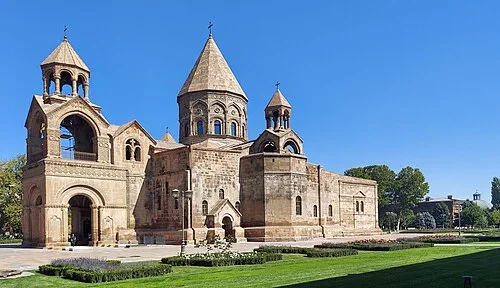 Monastic Quadrangle and Cathedral Approach
Etchmiadzin Cathedral: Mother Church of Armenia
Welcome to Etchmiadzin, the mother cathedral of the Armenian Apostolic Church. Tradition holds that it was founded between 301 and 303, when King Tiridates III made Armenia the first nation in the world to adopt Christianity as a state religion. The king's teacher and the church's patron saint, Gregory the Illuminator, is remembered as the founder. A cathedral has stood on this ground ever since the fourth century. The present church was raised over an older pagan sanctuary, a story the stones themselves will tell later on. Since 1441 this complex has been the Mother See, the administrative headquarters of the Armenian Church and the seat of its supreme head, the Catholicos. The visit leads through the courtyard, into the church, down toward its buried layers, and finally to the treasury of relics. Armenians around the world regard a pilgrimage here as much an act of identity as of faith.
P. Hughes · CC BY 4.0
02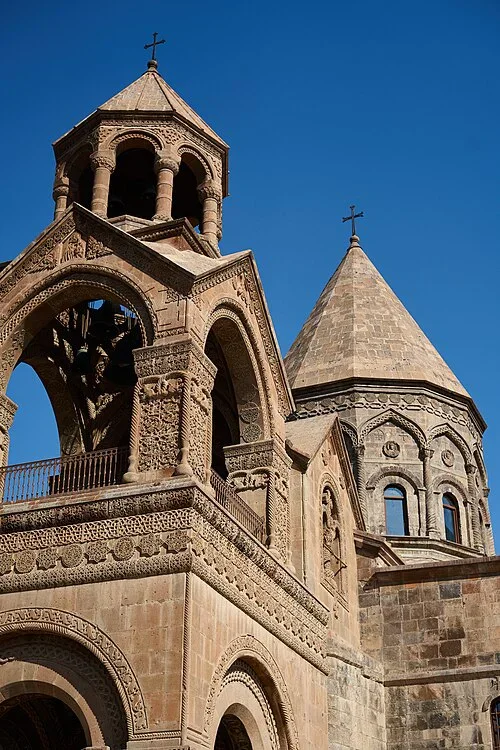 Western Belfry and Reliquary Portal
The Western Belfry
The tall tower at the western end of the cathedral is its bell tower, built in three tiers. Catholicos Pilippos laid its first stones in 1653, and his successor Hakob IV Jugayetsi completed it in 1658. It belongs to a seventeenth-century wave of bell towers added to Armenian churches across the region. In 1682 three smaller towers with red tuff turrets rose over the other three wings. This tower once held one of the strangest bells in Christendom. Travelers through the nineteenth century described a bronze bell inscribed with the Tibetan Buddhist mantra om ah hum, repeated three times. One scholar of Tibet judged it a consecrated Buddhist object, used for blessing offerings. How it reached Armenia is anyone's guess. Some thought it a gift from a Mongol khan; others that merchants brought it from Lhasa in the seventeenth century. During the Soviet anti-religious campaigns of the late 1930s the bell disappeared without a trace. Its inscription survives only because the scholar Ghevont Alishan copied it into a book in 1890.
Photo: Varoujan Tanielian · CC BY-SA 4.0
03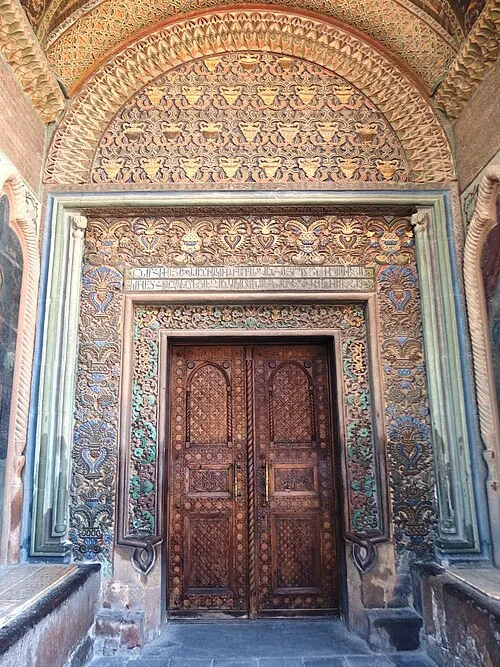 Western Belfry and Reliquary Portal
The Carved Reliquary Portal
The main entrance is a showcase of seventeenth-century Armenian stone carving. Every surface around the doorway is worked: dense floral patterns, geometric interlace and figural reliefs, framed by painted and gilded decoration. Carvers of this century rebuilt and adorned much of the cathedral, and this portal shows the tradition at its most ornate. The wooden doors set into the stone are younger. They were carved in Tiflis, the Armenian cultural center of the Caucasus, in 1889. Stone outside, wood within, two crafts meeting at the threshold.
Listen in the appPhoto: Palickap · CC BY 4.0
04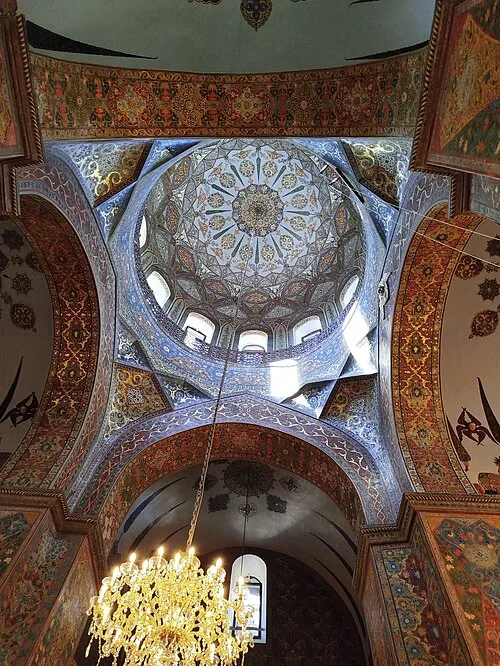 Cathedral Nave and Altar of the Descent
Inside the Fifth-Century Cathedral
The cathedral was nearly destroyed around the year 363, when the Sasanian king Shapur II invaded Armenia. Times were hard, and the catholicoi Nerses the Great and Sahak Parthev could manage only partial repairs. By the last quarter of the fifth century the building was dilapidated. Then came Vahan Mamikonian, prince and governor of Persian Armenia. A historian of his own time, Ghazar Parpetsi, recorded that he rebuilt the church from the foundations, work modern scholars place in 483 or 484. What he raised is essentially what surrounds you here: a square enclosing a Greek cross, four free-standing piers carrying the dome, and four apses projecting outward. It was among the largest monumental buildings of early medieval Armenia. Not long after, the seat of the Catholicos moved away to Dvin, yet the cathedral kept its rank as one of the greatest shrines of the Armenian Church. Scholars caution that centuries of rebuilding make the original fifth-century form hard to pin down; what survives is the core, not an untouched relic of 484.
Listen in the appPhoto: Մարի Ավետիսյան · CC BY-SA 4.0
05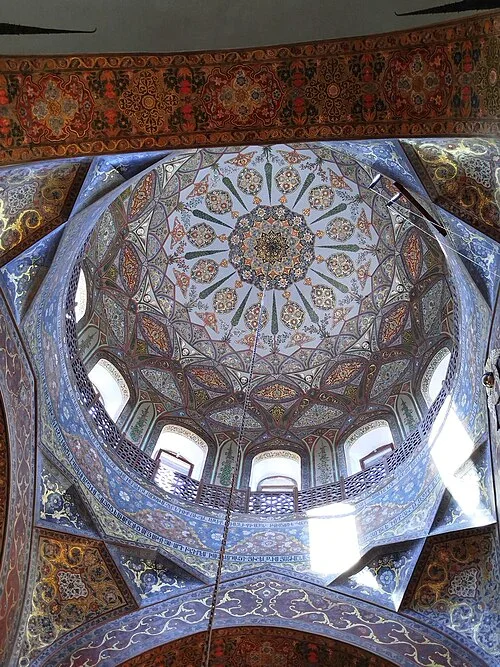 The Central Cupola and Hovnatanian Frescoes
The Dome Frescoes of the Hovnatanian Family
The painted dome overhead belongs to a family affair. Naghash Hovnatan began decorating the interior in 1712 and worked until 1721, filling the surfaces with flowers, birds, scrollwork and arabesques in the Persian manner. His painting of the dome, and his Mother of God beneath the altar, survive to this day. His relatives Hakob, Harutyun and Hovnatan carried the work through the eighteenth century, and the next generation continued into the nineteenth. The twentieth century repaid the debt. Lydia Durnovo restored the frescoes in 1956, and Vardges Baghdasaryan worked over them again in the early 1980s. Not every visitor has been kind. One British traveler, James Bryce, found the interior gloomy, yet allowed that it carried a certain sombre dignity, and an air of hoar antiquity about everything.
Listen in the appPhoto: Մարի Ավետիսյան · CC BY-SA 4.0
06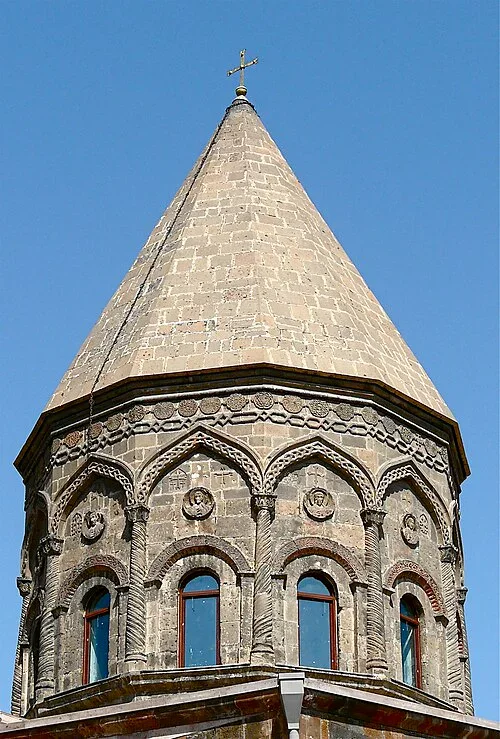 The Central Cupola and Hovnatanian Frescoes
The Conical Dome
The cathedral's signature from outside is its cone. A tall polygonal drum carries a steep conical roof, the typically Armenian crowning form, rising about thirty-four meters. Four massive piers inside hold the whole thing up. The first dome was wooden; a later renovation replaced it with the stone one seen now. Scholars prize this building because it stacks the styles of different eras of Armenian architecture in one structure. Alexander Sahinian argued that no other church shows the sequence so completely. The dome and roof were the focus of the most recent campaign, begun in 2012. After twelve years of work the cathedral reopened with ceremony on September 29, 2024, and the Catholicos honored the diaspora benefactors who funded it.
Listen in the appRita Willaert · CC BY 2.0
07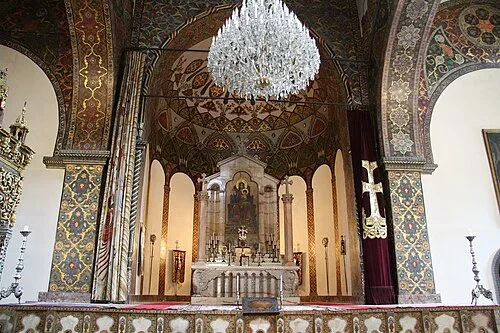 High Altar and Subterranean Crypt
The High Altar and the Vision of the Descent
The name of this place begins at the altar. The fifth-century historian Agathangelos tells how Gregory the Illuminator had a vision: a divine figure descended from heaven and struck the earth with a golden hammer, marking the spot where the cathedral should rise. Later tradition identified that figure as Christ himself. From that vision comes the name Etchmiadzin, which means the Descent of the Only-Begotten Son of God. Curiously, the name only caught on in the fifteenth century; earlier writers simply called it the Cathedral of Vagharshapat, after the royal capital around it. The church keeps the feast of Holy Etchmiadzin sixty-four days after Easter, singing a hymn by the eighth-century Catholicos Sahak III that retells Gregory's vision. The vision itself is tradition, recorded centuries after the event; the exact spot of the descent cannot be verified.
Listen in the appPhoto: GerritR · CC BY-SA 4.0
08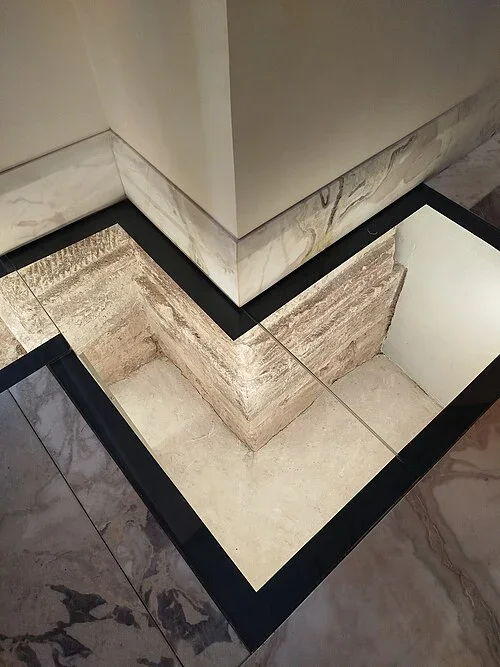 High Altar and Subterranean Crypt
Beneath the Altar: The Excavation Window
Beneath the high altar the ground holds older gods. Excavations in the 1950s cut down through the layers, and a glass panel in the floor now opens onto them. Deepest lies a granite stele of the Urartian kingdom, carved centuries before Christ, evidence of a sanctuary on this spot. Beside it an amphora came to light, interpreted as part of a fire temple. And there is a harder chapter. In the year 450 the Sasanian king Yazdegerd II tried to force Zoroastrianism on Christian Armenia, and he built a fire temple inside the cathedral itself. Its pyre was unearthed under the altar of the east apse. The Christian church had been deliberately raised over the pagan sanctuary to proclaim the new faith's triumph; the fire temple was a counter-claim that did not last.
Listen in the appPhoto: Մարի Ավետիսյան · CC BY-SA 4.0
09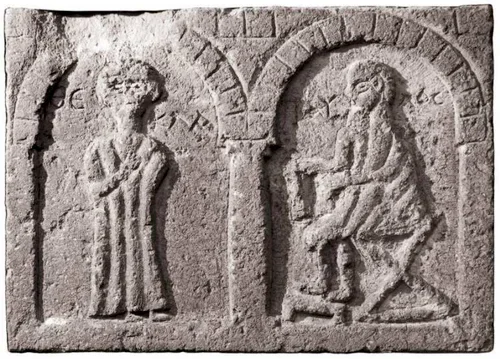 Northern Wall Early Christian Reliefs
The Paul and Thecla Relief
On the north wall of the cathedral, a weathered stone panel shows two figures under arches. On the left stands Saint Thecla, a follower of the apostle Paul; on the right Paul himself sits on a cross-legged stool. These reliefs are counted among the earliest Christian stone sculptures in Armenia, and scholars have argued over them for generations. Some place them before the invention of the Armenian alphabet around the year 405; others put them in the fifth or sixth century. The stone beside this one carries a Greek cross and Greek inscriptions naming several people: Arxia, Elpid, Daniel, Tirer and Garikinis. Not one of them has ever been securely identified. The last two are read as the Armenian names Tirayr and Garegin, but that remains a scholar's guess. Whoever they were, they left their names on the wall of a church that outlasted every kingdom around it.
Listen in the appVahagn Grigoryan · CC BY 2.5
10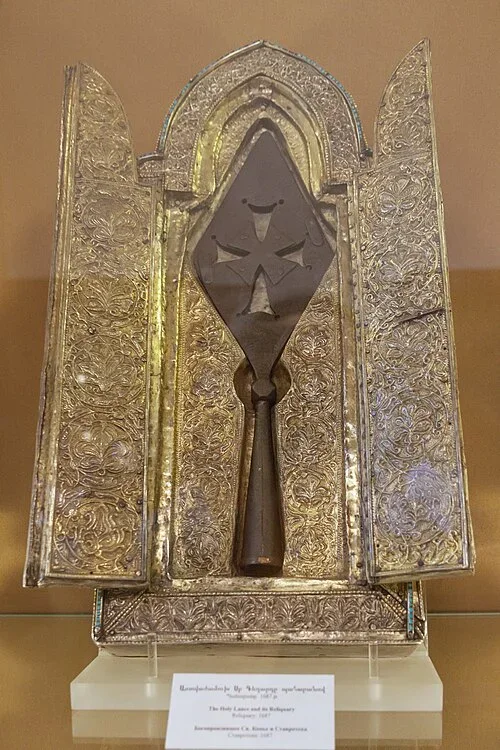 Museum Sacristy and Holy Relics Treasury
The Holy Lance in the Treasury
Among the treasures of the Armenian Church, none draws pilgrims like the Holy Lance. Tradition holds it to be the spear that pierced the side of Christ, and it rests here in a gilded reliquary shaped like a small triptych church. Its provenance is a matter of devotion rather than established fact. In 1868 a sacristy, a museum and room of relics, was built onto the east end of the cathedral, and today the lance is shown in the treasury of the Mother See. In 2018 the lance crossed the Atlantic, displayed to crowds at the Metropolitan Museum of Art in New York. From a quiet treasury to a museum gallery in Manhattan, few relics have traveled further.
Listen in the appMarcin Konsek · CC BY-SA 4.0
- 11
Noah's Ark Fragment and the Plunder of 1604
A fragment of Noah's Ark, and the Persian shah who tried to steal the whole cathedral.
- 12
The Catholicoi's Burial Ground
The graves of the catholicoi, and the patriarch who refused to flee in May 1918.
- 13
The 1233 Khachkar
A cross-stone of 1233, and the cathedral that survived even the Soviets.
Etchmiadzin Cathedral
Frequently asked questions
How much does the guide cost?
Free app download. Listed guide price: $0.99. Guide price shown in the app. Audio guide only. Venue admission is separate.
Can I listen without internet?
Yes. Download the guide’s audio, images, and maps in the app before your visit. Your downloaded content is then available offline.
Can I listen in my language?
This audio guide is available in 15 languages, including English.
Do I need to follow a schedule?
No. This is a self-guided experience. Choose your stops, pause whenever you like, and return to a story at your own pace.
At your own pace
Explore Etchmiadzin Cathedral.
Download Stanza, then search for “Etchmiadzin Cathedral”.
Free app download · Guide price shown in the app
Keep exploring
Nearby audio guides
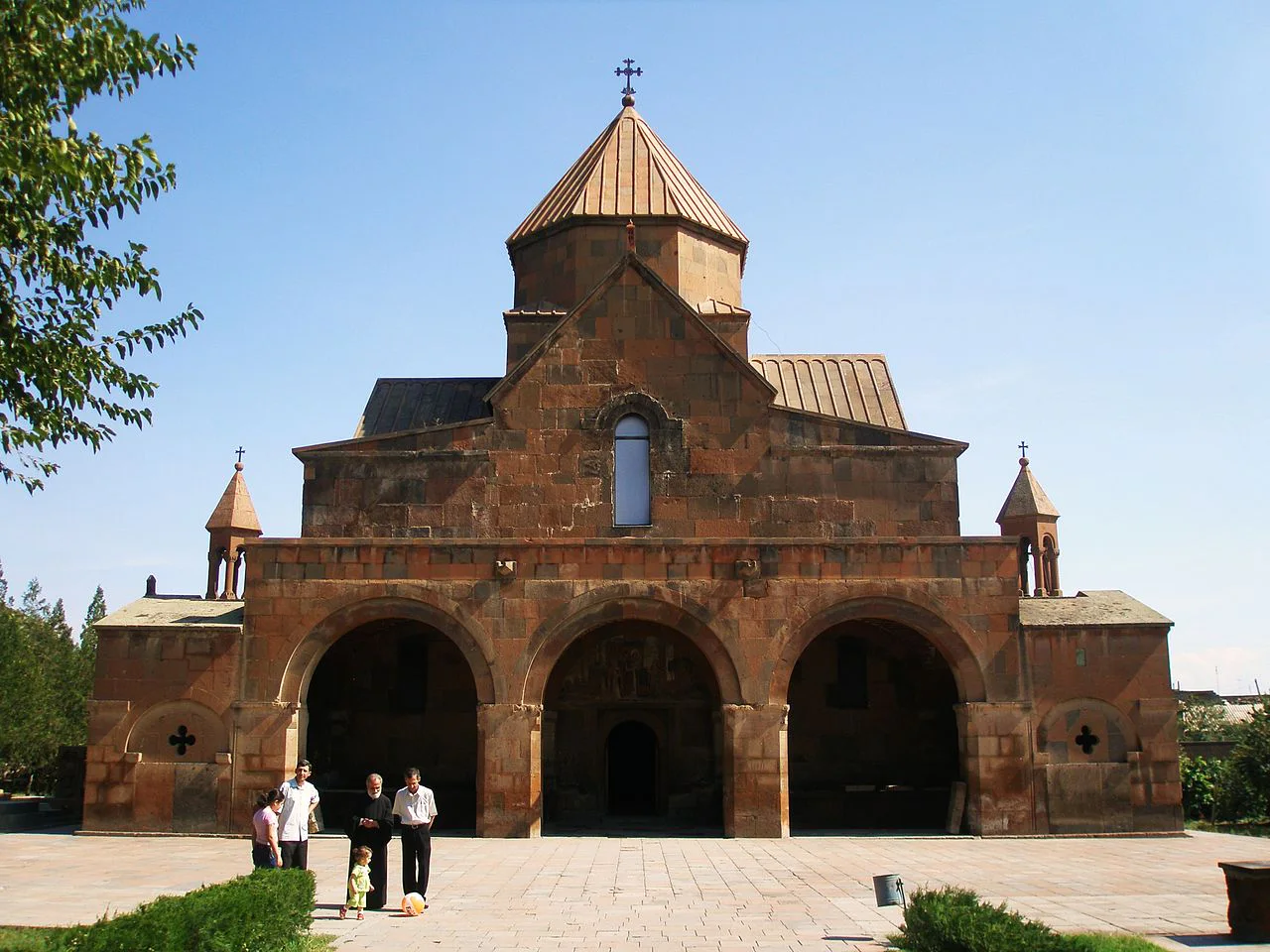
Vagharshapat · 1 km
Saint Gayane Church
Content & sources
Liveon001 © Travis K. Witt · CC BY-SA 3.0
Vagharshapat · 4 km
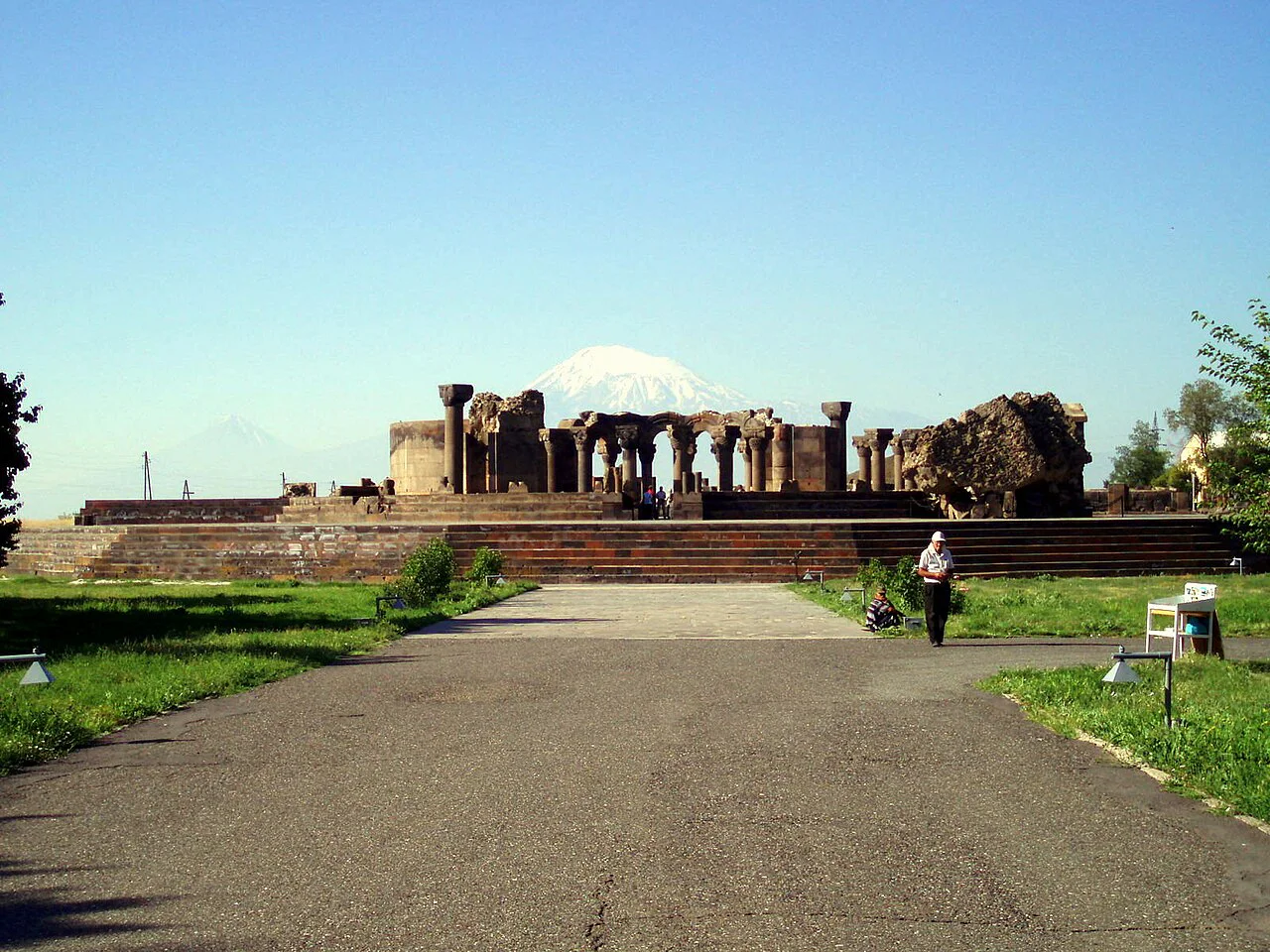
Zvartnots Cathedral
Content & sources
DAVID HOLT · CC BY-SA 2.0
Yerevan · 18 km
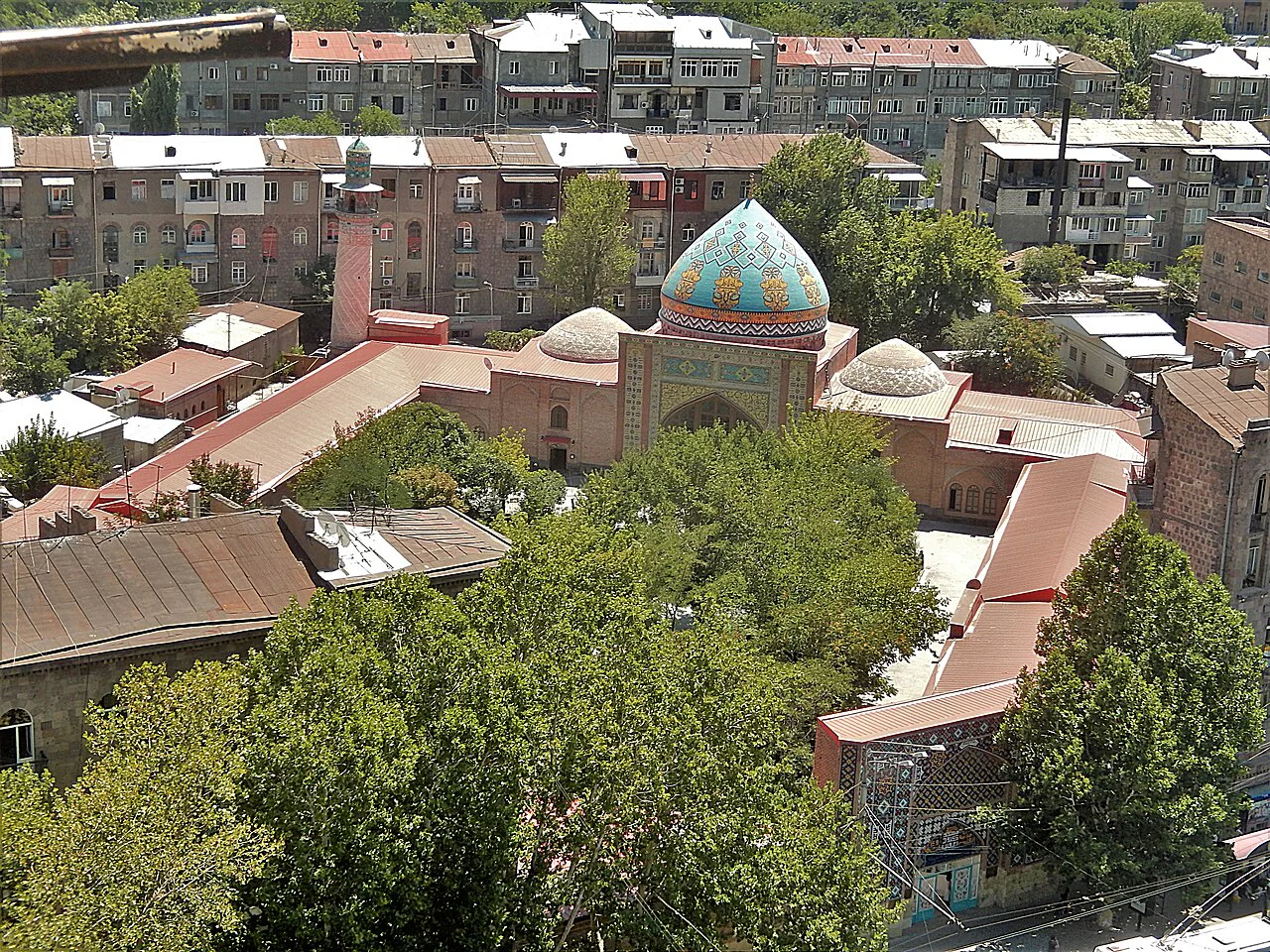
Blue Mosque, Yerevan
Content & sources
Armineaghayan · CC BY-SA 4.0
Yerevan · 21 km
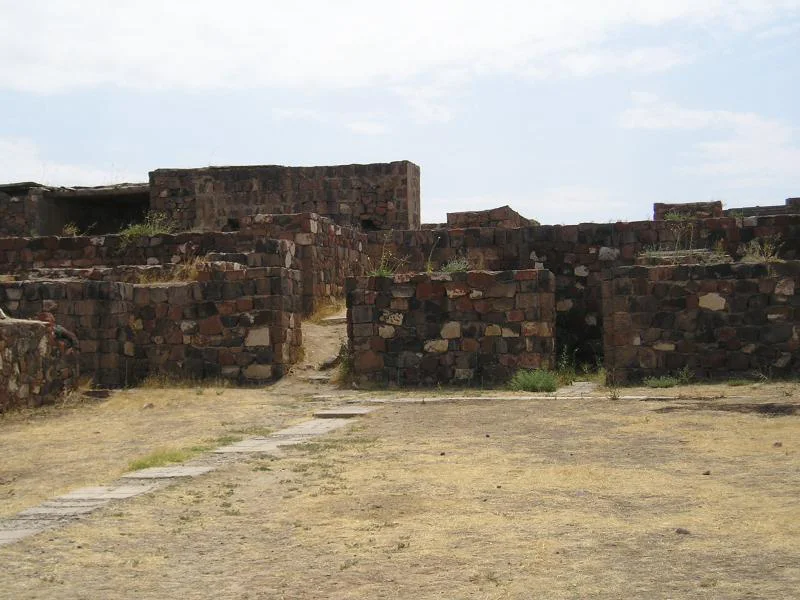
Erebuni Fortress
Content & sources
Photo: Numerius Negidius · Public domain