Stanza · Audio guide
Saint Gayane Church Audio Guide
A place to remember. A story to take with you.
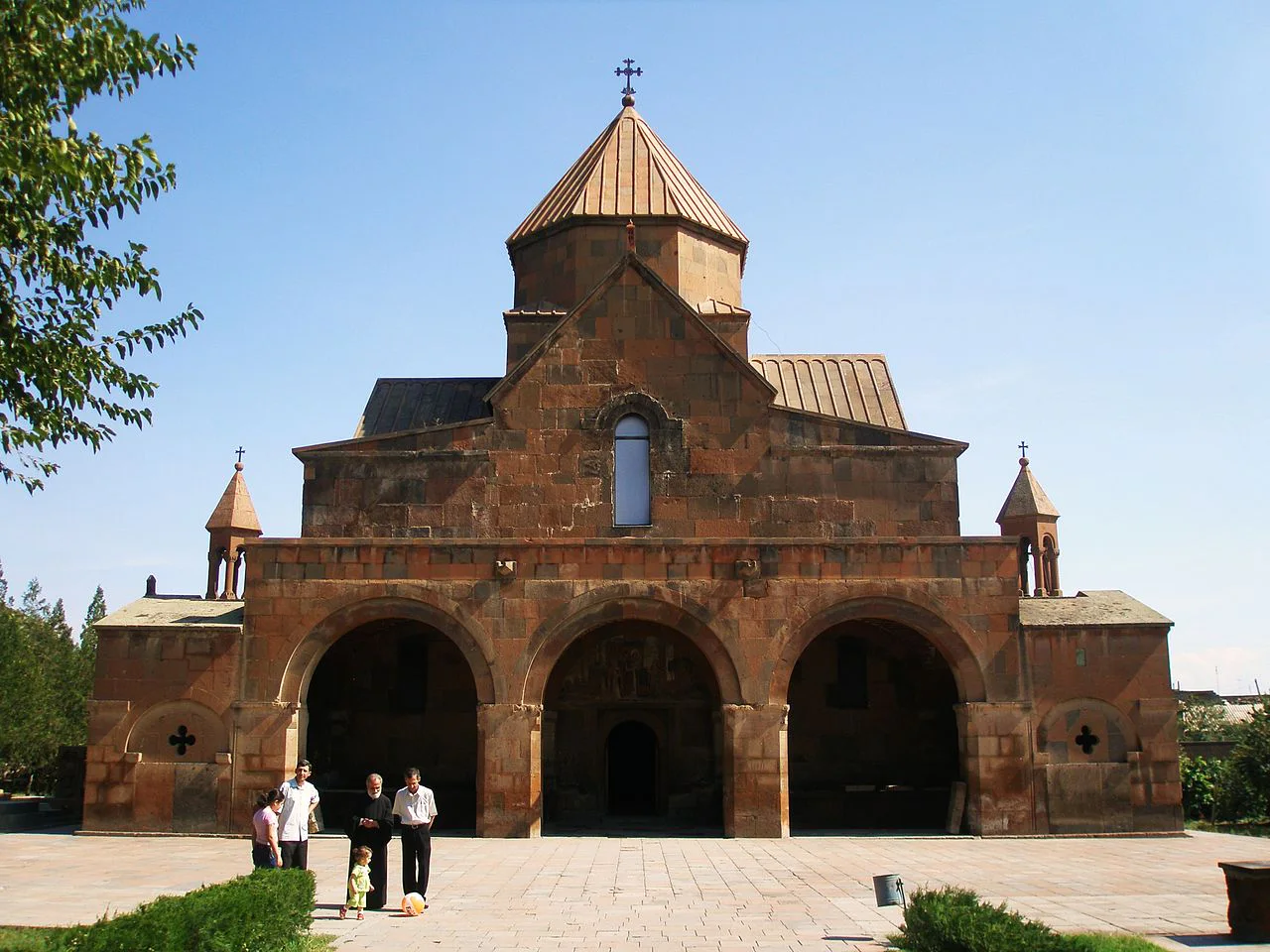
Saint Gayane Church is a 7th-century Armenian church located in Vagharshapat. It was built by Catholicos Ezra I in the year 630.
Download Stanza, then search for “Saint Gayane Church”.
About the tour
One guide. Your kind of visit.
Saint Gayane Church is a 7th-century Armenian church located in Vagharshapat. It was built by Catholicos Ezra I in the year 630.
Ready when you are.
- 01Get the free Stanza app.
iOS & Android
- 02Find your guide.
“Saint Gayane Church”
- 03Download before you go.
Works offline
Audio guide / 9 narrated stops
Inside the guide
Get to know a few of the stories before you go. Open a stop to read more.
01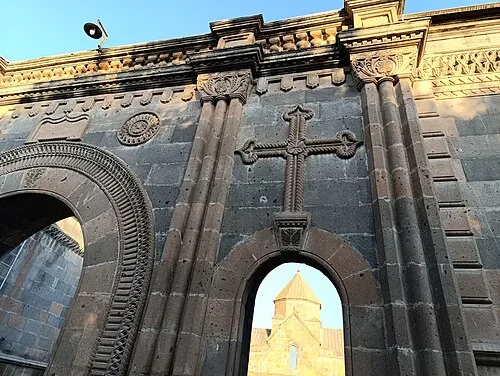 Monastic Gate & Exterior Approach
The Gate of the Monastic Enclosure
Welcome to Saint Gayane, in Vagharshapat — the city Armenians call Etchmiadzin, the religious heart of their country. The carved gateway opens into a walled churchyard, and the stone cross worked into the arch announces what kind of ground this is. The church inside is seventh century, and it stands a short walk from Etchmiadzin Cathedral. In 2000, UNESCO listed Saint Gayane together with the other churches of Etchmiadzin and the ruins of Zvartnots as a World Heritage Site. One idea holds it all together. This church was built on the spot where a woman named Gayane died for her faith, and everything here grows from that.
Photo: Beko · CC BY-SA 4.0
02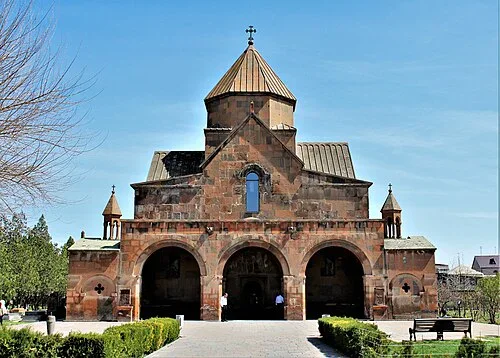 Monastic Gate & Exterior Approach
The Martyrdom Site of Saint Gayane
The story begins in Rome, in the year 301. A Christian nun named Hripsime was so beautiful that the emperor Diocletian wanted her for his wife. Rather than submit, she fled with her abbess, Gayane, and a community of nuns, and they made their way to Armenia. King Trdat there received a letter from Diocletian praising Hripsime's beauty, and he went looking for the women himself. He fell in love with Hripsime, and then with Gayane. Both refused him. Hripsime was tortured and killed at the place where Saint Hripsime church stands today. Gayane died on this very ground. As Hripsime suffered, Gayane's words to her were set down by the fifth-century historian Agathangelos: "be of good cheer, and stand firm." Thirty-eight more nuns were killed at the site of Shoghakat church. Then came the turn that changed Armenia. Trdat converted to Christianity and made it the official religion of his kingdom. In 630, Catholicos Ezra I began the stone church that stands here now, raised directly over the place where Gayane died.
Photo: Beko · CC BY-SA 4.0
03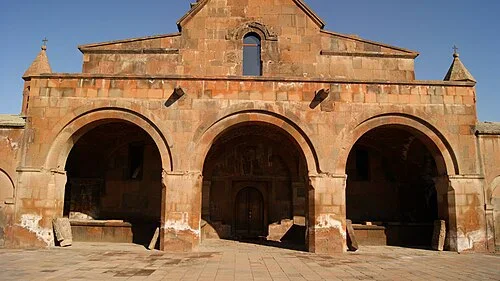 Western Arched Portico & Patriarchal Pantheon
The Western Arched Portico
Three great arches face the courtyard on the church's western side. This open gallery, called a gavit, was attached to the church in the 1680s under Catholicos Eleazar the First Aintaptsi. He built on a grand scale in those years: monastic buildings, a new enclosure wall, and this hall, along with two small chapels at its north and south ends, dedicated to Saints Peter and Paul, each with its own altar. The gallery runs as five connected bays. The three central ones are vaulted and open through large arches onto the courtyard. The two end bays sit a little lower, closed on three sides, with small four-lobed windows in their outer walls. Above the end bays, six-columned cupolas rise from the roof and can be seen from outside.
Listen in the appPhoto: Vahag851 · CC BY-SA 3.0
04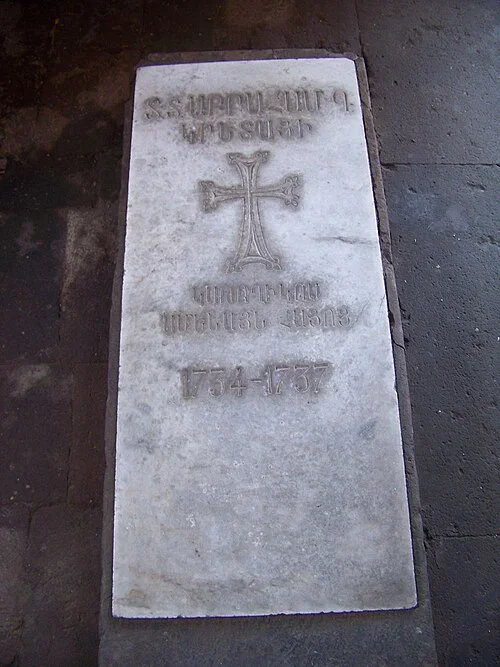 Western Arched Portico & Patriarchal Pantheon
The Tombstone of Abraham III
Set into the floor of this gallery lie marble tombstones, and one carries a name: Abraham the Third. A cross is carved at its center, with lines of Armenian letters above and below. The stone marks the grave of a Catholicos, the supreme head of the Armenian Apostolic Church. After this hall was built, it came to serve as the burial place of the Catholicoi, so the church's leaders came to rest beside the martyr's shrine. The dates carved on the slab are worn and hard to read with certainty, and no full life story of this Abraham has come down. His rank, and his resting place in this floor, are what remain.
Listen in the appPhoto: Jaba1977 · CC BY-SA 4.0
05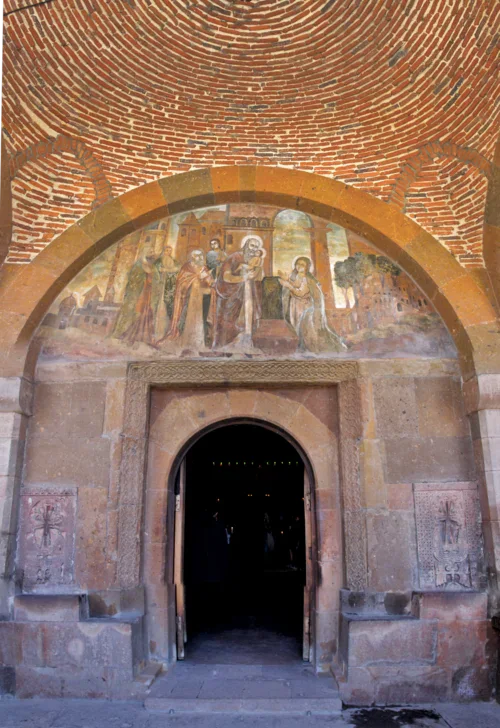 Entrance Portal & Frescoed Tympanum
The Portal and Tympanum Fresco
Above the main doorway, painted figures still hold their place on the curved plaster of the tympanum. Saints stand there in a long row, though the exact scene and the painter's name have not come down to us. Inside the portico, niches along the walls carry frescoes of clergymen, so the whole entrance zone was once a gallery of painted faces. The door itself is old wood, framed in carved stone, with carved slabs set into the masonry on either side. Three portals lead into this church, and this one through the arched portico is the main entrance; the others open through the north and south walls. Worshippers passed beneath these painted saints every time they came in from the courtyard.
Listen in the appPhoto: Beko · CC BY-SA 4.0
06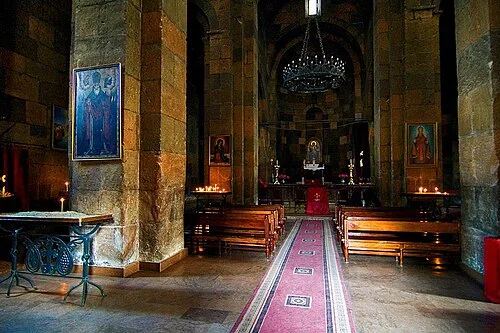 Central Nave & Domed Basilica Interior
The Three-Nave Interior
Inside, the space opens around four massive piers, free-standing in the middle of the church. They carry the central cupola and divide the interior into a broad central nave with side aisles. The middle sections of the side aisles rise a little higher than the corners and are roofed with vaults running across the building, forming a kind of crosswise nave. At the east end, a semicircular apse opens between two rectangular chambers. The design is the reason architects care about this building. UNESCO describes Saint Gayane as one of the earliest examples, in Armenian and in early Christian architecture generally, of a three-aisled basilica joined to a central dome. The long processional layout of a basilica survives, and the eye is still drawn to the domed bay at the center. And it is no museum piece: benches, icons and candles show a church where worship continues.
Listen in the appPhoto: Vigen Hakhverdyan · CC BY-SA 3.0
07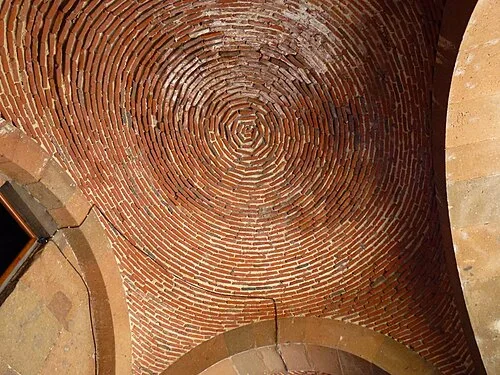 Central Nave & Domed Basilica Interior
The Octagonal Drum and Dome
From the square central bay, the ceiling climbs to an octagonal drum, and the join between them is made with squinches — small arches cut across the corners, a favorite device of Armenian builders for setting a dome over a square room. Saint Gayane belongs to a family of seventh-century experiments in domed basilicas, alongside churches like Mren, Bagawan and Odzun. It is also a survivor. A chronicler of the seventeenth century, Arakel Davrizhetsi, wrote that by his day only the walls and the dome-bearing piers were left standing. In 1652 Catholicos Philip the First rebuilt the church from the ground up, restoring the roof and the dome. His builders also dealt with a quieter threat: groundwater seeping toward the foundations. They cut a drainage channel out through the southern wall of the monastery and down toward the fields, carrying the water away — and putting it to use irrigating the land. Since that campaign the design has hardly changed, which is why the church counts among the best-preserved of early medieval Armenian buildings.
Listen in the appArman musikyan · CC BY-SA 3.0
08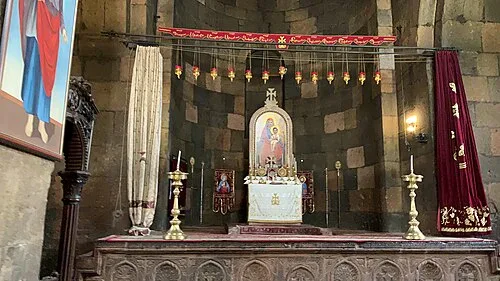 High Altar & Subterranean Martyrium of Saint Gayane
The High Altar above the Crypt
At the east end stands the high altar, dressed with icons and candlesticks and hung with ceremonial curtains. Beneath it, below this floor, lies the reason the church exists. A small underground chamber is reached by narrow stone steps that descend through the vestry to the southeast, and the relics of Saint Gayane rest there — a hidden tomb under a working altar. Pilgrims have come to this shrine for centuries, and worship continues here day by day. What remains of her is kept directly below the altar.
Listen in the appPhoto: Well-read MountainMan · CC BY-SA 4.0
09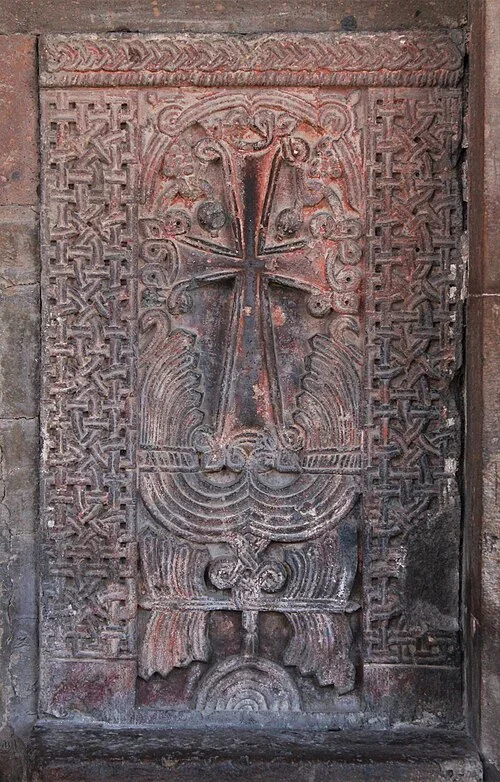 Monastic Courtyard & Sacred Khachkars
The Khachkar in the Gavit
One last carved stone waits on the way out, set in the gavit: a khachkar, the Armenian cross-stone. These stones are a tradition of their own in Armenia — memorials of faith, worked in deep relief with a cross at the center and a lacework of interlaced pattern around it. Nobody knows just when this stone was carved, or for whom. What is sure is its home: the gavit of Saint Gayane. Its rosette, its braided bands and its small figures show how much meaning a single slab of stone could carry. A church, a martyr's shrine, and stones of memory — that is Saint Gayane.
Listen in the appPhoto: Beko · CC BY-SA 4.0
Saint Gayane Church
Frequently asked questions
How much does the guide cost?
Free app download. Listed guide price: $0.99. Guide price shown in the app. Audio guide only. Venue admission is separate.
Can I listen without internet?
Yes. Download the guide’s audio, images, and maps in the app before your visit. Your downloaded content is then available offline.
Can I listen in my language?
This audio guide is available in 15 languages, including English.
Do I need to follow a schedule?
No. This is a self-guided experience. Choose your stops, pause whenever you like, and return to a story at your own pace.
At your own pace
Explore Saint Gayane Church.
Download Stanza, then search for “Saint Gayane Church”.
Free app download · Guide price shown in the app
Keep exploring
Nearby audio guides
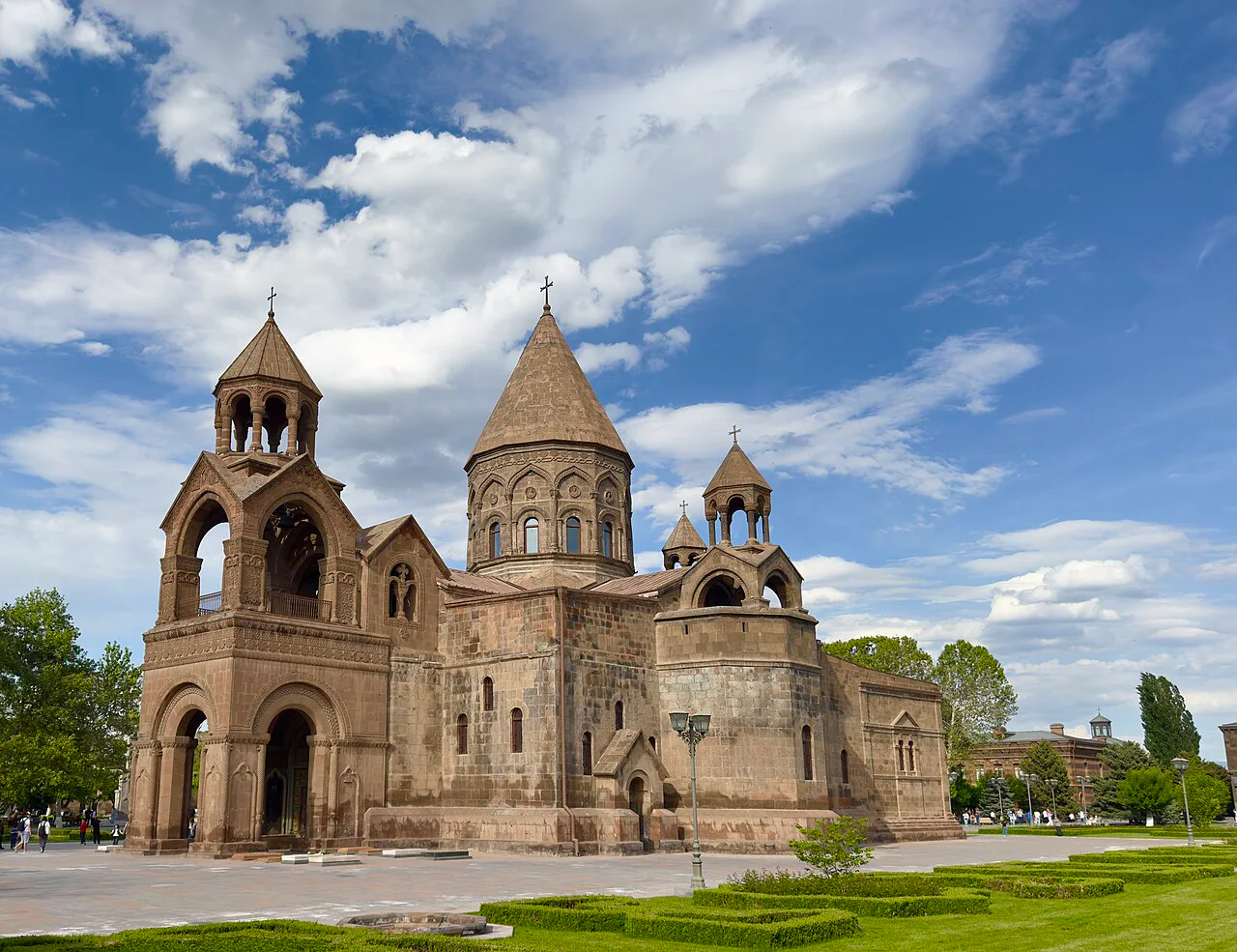
Vagharshapat · 1 km
Etchmiadzin Cathedral
Content & sources
Photo: Well-read MountainMan · CC BY-SA 4.0
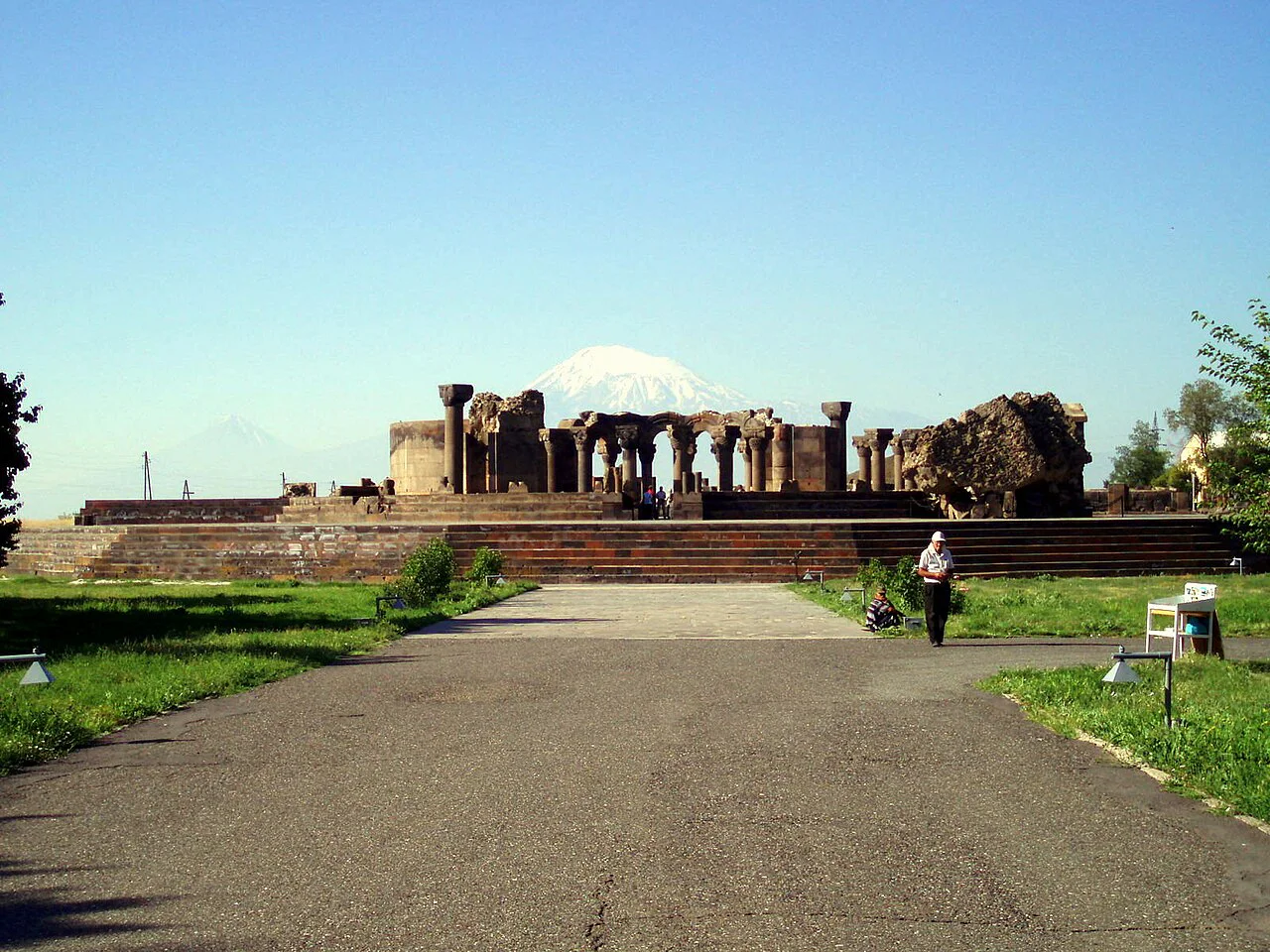
Vagharshapat · 4 km
Zvartnots Cathedral
Content & sources
DAVID HOLT · CC BY-SA 2.0
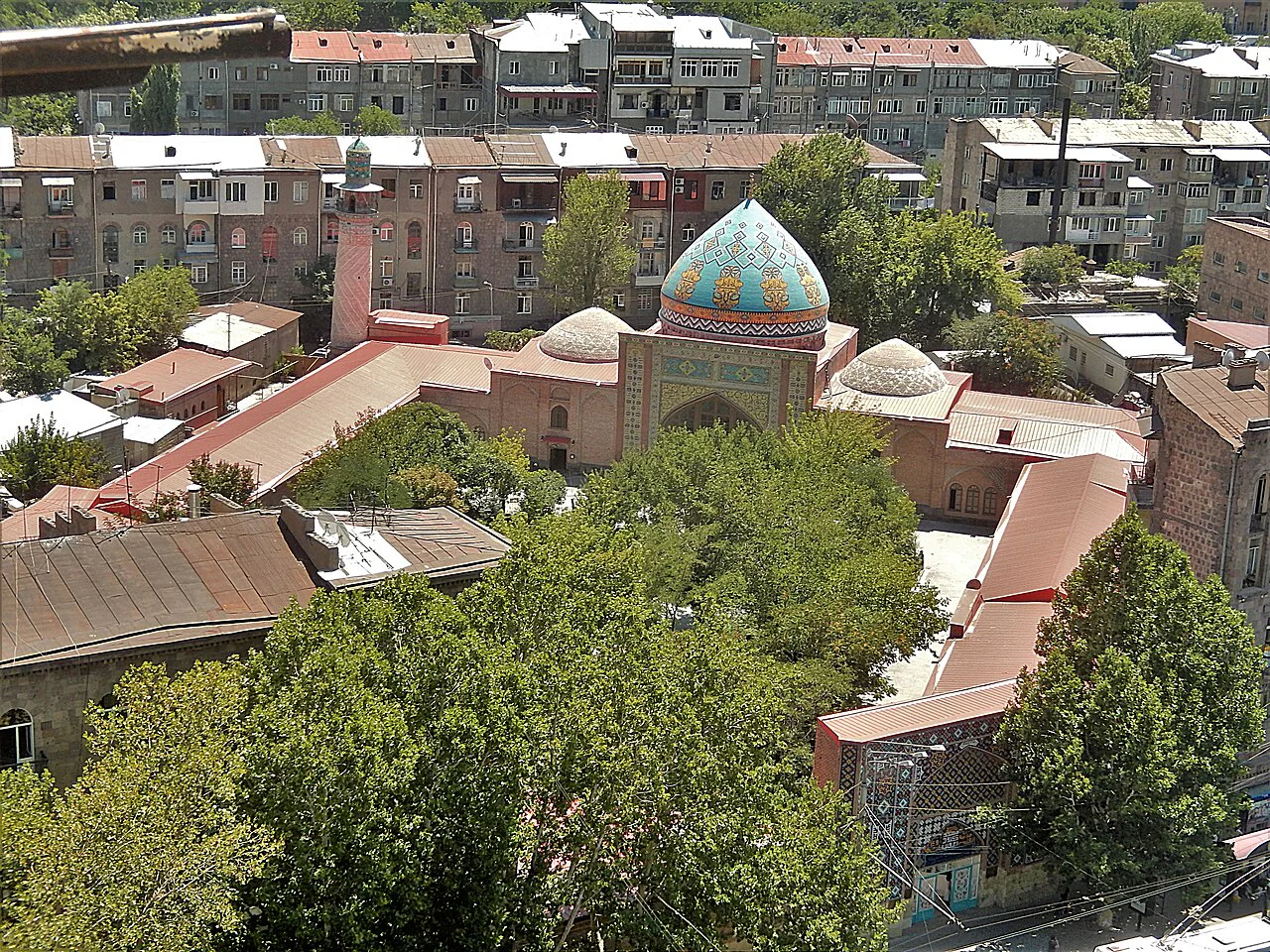
Yerevan · 18 km
Blue Mosque, Yerevan
Content & sources
Armineaghayan · CC BY-SA 4.0
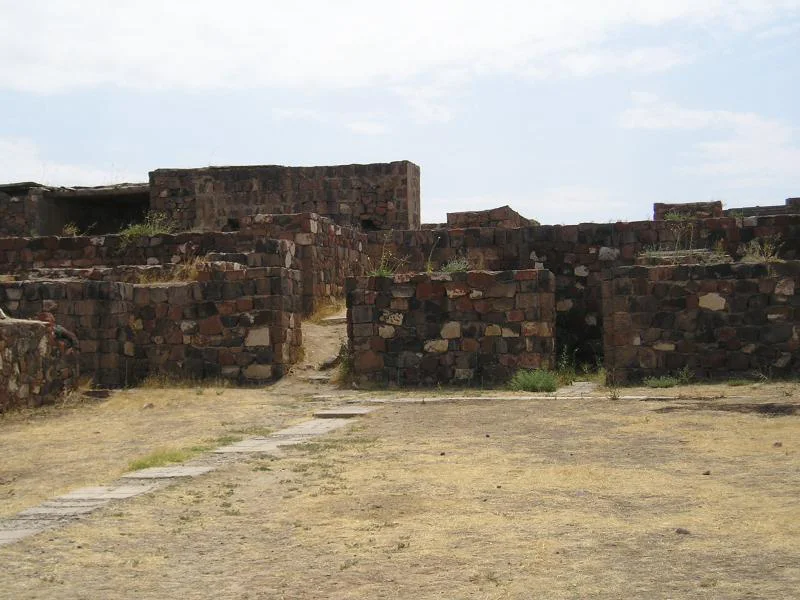
Yerevan · 21 km
Erebuni Fortress
Content & sources
Photo: Numerius Negidius · Public domain