 Stanza / Audio guide
Stanza · Audio guide
Salzburger Dom Audio Guide
A place to remember. A story to take with you.
Salzburg Cathedral is a seventeenth-century Baroque cathedral located in Salzburg, Austria. It is significant for being the site where composer Wolfgang Amadeus Mozart was baptized.
Download Stanza, then search for “Salzburger Dom”.
About the tour
One guide. Your kind of visit.
Salzburg Cathedral is a seventeenth-century Baroque cathedral located in Salzburg, Austria. It is significant for being the site where composer Wolfgang Amadeus Mozart was baptized.
Ready when you are.
- 01Get the free Stanza app.
iOS & Android
- 02Find your guide.
“Salzburger Dom”
- 03Download before you go.
Works offline
Audio guide / 14 narrated stops
Inside the guide
Get to know a few of the stories before you go. Open a stop to read more.
01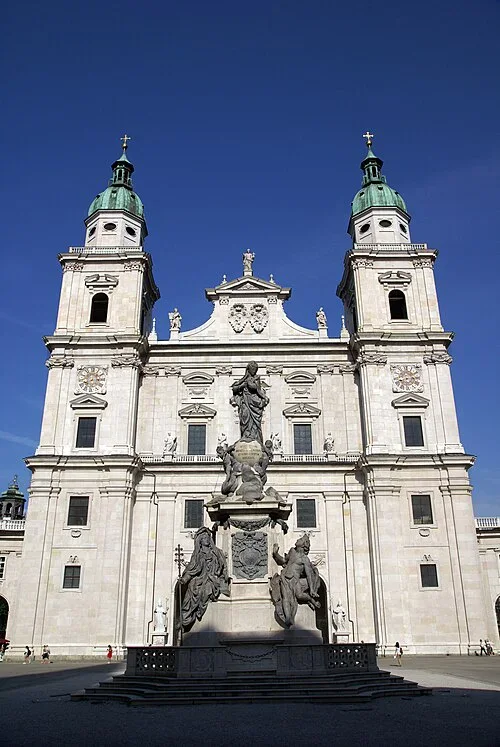 Domplatz and the Untersberg Marble Facade
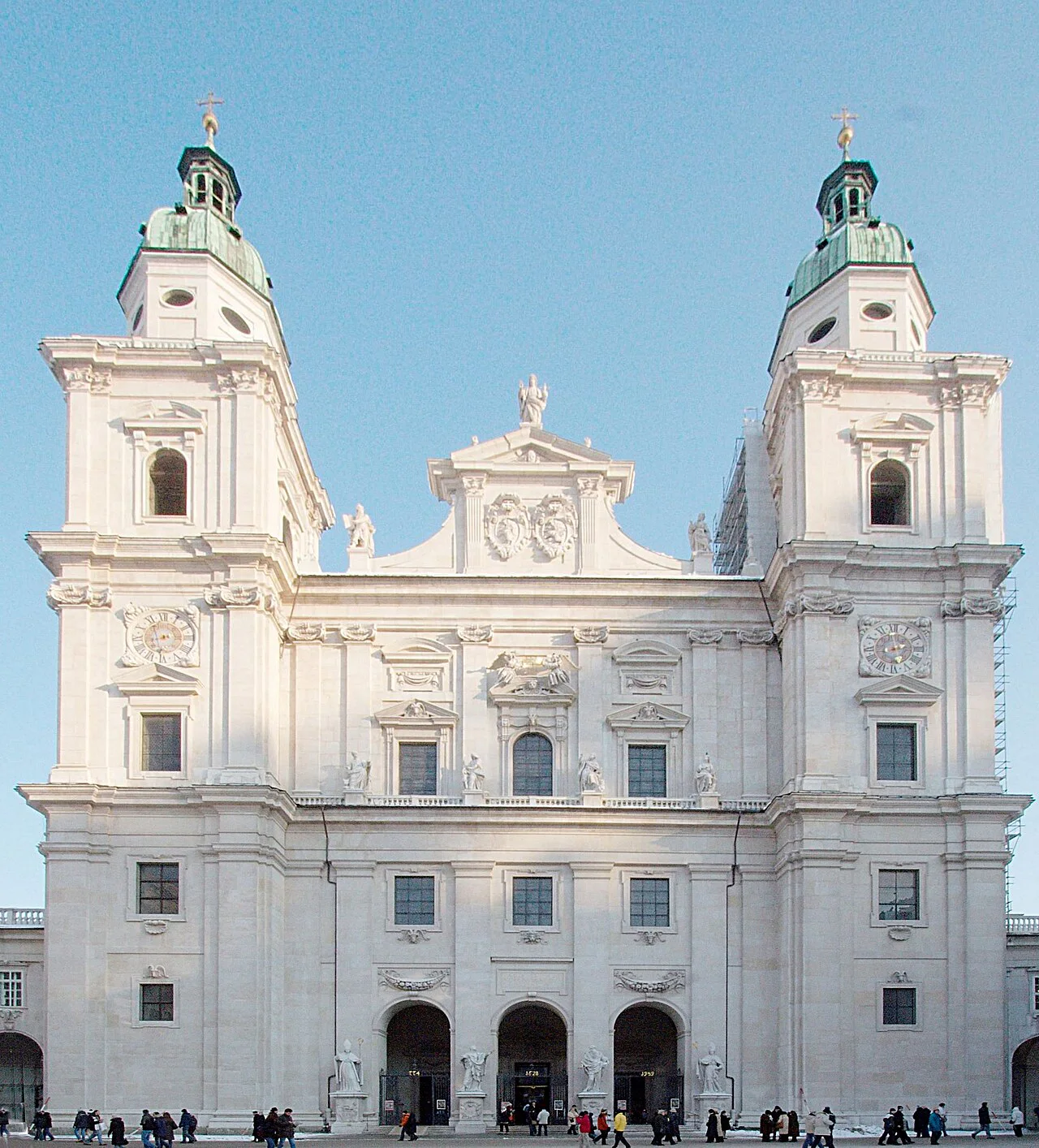
Cathedral Facade and Domplatz
Salzburg Cathedral is the church of Saints Rupert and Virgil. It is the metropolitan church, the leading church of the whole province, and the cathedral of the Archdiocese of Salzburg. It was the church of the Prince-Archbishops who ruled Salzburg, and it was finished during the Thirty Years' War. Today it is part of the UNESCO-listed historic center of the city. An earlier Romanesque church stood on this site before it. The facade is made of bright Untersberg marble. Two towers frame it, and a curved gable crowns the top. Three high round arches open on the lower level. Three open arcades, on the north, south and west, link the cathedral with the Salzburg Residenz and Saint Peter's Abbey. Together they enclose a square about a hundred meters long. In the middle of the square stands the Maria Immaculata column. Archbishop Sigismund von Schrattenbach commissioned it. The brothers Wolfgang and Johann Baptist Hagenauer made it between 1766 and 1771. It is built of marble and cast iron. The Virgin Mary sits enthroned on a mountain of clouds, and four allegorical figures stand around her: the angels, the devil, human wisdom and the Church. The scene shows reactions to the Immaculate Conception, the belief that Mary was conceived without sin. A plaque on the cathedral sums it up. The angels are delighted, human wisdom vanishes, the envious devil growls, and the triumphant Church rejoices. Seen from the arcades at the back of the square, the column lines up with the middle of the cathedral. From the same spot, the crown on the facade seems to rest on the Virgin's head.
Photo: Bede735c · CC BY-SA 3.0
02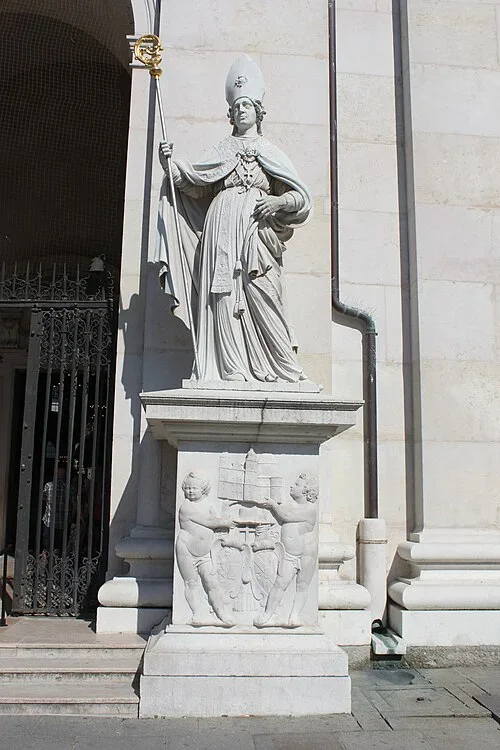 Domplatz and the Untersberg Marble Facade
Statue of Saint Virgil at the Facade
Saint Virgil stands in a bishop's miter, holding a model of a church. Bartholomäus van Opstal carved him around 1660, along with Saint Rupert, who holds a barrel of salt. The two inner figures, holding a key and a sword, were carved in the late 1690s by Bernhard Michael Mandl. Mandl also made all four pedestals. The pedestals bear the coats of arms of two archbishops of the Thun family. On this pedestal, two cherubs hold up a shield between them.
Photo: Anton-kurt · CC BY-SA 3.0 at
03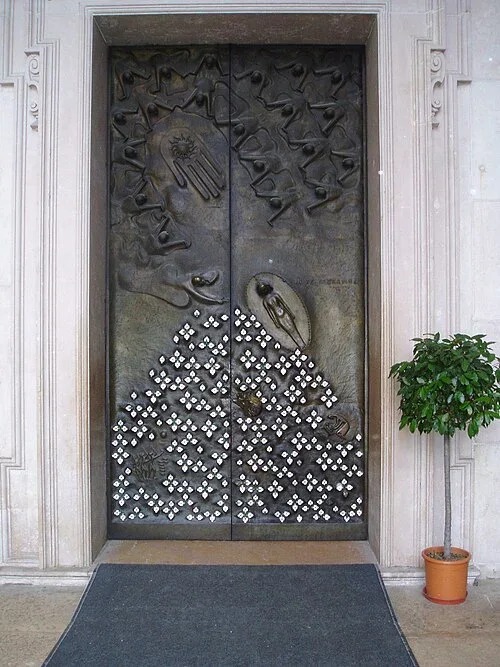 The Three Bronze Portals
Gate of Hope by Ewald Mataré
Ewald Mataré made the Gate of Hope, one of three bronze doors set in the entrance portals. Its upper part is crowded with jagged, angular shapes. In one leaf, a large hand-like form stands out near the top, and in the other, a small figure is set inside an oval. The center gate, the Gate of Love, is by Giacomo Manzù. Across the lower half of the Gate of Hope, small pale motifs repeat in rows that widen toward the bottom.
Listen in the appPhoto: Wikinaut · CC BY-SA 3.0
04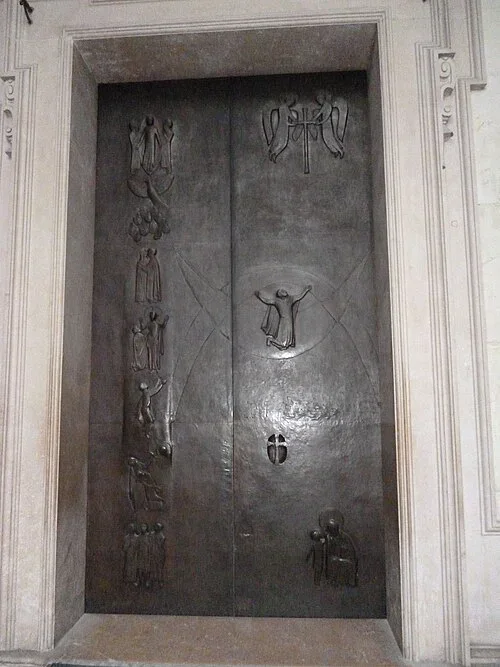 The Three Bronze Portals
Gate of Faith by Toni Schneider-Manzell
On the Gate of Faith, Paul kneels on the road to Damascus with his arms raised. It is the moment he changes from Saul to Paul. Toni Schneider-Manzell made the gate from a theological plan by Thomas Michels. The three bronze gates date from the late 1950s, and each one stands for one of the virtues of faith, hope and love. One leaf of the door carries seven scenes, one above another. The top scene is the Transfiguration on Mount Tabor, and the lowest shows three young men in a furnace. In between, a dove and flames stand for Pentecost, and an apostle places his hand in Christ's wounded side. The other leaf centers on Paul. Two spheres enclose him, one for grace coming from above and one for human will rising from below. Two angels above him raise Christ's cross as the sign of faith. His pose echoes the statue of Saint Paul at the entrance. The door handle is shaped like a cross.
Listen in the appPhoto: Alraunenstern · CC BY-SA 4.0
05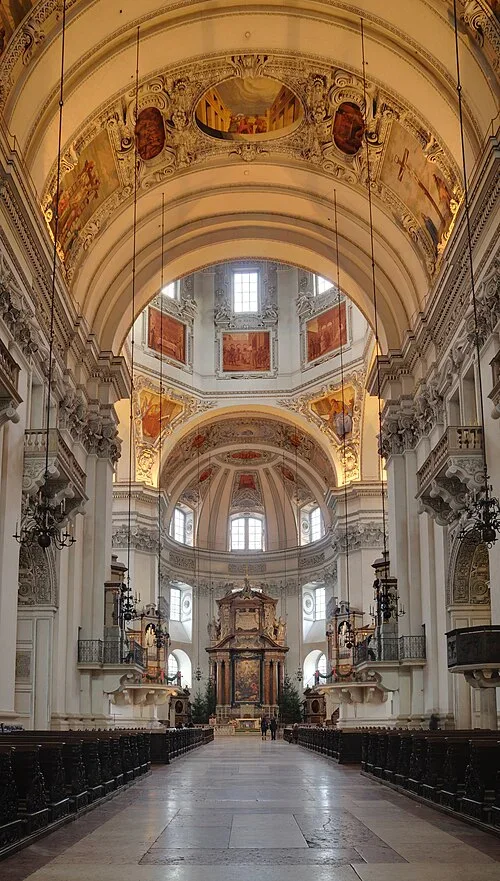 The Grand Nave and Bassarino Stuccowork
Nave Toward the High Altar
Prince-Archbishop Wolf Dietrich von Raitenau had seen Italian Baroque in Rome, and he wanted it in Salzburg. The old church had already been rebuilt several times in the early Middle Ages. In 1598 a fire severely damaged the old basilica. Repeated attempts at repair failed, so Wolf Dietrich ordered the old church torn down. Demolition began in 1606, and it cleared the ground for the Residenz Square, north of the cathedral. For the new church, he hired the Italian architect Vincenzo Scamozzi to draw up a plan. His successor laid the cornerstone in 1614. The architect Santino Solari then changed Scamozzi's plan dramatically. The new church was finished in 1628, less than fifteen years after work began.
Listen in the appPhoto: Taxiarchos228 · CC BY 3.0
06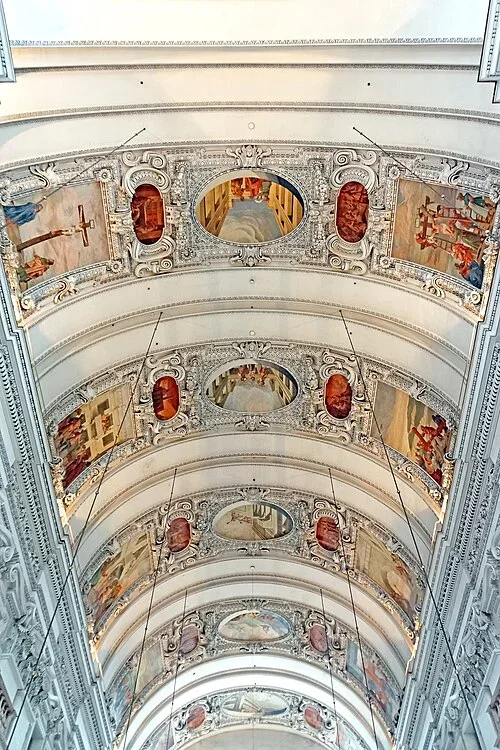 The Grand Nave and Bassarino Stuccowork
Nave Vault with Passion Paintings
Christ's Passion unfolds across the nave ceiling in fifteen large paintings, running up to the crucifixion. The paintings are attributed to Donato Mascagni, also called Fra Arsenio, and to Ignazio Solari, son of the architect. Ten smaller scenes, set in horizontal panels, show episodes from Christ's life. They run from the wedding at Cana to Jesus on the pinnacle of the Temple. The white stucco around the paintings is shaded black in its hollows. Its vines, cherubs and acanthus leaves came from the workshop of Giuseppe Bassarino. That stucco probably dates from around 1628.
Listen in the appDennis G. Jarvis · CC BY-SA 2.0
07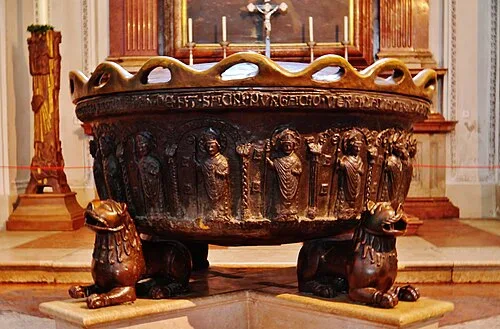 The Baptismal Font Chapel
Baptismal Font and Mozart's Baptism
Wolfgang Amadeus Mozart was baptized at this font the day after he was born, in January 1756. The font is one of the surviving objects that predate the Baroque cathedral. It is a Gothic piece from the fourteenth century. Around its rim runs a rhyming Latin verse that names the maker, Master Heinrich, and the year 1321. A second verse runs around the lower edge, in which the font speaks. The old law has erred, and the new law has made me holy.
Listen in the appPhoto: Zairon · CC BY-SA 4.0
08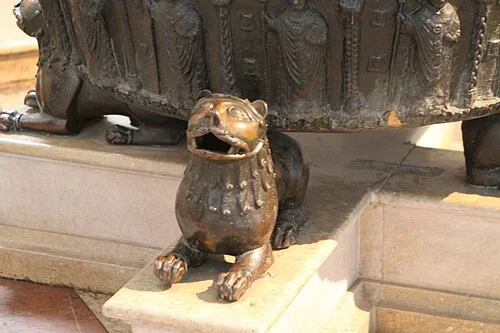 The Baptismal Font Chapel
Animal Support Beneath the Font
The basin is held up by animal figures, and this one crouches on a stone plinth with its mouth open. Its front paws rest on the plinth, just beneath the edge of the basin. A collar of dangling ornaments hangs around its neck.
Listen in the appPhoto: PictureObelix · CC BY-SA 3.0 at
09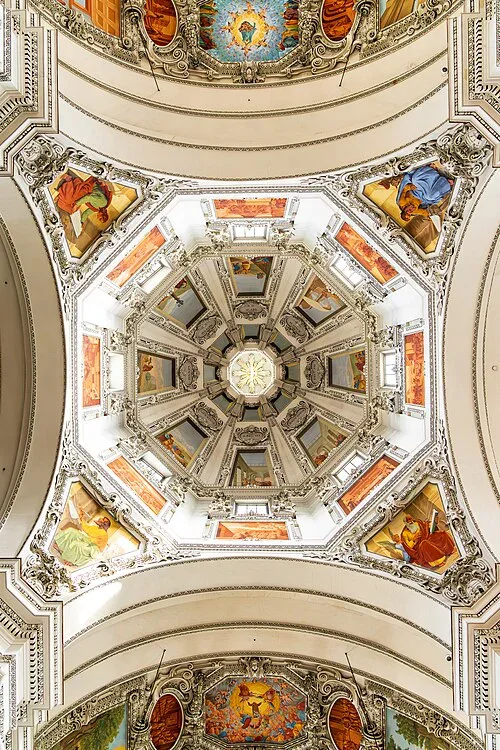 The Central Crossing Dome and Choir Organs
Crossing Dome Seen from Below
The dome over the crossing, the church's central space, rises about seventy-one meters. Its plan is built on three apses, rounded recesses that open off the central space. The church that stood here before already had three apses. Vincenzo Scamozzi made that form much more pronounced in his plan. Santino Solari kept the three apses when he reduced the building. The dome took its model from the Sixtus Chapel in the Roman basilica of Santa Maria Maggiore, a design by Domenico Fontana. In October 1944, during the first air raid on Salzburg, a single bomb crashed through the dome over the crossing. The dome collapsed. Repairs and the rebuilding of the dome ran from 1945 until 1959.
Listen in the appPhoto: Matthias Süßen · CC BY-SA 4.0
10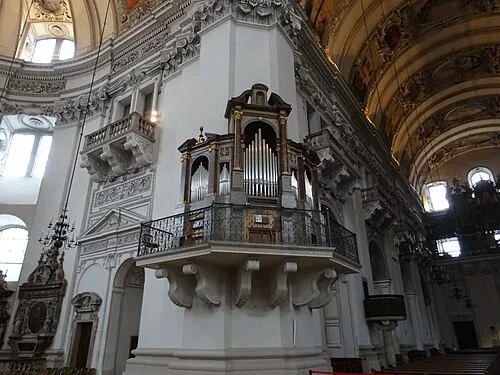 The Central Crossing Dome and Choir Organs
Gallery Organ on a Pier
Twelve choirs sang from the marble galleries when the church was consecrated. They sang a Te Deum, a hymn of praise, composed by Stefano Bernardi, the music director of the Salzburg court. The score of that Te Deum is lost. Music written for several separate choirs is called polychoral, and these galleries gave each choir its own place. Bernardi used the galleries again in a Mass for eight voices, written in 1630. An organ case now sits on a balcony that juts out from one of the piers. Later, the cathedral's music director, Joseph Messner, composed a Mass in memory of the wartime bombing. It is known as the Bombenmesse, or Bomb Mass.
Listen in the appStb1er · CC BY-SA 4.0
- 11
High Altar and Presbytery
A freestanding marble high altar, a Resurrection painting, and a Latin line from the Psalms.
- 12
Pair of Archbishops' Memorials
Two archbishops remembered beside the high altar, and angels with curly heads carved for one of them.
- 13
Crypt Room with Boltanski's Vanitas
Foundations of older churches, Roman mosaics, and a candlelit crypt room holding a 2009 work by Christian Boltanski.
- 14
Salvator Bell
Austria's second-largest bell, the Salvator, and the ringing that opens each church year in Salzburg.
Salzburger Dom
Frequently asked questions
How much does the guide cost?
Free app download. Listed guide price: $0.99. Guide price shown in the app. Audio guide only. Venue admission is separate.
Can I listen without internet?
Yes. Download the guide’s audio, images, and maps in the app before your visit. Your downloaded content is then available offline.
Can I listen in my language?
This audio guide is available in 15 languages, including English.
Do I need to follow a schedule?
No. This is a self-guided experience. Choose your stops, pause whenever you like, and return to a story at your own pace.
At your own pace
Explore Salzburger Dom.
Download Stanza, then search for “Salzburger Dom”.
Free app download · Guide price shown in the app
Keep exploring
Nearby audio guides
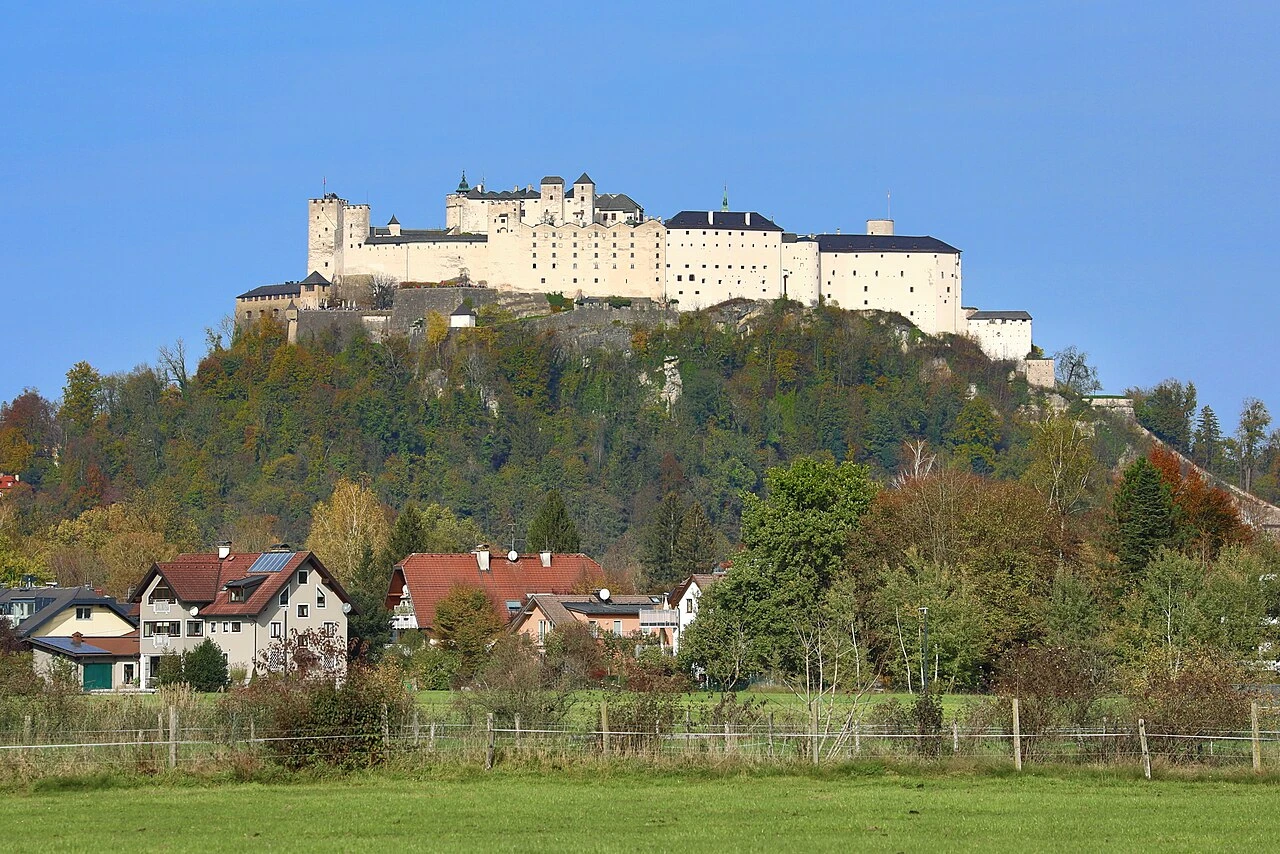
Salzburg · 1 km
Hohensalzburg Fortress
Content & sources
C.Stadler/Bwag · CC BY-SA 4.0
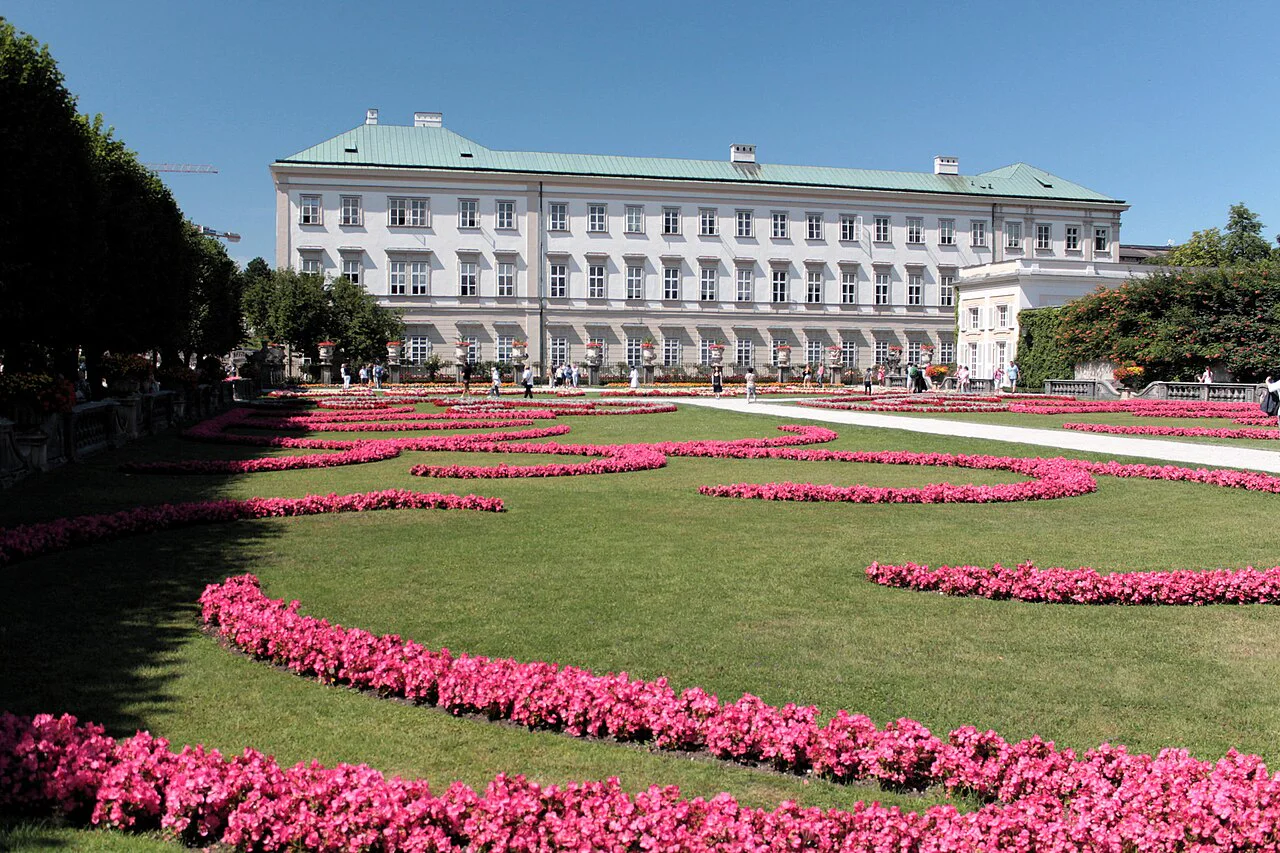
Salzburg · 1 km
Schloss Mirabell
Content & sources
Przemek Pietrak · CC BY-SA 3.0
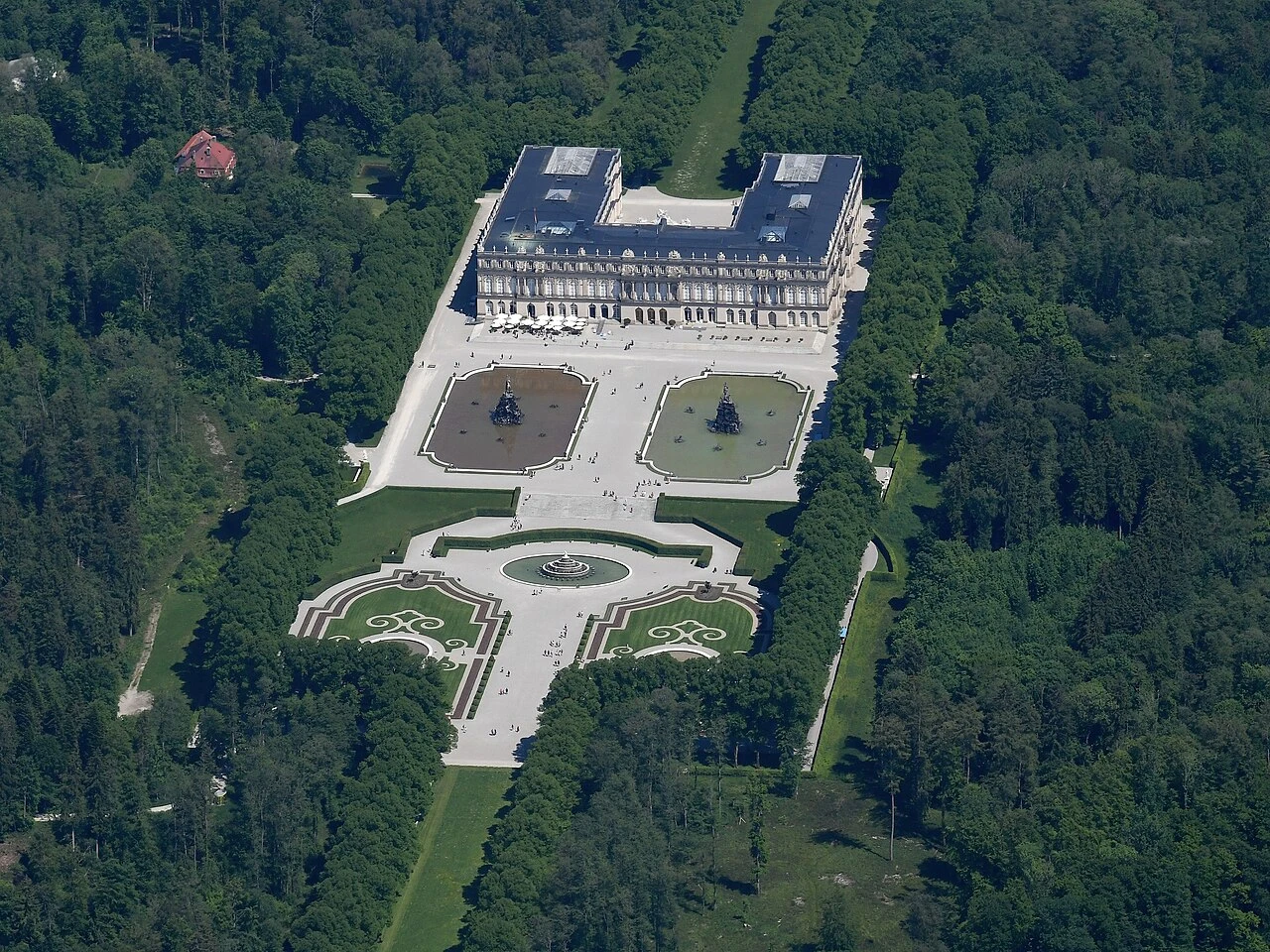
Chiemsee · 49 km
Herrenchiemsee Palace
Content & sources
Photo: Carsten Steger · CC BY-SA 4.0
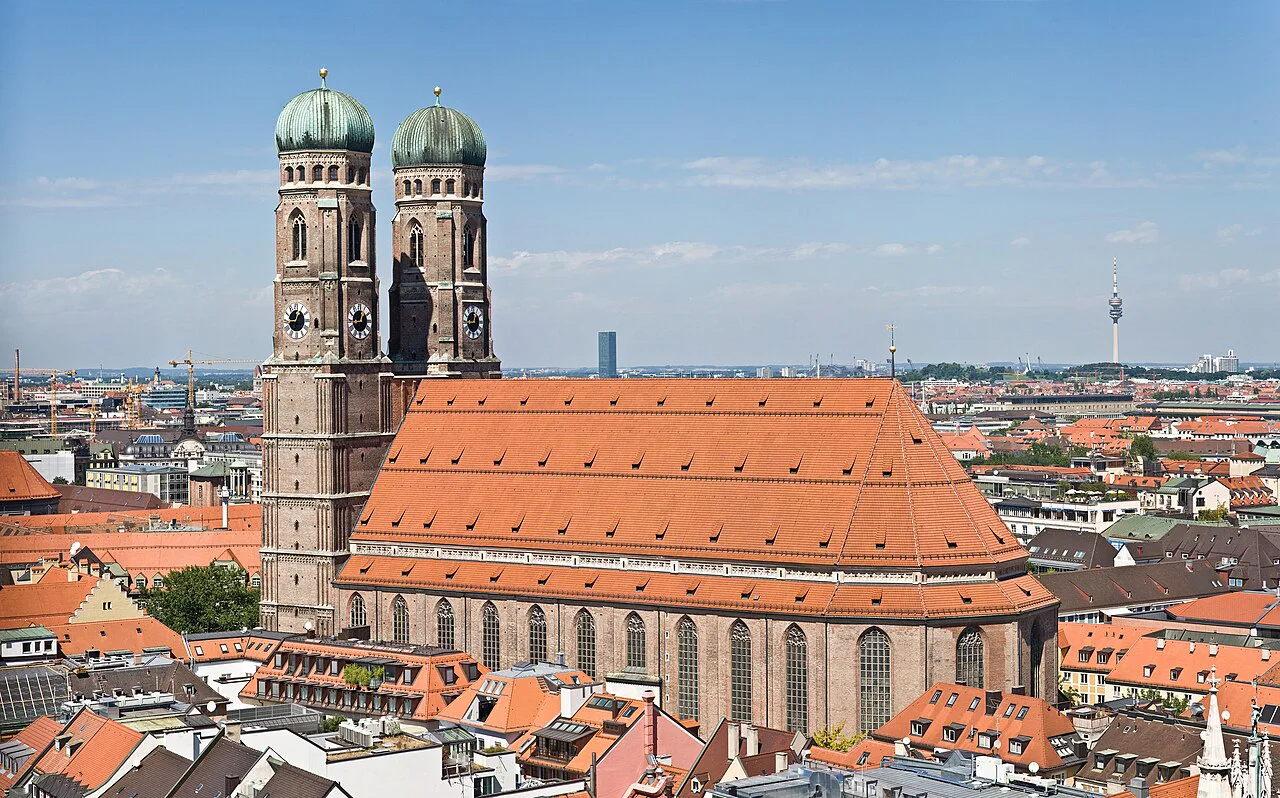
Munich · 116 km
Frauenkirche
Content & sources
Photo: Diliff · CC BY 2.5