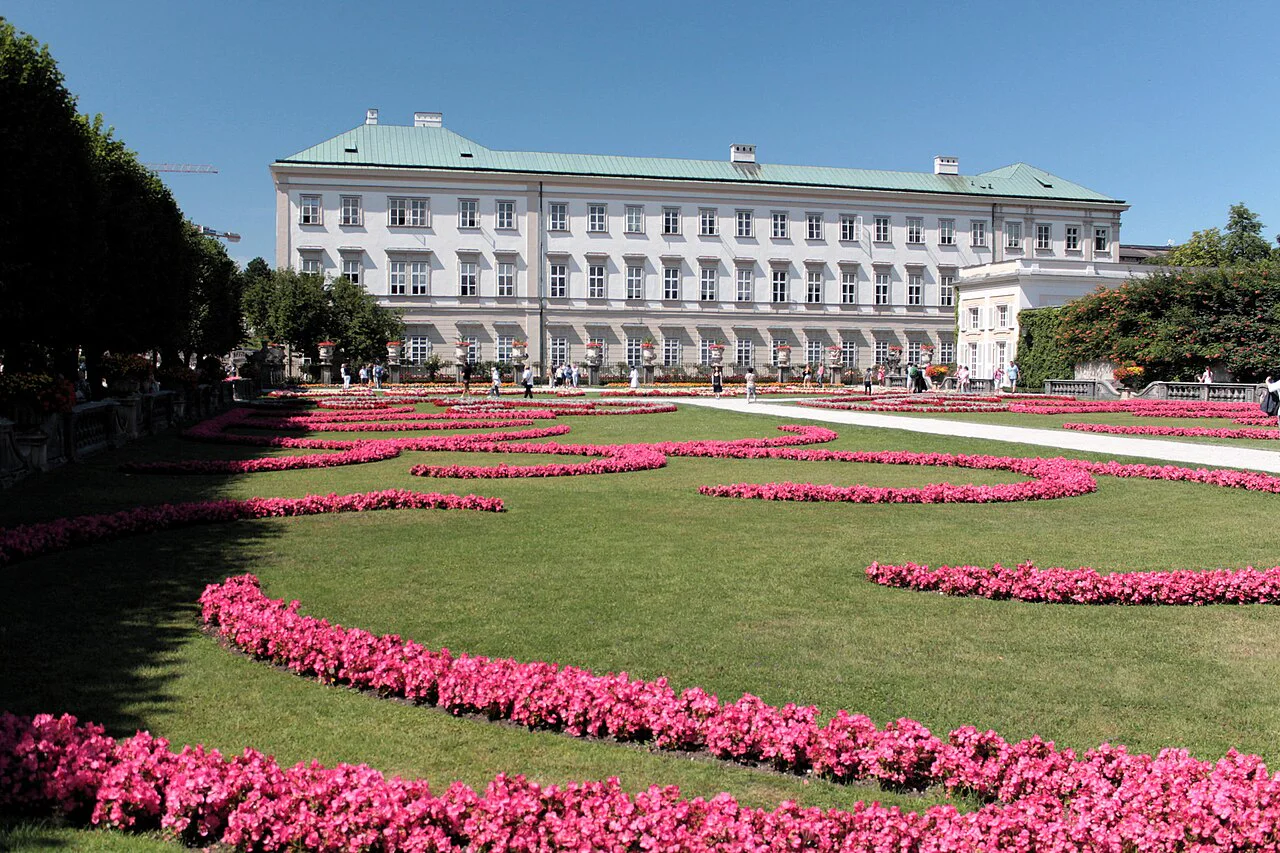
Stanza · Audio guide
Schloss Mirabell Audio Guide
A place to remember. A story to take with you.
Mirabell Palace is a historic building in the city of Salzburg, Austria. The palace and its gardens are a listed cultural heritage monument and part of a UNESCO World Heritage Site.
Download Stanza, then search for “Schloss Mirabell”.
About the tour
One guide. Your kind of visit.
Mirabell Palace is a historic building in the city of Salzburg, Austria. The palace and its gardens are a listed cultural heritage monument and part of a UNESCO World Heritage Site.
Ready when you are.
- 01Get the free Stanza app.
iOS & Android
- 02Find your guide.
“Schloss Mirabell”
- 03Download before you go.
Works offline
Audio guide / 13 narrated stops
Inside the guide
Get to know a few of the stories before you go. Open a stop to read more.
01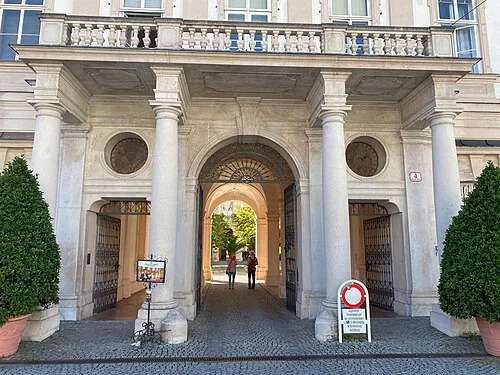 Mirabellplatz Entrance and Courtyard
Mirabellplatz Entrance Portal
Welcome to the entrance portal of Schloss Mirabell, one of Salzburg's best-loved palaces and part of the city's World Heritage historic centre. Here, at the gate, the palace's story begins, around 1606, with Prince-Archbishop Wolf Dietrich von Raitenau. He had suffered a stroke the year before, he had gout, and he wanted to escape the narrow streets of the old city. So he built himself a pleasure palace out here, beyond the medieval walls, on the shore of the Salzach river. It was a retreat for him and Salome Alt, his mistress, or possibly his secret wife. The palace was allegedly raised in just six months, modelled on Italian and French examples. Wolf Dietrich named it Schloss Altenau, after Salome. He also won the couple's fifteen children the right to be recognised as lawful heirs, and the family took the name Alt von Altenau. That goodwill did not last. In 1612 the archbishop was deposed and imprisoned up in Hohensalzburg Castle. His successor and nephew, Markus Sittikus, threw Salome and her family out of the palace. To erase every trace of his predecessor, he gave the building a new name: Mirabell, from the Italian for amazing, wonderful. Through this portal and into the courtyard, the palace has been welcoming people ever since.
Listen in the appPhoto: -wuppertaler · CC BY 4.0
02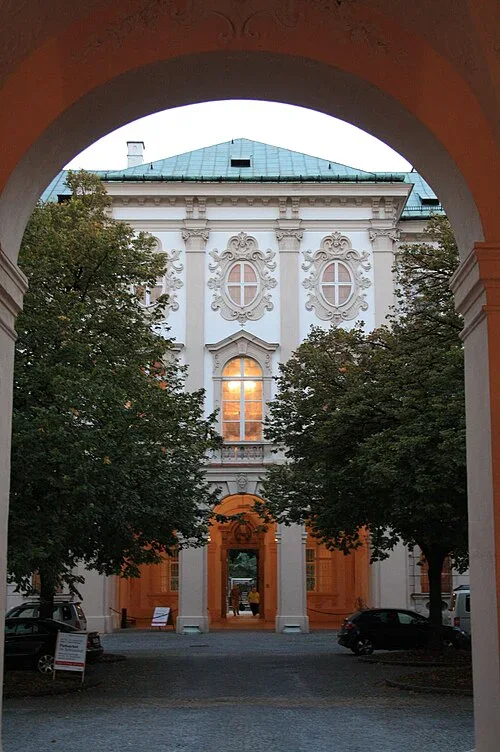 Mirabellplatz Entrance and Courtyard
Palace Courtyard and Facade
The archway frames the courtyard facade, and it hints at how much this palace has changed. The modest retreat of Salome Alt's day grew into something far grander. Between 1721 and 1727, Prince-Archbishop Franz Anton von Harrach had it rebuilt as a lavish Baroque complex of four wings around this courtyard. The architect was Johann Lukas von Hildebrandt, one of the most celebrated builders of the age, who worked for the imperial court. The palace also had a brief royal chapter. From 1810 to 1816 Salzburg was under Bavarian rule, and the palace served as the residence of the Bavarian crown prince. On the first of June 1815, his wife gave birth to a son here, Prince Otto of Bavaria. The boy would later become Otto the First, King of Greece. The restrained, plain-looking facade you see today is the result of the careful restoration that followed the fire of 1818, which we will come to later on.
Photo: Scheumus · CC0
03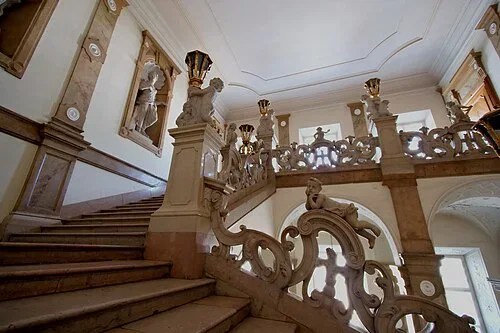 The Grand Donner Staircase (Donnerstiege)
The Donner Staircase
Inside the north corner of the west wing waits one of the palace's great showpieces: a ceremonial staircase that climbs from the ground floor to the second storey. It was built between 1725 and 1727, as part of the same rebuilding. Everything here is designed to impress a guest on the way up. The balustrade winds and curls in richly carved marble. Set into the side walls are niches, and in them stand mythological sculptures cut from Untersberg marble, the pale stone quarried from the mountain that overlooks Salzburg. They are the work of Georg Raphael Donner, an Austrian sculptor whose figures gave this stairway its name. Donner's marble gods and heroes wait in their niches as visitors climb past, just as they were meant to three centuries ago.
Listen in the appPhoto: MatthiasKabel · CC BY-SA 3.0
04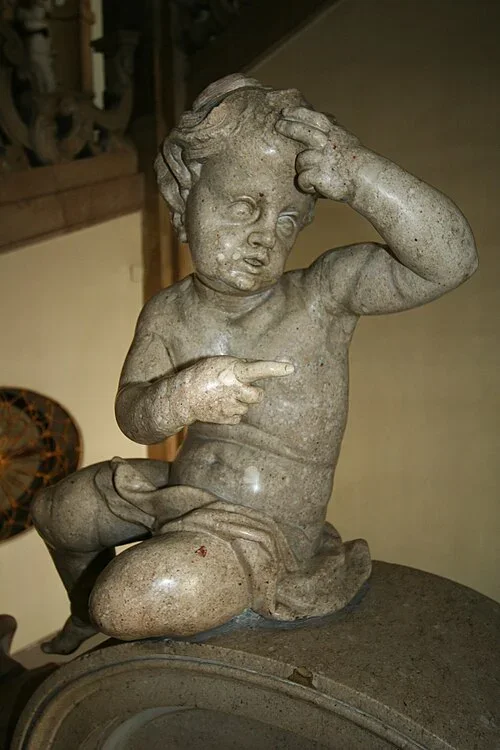 The Grand Donner Staircase (Donnerstiege)
A Balustrade Putto
The balustrade has its own population. Along its rail sit marble putti, the plump little children of Baroque sculpture, each in a different pose. They were made by a student and collaborator of Donner, and they are celebrated for something unusual: their faces. This one raises a hand to his brow and points with the other, mouth open as if calling out to someone below. Another might sulk, laugh or scold. The sculptor gave each child an expression and a gesture of its own, so the balustrade reads like a crowd of living children leaning over the rail. Above the stairway doors, antique-style busts keep a more dignified watch over the whole lively ensemble.
Listen in the appPhoto: MatthiasKabel · CC BY-SA 3.0
05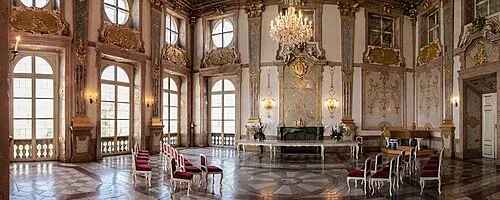 The Marble Hall (Marmorsaal)
The Marble Hall was built to host feasts, and it still does duty as the palace's grandest room. Its walls are clad in real marble, imitation marble and gilded stucco, set with decorative stucco fields between them. Once, a great ceiling painting by Johann Michael Rottmayr spread across the space above. It was lost in the blaze of 1818, when fire swept through the palace, and the ceiling has never had it back. What the room kept is its remarkable acoustics. Classical concerts have been held here for years in the Salzburg Palace Concerts, first directed by Luz Leskowitz and later by Konstantin Hiller. Ensembles like the Salzburg Soloists and the Bartók Quartet have played here, alongside soloists such as Jörg Demus and Igor Oistrach. The room is also one of the city's favourite places for weddings.
Listen in the appStefano Giustini · CC BY-SA 3.0 at
06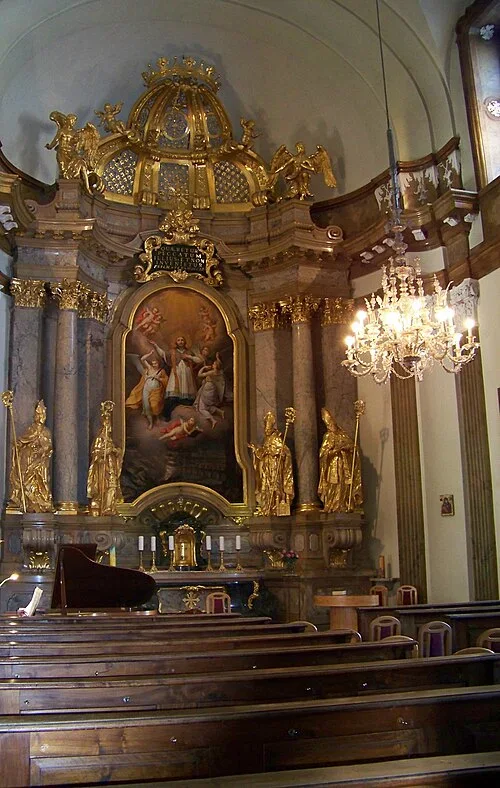 Palace Chapel of Saint John of Nepomuk
Tucked into the palace is a chapel dedicated to Saint John of Nepomuk, the Bohemian saint of the bridge at Prague. Its high altar, with sculpted figures of the saints Augustine, Rupert, Virgil and Martin, essentially dates from 1722. The chapel shared the palace's misfortune in the 1818 fire and was badly damaged. Its ceiling painting by Bartolomeo Altomonte was lost, and the altarpiece of Saint Nepomuk was destroyed. A new painting for the altar was later made by Johann Michael Hess. In 1837 Archbishop Friedrich Johann Jacob Cölestin von Schwarzenberg consecrated the chapel anew. In July 1938 it became the parish church of the Old Catholic Church of Austria. Before that, the Old Catholic services had been held in the Marble Hall. The chapel was renovated in 1952 and again in 1988, and it still holds services today.
Listen in the appPhoto: Kalkalpen77 · CC BY-SA 4.0
07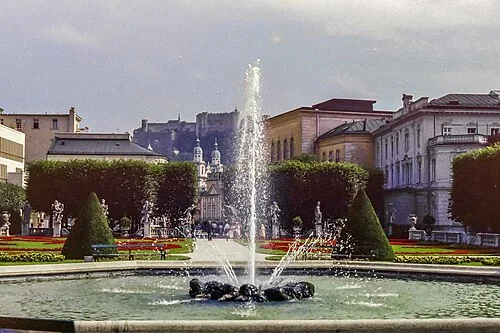 The Grand Parterre and Four Elements
The Grand Parterre and the Fortress Vista
The gardens answer the palace in green and stone. From 1687, under Prince-Archbishop Johann Ernst von Thun, the Mirabellgarten was laid out to plans by Johann Bernhard Fischer von Erlach, the most sought-after architect of the Austrian Baroque. Anton Danreiter later added to his work. The grounds cover roughly three and a half hectares, arranged as geometric parterres of clipped boxwood and flower beds. The great axis runs straight towards Hohensalzburg, the fortress on its rock above the old city, and the alignment is the garden's signature view. Populating the parterres stand twenty-eight statues of classical gods and heroes, carved around 1730. Fountains, sculptures and symbolic figures turn the whole layout into a statement of Baroque ideas about order, myth and power.
Listen in the appRaimond Spekking · CC BY-SA 4.0
08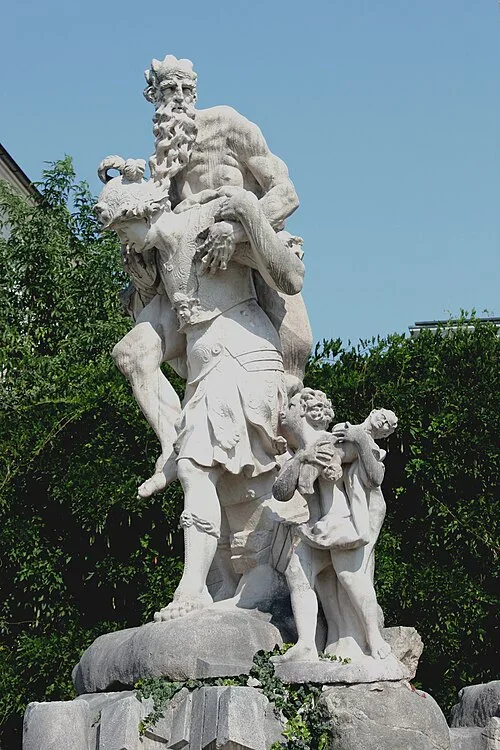 The Grand Parterre and Four Elements
Aeneas Rescuing Anchises — a Four Elements Group
Among the garden's sculptures, four marble groups are the most symbolic. They were made by the Italian sculptor Ottavio Mosto around 1690, and together they stand for the four classical elements: fire, air, earth and water. This one shows the flight from Troy. Aeneas, the Trojan hero, strides forward with his elderly father Anchises slung across his shoulders, while a small child clings at his side. The old man's beard flows, the son's muscles strain, and the whole group seems caught in motion as the city burns behind them. Its three companions nearby show Hercules, Paris and Pluto, each a scene of struggle and drama. Which element belongs to which group, no one can say for certain. What is certain is the ambition: a prince's garden retelling classical myth in stone.
Listen in the appPhoto: Dr. Reinhard Medicus · CC BY-SA 4.0
09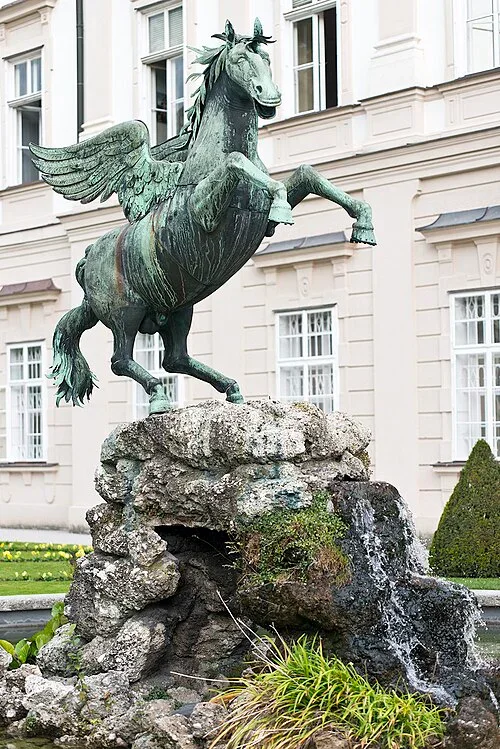 The Pegasus Fountain and Steps
The Pegasus Fountain
A bronze Pegasus rears on a rocky crag above its basin, wings spread, water spilling down the stone. The winged horse of Greek myth fits the garden's scheme, where fountains and mythological figures were part of Fischer von Erlach's original concept. But this fountain is famous for something no prince-archbishop could have planned. In the 1965 film The Sound of Music, Maria and the children sing Do-Re-Mi here, dancing around the fountain and using the surrounding steps as a musical scale, one step for every note. That scene made these gardens one of the most popular tourist attractions in Salzburg. Visitors still come from everywhere to find the horse with the wings.
Listen in the appSteve Collis from Melbourne, Australia · CC BY 2.0
10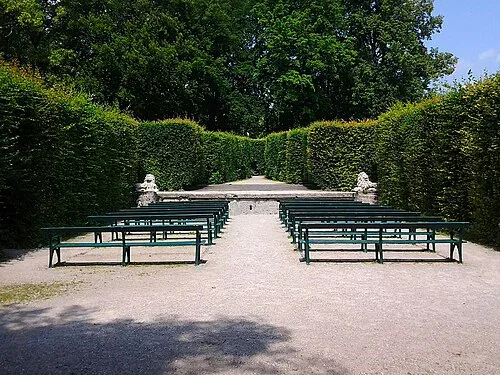 The Sylvan Hedge Theater (Heckentheater)
Deep in the garden, the hedges close in and form walls. This is the Heckentheater, a sylvan theater made of boxwood, designed between 1704 and 1718. The clipped green wings enclose a raised stage, and rows of benches face it across a gravel floor. Hedge theaters like this were a Baroque idea of an outdoor room: a stage and auditorium built from living plants instead of timber and plaster. In such green theaters a court could watch plays, music and entertainments on summer evenings, with the garden itself as the scenery. The benches here are quieter now, but the room of leaves is still shaped and waiting.
Listen in the appPhoto: Eweht · CC BY 3.0
- 11
The Dwarf Garden (Zwergerlgarten)
An elevated bastion garden where twenty-eight marble dwarfs once lined the paths.
- 12
A Dwarf Figure Up Close
One dwarf up close: a wide hat, a wicked grin, and carving that mixes mockery with real skill.
- 13
The Orangery and Rose Garden
The orangery and rose garden, and how a prince's private retreat became the city's own.
Schloss Mirabell
Frequently asked questions
How much does the guide cost?
Free app download. Listed guide price: $0.99. Guide price shown in the app. Audio guide only. Venue admission is separate.
Can I listen without internet?
Yes. Download the guide’s audio, images, and maps in the app before your visit. Your downloaded content is then available offline.
Can I listen in my language?
This audio guide is available in 15 languages, including English.
Do I need to follow a schedule?
No. This is a self-guided experience. Choose your stops, pause whenever you like, and return to a story at your own pace.
At your own pace
Explore Schloss Mirabell.
Download Stanza, then search for “Schloss Mirabell”.
Free app download · Guide price shown in the app
Keep exploring
Nearby audio guides
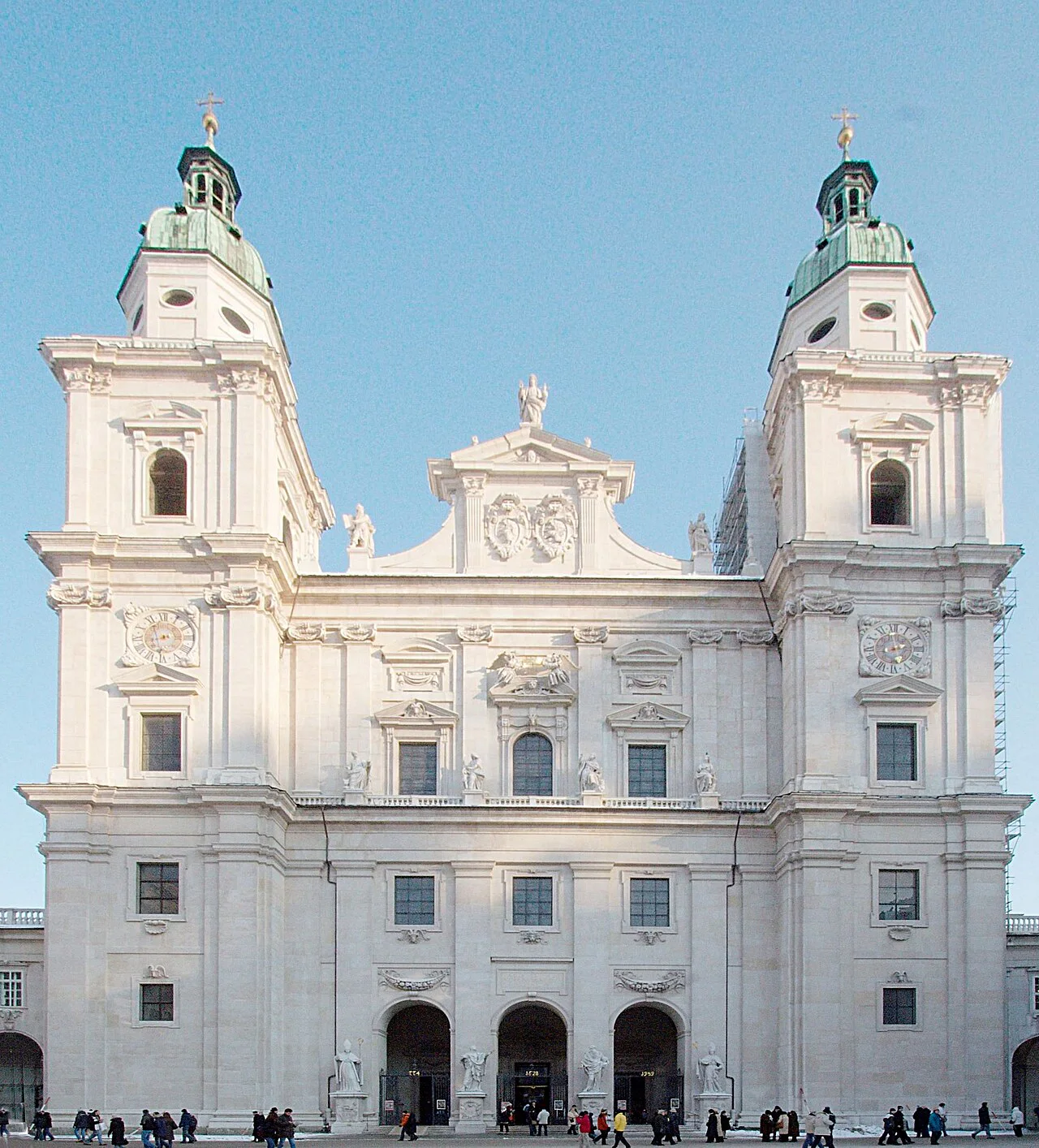
Salzburg · 1 km
Salzburger Dom
Content & sources
No machine-readable author provided. Sir James assumed (based on copyright claims). · CC BY-SA 3.0
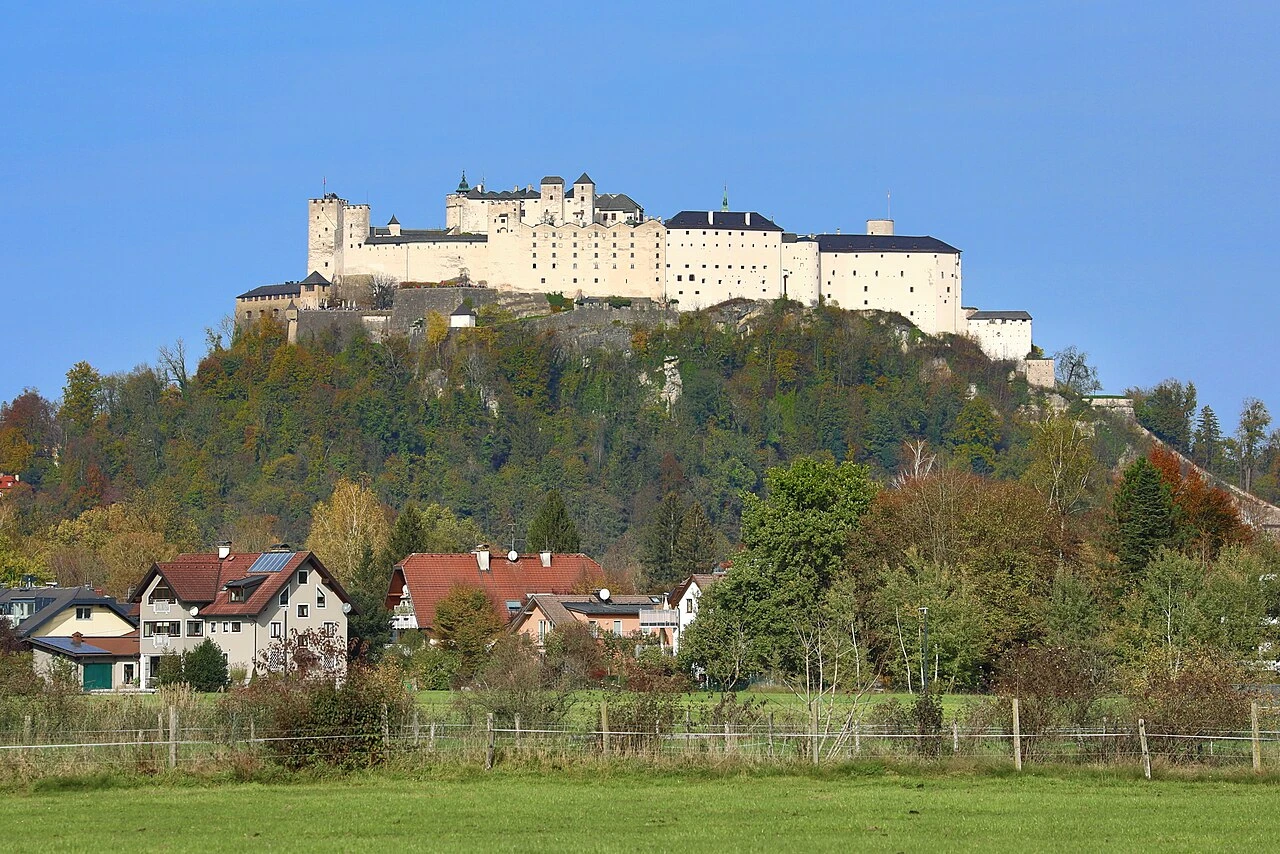
Salzburg · 1 km
Hohensalzburg Fortress
Content & sources
C.Stadler/Bwag · CC BY-SA 4.0
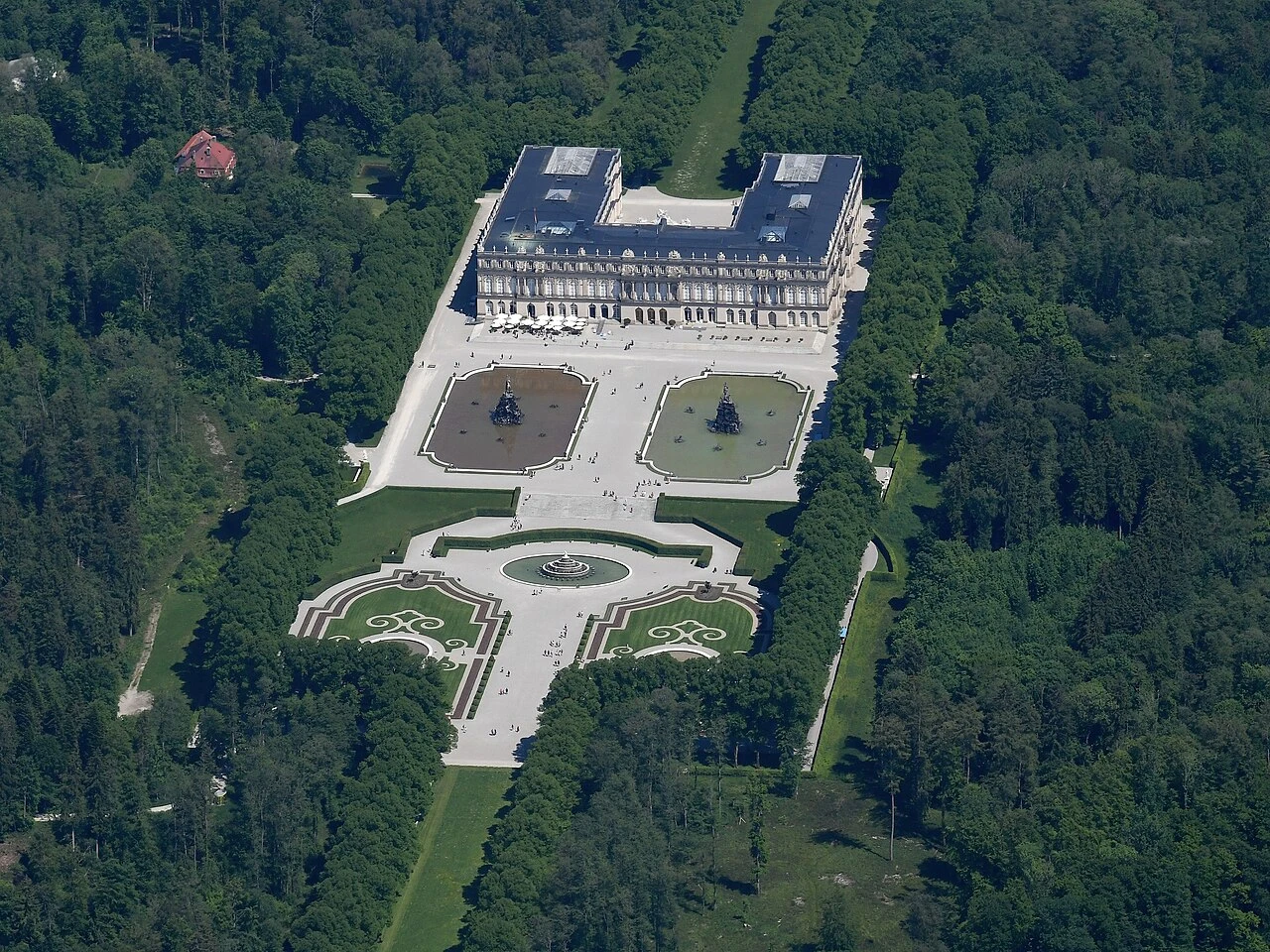
Chiemsee · 48 km
Herrenchiemsee Palace
Content & sources
Photo: Carsten Steger · CC BY-SA 4.0
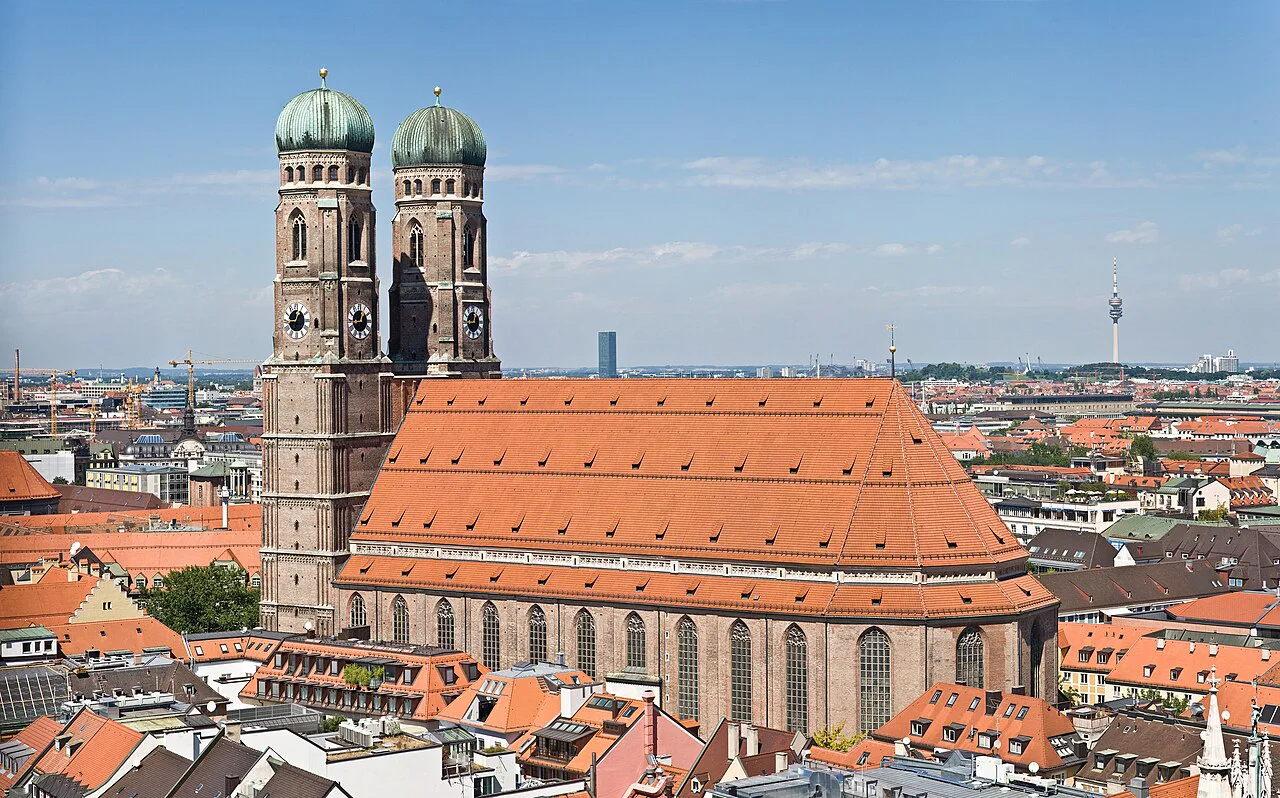
Munich · 115 km
Frauenkirche
Content & sources
Photo: Diliff · CC BY 2.5