Stanza · Audio guide
Banteay Srei Audio Guide
A place to remember. A story to take with you.
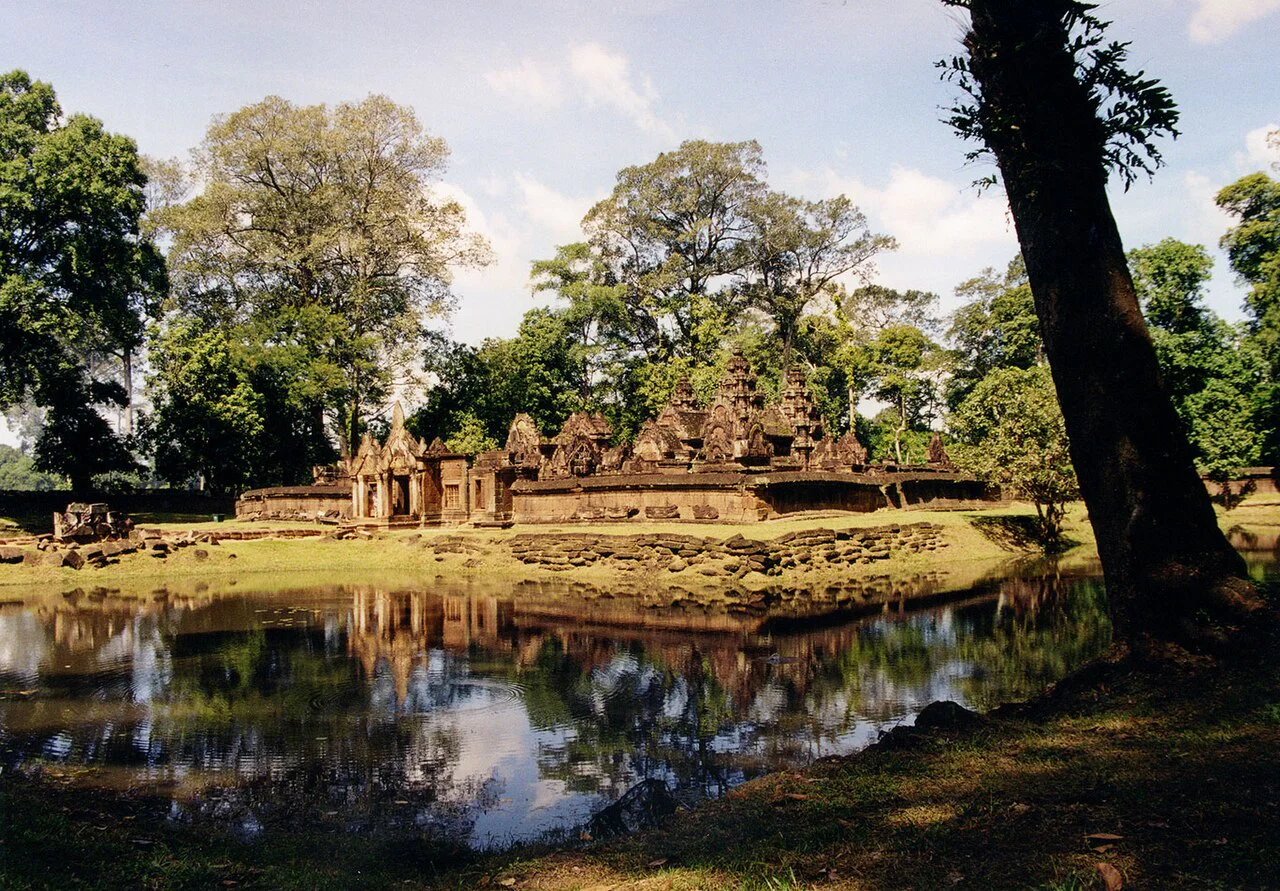
Banteay Srei is a 10th century Cambodian temple dedicated to the Hindu gods Shiva and Parvati. It is built of red sandstone and features elaborate decorative wall carvings.
Download Stanza, then search for “Banteay Srei”.
About the tour
One guide. Your kind of visit.
Banteay Srei is a 10th century Cambodian temple dedicated to the Hindu gods Shiva and Parvati. It is built of red sandstone and features elaborate decorative wall carvings.
Ready when you are.
- 01Get the free Stanza app.
iOS & Android
- 02Find your guide.
“Banteay Srei”
- 03Download before you go.
Works offline
Audio guide / 12 narrated stops
Inside the guide
Get to know a few of the stories before you go. Open a stop to read more.
01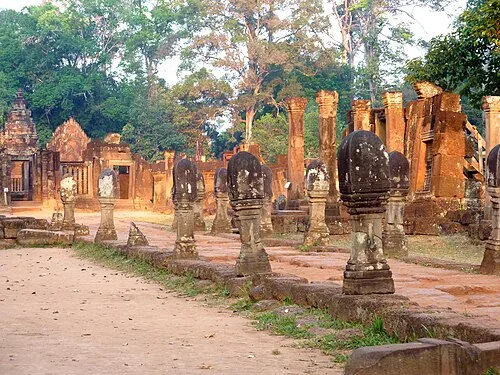 Processional Causeway and Outer Approach
The Processional Approach to Ishvarapura
Banteay Srei is the only major temple at Angkor that was not built by a ruler. Its construction is credited to two courtiers, Yajnavaraha and Vishnukumara. They served King Rajendravarman the Second, and the temple was consecrated in 967. The founding inscription calls Yajnavaraha a scholar and a philanthropist. It says he helped people who suffered from illness, injustice, or poverty. The temple once stood inside a town called Ishvarapura. Its outer wall is believed to have measured about five hundred metres square. The wall may have been made of wood. Only the gateway survives from that wall today. The rows of stone posts along this path mark where corridors once ran on either side. The temple is devoted to Shiva and Vishnu. Its modern name, Banteay Srei, means citadel of women, or citadel of beauty.
Photo Dharma from Penang, Malaysia · CC BY 2.0
02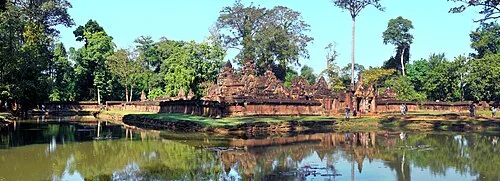 Sacred Moat and Third Enclosure
The Sacred Moat and the Third Enclosure
Most of the third enclosure is taken up by a moat. The enclosure is a rectangle of laterite wall, roughly a hundred metres in each direction. It has gateways at its east and west ends. Causeways to the east and west divide the moat into two parts. In Khmer temple symbolism, water like this is usually read as the cosmic ocean around the sacred mountain. The temple was rediscovered in 1914. In the 1930s it was restored by anastylosis, the first important use of that method at Angkor. Anastylosis rebuilds a ruin using its own original stones wherever possible, a little like solving a three-dimensional puzzle. Until 1936, people assumed the temple was later than it really was, because its carving was so lavish. That year the foundation stela came to light, and it showed the temple was older than people had thought.
Photo: LBM1948 · CC BY-SA 4.0
03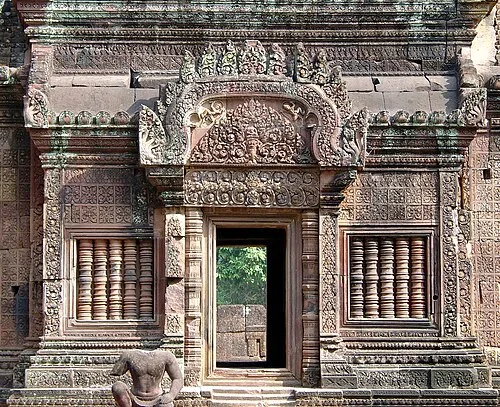 Second Enclosure and Mandapa Facade
The Mandapa: A Temple Built at Human Scale
The eastern doorway into the sanctuary is just over a metre high. Through it lies the mandapa, an entrance chamber with a roof of brick laid in overhanging steps. Measured against Angkor's other monuments, this is a small-scale world. Decorative carving covers almost every available surface, and this facade is no exception. Slim carved colonettes frame the doorway. Above it, a deeply cut panel fills the arch, crowded with figures and ornament. Anyone entering the sanctuary must stoop through that doorway.
Listen in the appMichael Gunther · CC BY-SA 4.0
04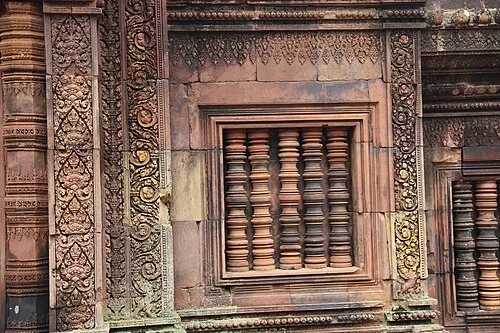 Second Enclosure and Mandapa Facade
Rose Sandstone Carved Like Wood
The temple is built mostly of a hard red sandstone that can be carved almost like wood. Brick and laterite were used only for the enclosure walls and a few structural parts. The fine sandstone went into the lintels and the decorated gables above the doorways. A false door, carved to look like an opening, shows what this stone can do. Its bars swell and narrow like the balusters a woodworker turns on a lathe. Maurice Glaize, a pioneering scholar of Angkor, wrote about this temple's carving. He judged the work closer to the art of the goldsmith, and to carving in wood, than to sculpture in stone.
Listen in the appGary Todd from Xinzheng, China · CC0
05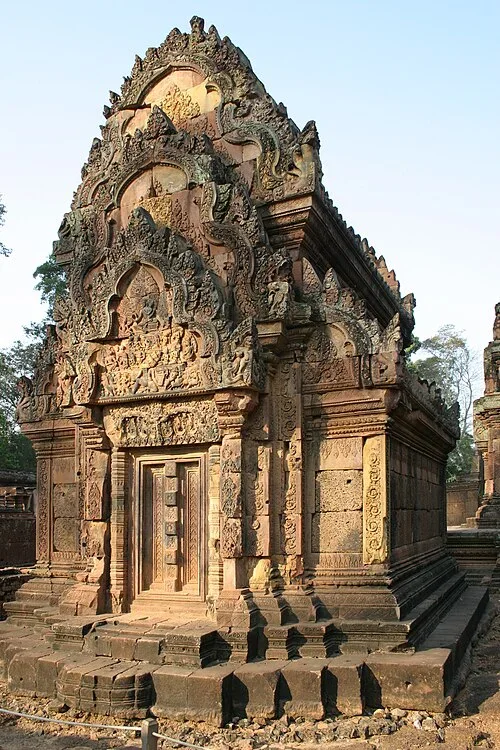 Southern Library and the Kailasha Reliefs
The Southern Library and the Birth of Narrative Pediments
A pediment is the roughly triangular space above a doorway or an opening. At Banteay Srei, the pediments are large compared with the openings beneath them, and they rise in a sweeping gable shape. For the first time in Khmer architecture, whole scenes from mythology fill these spaces. Two small buildings in the inner enclosure are called libraries, by convention. Each has a pediment on its eastern side and another on its western side. Glaize called the four library pediments works of the highest order. The buildings south of the temple's central east-west axis appear to be devoted to Shiva. On the east-facing pediment of the southern library, Shiva and Parvati sit on Mount Kailasha, their mythical home. In the middle of that scene stands the demon king Ravana.
Listen in the appPhoto: Gerd Eichmann · CC BY-SA 4.0
06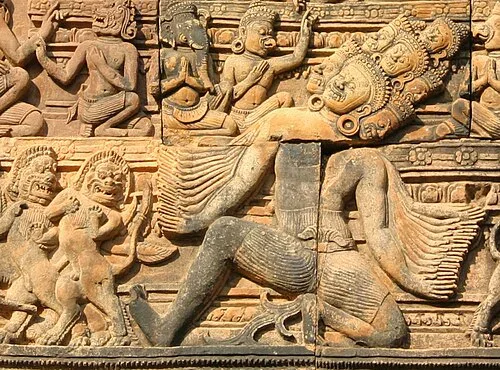 Southern Library and the Kailasha Reliefs
Ravana Shakes Mount Kailasha
Ravana, the ten-headed demon king, stands at the centre of this carving and shakes Mount Kailasha to its foundations. Animals flee from him. Above them, wise saints and mythological beings discuss what is happening, and they pray to Shiva and Parvati. Shiva and Parvati sit at the summit of the mountain. The slopes are arranged in strict tiers. At the top sit bearded saints and ascetics. In the middle are beings with animal heads and human bodies. At the bottom are large animals, including lions. According to the legend, Shiva and Parvati stopped Ravana by pressing the mountain down with their toes. They trapped him beneath it, and released him after some time. The west-facing pediment of the same library carries another legend, one about love. Kamadeva, the god of love, is shown aiming an arrow at Shiva. According to the legend, he did this to make Shiva take an interest in Parvati. The lowest tier of that scene belongs to ordinary people, who mingle with tame deer and gentle cattle. Shiva and Parvati were greatly disturbed by the arrow. Both of them gazed at Kamadeva with their third eyes, and he was burned to ashes. The legend says he was brought back to life later.
Listen in the appPhoto: Gerd Eichmann · CC BY-SA 4.0
07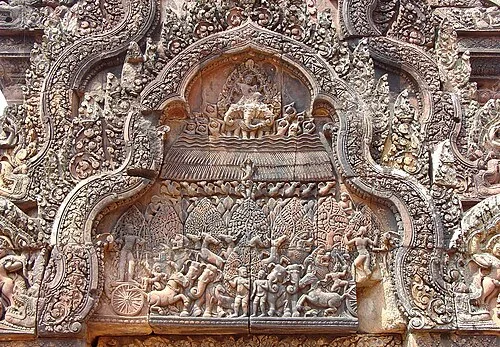 Northern Library and Mahabharata Legends
Indra's Rain and the Burning of the Khandava Forest
The fire god Agni set the Khandava Forest alight, hoping to kill the Naga king, a serpent ruler who lived there. Indra, the god of the sky, answered with enormous rains to put the fire out. This carving sits on the northern library, on the side of the temple that appears to be devoted to Vishnu. In the Mahabharata, Krishna and his cousin, a Pandava prince, side with Agni. Their arrows fall so thickly that they block and destroy Indra's rain. The Naga king's son is shown trying to escape the blaze, and he succeeds. Other animals rush about in panic, and they escape too.
Listen in the appMichael Gunther · CC BY-SA 4.0
08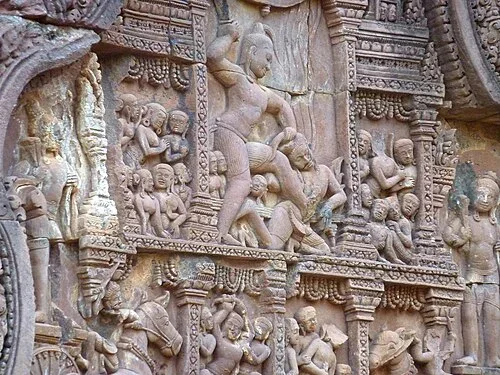 Northern Library and Mahabharata Legends
Krishna Slays the Tyrant Kamsa
The god Vishnu, in his form as Krishna, kills his own evil maternal uncle, Kamsa, at Mathura. Krishna seizes Kamsa and strikes him down, while crowds of onlookers fill the tiers around them. This scene is one of the four library pediments, and it faces west. Krishna is the eighth avatar of Vishnu in the Dashavatara series.
Listen in the appPhoto Dharma from Penang, Malaysia · CC BY 2.0
09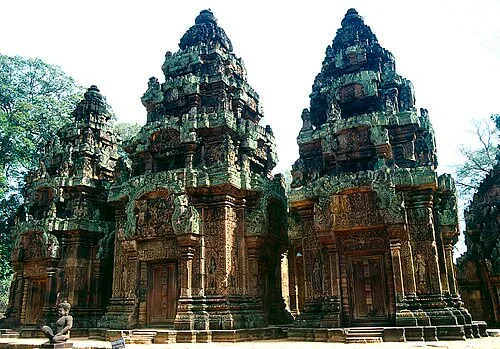 Inner Sanctuary Platform and Central Towers
The Three Sanctuary Towers
The temple's heart stands on a platform less than a metre high. Three towers rise from it. The central one is the tallest, at nine point eight metres. The temple's original name was Tribhuvanamaheshvara, meaning great lord of the threefold world. The name is an epithet of Shiva, and it refers to the statue of Shiva that was the temple's central religious image. Glaize noted that the small carved ornaments, called antefixes, on each tier make the towers look delicate. The inner buildings are the most successfully restored parts of the temple, helped by their hard sandstone and small scale. As recently as 2010, the inner temples were roped off and could not be entered.
Listen in the appPhoto: Ziegler175 · CC BY-SA 3.0
10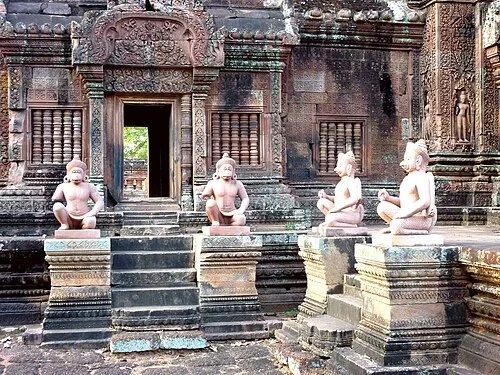 Inner Sanctuary Platform and Central Towers
Guardians with Animal Heads
Six stairways climb to the sanctuary platform, and each is guarded by a pair of kneeling figures. They have human bodies and animal heads, and they are the temple's protectors, known as dvarapalas. Most of the guardians now in place are replicas. The originals were either stolen or removed to museums. Toward the end of the twentieth century, authorities removed some original statues and replaced them with concrete replicas. Looters then began attacking those concrete replicas. Even a statue of Shiva and Parvati, moved to the National Museum of Cambodia in Phnom Penh for safekeeping, was targeted by thieves.
Listen in the appPhoto Dharma from Penang, Malaysia · CC BY 2.0
- 11
A Devata of the Citadel of Women
A goddess carved in a niche, a possible origin for the temple's name, and a 1923 theft that drew attention to it.
- 12
The Duel of the Monkey Kings: Closing the Tour at the Western Gate
Two monkey kings fight a duel, and a hero from the Ramayana decides how it ends.
Banteay Srei
Frequently asked questions
How much does the guide cost?
Free app download. Listed guide price: $0.99. Guide price shown in the app. Audio guide only. Venue admission is separate.
Can I listen without internet?
Yes. Download the guide’s audio, images, and maps in the app before your visit. Your downloaded content is then available offline.
Can I listen in my language?
This audio guide is available in 15 languages, including English.
Do I need to follow a schedule?
No. This is a self-guided experience. Choose your stops, pause whenever you like, and return to a story at your own pace.
At your own pace
Explore Banteay Srei.
Download Stanza, then search for “Banteay Srei”.
Free app download · Guide price shown in the app
Keep exploring
Nearby audio guides
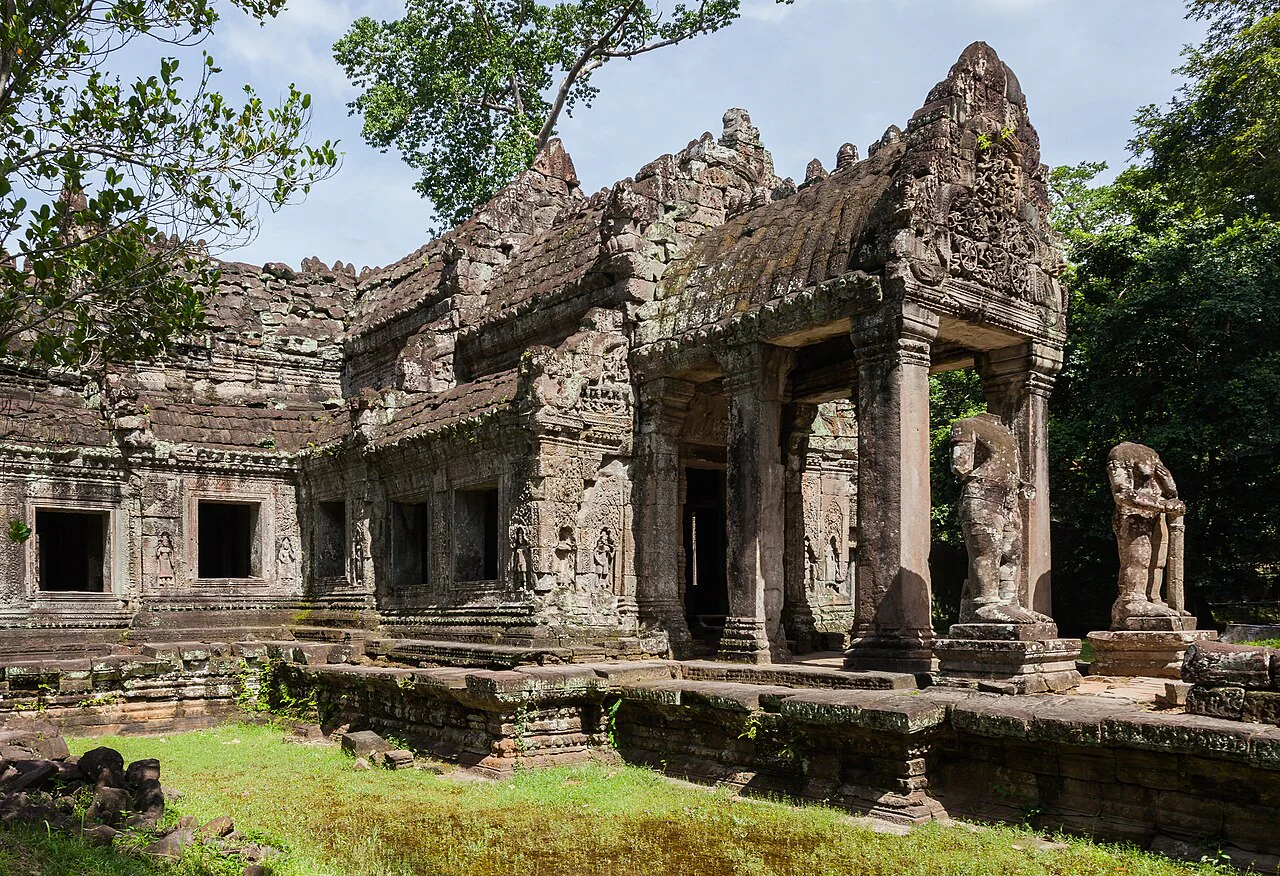
Siem Reap · 18 km
Preah Khan
Content & sources
Diego Delso · CC BY-SA 3.0
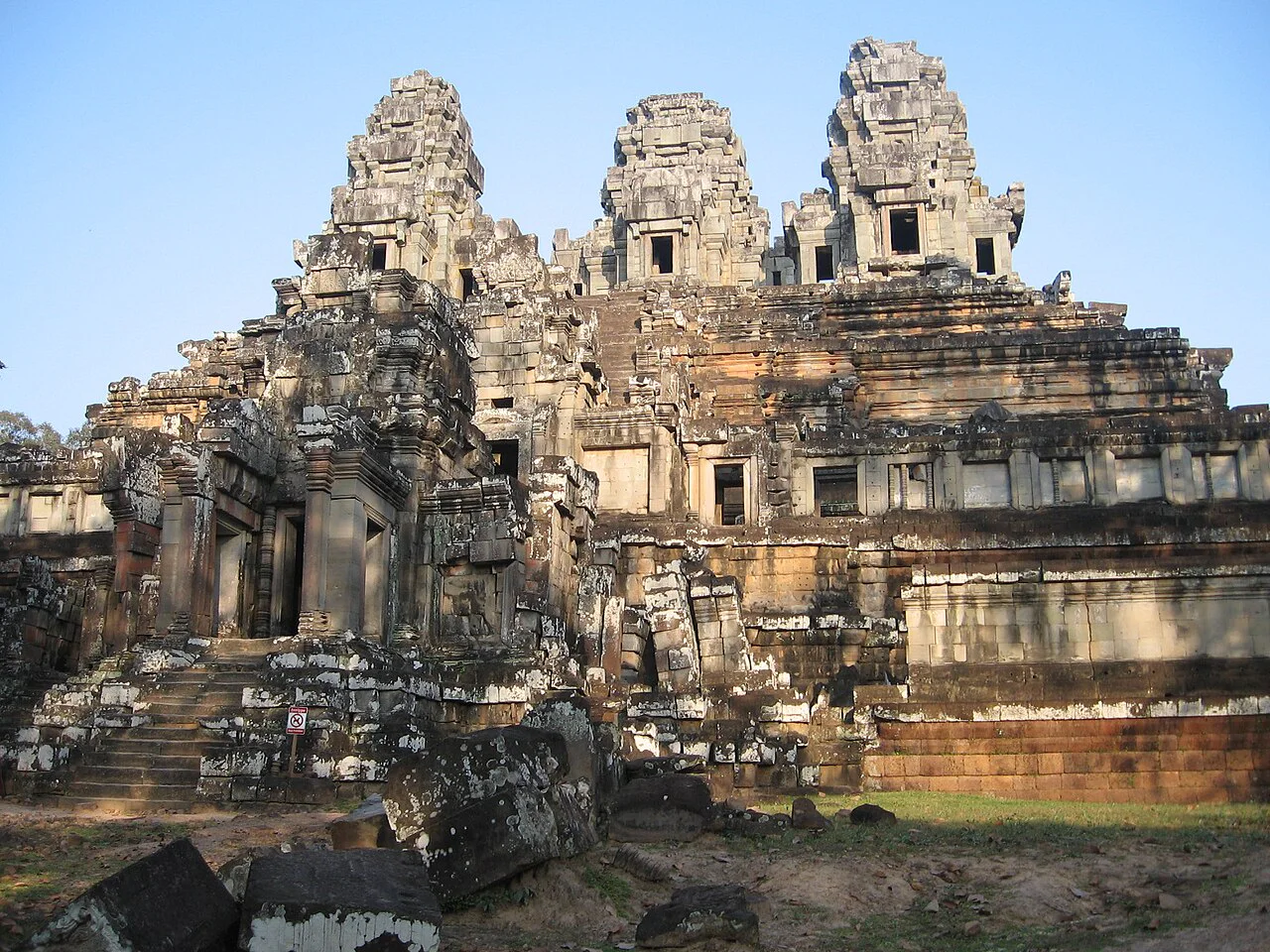
Siem Reap · 19 km
Ta Keo
Content & sources
Liftold at vi.wikipedia · Public domain
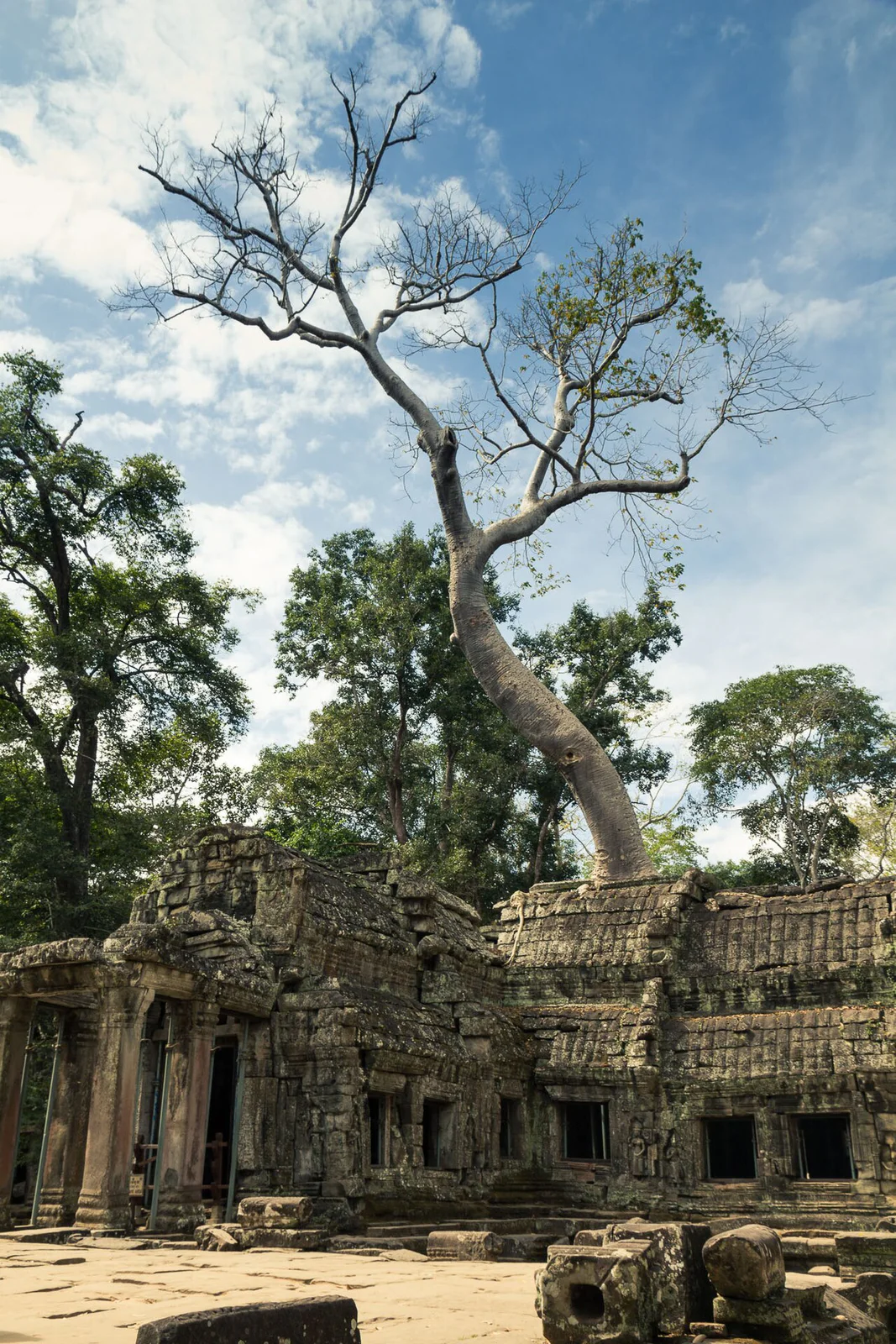
Siem Reap · 20 km
Ta Prohm
Content & sources
Dmitry A. Mottl · CC BY-SA 4.0
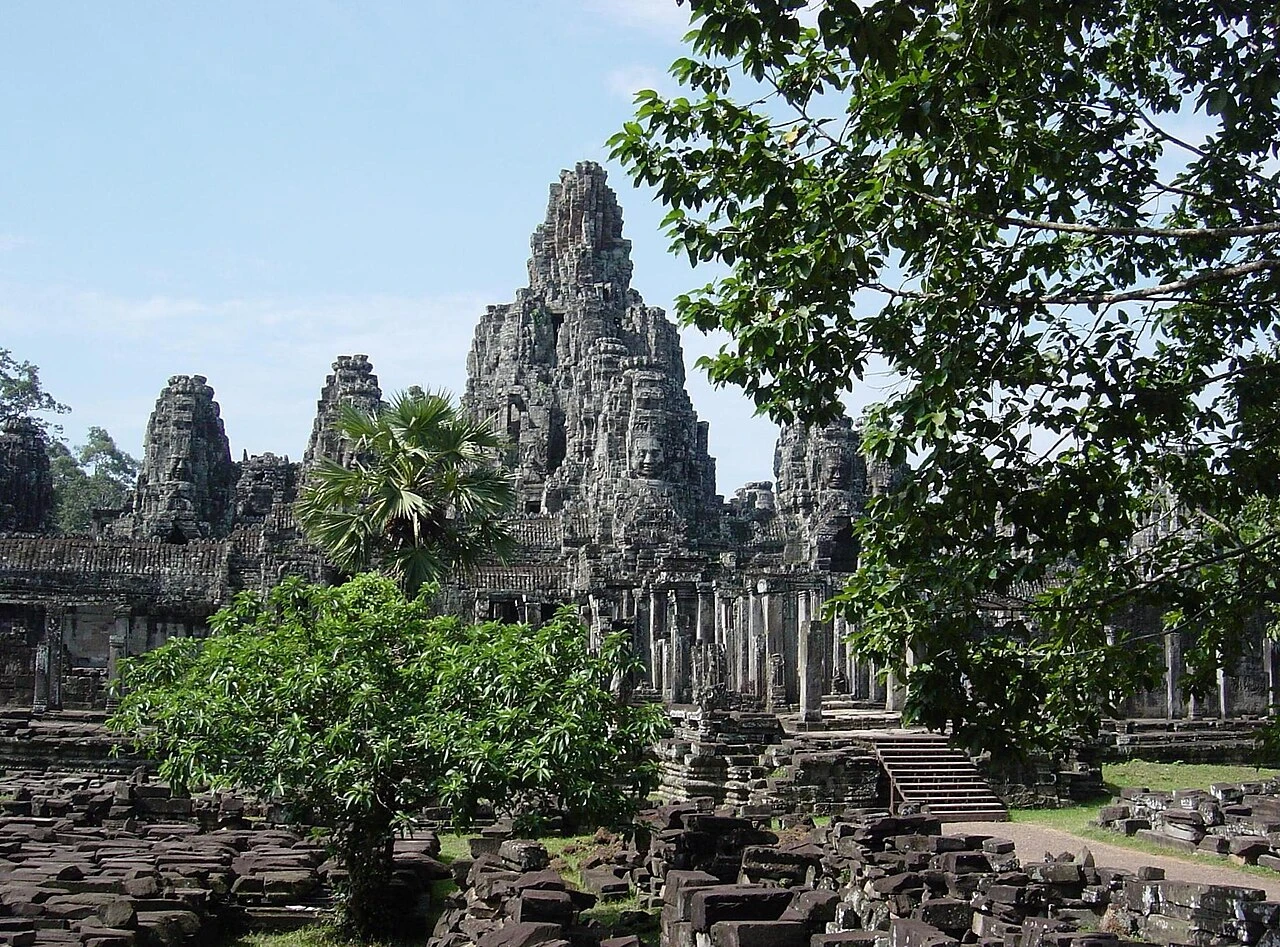
Siem Reap · 21 km
Angkor Thom
Content & sources
Charles J Sharp · CC BY 2.5