Stanza · Audio guide
Ta Prohm Audio Guide
A place to remember. A story to take with you.
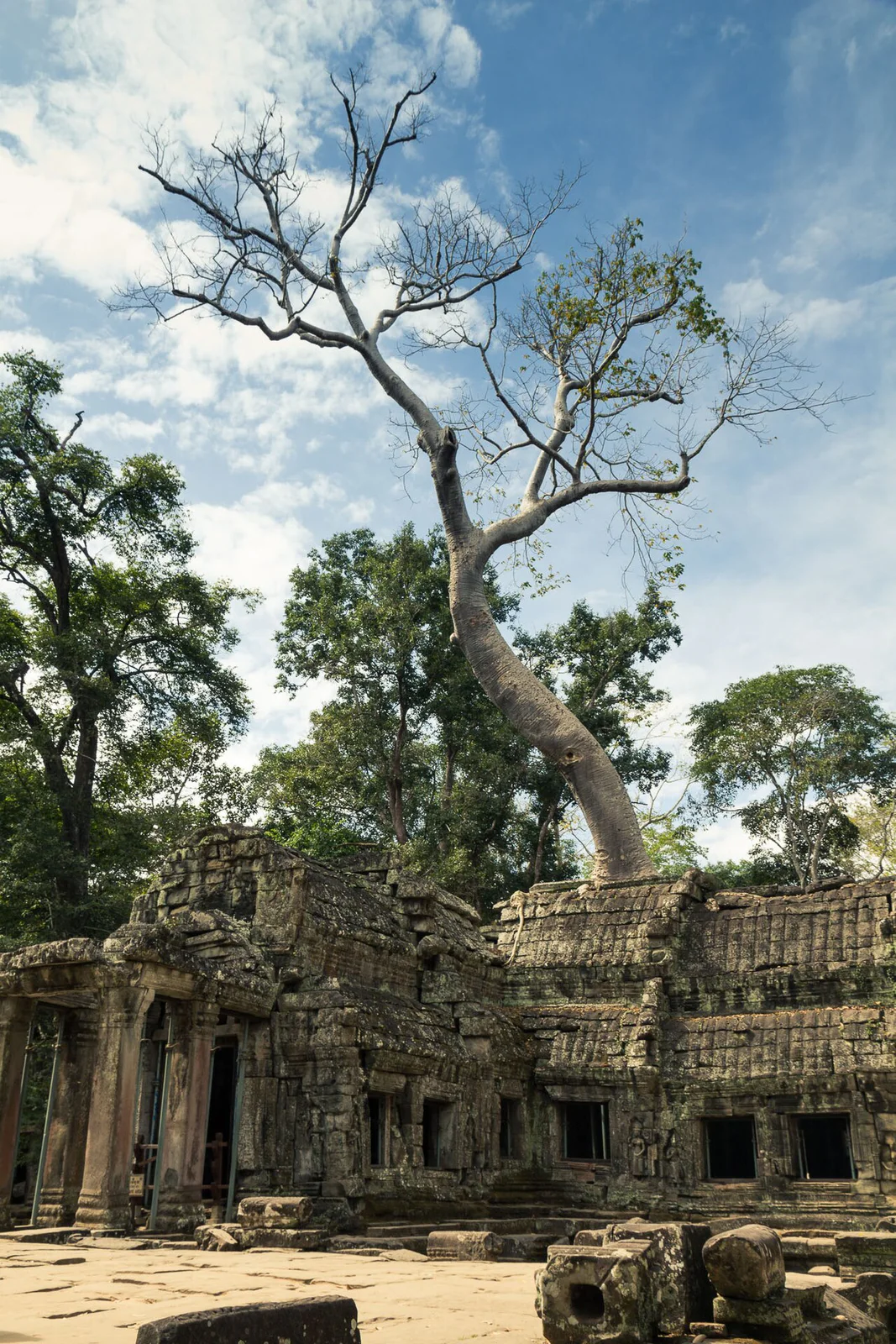
Ta Prohm is a temple near the city of Siem Reap that was built in the Bayon style during the late 12th and early 13th centuries. It was founded by King Jayavarman VII as a Mahayana Buddhist monastery and…
Download Stanza, then search for “Ta Prohm”.
About the tour
One guide. Your kind of visit.
Ta Prohm is a temple near the city of Siem Reap that was built in the Bayon style during the late 12th and early 13th centuries. It was founded by King Jayavarman VII as a Mahayana Buddhist monastery and center of learning.
Ready when you are.
- 01Get the free Stanza app.
iOS & Android
- 02Find your guide.
“Ta Prohm”
- 03Download before you go.
Works offline
Audio guide / 13 narrated stops
Inside the guide
Get to know a few of the stories before you go. Open a stop to read more.
01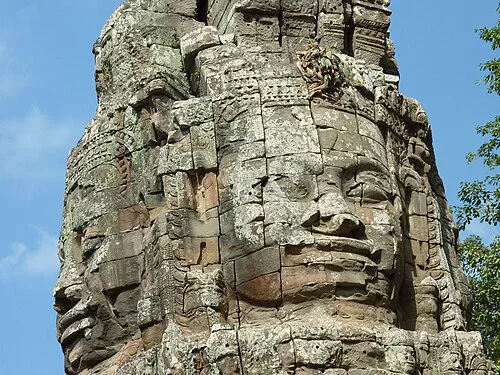 East Gopura and Forested Approach
East Gopura Face Tower
Welcome to Ta Prohm, the jungle temple of Angkor. The faces carved into this gateway tower are serene, with full lips and half-closed eyes, gazing out in every direction. They were not part of the original plan. King Jayavarman VII founded this monastery in 1186 and named it Rajavihara, the Royal Monastery. It was a Mahayana Buddhist centre of learning, dedicated to his mother, and one of the first temples of his vast building program. The face towers came later, in the thirteenth century, carved in the same style as the Bayon at Angkor Thom. So the temple kept growing long after its foundation. Some of those towers have since collapsed. This one still lifts its faces against the sky.
Photo Dharma from Penang, Malaysia · CC BY 2.0
02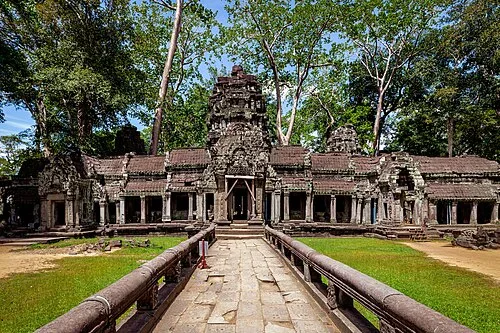 East Gopura and Forested Approach
The Outer Enclosure: A Monastery the Size of a Town
Ta Prohm is a temple of enormous scale, and the outer enclosure shows it best. This is a flat temple, not a mountain of tiers: five rectangular walls, one inside the other, around a central sanctuary. The outermost wall runs a thousand metres one way and six hundred and fifty the other. That enclosure held enough ground for a substantial town, and the forest inside it grew over that town long ago. A stone inscription set up when the temple was new records who lived here. More than twelve and a half thousand people lived and served within its walls. Among them were eighteen high priests. Another eighty thousand villagers in the surrounding countryside worked to supply the temple with services and goods. Two moats once lay inside and outside the fourth enclosure. That unusual pair led some historians to wonder whether an older Buddhist shrine stood on this spot first, with the great monastery built as its expansion. No one has settled the question.
This Photo was taken by Supanut Arunoprayote. Feel free to use any of my images, but please mention me as the author and may send me a message. (สามารถใช้ภาพได้อิสระ แต่กรุณาใส่เครดิตผู้ถ่ายและอาจส่งข้อความบอกกล่าวด้วย) Please do not upload an updated image here without consultation with the Author. The author would like to make corrections only at his own source. This ensures that the changes are preserved.Please if you think that any changes should be required, please inform the author.Otherwise you can upload a new image with a new name. Please use one of the templates derivative or extract. · CC BY 4.0
03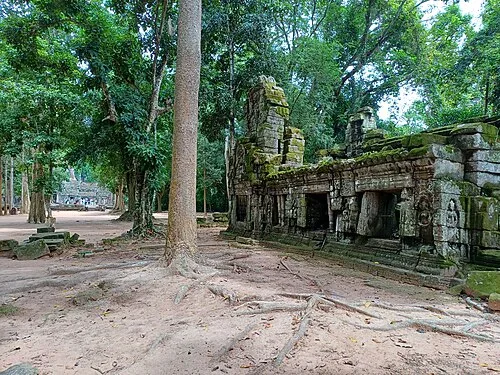 The House of Fire (Dharmasala)
The House of Fire
East of the fourth eastern gateway stands one of the temple's sturdiest outbuildings, known as the House of Fire. Its walls are thick, its openings few, built to last. No one knows its exact job; the name and the position are what survive. What is known is the habit of the king who built this place. Jayavarman VII is credited with raising rest houses and way stations across his empire, so that travellers could halt in safety on long journeys. Buildings like this one stood at the working edge of the monastery, where the sacred compound met the road.
Listen in the appRadosław Botev · CC BY 3.0 pl
04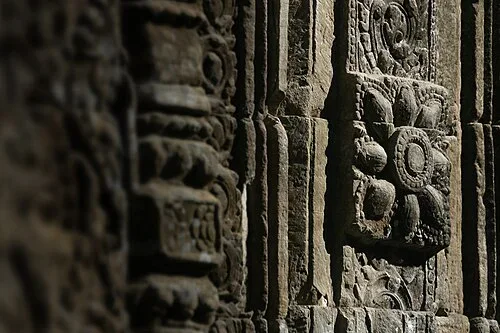 The Hall of Dancers
Between the third and fourth eastern gateways lies the Hall of Dancers. The foundation inscription gives a striking figure: six hundred and fifteen dancers were attached to Rajavihara, and this hall was their ceremonial stage. Its walls and pillars carry them still, carved in rows along the lintels, each figure with jewellery and a dancer's poise. The carving here is unusually crisp, and there is a reason. A renovation of the Hall of Dancers was completed in November 2022, returning much of the detail to view. The rosettes and floral medallions around the dancers read almost as freshly as the day the chisel left them.
Listen in the appGreg Willis from Denver, CO, usa · CC BY-SA 2.0
05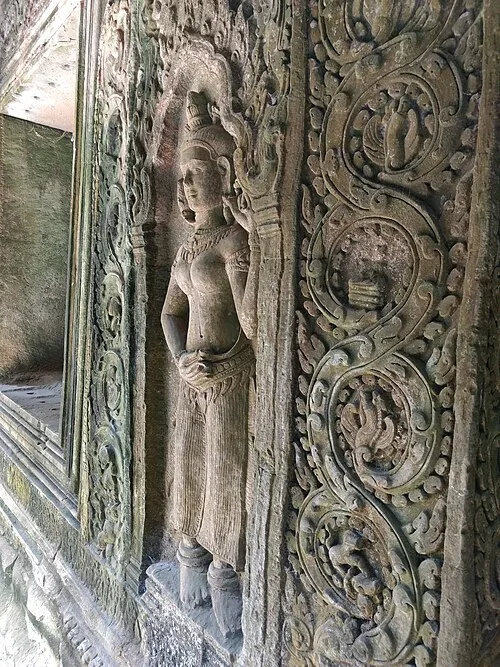 The Hall of Dancers
Devata and Apsara Carvings
Ta Prohm is carved differently from its great neighbours. Angkor Wat and Angkor Thom are covered with narrative reliefs, long stories told in stone. Here such scenes are few. What the temple offers instead are single figures: devatas, minor female deities, standing in niches; meditating monks and ascetics; and dvarapalas, the guardian figures set at doorways. The devata in this niche is a fine example, framed by swirling foliage with small creatures tucked into the scrolls. Some narrative reliefs do survive, though one is badly eroded. It shows the Great Departure, Siddhartha leaving his father's palace on his way to becoming the Buddha. Mostly, though, the walls belong to the devatas, each one standing alone in her frame.
Listen in the appPhoto: Shyamal · CC BY-SA 3.0
06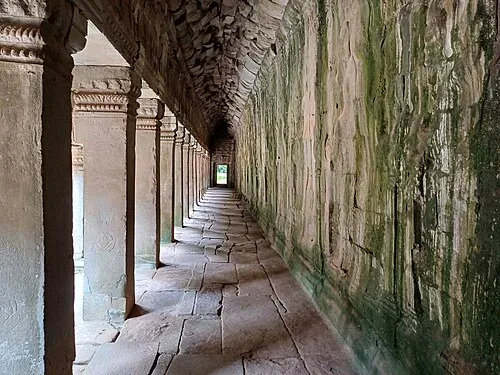 Third Enclosure and the Strangler Figs
Inside the Galleried Enclosures
The long galleries show how Ta Prohm is put together. Three of its inner enclosures are galleried, corridors roofed in stone and lined with columns. The corner towers of the first enclosure stand around the central sanctuary in a quincunx, a pattern of five, four corners and a centre. The stonework holds together without any mortar. Blocks were cut to fit, and nothing binds them but their own weight. That detail matters for what came later, because loosened stones are easy for roots to pry apart. Building went on here long after the founder's death. Additions continued as late as the reign of Srindravarman, at the end of the thirteenth century, so some of the buildings scattered across the site are later than others.
Listen in the appRadosław Botev · CC BY 3.0 pl
07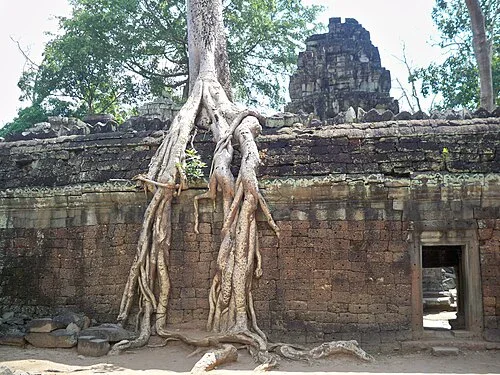 Third Enclosure and the Strangler Figs
When the Jungle Took Hold
After the Khmer Empire fell in the fifteenth century, Ta Prohm was abandoned and left alone for centuries. The jungle moved in. Trees rooted in the loosened stones and grew with the ruins, until tree and temple became one structure. Two species do most of the work, and even specialists do not fully agree on their names. The giants may be silk-cotton trees, or they may be thitpok. The smaller ones are called either strangler figs or gold apple trees. The roots pouring over this wall belong to one of the giants, splitting the masonry as they descend. Maurice Glaize, an early scholar of Angkor, watched the trunks soaring skywards under a shadowy green canopy. Their endless roots, he wrote, coil more like reptiles than plants. He meant it as praise of a kind. Few places at Angkor show stone and forest so tightly bound together.
Listen in the appPhoto: Liftold · CC BY-SA 3.0
08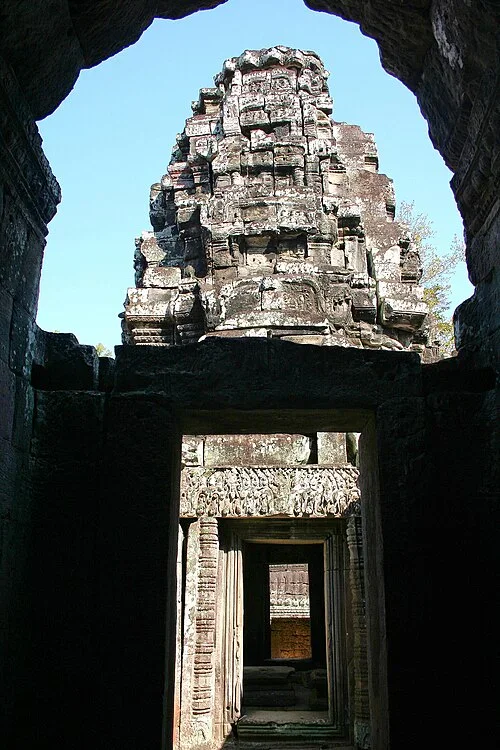 The Central Sanctuary of Prajnaparamita
At the centre of the five enclosures stood the temple's sacred image: Prajnaparamita, the personification of wisdom, carved with the face of Jayavarman VII's own mother. The monastery had been dedicated to her, and here she was enshrined as transcendent wisdom herself. The family filled the temple. Two satellite temples inside the third enclosure honoured the king's guru, Jayamangalartha, and his elder brother. And across Angkor stood a companion foundation. Preah Khan, dedicated in 1191, held an image of the bodhisattva of compassion, Lokesvara, modelled on the king's father. Mother and father, wisdom and compassion, each with a temple of their own. The foundation inscription also lists what the monastery amassed: gold, pearls and silks, riches gathered to serve the sanctuary. The towers here rise only modest heights, and the forest canopy has grown far above them.
Listen in the appPhoto: Random username 083794703875938 · CC0
09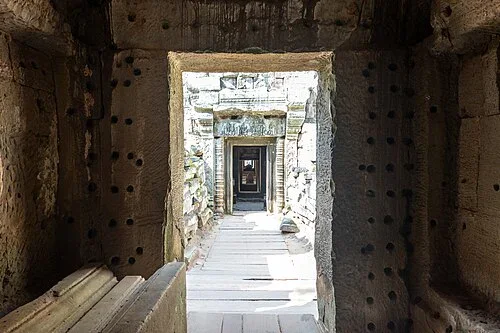 The Central Sanctuary of Prajnaparamita
Rescue and Stabilisation
Keeping this ruin visitable is its own story. In 1992 UNESCO placed Ta Prohm on the World Heritage List, and conservation became a partnership between the Archaeological Survey of India and APSARA, the Cambodian authority for Angkor. By 2013 the Indian team had restored most of the complex, and some sections were rebuilt from nothing. Wooden walkways, platforms and roped railings now thread through the ruins, put in place to keep visitors' feet off the fragile fabric. Even the rows of small holes pocking the walls here have no agreed explanation. The ruin keeps some of its details to itself.
Listen in the appPhoto: No(0)GoodNamesLeft · CC BY-SA 4.0
10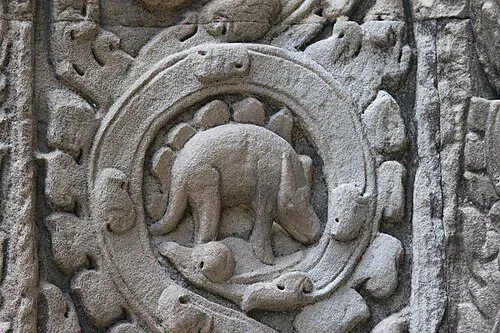 The Enigmatic Stegosaurus Relief
The 'Dinosaur' of Ta Prohm
One small carving here has made Ta Prohm famous far beyond archaeology. Set in a round medallion on a corner porch is a rough-hewn animal with a rounded back and a ridge of plates along its spine. To many visitors it looks unmistakably like a stegosaurus, a dinosaur that vanished from the earth ages before any human cut stone, and that claim has travelled widely. Scholars read it more simply. They see an ordinary animal, perhaps a boar or a rhinoceros, set against a background of stylised leaves. The carving itself gives no answer. Whatever the sculptor intended, the little beast has become a curiosity all its own.
Listen in the appHarald Hoyer from Schwerin, Germany · CC BY-SA 2.0
- 11
The Tomb Raider Tree
The root-draped doorway that carried this temple to a worldwide audience in 2001.
- 12
The Face in the Tree
A carved face, still serene, held fast in the grip of a living trunk.
- 13
The West Gopura: Leaving the Jungle Temple
Why the French conservators left this temple wild, and what that choice means for everything seen here.
Ta Prohm
Frequently asked questions
How much does the guide cost?
Free app download. Listed guide price: $0.99. Guide price shown in the app. Audio guide only. Venue admission is separate.
Can I listen without internet?
Yes. Download the guide’s audio, images, and maps in the app before your visit. Your downloaded content is then available offline.
Can I listen in my language?
This audio guide is available in 15 languages, including English.
Do I need to follow a schedule?
No. This is a self-guided experience. Choose your stops, pause whenever you like, and return to a story at your own pace.
At your own pace
Explore Ta Prohm.
Download Stanza, then search for “Ta Prohm”.
Free app download · Guide price shown in the app
Keep exploring
Nearby audio guides
Siem Reap · 1 km
Ta Keo
Content & sources
Liftold at vi.wikipedia · Public domain
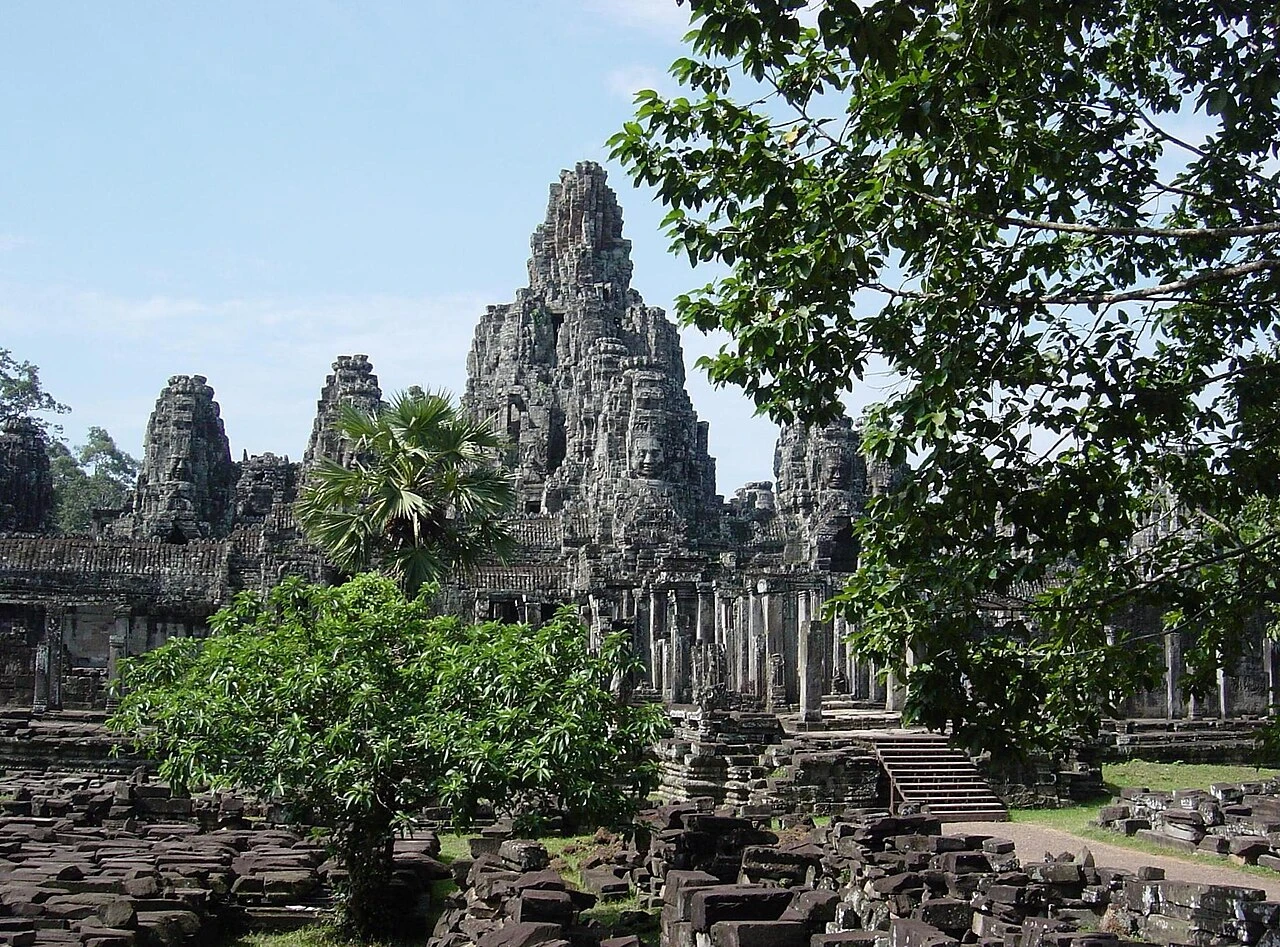
Siem Reap · 3 km
Angkor Thom
Content & sources
Charles J Sharp · CC BY 2.5
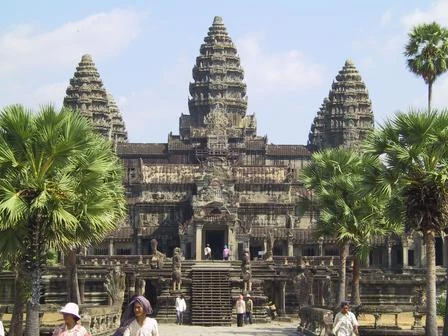
Siem Reap · 3 km
Angkor Wat
Content & sources
The original uploader was Fuzheado at English Wikipedia. · CC BY-SA 2.0
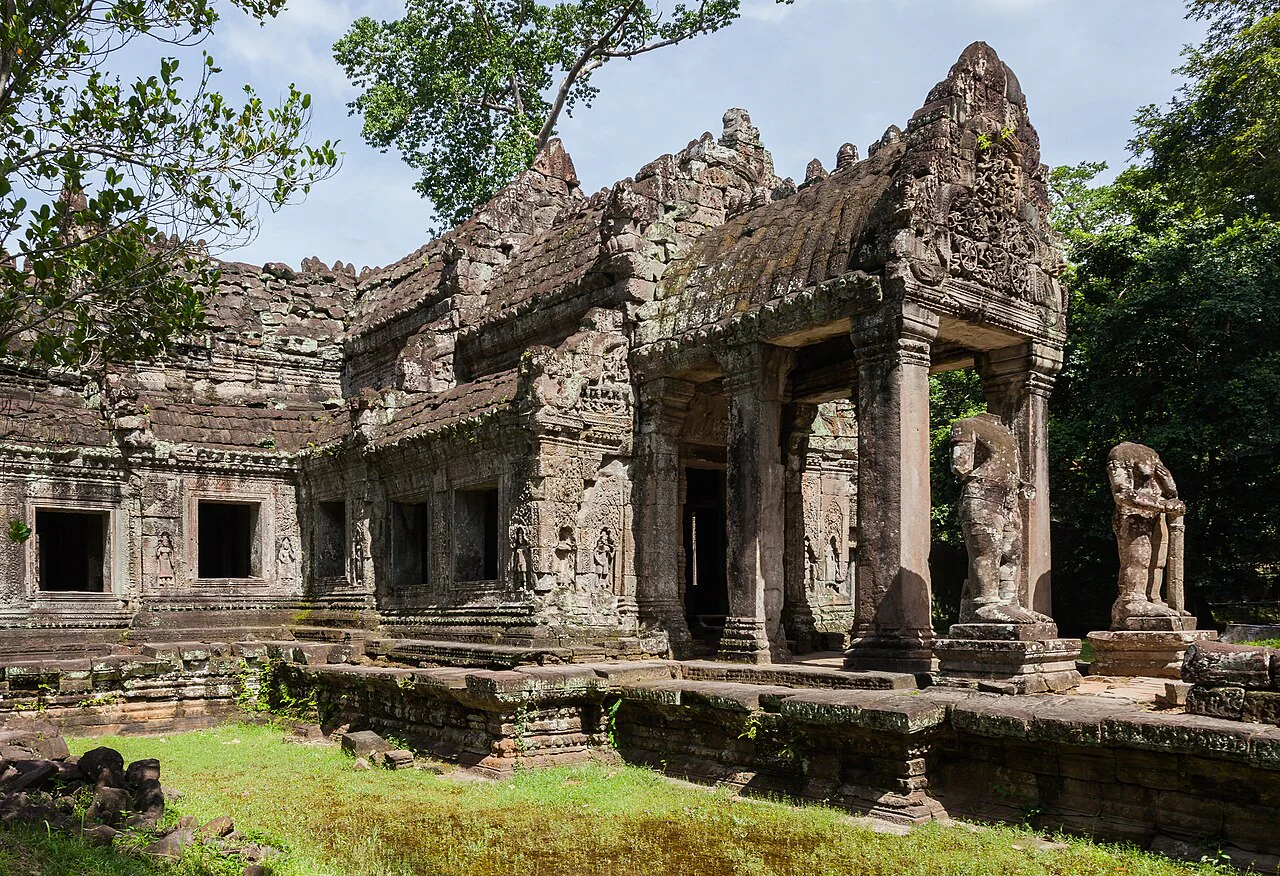
Siem Reap · 4 km
Preah Khan
Content & sources
Diego Delso · CC BY-SA 3.0