Stanza · Audio guide
Koh Ker Audio Guide
A place to remember. A story to take with you.
Koh Ker is a remote archaeological site in northern Cambodia that served as a capital of the Khmer Empire. The area contains more than 180 sanctuaries, though only about two dozen monuments are currently…
Download Stanza, then search for “Koh Ker”.
About the tour
One guide. Your kind of visit.
Koh Ker is a remote archaeological site in northern Cambodia that served as a capital of the Khmer Empire. The area contains more than 180 sanctuaries, though only about two dozen monuments are currently accessible to tourists.
Ready when you are.
- 01Get the free Stanza app.
iOS & Android
- 02Find your guide.
“Koh Ker”
- 03Download before you go.
Works offline
Audio guide / 17 narrated stops
Inside the guide
Get to know a few of the stories before you go. Open a stop to read more.
01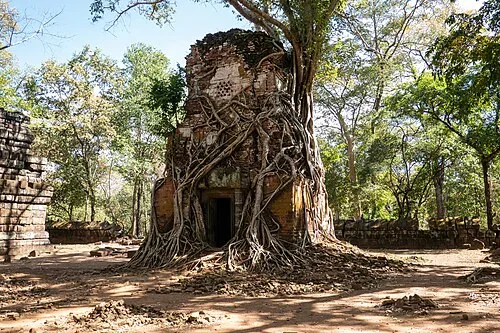 Prasat Pram: The Strangler Fig Sanctuary
Prasat Pram: Arrival in a Breakaway Capital
Old trees have taken this brick tower for their own, roots pouring down its walls like a curtain. Welcome to Koh Ker, a remote forested plateau in northern Cambodia, about a hundred and twenty kilometres from Angkor. The old inscriptions call this place Lingapura, the city of lingams, or Chok Gargyar, the iron tree forest. In the years around 921, a lord named Jayavarman IV turned his back on the Angkor region, probably after a dispute over the throne with the sons of King Yasovarman I. He brought the royal state cult of Shiva with him and built a rival seat of power here. Some historians call him a usurper; most believe he had a rightful claim, because he had married a half-sister of Yasovarman. Either way, from 928 to 944 this forest city was the capital of the whole Khmer Empire. The tower wrapped in roots is Prasat Pram, one of the sanctuaries of that brief, brilliant reign.
PsamatheM · CC BY-SA 4.0
02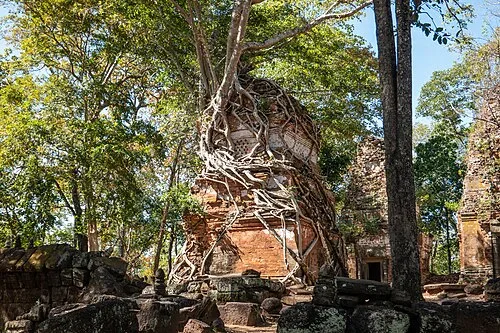 Prasat Pram: The Strangler Fig Sanctuary
Prasat Pram: The Five Towers and the Fire Shrine
Pram means five, and this sanctuary wears its name plainly. Three brick towers stand in a row on one platform, all facing east, the middle one a little taller than its neighbours. Two more towers stand in front of the platform, facing west. Each of the main towers once held a lingam, the symbol of Shiva, in its shrine. Those lingams, and the beautifully carved lintels, were looted long ago. One of the two front towers carries a telling detail: diamond-shaped holes pierce its upper wall. Holes like these mark out a fire sanctuary, and fire cults mattered greatly to the Khmer kings. This small tower, then, kept a sacred flame. Two of the five towers are now clothed in the roots of huge trees, brick and trunk grown into a single shape.
PsamatheM · CC BY-SA 4.0
03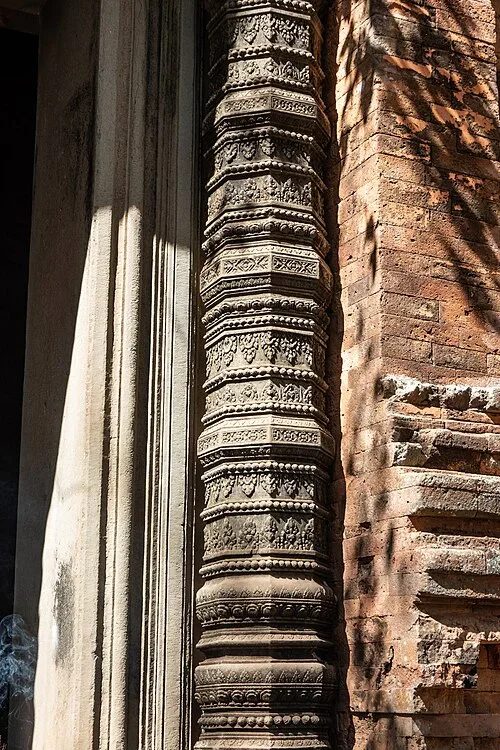 Prasat Pram: The Strangler Fig Sanctuary
Prasat Pram: The Brickwrights' Secret
The towers here are brick, and the bricks themselves are small, regular and very solid. What holds them together is a thin layer of organic mortar whose formula nobody has worked out, possibly some kind of plant sap. After more than a thousand years, these brick sanctuaries stand in far better shape than the laterite ones nearby. Originally the towers wore a coat of white stucco, and traces of it still cling to the walls. The crisp carving on the sandstone colonnette beside the doorway shows the skill of Jayavarman IV's workshops: every band of beads, leaves and rosettes cut clean after a millennium. Good stone was never a problem here. Excellent laterite and sandstone were quarried in great quantities in the region itself.
Listen in the appPsamatheM · CC BY-SA 4.0
04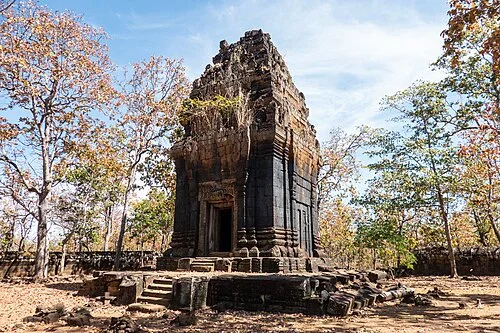 Prasat Neang Khmau: The Black Lady Shrine
Prasat Neang Khmau: The Black Lady
South of the main complex, a single dark tower rises from the trees. It is built of sandstone and brick, an early tenth-century temple dedicated to Shiva. Fire has scorched its outer surface black, and that burned skin gave the temple its Khmer name: Neang Khmau, the Black Lady. The name is also said to carry the sense of a black virgin. But the fire damage is the plainer explanation, written on the stone itself.
Listen in the appPsamatheM · CC BY-SA 4.0
05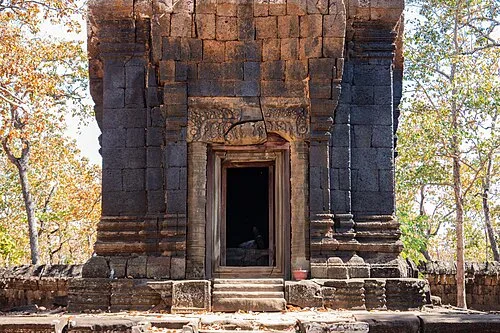 Prasat Neang Khmau: The Black Lady Shrine
Prasat Neang Khmau: The Exiled Princess
Local legend tells of a powerful king, Preah Bat Sorya Teyong, whose daughter Neang Khmao fell under the spell of a man called Bandit Srey, who used magic to win her love. When her father heard of it, he exiled her and built temples for her to live in. In exile, the story goes, she fell in love with a monk, and the monk gave up his vows to live with her there. From then on, people say, the place bore her name. It is a tale the countryside tells, travelling with the name rather than carved anywhere. The lintel above the doorway is more down to earth: the work of masons in the early tenth century, still fitted in place.
Listen in the appPsamatheM · CC BY-SA 4.0
06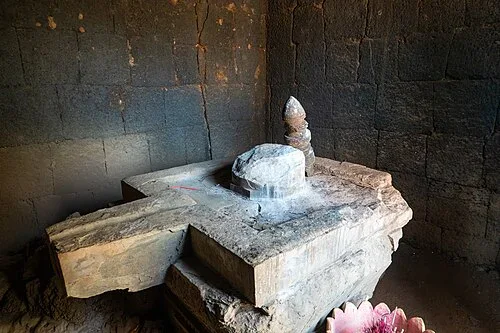 Prasat Neang Khmau: The Black Lady Shrine
Inside the Shrine: The Linga and the Yoni
Inside this dark chamber, Shiva's symbol rests on its pedestal, and a fresh lotus lies before it as an offering. The rounded stone is a lingam; the block beneath it is the yoni, its base. Devotion here followed a set ritual. A priest poured water over the lingam, and the water became holy by touching the symbol of Shiva. It ran down the yoni and collected in a channel carved there, then flowed outside through a spout to where worshippers waited to touch the blessed water. Around the altar there was room for only a few priests to perform the rites. Koh Ker pushed this cult to its extreme. Along the ring road, the shrines called Prasat Balang and Prasat Thneng hold lingams about two metres tall, each carved from the living bedrock where it stands. At Prasat Thneng, looters once tried to hack the great lingam away. They left a notch half a metre deep, but the symbol of Shiva still stands unshakeable on its damaged base.
Listen in the appPsamatheM · CC BY-SA 4.0
07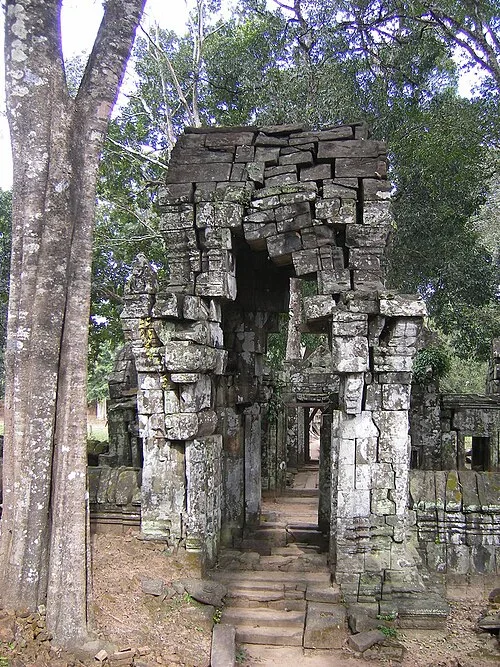 The Grand East Gopura and Prasat Krahom
The Grand East Gopura: Gateway of a Planned City
This crumbling gateway opens the main complex of the ancient capital. Behind it, the double sanctuary of Prasat Thom and the Prang stretches in a straight line about eight hundred metres long. That is unusual, because most temples of the Khmer kings were laid out in concentric squares, one enclosure inside another. Here the plan is linear, and its orientation matches something enormous nearby: the Rahal, the great water tank of the city. The Rahal runs about twelve hundred metres long. It is roughly five hundred and sixty metres wide, and instead of facing east to west like the reservoirs of Angkor it follows an axis of north fifteen degrees west. The most important monuments at Koh Ker share that same orientation. That is why researchers think the Rahal was constructed first, and the temples were laid out around it. The tank was carved partly out of the stone ground, though whether a natural hollow dictated its odd angle nobody can say. These days most of the Rahal is dry and grassed over, with a few puddles near the double sanctuary.
Listen in the appfxru · CC BY-SA 2.0
08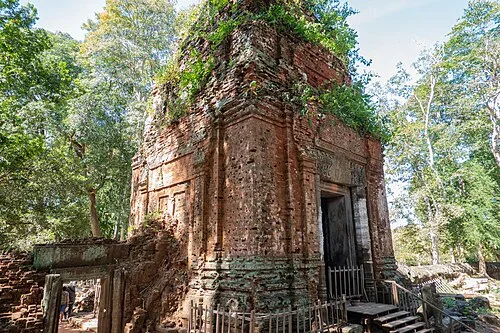 The Grand East Gopura and Prasat Krahom
Prasat Krahom: The Red Tower and the Dancing Shiva
A red brick tower marks the entrance to the enclosed monuments, and its name says the colour: krahom means red. It stands on a cruciform plan and, unlike much of the complex, it is in good condition. It once guarded a treasure. Inside stood a statue of the Dancing Shiva, with five heads and ten arms, three and a half metres tall. The figure is now broken completely. A single fragment, one hand about half a metre long, survives in the National Museum in Phnom Penh.
Listen in the appPsamatheM · CC BY-SA 4.0
09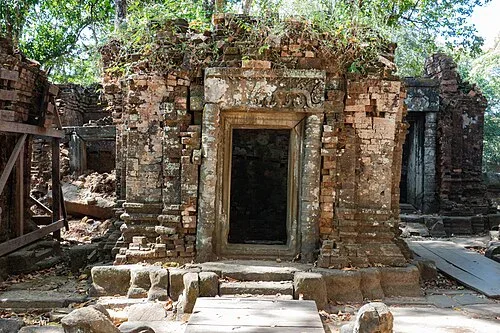 The Grand East Gopura and Prasat Krahom
Beyond the Gate: Paying for a Capital
Every one of these ruins had to be paid for. Inscriptions found at Koh Ker describe how Jayavarman IV raised his money, through a restrictive system of taxation. Taxes were collected in rice across the whole country. That rice fed the workers who came from different provinces to build for the king. With that supply, in under two decades, his builders raised about forty temples, the great seven-tiered pyramid and a huge water reservoir. The carved lintel above the doorway here is one small piece of that vast programme.
Listen in the appPsamatheM · CC BY-SA 4.0
10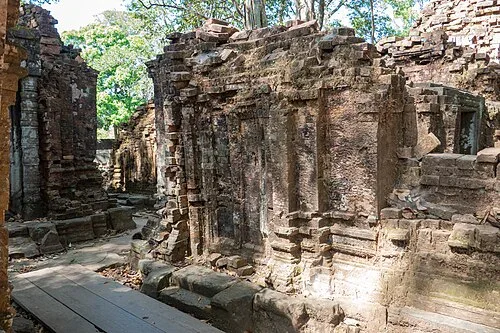 Prasat Thom: The Ancestral Enclosure
Prasat Thom: The Moated Sanctuary
Prasat Thom is the religious heart of the old capital, and water sets it apart. The eastern court holds a moat about forty-seven metres wide, its banks lined with trees. Two dams cross the water, one on the east side and one on the west, leading down to the ground inside. Naga balustrades flank both dams, the coiled serpents that guard Khmer causeways. On the eastern dam, a colonnade with pillars once stood between the Nagas, so the approach ran under a roof. Behind each Naga on that eastern side, a huge Garuda is said to have stood, the great bird of Khmer myth. Crossing here was a ceremony in itself: over the water, between the serpents, along a pillared gallery, towards the sanctuary of the ancestors. The ruined brick shrines and corridors beyond the moat are what survive of that ceremonial stage.
Listen in the appPsamatheM · CC BY-SA 4.0
- 11
Walls of Laterite: The Enclosure Fabric
Laterite walls, barred stone windows, and the twenty-one towers that once held lingams.
- 12
The Guardian: Koh Ker's Sculptural Revolution
A weathered relief figure that shows the Koh Ker style at its pinnacle.
- 13
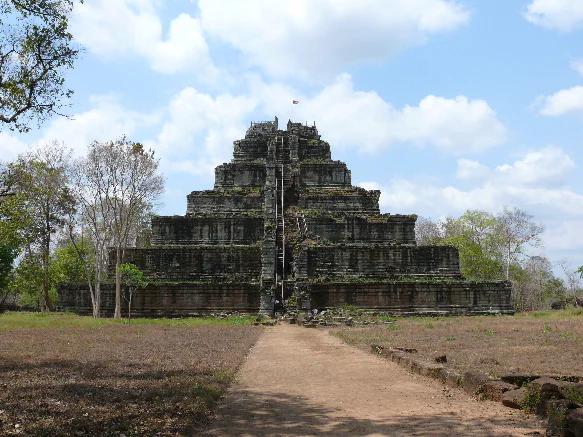
The Prang: Seven Tiers to the Sky
The seven-tiered state pyramid of Jayavarman IV, and the giant lingam that inscriptions say crowned it.
- 14
Ascending the Pyramid
How the pyramid was climbed, and the scholars' guess about what stood on the seventh tier.
- 15
Behind the Pyramid: The Tomb of the White Elephant
A perfectly circular mound behind the pyramid, claimed by legend as an elephant's grave and by archaeologists as a king's.
- 16
Banteay Pir Choan: A City of 180 Sanctuaries
The scale of the lost city: a hundred and eighty sanctuaries, most of them still hidden and off limits.
- 17
Closing: From Jungle Kingdom to World Heritage
Hunters, French scholars, looted statues and a UNESCO inscription: how Koh Ker returned to the world.
Koh Ker
Frequently asked questions
How much does the guide cost?
Free app download. Listed guide price: $1.99. Guide price shown in the app. Audio guide only. Venue admission is separate.
Can I listen without internet?
Yes. Download the guide’s audio, images, and maps in the app before your visit. Your downloaded content is then available offline.
Can I listen in my language?
This audio guide is available in 15 languages, including English.
Do I need to follow a schedule?
No. This is a self-guided experience. Choose your stops, pause whenever you like, and return to a story at your own pace.
At your own pace
Explore Koh Ker.
Download Stanza, then search for “Koh Ker”.
Free app download · Guide price shown in the app
Keep exploring
Nearby audio guides
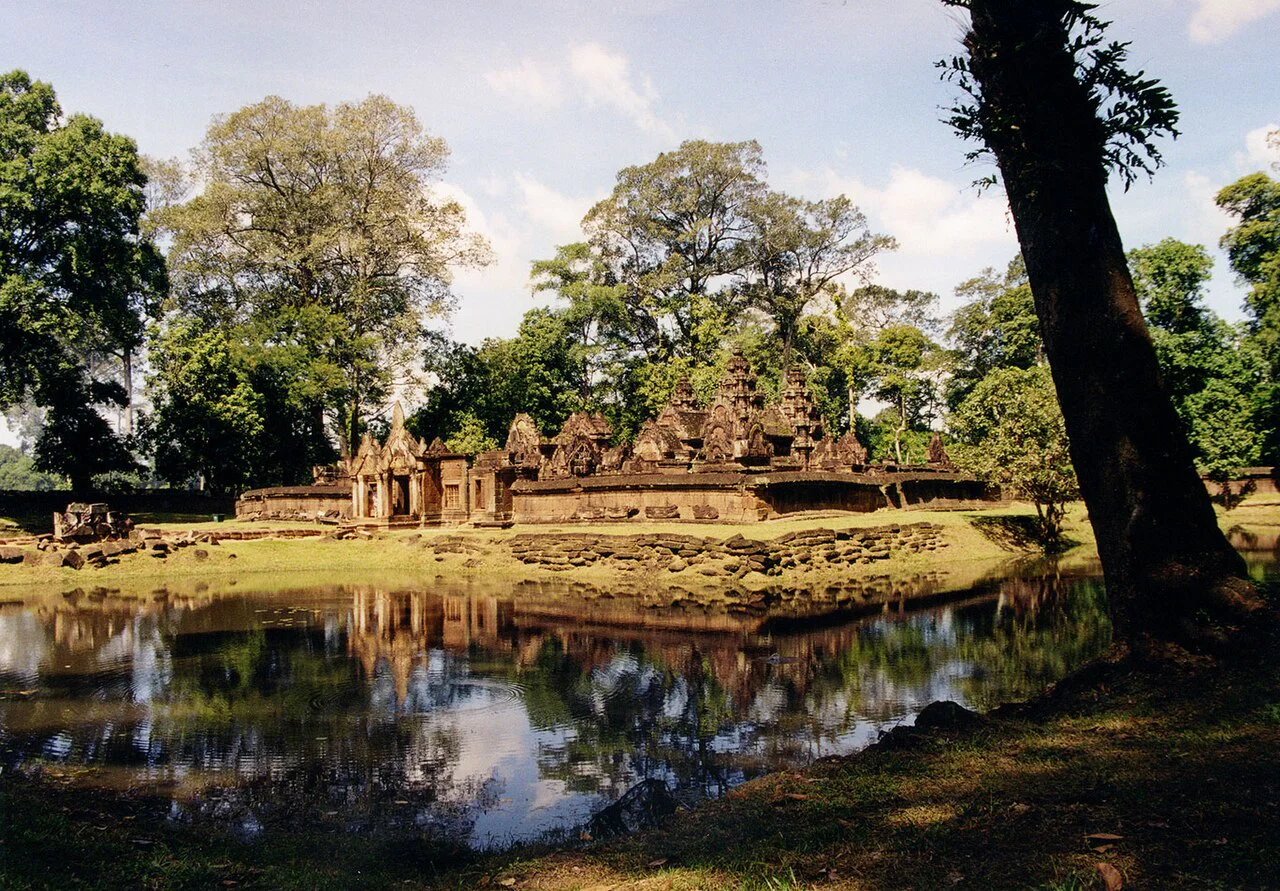
Siem Reap · 65 km
Banteay Srei
Content & sources
Photo: Tsui · CC BY-SA 3.0
Siem Reap · 79 km
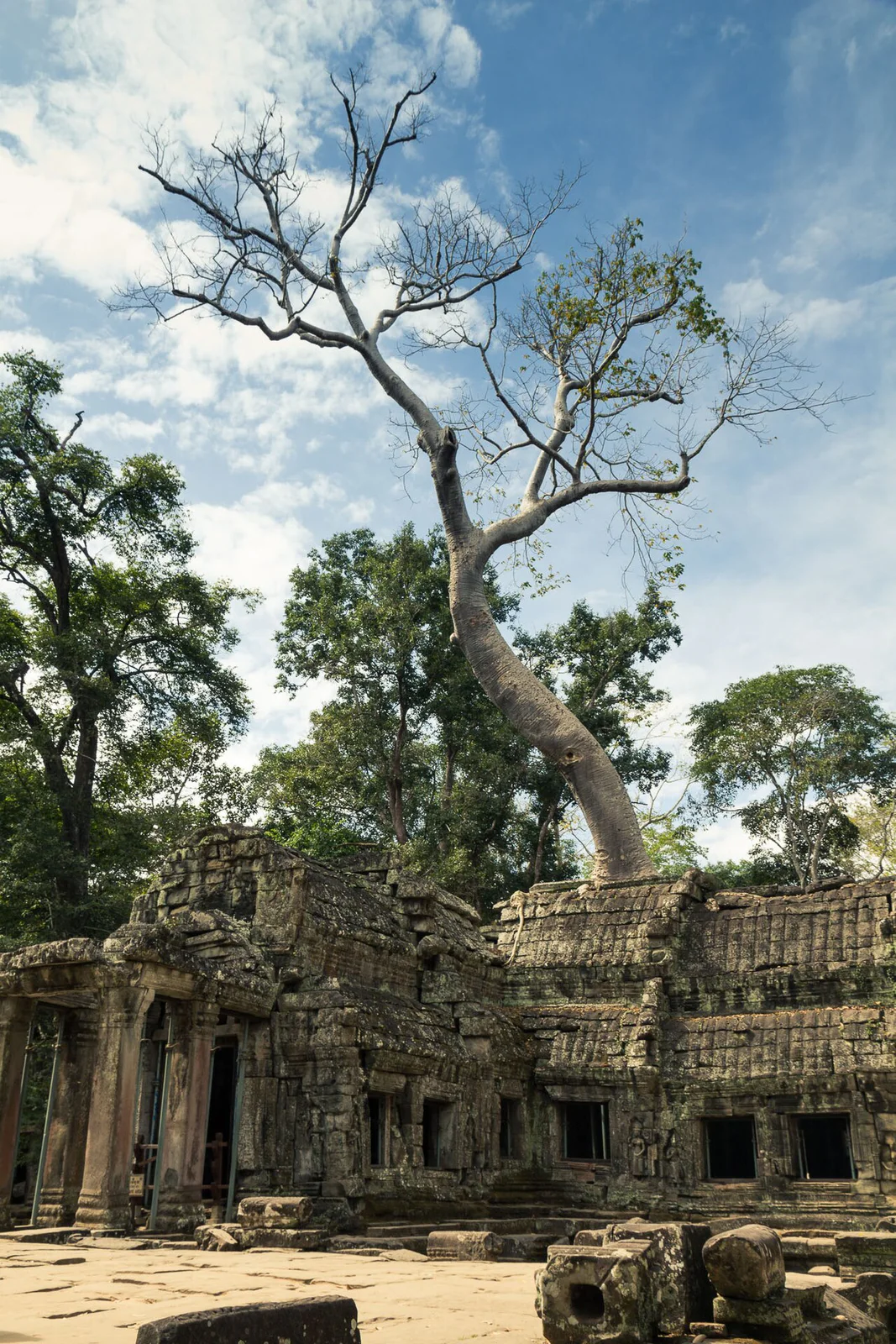
Ta Prohm
Content & sources
Dmitry A. Mottl · CC BY-SA 4.0
Siem Reap · 80 km
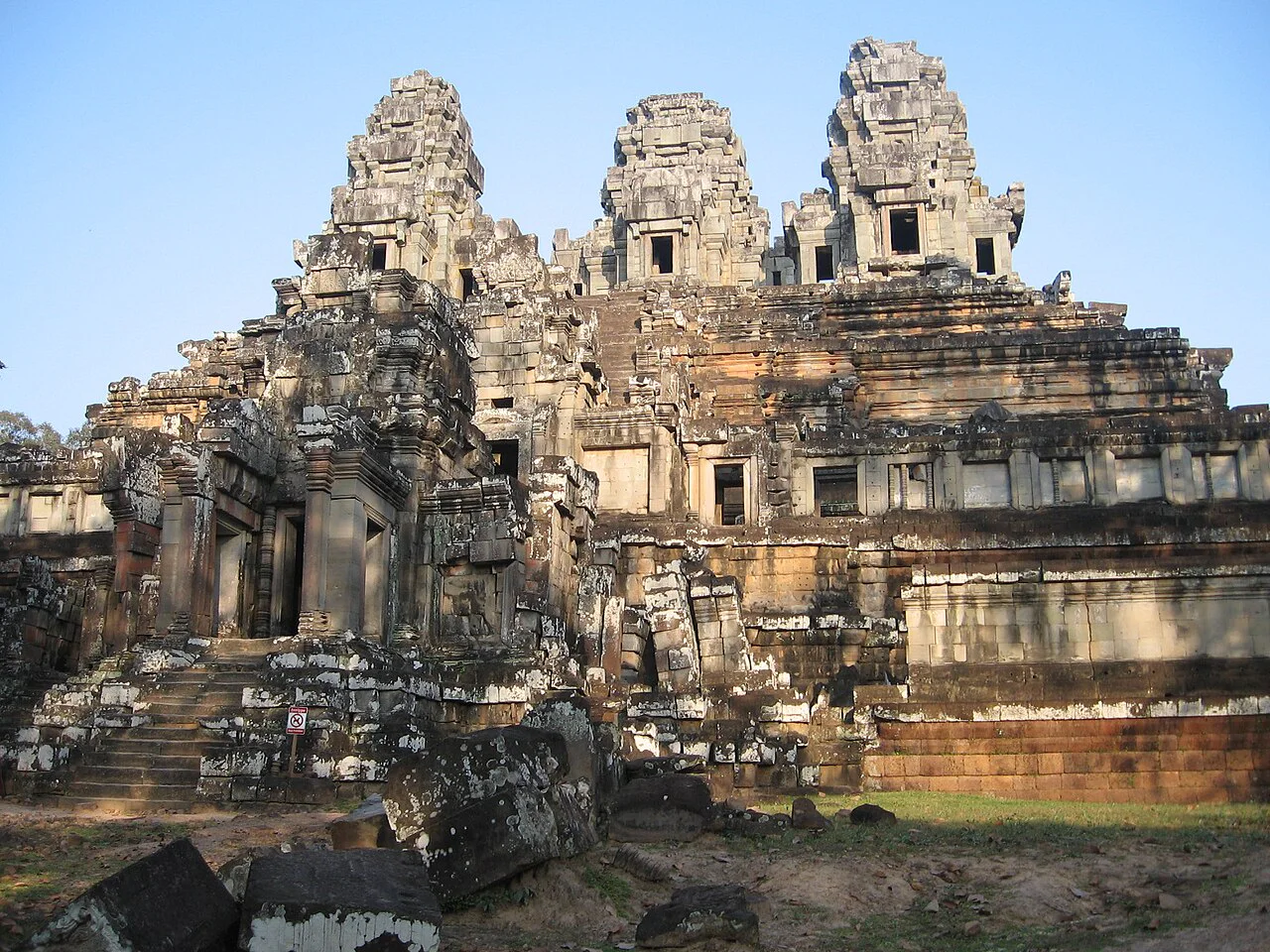
Ta Keo
Content & sources
Liftold at vi.wikipedia · Public domain
Siem Reap · 80 km
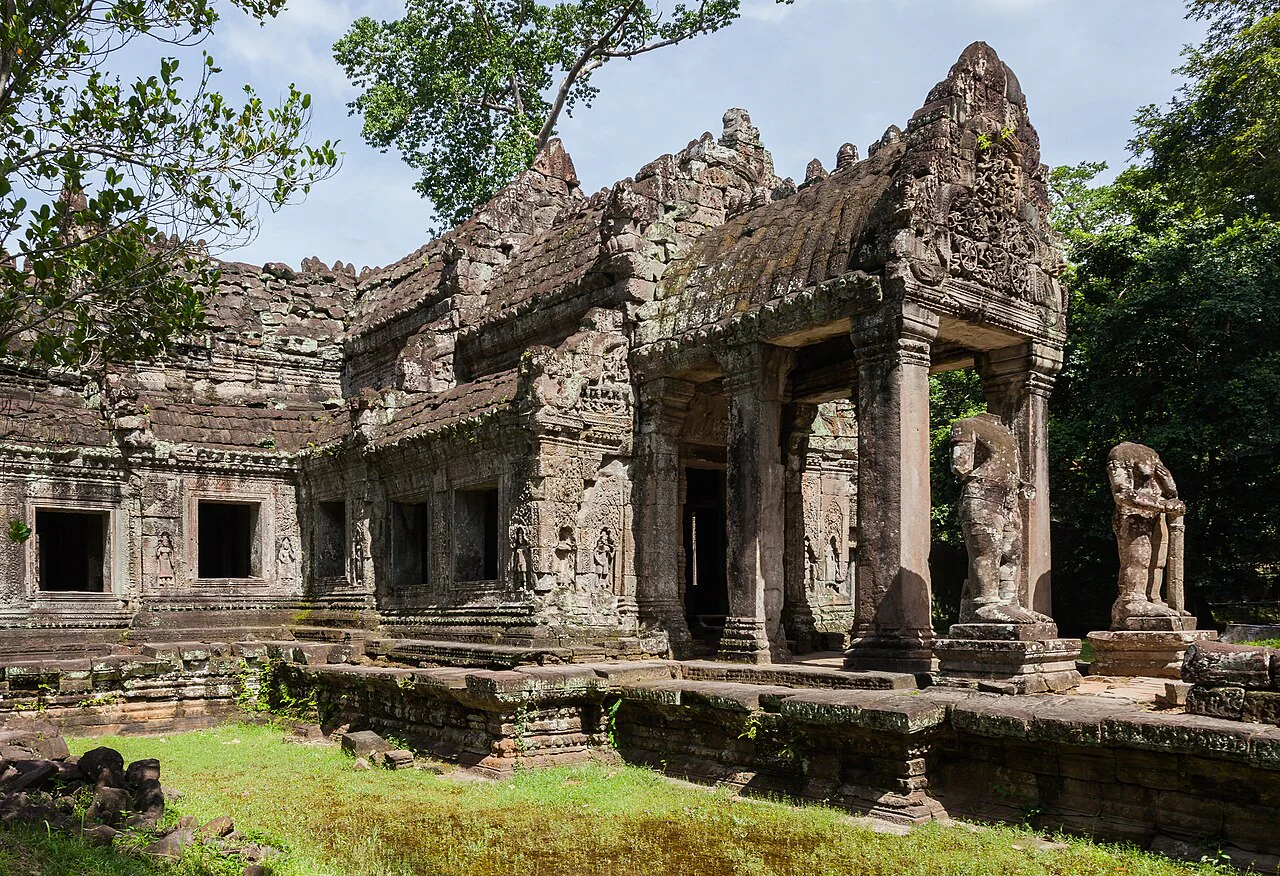
Preah Khan
Content & sources
Diego Delso · CC BY-SA 3.0