Stanza · Audio guide
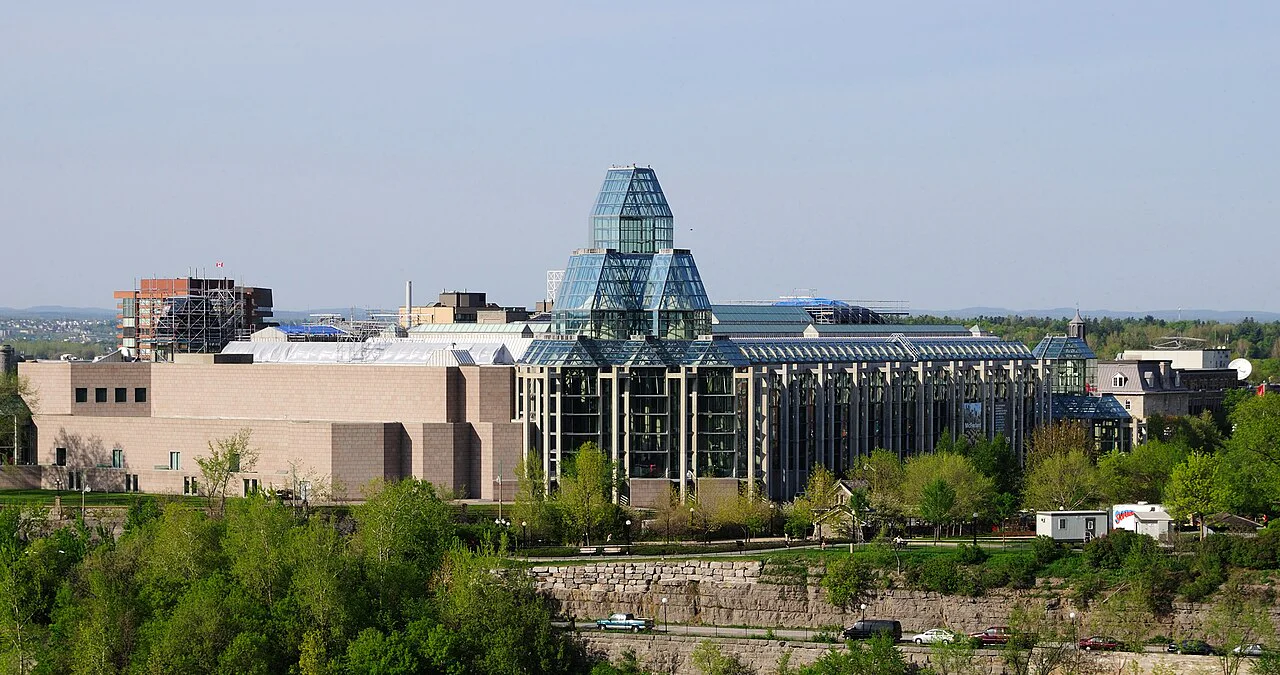
National Gallery of Canada Audio Guide
A place to remember. A story to take with you.
The National Gallery of Canada is Canada's national art museum, located in the capital city of Ottawa, Ontario. It is one of the largest art museums in North America by exhibition space.
Download Stanza, then search for “National Gallery of Canada”.
About the tour
One guide. Your kind of visit.
The National Gallery of Canada is Canada's national art museum, located in the capital city of Ottawa, Ontario. It is one of the largest art museums in North America by exhibition space.
The National Gallery of Canada guide tells the stories of 40 artworks, including Hope I (Gustav Klimt), The Age of Bronze (Auguste Rodin), The Death of General Wolfe (Benjamin West), Forest (Paul Cézanne), Hay Harvest at Éragny (Camille Pissarro), Madonna with the Child and Sts Rock and Sebastian (Lorenzo Lotto), Holy Family with the Three Hares (Albrecht Durer), and Eve, the Serpent and Death (Hans Baldung Grien). Every artwork is free to hear in the Stanza app until 1 January.
Ready when you are.
- 01Get the free Stanza app.
iOS & Android
- 02Find your guide.
“National Gallery of Canada”
- 03Download before you go.
Works offline
Audio guide / 40 artworks
Inside the guide
Get to know a few of the stories before you go. Open a stop to read more.
01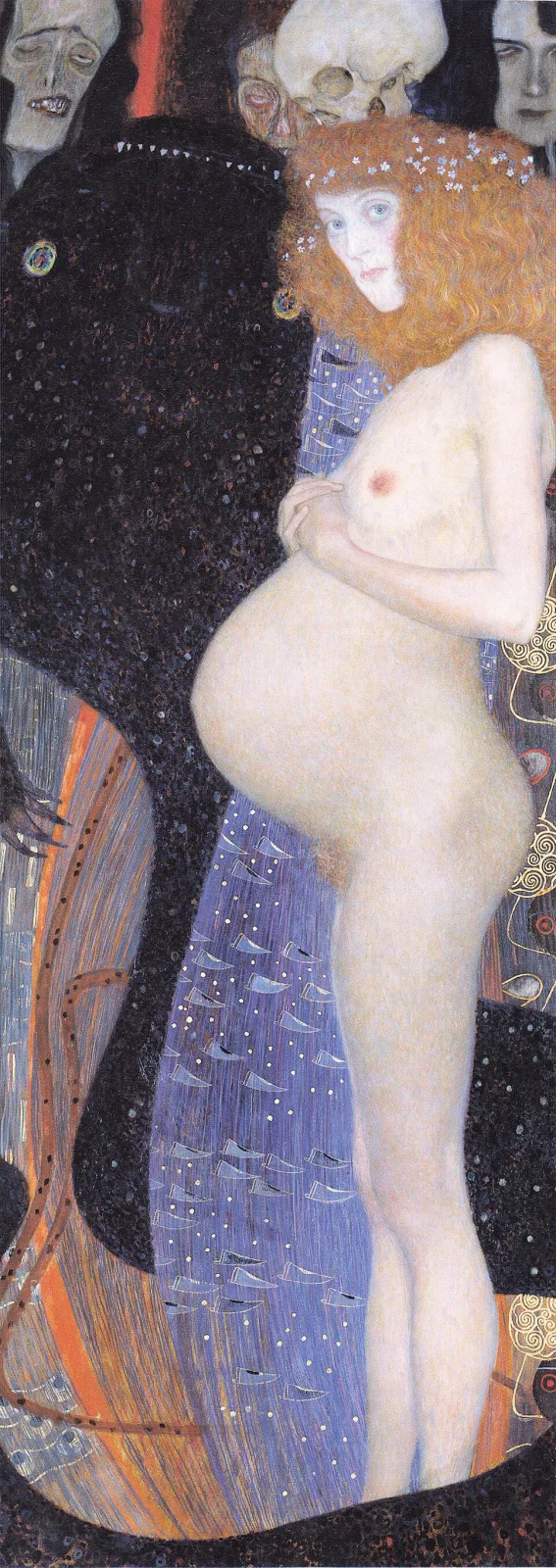
Hope I
Gustav Klimt was waiting for his model, and she did not come. He sent someone to ask if she was ill. She was pregnant, not ill. He told her to come anyway, and the moment he saw her, he chose her as his model. There she is, facing you head on, nude and pregnant, her hands pressed together high on her chest above the rounded belly. Forget-me-nots crown the great mass of her hair. For a moment this looks like a picture of life beginning. But a skull hangs directly above her head. Behind her, three sickly figures stand for disease, old age and madness. On the left a sea monster bares its teeth. Its clawed hand sits level with her belly, and its long tail winds round her feet and out of the frame. The year before, Klimt's baby son Otto died in infancy. His first sketch showed a man beside the woman, comforting her. In the finished painting that man is gone, and a skull stands in his place. That loss may be why birth and death sit together here. Klimt planned to show it in Vienna in 1903, but withdrew it. Its owner shut it in a cabinet with double doors, and it was not shown there until 1909, when it caused a scandal.
Listen in the appGustav Klimt · Public domain
02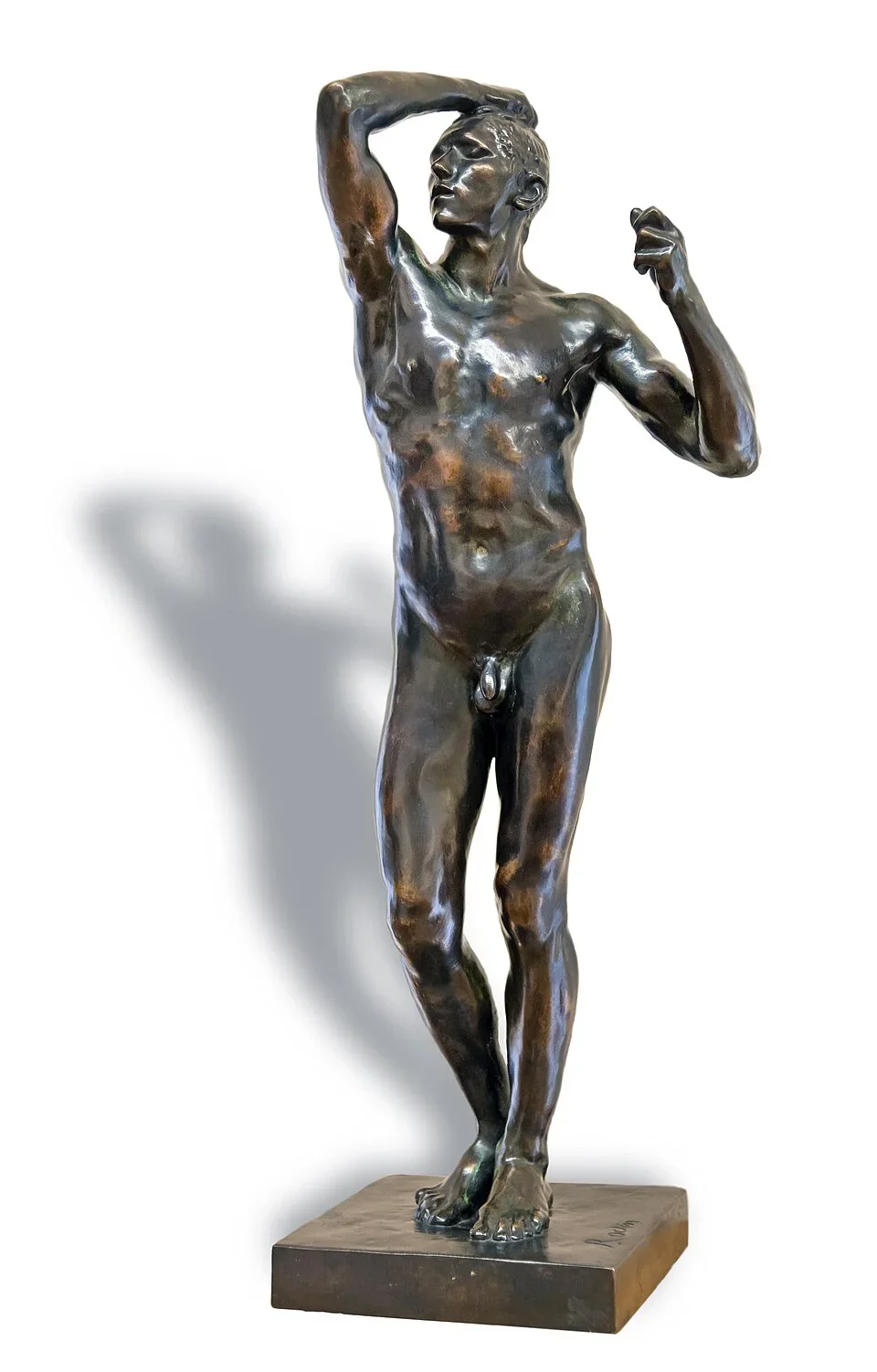
The Age of Bronze
People who first saw this figure thought its maker had cheated. No one, they said, could shape a body so lifelike by hand. He must have taken a mold straight from a living man, even a dead one. The accusation followed the work from Brussels to Paris, and it only helped. People were eager to judge for themselves. Rodin modeled this figure from a twenty-two-year-old Belgian soldier named Auguste Neyt. Professional models could not hold the natural poses he wanted, so he turned to a soldier. Photographs of that soldier still survive. The pose owes something to Michelangelo's Dying Slave, with its elbow raised above the head, and Rodin had studied Michelangelo in Italy. The figure once held a spear, which made him a warrior on the edge of defeat. He took it away before showing the work, leaving nothing but the body and the feeling in it. Look closely and the weight shifts to the right, the lips relax, the head sits on the shoulders. They leave you wondering about the man's suffering and inner life. But what this man is meant to be is still not known.
Listen in the appDidier Descouens · Public domain
03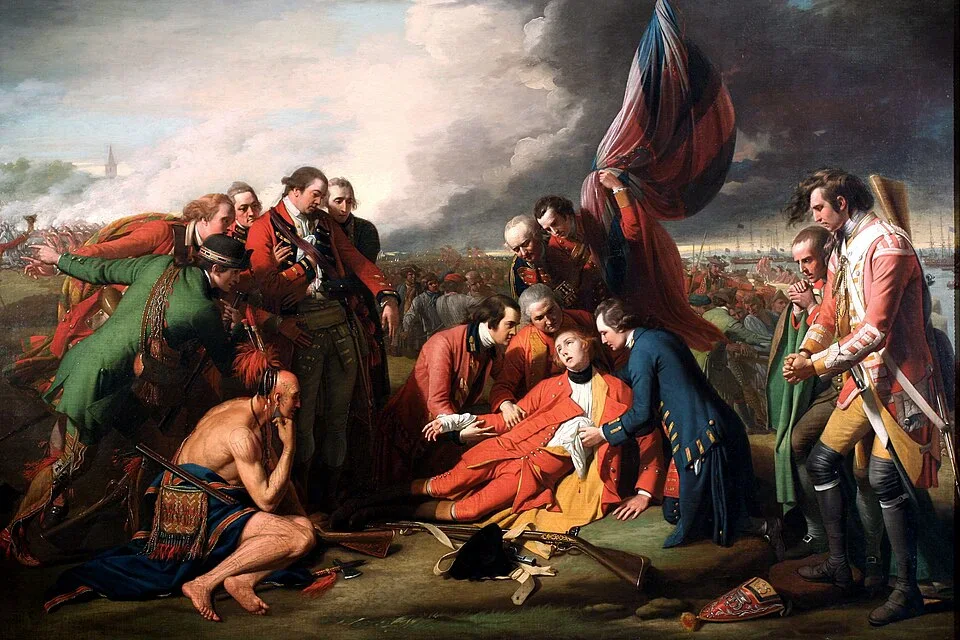
The Death of General Wolfe
Nobody knows who stood beside General Wolfe as he died. He was hit by several gunshots at the height of the fighting, which lasted just fifteen minutes. There is no record of a circle around him. Yet here a whole group has gathered. Captain Hervey Smythe holds Wolfe's right arm. A doctor in a blue jacket, Thomas Hinde, tries to stop the bleeding, and Wolfe would die in his care. On the ground lie Wolfe's musket, cartridge box and bayonet. He went into battle armed as his men were, in a plain red coat and breeches, not a commander's dress. An Indigenous warrior kneels, chin on his fist, watching Wolfe, a gesture that in art means deep thought. Only four of the fourteen men were at the battle, and none can be shown to have been at Wolfe's death. West built the men into a triangle beneath the flag, like a Lamentation, the scene where Christ is held by his mother. Wolfe is in Christ's place. West turned a casualty into a martyr, a symbol of British victory. Joshua Reynolds urged him to dress the figures in classical robes, but he painted them in the clothes of his own time. George the Third would not buy the picture, saying the clothes damaged its dignity. West made it to mark the battle that settled the fate of France's North American colonies.
Listen in the appBenjamin West · Public domain
04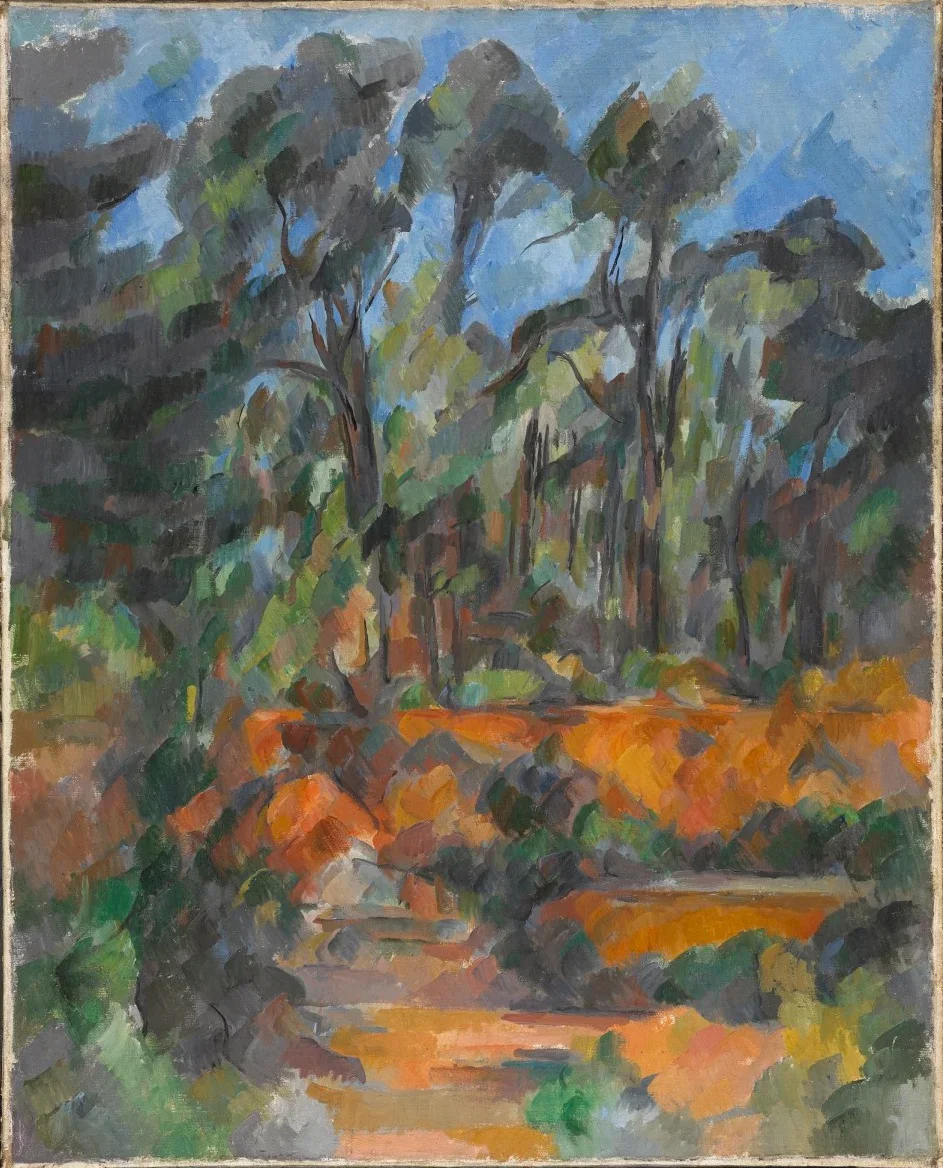
Forest
A road runs into a clearing sheltered by tall pines. Red earth shows in the middle, and towards the edges the leaves and the sky turn grey and blue. There is no centre to this scene, no one thing that stands out. That is an unusual subject to choose. What holds it together is balance. The warm middle answers the cool edges, upright lines answer level ones, and light tones answer dark. The looser edges are deliberate too, with patches of colour left beside bare canvas. This is woodland near Aix-en-Provence, possibly the entrance to the Château Noir. Cézanne came back here again and again to paint. In 1899, he tried to buy the estate and failed.
Listen in the appPaul Cézanne · Public domain
05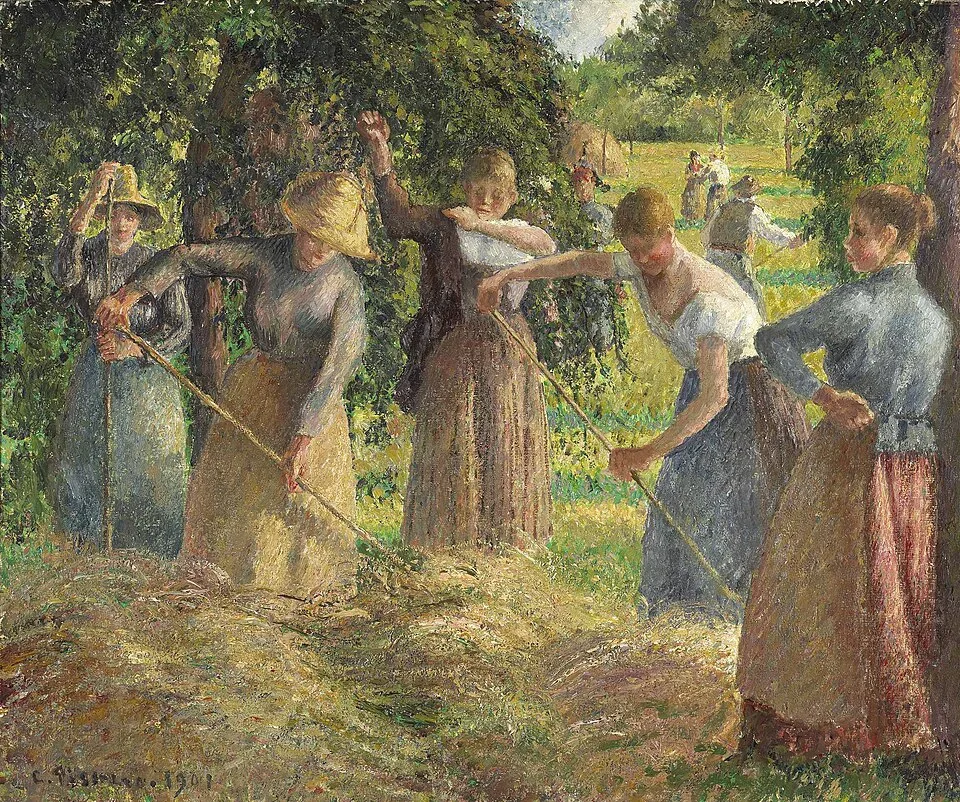
Hay Harvest at Éragny
The women are out in the field, working the hay. This is the sort of scene Camille Pissarro found at Éragny. He moved here in 1884, with his family, from a home near Pontoise, and stayed until his death in 1903. The place suited him. It gave him farm work to paint. And farm work was his subject for thirty years, potato harvests among them, in paintings and drawings. This hay harvest, from 1901, comes near the end of that long run. The women's poses repeat, one figure answering the next, across the whole scene. Out of that repetition he made a steady, balanced rhythm that runs right through it.
Listen in the appCamille Pissarro · Public domain
06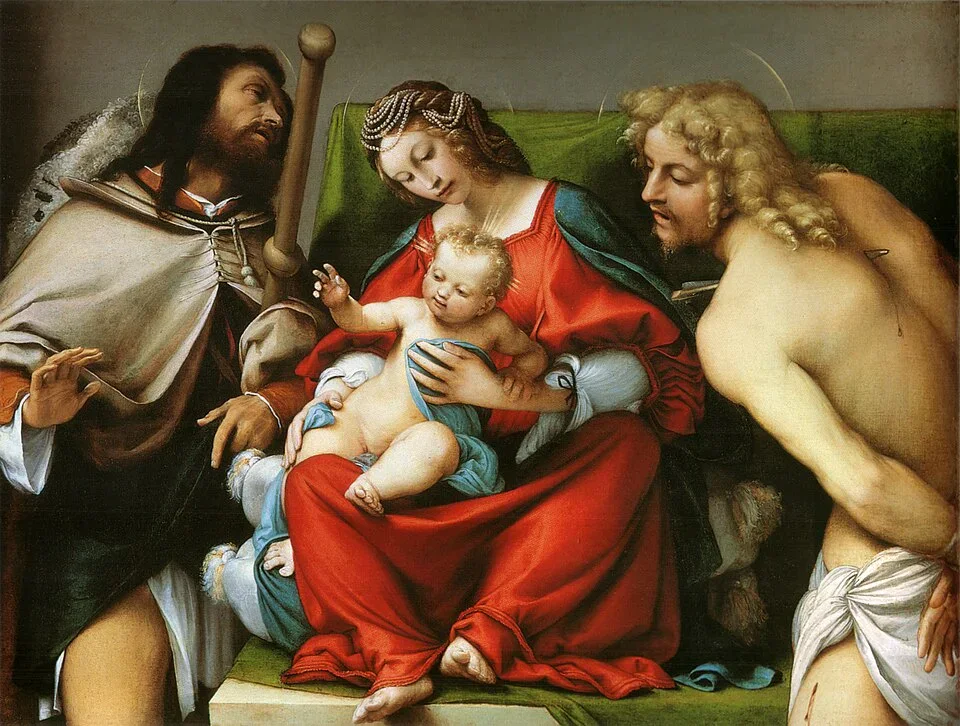
Madonna with the Child and Sts Rock and Sebastian
There is a wound in Saint Roch's thigh, on the left of the picture. The Christ Child blesses it, and it heals. Roch and Sebastian were both called on against plague, and Sebastian twists forward to see the healing, his face astonished. The man who ordered this painting knew such wounds. He was Battista Cucchi, a surgeon in Bergamo, and Lorenzo Lotto painted it for him. Cucchi kept a medical register, and it still survives, with his operations written in it, abscesses and nasal polyps and broken limbs. In the picture he ordered, a wound is made well. Cucchi left the painting in his will to a nun, Lucrezia de Tirabuschis, at the convent of Santa Grata. It stayed in the sacristy and came out only on the first of May each year. In 1798 the nuns, facing closure, sold it cheaply to an abbot who never catalogued it, so it would not be seized.
Listen in the appLorenzo Lotto · Public domain
07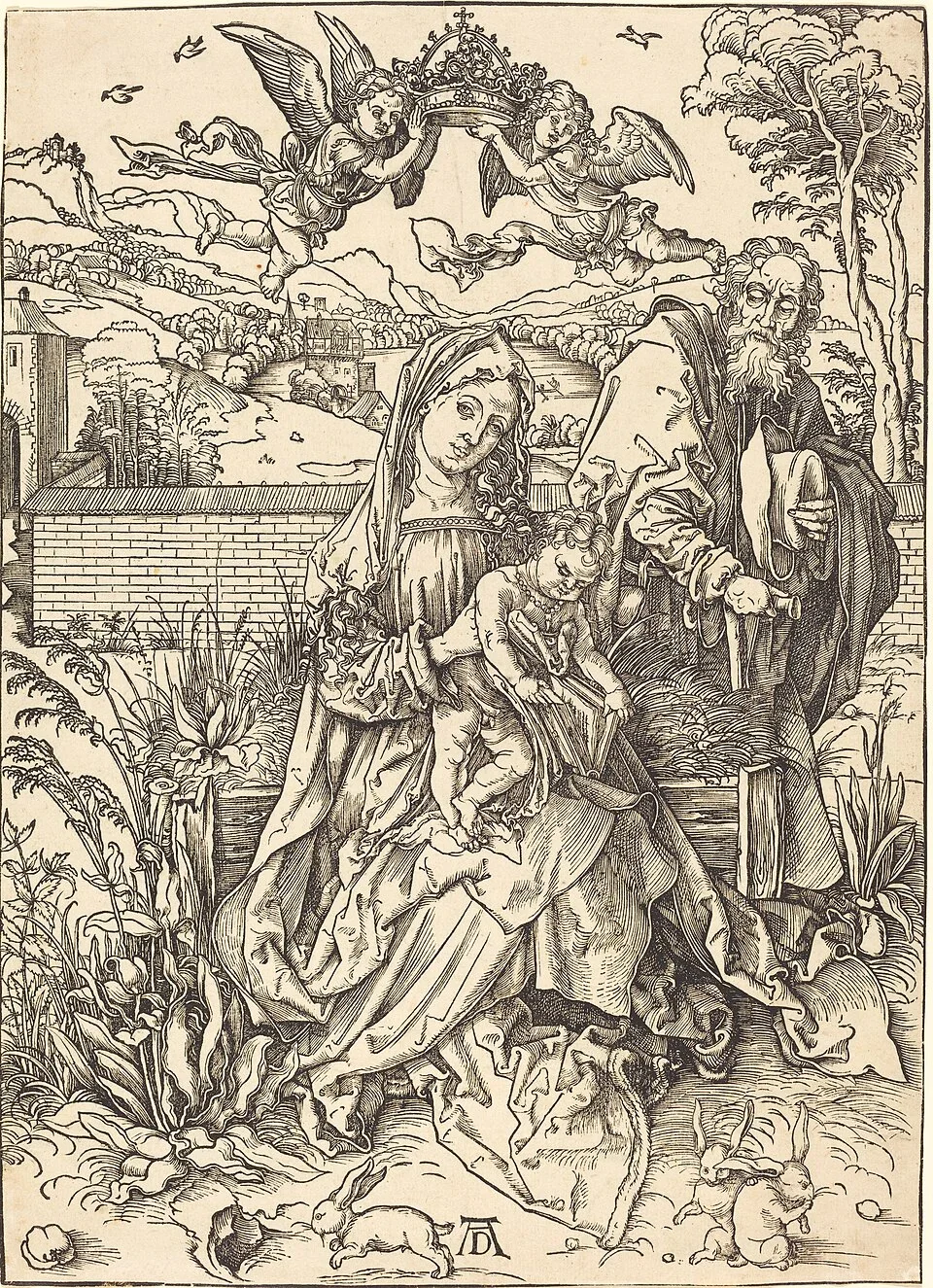
Holy Family with the Three Hares
Every line here was cut into a solid block of wood, yet each is as fine as a pen stroke. No woodcut had ever carried such delicacy. Dürer had made this subject once before, in a Holy Family with a Butterfly, and here he took it much further. The figures became monumental. Behind them the landscape stretches far into the distance, and plants are drawn beside and above the grassy bench where Mary sits. That deep landscape and those plants were new to woodcut. Above Mary, two angels hold a crown, a detail borrowed from Flemish painting, linking this Holy Family to the Coronation of the Virgin. At the bottom center, he signed it with his monogram.
Listen in the appAlbrecht Dürer · CC0
08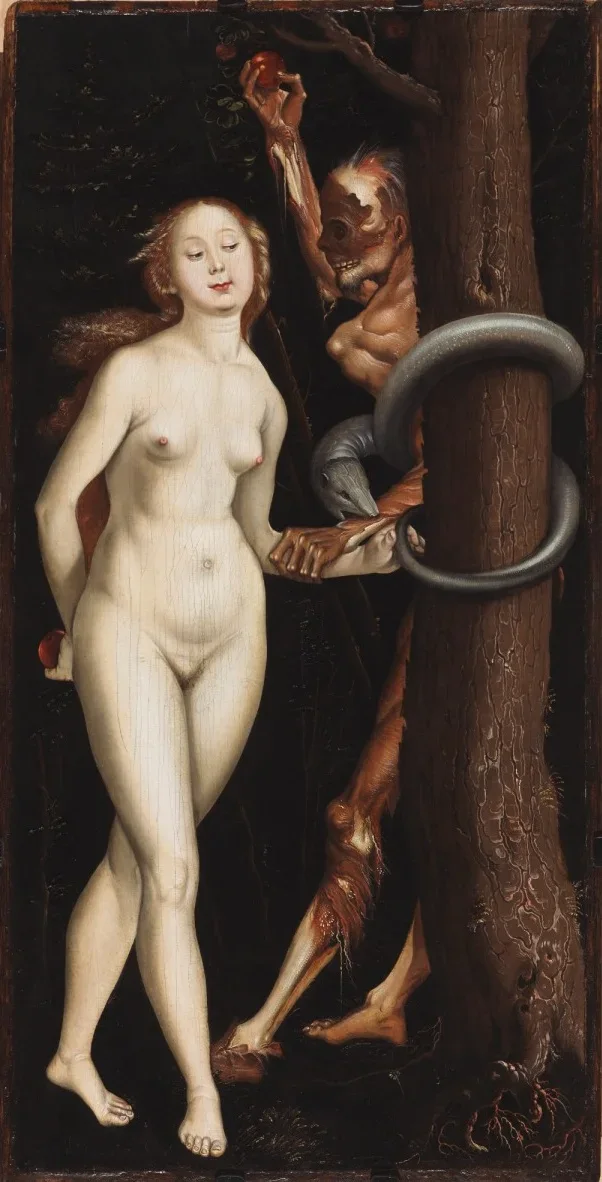
Eve, the Serpent and Death
A woman, a man and a serpent twine around a tree trunk, pale against a dark forest, filling the panel. The serpent has red eyes and a weasel's head, and its jaws close around the man's wrist. That same hand grips the woman's arm. Her left hand holds the serpent's tail, and her right hand holds an apple behind her back. The man's other arm reaches up to grasp an apple of his own. And so it goes around, each one caught in the next one's grip. His body is wasting away, more bone than flesh, and his left foot ends in a hoof. He is Death, often taken for Adam. The apple in each hand is where it all began. Baldung returned to the Fall again and again in woodcuts and paintings. Only here did he give the serpent the active part.
Listen in the appHans Baldung Grien · Public domain
09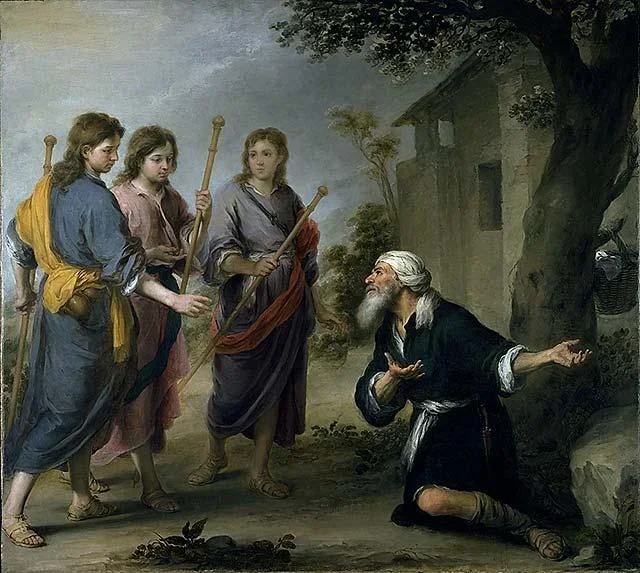
Abraham Receiving the Three Angels
Abraham kneels and begs three travelers to step into his home. They have asked for nothing. He is doing all the asking, urging them to accept his hospitality. Murillo painted them as ordinary men, not the angels of the Bible story. Each wears a garment of a different color and carries a long staff, like pilgrims. Two of them look at the kneeling Abraham. He is in black, with a white turban and sandals, and he gestures with his hands toward his humble doorway. They meet beneath the oak of Mamre, with a large, solid house behind them. That welcome is why the picture was made. The painter himself belonged to a Seville brotherhood pledged to acts of mercy, and sheltering a stranger was one of them. They ordered eight paintings in all, and Abraham was their example. In the Bible, the three are angels, come to tell Abraham that his aged wife Sarah will bear a son, Isaac. Christians have read the three as the Trinity. And the man on his knees is giving hospitality to angels without knowing it. In 1810 Napoleon's army carried the picture out of Seville. Only four of the eight stayed behind.
Listen in the appBartolomé Esteban Murillo · Public domain
10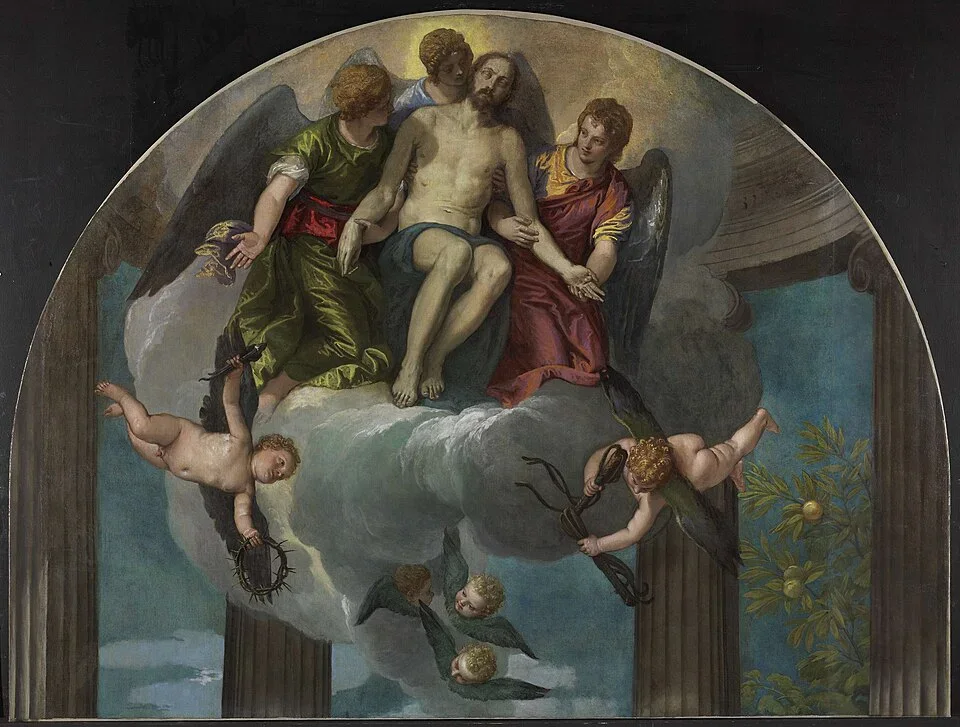
Petrobelli Altarpiece
This is one piece of a picture that was broken apart. It was cut into fragments and scattered to four collections, in England, Scotland, Canada and the United States. The figure at its centre, the archangel Saint Michael, lost his body altogether. All that survived was a wing, a spear, an arm and a hand holding a pair of scales. The scales are how he was recognised. In 2009 they stood together as one picture for the first time in over two hundred years. This fragment is the top of that picture. Here is the dead Christ. The columns in this piece line up with the fragments at either side, and that match let the picture be fitted back together. Veronese made it for two cousins, Girolamo and Antonio Petrobelli, probably for their family's burial chapel in Lendinara, near Venice. They had inherited their uncle's estate and had no legitimate heirs. A grand altarpiece, they hoped, would secure their place among the town's leading families. He painted them as donors, presented to Christ by the saints whose names they carried. The vision was of things to come. Michael will weigh the souls of the dead on the last day, and for the faithful that was the hope of salvation. Angels carry three of the instruments of his passion, the tools of the death that redeemed mankind.
Listen in the appPaolo Veronese · Public domain
- 11
The Jack Pine
Tom Thomson · 1917
- 12
Northern River
Tom Thomson · 1914–1915
- 13
Portrait de paysan (Portrait of a Peasant)
Paul Cézanne · 1905–1906
- 14
Lot and his Daughters
Orazio Gentileschi · 1622
- 15
Actaea, the Nymph of the Shore
Frederic Leighton · 1868
- 16
Spring Ice
Tom Thomson · 1915–1916
- 17
Bowl with Zinnias and Other Flowers
Vincent van Gogh · 1886
- 18
St Francis and Brother Leo Meditating on Death
El Greco · 1597–1603
- 19
Iris
Vincent van Gogh · 1889
- 20
Virgin and Child with St Anthony the Abbot and a Donor
Hans Memling · 1472
- 21
Esther at the Palace Gate
Sandro Botticelli, Filippino Lippi · c. 1475
- 22
The Triumph of Mordecai
Sandro Botticelli, Filippino Lippi · c. 1475
- 23
The Temptation of Saint Anthony
Follower of Hieronymus Bosch · 1500
- 24
Dazzle-ships in Drydock at Liverpool
Edward Wadsworth · 1919
- 25
The Third-Class Carriage
Honoré Daumier · 1862–1864
- 26
Hercules at the Crossroad
Albrecht Durer · 1498–1499
- 27
Camels at the Watering-place
Jean-Léon Gérôme · 1857
- 28
Aeneas at the Entrance to the Elysian Fields
Dosso Dossi · c. 1520
- 29
Vulcan and Aeolus by Piero di Cosimo
Piero di Cosimo · c. 1500–1505
- 30
An Allegory of the Arts
Giuseppe Maria Crespi · c. 1730
- 31
The Bridge at Narni
Jean-Baptiste Camille Corot · 1827
- 32
The Japanese Scroll
James Tissot · 1872–1873
- 33
The Annunciation of the Virgin's Death
Paulus Bor · 1635–1640
- 34
The Reply [The Letter]
James Tissot · 1874
- 35
Jeux de fillettes à Laghouat
Nasreddine Dinet · 1899
- 36
The Entombment
Peter Paul Rubens · 1611–1612
- 37
La Gouvernante
Jean-Baptiste-Siméon Chardin · 1739
- 38
Mary Neville, Lady Dacre
Hans Eworth · 1540
- 39
A Sermon in the Oude Kerk, Delft
Emanuel de Witte · 1651–1652
- 40
The Fortune-teller
Simon Vouet · c. 1618
National Gallery of Canada
Frequently asked questions
How much does the guide cost?
Free app download. Free until 1 January. Listed guide price: $1.99. Audio guide only. Venue admission is separate.
Can I listen without internet?
Yes. Download the guide’s audio, images, and maps in the app before your visit. Your downloaded content is then available offline.
Can I listen in my language?
In English for now. More languages soon.
Do I need to follow a schedule?
No. This is a self-guided experience. Choose your stops, pause whenever you like, and return to a story at your own pace.
Which artworks are in the National Gallery of Canada audio guide?
40 artworks, including Hope I (Gustav Klimt), The Age of Bronze (Auguste Rodin), The Death of General Wolfe (Benjamin West), Forest (Paul Cézanne), Hay Harvest at Éragny (Camille Pissarro), Madonna with the Child and Sts Rock and Sebastian (Lorenzo Lotto), Holy Family with the Three Hares (Albrecht Durer), and Eve, the Serpent and Death (Hans Baldung Grien). The full list is on this page.
Is this the museum’s official audio guide?
No. Stanza is an independent audio guide app and is not affiliated with National Gallery of Canada. Museum admission is separate.
At your own pace
Explore National Gallery of Canada.
Download Stanza, then search for “National Gallery of Canada”.
Free app download · Guide price shown in the app
Keep exploring
Audio guides — Canada
Montreal
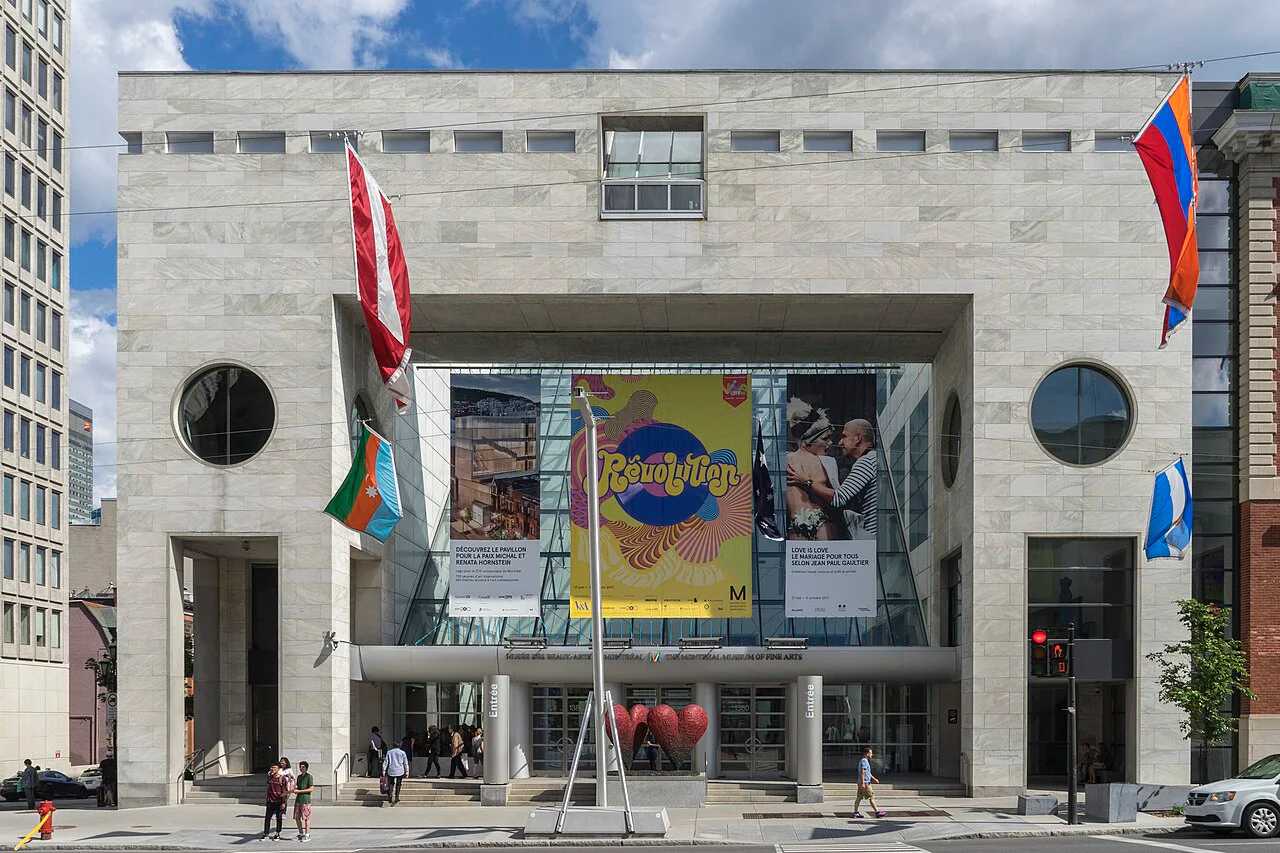
Montreal Museum of Fine Arts
Content & sources
Thomas Ledl · CC BY-SA 4.0
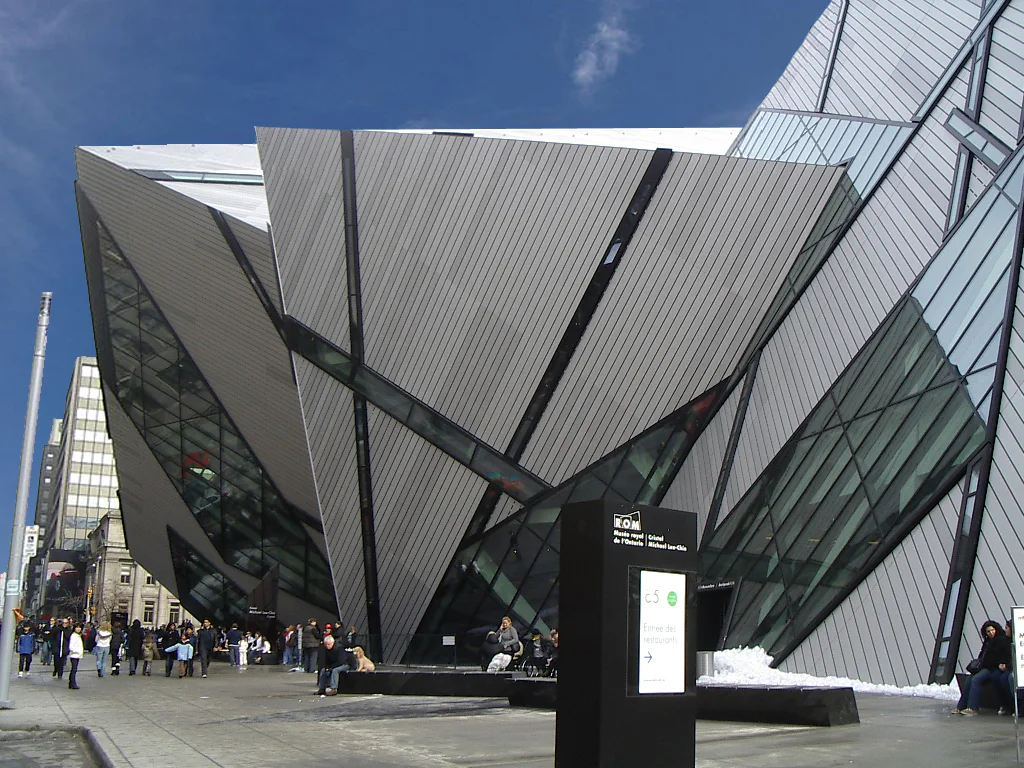
Toronto
Royal Ontario Museum
Content & sources
Photo: Staka · CC BY-SA 4.0
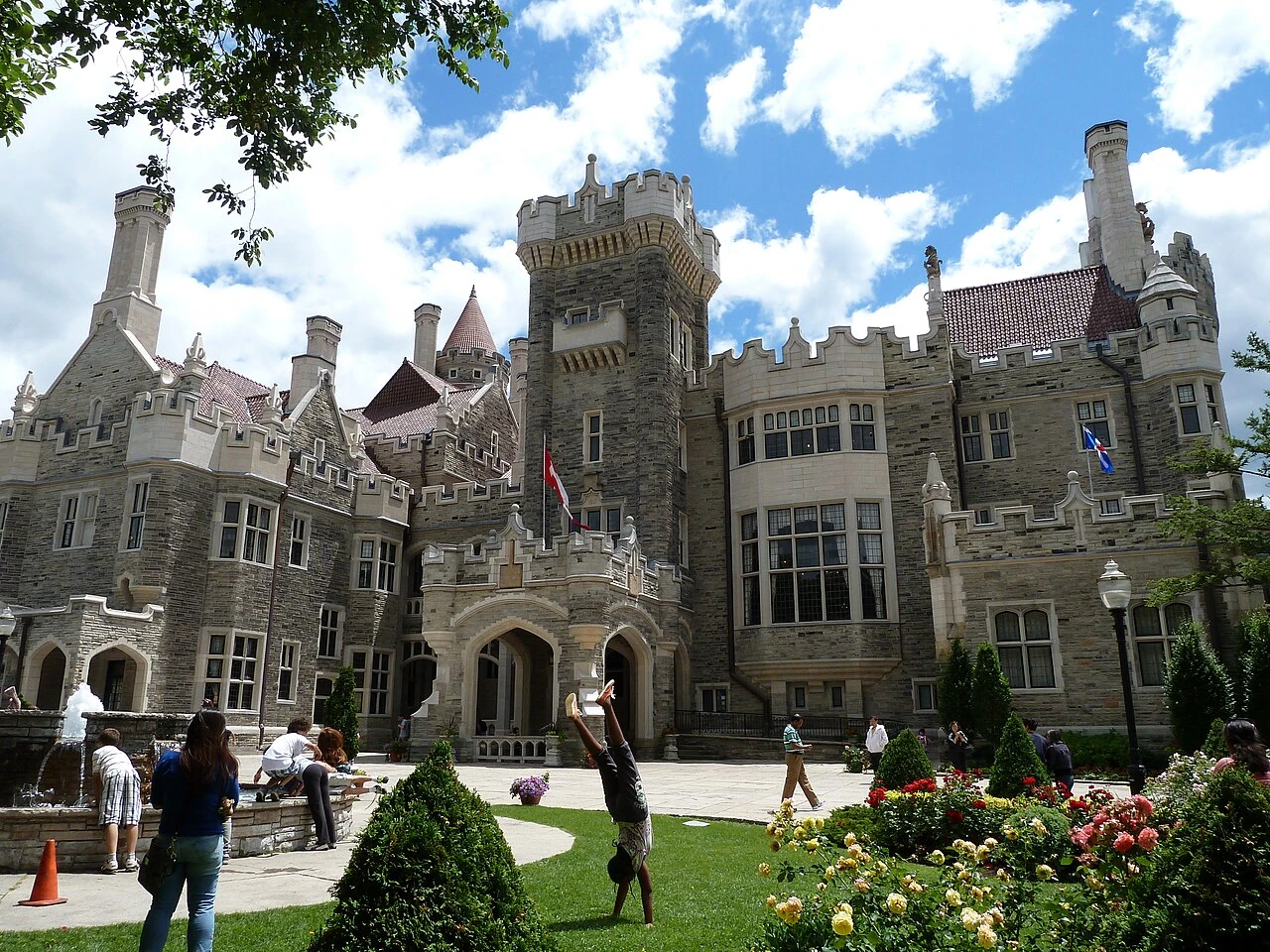
Toronto
Casa Loma
Content & sources
Priscilla Jordão from São Paulo, Brasil · CC BY-SA 2.0
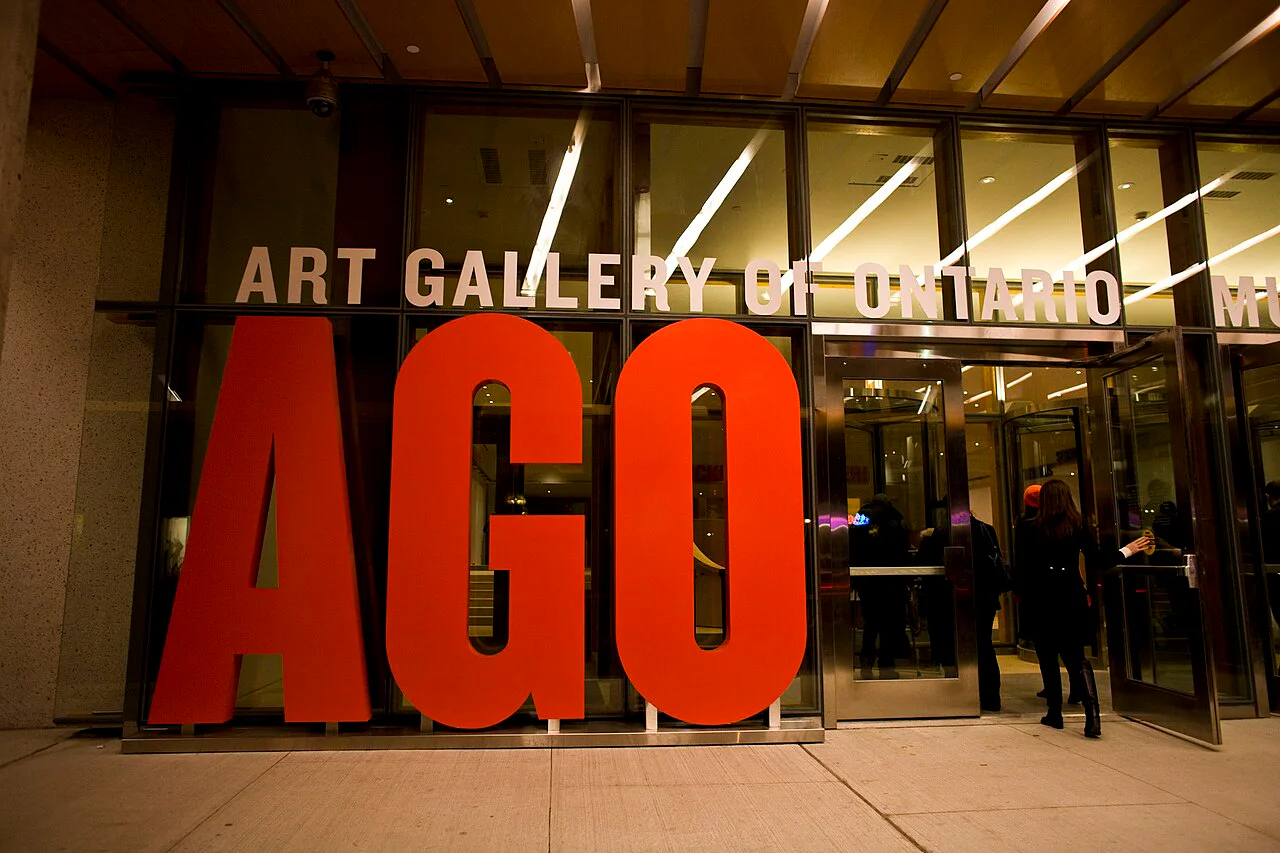
Toronto
Art Gallery of Ontario
Content & sources
Owen Byrne from Ottawa, Canada · CC BY 2.0
Art museums
More art museum audio guides
Montreal · 31 artworks
Montreal Museum of Fine Arts
Content & sources
Thomas Ledl · CC BY-SA 4.0
Toronto · 21 artworks
Royal Ontario Museum
Content & sources
Photo: Staka · CC BY-SA 4.0
Toronto · 21 artworks
Art Gallery of Ontario
Content & sources
Owen Byrne from Ottawa, Canada · CC BY 2.0
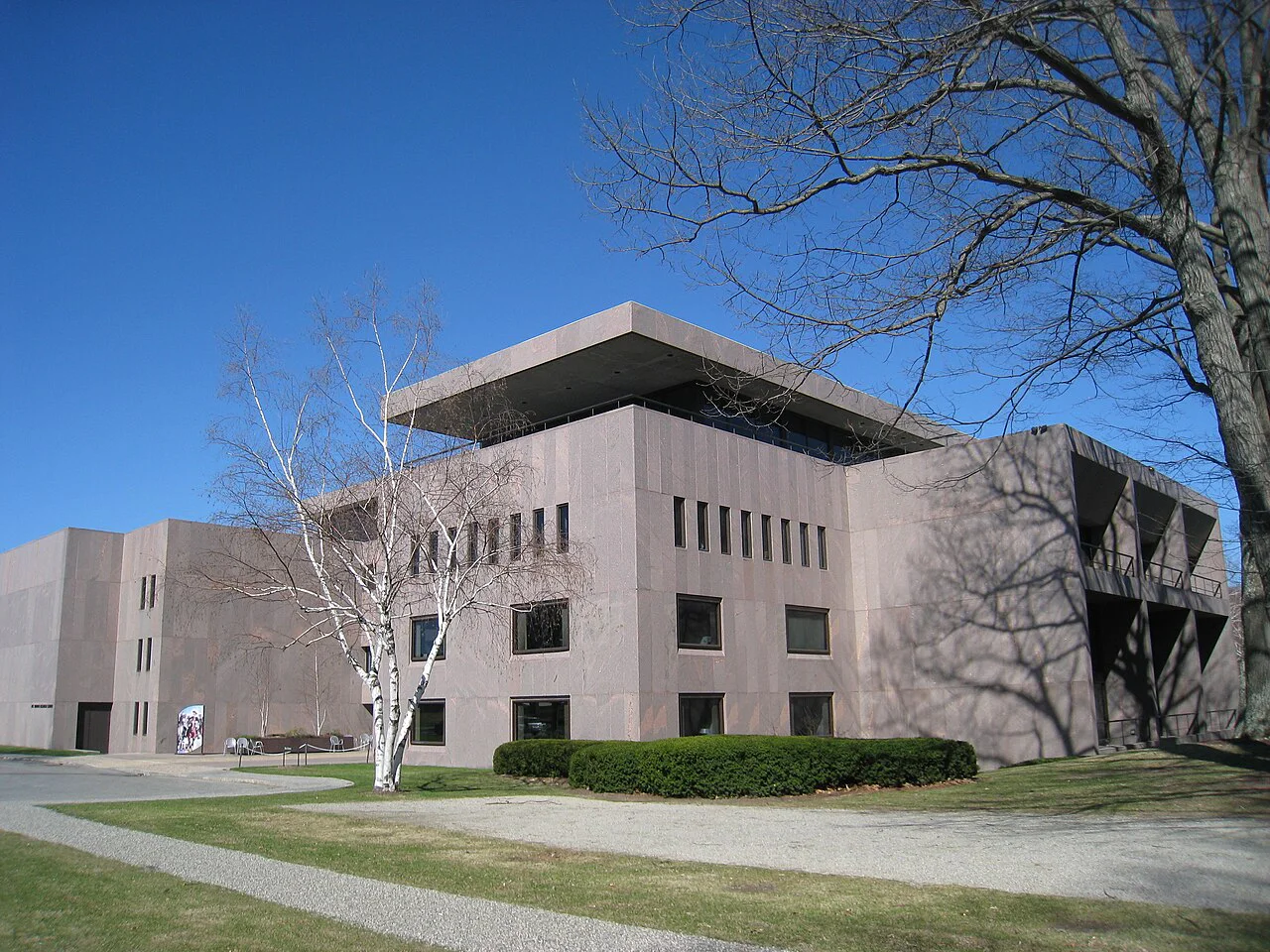
Williamstown · 39 artworks
Clark Art Institute
Content & sources
Photo: Daderot · Public domain
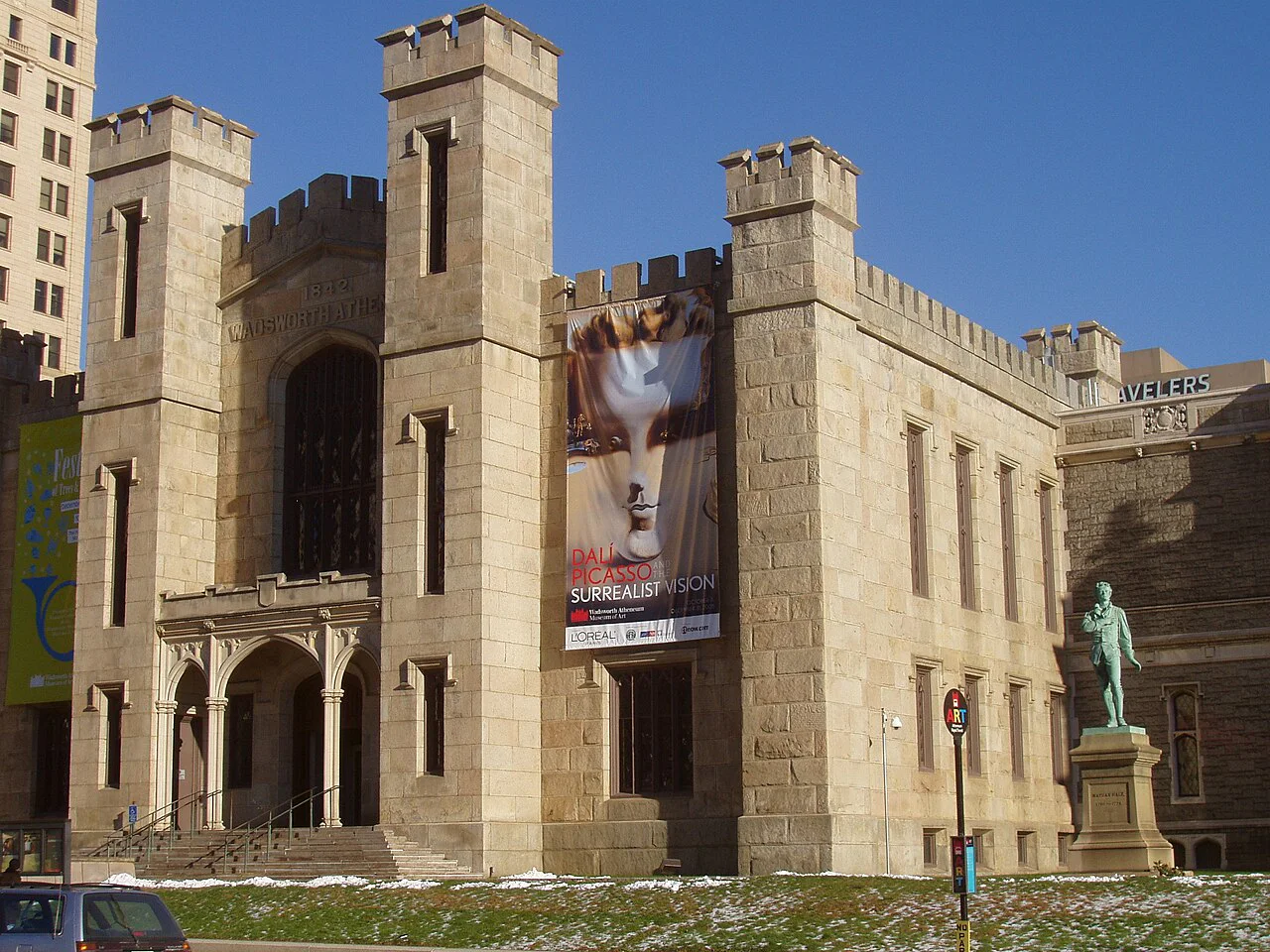
Hartford · 32 artworks
Wadsworth Atheneum
Content & sources
Daderot at English Wikipedia · CC BY-SA 3.0
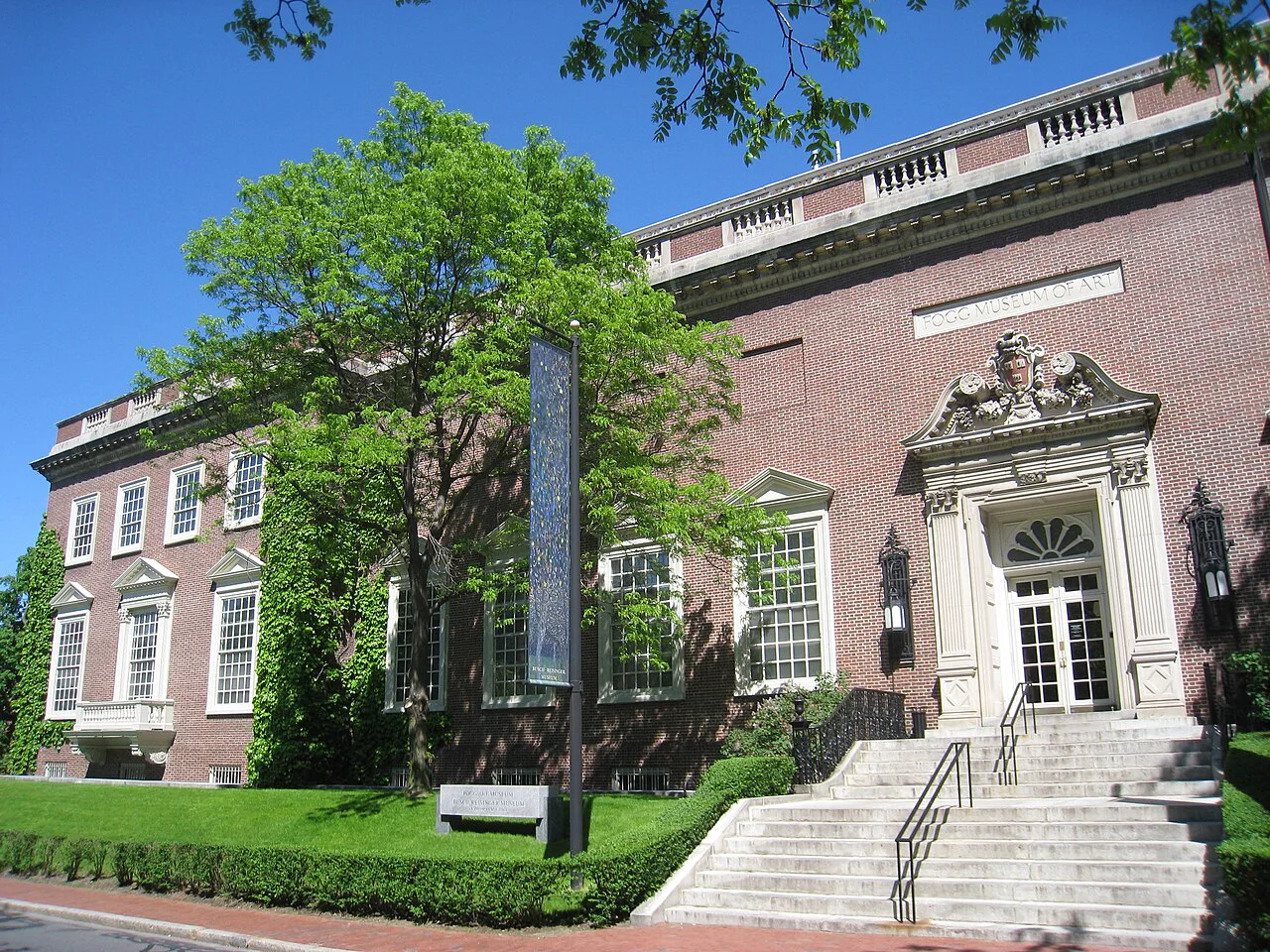
Cambridge · 58 artworks
Harvard Art Museums
Content & sources
Photo: Daderot · Public domain