Stanza · Audio guide
大昭寺 Audio Guide
A place to remember. A story to take with you.
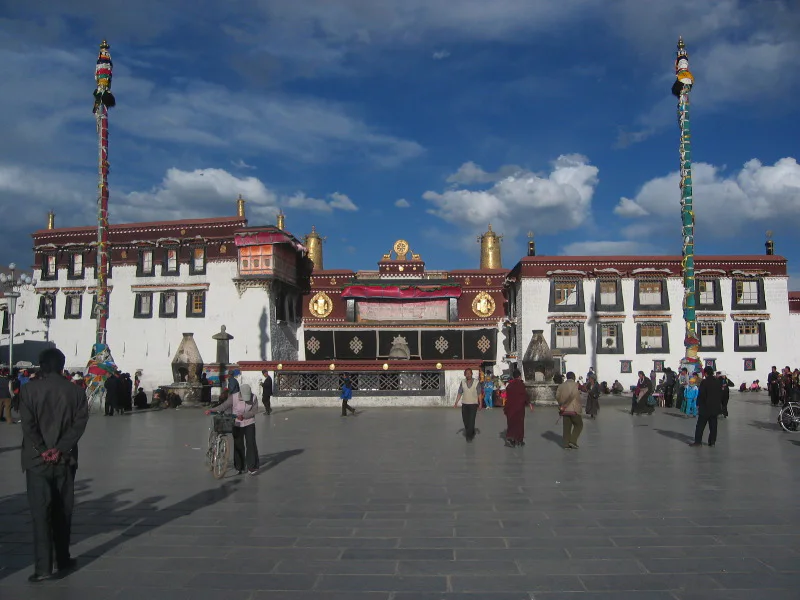
The Jokhang is a Tibetan Buddhist temple and monastery located in Barkhor Square in Lhasa. It is considered the heart of Lhasa and was built in approximately 640 by King Songsten Gampo.
Download Stanza, then search for “大昭寺”.
About the tour
One guide. Your kind of visit.
The Jokhang is a Tibetan Buddhist temple and monastery located in Barkhor Square in Lhasa. It is considered the heart of Lhasa and was built in approximately 640 by King Songsten Gampo.
Ready when you are.
- 01Get the free Stanza app.
iOS & Android
- 02Find your guide.
“大昭寺”
- 03Download before you go.
Works offline
Audio guide / 13 narrated stops
Inside the guide
Get to know a few of the stories before you go. Open a stop to read more.
01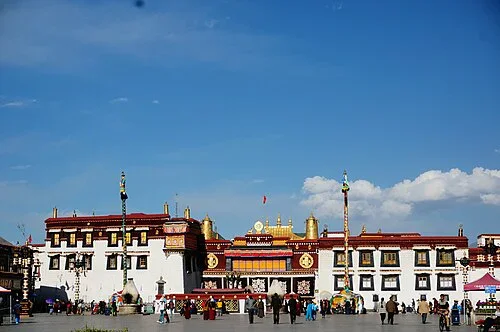 Barkhor Square and the Peace Alliance Stele
The Jokhang Across Barkhor Square
The Jokhang is often called the heart of Lhasa. Many Tibetans consider it the most sacred temple in Tibet. It is a Tibetan Buddhist temple, and its complex includes a monastery of the Gelug school. The temple sits in Barkhor Square, the market square of central Lhasa. Streets run out from it in every direction, and much of the city's trade gathers around it. Pilgrims walk a circuit around the temple, a walk that takes about twenty minutes. King Songtsen Gampo began building the temple around 640. The story goes that he tossed his hat ahead of him and promised to build a temple wherever it landed. The hat fell into a lake, and a white stupa rose out of the water. The temple was built over that spot. The lake was later filled in, and goats hauled the earth to do it. The capital took its name from them, Rasa, which means Goats. What remains of the lake is a small well, still fed by the old waters.
Andrew and Annemarie · CC BY-SA 2.0
02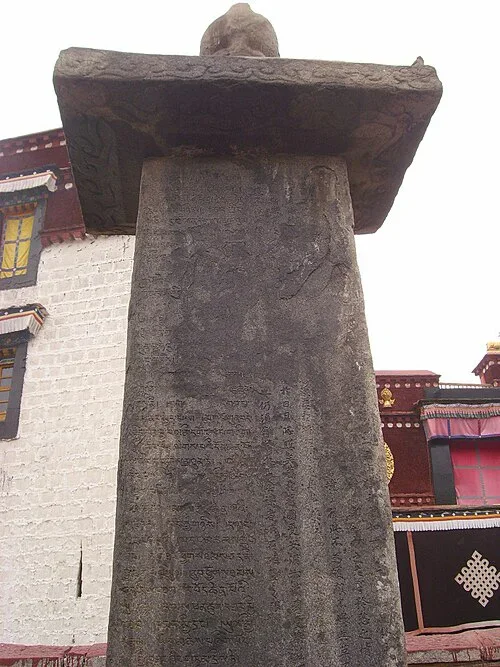 Barkhor Square and the Peace Alliance Stele
Tang-Tubo Peace Alliance Tablet
The Peace Alliance Tablet is a stone pillar outside the Jokhang, and its inscription is a treaty. The tablet is over five metres high. A carved cap sits on top, in the shape of a palace. The treaty is dated 821 or 822. It marks the boundary between Tibet and China, agreed by the Tibetan king Ralpacan and the Chinese emperor Muzong. The text is cut in both Tibetan and Chinese. One line reads: 'Tibet and China shall abide by the frontiers of which they are now in occupation.' From then on, neither side was to wage war or seize land. Brick walls enclosed the pillar when Barkhor Square was developed in 1985. Nearby, a walled enclosure holds the stump of an old willow. People call it the Princess Willow, and it is said that Princess Wencheng, the Chinese bride of the Tibetan king, planted it. The stump still sits inside its walls, beside the tablet.
Photo: Inhorw · CC BY-SA 3.0
03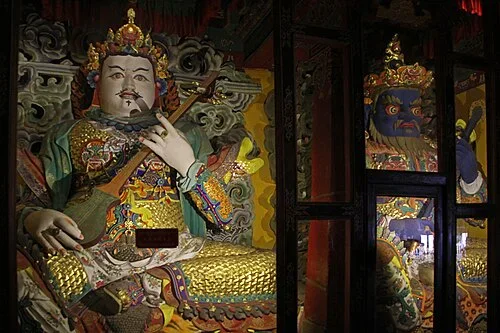 Grand Western Portal and Hall of the Four Heavenly Kings
Entrance Guardian Kings (Chokyong) in Glazed Cases
The Guardian Kings, called Chokyong in Tibetan, guard the entrance to the Jokhang. Four of them are placed inside the entrance, two on each side. Their role is to guard the threshold, where the outside world ends and the temple begins. One of these figures wears richly patterned robes in gold, green and red. It sits behind glass in a frame of dark wood. In the next case, another figure has a fierce blue face. From the entrance, the temple's central axis runs on to the Buddha Hall.
Listen in the appPhoto: Gerd Eichmann · CC BY-SA 4.0
04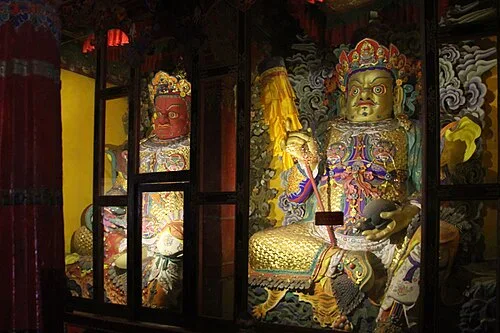 Grand Western Portal and Hall of the Four Heavenly Kings
Pair of Guardian Figures in a Glazed Case
Guardian kings appear in many Buddhist temples, and a common pattern shows them watching over the four directions. Here, a figure with a deep red face sits at the left. On the right, a seated figure is finished in gold. Both sit behind glass, and their wooden frames divide the view into panels. Painted clouds curl across the wall behind them.
Listen in the appPhoto: Gerd Eichmann · CC BY-SA 4.0
05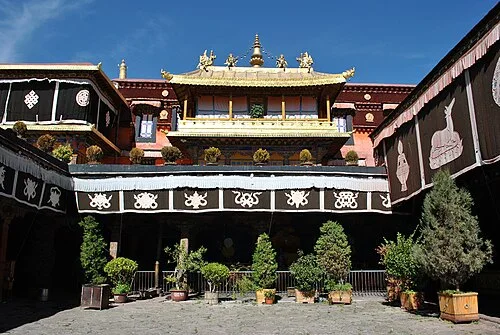 The Central Courtyard and Ancient Woodwork
Central Courtyard of the Jokhang
The courtyard is laid out as two rings, one inside the other, and each ring holds its own temple. The whole complex faces west, toward Nepal, in honour of Princess Bhrikuti, the Nepalese bride. The seventh-century temple had eight rooms, and those rooms held scriptures and statues of the Buddha. The upper floors of the central Buddha Hall and its annex buildings came in the eleventh century, centuries after the first rooms. Many more improvements were made under the Ming dynasty, after 1409.
Listen in the appMaris Burbergs · CC BY 3.0
06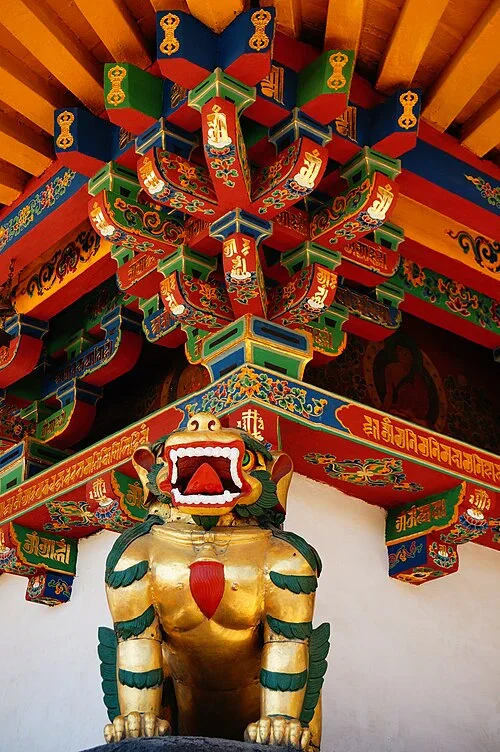 The Central Courtyard and Ancient Woodwork
Gilded Lion and Painted Eave Brackets
Many Nepalese and Indian artists and craftsmen worked on the temple's original design and construction. Carbon dating has shown that the wooden beams and rafters are original. Parts of the temple have been rebuilt, so not every painted piece is original. Here, a gold, lion-like figure crouches at the base of a painted eave. Above it, carved and painted brackets run in red, green and blue. The carved door frames, columns and finials came from the Kathmandu Valley in Nepal. They date to the seventh and eighth centuries.
Listen in the appAndrew and Annemarie · CC BY-SA 2.0
07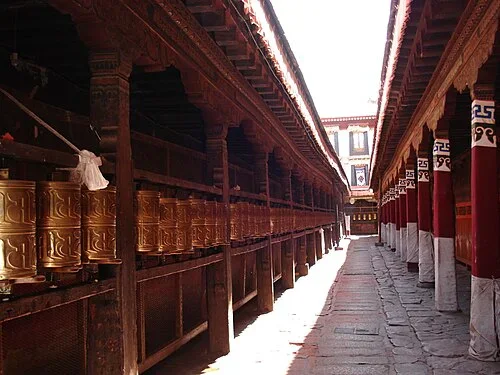 Nangkhor Inner Circumambulation Gallery
Nangkhor Gallery of Prayer Wheels
As pilgrims walk, they turn the prayer wheels. The outer circle of the temple has a path lined with large prayer wheels, and it leads toward the shrine. In August 1966, Red Guards attacked the Jokhang during the Cultural Revolution. For about fourteen years afterward, there was no worship here. Renovation began in 1972, and Premier Zhou Enlai approved the work. It was mostly finished by 1980. After that, the temple was consecrated again.
Listen in the app段修刚 · Public domain
08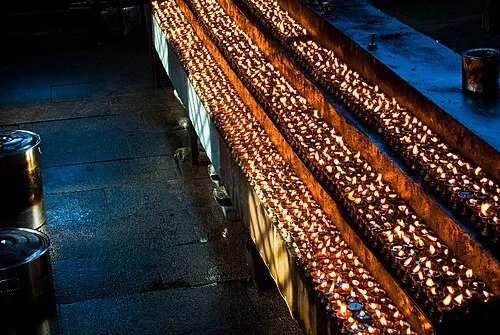 Nangkhor Inner Circumambulation Gallery
Rows of Votive Lamps
Rows of small flames line a sloping ledge, and each one is an offering. These are votive lamps, lit as gifts made in prayer. The temple's inner rooms form a dark maze of chapels, lit by candles and filled with incense.
Listen in the appAntoine Taveneaux · CC BY-SA 3.0
09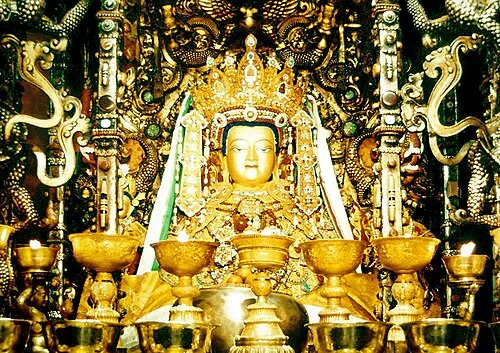 Sanctum of the Jowo Shakyamuni
The Jowo Shakyamuni
A Chinese princess brought this gilded bronze statue to Tibet as part of her dowry. Her marriage came only after a dispute. Songtsen Gampo, the Tibetan king, first asked Emperor Taizong of the Tang dynasty for a Chinese bride. Taizong refused, considering the Tibetans barbarians. He then announced a marriage between one of his daughters and the king of Duyu, who was a Hun. Songtsen Gampo was furious. He raided areas under Tang control and even attacked a Tang city. He warned that the fighting would continue unless the emperor agreed. Then he sent a gift of gold-studded armour and asked again. This time Taizong agreed, and Princess Wencheng went to Tibet in 640. The statue was first enshrined in the Ramoche temple. Later it was moved to the Jokhang. A Nepalese bride also brought a statue of her own, and accounts differ on where it is kept. Seated in a lotus position, the statue is about one and a half metres tall. It shows the Buddha at age twelve. Tibetans call it the Jowo, and it is their country's most revered statue.
Listen in the appPhoto: LBM1948 · CC BY-SA 4.0
10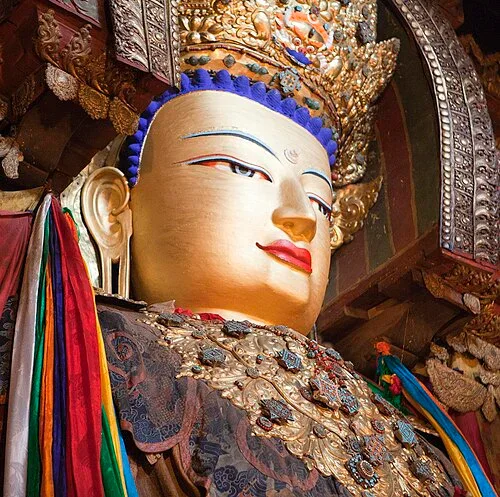 Sanctum of the Jowo Shakyamuni
Close-up of a Gilded Statue (Unidentified)
Devotion at the main statue starts with a queue along the platform. Each person may place a katak, a ceremonial scarf, around the Buddha's neck, or touch the statue's knee. Pilgrims also prostrate themselves before they approach. Some crawl a long way to reach the main shrine. As they move, they chant 'Om mani padme hum', which means hail to the jewel in the lotus. In 1792, during a war with the Gorkhas of Nepal, the Qianlong Emperor drove them out of Tibet. Afterward, he barred Nepalese visitors from the Jokhang. Tibetans were also forbidden to make pilgrimages abroad. The emperor suggested that worshipping the Jowo at the Jokhang would work just as well.
Listen in the appChristopher Michel · CC BY 2.0
- 11
Prince of Dharma Chapel and Painted Panel
Upstairs, a chapel honours Tibet's early kings and scholars, and a painting raises a question.
- 12
Golden Deer and Dharma Wheel on the Roof
A pair of golden deer flanking a golden Dharma wheel on the roof, with the Potala Palace nearby.
- 13
Gilded Roof Spout with Bell
A bell hangs from a gilded spout, one of many ornaments on the Jokhang's roof.
大昭寺
Frequently asked questions
How much does the guide cost?
Free app download. Listed guide price: $0.99. Guide price shown in the app. Audio guide only. Venue admission is separate.
Can I listen without internet?
Yes. Download the guide’s audio, images, and maps in the app before your visit. Your downloaded content is then available offline.
Can I listen in my language?
This audio guide is available in 15 languages, including English.
Do I need to follow a schedule?
No. This is a self-guided experience. Choose your stops, pause whenever you like, and return to a story at your own pace.
At your own pace
Explore 大昭寺.
Download Stanza, then search for “大昭寺”.
Free app download · Guide price shown in the app
Keep exploring
Audio guides — China
Lhasa · 2 km
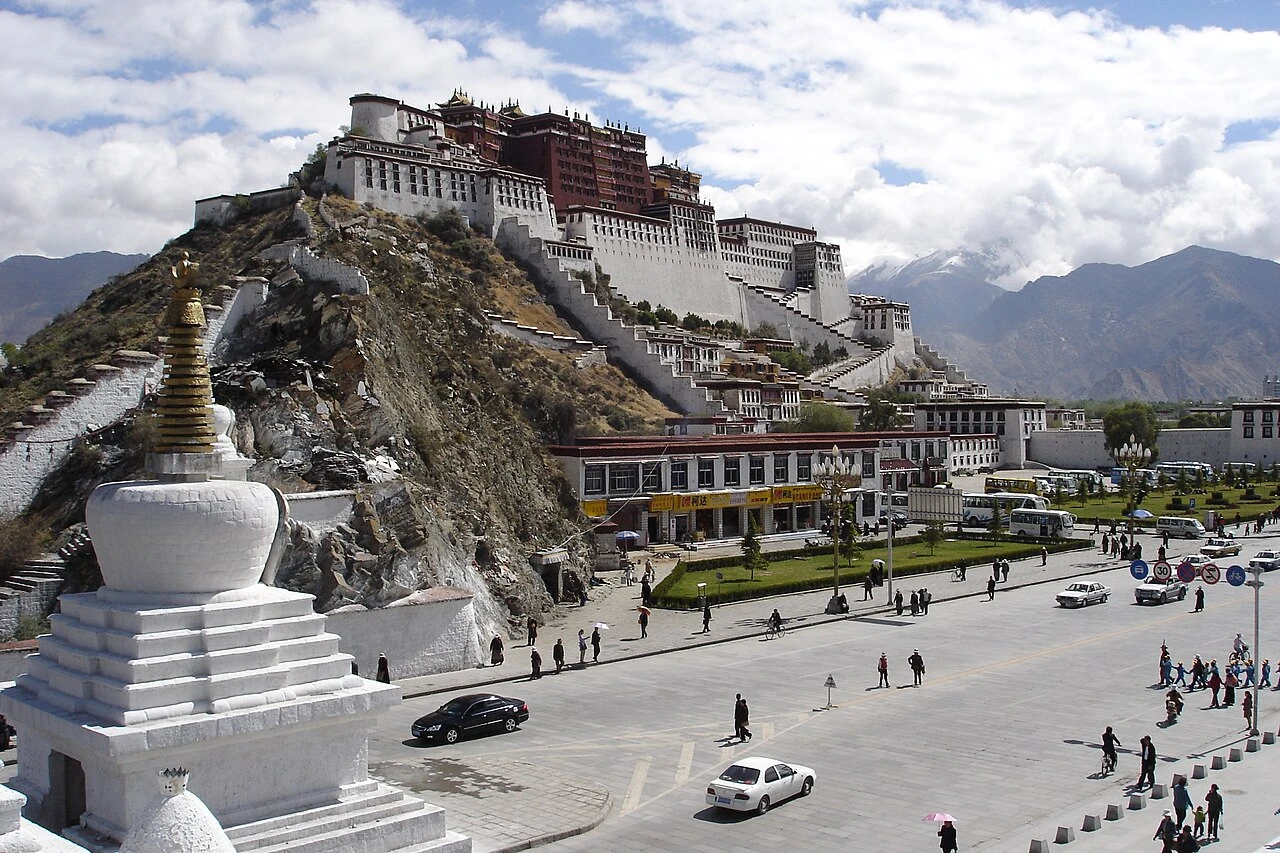
Potala Palace
Content & sources
Photo: Ondřej Žváček · CC BY 2.5
Lhasa · 4 km
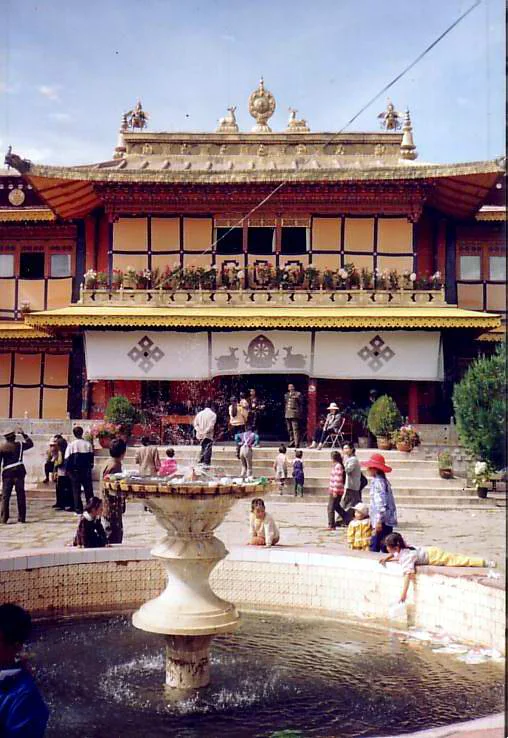
罗布林卡
Content & sources
John Hill at English Wikipedia · CC BY-SA 3.0
Dunhuang City
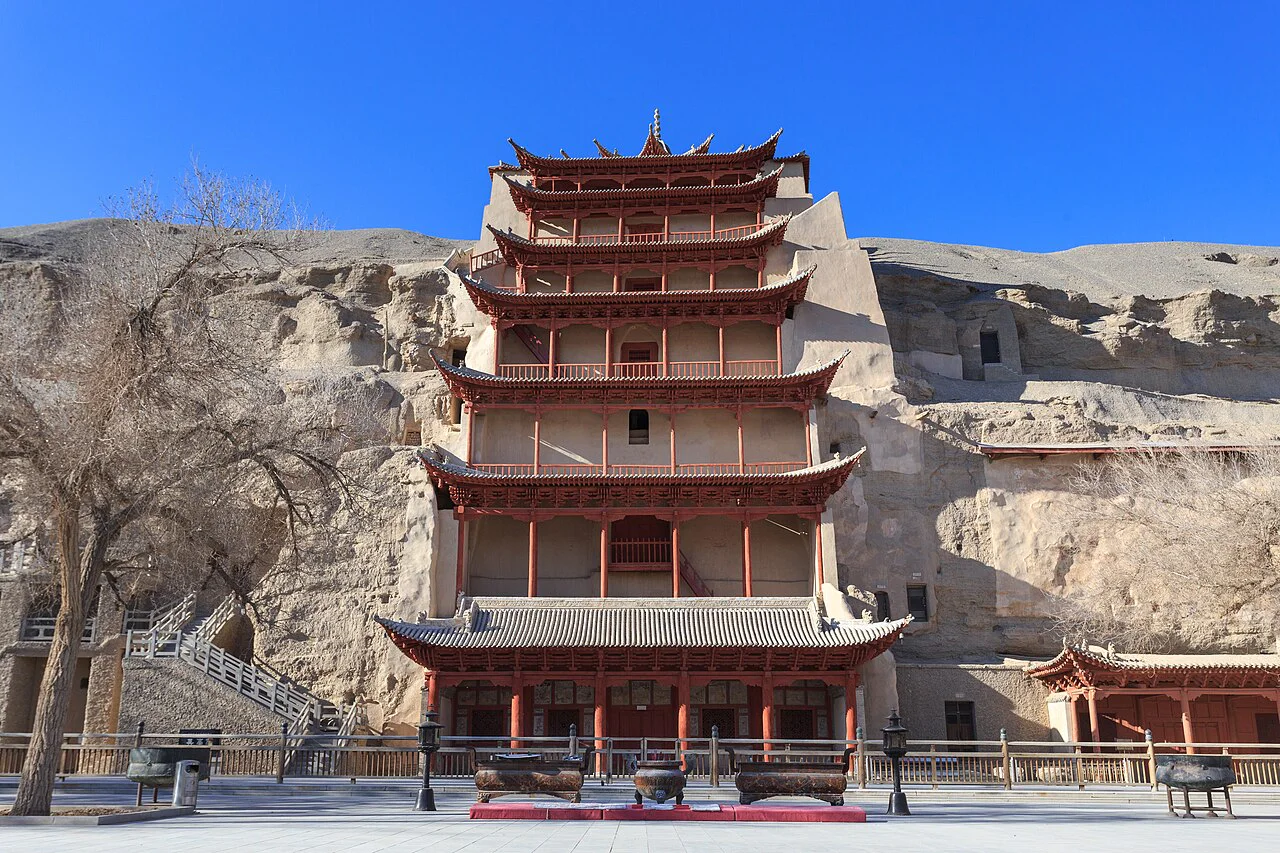
莫高窟
Content & sources
Photo: Zhangzhugang · CC BY-SA 4.0
Shizhong
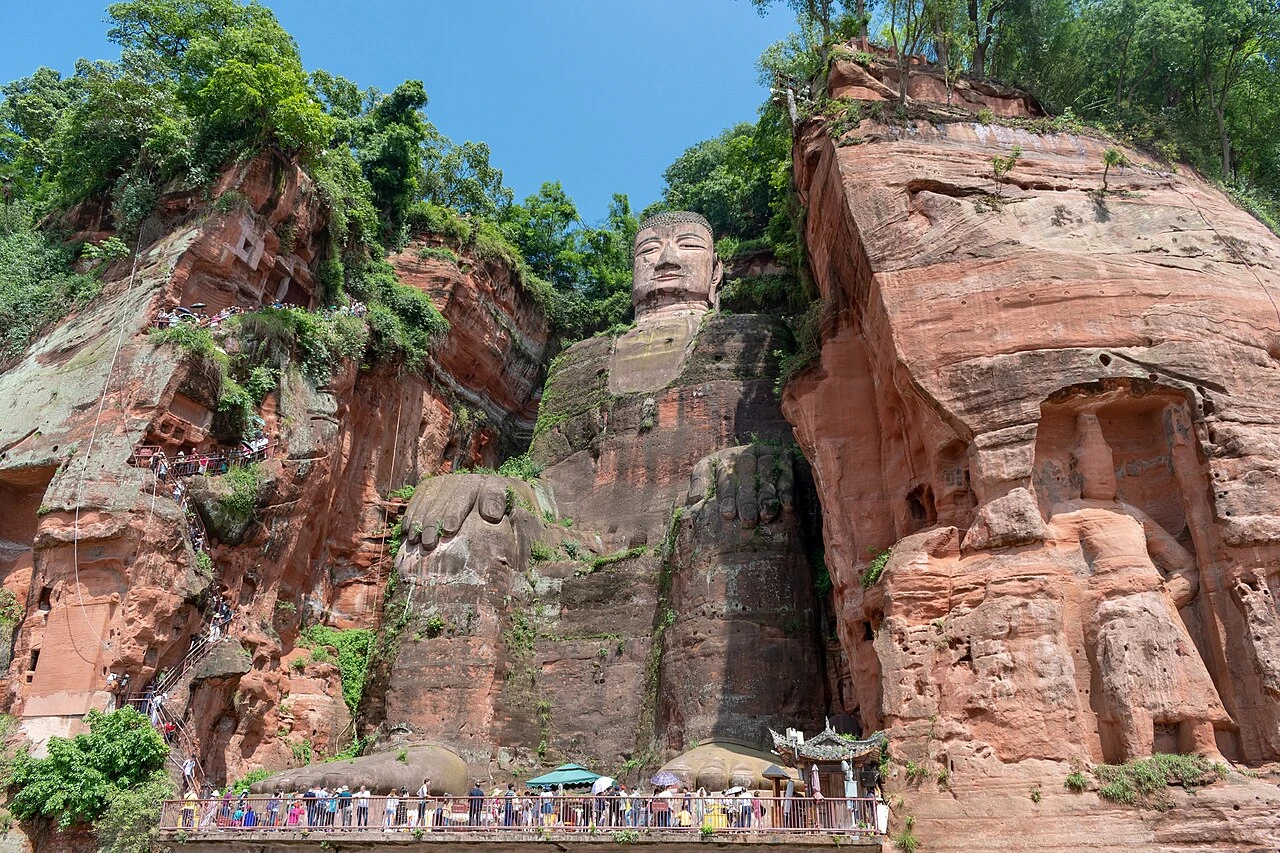
Leshan Giant Buddha
Content & sources
xiquinhosilva · CC BY 2.0