Stanza · Audio guide
罗布林卡 Audio Guide
A place to remember. A story to take with you.
Norbulingka is a palace and surrounding park in Lhasa that served as the traditional summer residence of the Dalai Lamas. It is a UNESCO World Heritage Site and a unique representation of Tibetan palace…
Download Stanza, then search for “罗布林卡”.
About the tour
One guide. Your kind of visit.
Norbulingka is a palace and surrounding park in Lhasa that served as the traditional summer residence of the Dalai Lamas. It is a UNESCO World Heritage Site and a unique representation of Tibetan palace architecture.
Ready when you are.
- 01Get the free Stanza app.
iOS & Android
- 02Find your guide.
“罗布林卡”
- 03Download before you go.
Works offline
Audio guide / 10 narrated stops
Inside the guide
Get to know a few of the stories before you go. Open a stop to read more.
01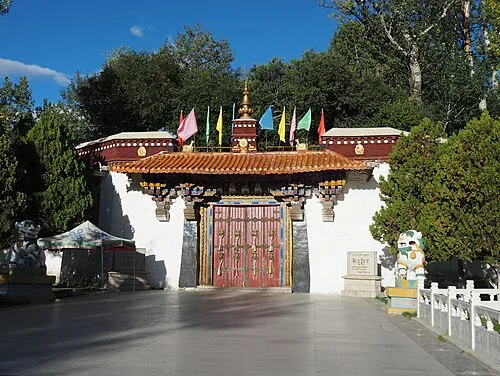 The Grand East Gate and Plateau Botanical Gardens
East Gate of Norbulingka
Welcome to Norbulingka, whose name in Tibetan means a jewelled park. Behind this gate lies a palace and garden that served the Dalai Lamas as their summer residence from the 1780s until 1959. The Seventh Dalai Lama began building here in 1755, and the complex grew into both an administrative centre and a religious one. It stands about three kilometres west of the Potala Palace, the Dalai Lamas' winter home. In 2001 UNESCO added Norbulingka to the World Heritage List as part of the Historic Ensemble of the Potala Palace. Before 1959, this east side served as the estate's main front. The red double doors, the white walls and the tiled roof with its gilded finials give a first taste of the style within, and the prayer flags above the gateway carry their colours into the wind.
Laika ac from UK · CC BY-SA 2.0
02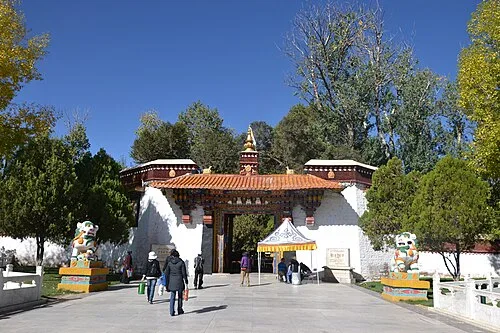 The Grand East Gate and Plateau Botanical Gardens
Approach and Guardian Lions at the East Gate
Two guardian lions on pedestals flank this gate, one of them with a cub at its side. In Tibetan tradition they stand for the Snow Lion, the mythical symbol of Tibet that legend says leaps from one snow peak to another. The gate itself was once a checkpoint. Guards posted here decided who could enter the park. Visitors were expected to arrive in Tibetan dress, and western hats, which had become fashionable in Lhasa for a time, were turned away. Shoes came off as well; wearing them inside the park was banned. Officials received their own ceremony. Nobles and high-ranking officials were greeted with a formal arms salute, and lower officials were saluted too. From their pedestals, the lions watched all of it.
guan · CC BY 3.0
03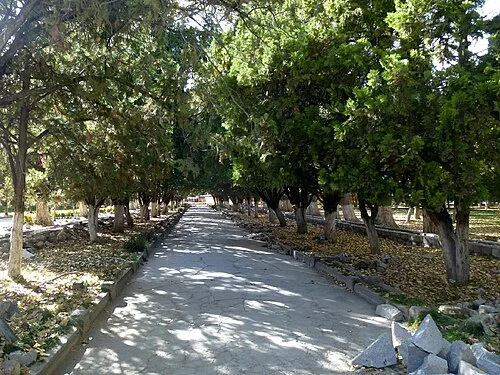 The Grand East Gate and Plateau Botanical Gardens
Tree-Lined Walkway in Norbulingka Park
When work began here in the 1750s, this ground was barren, overgrown with weeds and scrub, and infested with wild animals. What drew people to the spot was a spring. The Seventh Dalai Lama, whose health was frail, came here in the summer months to treat his health problems with its waters. The Qing dynasty then permitted him a palace at the site, and a resting pavilion called the Wurao Phodrang was raised. From there the garden grew. Fruit trees and evergreens were brought from across Tibet and planted, tended by a large retinue of gardeners, and the park was completed in 1783 under the Eighth Dalai Lama. Today it covers about 36 hectares at an elevation of 3,650 metres. It has been called the world's highest, largest and best-preserved ancient artificial horticultural garden, and it has earned the nickname Plateau Oxygen Bar. Apples, peaches and apricots were planted too, though the fruit never ripened in Lhasa's climate.
Listen in the appHiroki Ogawa · CC BY 3.0
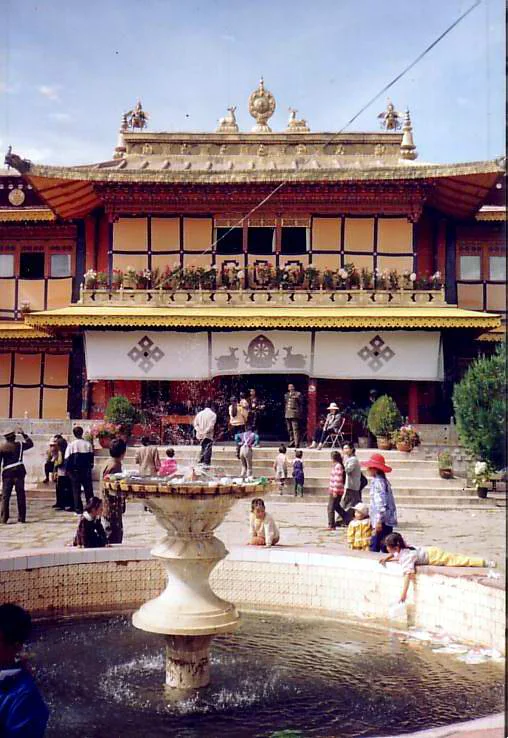
04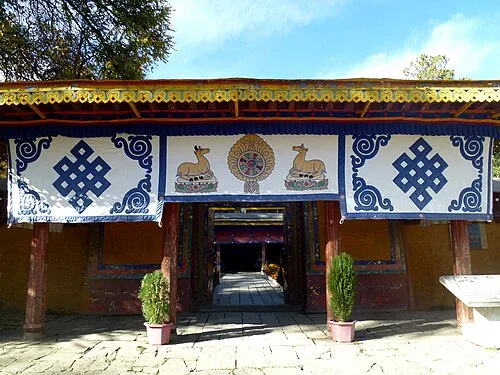 Kelsang Phodrang: The Old Summer Palace
Kelsang Phodrang (Old Summer Palace) Courtyard Portal
This portal, with its yellow-washed walls and red wooden columns, leads into the oldest palace quarter at Norbulingka. Kelsang Phodrang was built for the Seventh Dalai Lama, beside the springs. It rises three storeys and held chambers for the worship of Buddha, bedrooms, reading rooms and shelters. His successor enlarged it: the Eighth Dalai Lama added three temples and the perimeter wall on the south-east side. The twentieth century was harder on the building. During the Cultural Revolution the complex suffered extensive damage. In 2002 the central government sanctioned 67.4 million yuan for restoration, and the work that began in 2003 concentrated on this palace and the Kashag cabinet offices. Over the doorway hangs a blue-and-white banner with endless-knot motifs, flanked by painted emblems of deer and a wheel.
Listen in the appHiroki Ogawa · CC BY 3.0
05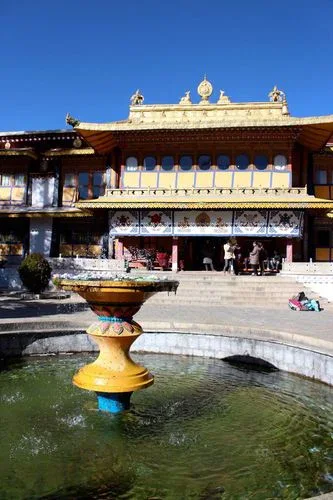 Kelsang Phodrang: The Old Summer Palace
Kelsang Phodrang Main Facade and Fountain Basin
This is the main front of Kelsang Phodrang, and the palace was more than a residence; it was a seat of government. Each summer the Dalai Lama moved here for about six months of the warm season, and the Kashag, Tibet's cabinet, moved its offices with him. The liveliest days came in the seventh month of the Tibetan calendar, during the Shoton festival, popularly known as the yogurt festival. Folk operas were performed opposite the Khamsum Zilnon pavilion, and the Dalai Lamas watched from the first floor of this palace. The festival is still held in these grounds every year.
Listen in the appPhoto: Phurbutsering · CC BY-SA 3.0
06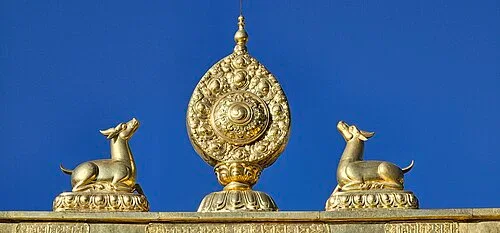 Kelsang Phodrang: The Old Summer Palace
Gilded Deer and Dharma Wheel Roof Ornament
Gold catches the sky along the roofs here. Two recumbent deer in gilded metal flank a Dharma wheel, crowned by a finial shaped like a flame. The pairing is one of the oldest emblems in Buddhist art. The wheel stands for the Buddha's teaching, and the deer recall the deer park at Sarnath, where that teaching was first set out. Kelsang Phodrang is counted a beautiful example of Yellow Hat architecture, the order of the Dalai Lamas, and the buildings here wear their faith openly, right down to the roofline.
Listen in the appPhoto: Nabin K. Sapkota · CC BY-SA 4.0
07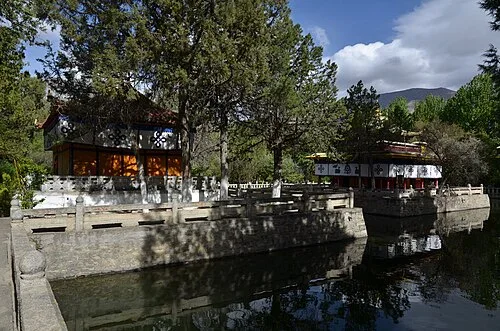 Tsokyil Phodrang: The Lake Pavilions and Water Garden
Lake Pavilion Across the Water, Norbulingka
Northwest of the old palace, the garden turns to water. The Tsokyil Phodrang is described as a pavilion set in the midst of a lake, and the building standing across this still water is the one identified with that name. The design intent is easy to read. A stone-railed bank holds the water in, the pavilion keeps its distance on the far side, and trees and hills close the view behind it. This whole quarter was made as a retreat, set apart from the formal palace courts, with the reflection doubling the roofline in the water.
Listen in the appPavel Špindler · CC BY 3.0
08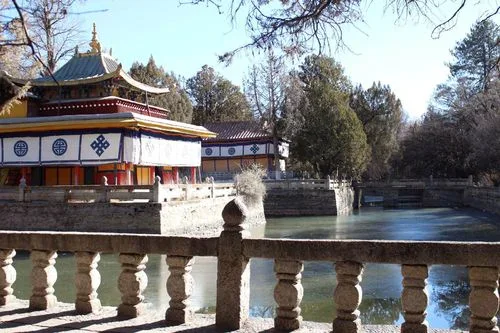 Tsokyil Phodrang: The Lake Pavilions and Water Garden
Stone Balustrade Bridge to the Island Pavilion
The lake quarter was built as a world of islands. Three islands in the lake were joined to the land by short bridges, and a palace stood on each one. The bridge here carries a row of carved balusters, each one shaped by hand, leading the eye across the water to a golden-roofed pavilion with a blue-and-white knot panel on its wall. The pavilion is labelled Druzin Phodrang on the site, though that name does not appear in the older accounts. Each crossing took a visitor out of the formal courts and into the quieter water garden.
Listen in the appPhoto: Phurbutsering · CC BY-SA 3.0
09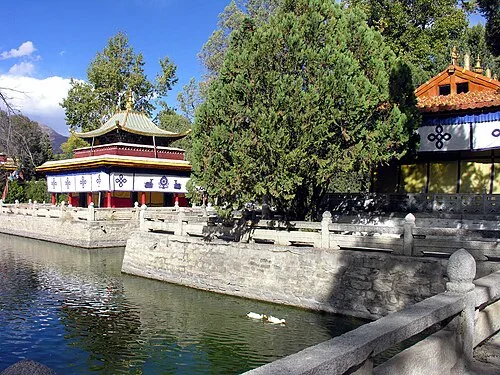 Tsokyil Phodrang: The Lake Pavilions and Water Garden
Lakeside Pavilion and Waterbirds
Here at the lakeside, the water had a living side as well. In its heyday, brahminy ducks paddled on the water and peacocks walked the grounds. Nearby stood a horse stable and a row of four houses built to hold the gifts the Dalai Lamas received from the Chinese emperors and other foreign dignitaries. Gift animals needed a home too, so a zoo was created here for them. Heinrich Harrer, who knew the place in the 1950s, wrote that it mostly held injured animals, and added a line that stayed with the place: in the garden of precious stones they will be well treated, everyone knows it.
Listen in the appDennis G. Jarvis · CC BY-SA 2.0
10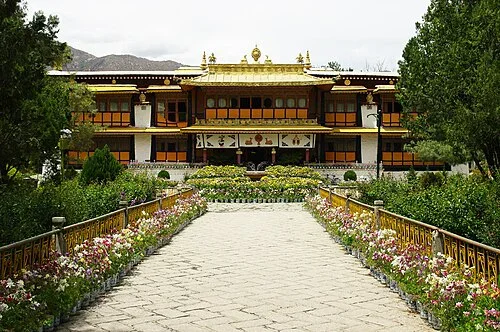 Takten Migyur Phodrang: The New Summer Palace
Takten Migyur Phodrang (New Summer Palace) Facade
This is the front of the Takten Migyur Phodrang, the last major building at Norbulingka and the Fourteenth Dalai Lama's own. Work on the Takten Migyur Phodrang began in 1954 and finished in 1956, a double-storey mix of temple and villa that the accounts call the most elegant palace on the site, with chapels, gardens, fountains and pools. Its Tibetan name means a palace forever indestructible. It was his home for only three years. On the night of 17 March 1959 the young Dalai Lama left Norbulingka dressed as an ordinary Tibetan, a rifle across his shoulder. A dust storm was blowing, and no one recognized him. He and his officials rode out of the city on horses and spent two weeks crossing the Himalayas before reaching India, where they received asylum. The Chinese learned of the escape only two days later. Inside, his rooms were apparently left as he had left them. A book published in 1989 reported that the yellow brocade bedspread was still unmade, because no one had dared to touch it. Another visitor noted a Philips gramophone and stacks of 78 rpm records. Norbulingka had begun, two centuries earlier, with a single spring.
Listen in the appBgabel · CC BY-SA 3.0
罗布林卡
Frequently asked questions
How much does the guide cost?
Free app download. Listed guide price: $0.99. Guide price shown in the app. Audio guide only. Venue admission is separate.
Can I listen without internet?
Yes. Download the guide’s audio, images, and maps in the app before your visit. Your downloaded content is then available offline.
Can I listen in my language?
This audio guide is available in 15 languages, including English.
Do I need to follow a schedule?
No. This is a self-guided experience. Choose your stops, pause whenever you like, and return to a story at your own pace.
At your own pace
Explore 罗布林卡.
Download Stanza, then search for “罗布林卡”.
Free app download · Guide price shown in the app
Keep exploring
Audio guides — China
Lhasa · 2 km
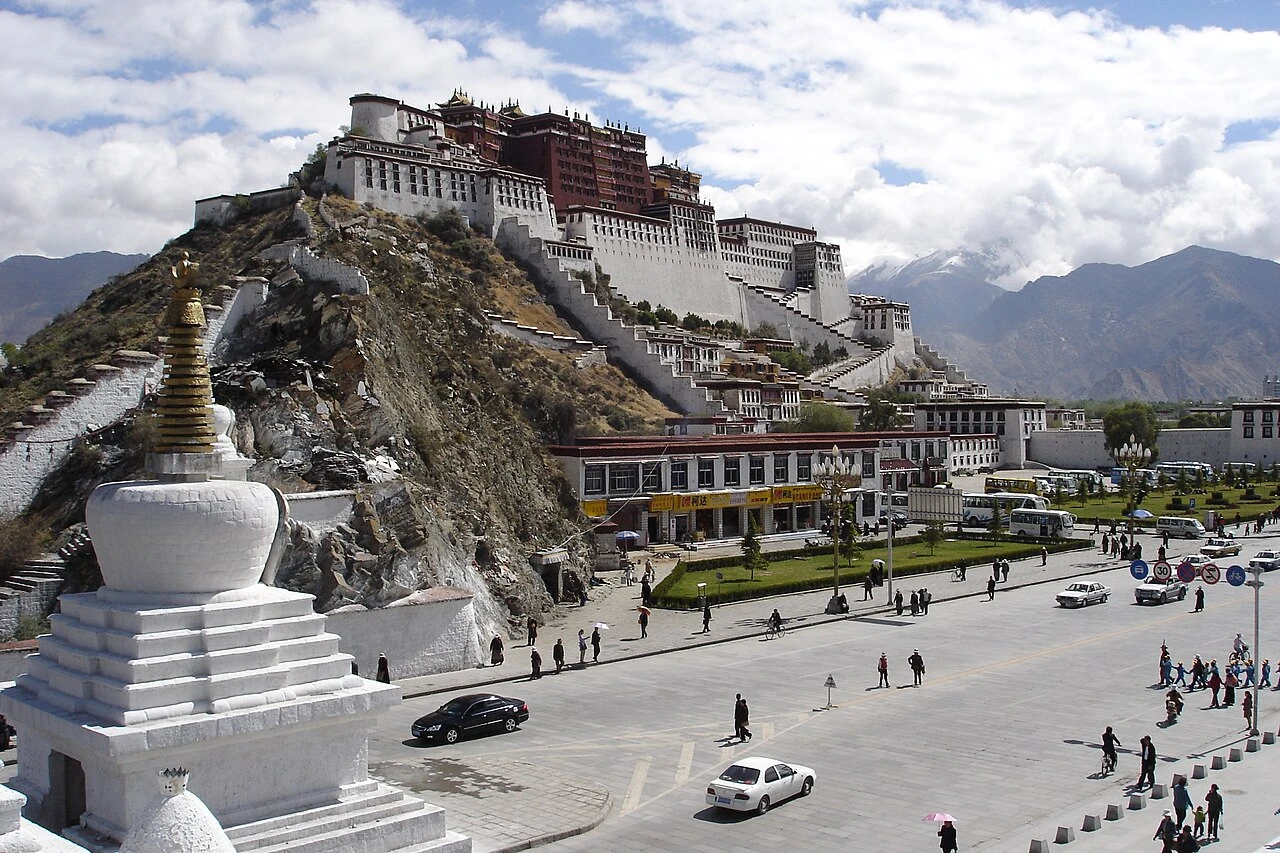
Potala Palace
Content & sources
Photo: Ondřej Žváček · CC BY 2.5
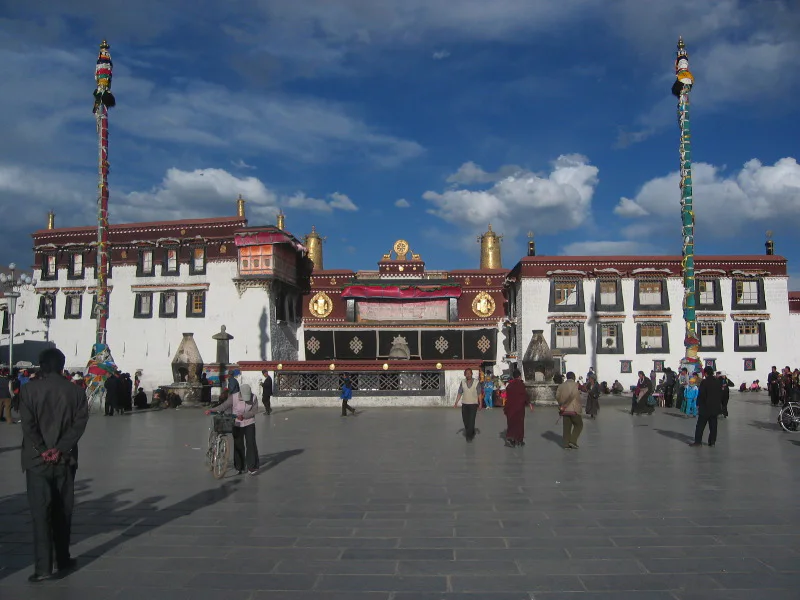
Lhasa · 4 km
大昭寺
Content & sources
onwardtibet.org · CC BY-SA 2.0
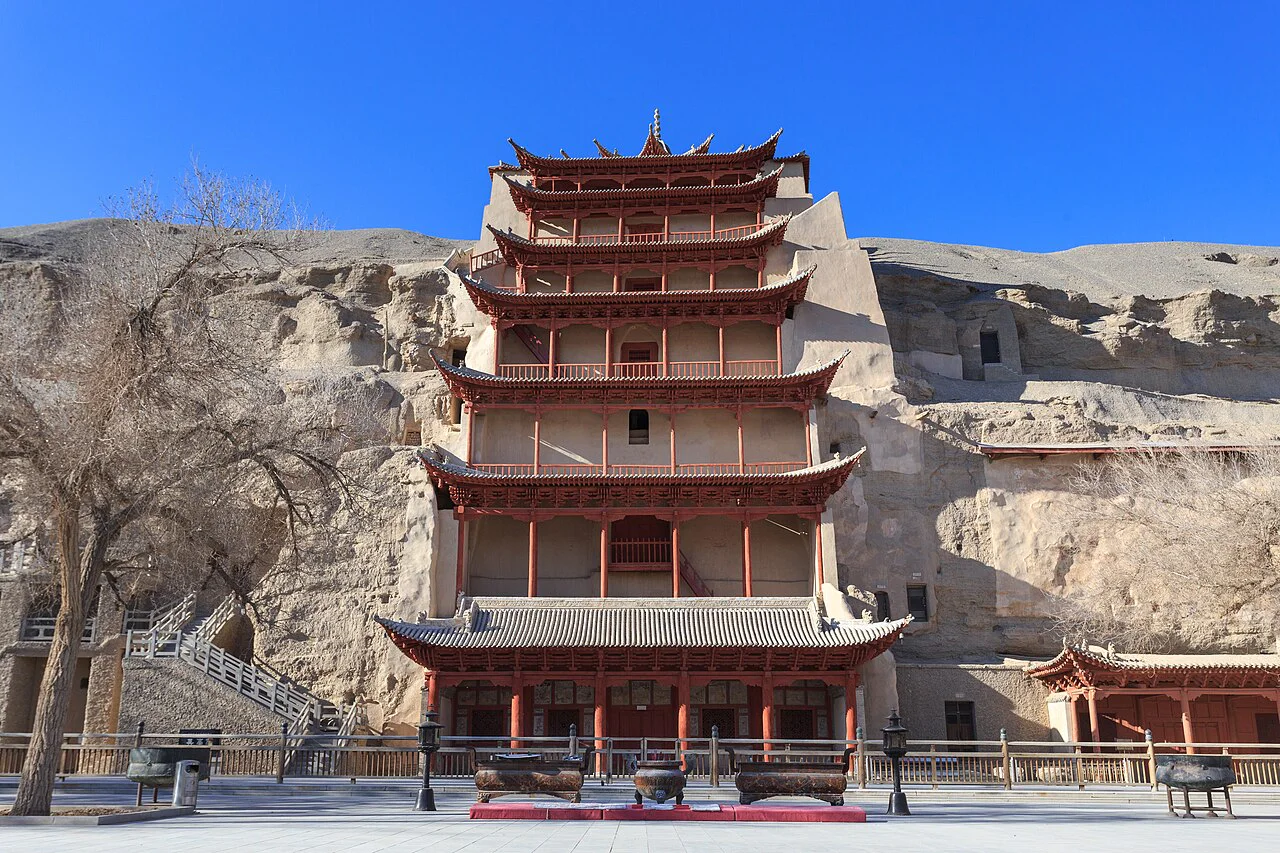
Dunhuang City
莫高窟
Content & sources
Photo: Zhangzhugang · CC BY-SA 4.0
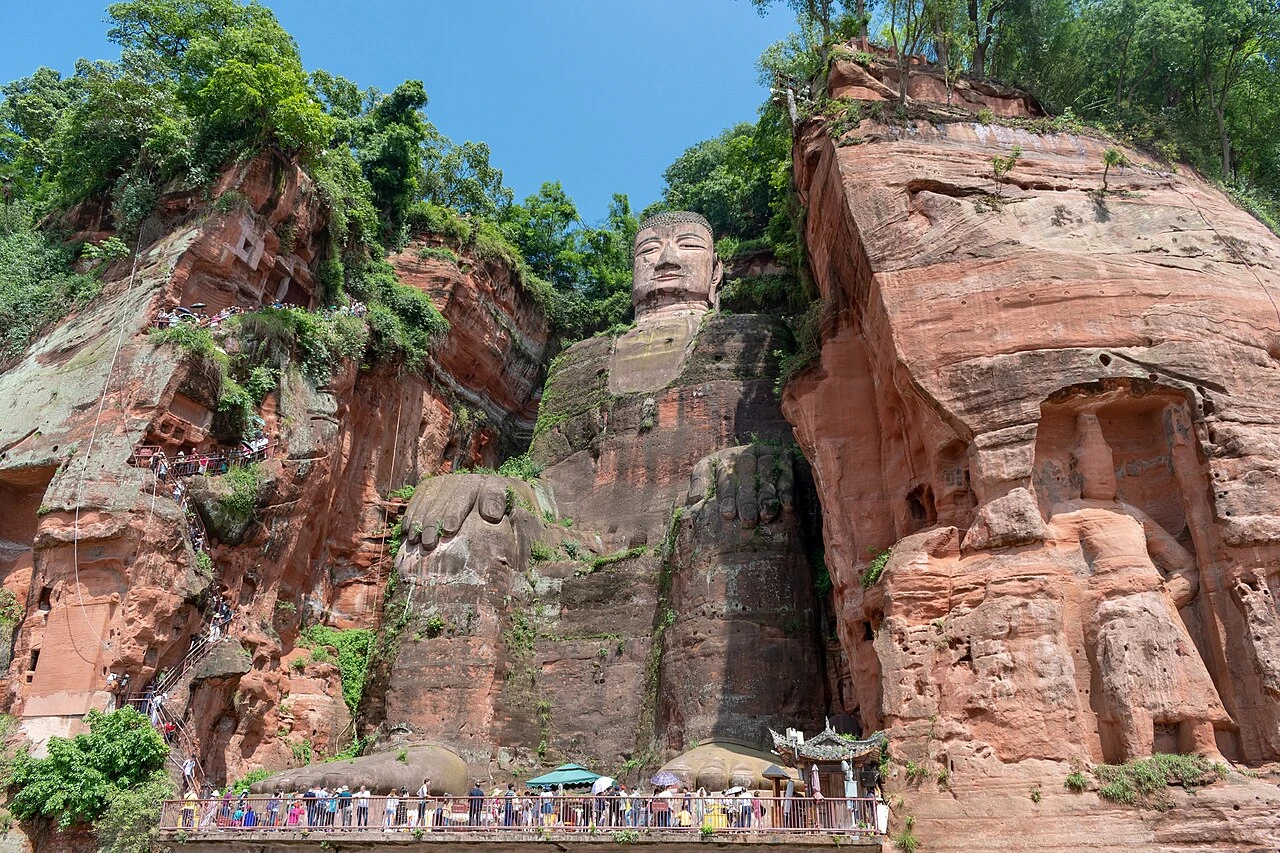
Shizhong
Leshan Giant Buddha
Content & sources
xiquinhosilva · CC BY 2.0