 Stanza / Audio guide
Content & sources
Stanza · Audio guide
中山陵 Audio Guide
A place to remember. A story to take with you.
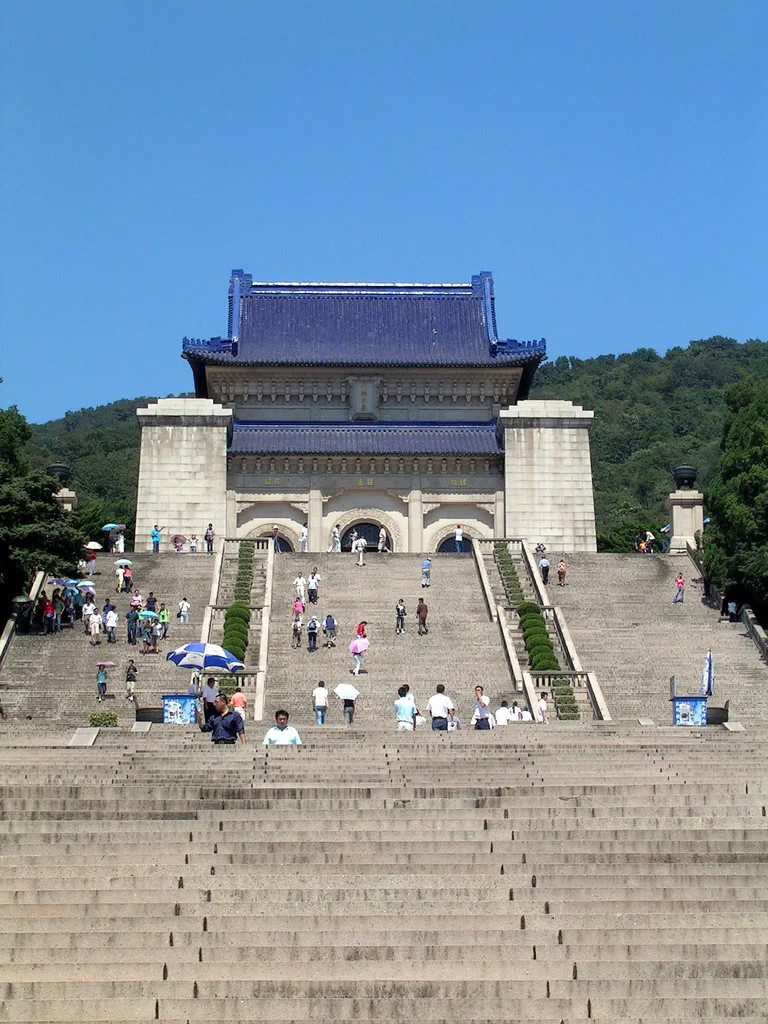
The Sun Yat-sen Mausoleum is situated at the foot of the second peak of Purple Mountain in Nanjing, China. Construction of the tomb started in 1926 and was completed in 1929 to honor Sun Yat-sen.
Download Stanza, then search for “中山陵”.
About the tour
One guide. Your kind of visit.
The Sun Yat-sen Mausoleum is situated at the foot of the second peak of Purple Mountain in Nanjing, China. Construction of the tomb started in 1926 and was completed in 1929 to honor Sun Yat-sen.
Ready when you are.
- 01Get the free Stanza app.
iOS & Android
- 02Find your guide.
“中山陵”
- 03Download before you go.
Works offline
Audio guide / 14 narrated stops
Inside the guide
Get to know a few of the stories before you go. Open a stop to read more.
01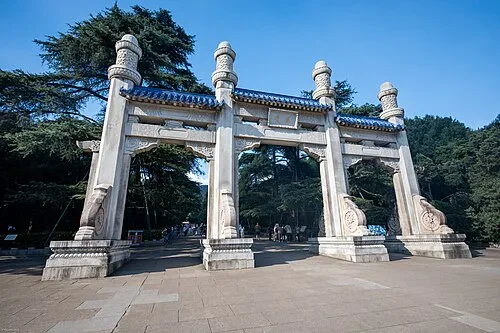 Bo'ai Archway
The Bo'ai Archway: Threshold of the Mausoleum
Welcome to the Sun Yat-sen Mausoleum, on the forested slopes of Purple Mountain above Nanjing. Four great granite pillars rise here, crowned with cobalt-blue glazed tiles, marking the start of a long climb to a tomb. The man buried at the top is Sun Yat-sen, honoured on both sides of the Taiwan Strait and often called the Father of Modern China. He fought the imperial Qing government, and after the revolution of 1911 he ended two thousand years of monarchy and founded the Republic of China. It was in Nanjing that he first established a provisional republican government. When he died in 1925, the young republic set out to build him a tomb worthy of that story. Work began in January 1926 and was finished by early 1929. From this archway to the burial vault, the axis runs about seven hundred meters up the mountainside, climbing seventy meters in height. What follows is not a stroll but a pilgrimage route, laid out step by step through stone, trees and stairs.
xiquinhosilva · CC BY 2.0
02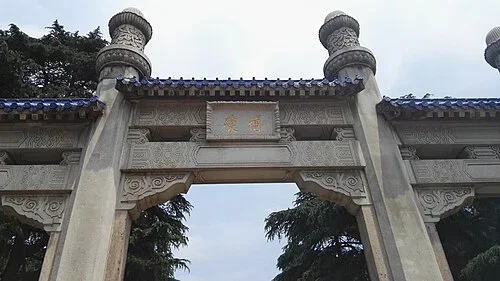 Bo'ai Archway
The Inscription 'Bo'ai' - Universal Love
Under the central arch hangs a carved tablet with two Chinese characters: Bo'ai, meaning universal love. They are written in Sun Yat-sen's own calligraphy. The phrase was a guiding ideal of his political thought, the belief that a leader should care for all the people rather than rule for a dynasty or a clique. That is what makes this threshold unusual. An imperial tomb would open with grandeur and warnings; this one opens with a personal motto of a citizen-leader, in his own hand. The whole journey up the mountain begins with an idea, not a command.
Photo: 4084470 0.smil · CC BY 4.0
03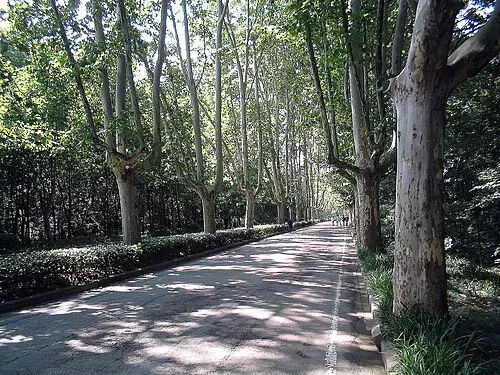 Pine and Cypress Tomb Avenue
The Tomb Avenue: Transition to the Mountain
The way up begins along a broad, straight avenue, lined with rows of cedars and cypresses. The designers meant this as a transition. Behind the archway, a tomb passage carries the visitor out of the ordinary world and into the precinct of the mountain. Along the slopes, pines, cypresses and ginkgos stand guard on either side of the stairway, trees long associated with graveyards and with endurance. The whole monument sits inside a scenic area of more than three square kilometers, so this greenery is not decoration but setting. The avenue slows the visitor down, and the mountain closes in quietly, tree by tree.
Listen in the appGuy Freeman · CC BY-SA 2.0
04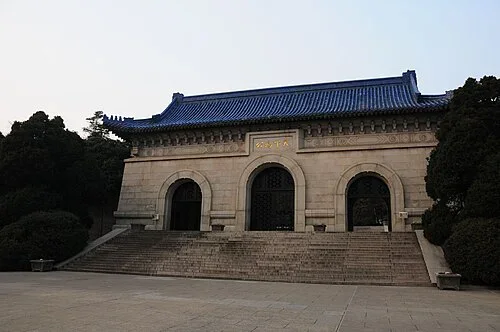 Mausoleum Gate and Inscriptions
The Mausoleum Gate
At the head of the stairs stands the Mausoleum Gate, a massive archway of granite under a deep blue tiled roof. It rises about sixteen meters and stretches twenty-seven meters wide, pierced by three arched openings. Three arches made it a ceremonial passage rather than a defensive one, built for processions of mourners and pilgrims, not for holding back armies. The gate holds its place in a strict sequence: archway, tomb passage, gate, then a stele pavilion, and beyond that the memorial hall and the burial vault. Everything is arranged on one axis, symmetrical and deliberate. The granite mass with blue tiles is the monument's recurring formula, repeated from the first archway to the hall at the top.
Listen in the appdrnan tu · CC BY-SA 2.0
05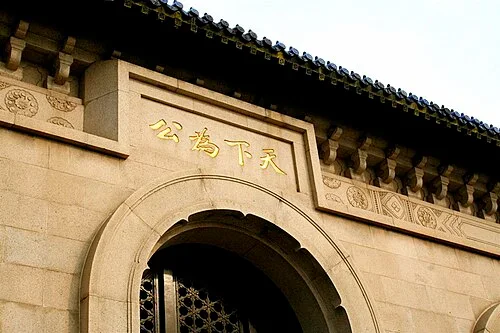 Mausoleum Gate and Inscriptions
'Tian Xia Wei Gong' - What Is Under Heaven Is for All
Above the central arch gleam four gilded characters: Tian Xia Wei Gong. They mean, roughly, what is under heaven is for all. The words come from a classical text, but Sun Yat-sen made them his personal motto, and they are written here in his own hand. For him the phrase captured his democratic creed: the realm belongs to everyone, not to one ruling family. Placing his own calligraphy on the gate turns the whole monument into a statement of principle.
Listen in the appPatrick from Beijing, China · CC BY 2.0
06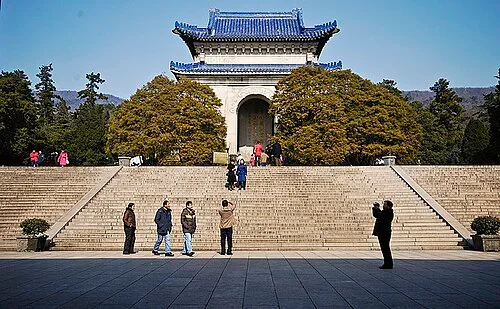 Stele Pavilion and the Blank Monument
The Stele Pavilion and the Wordless Monument
Behind the gate rises a heavy stone pavilion with a double roof, built to house a single object: a granite stele nine meters tall, set up by the Kuomintang. What is missing from it is the story. Imperial tomb stelae traditionally catalogued an emperor's deeds in long carved essays, composed by court scholars. Here the tradition holds that no ordinary epitaph could sum up what Sun had done, so the stone carries only a short dedicatory inscription instead of a full account of his life. Restraint itself became the tribute.
Listen in the appDale Ellerm · CC BY 2.0
07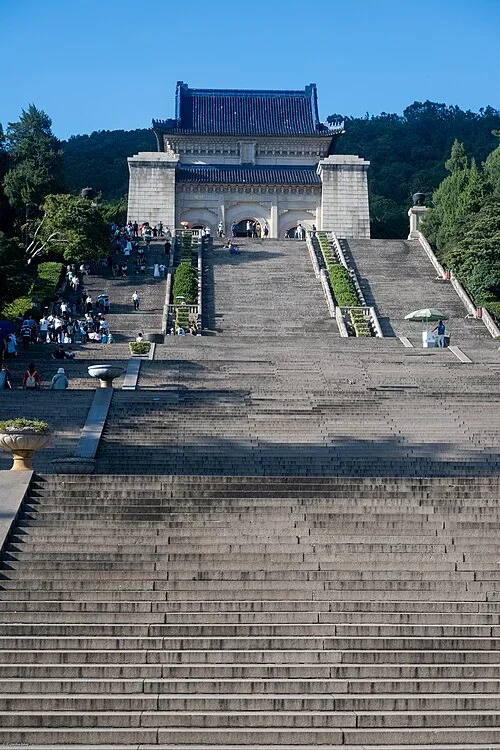 The 392 Steps and Commemorative Terraces
The 392 Steps: Ascent and Illusion
The great staircase now fills the view: three hundred ninety-two granite steps, set on ten platforms, rising toward the hall at the top. Everything here is white granite and reinforced concrete, modern materials doing the work of an imperial approach. The climb hides a famous trick. From below, the eye reads an unbroken sweep of stairs, the terraces disappearing into the rhythm of the risers. Turn and walk down, and the steps vanish; only the level platforms remain. The builders calibrated that effect deliberately, alternating stairs and landings to fool the eye in each direction. The number of steps is often given a meaning too: at the founding of the republic, China was said to have roughly three hundred ninety-two million people, one step for each million. Every person who climbs it carries the whole nation up the mountain.
Listen in the appxiquinhosilva · CC BY 2.0
08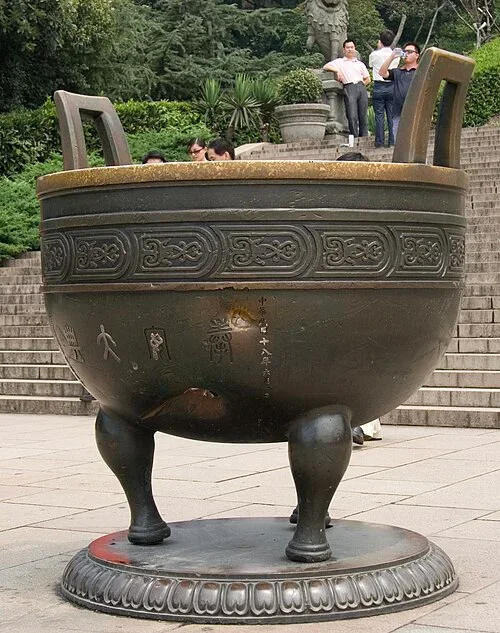 The 392 Steps and Commemorative Terraces
The Battle-Scarred Bronze Ding
On a stone terrace beside the stairs sits a huge bronze ding, the ancient Chinese vessel of state authority, mounted on a three-tier stand. This one carries wounds. During the Battle of Nanjing in December 1937, fighting swept across the slopes of Purple Mountain, and Japanese shelling of the staircase left two shrapnel holes in this vessel on the western steps. The two holes are still there, a record of what the site endured. Oddly, the tomb itself was guarded: when Wang Jingwei's Japanese-backed government was set up in 1940, Japanese troops were posted to prevent any encroachment on the mausoleum. The mountain saw real combat, and this scarred bronze pot is what remains of it.
Listen in the appKimonBerlin · CC BY-SA 2.0
09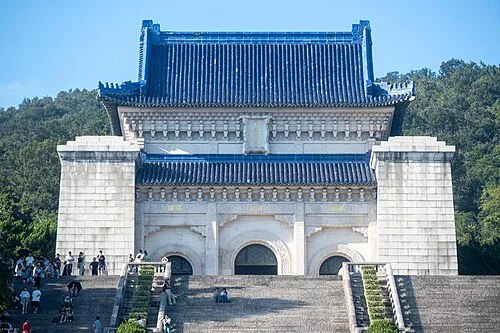 Sacrificial Hall Facade and Architectural Design
The Sacrificial Hall: East Meets West in Stone
At the top of the stairs stands the Sacrificial Hall, the architectural crown of the whole monument. Its silhouette is pure Chinese palace: blue glazed tiles, sweeping layered eaves, the look of an imperial building. Its bones are modern, the work of a twentieth-century engineer. Before the facade stand a pair of huabiao, ornamental columns of a kind that have flanked Chinese ceremonial buildings since antiquity, each about twelve and a half meters tall. The hall itself measures roughly thirty meters long and twenty-five meters wide, rising twenty-nine meters high. Chinese writers have called it the first mausoleum of modern Chinese architecture.
Listen in the appxiquinhosilva · CC BY 2.0
10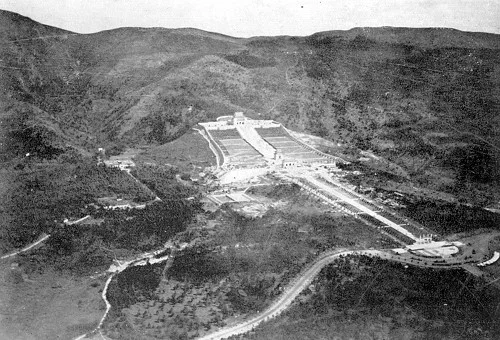 Sacrificial Hall Facade and Architectural Design
The Alarm-Bell Plan and the Architect Lü Yanzhi
Seen from the air, the mausoleum reveals its secret: the ground plan is an alarm bell laid across the mountainside. The burial vault forms the bell's button, and the plaza and archway at the bottom form the hammer. The shape reads as a call to awaken the nation, an alarm rung in stone for the man who woke China from empire. The design won an open competition advertised in the newspapers in May 1925. For ten yuan, any architect at home or abroad could buy twelve pictures of the site and try; more than forty proposals came in. That September the committee met in Shanghai and chose, unanimously, a young architect named Lü Yanzhi. His brief demanded a traditional Chinese style that was also modern and memorial, within a budget of three hundred thousand yuan; the final cost ran past ten times that. Lü threw himself into the works and died shortly after the mausoleum was finished, leaving his close friend Huang Tanpu to carry the project through. The aerial view also tells an honest story about the land: in the early years of the republic these slopes were bare, so most of the trees framing the stairway today are later growth. Even the bell was adjusted as it was built, with a tomb passage added and the archway moved further out.
Listen in the appUnknown author · Public domain
- 11
The Seated Statue in the Sacrificial Hall
A seated figure in Italian white marble, four point six meters of citizen-thinker rather than conqueror.
- 12
The Mosaic Ceiling and the Blue Sky Banner
The mosaic ceiling carries the Blue Sky with a White Sun, a flag whose place over the tomb has shifted with politics.
- 13
The Burial Chamber: The Reclining Effigy
The reclining effigy lies above the true grave, five meters down, where Sun was laid to rest in June 1929.
- 14
The Music Stage: A Living Place of Memory
At the Music Stage below the tomb, remembrance has always been public, communal and shared across the Chinese world.
中山陵
Frequently asked questions
How much does the guide cost?
Free app download. Listed guide price: $0.99. Guide price shown in the app. Audio guide only. Venue admission is separate.
Can I listen without internet?
Yes. Download the guide’s audio, images, and maps in the app before your visit. Your downloaded content is then available offline.
Can I listen in my language?
This audio guide is available in 15 languages, including English.
Do I need to follow a schedule?
No. This is a self-guided experience. Choose your stops, pause whenever you like, and return to a story at your own pace.
At your own pace
Explore 中山陵.
Download Stanza, then search for “中山陵”.
Free app download · Guide price shown in the app
Keep exploring
Audio guides — China
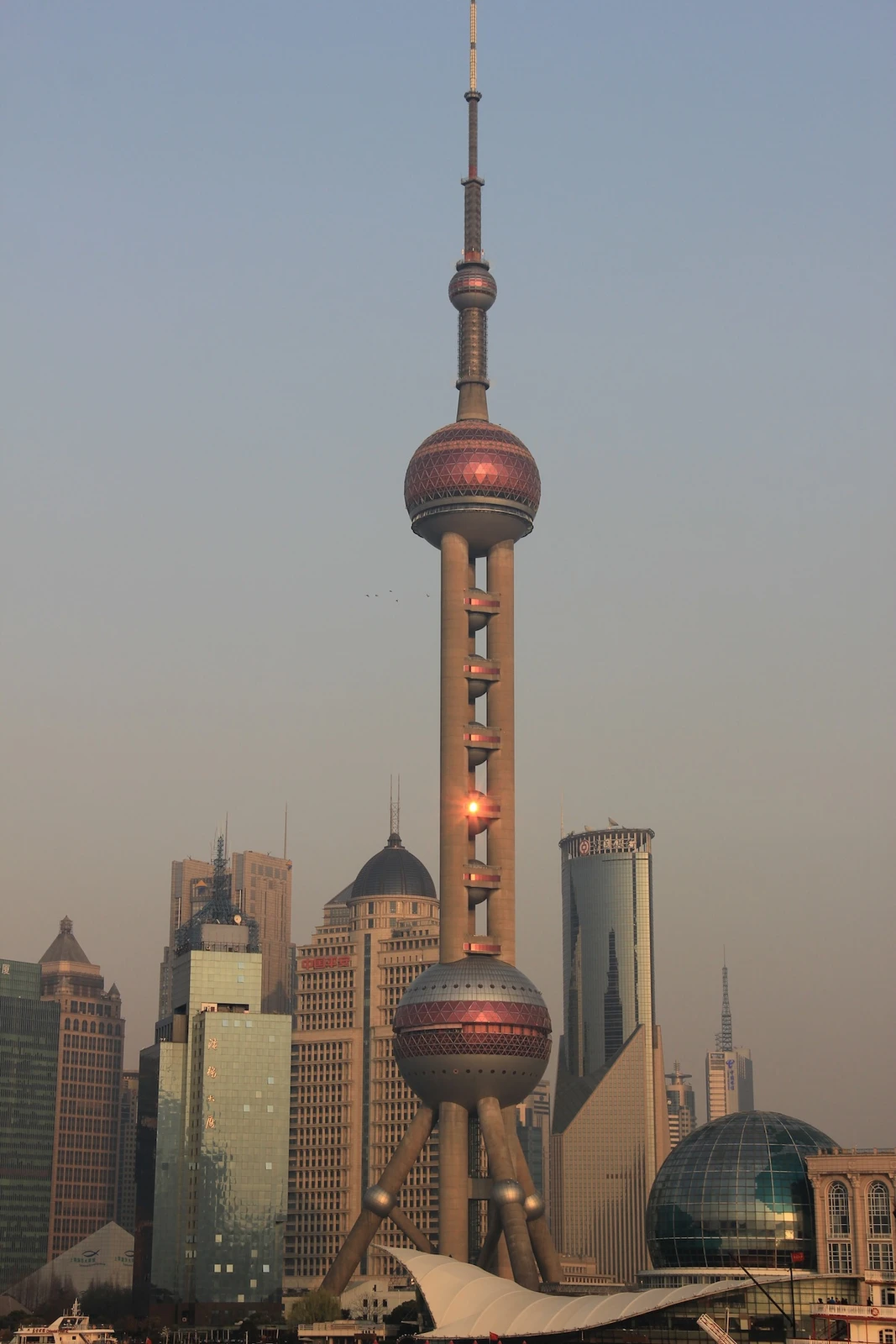
Pudong
Oriental Pearl Tower
Content & sources
Dottie Day · CC BY 2.0
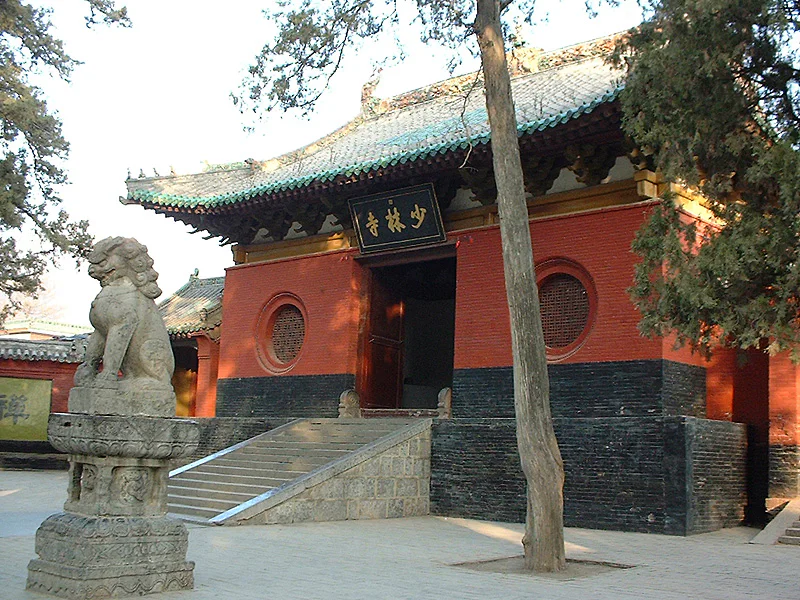
Dengfeng
少林寺
Content & sources
User:Yaoleilei · CC BY-SA 3.0
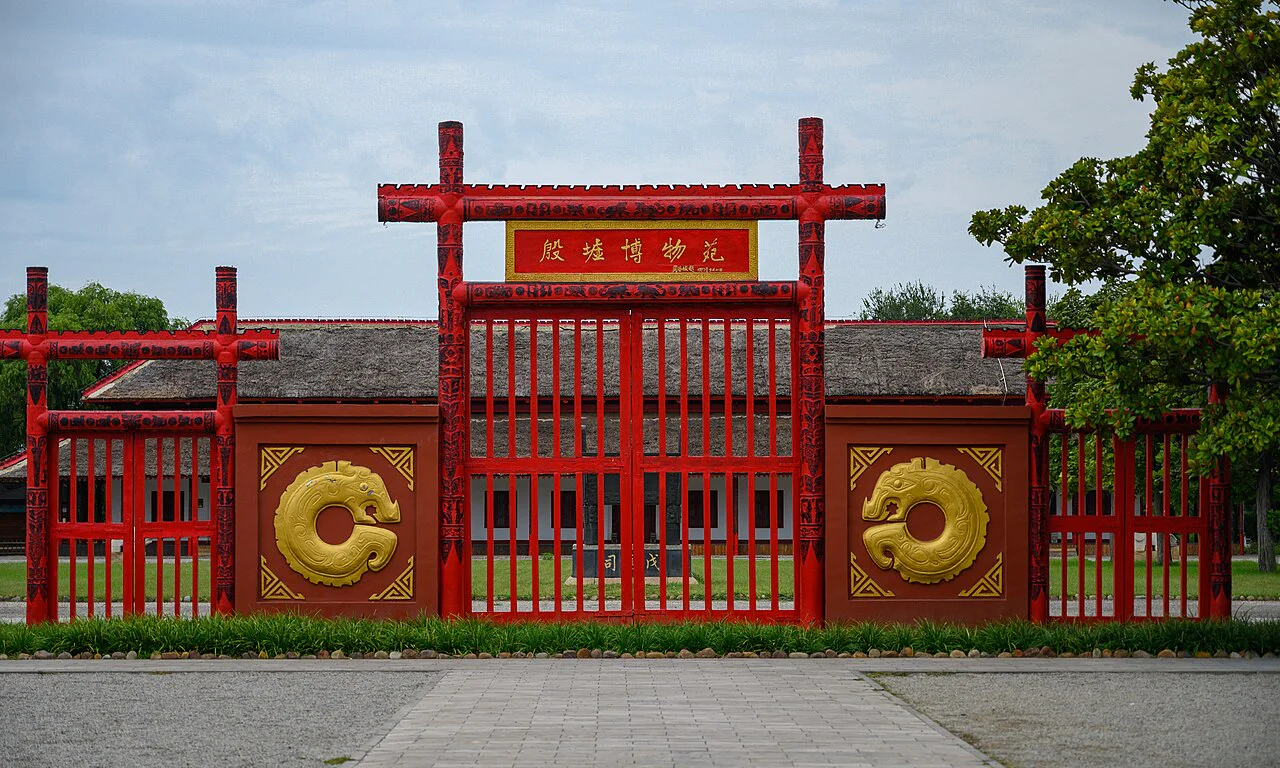
Anyang
殷墟
Content & sources
xiquinhosilva · CC BY 2.0
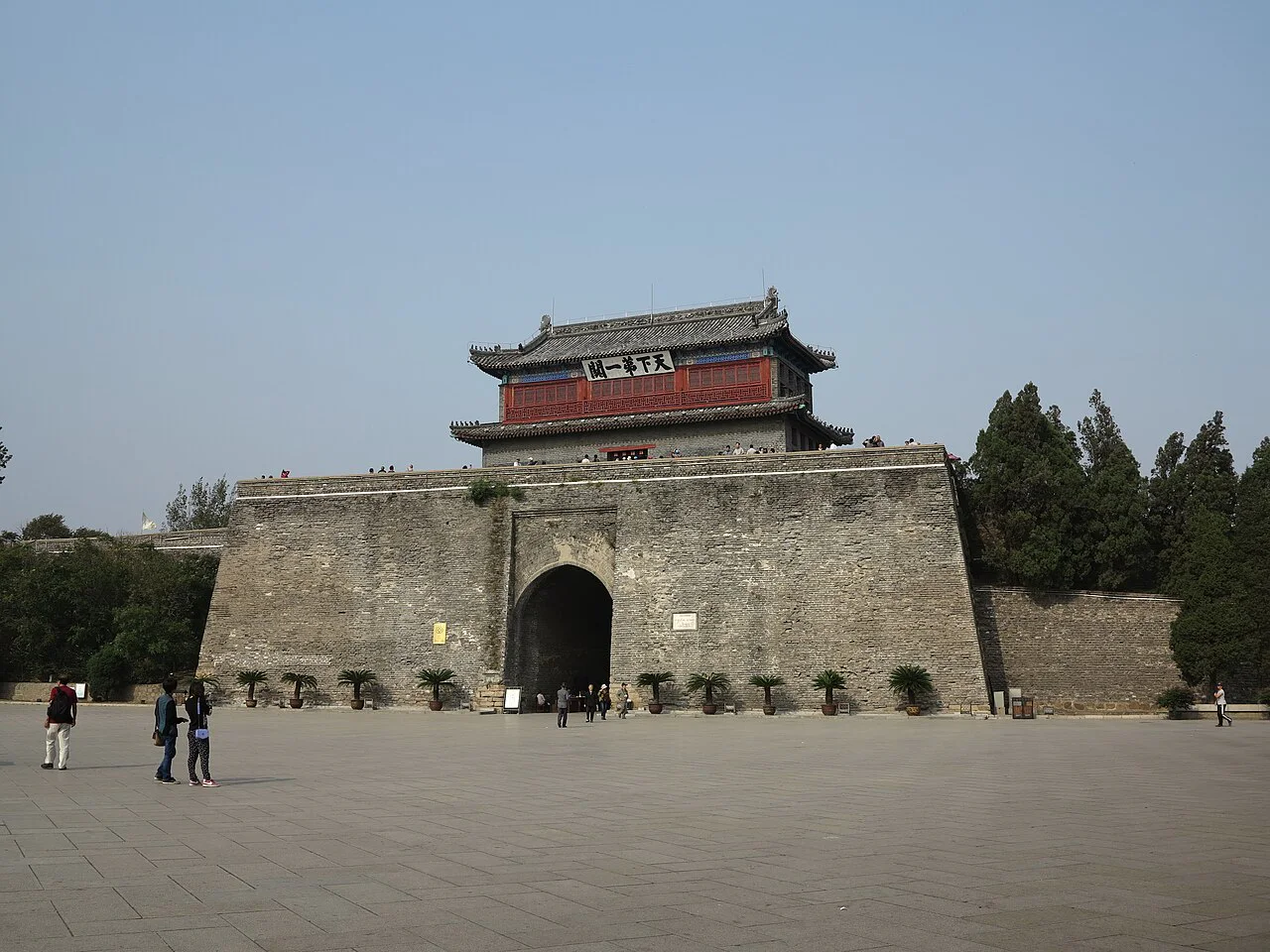
Qinhuangdao
山海关
Content & sources
Nyx Ning · CC BY-SA 3.0
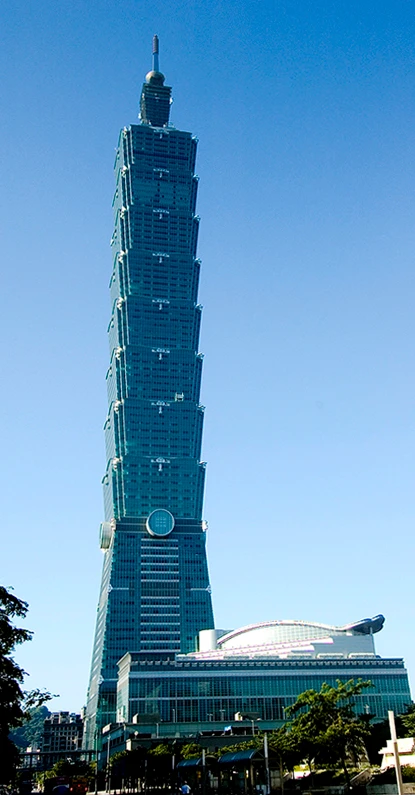
Taipei
Taipei 101
Content & sources
Alton.arts at English Wikipedia · CC BY 2.5