Stanza · Audio guide
Saints Cyril and Methodius Cathedral Audio Guide
A place to remember. A story to take with you.
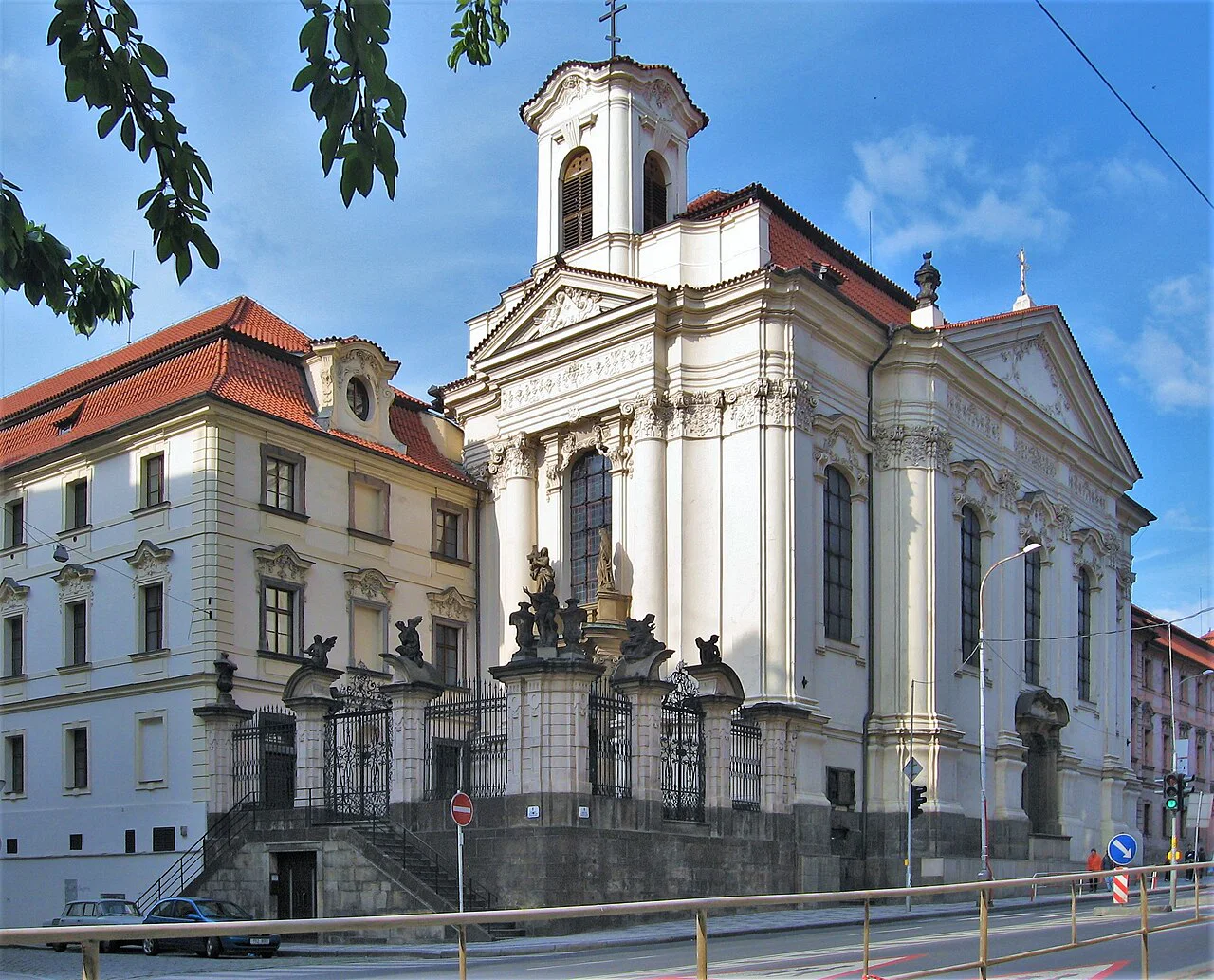
The Saints Cyril and Methodius Cathedral is located in Nové Město, Prague. It serves as the principal Czech and Slovak Orthodox Church.
Download Stanza, then search for “Saints Cyril and Methodius Cathedral”.
About the tour
One guide. Your kind of visit.
The Saints Cyril and Methodius Cathedral is located in Nové Město, Prague. It serves as the principal Czech and Slovak Orthodox Church.
Ready when you are.
- 01Get the free Stanza app.
iOS & Android
- 02Find your guide.
“Saints Cyril and Methodius Cathedral”
- 03Download before you go.
Works offline
Audio guide / 11 narrated stops
Inside the guide
Get to know a few of the stories before you go. Open a stop to read more.
01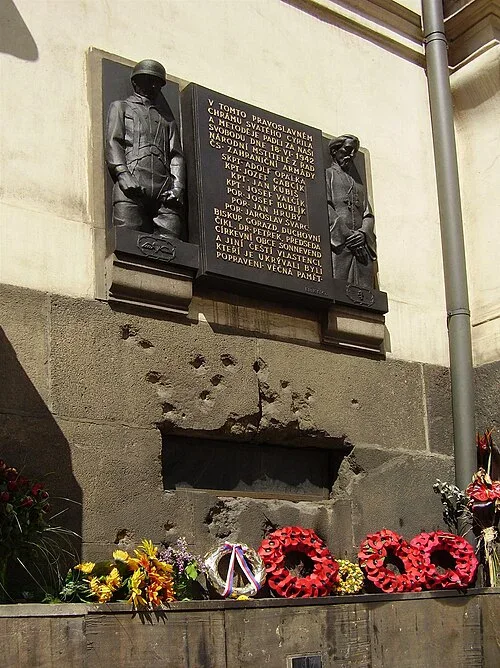 Resslova Street Exterior and Bullet-Scarred Crypt Window
Memorial Plaque to the Paratroopers and Priests
Welcome to the cathedral of Saints Cyril and Methodius, a Baroque church in Prague's New Town that carries one of the city's heaviest wartime stories. The bronze plaque here carries relief portraits of the parachutists who died in this church and of Bishop Gorazd. They stand for the two groups this place remembers, the parachutists and the clergy who died with them in 1942. The inscription names seven Czechoslovak soldiers, among them Jan Kubiš and Jozef Gabčík, who took part in the attack on Reinhard Heydrich, the man who governed occupied Bohemia and Moravia. After them come the names of Orthodox priests who sheltered the soldiers and paid with their lives. The stone around the plaque is pitted with marks from German machine-gun fire. Fresh wreaths and flowers lean against the wall below, left by people who still come. The fight itself is waiting a few steps away, at the small window set low in this same wall.
Honza Groh · CC BY 3.0
02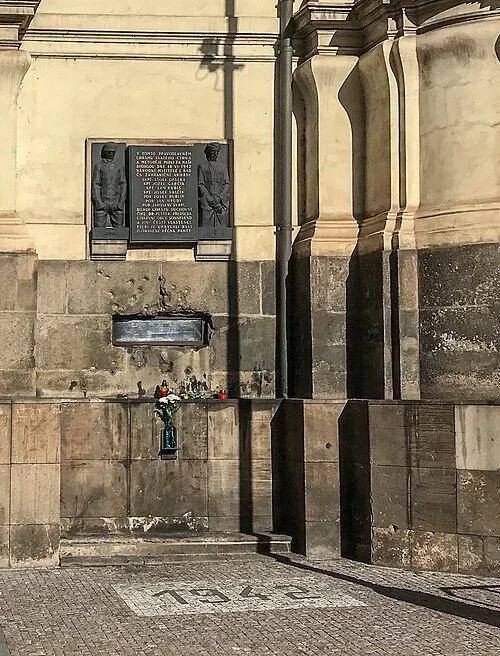 Resslova Street Exterior and Bullet-Scarred Crypt Window
Bullet-Scarred Crypt Window from Resslova Street
This pale Baroque building is the principal Czech and Slovak Orthodox cathedral, and it is also a national memorial. The reason sits at street level: a small window, barred, opening into the crypt below the church. Its surrounding stone is chewed with bullet gouges, the most visible trace of what happened here on 18 June 1942. That morning, about eight hundred men of the Gestapo and the Waffen-SS surrounded the building. They had learned that seven Czechoslovak parachutists, the agents behind the assassination of Reinhard Heydrich, were hiding inside. The order was to take them alive. A fierce gun battle followed, and by its end all seven defenders were dead, killed in the fighting or by their own hand rather than be captured. The date 1942 is set into the cobblestones of Resslova Street, so the year itself has become part of the pavement.
Vit · CC BY-SA 4.0
03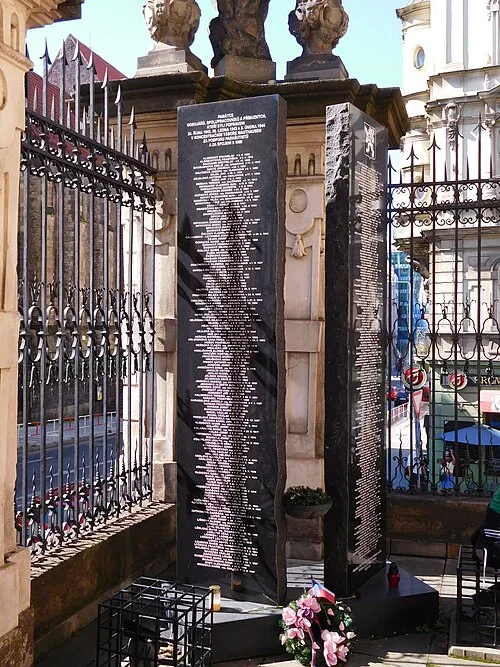 Elevated Terrace and World War II Victims Monument
Memorial to the Victims of the Heydrichiade
Revenge for the Heydrich assassination did not stop with the parachutists. The Nazis turned on anyone who had helped them, and on many who had not. Two hundred and sixty-two Czech supporters were arrested, transported to the concentration camp at Mauthausen, and shot there on 24 October 1942. Nine members of this cathedral's own congregation died among them. These tall dark stone columns carry their answer: name after name, cut in long lines from top to bottom. The lists run on and on, column beside column, and their sheer length is the point. Reading them takes longer than the arrests that sealed those fates did. A wreath with a Czech flag lies at the foot of the columns, renewed by visitors.
Listen in the appPhoto: JiriMatejicek · CC BY-SA 3.0
04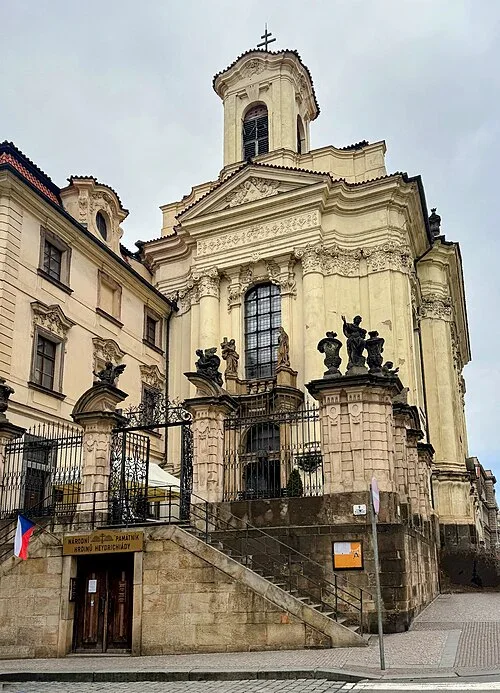 Main Baroque Portal and Entrance
Baroque Portal of the Church of St. Charles Borromeo
Long before the war, this was a Roman Catholic church dedicated to Saint Charles Borromeo, the Milanese archbishop honoured as a patron of the sick and suffering. In 1705 the Archbishop of Prague, Breuner, founded a home for retired priests on this spot, and the church was built to serve it. Work began in 1730 under the architect Pavel Ignác Bayer. After Bayer's death the project passed through other hands and was finished by Kilian Ignaz Dientzenhofer, the great name of Czech Baroque, who completed the building in 1740. The stone statues of Faith and Justice above the main entrance survive from that campaign. The steep stairs are not just ceremony. The church stands on a slate rock terrace raised three to four metres above the street, because when old Prague was cleared in the late nineteenth century the whole district was levelled down and today's Resslova Street was cut through.
Listen in the appPhoto: СЕРП75ДНІПРО · CC BY-SA 4.0
05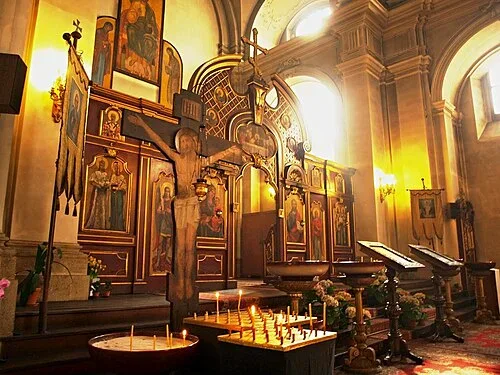 Main Church Nave and Orthodox Iconostasis
The Iconostasis and the Orthodox Cathedral of 1935
In 1935 this former Catholic church was consecrated as the Orthodox cathedral of Saints Cyril and Methodius, the two Byzantine missionaries who brought Christianity to the Slavs. The change is visible in the heart of the nave. An icon screen now closes off the sanctuary in the Orthodox manner, crowded with painted icons, with a large crucifix before it and candle stands where worshippers light their own thin candles. The Baroque interior and the Orthodox furnishing sit together, nearly two centuries apart. The dedication was no accident, and Prague newspapers made much of it at the consecration. Tradition says that Saint Methodius himself stood on this spot when Duke Bořivoj, the first Christian ruler of Bohemia, was baptised here with his wife Ludmila. That baptism rests on oral tradition rather than record. What the record does keep is the old name of the neighbouring street, Na Zderaze, which recalls a Czech lord of the eleventh century.
Listen in the appVit · CC BY-SA 4.0
06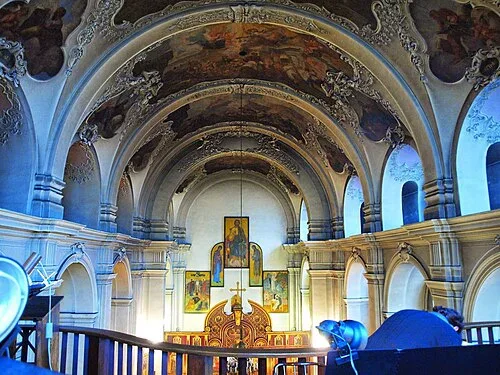 Main Church Nave and Orthodox Iconostasis
Baroque Vault and Side Galleries
The ceiling rewards a raised chin. The vault of this single-nave hall church is covered in painting, framed by lively Baroque stucco that swirls around the windows and arches. The stucco work was done by Michal Ignác Palliardi, who worked on the decoration in 1739. Along the sides, elevated galleries run the length of the nave, giving the hall its layered look. This is a working cathedral, not a frozen monument. The interior was reconstructed in 1998, and a metal plaque in the church records who earned the credit. Then in May 2012 the interior was freshly whitewashed again. The paint keeps going on, and the candles keep being lit.
Listen in the appVit · CC BY-SA 4.0
07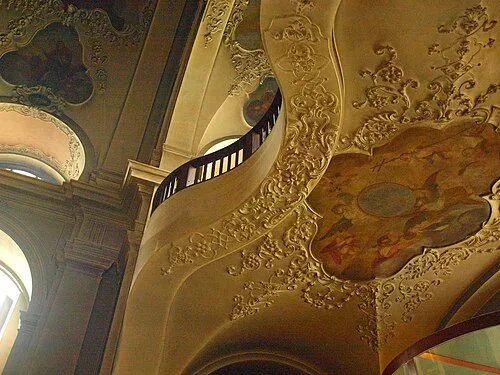 Choir Loft and Gallery Battle Site
The Choir Loft Battle Site
When the SS stormed the church, the fight began up here at the level of the nave and the choir gallery. Three of the seven parachutists met them: Adolf Opálka, Jan Kubiš and Josef Bublík. They defended the nave and the loft, and all three fell in that defence. The gallery curves overhead in stuccoed sweeps, an elegant frame for a desperate fight. The traces are still there. Bullet gouges from German weapons remain visible today on the gallery railings and on the floor of the loft itself. The men who died up here bought time for the others, who had withdrawn to the crypt below.
Listen in the appVit · CC BY-SA 4.0
08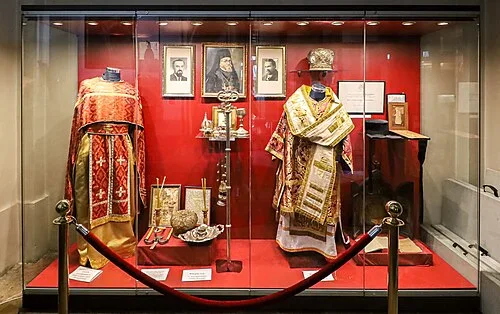 Descent to Underground Crypt and Clergy Memorial
Bishop Gorazd and His Clergy - Memorial Display
The glazed case holds vestments and portraits of the Orthodox clergy of this cathedral, and behind them stands one of the war's quiet acts of courage. Bishop Gorazd, born Matěj Pavlík, had consecrated this building as an Orthodox cathedral in 1935. After the parachutists were hidden in his crypt, he wrote letter after letter, to the prime minister, to the minister of education, to the office of the Reich Protector. In them he took the entire responsibility for the sheltering upon himself, ready to accept any punishment, even death, if his fellow clergy were spared. It did not save them. He was tried on 3 September 1942 together with Father Čikl and the council elder Jan Sonnevend, and all three were condemned. Gorazd and the two men were shot at the Kobylisy shooting range the next day. Father Vladimír Petřek followed them to the same place one day later.
Listen in the appVit · CC BY-SA 4.0
09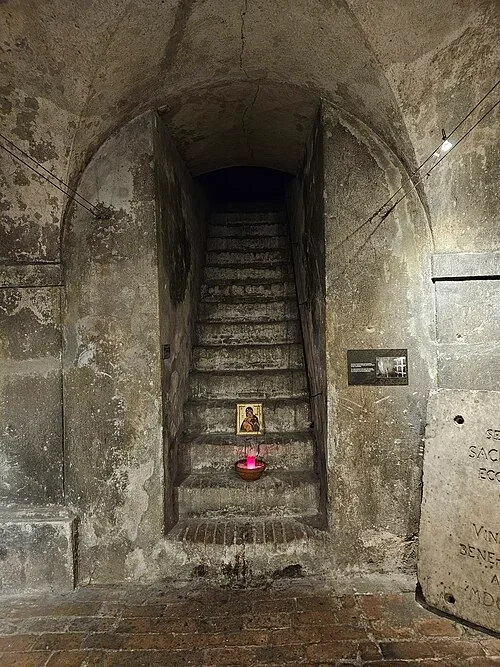 Descent to Underground Crypt and Clergy Memorial
Descent to the Crypt
These narrow stone steps drop from the church into the dark vaults below, and they once carried seven men to safety. After Operation Anthropoid, the attack on Heydrich on 27 May 1942, the seven Czechoslovak parachutists needed somewhere to disappear. Jan Sonnevend, chairman of the parish council, and Father Vladimír Petřek gave them shelter in the crypt beneath this church. The plan was for the hiding place to serve only briefly, until the men could get away. It was one of their own who ended that hope. Karel Čurda, a parachutist from the group Out Distance, later turned informer for the Gestapo and revealed the refuge before the men could escape. The steps are worn and low, the walls rough plaster, a small icon and a candle resting on one of them. What happened next is a few paces further down.
Listen in the appPhoto: VANOCE2022 · CC0
10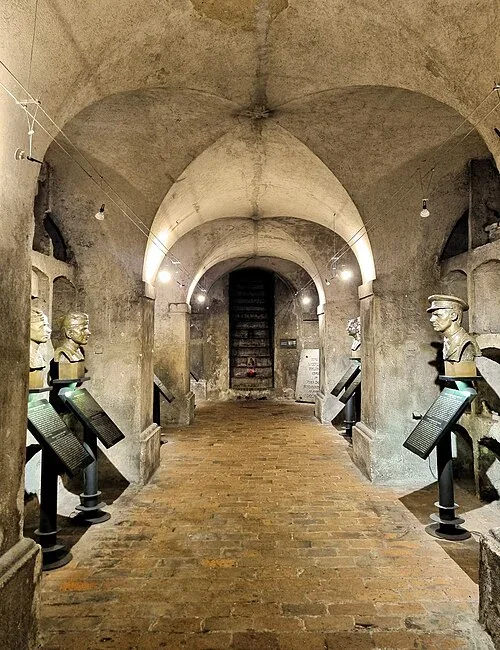 The Crypt Chamber - Heroic Last Stand
The Crypt of the Seven Paratroopers
This brick-vaulted crypt is where the story ends. When the Germans broke in, four of the parachutists refused to surrender. They fought on here in the underground dark, against tear gas and against water pumped in from outside, and kept fighting to the end. Their last four bullets they saved for themselves, rather than be taken alive. Today the crypt is a museum dedicated to the seven men as national heroes, part of the National Memorial to the Heroes of the Heydrichiad. Bronze busts by the sculptor Milan Benda line the vaulted space, one for each of the soldiers, with memorial panels beneath. The arches are rough stone, the floor old brick, and candles burn along the walls. The busts watch over a room that was once their prison, and became their monument.
Listen in the appPhoto: Ondřej Žváček · CC BY 4.0
- 11
The Crypt Wall Hole and Visitors' Tributes
The hole in the crypt wall, the poppies left beside it, and a place of reconciliation.
Saints Cyril and Methodius Cathedral
Frequently asked questions
How much does the guide cost?
Free app download. Listed guide price: $0.99. Guide price shown in the app. Audio guide only. Venue admission is separate.
Can I listen without internet?
Yes. Download the guide’s audio, images, and maps in the app before your visit. Your downloaded content is then available offline.
Can I listen in my language?
This audio guide is available in 15 languages, including English.
Do I need to follow a schedule?
No. This is a self-guided experience. Choose your stops, pause whenever you like, and return to a story at your own pace.
At your own pace
Explore Saints Cyril and Methodius Cathedral.
Download Stanza, then search for “Saints Cyril and Methodius Cathedral”.
Free app download · Guide price shown in the app
Keep exploring
Nearby audio guides
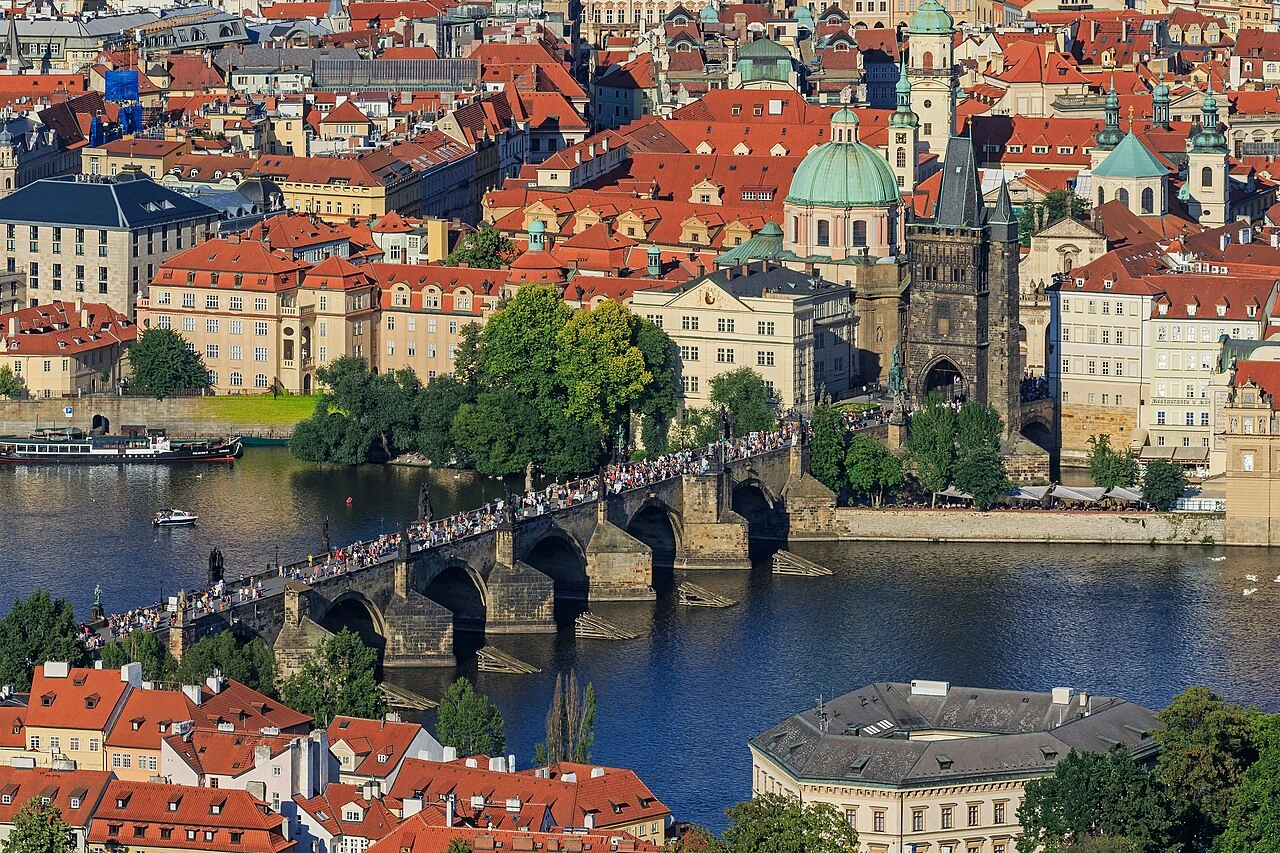
Prague · 1 km
Charles Bridge
Content & sources
Photo: A.Savin · FAL
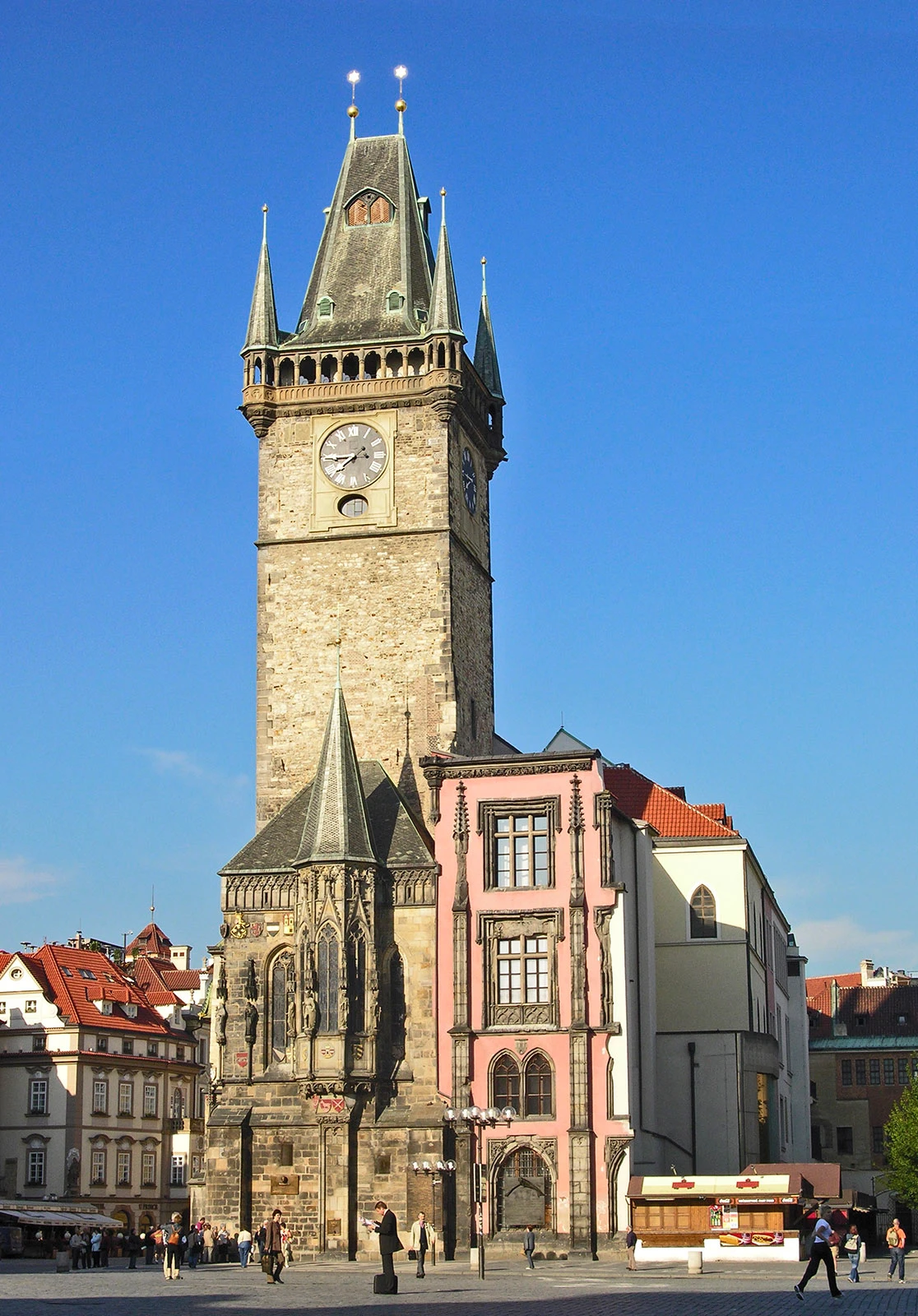
Prague · 1 km
Old Town Hall
Content & sources
Hans Peter Schaefer, http://www.reserv-a-rt.de · CC BY-SA 3.0
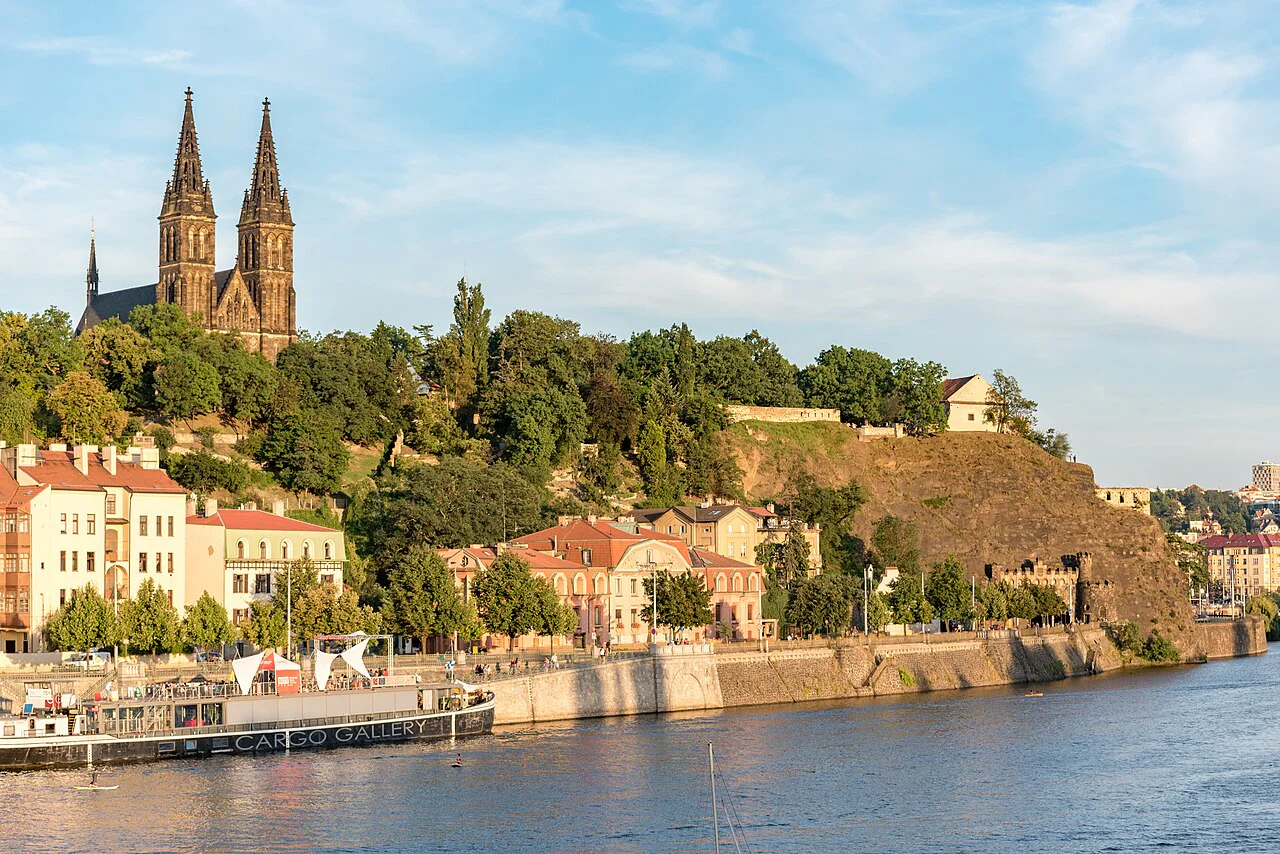
Prague · 1 km
Vyšehrad
Content & sources
Photo: Tilman2007 · CC BY-SA 4.0
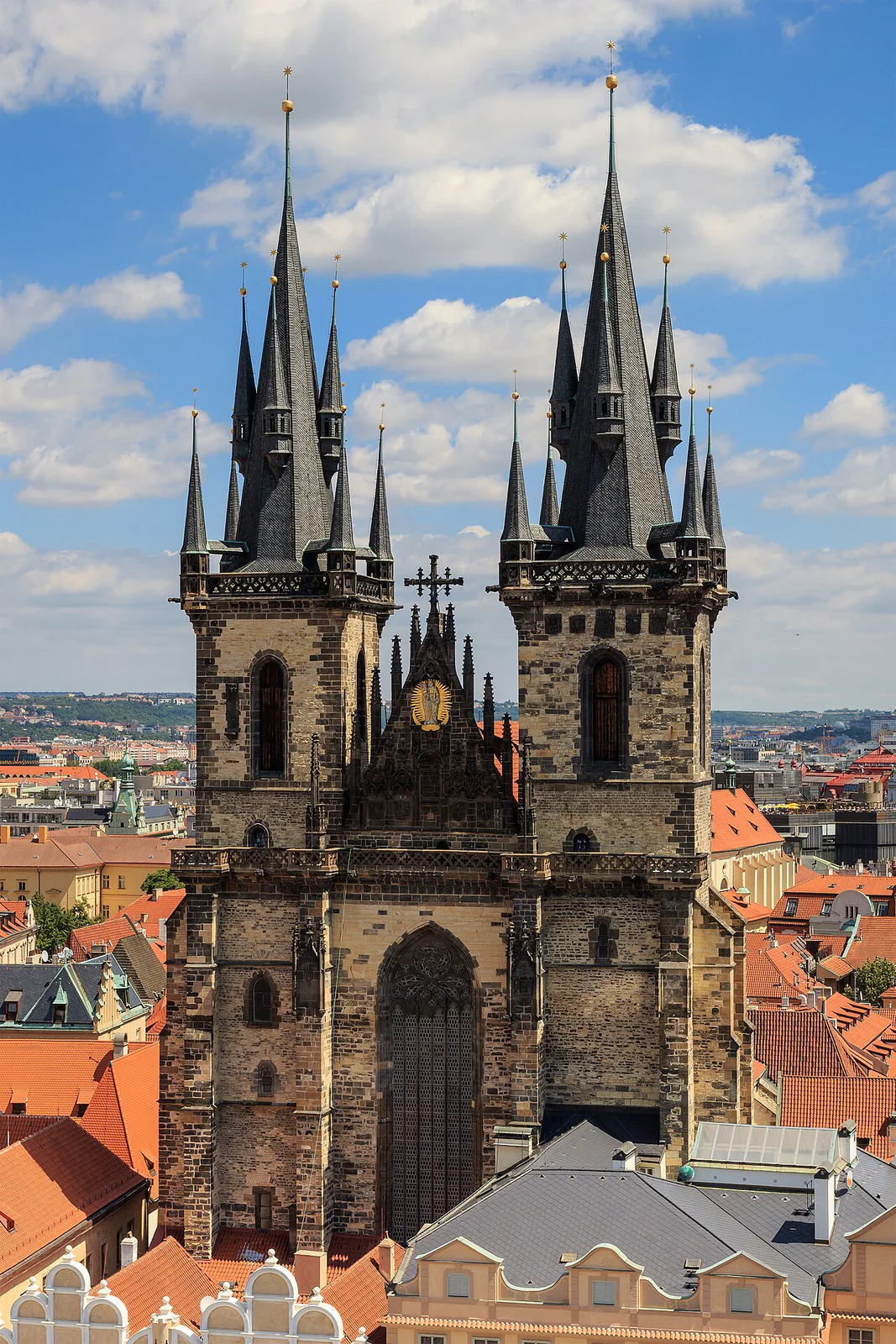
Prague · 1 km
Church of Our Lady before Týn
Content & sources
Photo: A.Savin · FAL