Stanza · Audio guide
Amr ibn al-As Mosque Audio Guide
A place to remember. A story to take with you.
The Amr ibn al-As Mosque is located in the Fustat neighbourhood of Old Cairo and was built in 642 CE. It was the first mosque constructed in Egypt and served as an important centre of Islamic learning for 600…
Download Stanza, then search for “Amr ibn al-As Mosque”.
About the tour
One guide. Your kind of visit.
The Amr ibn al-As Mosque is located in the Fustat neighbourhood of Old Cairo and was built in 642 CE. It was the first mosque constructed in Egypt and served as an important centre of Islamic learning for 600 years.
Ready when you are.
- 01Get the free Stanza app.
iOS & Android
- 02Find your guide.
“Amr ibn al-As Mosque”
- 03Download before you go.
Works offline
Audio guide / 9 narrated stops
Inside the guide
Get to know a few of the stories before you go. Open a stop to read more.
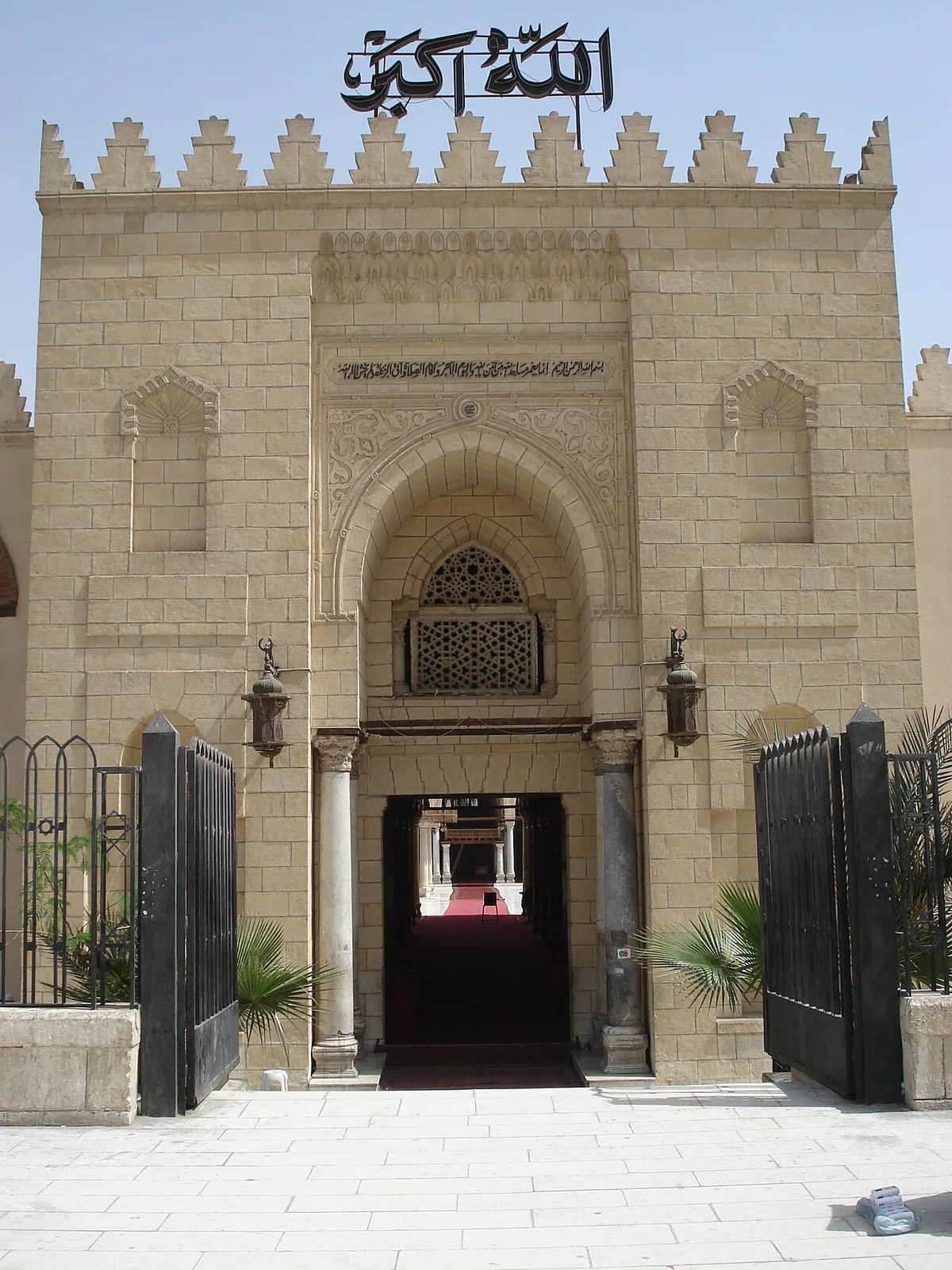
01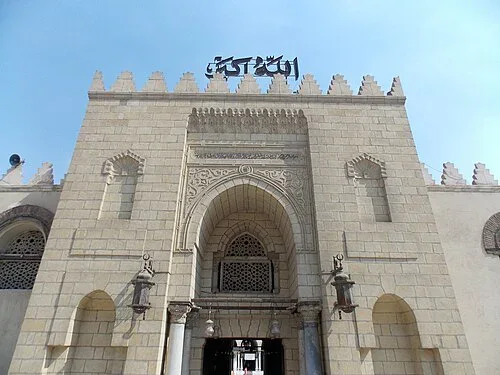 Western Monumental Entrance
The Monumental Western Entrance
Welcome to the Mosque of Amr ibn al-As, in the Fustat district of Old Cairo. Around the year 642, the Arab commander Amr ibn al-As raised a house of prayer here, at the heart of a brand-new capital city. It was the first mosque ever built in Egypt, and one of the first anywhere in Africa. Every mosque on this continent that came after it looks back to this one. Almost nothing of that seventh-century building survives; war, fire and rebuilding have renewed it again and again. Even this grand entrance was partly reconstructed in the 1980s. The mosque is still a living place of worship, with a devout congregation, and it opens to visitors between prayer times. Over the next few stops, its courtyard, its columns and its prayer niches will tell how it earned its old Arabic name: the Crown of Mosques.
Samir I. Sharbaty · CC BY-SA 3.0
02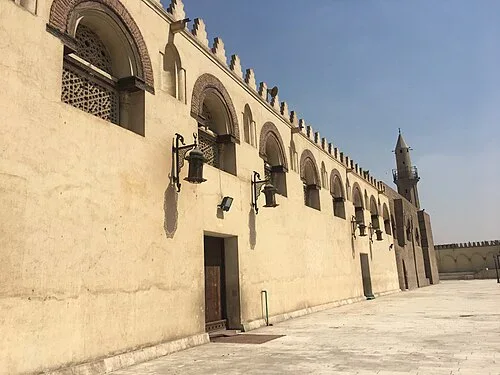 Western Monumental Entrance
The Outer Wall and Minaret
The original mosque of 642 had no minarets at all. It was a low shed, and the call to prayer needed no tower. In 673 the governor Maslama ibn Mukhallad rebuilt the complex and set a minaret at each of its four corners, doubling the mosque's size as he went. From these towers the call to prayer could be heard across the whole of Fustat, and the muezzins of nearby mosques took it up in turn. Under the Fatimids a fifth minaret rose at the entrance, so the mosque once had one at every corner and one more for good measure. All five of those are gone. The towers seen today were built by the Mamluk leader Mourad Bey, who had the dilapidated mosque torn down and rebuilt in 1796, before Napoleon's French expedition reached Egypt. The minarets themselves went up around 1800. During the French occupation, soldiers pulled much of the interior woodwork out and burned it as firewood, which is one reason so much of what stands here is young.
Photo: Eslam elkebeer · CC BY-SA 4.0
03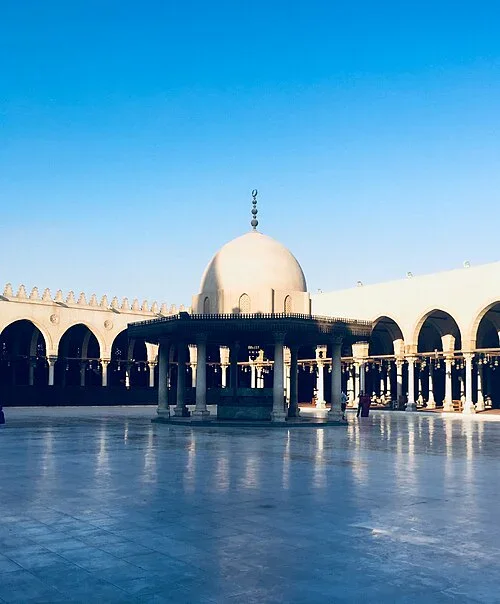 Central Open-Air Courtyard (Sahn)
The Central Courtyard (Sahn)
The story goes that a dove chose this place. In 641, before marching on Alexandria, the commander Amr ibn al-As pitched his tent on the eastern bank of the Nile, and a dove settled there and laid an egg. He took it as a blessing and left the tent undisturbed. When he returned victorious, the Caliph Umar had decreed that the new capital could not sit in far-away Alexandria, so Amr chose the spot of the dove's egg as its centre. He named the city Fustat, the City of the Tents, after the army encampment around it, and built his mosque at the site of his own tent. Whether tent and mosque occupied exactly the same ground is part of the legend; the mosque certainly stands within the old encampment. For centuries this courtyard was the heart of the new capital, a place of gathering and of learning. For six hundred years the mosque was one of the great centres of Islamic scholarship, until the Al-Azhar Mosque, founded by al-Muizz, took over that role.
Listen in the appAbdelrahman Farag · CC BY-SA 4.0
04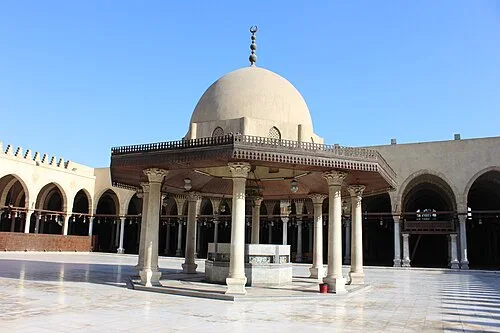 Central Ablution Fountain (Sabil)
The Ablution Fountain
The dome in the middle of the courtyard shelters the ablution fountain. Before prayer, worshippers perform wudu, the ritual washing of hands, face and arms, and here the water is close at hand. The dome rests on eight round marble columns, raising a roof over the basin while the great courtyard around it stays open to the sky. It is a quiet piece of practical design: shade and water at the centre, everything else left to the light. When the basin is busy before prayer time, it is one of the few places in the mosque where the building's daily purpose is on full show.
Listen in the appلا روسا · CC BY-SA 4.0
05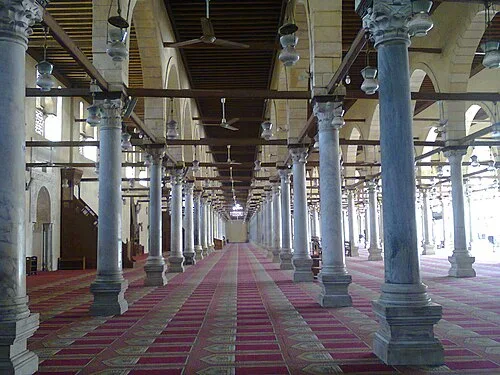 The Forest of Spolia Columns
The Prayer Hall Colonnade
The first mosque on this spot was a humble rectangle, about twenty-nine metres long and seventeen wide. Its columns were split palm tree trunks, its walls of stone and mud brick, its roof of wood and palm leaves, and its floor of gravel. There were no adornments and no minarets, only enough room for the commander's army to pray. From that shed the mosque grew for nearly two centuries. In 698, Abd al-Aziz ibn Marwan enlarged it once more. In 827, under the governor Abd Allah ibn Tahir, new aisles were built parallel to the qibla wall, the wall facing Mecca, and the mosque reached roughly its present size, about a hundred and twenty metres long. Nothing of the original building remains; the hall around you is the sum of more than thirteen hundred years of rebuilding. In the northeast corner of this hall, a domed structure is associated with Abd Allah, the son of the founder, and still draws pilgrims.
Listen in the appPhoto: Baldiri · CC BY-SA 3.0
06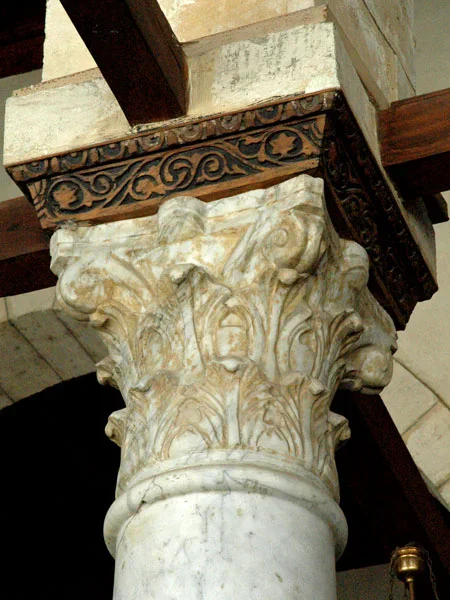 The Forest of Spolia Columns
A Recycled Classical Capital
This capital, with its acanthus leaves carved in marble, was not made for this mosque. The prayer hall's columns were salvaged from older Roman, Byzantine and Coptic buildings across Egypt, which is why no two neighbouring capitals quite match. Builders in the early Islamic city reused whatever fine stone and marble they could find, and the result is a forest of columns, each one carrying a different past. Above the capital sits a dark wooden beam, carved with scrolling foliage. This is an architrave, the beam that ties the last column of each row back to the wall. The only older fabric of the mosque still visible is a set of these architraves along the southern wall, probably added during the reconstruction of 827. Look along the rows and the mismatched capitals tell the story on their own: this hall was assembled, not built in one go.
Listen in the appPhoto: Baldiri · CC BY-SA 3.0
07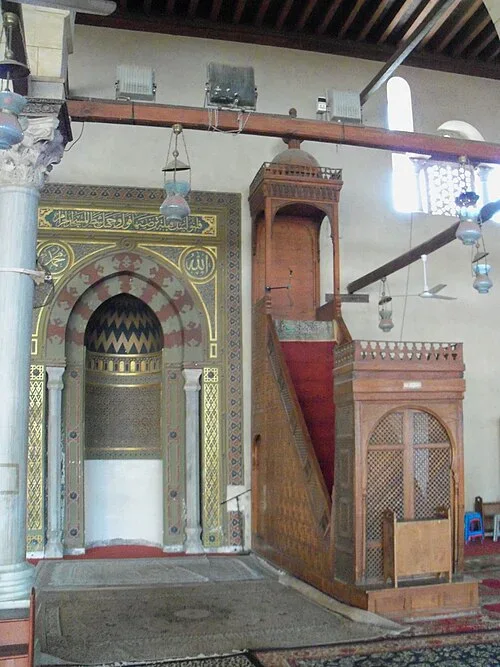 The Mihrabs and Minbars
The Mihrab and Minbar
The first mosque had no prayer niche at all. To show the direction of Mecca, four columns were simply set into the qibla wall, pointing the way. In 711, a concave niche was added in place of the flat marking, and that shape, the mihrab, became the feature that marks the direction of prayer in mosques ever after. The one here is richly decorated, with a pointed arch and bands of inscription above it. Beside it stands the minbar, the stepped wooden pulpit. From its stairs the preacher climbs to deliver the Friday sermon, addressing the congregation seated across the hall. Between the niche and the pulpit, this corner of the qibla wall holds the spiritual focus of the whole mosque, as it has for well over a thousand years.
Listen in the appPhoto: Protious · CC0
08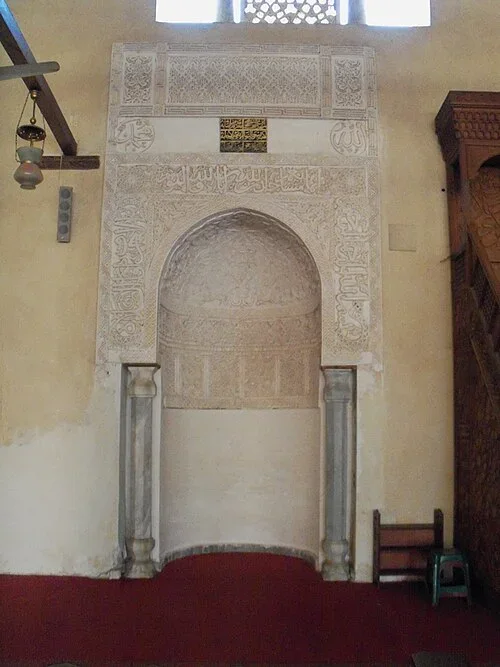 The Mihrabs and Minbars
The Second Mihrab
A mosque normally has one prayer niche, but this qibla wall carries two, side by side, which is a rare arrangement. Why the builders gave the wall a second mihrab is a puzzle the old accounts do not settle. What the carving here does show is how later patrons kept adorning the prayer wall. Across the medieval centuries, restorers re-covered the wall with stucco work, layer upon layer of pattern and inscription. One Fatimid caliph, al-Mustansir, is recorded as adding a silver belt to a prayer niche here. The same record says Saladin had it removed when he restored the mosque, though which of the two niches it graced is not stated. The carved niche itself, with its fluted half-dome and marble columns, is what remains of that long tradition of embellishment.
Listen in the appPhoto: Protious · CC0
09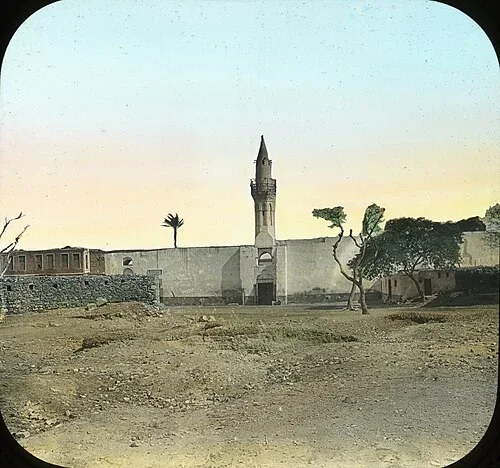 The Southern Wall and Historical Legacy
The Mosque in an Early Photograph
In 1169, with Crusader armies advancing on Egypt, the country's own vizier, Shawar, ordered Fustat burned, to deny the city to the enemy. The blaze destroyed the capital, and the mosque was left ruined among the ashes. After the Crusaders were expelled and Nur al-Din's army took the country, Saladin came to power and had the mosque rebuilt in 1179, adding a belvedere below one of its minarets. That was far from the last renewal. Mourad Bey rebuilt the mosque in 1796, it was rebuilt again in 1875, and it was restored in the twentieth century under Abbas Helmi II. Nearly everything visible in the mosque today is the work of later generations. What has never changed is the purpose of the place: since the 640s, this has been a house of prayer, and each generation that inherited it chose to rebuild it rather than let it go.
Listen in the appBrooklyn Museum · No restrictions
Amr ibn al-As Mosque
Frequently asked questions
How much does the guide cost?
Free app download. Listed guide price: $0.99. Guide price shown in the app. Audio guide only. Venue admission is separate.
Can I listen without internet?
Yes. Download the guide’s audio, images, and maps in the app before your visit. Your downloaded content is then available offline.
Can I listen in my language?
This audio guide is available in 15 languages, including English.
Do I need to follow a schedule?
No. This is a self-guided experience. Choose your stops, pause whenever you like, and return to a story at your own pace.
At your own pace
Explore Amr ibn al-As Mosque.
Download Stanza, then search for “Amr ibn al-As Mosque”.
Free app download · Guide price shown in the app
Keep exploring
Nearby audio guides
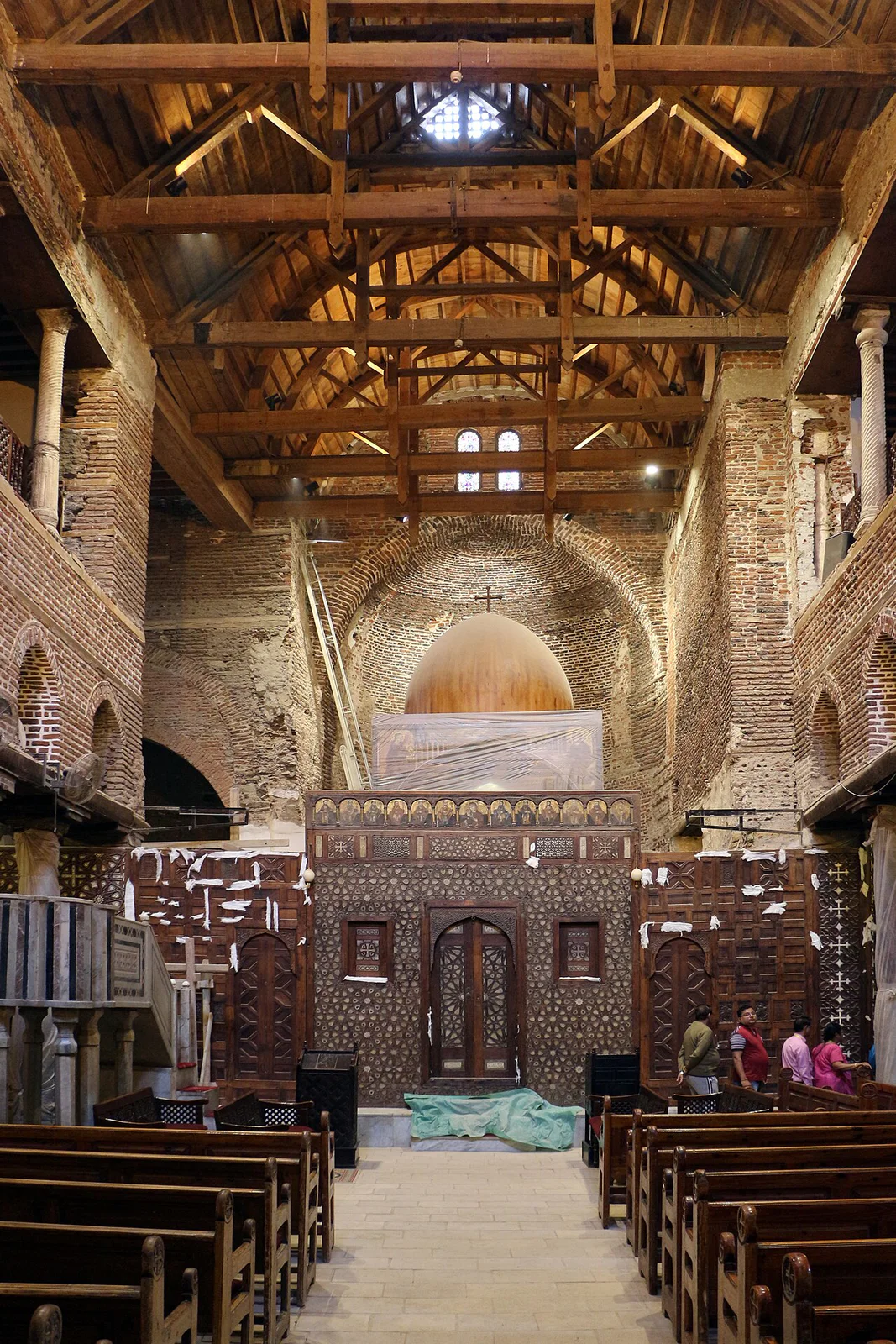
Cairo · 1 km
Saints Sergius and Bacchus Church
Content & sources
Photo: Sailko · CC BY 3.0
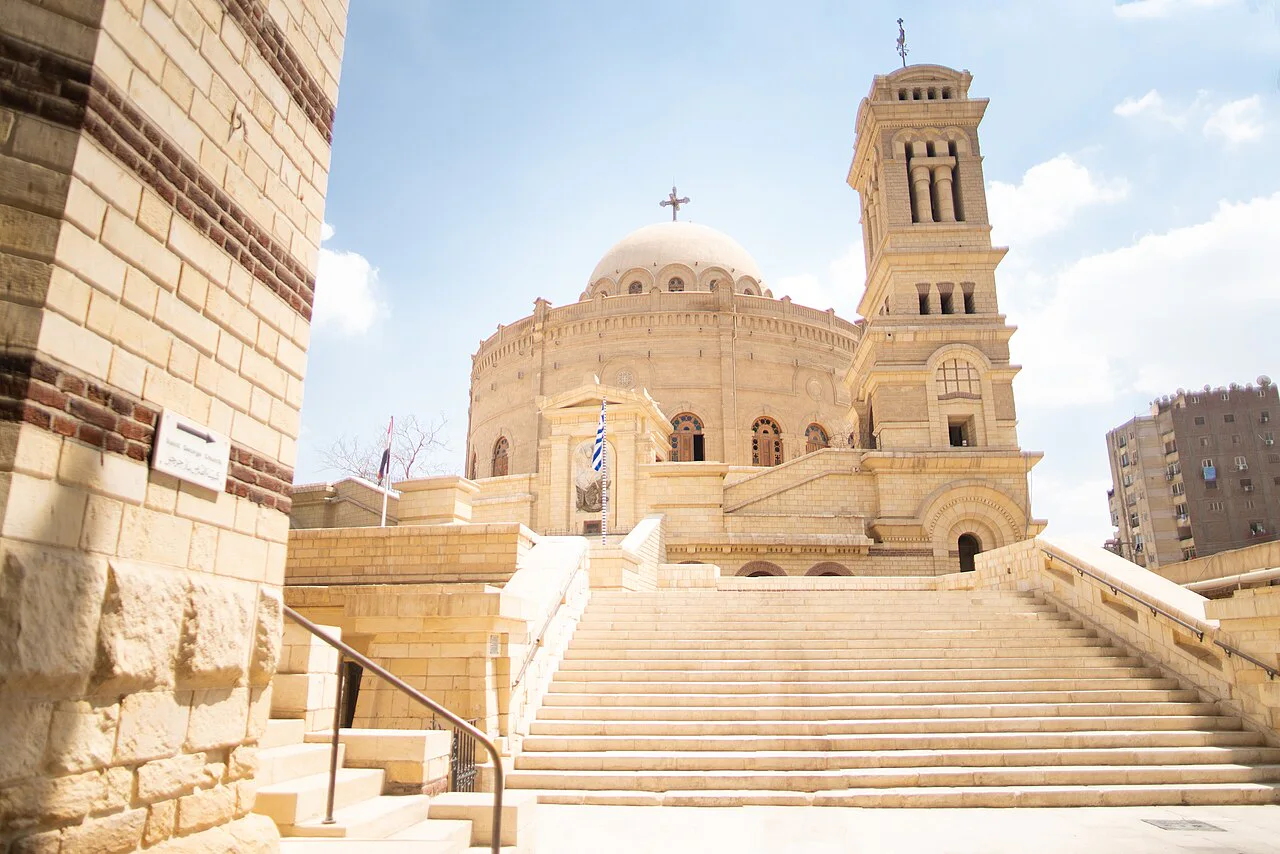
Cairo · 1 km
Church of St. George
Content & sources
Московская духовная академия · CC BY-SA 2.0
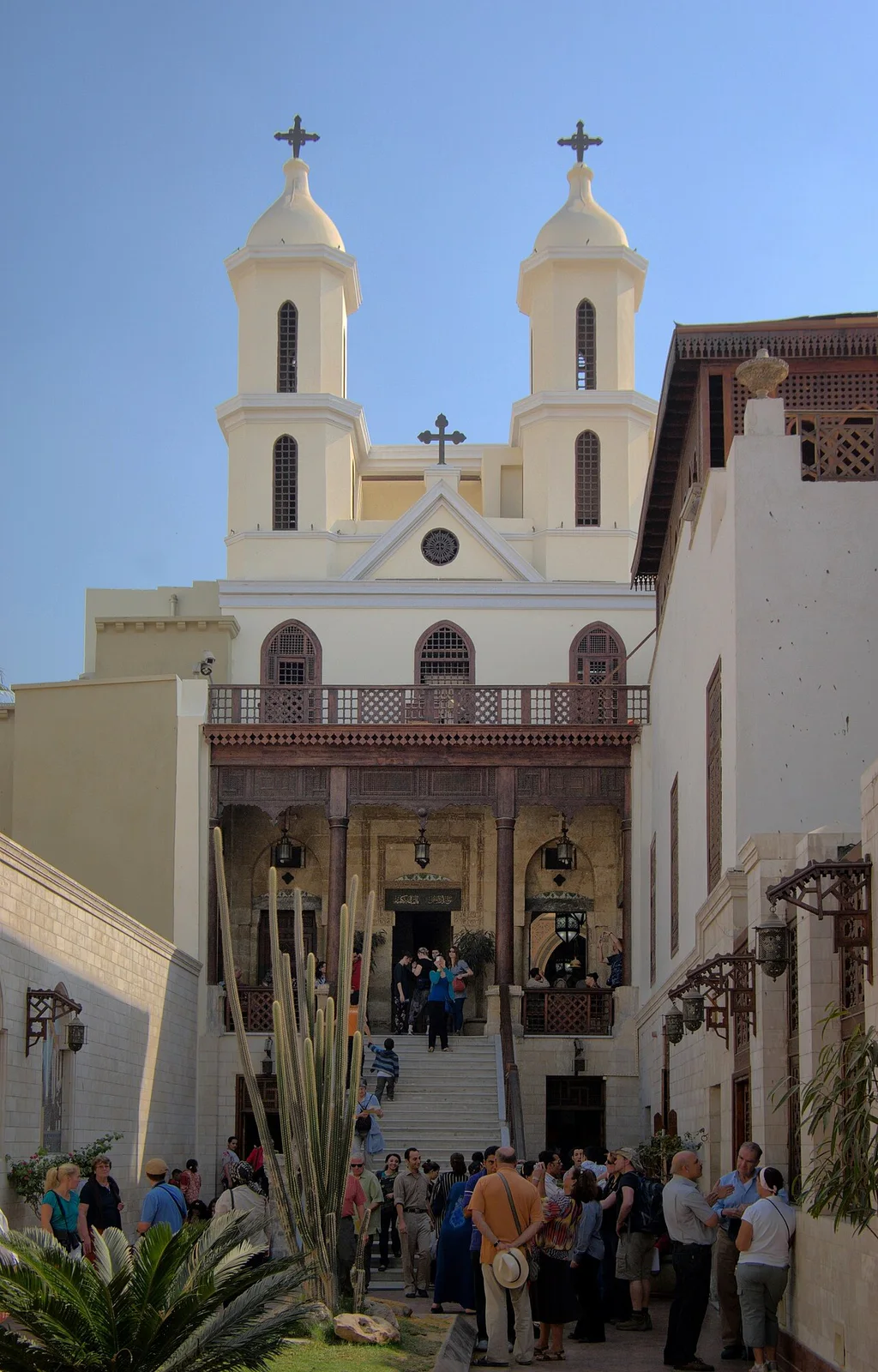
Cairo · 1 km
Hanging Church
Content & sources
Photo: Berthold Werner · CC BY-SA 3.0
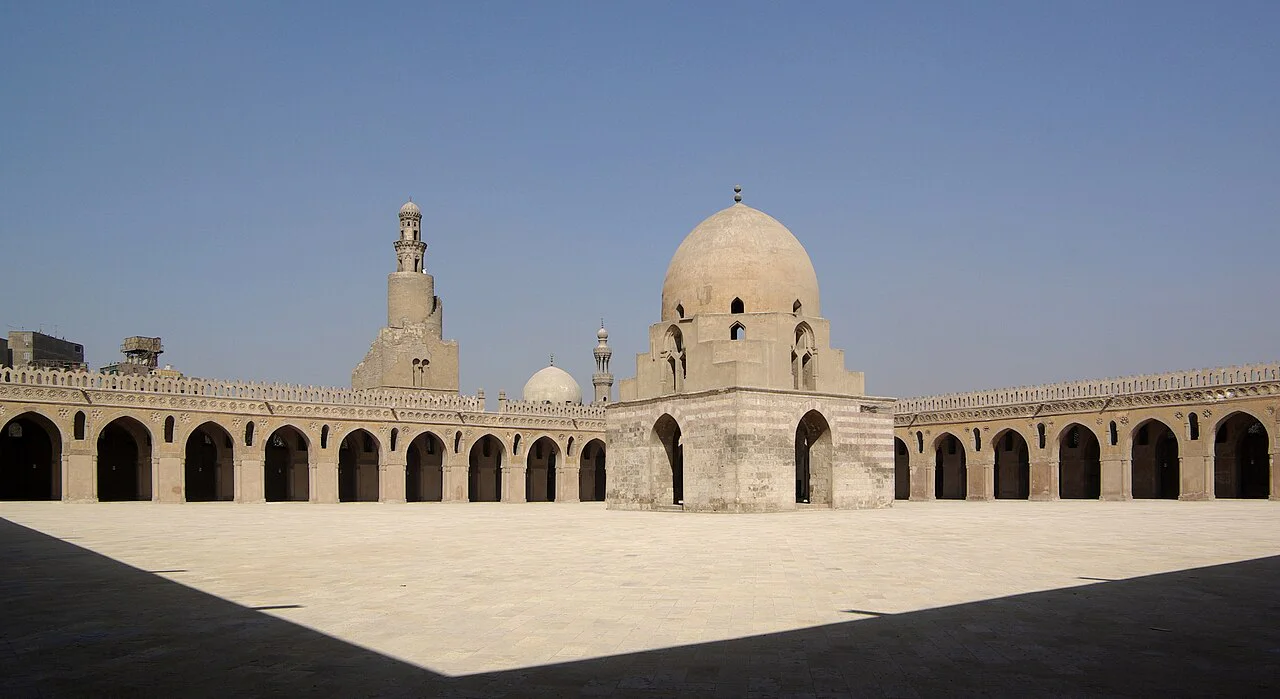
Cairo · 3 km
Mosque of Ibn Tulun
Content & sources
User:Berthold Werner · CC BY 3.0