Stanza · Audio guide
Church of St. George Audio Guide
A place to remember. A story to take with you.
The Church of St. George is a Greek Orthodox church located within the Babylon Fortress in Coptic Cairo. It is part of the Holy Patriarchal Monastery of St George under the Greek Orthodox Patriarchate of…
Download Stanza, then search for “Church of St. George”.
About the tour
One guide. Your kind of visit.
The Church of St. George is a Greek Orthodox church located within the Babylon Fortress in Coptic Cairo. It is part of the Holy Patriarchal Monastery of St George under the Greek Orthodox Patriarchate of Alexandria and all Africa.
Ready when you are.
- 01Get the free Stanza app.
iOS & Android
- 02Find your guide.
“Church of St. George”
- 03Download before you go.
Works offline
Audio guide / 9 narrated stops
Inside the guide
Get to know a few of the stories before you go. Open a stop to read more.
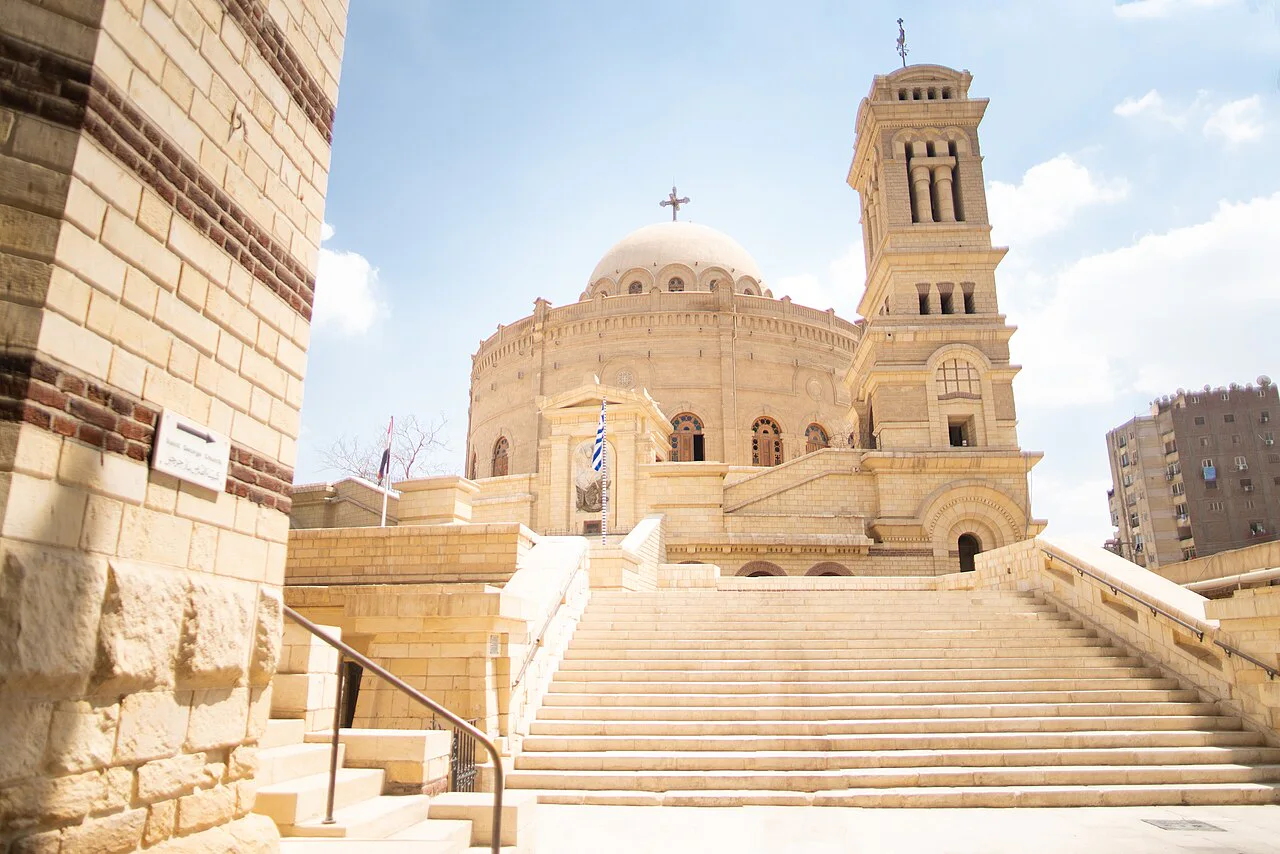
01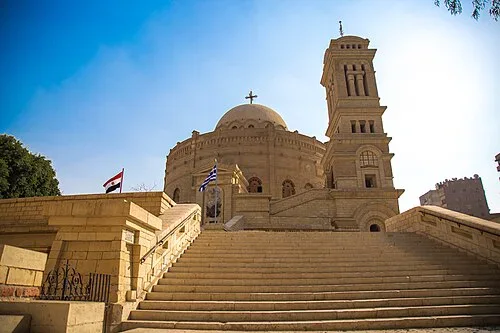 The Roman Bastion and Monastery Gate
The Round Church Above the Roman Tower
Welcome to the Church of St George, in the old quarter of Coptic Cairo. It belongs to the Greek Orthodox Patriarchate of Alexandria and all Africa. The first thing to notice is its shape. Everything about it is round: the great drum of the walls, the dome on top, even the way the staircase climbs toward it. It is the only round church in Egypt. And it sits high above the street for a reason. The whole building rests directly on a massive tower of the Babylon Fortress, a Roman stronghold that once guarded this stretch of the Nile. Roman engineers raised that tower centuries before any church stood here. Christians later moved in, building chapels and monasteries inside the fortress walls. A church on this spot goes back to the tenth century, or earlier. So the story begins with imperial defense, and slowly becomes a story of prayer. The staircase in front of you climbs the Roman masonry itself, from the old fortress floor up to the church door.
Photo: Mohammedghorayeb · CC BY-SA 4.0
02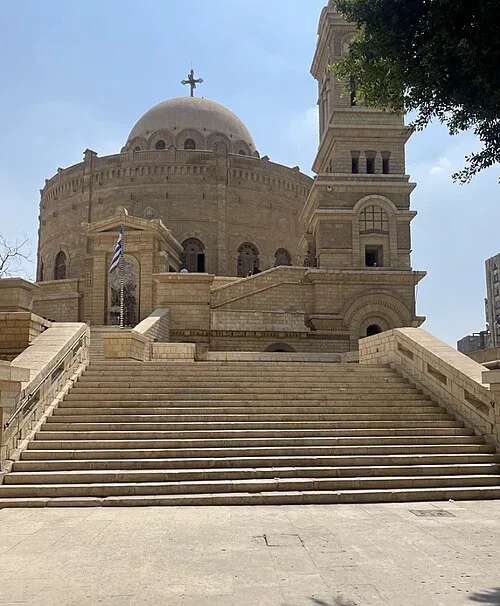 The Roman Bastion and Monastery Gate
Fire and Rebirth: the 1909 Rotunda
The church in front of you is younger than it looks. A fire swept through the medieval building in 1904, destroying most of what centuries had left. The Greek Orthodox Patriarchate answered with a full rebuilding. Work began on a new domed rotunda, rising again on the old Roman tower. It was finished in 1909, five years after the fire. So the stone facade, the dome and the bell tower all come from that one campaign. They are the work of the twentieth century, not survivors of the Middle Ages. The district around it keeps an older name for the church, in Arabic: Mar Girgis. Much of Coptic Cairo answers to that name, and the next stop explains the saint behind it.
Photo: Sphotography13 · CC BY-SA 4.0
03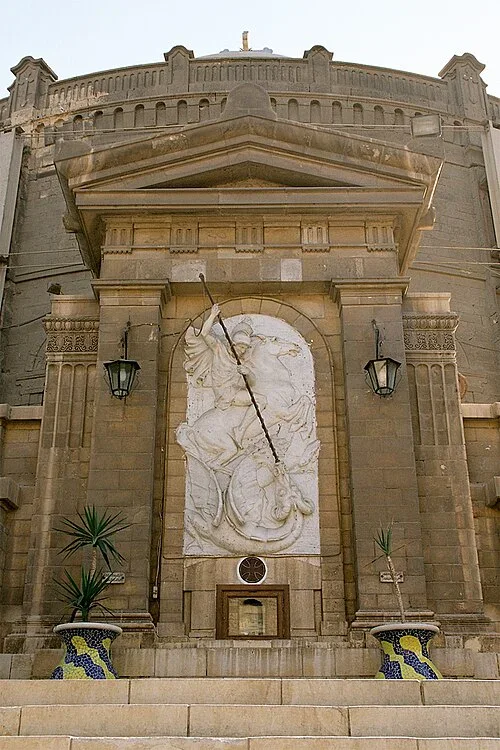 The Grand Entrance and Saint George Relief
Saint George Slaying the Dragon
Above the entrance, carved deep into the stone, Saint George rides into battle. He sits tall on his horse, spear raised, striking down a dragon-like serpent that struggles beneath the hooves. George was a Roman soldier and a martyr, put to death for his faith in the early centuries of Christianity. The dragon came later, in the legends that grew around his cult across the eastern Mediterranean. Those stories made him one of the most beloved saints in the Greek Orthodox world, which is why this monastery carries his name. The carving is the legendary image, not a portrait of a real battle. It tells you at the door exactly whose church this is.
Listen in the appPhoto: Blueshade · CC BY-SA 2.5
04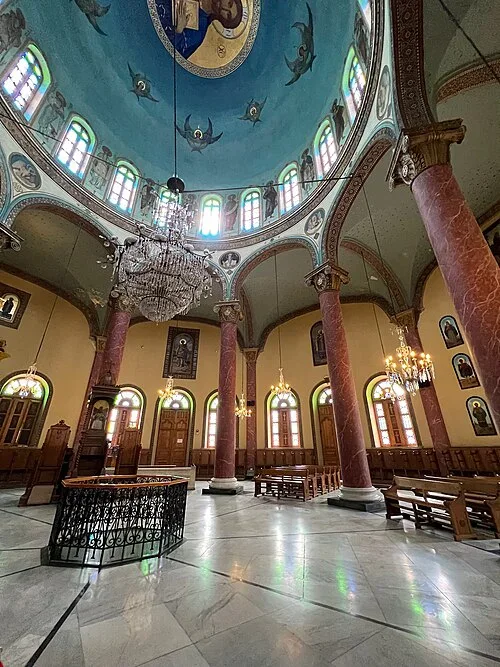 The Circular Nave and Red Marble Columns
Inside Egypt's Only Rotunda Church
Inside, the church opens into a single round hall. Eight great columns of deep red marble stand in a ring, holding the arches that carry the dome. Architects have compared the plan to the Basilica of San Vitale in Ravenna, the famous sixth-century rotunda in Italy. A round church is a rare thing, and it changes how worship feels. There is no long nave pulling the eye toward one end. Instead the faithful gather in the round, and the liturgy still faces the sanctuary, set into the circle. The circle above your head answers the circle below your feet.
Listen in the appPhoto: Sailko · CC BY 3.0
05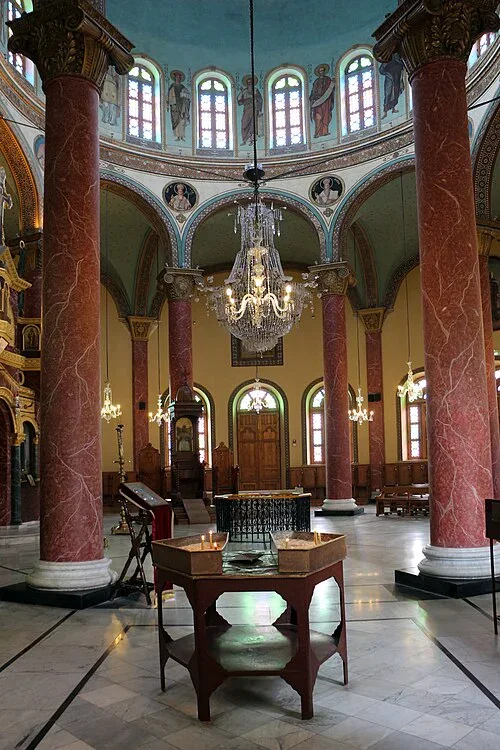 The Circular Nave and Red Marble Columns
The Nilometer in the Floor
At the center of the marble floor, behind a low railing, lies one of the strangest features of any church in Egypt. It is a nilometer, an ancient instrument for measuring the water of the Nile. Every year the river flooded, and the height of that flood decided whether Egypt would eat. Priests and officials had measured it for centuries before Christianity arrived here. A nilometer inside a church ties the Christian building straight back to the older Egyptian world of the river. Exactly how this shaft worked, and where it first stood, are questions still being worked out. But its position is striking either way: the measure of the Nile sits at the very heart of the rotunda, beneath the dome.
Listen in the appPhoto: Sailko · CC BY 3.0
06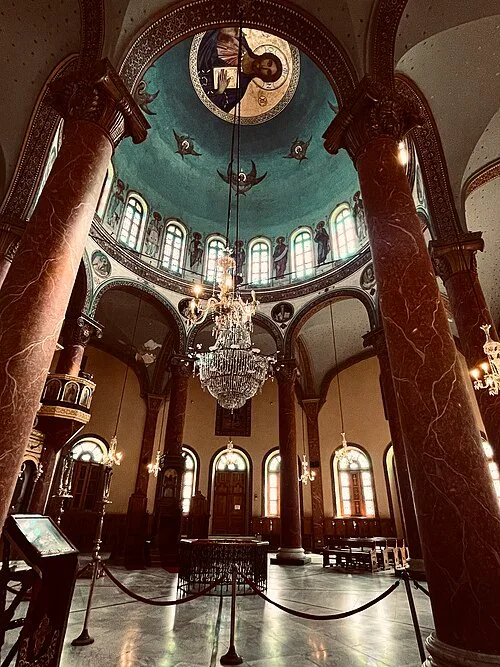 The Celestial Sky-Blue Dome
The Sky-Blue Dome
The dome is the reason many people come. It is painted a deep sky blue, and at its crown Christ looks down over the whole church. Around the base, a ring of arched stained-glass windows lets the light in, colored and soft. In the Byzantine way of building, the dome stands for heaven. It curves over the congregation like the sky over the earth, with Christ at the highest point of all. The 1909 builders gave the rebuilt church this dome as its signature. Everything else in the rotunda, the columns, the arches, the golden light, rises toward it. However long the visit lasts, the dome is the view that stays.
Listen in the appPhoto: Alessiaazari · CC BY 4.0
07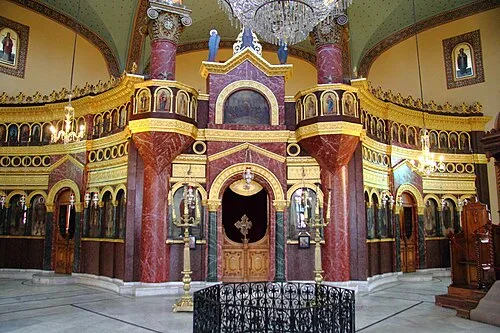 The Golden Iconostasis and Healing Icon
Sanctuary Screen of a Patriarchal Monastery
Across the east side of the church runs the iconostasis, the sanctuary screen. It is a wall of carved and gilded panels, filled with icons, framed in red marble. In Orthodox worship it marks the boundary between two worlds: the nave where the faithful stand, and the sanctuary where the Eucharist is celebrated. The central doors open only at moments of the liturgy, so the screen both hides the holiest space and reveals it. This is no museum piece. The building is the heart of the Holy Patriarchal Monastery of St George, a living seat of the Greek Orthodox Patriarchate of Alexandria and all Africa. The Patriarch's official residence stands within the monastery grounds. A Greek Orthodox stronghold in the middle of a mostly Coptic Orthodox district is unusual, and this monastery has held that place for centuries.
Listen in the appPhoto: Djehouty · CC BY-SA 4.0
08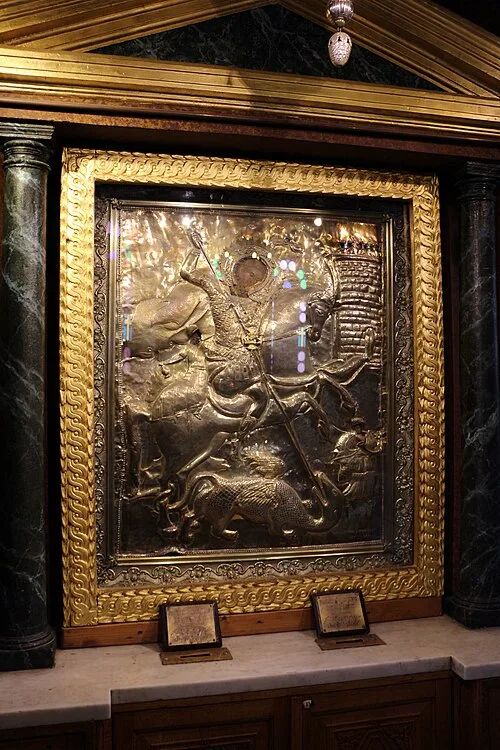 The Golden Iconostasis and Healing Icon
The Miraculous Icon Behind Bronze Bars
The icon of Saint George here is sheathed in silver, beaten into relief around the painted figure. He rides his horse with spear raised, the same image as the carving at the entrance, but worked in metal. Beloved icons were often dressed this way, as generations of pilgrims gave silver in gratitude. This icon has drawn pilgrims for a very long time. In the 1550s a Russian traveler named Vasily Poznyakov visited the monastery and wrote about what he saw. He described an icon of Saint George kept behind bronze bars, to which many miracles and healings were attributed. That is the devotion of pilgrims in his own words, not a claim anyone can test. Whether the icon seen today is the very one he described, nobody can say for certain. But pilgrims have been coming to it for nearly five hundred years.
Listen in the appPhoto: Sailko · CC BY 3.0
09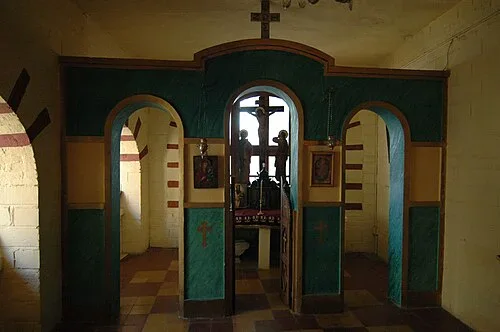 The Holy Family Crypt Chapel
Crypt Chapel in the Roman Tower
Below the church, inside the first level of the Roman fortress, the walls are old and the light is dim. A chapel stands here, simple and painted, its arches cut into the ancient masonry. Tradition holds that a cave on this spot sheltered the Holy Family during their flight into Egypt, when Mary, Joseph and the child Jesus hid from Herod. That is pious legend attached to the place, not something excavation has settled. The lower level holds more than the chapel. In closed areas of this level are chapels and the tombs of former Patriarchs of Alexandria, the leaders of the church this monastery serves. They are not open to visitors now. The layers here tell the whole story at once: a Roman tower, a church raised on top of it, a shrine reborn after fire, and patriarchs buried in its foundations. From fortress stone to living altar, all of it in one building.
Listen in the appFrancesco Gasparetti from Senigallia, Italy · CC BY 2.0
Church of St. George
Frequently asked questions
How much does the guide cost?
Free app download. Listed guide price: Free guide. Guide price shown in the app. Audio guide only. Venue admission is separate.
Can I listen without internet?
Yes. Download the guide’s audio, images, and maps in the app before your visit. Your downloaded content is then available offline.
Can I listen in my language?
This audio guide is available in 15 languages, including English.
Do I need to follow a schedule?
No. This is a self-guided experience. Choose your stops, pause whenever you like, and return to a story at your own pace.
At your own pace
Explore Church of St. George.
Download Stanza, then search for “Church of St. George”.
Free app download · Guide price shown in the app
Keep exploring
Nearby audio guides
Cairo · 1 km
Saints Sergius and Bacchus Church
Content & sources
Photo: Sailko · CC BY 3.0
Cairo · 1 km
Hanging Church
Content & sources
Photo: Berthold Werner · CC BY-SA 3.0
Cairo · 1 km
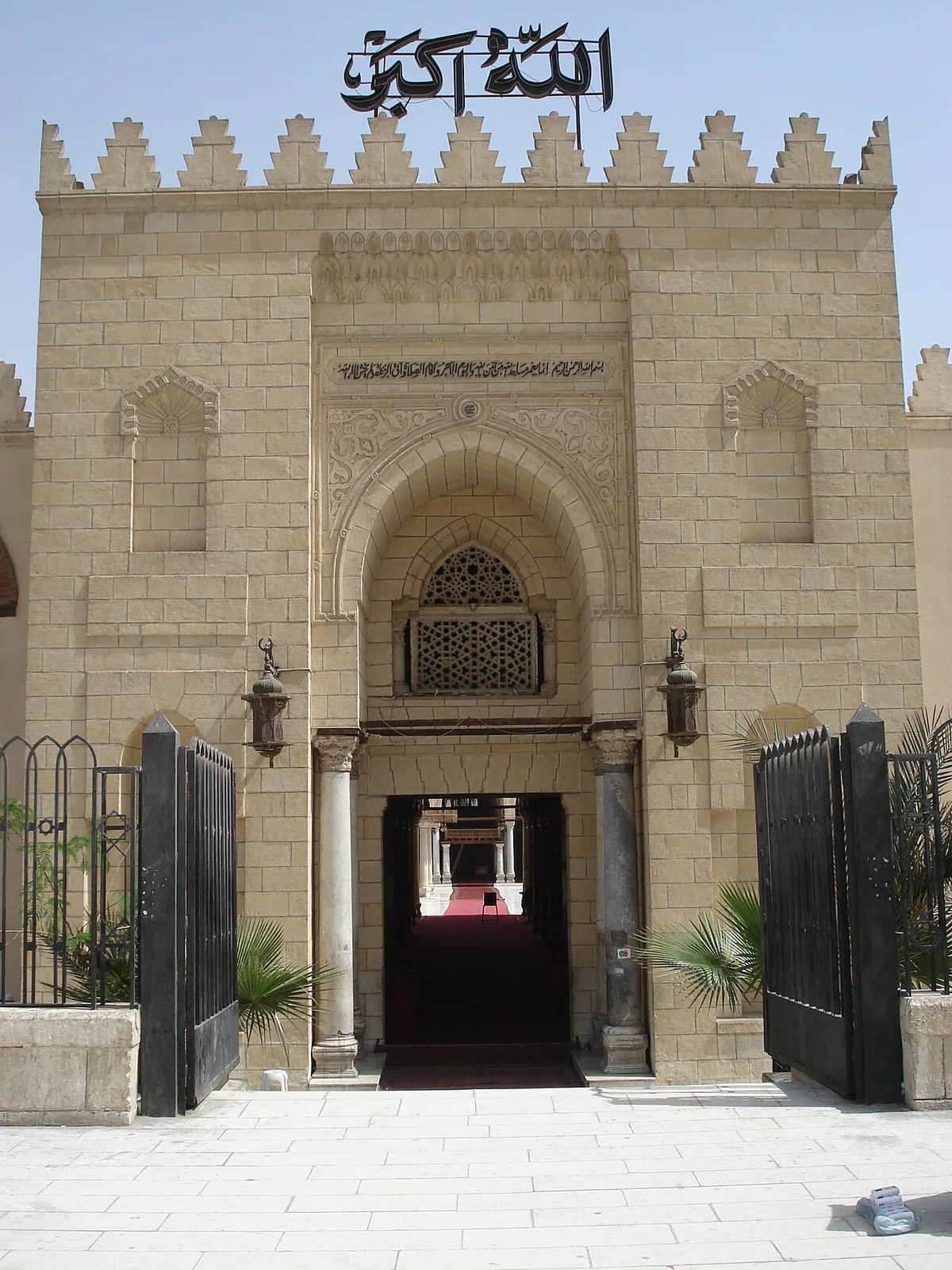
Amr ibn al-As Mosque
Content & sources
Photo: Buyoof · CC BY-SA 3.0
Cairo · 3 km
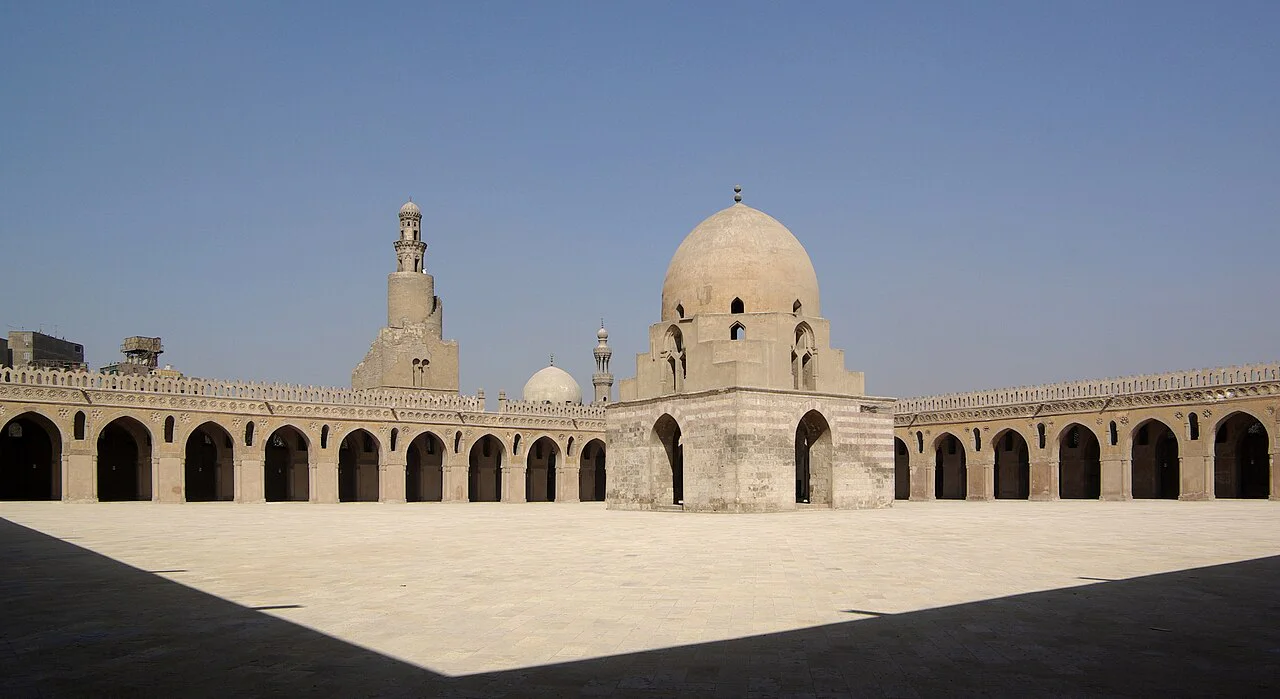
Mosque of Ibn Tulun
Content & sources
User:Berthold Werner · CC BY 3.0