Stanza · Audio guide
Serabit el-Khadim Audio Guide
A place to remember. A story to take with you.
Serabit el-Khadim is an archaeological site in the southwest Sinai Peninsula where ancient Egyptians mined resources such as turquoise. The site contains ancient mining camps and a long-lived Temple of…
Download Stanza, then search for “Serabit el-Khadim”.
About the tour
One guide. Your kind of visit.
Serabit el-Khadim is an archaeological site in the southwest Sinai Peninsula where ancient Egyptians mined resources such as turquoise. The site contains ancient mining camps and a long-lived Temple of Hathor, who was known locally as the mistress of turquoise.
Ready when you are.
- 01Get the free Stanza app.
iOS & Android
- 02Find your guide.
“Serabit el-Khadim”
- 03Download before you go.
Works offline
Audio guide / 14 narrated stops
Inside the guide
Get to know a few of the stories before you go. Open a stop to read more.
01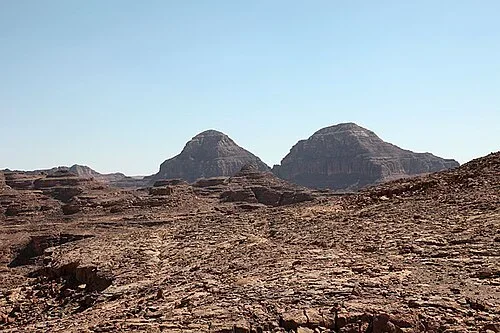 Rod el-Ayr Valley & Mountain Approach
The Desert Plateau of Serabit el-Khadim
Welcome to Serabit el-Khadim, a lonely mountain in the southwest of the Sinai Peninsula. Everything here began with rock that gleamed blue-green. For centuries the ancient Egyptians sent expeditions to these heights to cut turquoise and copper from the mountainside. At the top they built a temple to Hathor, the goddess who protected people in the desert. A temple in empty wilderness sounds strange until you see how the Egyptians thought. The turquoise was worthless to them without the goddess's protection, and the mining expeditions answered to the pharaoh's authority. So the mountain became sacred ground, part shrine and part mining camp. The path ahead climbs through desert ravines to ruins that grew over generations. Those ruins hold stories of kings, miners and a discovery that changed how the world writes.
Roland Unger · CC BY-SA 3.0
02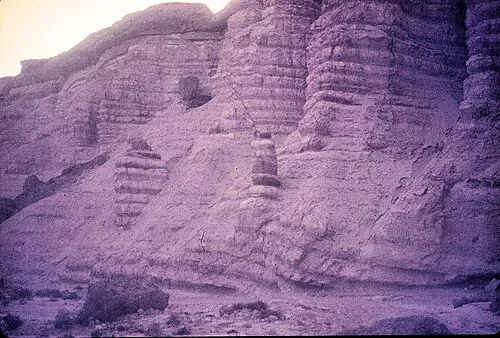 Rod el-Ayr Valley & Mountain Approach
The Ascent Through the Sandstone Ravines
The cliffs here show what any visit to the temple demanded. From the desert floor the route runs up steep ravines of sandstone and out onto a high plateau. There was no road and no river, only heat, rock and the climb itself. What pulled expeditions up this ridge was hidden in the mountain: veins of turquoise threading through the stone. Everything the miners needed had to be carried up the same way, on foot, through this broken ground. The reward for all that effort waits at the top.
רוני קניגסברג · CC BY 2.5
03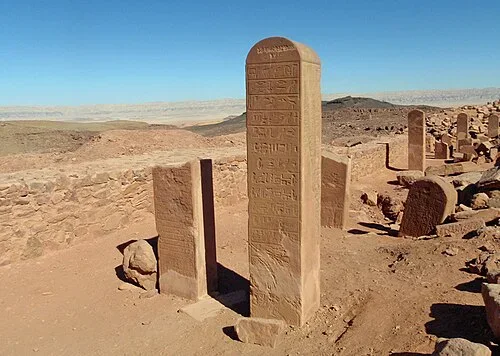 Outer Temple Entrance & Commemorative Stelae
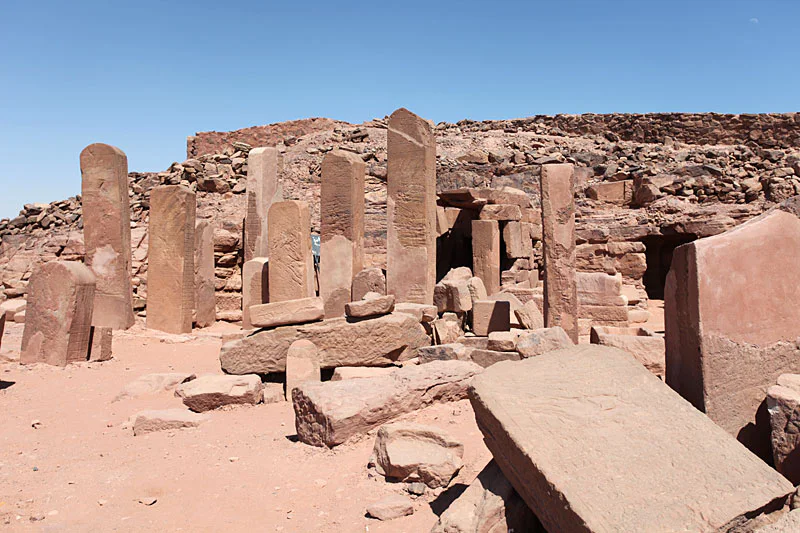
The Standing Stelae at the Temple Entrance
Tall carved pillars stand along the path to the temple, and more rise among the ruins. Egyptian stelae are upright stone slabs, and these were erected by expeditions and mining groups to mark their time on the mountain. Each one recorded who had come, under which king, and what the mission achieved. The name of the place comes straight from them. Local Bedouin called the site Serabit el-Khadim, which translates as Columns of the Slave. They imagined the pillars had been raised by slaves in chains. The carvings tell a different story. The columns record organized royal expeditions, with officials, priests and workmen dispatched by the pharaoh. The slaves in the name were a guess; the pillars were monuments of the Egyptian state.
Listen in the appPhoto: Felipe Ligeiro FL · CC BY-SA 4.0
04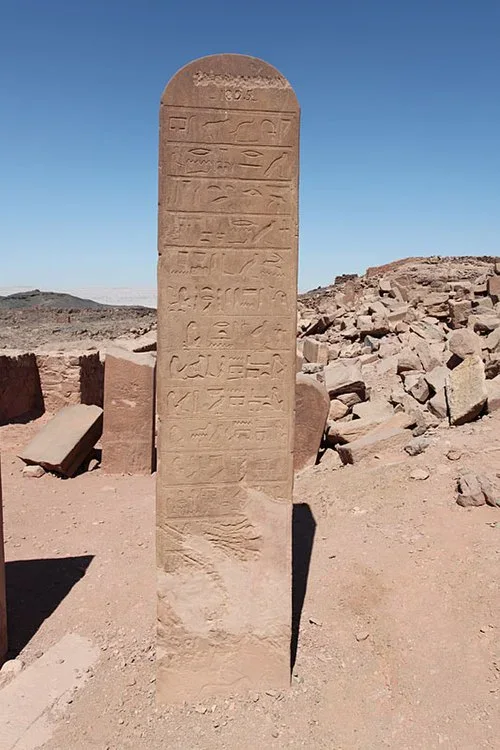 Outer Temple Entrance & Commemorative Stelae
Reading a Royal Stela
Up close, one of these stelae shows what a royal monument looked like. A rounded top, rows of hieroglyphs cut down the face, figures of kings and gods. The temple behind these pillars was first established in the reign of Senusret I, a Middle Kingdom king who ruled from 1971 to 1926 BC. Work did not stop with him. Additions continued for centuries, and the temple was partly reconstructed in the New Kingdom, the age of Egypt's most powerful pharaohs. Each generation of mining missions left its mark in hieroglyphs on stone. A single stela can hold a king's name, the size of his expedition and the success of its work. Read together, the pillars turn the mountain into a chronicle of royal enterprise stretching across many hundreds of years.
Listen in the appRoland Unger · CC BY-SA 3.0
05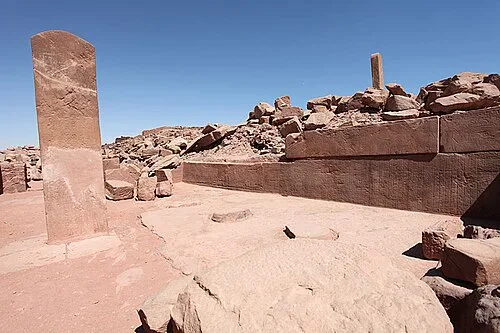 Temple Courtyard & Purification Halls
The Temple Courtyard
The courtyard shows how the temple grew. Its walls and halls were built and enlarged by the pharaohs of succeeding reigns, generation after generation. Each reign that sent a mission up the mountain left the sanctuary larger than it was found. Halls were added, courts were extended, and later reigns rebuilt what earlier ones had raised. The architecture works like a record. Stonework from one reign stands beside a court from another, so the building itself traces the centuries of returning missions. What began as a shrine for a single expedition became a full temple complex, raised by the pharaohs' men with the means of the mining ventures themselves.
Listen in the appRoland Unger · CC BY-SA 3.0
06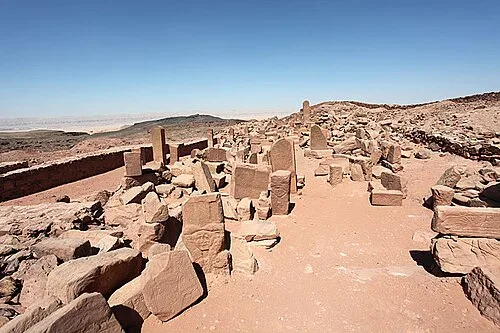 Temple Courtyard & Purification Halls
The Southern Ruins and Their Offerings
The scattered ruins on the southern side speak of a quieter kind of visit. This temple was not only a monument to kings; it was a place of worship and healing. Votive stelae, small stones dedicated in prayer, were found along the pathway, inside the temple itself and in the nearby caves. Members of the expeditions left offerings before they went down to the mines, and gave thanks when they came back up. Mining turquoise in this desert was dangerous work, and the votive stones show who the workers turned to. The sheer number of them, gathered along the path and in the caves, is why the site is read as a place of healing as well as worship. The route to the temple doubled as a gallery of personal devotion.
Listen in the appRoland Unger · CC BY-SA 3.0
07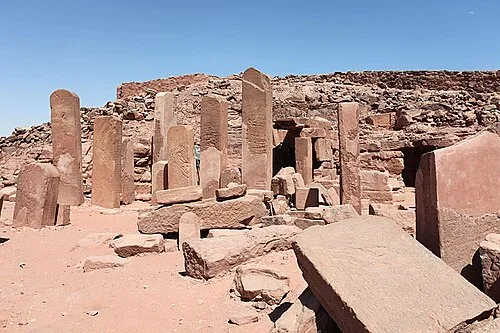 Chapels of Hatshepsut and Thutmose III
The Chapels of Hatshepsut and Thutmose III
Two of the later additions carry royal names: chapels built under Queen Hatshepsut and Thutmose III, in the New Kingdom. Hatshepsut ruled as a female pharaoh, and Thutmose III was the king who followed her. Both sent expeditions to these mines, and both marked their patronage by adding sacred spaces of their own to the temple. Their chapels show the pattern of the whole site. Every ruler who claimed a share of Sinai's turquoise left a building to prove it. The founding stela by the entrance records the earlier kings; these chapels are the New Kingdom's answer, built when Egypt's reach extended deep into Sinai.
Listen in the appRoland Unger · CC BY-SA 3.0
08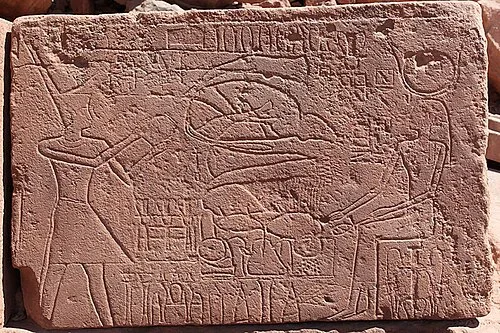 Chapels of Hatshepsut and Thutmose III
Amenemhat III Offers to Hathor
One relief from Court P captures the politics of the temple in a single image. Pharaoh Amenemhat III, a Middle Kingdom king, stands facing the goddess Hathor, hands raised in offering. The temple's purpose was exactly this: to honor Hathor as the guide of the kings who sent expeditions to the mines, and to glorify the power of the pharaohs behind those missions. The carving lays out the arrangement for anyone to read. The king serves the goddess with offerings; the goddess in return watches over his men and delivers the turquoise. A monument like this was also a message. It told everyone in the court that the wealth of the mountain flowed through the pharaoh's devotion.
Listen in the appRoland Unger · CC BY-SA 3.0
09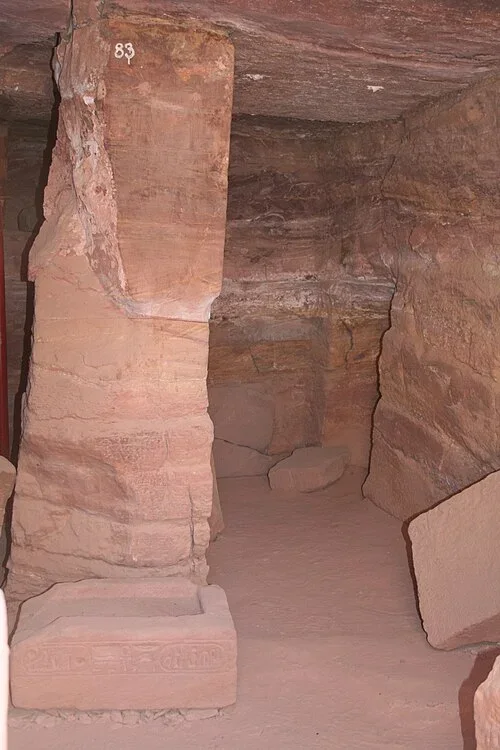 Hathor Cave Sanctuary (Holy of Holies)
Inside the Rock-Cut Cave Sanctuary
At the heart of the temple, the mountain itself becomes the shrine. A chamber cut into the living rock forms the holy of holies, the innermost sanctuary of the site. Inside, the walls are carved straight out of the sandstone, and a free-standing pillar of native rock rises within the chamber. This is the room the expeditions came to. After the long climb, the courts and the chapels, the leaders of the missions reached this cave to stand before the goddess in person. The rock keeps the air cool and the light dim, a world away from the bright desert outside. Every structure on the plateau leads, in the end, to this room.
Listen in the appPhoto: Einsamer Schütze · CC BY-SA 3.0
10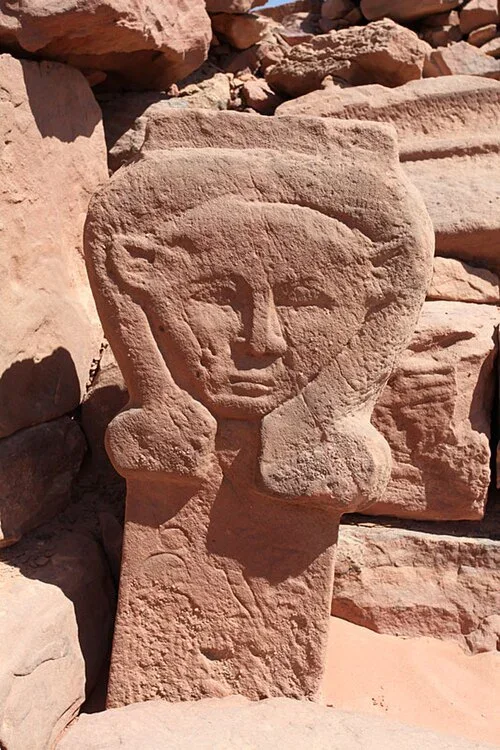 Hathor Cave Sanctuary (Holy of Holies)
The Face of Hathor, Mistress of Turquoise
The face carved on this stone belongs to Hathor, the goddess to whom the whole mountain was dedicated. In Egyptian religion she was favored as a protector in desert regions, which made her the natural guardian of a mining frontier. Here she carried a local title: Mistress of Turquoise. Under that name she watched over the mines, the travelers who reached them and the gem they produced. The carving shows her face framed with cow's ears, one of the forms in which Egyptians depicted her. To the Egyptians this was not empty rock. It was her domain, and the turquoise was her gift.
Listen in the appRoland Unger · CC BY-SA 3.0
- 11
The Head of Queen Tiye and Petrie's Excavation
The 1904 excavation by Flinders Petrie, and the dark stone bust of Queen Tiye it brought to light.
- 12
The Proto-Sinaitic Inscription
About thirty inscriptions in a script adapted from Egyptian hieroglyphs, among the earliest alphabets anywhere.
- 13
The Bilingual Sphinx
A sphinx carrying two scripts at once, and the prisoners of war who invented alphabetic letters.
- 14
The Plateau View: What the Mountain Remembers
The view from the summit: kings, priests and workers on one ridge, and the monuments that came home.
Serabit el-Khadim
Frequently asked questions
How much does the guide cost?
Free app download. Listed guide price: $0.99. Guide price shown in the app. Audio guide only. Venue admission is separate.
Can I listen without internet?
Yes. Download the guide’s audio, images, and maps in the app before your visit. Your downloaded content is then available offline.
Can I listen in my language?
This audio guide is available in 15 languages, including English.
Do I need to follow a schedule?
No. This is a self-guided experience. Choose your stops, pause whenever you like, and return to a story at your own pace.
At your own pace
Explore Serabit el-Khadim.
Download Stanza, then search for “Serabit el-Khadim”.
Free app download · Guide price shown in the app
Keep exploring
Audio guides — Egypt
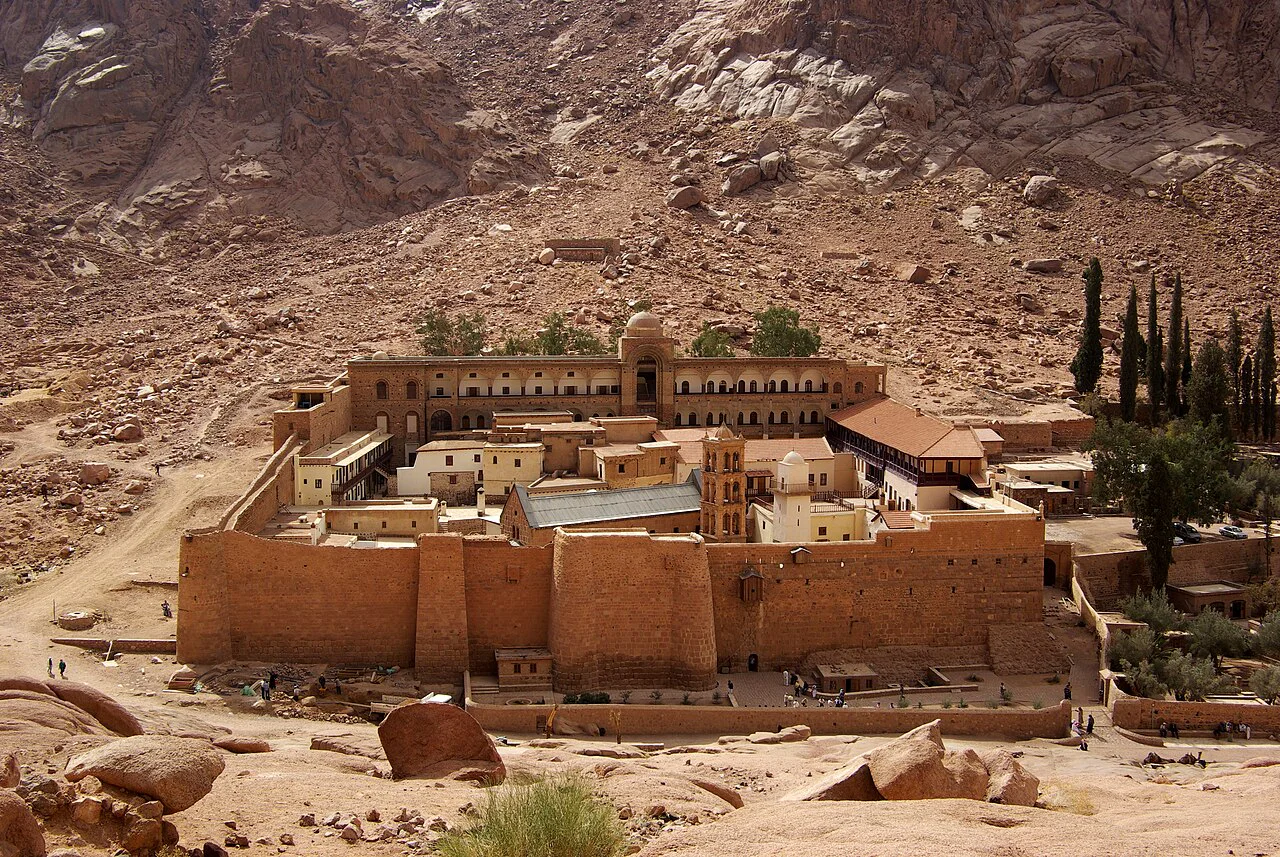
Saint Catherine · 73 km
Saint Catherine's Monastery
Content & sources
Berthold Werner · CC BY-SA 3.0
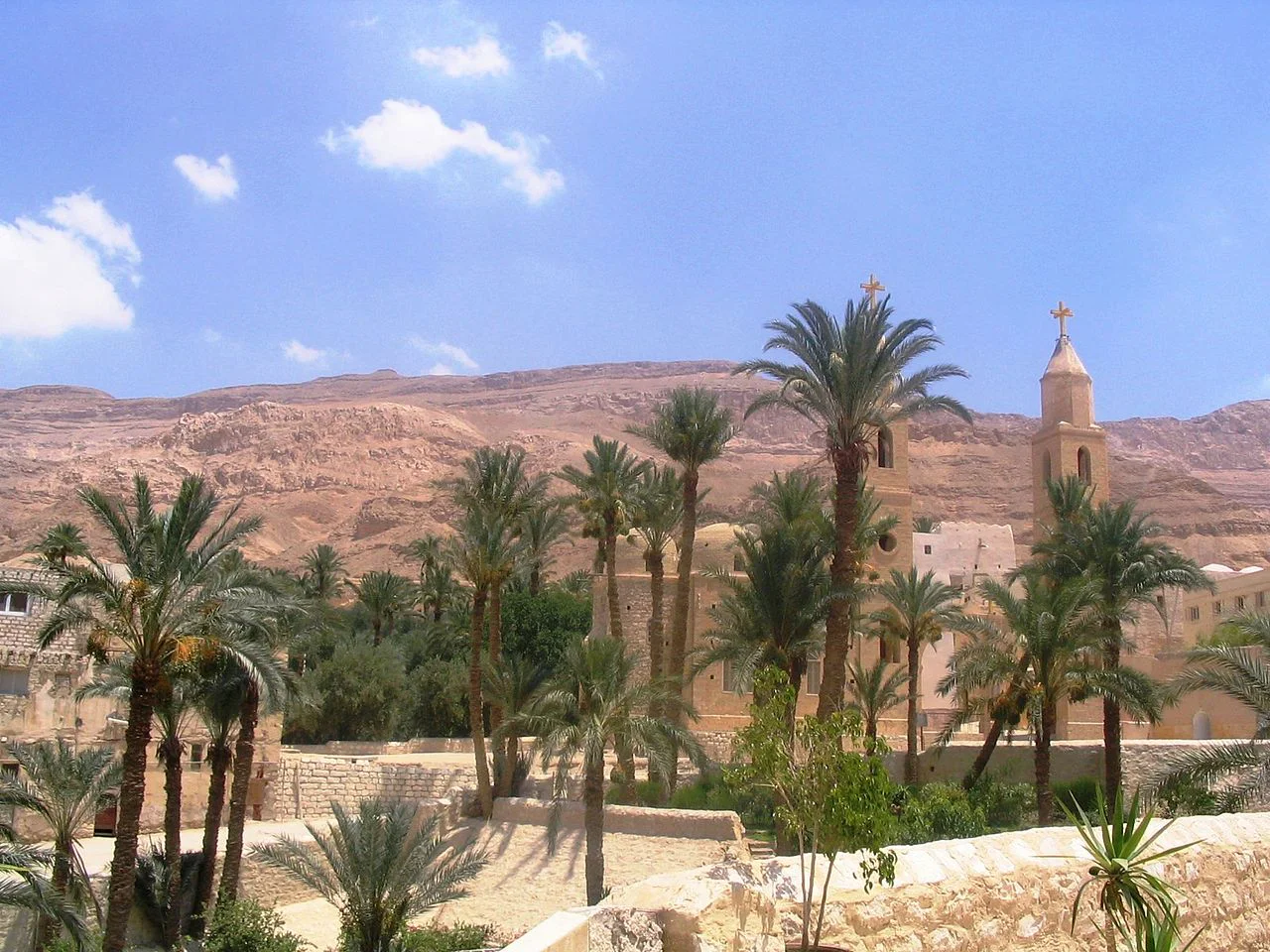
Monastery of Saint Anthony · 109 km
Monastery of Saint Anthony
Content & sources
Tentoila (talk) · Public domain
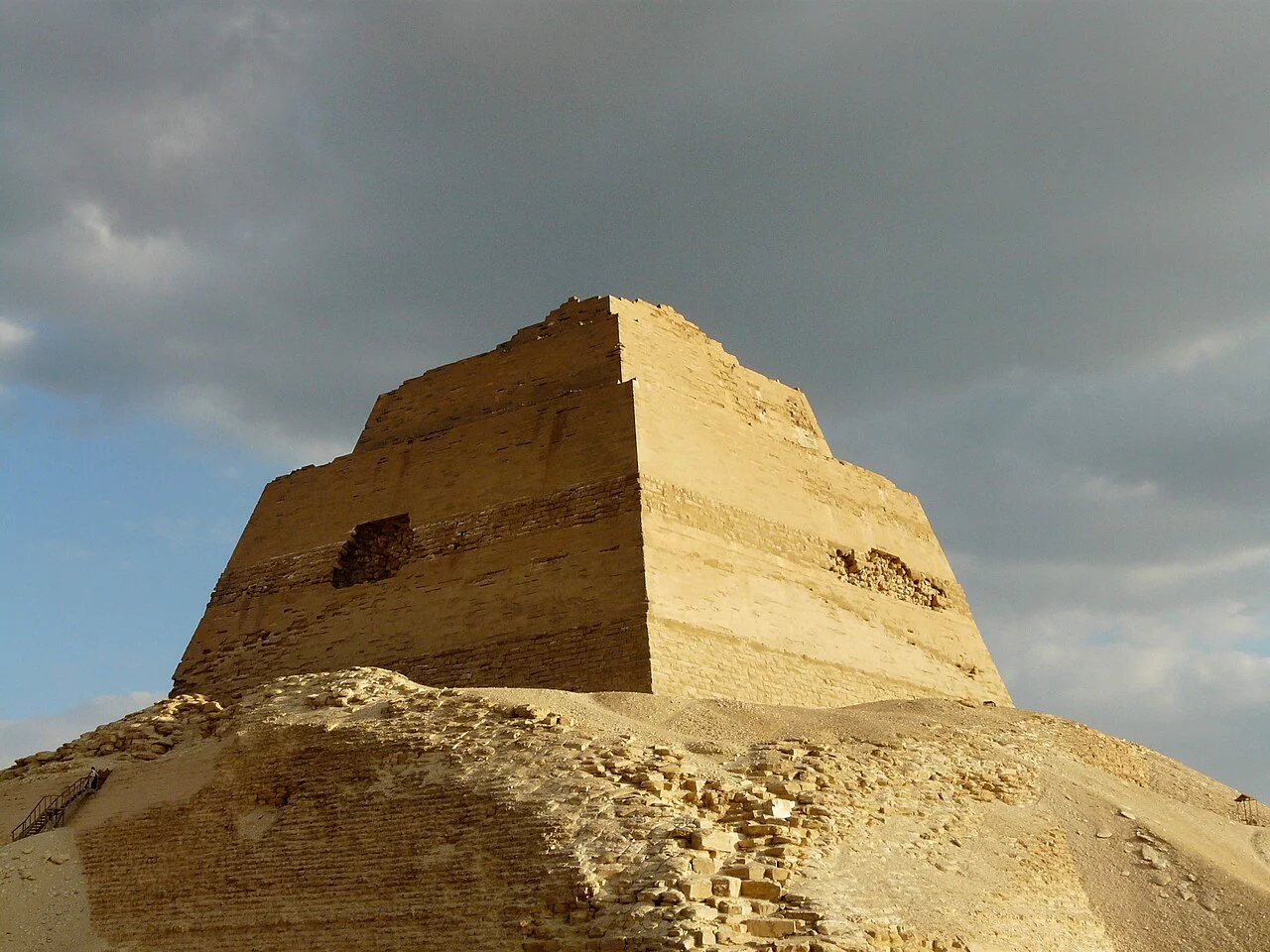
Meidoum
Meidum
Content & sources
Photo: Kurohito · CC BY-SA 3.0
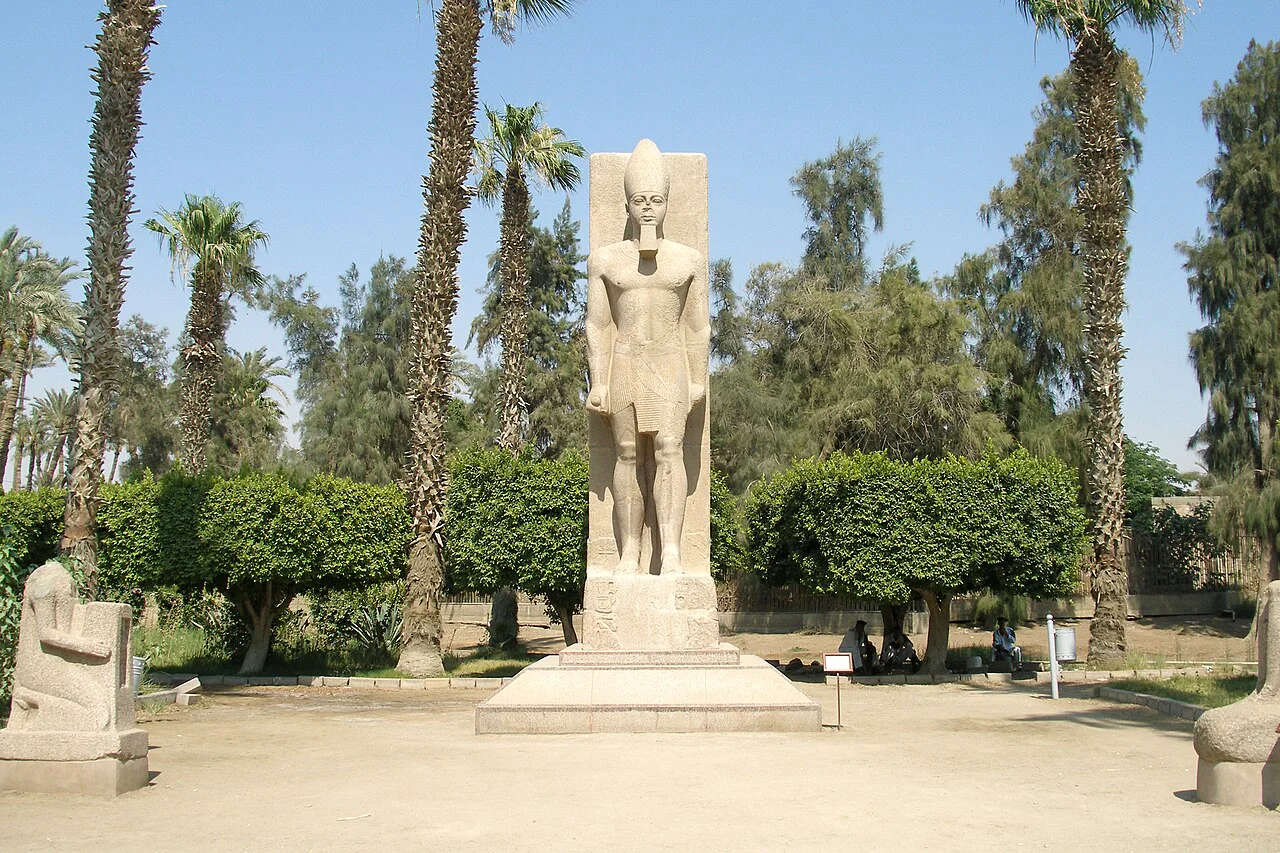
Mit Rahinah
Memphis, Egypt
Content & sources
Vyacheslav Argenberg · CC BY 4.0