Stanza · Audio guide
Church of the Holy Spirit, Tallinn Audio Guide
A place to remember. A story to take with you.
The Church of the Holy Ghost is a medieval Lutheran church located in the old town district of Tallinn, Estonia. It is situated behind Raekoja plats, opposite the Great Guild and the city's oldest café.
Download Stanza, then search for “Church of the Holy Spirit, Tallinn”.
About the tour
One guide. Your kind of visit.
The Church of the Holy Ghost is a medieval Lutheran church located in the old town district of Tallinn, Estonia. It is situated behind Raekoja plats, opposite the Great Guild and the city's oldest café.
Ready when you are.
- 01Get the free Stanza app.
iOS & Android
- 02Find your guide.
“Church of the Holy Spirit, Tallinn”
- 03Download before you go.
Works offline
Audio guide / 8 narrated stops
Inside the guide
Get to know a few of the stories before you go. Open a stop to read more.
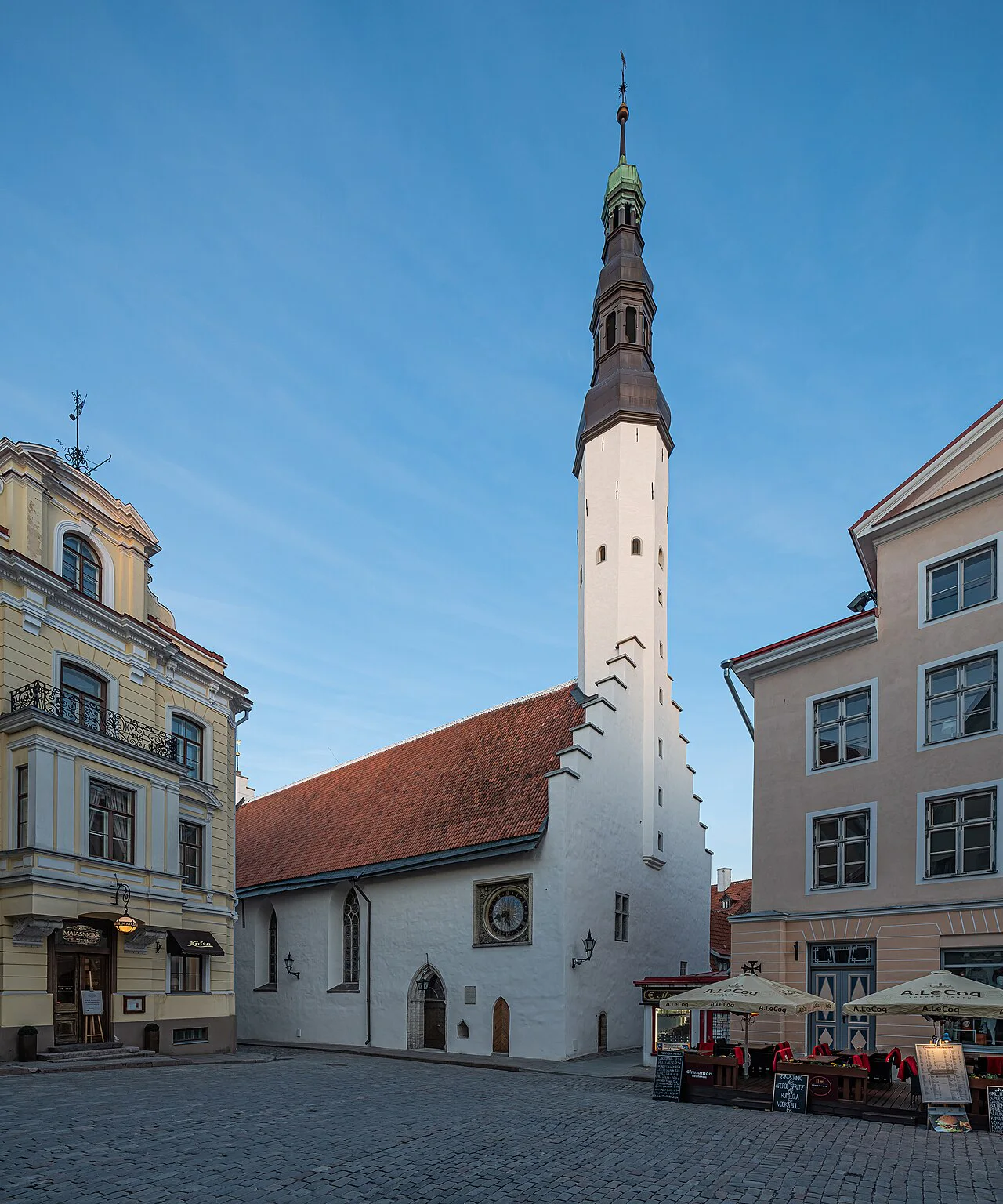
01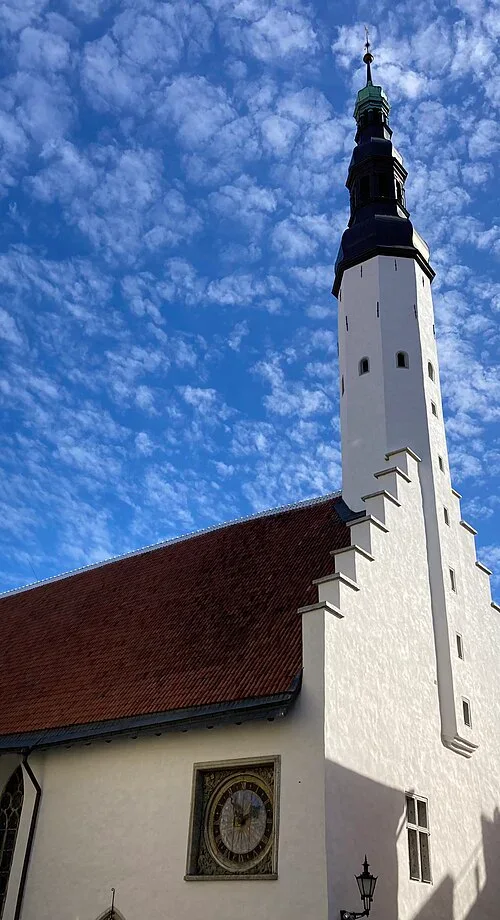 Exterior North Façade and Ackermann Clock
The Church from Pühavaimu Street
Welcome to the Church of the Holy Spirit, tucked behind Tallinn's Town Hall square. It is the smallest medieval parish church left in the Old Town, and from the start it carried three jobs at once. It served as an almshouse chapel, a chapel for the Town Council, and a parish church for the town around it. A priest here is recorded in 1316. The church itself appears in writing three years later. Building probably began in the first half of the thirteenth century. The church does not face due east, the way most churches do, which may suggest that this street block was already built up when it rose. Its whitewashed walls carry the town's hallmark crow-stepped gables, and an octagonal tower rises above them. The spire, though, is a reconstruction. The tower burned in 1684. It burned again on the twenty-ninth of May, 2002, when the Baroque spire collapsed onto the roof. Firefighters managed to save the medieval interior. The weathervane on the rebuilt spire carries the year 1688. The tour moves on to the carved clock above the portal, then inside to the vaulted nave and its painted galleries, the high altar of 1483, and finally the almshouse side at the rear gable.
Ursula Roomere · CC BY-SA 4.0
02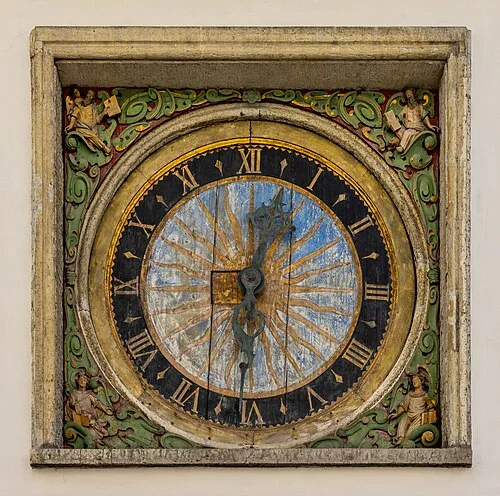 Exterior North Façade and Ackermann Clock
Ackermann's Clock of 1684
Above the north portal hangs the finest thing on the church's outer walls, a carved and painted clock made in 1684. Its maker was Christian Ackermann, a master woodcarver of Tallinn. The dial keeps old Roman numerals, with gilt sun rays spreading out from the centre. Painted figure reliefs hold the corners of the frame. Around the whole face runs lush Baroque vine-carving, thick with green and gold. For a long time this face served as the public timekeeper of the market quarter around the church. It is an exceptional survival of civic Baroque woodcarving, left out in the open on a church wall.
Photograph by Mike Peel (www.mikepeel.net). · CC BY-SA 4.0
03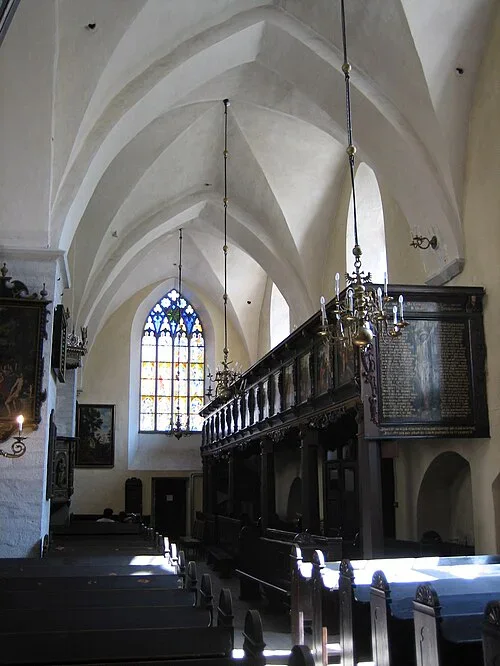 The Two-Aisled Nave and Painted Galleries
The Two-Aisled Nave and Its Vaults
Inside, the plan breaks the usual medieval pattern. Most town churches of the period have three aisles, but this one has exactly two. The north side stands flush against the street, so there was no room for a second side aisle. As a result the choir is pushed off-centre to the north. The choir, built around 1300, is the oldest part of the church. In 1360 a wooden ceiling gave way to the present vaulting, and the tower and large Gothic windows were added at the same time. By about 1380 the church had reached the two-aisled form it keeps today. Major rebuilds of the facades probably followed the great Tallinn fire of 1433. What remains is a low, broad hall church, built simply for worship on a cramped town plot.
Listen in the appPhoto: Pöllö · CC BY 2.5
04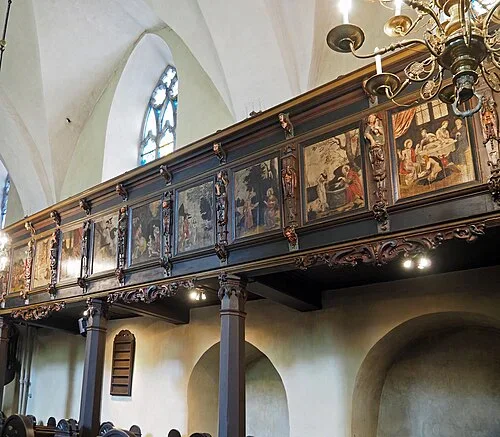 The Two-Aisled Nave and Painted Galleries
The Painted Galleries
Running along the upper level of the nave, the gallery parapet carries a dense band of painted panels. In the mid-seventeenth century the galleries were clad with richly painted scenes from the Bible. The work was probably done by several different artists, one after another. In a small hall where few in the congregation could read, the upper walls became a picture book. Carved and figured supports hold the panels in place along the railing. It is a Baroque layer laid over Gothic masonry, much like the painted clock added outside long after the walls rose.
Listen in the appPhoto: Hajotthu · CC BY-SA 3.0
05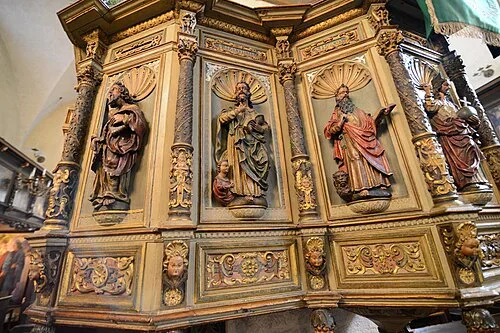 The Historic Pulpit and Estonian Heritage
The Pulpit and the Estonian Word
The carved pulpit, with its gilded evangelist figures standing in arched niches, carries the church's proudest claim. This was the first church in Estonia to hold services in Estonian, rather than in German or Latin. In 1535 the first extracts of the catechism to be printed in Estonian were produced here, planting the root of the written Estonian word. The church's most famous pastor, Balthasar Russow, served the Estonian-speaking congregation from 1560 to 1600. On the side he wrote a vivid chronicle of Livonia and its wars, in Low German. The pulpit's own carving date and maker are not recorded. Its story here is the preaching that rang out from it.
Listen in the appJorge Láscar · CC BY 2.0
06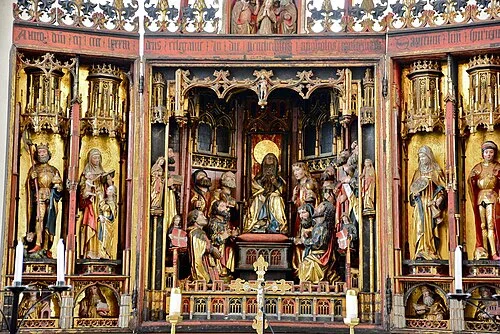 The Chancel and Bernt Notke High Altar
Bernt Notke's High Altar of 1483
The high altar is the treasure of the chancel. It was probably commissioned by the Town Council from Bernt Notke, the celebrated master of Lübeck, and completed in 1483. The oak shrine rises just over two metres. It is nearly two metres wide. Its central panel shows the descent of the Holy Spirit on the twelve apostles at Pentecost, a fitting subject for a church of the Holy Spirit that also served as the council's chapel. The inner wings carry carved and gilded figures of saints. The outer faces are painted with scenes of Christ's Passion. On the fourteenth of September, 1524, a mob of some four to five hundred townspeople, German and Estonian alike, swept through Tallinn's churches smashing images, altars and relics. This altar was spared. It remains one of the finest late-medieval woodcarvings in Northern Europe.
Listen in the appAlejandro · CC BY 2.0
07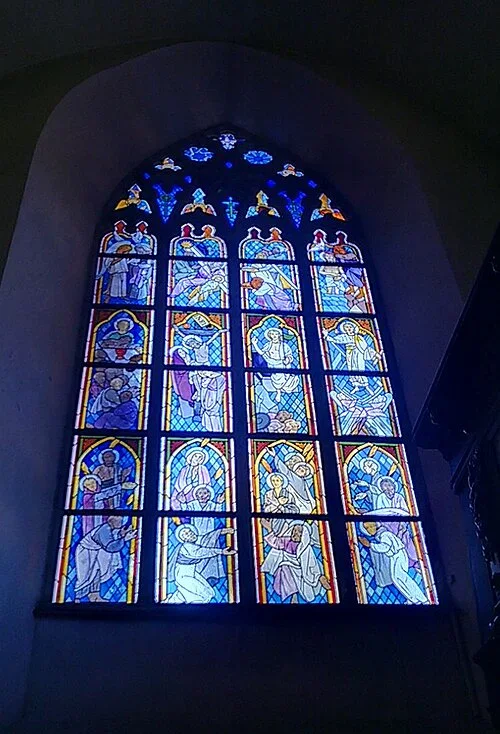 Chancel Windows and Saiakäik Stepped Gable
The Chancel Window
The tall chancel window keeps its medieval Gothic opening, with fine stone dressing around the frame. The glass filling it is far younger, late twentieth-century work. Jewel-blue panels now glow inside an opening built for light centuries earlier. It is the newest layer in a building whose fabric spans seven centuries.
Listen in the appEthan Doyle White · CC BY-SA 3.0
08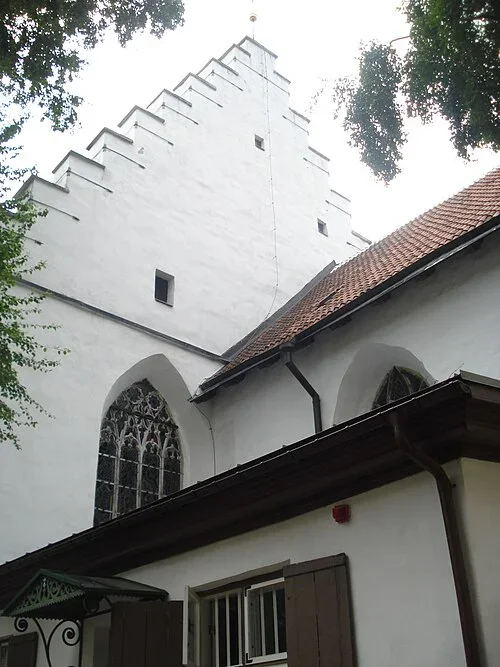 Chancel Windows and Saiakäik Stepped Gable
The Rear Gable and the Almshouse
This stepped gable is the face the church turns toward its oldest neighbours. The church was built as the chapel of a greater Holy Spirit almshouse, a hospital for the town's poor and sick. In the fifteenth century the wealthy town councillor Herman Weldegge founded a hospital here, but the almshouse building beside the church is recorded as early as 1334, and is believed to reach back further still. The sick and elderly entered the church through a second doorway, from the almshouse yard on this south side. The priest's duty was to carry the sacraments to the almshouse's residents. The stepped look of this gable probably took its present shape in the seventeenth century, alongside the Baroque work on the tower. A small church, built to serve the poorest of the town, has kept that work going ever since.
Listen in the appPhoto: Alma Pater · CC BY-SA 3.0
Church of the Holy Spirit, Tallinn
Frequently asked questions
How much does the guide cost?
Free app download. Listed guide price: $0.99. Guide price shown in the app. Audio guide only. Venue admission is separate.
Can I listen without internet?
Yes. Download the guide’s audio, images, and maps in the app before your visit. Your downloaded content is then available offline.
Can I listen in my language?
This audio guide is available in 15 languages, including English.
Do I need to follow a schedule?
No. This is a self-guided experience. Choose your stops, pause whenever you like, and return to a story at your own pace.
At your own pace
Explore Church of the Holy Spirit, Tallinn.
Download Stanza, then search for “Church of the Holy Spirit, Tallinn”.
Free app download · Guide price shown in the app
Keep exploring
Nearby audio guides
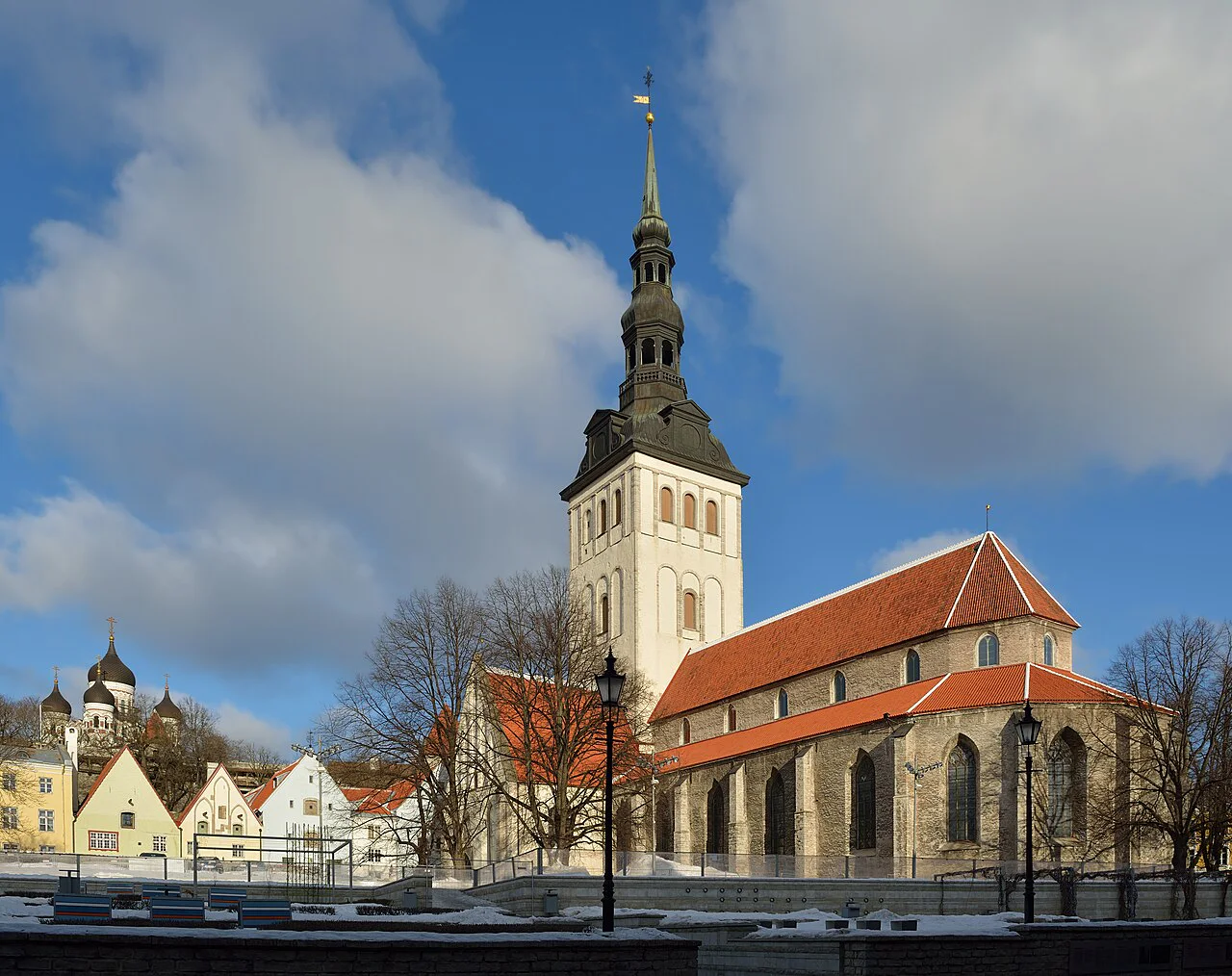
Tallinn · 1 km
St. Nicholas Church, Tallinn
Content & sources
Ivar Leidus · CC BY-SA 3.0 ee
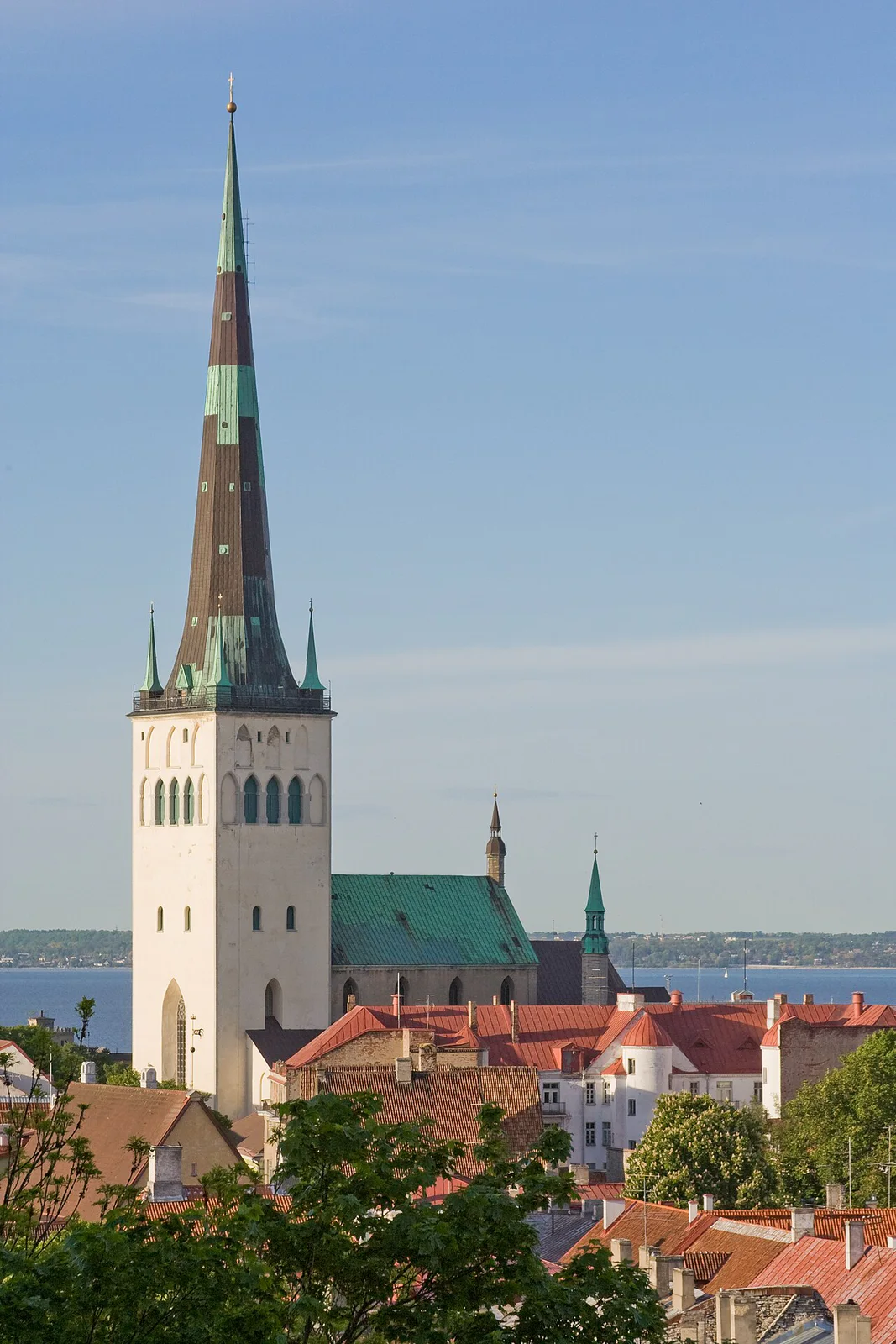
Tallinn · 1 km
St. Olaf's Church, Tallinn
Content & sources
Olga Itenberg · CC BY 2.0
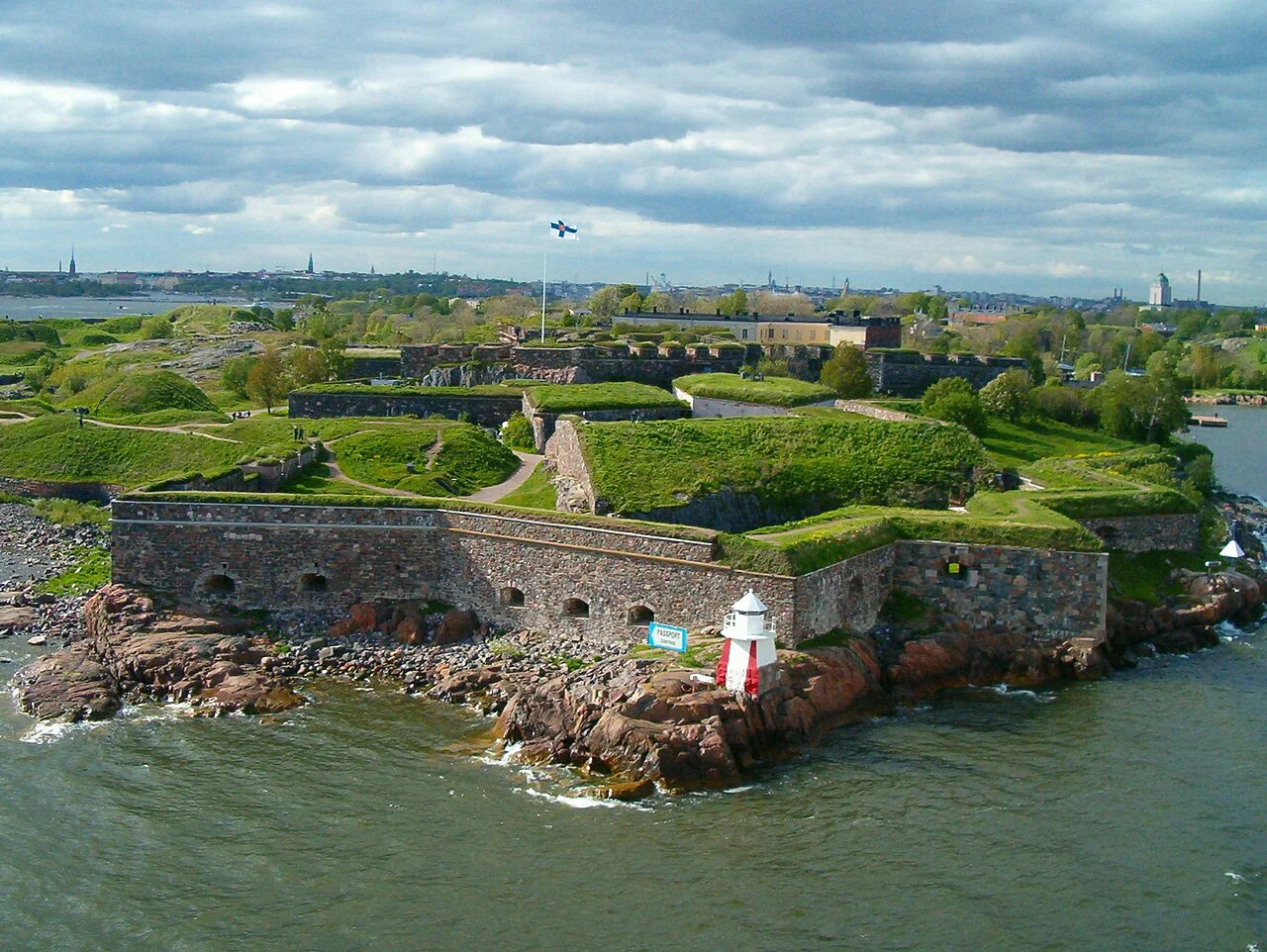
Helsinki · 80 km
Suomenlinna
Content & sources
Michal Pise, Michal.Pise · CC BY 2.0
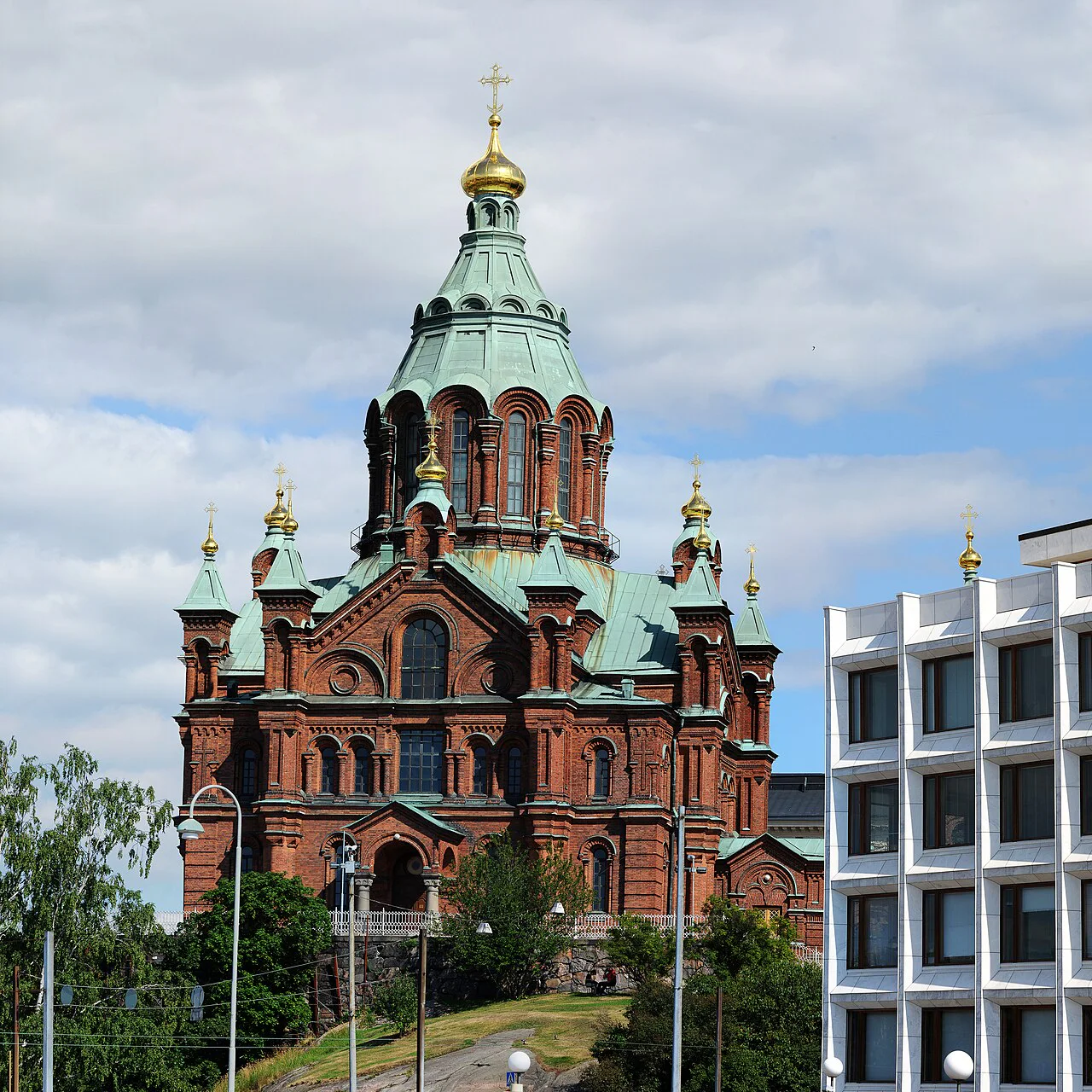
Helsinki · 82 km
Uspenski Cathedral
Content & sources
Ralf Roletschek (talk) - Fahrradtechnik auf fahrradmonteur.de · FAL