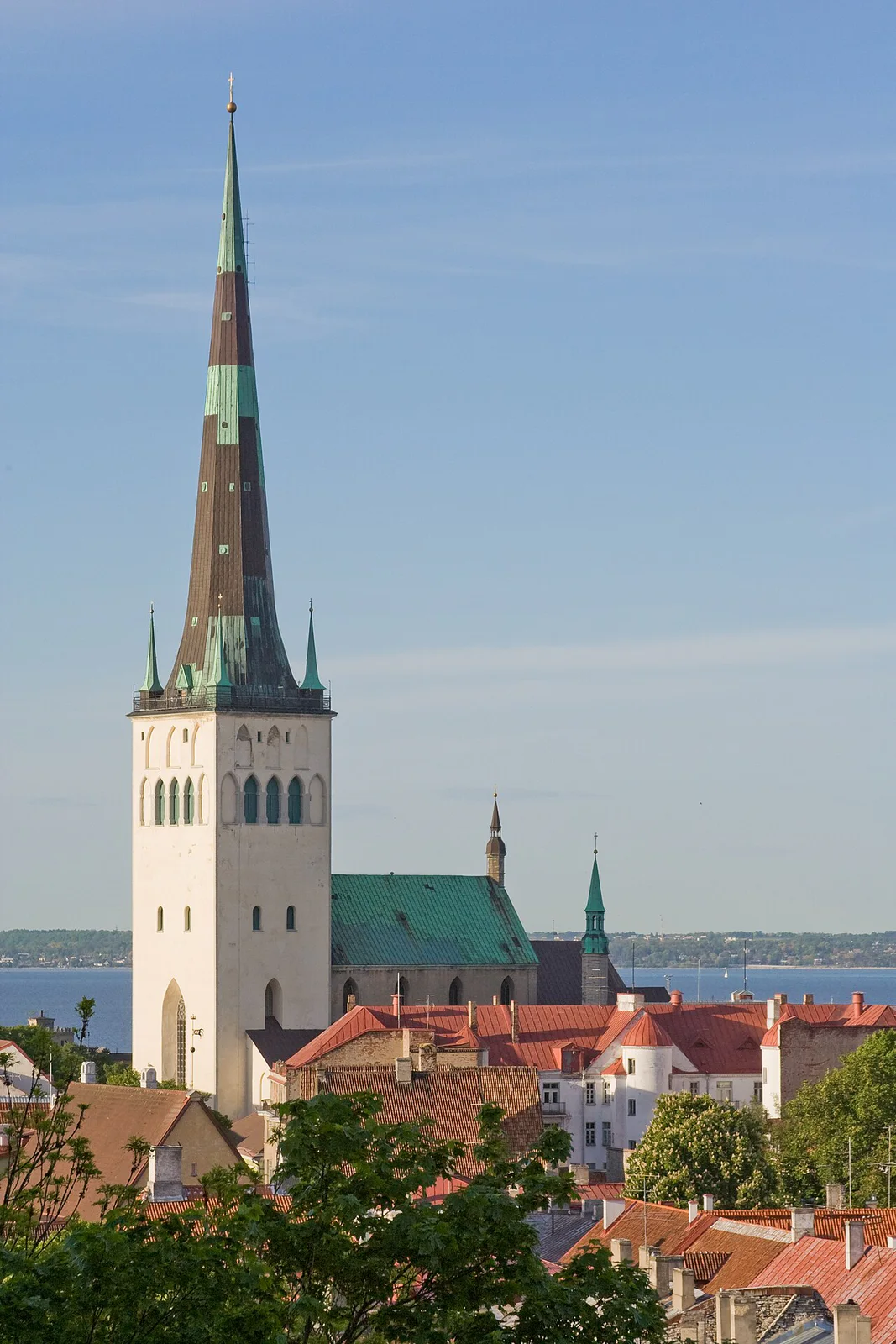
Stanza · Audio guide
St. Olaf's Church, Tallinn Audio Guide
A place to remember. A story to take with you.
St. Olaf's Church is a Baptist church located in Tallinn, Estonia. It is the tallest church building in Estonia, standing 123.7 meters above ground level.
Download Stanza, then search for “St. Olaf's Church, Tallinn”.
About the tour
One guide. Your kind of visit.
St. Olaf's Church is a Baptist church located in Tallinn, Estonia. It is the tallest church building in Estonia, standing 123.7 meters above ground level.
Ready when you are.
- 01Get the free Stanza app.
iOS & Android
- 02Find your guide.
“St. Olaf's Church, Tallinn”
- 03Download before you go.
Works offline
Audio guide / 11 narrated stops
Inside the guide
Get to know a few of the stories before you go. Open a stop to read more.
01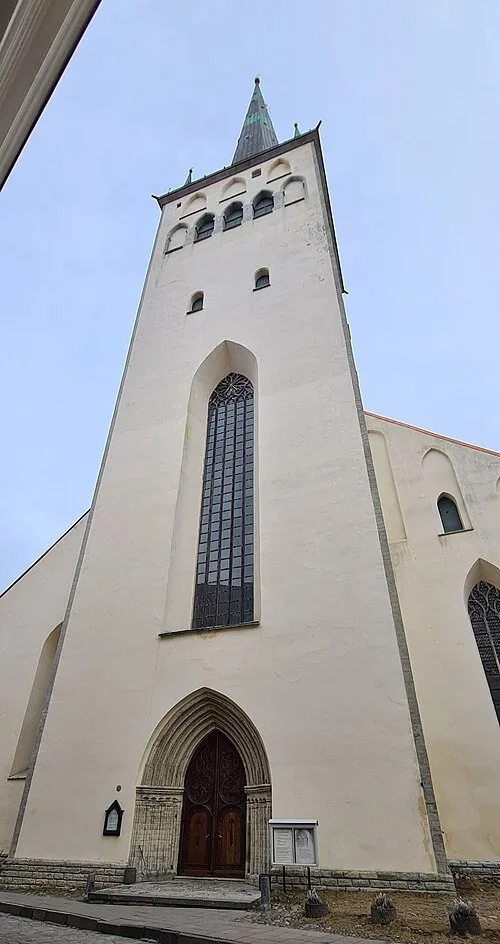 Western Gothic Portal and the Legend of Olev
Western Tower and Main Portal
Welcome to St. Olaf's Church, known in Estonian as Oleviste kirik, on Lai Street in Tallinn's Old Town. The church takes its name from Olav the Second Haraldsson, a Norwegian king who lived from 995 to 1030. He led Norway's conversion to Christianity, fell in battle in 1030, and was declared a saint. Seafarers looked to him as their patron, which suited a port town like this one. The first written record of the church dates to 1267, when Queen Margaret of Denmark granted its parish rights to the Cistercian convent of St. Michael in Reval, as Tallinn was then called. An earlier church probably stood on this spot, raised by Scandinavian merchants, though nothing of it has been confirmed. What rises here now is the tallest church building in Estonia, reaching 123.7 metres from the ground. The pointed-arch doorway at the base of the white tower is the building's public face, and the tower above it climbs out of sight.
Photo: BeshevI · CC BY-SA 4.0
02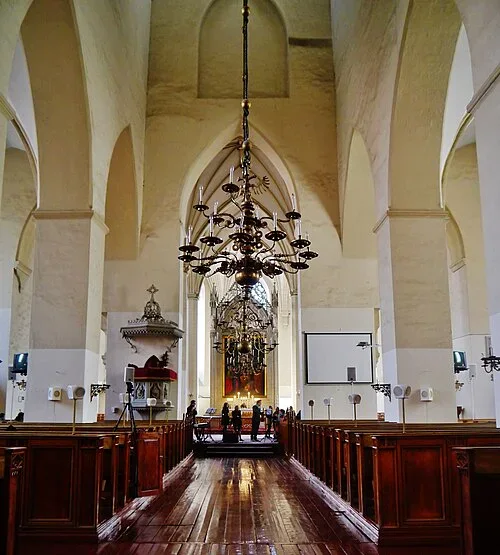 The Soaring Central Nave and Ribbed Vaulting
Central Nave Interior
Rows of wooden pews run down this nave toward the altar, under a brass chandelier that hangs from high above. The story of this interior turns on one day in September 1524. That was when the Reformation reached Tallinn, and iconoclastic violence swept through the richly decorated church. Everything here of artistic value was destroyed. The stone walls outside took no damage; the loss was all inside. After the Reformation, St. Olaf's rose to a new rank. Until then, St. Nicholas's church had been Tallinn's principal church. Now St. Olaf's took its place. The congregation that gathered in these pews was large, and for centuries it worshipped mostly in German, right up until 1939. The church also became a place of learning. A library was founded here in 1552, a generation after the image-breaking. Today the nave serves a living congregation, with a pulpit on one of the piers and even a projection screen among the old stonework.
Photo: Zairon · CC BY-SA 4.0
03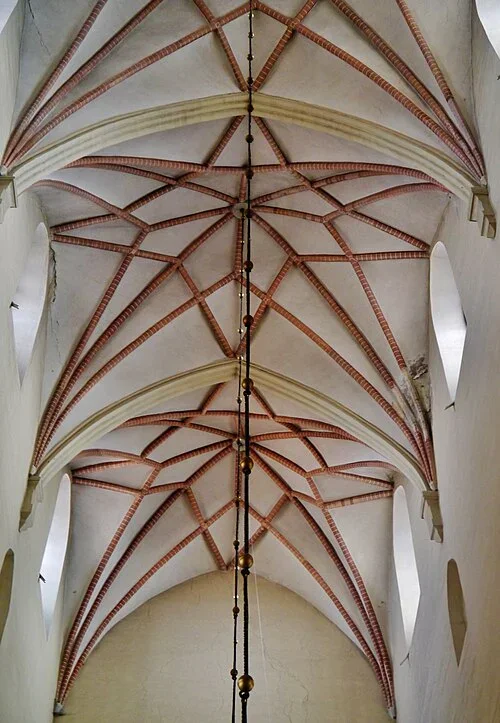 The Soaring Central Nave and Ribbed Vaulting
Ribbed Vaulting of the Nave
Tilt your eyes upward and the ceiling becomes a lattice, pale surfaces held between ribs of reddish brick. This vault is the survivor of a disaster. On the eleventh of May 1433, a great fire swept the church and left it badly damaged. The townspeople decided on a new nave, the long central hall where the congregation sits. Work ran from 1436 to 1450 under a master builder named Andreas Kulpesu. The old nave and its chapels were torn down, and the church was rebuilt longer and wider, reaching the size it keeps today. The result was ambition in stone. The central nave rises thirty-one metres, the highest vaulted ceiling in Estonia. The hanging light drops from the vault on a long rod, a small measure of just how far up that ceiling sits.
Listen in the appPhoto: Zairon · CC BY-SA 4.0
04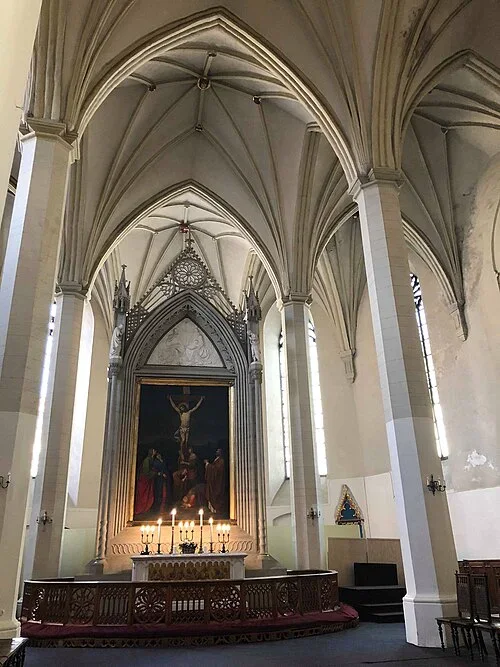 The High Altar: Reformation, Fire, and Imperial Rebirth
Chancel Altar with Crucifixion Painting
At the head of the church, framed by a pointed arch, a painting shows the crucified Christ with mourners gathered at the foot of the cross, and candles burn on the altar below. This corner of the church owes its look to a catastrophe. Lightning struck one of the corner towers on the night leading into the sixteenth of June 1820, a date given in the old calendar. The fire spread to the other corner towers and then to the main tower, and burned for four hours. The authorities ordered the neighbouring houses evacuated, but the church's interior was left to the flames and was destroyed. What followed was a rebuilding on an imperial scale. The restoration took twenty years, from 1820 to 1840, and the Russian Emperors Alexander the First and Nicholas the First supported it. The new furnishings were made in the neo-Gothic style, echoing the medieval pointed arches around them. This altar dates to 1835, one of the works of those rebuilding years. The church reopened on the sixteenth of June 1840, exactly twenty years after the lightning strike.
Listen in the appPhoto: Petitpeton · CC BY-SA 4.0
05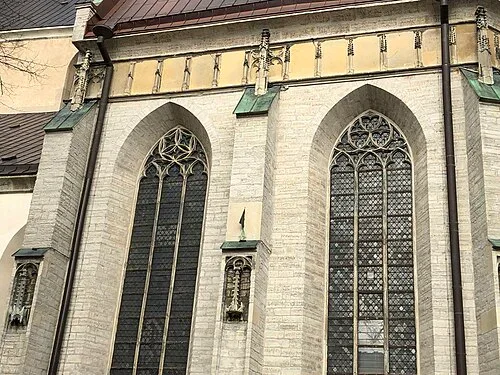 St. Mary's Chapel and the Hans Pawels Cenotaph
St. Mary's (Bremen) Chapel Exterior
Along the outside wall, two tall pointed windows with delicate stone tracery rise toward a band of small carved figures standing in a row above them. This is St. Mary's Chapel, also called the Bremen Chapel, a late-Gothic addition on the south side of the choir, facing Long Street. Two builders are credited with it, Bernt Wolf and Gert Koningk. When it was finished is a matter of disagreement. One account gives 1521 as the year of completion. Another says the work ran from 1513 to 1523 and was left unfinished. Either way, the chapel is counted among the most richly formed surviving examples of late-Gothic architecture in Tallinn. It had a predecessor on the same side of the church, a fifteenth-century chapel that was demolished during the great rebuilding of the nave. The chapel that replaced it was built for the merchants and craftsmen who worshipped here, and its wall would soon carry a memorial of its own.
Listen in the appPhoto: Eerokangor · CC BY-SA 4.0
06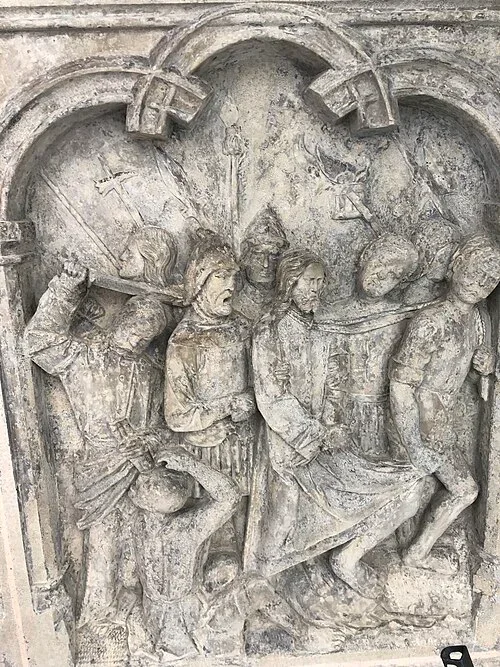 St. Mary's Chapel and the Hans Pawels Cenotaph
Hans Pawels Cenotaph Relief
Set into the outer wall of St. Mary's Chapel is a carved stone relief, pale with age. Under a gabled arch, a group of figures presses together, some of them apparently armed, their faces worn soft by centuries of weather. The monument is a cenotaph, a memorial without a body, honouring a merchant named Hans Pawels. A cenotaph marks someone whose remains lie elsewhere, and where Pawels himself was buried is not known. What the carved scene depicts is not identified either. What is certain is the placement. A wealthy man of the trading town was commemorated on the wall of a chapel built by that same merchant community, his image facing the street where he did business.
Listen in the appEero Kangor · CC BY-SA 4.0
07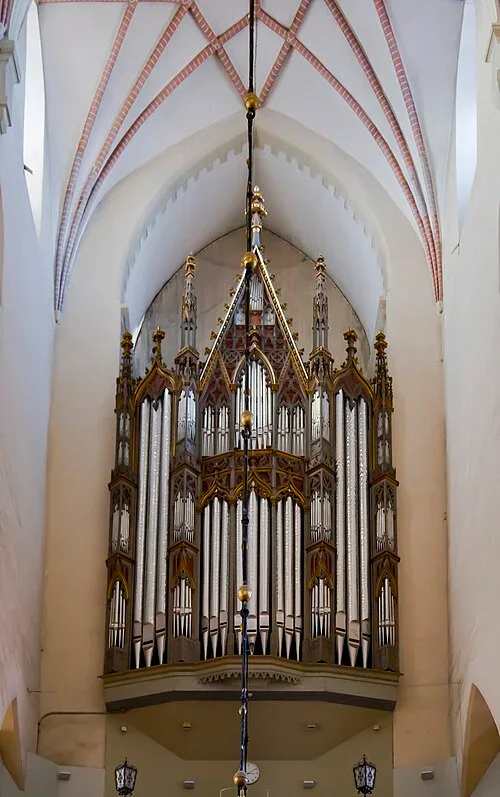 The Historic Organ Loft and Protestant Sanctuary
Historic Organ Case and Pipes
Under a ribbed vault, an organ case rises in a pointed arch, crowned with gilded finials, rows of tall metal pipes standing in ranks behind it. This instrument was built between 1840 and 1842 by Friedrich Hermann Lütkemüller, a German organ builder. The installation was carried out by the firm of Johann Eberhard Walcker, with three assistants sent along to help. Lütkemüller later wrote about the job in his autobiography, and his account shows how the work really ran. During the eight months Walcker was away, Lütkemüller was left to manage the whole undertaking on his own. He called this one the Reval organ, and the voicing and tuning were already his work. He trusted his own ear more than that of a local repairer, and said so plainly. The finished instrument carries seventy-six registers across three manuals and a pedal, with pneumatic actions, and it was renovated in 1914. It has filled this nave with sound for well over a century and a half.
Listen in the appDiego Delso · CC BY-SA 3.0
08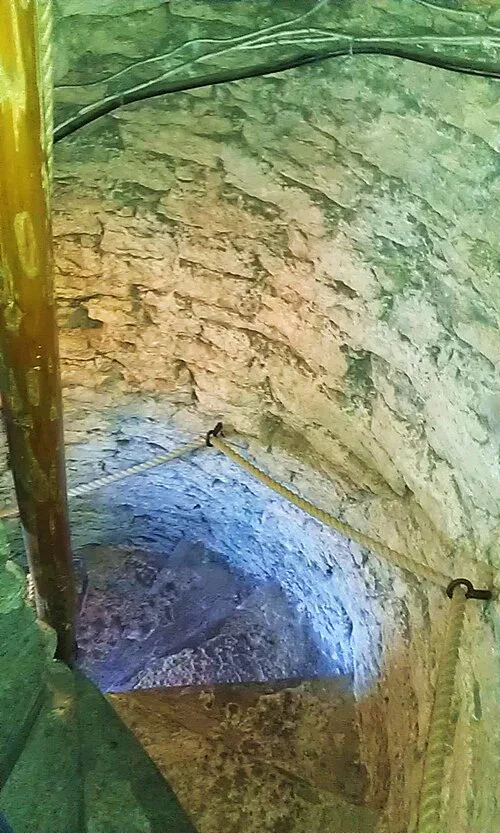 The Tower Ascent and Medieval Spiral Staircase
Rope-Guided Stair in the Tower
A narrow stone stairway spirals upward through the tower, its walls rough and ancient, with a rope strung on metal fittings to hold on to. This is the way up. The tower's stone base stands fifty-seven metres high before the spire even begins, and the climb through it is steep and close. The tower has earned its sturdiness the hard way. It has been struck by lightning around ten times, and the church as a whole has burned down three times in its known history. One of those fires came on the night of Peter and Paul in 1625. Lightning hit the tower and set it alight, and the blaze quickly slipped out of control. The tower burned, along with its roof covered in copper and tin, the chancel head and the church pews. The stone you see around this stairway has stood through all of it, and the rope on its fittings is there for the climb that visitors still make.
Listen in the appEthan Doyle White · CC BY-SA 3.0
09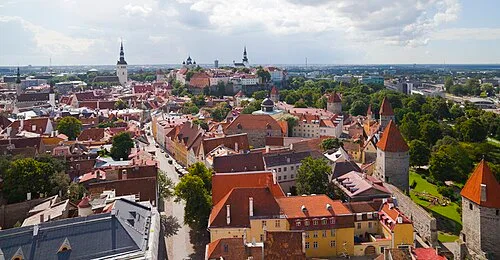 The 60-Meter Observation Platform and Spire
Observation Platform View over the Old Town
From the tower's open-air platform, sixty metres up, Tallinn spreads out below: dense red roofs, the spires of other churches, and a round defensive tower with a conical roof at the right edge of the view. Height like this has always drawn attention, and in the twentieth century it drew the wrong kind. From 1944 until 1991, the Estonian branch of the Soviet KGB used the church's spire as a radio tower and a surveillance point. Their headquarters stood nearby, and the spire's command of the rooftops made it useful to them. The view from the platform shows exactly what such a post would have overseen, the whole of the Old Town laid out in one sweep. For nearly half a century, a house of worship doubled as an instrument of the security state. The church survived that era the way it survived the fires, and the platform at sixty metres now belongs to visitors instead.
Listen in the appDiego Delso · CC BY-SA 3.0
10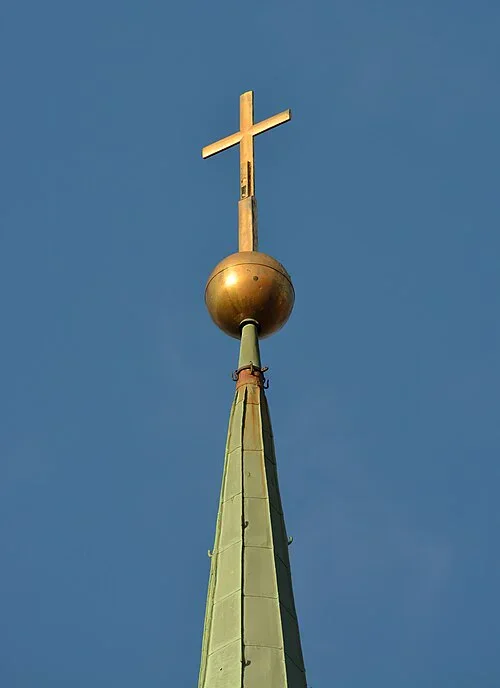 The 60-Meter Observation Platform and Spire
Gilded Sphere and Cross at the Spire Summit
At the very tip of the spire, a gilded sphere carries a slender cross against the sky, and the green-toned metal of the spire narrows to meet it. The sphere measures one hundred and fourteen centimetres across. And it is here that the church's most famous story belongs. The people of Tallinn, the legend goes, wanted to build the tallest church in the world. But a curse hung over the work: whoever finished it would die, so no one dared take it on. Then a stranger appeared and asked a sum the city could not pay. He offered a way out. If they could learn his name, he would forgive the debt. So the Tallinners sent a spy to his house, and there the spy heard the man's wife singing a song with the name Olev in it. They waited until the stranger stood on the tower setting the cross in place, and then they shouted up, Olev, the cross is crooked. Startled, he fell to the ground, and a toad and a snake were said to leap from his mouth, the mark of a demonic pact. It is folklore, not chronicle, but the town gave its church builder a name that lasts in it still.
Listen in the appIvar Leidus · CC BY-SA 3.0 ee
- 11
Old Town at Sunset from the Air
A tower raised as a sea mark, and the Baptist congregations who have kept the church since 1950.
St. Olaf's Church, Tallinn
Frequently asked questions
How much does the guide cost?
Free app download. Listed guide price: $0.99. Guide price shown in the app. Audio guide only. Venue admission is separate.
Can I listen without internet?
Yes. Download the guide’s audio, images, and maps in the app before your visit. Your downloaded content is then available offline.
Can I listen in my language?
This audio guide is available in 15 languages, including English.
Do I need to follow a schedule?
No. This is a self-guided experience. Choose your stops, pause whenever you like, and return to a story at your own pace.
At your own pace
Explore St. Olaf's Church, Tallinn.
Download Stanza, then search for “St. Olaf's Church, Tallinn”.
Free app download · Guide price shown in the app
Keep exploring
Nearby audio guides
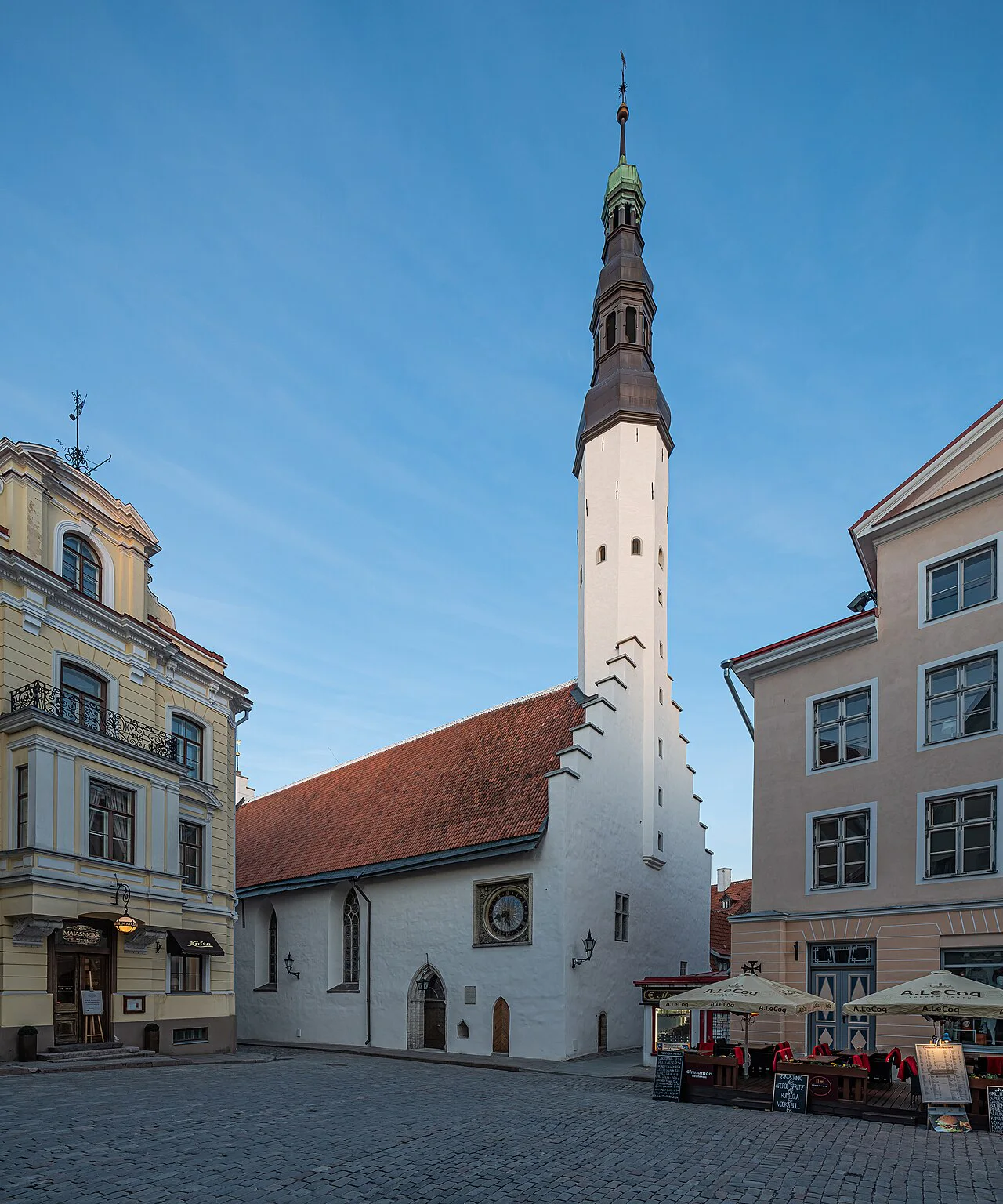
Tallinn · 1 km
Church of the Holy Spirit, Tallinn
Content & sources
Photo: A.Savin · FAL
Tallinn · 1 km
St. Nicholas Church, Tallinn
Content & sources
Ivar Leidus · CC BY-SA 3.0 ee
Helsinki · 79 km
Suomenlinna
Content & sources
Michal Pise, Michal.Pise · CC BY 2.0
Helsinki · 82 km
Uspenski Cathedral
Content & sources
Ralf Roletschek (talk) - Fahrradtechnik auf fahrradmonteur.de · FAL