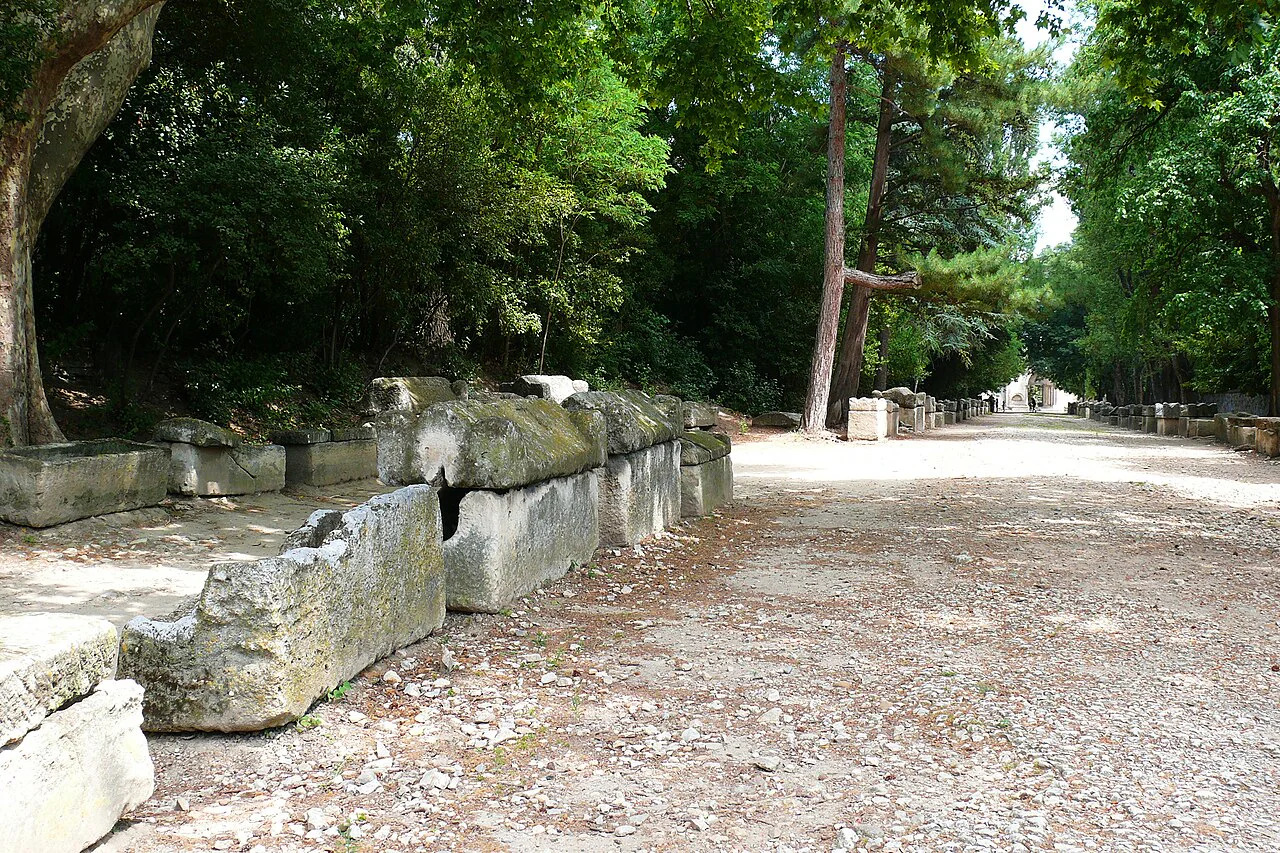
Stanza · Audio guide
Alyscamps Audio Guide
A place to remember. A story to take with you.
The Alyscamps is a large Roman necropolis located a short distance outside the old town of Arles, France. It was one of the most famous necropolises of the ancient world.
Download Stanza, then search for “Alyscamps”.
About the tour
One guide. Your kind of visit.
The Alyscamps is a large Roman necropolis located a short distance outside the old town of Arles, France. It was one of the most famous necropolises of the ancient world.
Ready when you are.
- 01Get the free Stanza app.
iOS & Android
- 02Find your guide.
“Alyscamps”
- 03Download before you go.
Works offline
Audio guide / 8 narrated stops
Inside the guide
Get to know a few of the stories before you go. Open a stop to read more.
01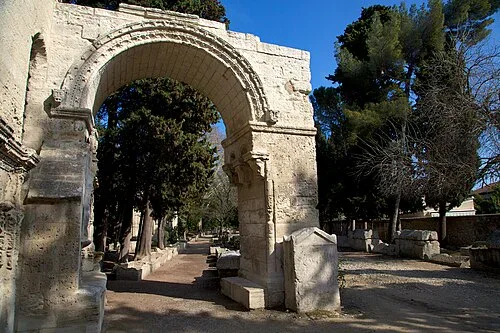 The Entrance Arch of Saint-Césaire
Entrance Arch to the Necropolis
Welcome to the Alyscamps, the great burial ground of Roman Arles. Roman custom traditionally forbade burying the dead inside a city, so the roads just outside the gates filled with tombs, the way the Appian Way outside Rome still does. This road was the last stretch of the Aurelian Way, running up to the city gates, and it became lined with the memorials of well-off citizens, from plain sarcophagi to elaborate monuments. The name itself promises something beautiful. It comes from the Provençal Aliscamps, from the Latin Elisii Campi, the Elysian Fields, the meadows where the blessed dead were thought to rest. Through this old arch the tombs stretch away under the trees. For nearly fifteen hundred years this was Arles' main cemetery, and in 1981 it joined the UNESCO World Heritage list with the city's Roman and Romanesque monuments.
Photo: Ddeveze · CC BY-SA 3.0
02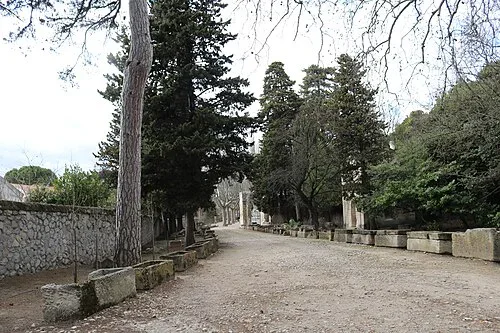 The Avenue of Sarcophagi
This straight avenue, lined with stone sarcophagi under tall trees, became the image of the Alyscamps known across Europe. Dante thought of it when he wrote the Inferno. In the ninth canto of the Divine Comedy he compares a part of hell to Arles, where the ground is studded with tombs, and alludes to the Alyscamps. Centuries later, in late October 1888, the alley drew two painters. Vincent van Gogh and Paul Gauguin chose it as the first place they worked side by side during Gauguin's stay in Arles, both painting the avenue and its falling autumn leaves. The alley is still a stage: in 2018 the fashion house Gucci staged a show here. But the painted rows of coffins are what people remember, the view Dante put into hell and the painters put onto canvas.
Photo: Thérèse Gaigé · CC BY-SA 4.0
03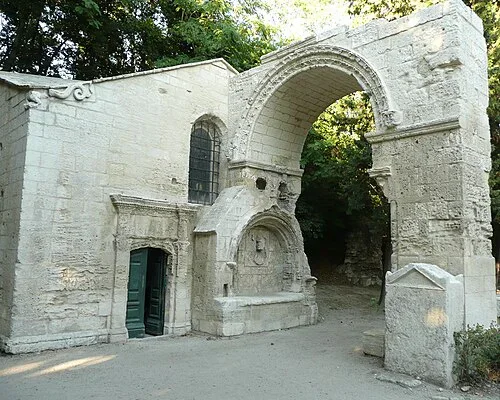 Chapelle Saint-Accurse
Even a small building here has its own story. This modest chapel, with its rounded arch sheltering a niche, is the chapel of Saint-Accurse. Its recorded history says it was built in 1520, first as an expiatory chapel, a place where prayers were offered for the dead, and later used as a burial place itself. That makes it a latecomer, raised in the cemetery's long afterlife. But it shows something important about the Alyscamps: a burial ground this prestigious did not stay a common field of sarcophagi. Families and brotherhoods claimed their own patches and built their own funerary structures alongside the rows of stone coffins. A place among the Elysian Fields was worth marking with walls of your own.
Listen in the appPhoto: Finoskov · CC BY-SA 4.0
04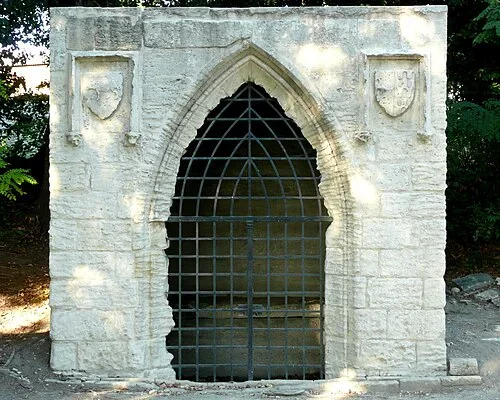 Chapelle des Porcelet
The carved shields on this chapel's facade announce the family that built it: the Porcelet, one of Arles' noble houses, who raised their Gothic chapel here in the sixteenth century. Their heraldry speaks of a time when burial among these tombs carried real status. It was also the time the necropolis was stripped. From the Renaissance onward, prelates, lords and kings took away the finest carved sarcophagi to enrich their collections, and city councillors handed them out as gifts to distinguished visitors. In 1564 Charles IX and his mother Catherine de Médicis visited Arles. They left by boat on the Rhône, taking a precious cargo of antique sarcophagi, columns and sculptures with them. Off Pont-Saint-Esprit, upstream, the vessel sank. The best of the Alyscamps went to the bottom of the river.
Listen in the appPhoto: Finoskov · CC BY-SA 4.0
05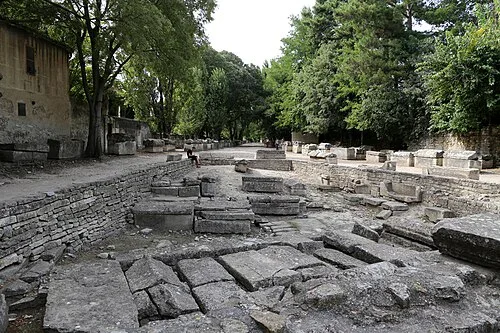 The Open-Air Cemetery
The Excavated Burial Grounds
People wanted to be buried here more than almost anywhere in Europe. As early as the fourth century there were already several thousand tombs, so many that sarcophagi were stacked three layers deep. The dead even arrived by river. From all over Europe, bodies were floated down the Rhône on small rafts, with money attached to pay the Arlesians who did the burying. The boatmen who ferried the coffins made a healthy profit from the trade. Then the ground itself was cut apart. In 1848 the Paris-Lyon-Méditerranée railway and its works sliced through the necropolis, and a canal cut across it too. What remains here, with its exposed foundations and slabs, is a remnant of one of the most crowded cemeteries of the medieval world.
Listen in the appPhoto: Sailko · CC BY 3.0
06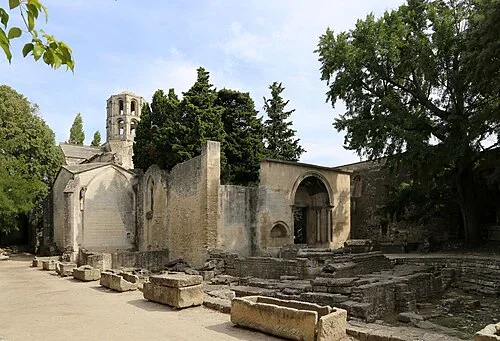 The Portal of Saint-Honorat
Church of Saint-Honorat
A Roman civil servant named Genesius changed what this ground meant. In the year 303 he refused an order to persecute Christians, and he was beheaded for it. His body was buried in the Alyscamps, and his cult grew so quickly that the old pagan necropolis became a goal for pilgrims. From the eleventh to the thirteenth centuries, this cemetery known to all Christendom gained its churches. Around 1035, Archbishop Raimbaud gave the ancient church of Saint-Genès, with all its dependencies, to the monks of Saint-Victor in Marseille. The price was a pound of incense, owed each year on the feast of Saint-Trophime. The Alyscamps then became a compulsory passage on the way to Compostela for pilgrims leaving Provence, and the church of Saint-Honorat stands among the sarcophagi as the heart of that monastic settlement.
Listen in the appPhoto: Sailko · CC BY 3.0
07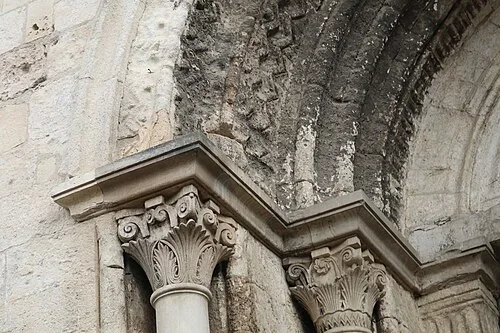 The Portal of Saint-Honorat
Romanesque Porch of Saint-Honorat
The porch of Saint-Honorat rewards a close eye. Its capitals are carved as Corinthian capitals, with the acanthus leaves the Roman stonemasons used, and the arches above them mould in the same classical vocabulary. That choice was not accidental. The Romanesque masons were reaching back to the antique forms that surrounded them here, in a city still full of Roman monuments, on ground that had carried the Roman dead for centuries. The medieval carvers and their Roman predecessors speak the same language of leaves and scrolls, a few steps from sarcophagi cut a thousand years before the church. It is one of the quiet reasons this whole site earned its place on the World Heritage list.
Listen in the appPhoto: Thérèse Gaigé · CC BY-SA 4.0
08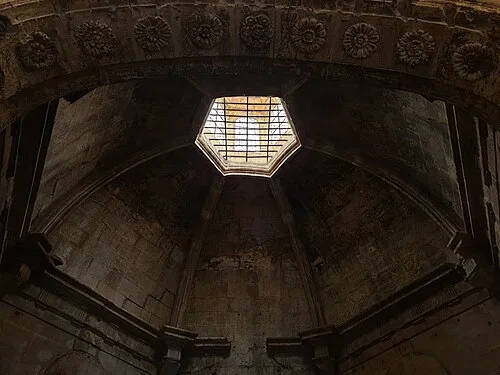 Inside Saint-Honorat Church
The Lantern Tower of Saint-Honorat
Inside Saint-Honorat, the eye climbs to the octagonal lantern tower, its vaulted ceiling opening to a grated skylight that lets daylight fall into the church below. It is the building's most distinctive medieval feature. And it belongs to a place that once held the most famous grave in Provence. Saint Trophimus, possibly the first bishop of Arles, was buried in the Alyscamps soon after Genesius. The medieval claim was bold: Christ himself attended the burial, knelt on a sarcophagus lid, and left the imprint of his knee in the stone. Pilgrims came for that holiness for centuries. Then, in 1152, Trophimus' relics were transferred to the cathedral in the centre of town, and much of the necropolis' prestige went with them. A place whose glory was literally carried off, the Alyscamps spent its afterlife as a quarry, a promenade, and a subject for painters, its tombs still resting along the old Roman road.
Listen in the appPhoto: Rc1959 · CC BY-SA 4.0
Alyscamps
Frequently asked questions
How much does the guide cost?
Free app download. Listed guide price: $0.99. Guide price shown in the app. Audio guide only. Venue admission is separate.
Can I listen without internet?
Yes. Download the guide’s audio, images, and maps in the app before your visit. Your downloaded content is then available offline.
Can I listen in my language?
This audio guide is available in 15 languages, including English.
Do I need to follow a schedule?
No. This is a self-guided experience. Choose your stops, pause whenever you like, and return to a story at your own pace.
At your own pace
Explore Alyscamps.
Download Stanza, then search for “Alyscamps”.
Free app download · Guide price shown in the app
Keep exploring
Nearby audio guides
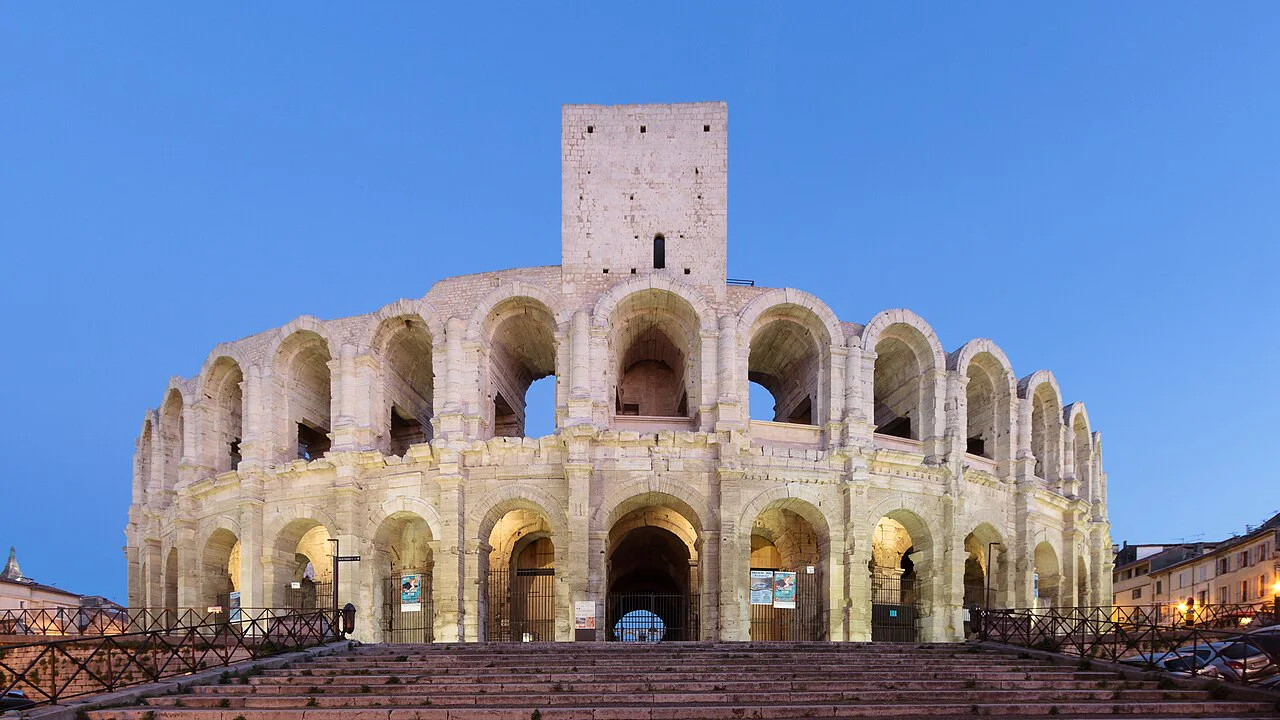
Arles · 1 km
Arènes d'Arles
Content & sources
Photo: PierreSelim · CC BY 3.0
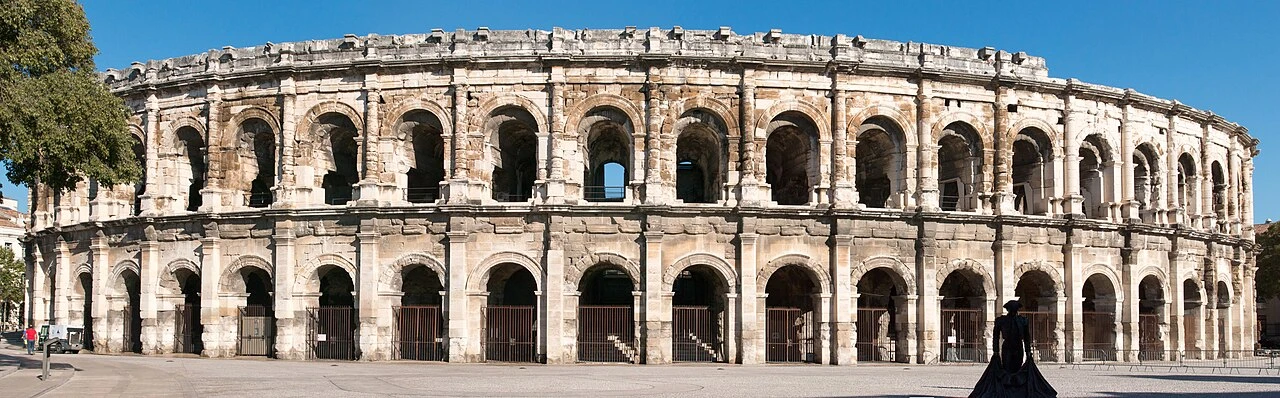
Nîmes · 29 km
Amphitheater of Nîmes
Content & sources
Daniel VILLAFRUELA. · CC BY-SA 3.0
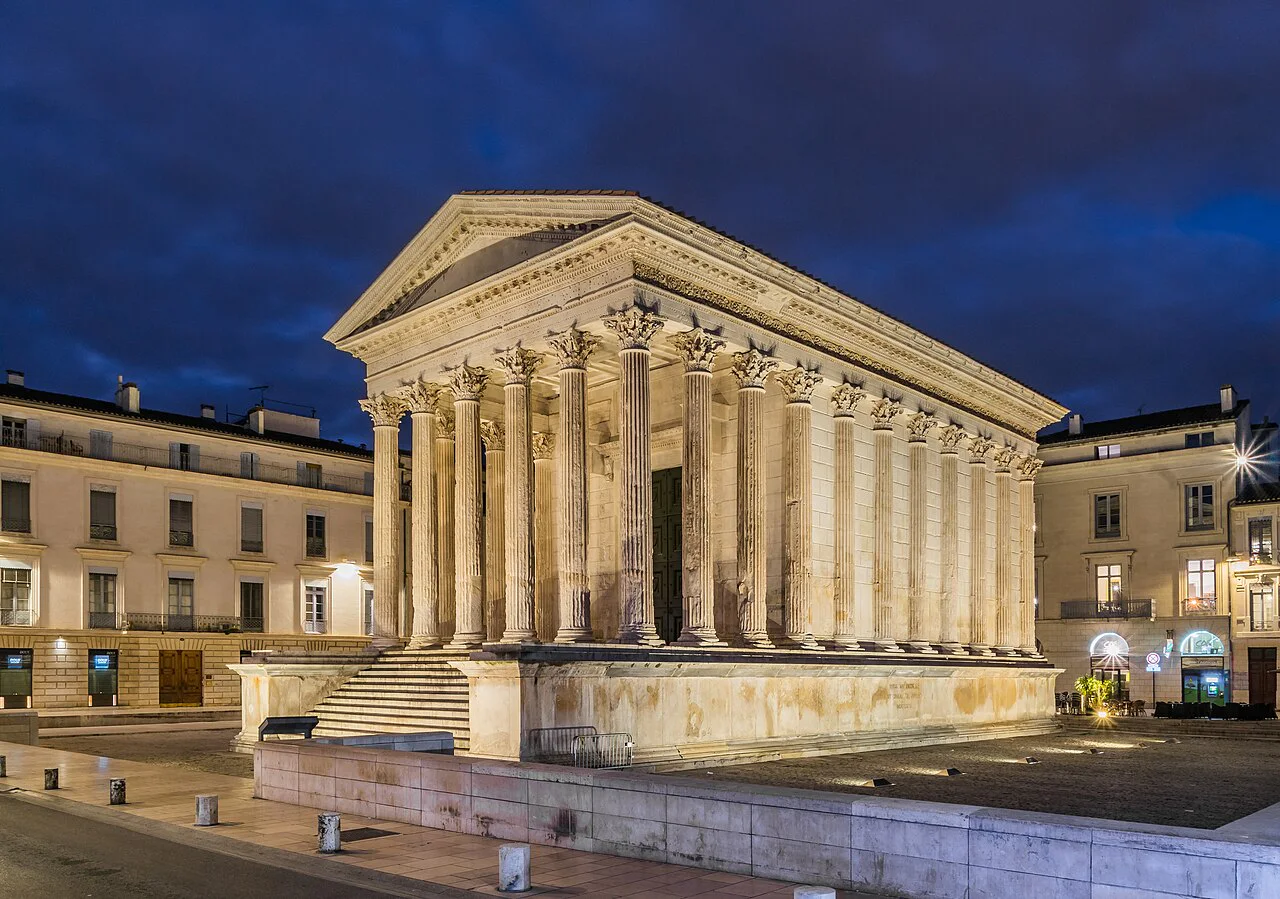
Nîmes · 29 km
Maison carrée
Content & sources
Krzysztof Golik · CC BY-SA 4.0
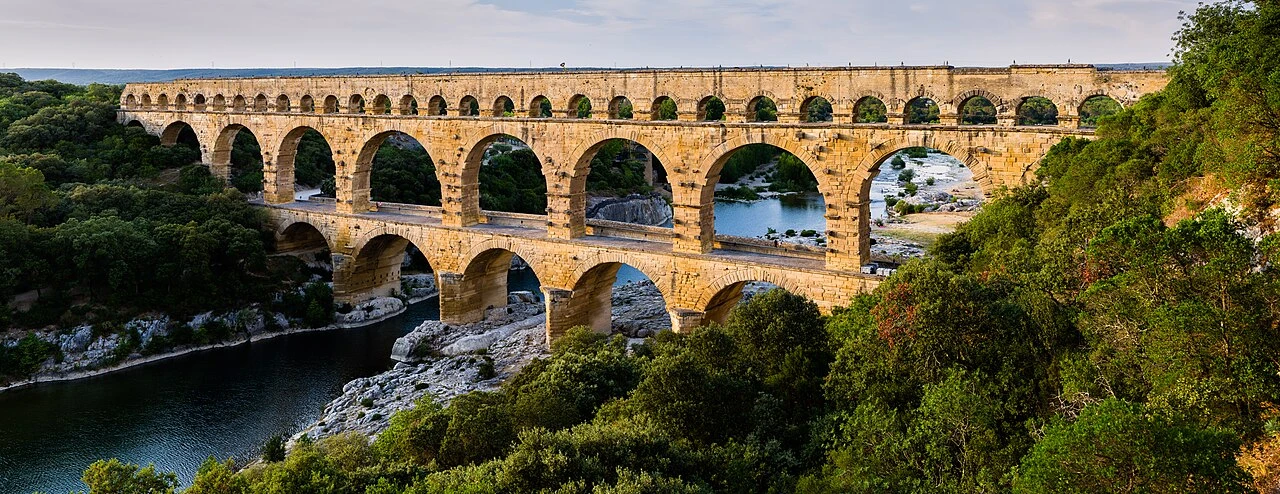
Vers-Pont-du-Gard · 32 km
Pont du Gard
Content & sources
Benh LIEU SONG (Flickr) · CC BY-SA 3.0