Stanza · Audio guide
Église Saint-Sulpice de Paris Audio Guide
A place to remember. A story to take with you.
The Church of Saint-Sulpice is a Catholic church located in Paris, France. It is the second largest church in the city and is known for its Great Organ and the Gnomon of Saint-Sulpice.
Download Stanza, then search for “Église Saint-Sulpice de Paris”.
About the tour
One guide. Your kind of visit.
The Church of Saint-Sulpice is a Catholic church located in Paris, France. It is the second largest church in the city and is known for its Great Organ and the Gnomon of Saint-Sulpice.
Ready when you are.
- 01Get the free Stanza app.
iOS & Android
- 02Find your guide.
“Église Saint-Sulpice de Paris”
- 03Download before you go.
Works offline
Audio guide / 13 narrated stops
Inside the guide
Get to know a few of the stories before you go. Open a stop to read more.
01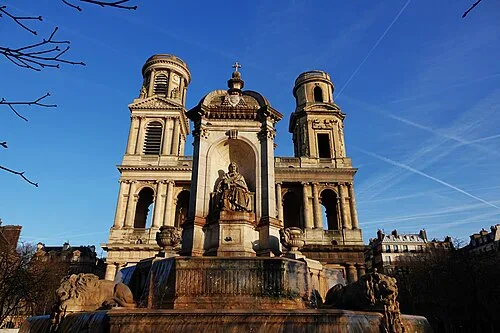 Place Saint-Sulpice and the Western Façade
Welcome to Saint-Sulpice, among the largest churches in Paris and a building with nearly four centuries of stories inside it. A church has stood here since the Middle Ages, but what you see now is the second building on the site. The old medieval church had grown decayed, and in 1646 the parish priest Jean-Jacques Olier founded its replacement. Olier also established the Society of Saint-Sulpice, a congregation of priests with its own seminary attached to the church. The Queen Regent, Anne of Austria, came in person to lay the first stone. The fountain in the square came much later, designed in 1847 by the architect Louis Visconti. Its four sides carry statues of great preaching bishops from the days of Louis XIV: Bossuet, Fénelon, Fléchier and Massillon. Not one of the four ever became a cardinal, so the neighbourhood affectionately renamed it the fountain of the four cardinal points. In 2019, after the fire at Notre-Dame, this church temporarily served the diocese for its great ceremonies.
Photo: Ibex73 · CC BY-SA 4.0
02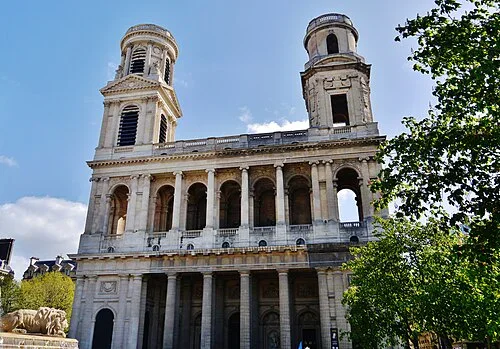 Place Saint-Sulpice and the Western Façade
The Mismatched Towers of the West Front
The west front was decided by a competition. In 1732 the designer Servandoni won it, inspired by the great entrance front of Saint Paul's Cathedral in London. His two tiers of columns, Ionic above Doric, drew praise from one architect writing in 1752, who said the building opened a practically new road for French architects. Servandoni died in 1766 with the towers unfinished. Twin towers then rose to his design, but his pupil Chalgrin rebuilt the northern one between 1777 and 1780, taller and more severely classical. The Revolution interrupted the work, and the southern tower was never rebuilt to match. Hence the mismatched pair today. In the 1790s the towers took on a second life. The physicist Claude Chappe mounted optical telegraphs on them: the south tower began the line towards Lyon, the north tower the line towards Strasbourg.
Photo: Zairon · CC BY-SA 4.0
03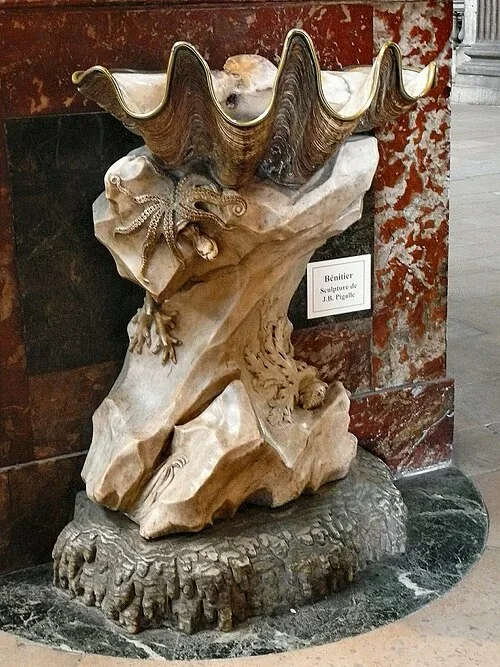 The Entrance and Giant Clam Shell Fonts
The Giant Clam Shell Holy Water Font
Just inside the entrance stand two of the most surprising holy water fonts in Paris. They are the two halves of a giant clam, a Tridacna gigas from tropical seas. The Venetian Republic gave the shell to King Francis I as a diplomatic gift. Each half now rests on a base carved to look like living rock, the work of the sculptor Jean-Baptiste Pigalle. His chisel added the creatures of the seabed: an octopus spreading its arms, coral, shells. A present from one state to a king, ended up holding holy water at a Paris church door.
Listen in the appOxxo · CC BY-SA 3.0
04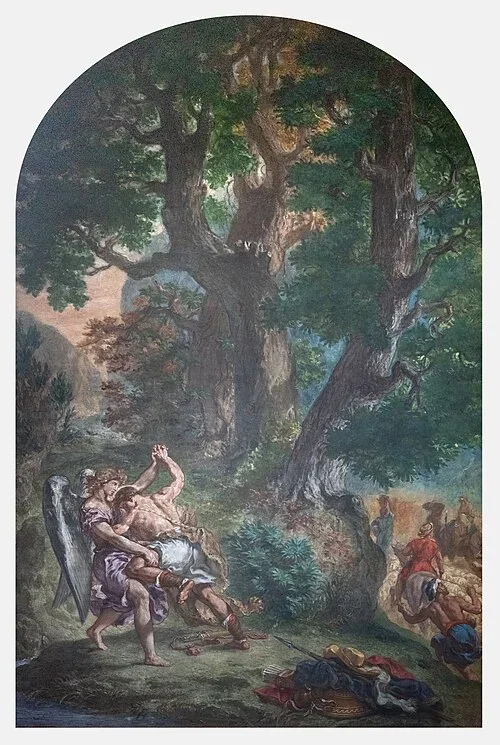 Chapel of the Holy Angels: Delacroix's Masterpieces
Delacroix's Jacob Wrestling with the Angel
In the first side chapel on the right hangs the last great undertaking of Eugène Delacroix. He worked here from 1855 to 1861, six years on the walls and vault of the Chapel of the Holy Angels. He took lodgings nearby on the rue Furstemberg, close enough to reach his scaffolds each day. The panel of Jacob Wrestling with the Angel absorbed him longest. The angel grips Jacob in a slow, powerful turn, and a vast tree spirals upward with the force of their struggle. Two later painters, Paul Gauguin and Maurice Denis, celebrated this picture above all, and its bold colour helped steer French painting toward symbolism.
Listen in the appGleb Simonov · Public domain
05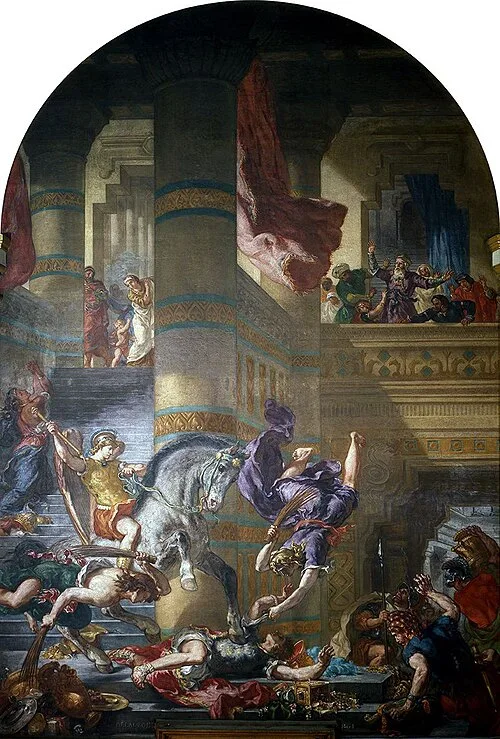 Chapel of the Holy Angels: Delacroix's Masterpieces
Heliodorus Driven from the Temple
The second wall panel tells a harsher story. Heliodorus tried to rob the temple of Jerusalem, and a heavenly rider throws him from his horse amid the falling treasure. Delacroix painted both wall scenes in oil mixed with wax, worked directly onto the plaster. The scene above them, Saint Michael Vanquishing the Demon, is made differently: oil on canvas, glued to the vault. A temple profaned and cleansed was a pointed choice for this church, which had itself suffered profanation in its own past. Another chapel of the church, dedicated to Saint Vincent de Paul, holds a fresco by Alexandre Charles Guillemot showing the saint at the deathbed of Louis XIII.
Listen in the appEugène Delacroix · Public domain
06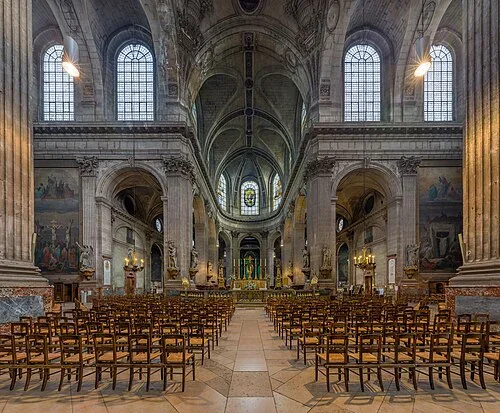 The Grand Nave and Cantilevered Pulpit
The Vast Nave
The nave gives the measure of the whole undertaking. Designs had been drawn up in 1636 by Christophe Gamard, and work began in 1646. Then the civil war of the Fronde intervened, and by 1660 only the Lady Chapel stood. Daniel Gittard supplied a new overall plan and completed the sanctuary, transept and north portal by 1678, when money ran out. Work resumed in 1719 under a new parish priest, who raised funds with a royal lottery. Gilles-Marie Oppenord directed the building of the nave, but his bell tower over the crossing proved so heavy it had to be torn down, and he lost the post. The nave was finished in 1736. The church was consecrated in 1745. Large arched windows flood the interior with daylight, in a plain two-storey elevation of remarkable scale. More than a hundred and twenty metres long, it is one of the largest churches in Paris.
Listen in the appPhoto: Diliff · CC BY-SA 3.0
07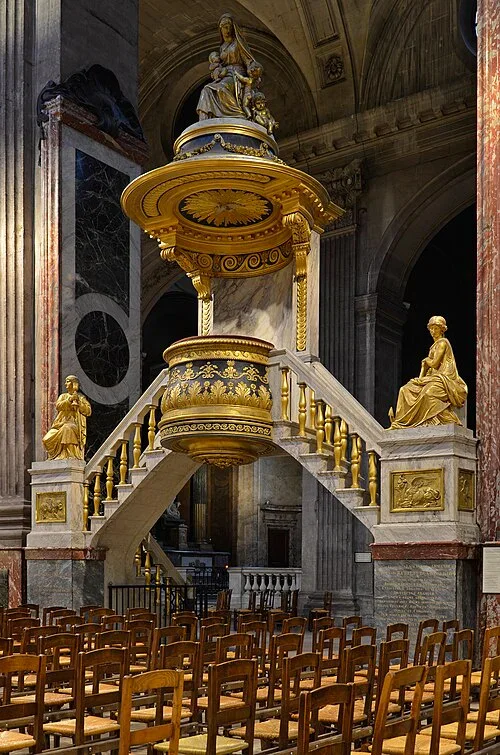 The Grand Nave and Cantilevered Pulpit
The Cantilevered Pulpit and the Revolutionary Defiance
A preacher's voice carries remarkably well under this oak canopy. Charles de Wailly designed the pulpit, completed in 1788 as a gift from the duc d'Aiguillon, a descendant of Richelieu. Made of oak and marble, it rests on nothing but its own lateral staircases. From here in 1791 the parish priest declared, before the National Guard and his flock, that he refused to swear the oath demanded of the clergy by the new Civil Constitution. The revolutionaries spared the pulpit itself, judging it useful, and their own orators later spoke from it. The church around it fared worse: it became first the Temple of Reason, then the Temple of Victory.
Listen in the appPhoto: Selbymay · CC BY-SA 3.0
08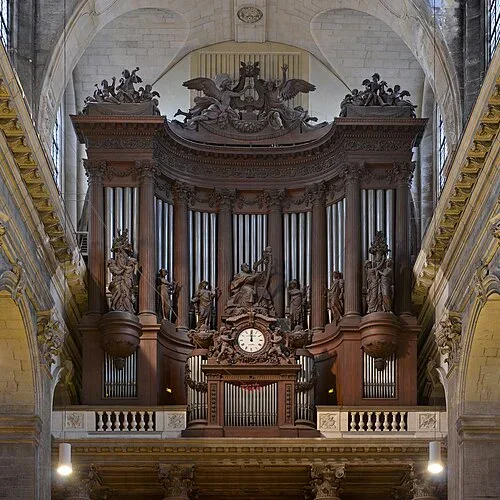 The Great Cavaillé-Coll Organ Gallery
The Great Organ of Cavaillé-Coll
High on the west gallery stands the great organ, considered the masterpiece of Aristide Cavaillé-Coll. In 1862 he rebuilt an earlier French classical instrument, keeping much of what its eighteenth-century builder had made, inside the monumental case designed by Chalgrin. The finished instrument carries a hundred and two speaking stops. They answer to five manuals and a pedal board, and the whole is reckoned the peak of the French romantic symphonic organ. Its survival owes much to its players. Charles-Marie Widor held the organ bench for more than sixty years, and Marcel Dupré succeeded him and played until 1971. Only two organists in a whole century, and between them they kept the instrument almost exactly as Cavaillé-Coll left it.
Listen in the appSelbymay · CC BY-SA 3.0
09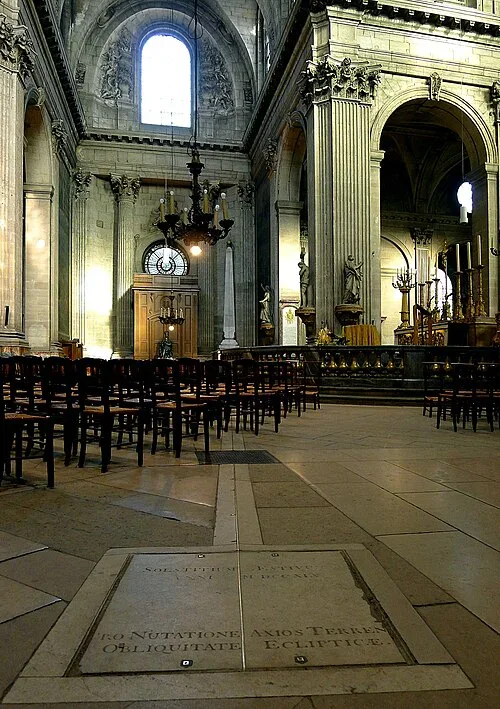 The Astronomical Gnomon and Meridian Line
Set into the floor of the transept runs a line of brass, part of an astronomical instrument built into the church itself. In 1727 the parish priest Jean-Baptiste Languet de Gergy asked for a gnomon, an instrument that reads the seasons by the sun, to fix the exact moment of the equinoxes and so the date of Easter. The English clock-maker and astronomer Henry Sully constructed it. A small opening with a lens in the south transept window casts a spot of sunlight along the meridian line. The instrument also served other scientific measurements, and that sober reputation may have saved the church from destruction during the Revolution. A best-selling novel later called the line the Rose Line and tied it to an imaginary pagan temple. The church keeps a notice on display correcting the story: no such temple ever existed here.
Listen in the appPhoto: Mbzt · CC BY-SA 3.0
10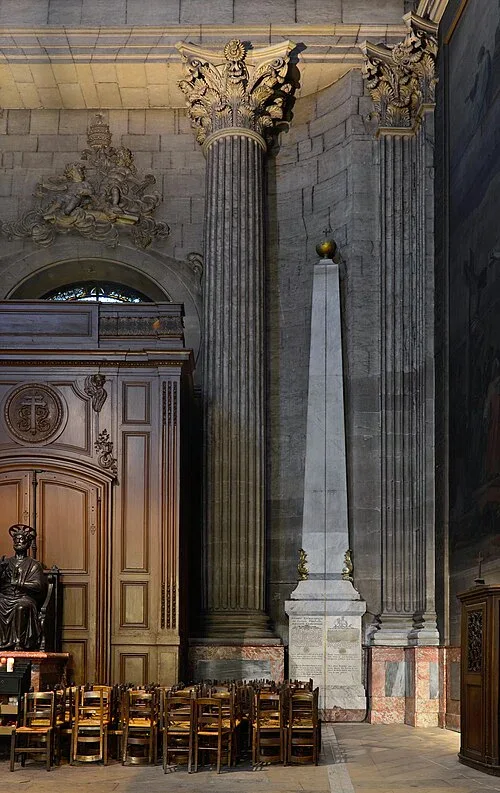 The Astronomical Gnomon and Meridian Line
The Marble Obelisk of the Meridian
The brass line climbs a white marble obelisk, nearly eleven metres tall. A sphere surmounted by a cross crowns it, and the stone is dated 1743. At noon on the winter solstice the sun's ray touches the line on the obelisk itself. At the equinoxes it falls instead on a copper plate set in the floor near the altar. The obelisk also carries a Revolutionary scar. Among the benefactors' names carved on its pedestal, those of the king and his ministers were deliberately effaced.
Listen in the appPhoto: Selbymay · CC BY-SA 3.0
- 11
The Choir and Bouchardon's Statues
The grand choir of Gittard and Bouchardon, and the silver Virgin nicknamed Our Lady of the Old Tableware.
- 12
The Lady Chapel and the Columns of Leptis Magna
Ancient marble columns from a Roman city in Libya, and Pigalle's Virgin crushing the serpent.
- 13
The Dome of the Lady Chapel
Lemoyne's Assumption floating on hidden light, and a last look at what centuries have gathered into one church.
Église Saint-Sulpice de Paris
Frequently asked questions
How much does the guide cost?
Free app download. Listed guide price: $0.99. Guide price shown in the app. Audio guide only. Venue admission is separate.
Can I listen without internet?
Yes. Download the guide’s audio, images, and maps in the app before your visit. Your downloaded content is then available offline.
Can I listen in my language?
This audio guide is available in 15 languages, including English.
Do I need to follow a schedule?
No. This is a self-guided experience. Choose your stops, pause whenever you like, and return to a story at your own pace.
At your own pace
Explore Église Saint-Sulpice de Paris.
Download Stanza, then search for “Église Saint-Sulpice de Paris”.
Free app download · Guide price shown in the app
Keep exploring
Nearby audio guides
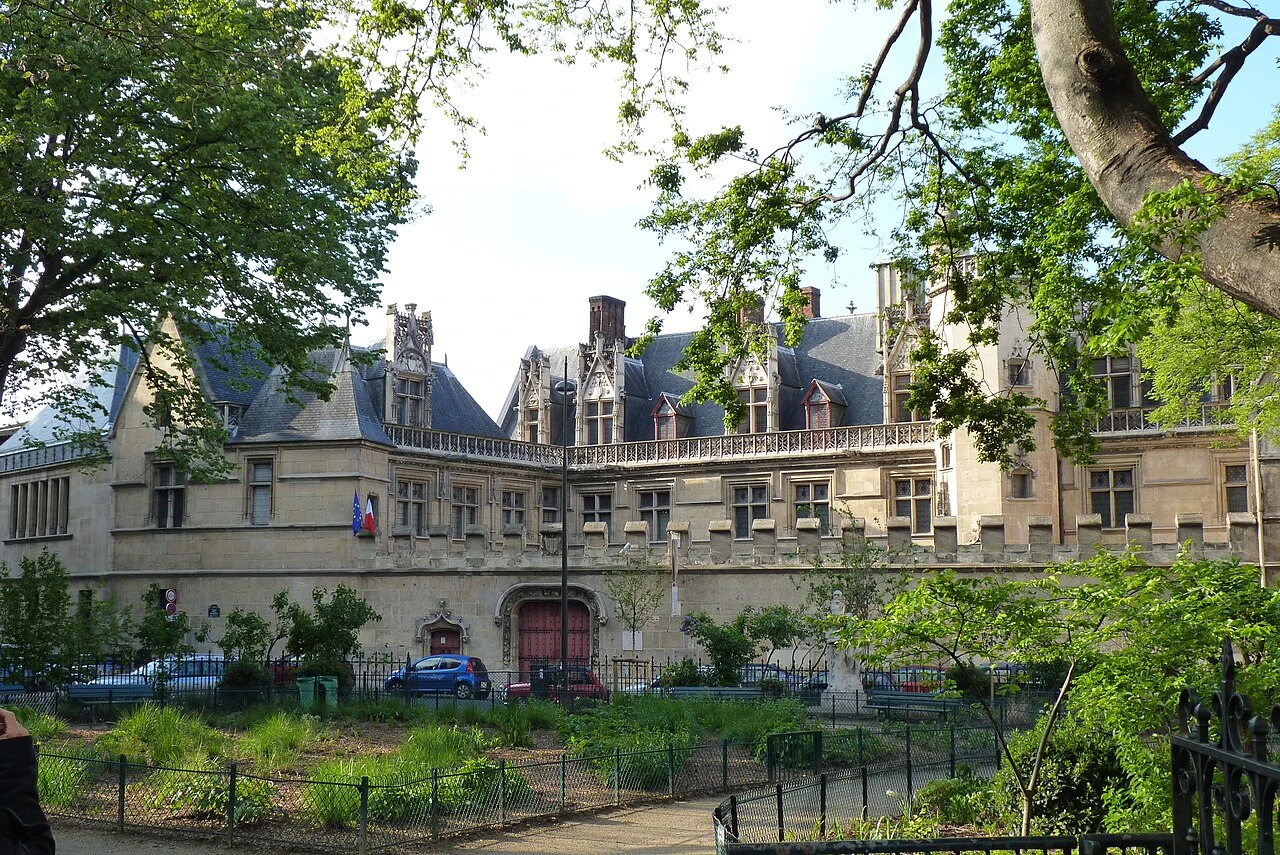
Paris · 1 km
Cluny Museum
Content & sources
ctj71081 · CC BY-SA 2.0
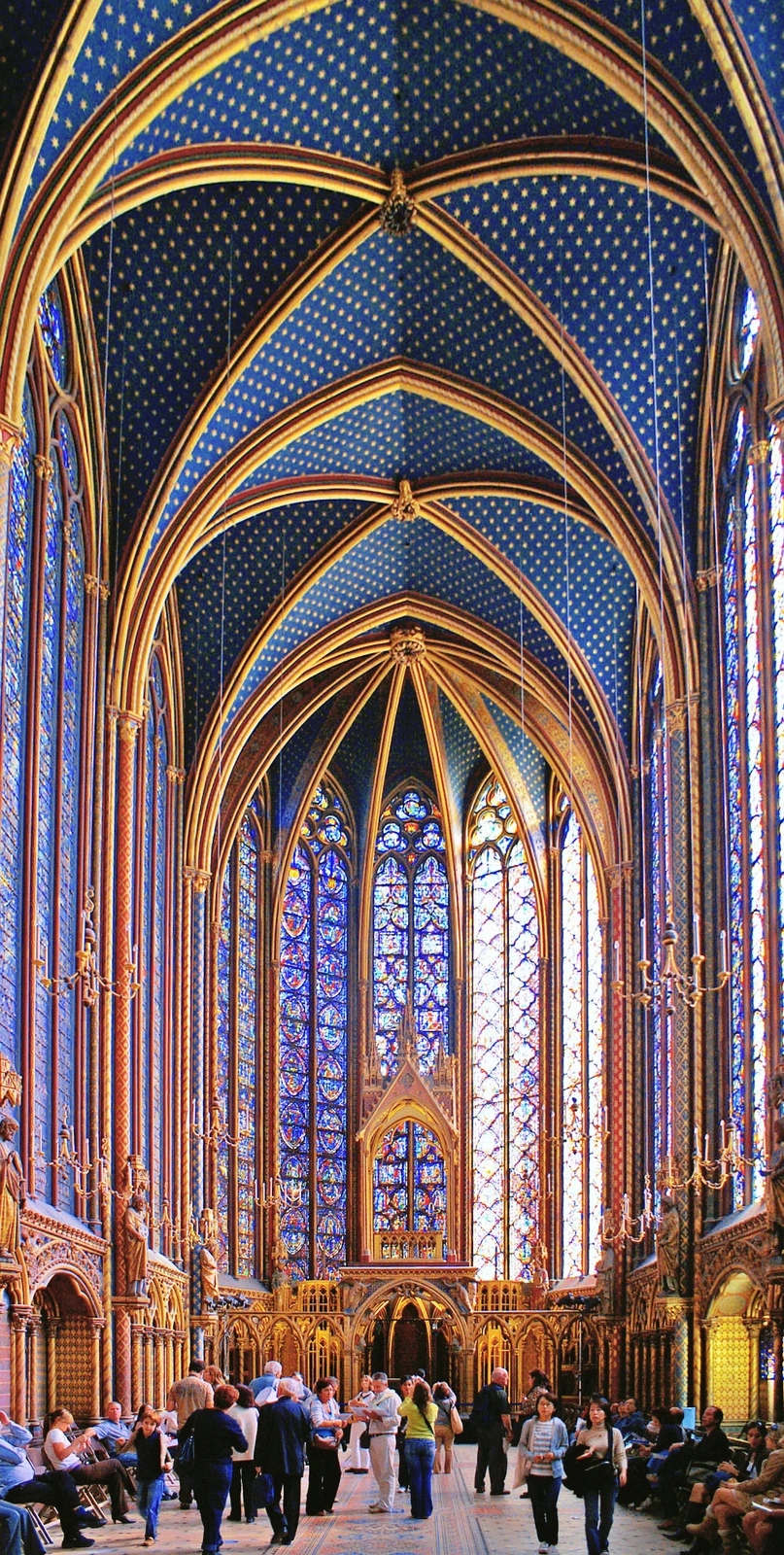
Paris · 1 km
Sainte-Chapelle
Content & sources
Didier B (Sam67fr) · CC BY-SA 2.5
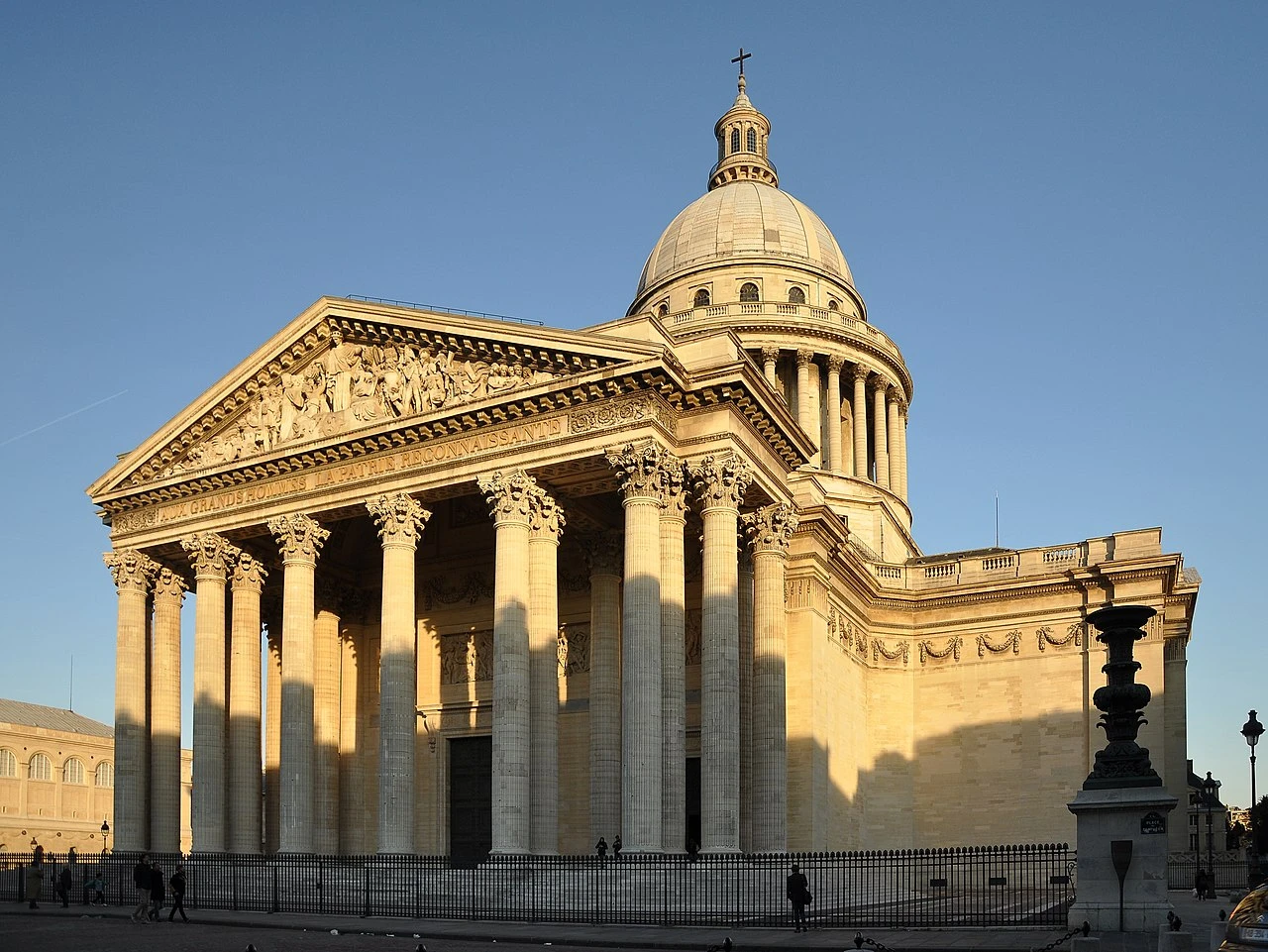
Paris · 1 km
Panthéon
Content & sources
Photo: Moonik · CC BY-SA 3.0
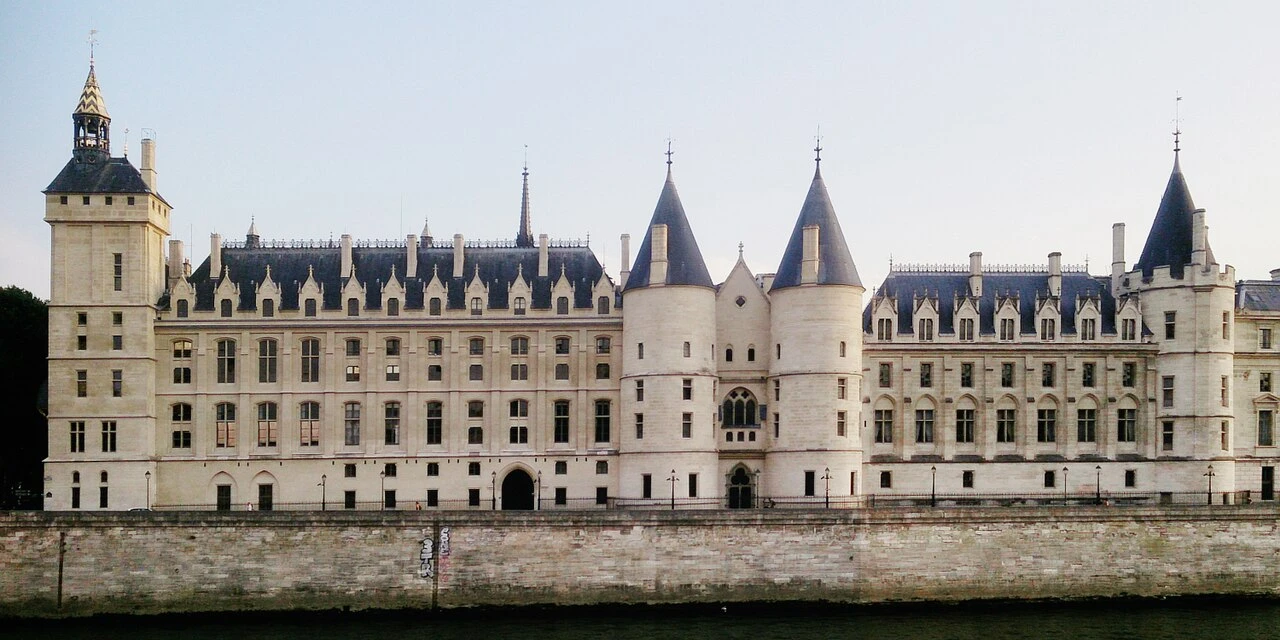
Paris · 1 km
Conciergerie
Content & sources
Photo: Xandru · CC BY-SA 4.0