Stanza · Audio guide
ConciergerieAudio guide
A place to remember. A story to take with you.
The Conciergerie is a historic medieval building in Paris, France. It served as a royal palace, a revolutionary tribunal, and famously as a prison.
Download Stanza, then search for “Conciergerie”.
About the tour
One guide. Your kind of visit.
The Conciergerie is a historic medieval building in Paris, France. It served as a royal palace, a revolutionary tribunal, and famously as a prison.
Ready when you are.
- 01Get the free Stanza app.
iOS & Android
- 02Find your guide.
“Conciergerie”
- 03Download before you go.
Works offline
Audio guide / 13 narrated stops
Inside the guide
Get to know a few of the stories before you go. Open a stop to read more.
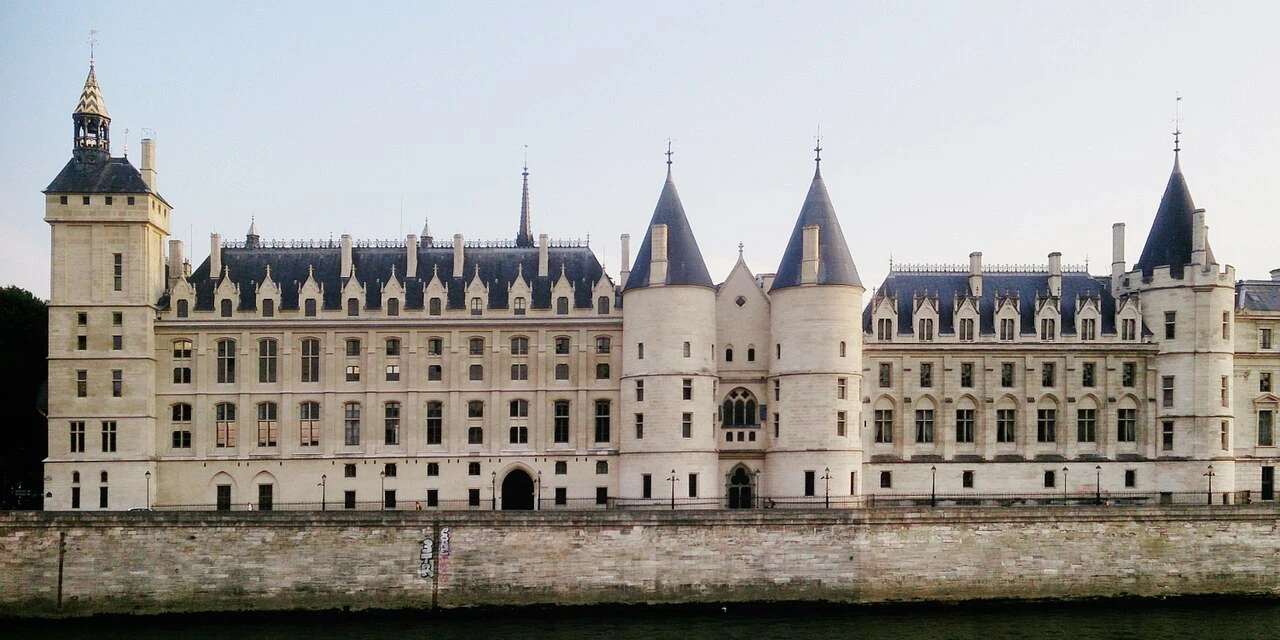
01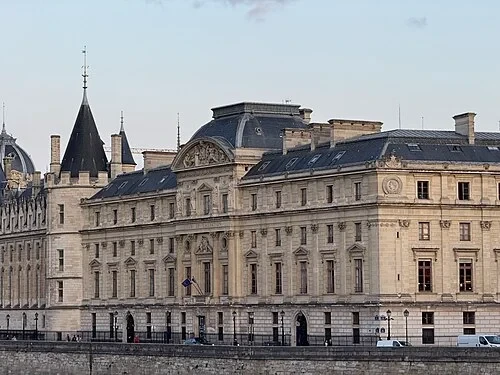 The Medieval Facade and the Four TowersThe Royal Facade
Welcome to one of the most historic sites in Paris. While this building is widely recognized today for its grim history as a prison, it was originally conceived as a symbol of royal grandeur. Between 1285 and 1314, King Philip IV, known as Philip the Fair, transformed the site into a magnificent royal palace. For centuries, this Gothic masterpiece served as the primary residence for French monarchs. However, the royal family's time here eventually came to an end. In 1364, King Charles V decided to move the official royal residence to the Louvre, seeking a location that was better fortified and removed from the dense administrative center of the city. Following this departure, the building began a slow and somber transformation. While it continued to house the Parliament of Paris and various judicial offices, the lower levels were increasingly utilized as a permanent prison. This shift marked the beginning of a new chapter where the former palace would become inextricably linked with the administration of justice and, eventually, the darker days of the French Revolution.
Photo: Chabe01 · CC BY-SA 4.0
02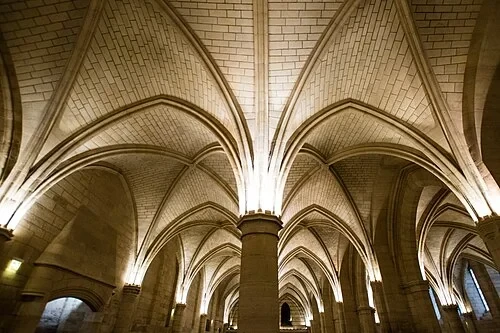 Salle des Gens d'Armes (Hall of the Men-at-Arms)Hall of the Men-at-Arms
This vast underground space represents the architectural climax of the medieval palace. Known as the Hall of the Men-at-Arms, it is widely considered the largest surviving non-religious Gothic hall in Europe. To understand its grandeur, consider its massive scale: the room spans 61.2 meters in length and 28 meters in width. Overhead, the intricate stone vaults rise nearly 9 meters above the floor. This forest of sturdy pillars was not merely for show; it provided the essential structural support for the grand royal apartments that once sat directly above. During the 14th century, this hall was a center of constant activity, serving as the primary dining and ceremonial space for the royal household's massive staff. At its height, the palace employed up to 2,000 individuals, including guards, administrators, and domestic workers, all of whom would gather here for meals and assemblies. The rows of columns create a sense of rhythmic perspective, illustrating the sophisticated engineering capabilities of the craftsmen working under Philip IV. Today, the hall stands as a quiet, stone witness to the bustling court life that defined this site before its eventual conversion into a revolutionary prison.
Xin Sy · CC BY 2.0
03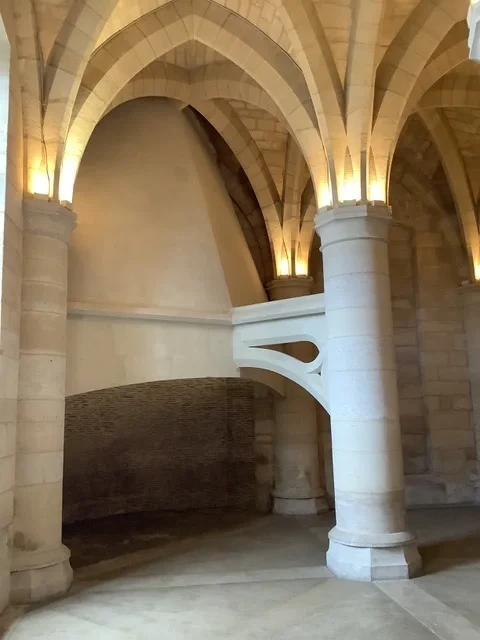 The Royal KitchensThe Royal Kitchens
Feeding a royal household of two thousand people was a massive logistical challenge that required specialized architecture. These kitchens, located in a separate pavilion completed around 1353, were designed specifically to meet that demand. Notice the four massive corner fireplaces, which are the most striking features of the room. These hearths were built on a scale large enough to roast entire oxen, which was necessary to provide enough protein for the king's extensive staff and guests. The design of these fireplaces is a marvel of medieval engineering. Each one includes a sophisticated smoke evacuation system, utilizing large flues to draw heat and fumes away from the workspace. Because of the intense temperatures generated by these constant fires, the pavilion required heavy stone pillars to support the structural weight and resist the heat. Food was prepared here and then transported to the adjacent Hall of the Men-at-Arms. The height of the ceilings and the thickness of the walls reflect a space built for endurance and heavy utility, reminding us that behind the elegance of the royal court was a massive, industrial-scale operation dedicated to the daily needs of the monarchy.
Listen in the appPhoto: SiefkinDR · CC BY-SA 4.0
04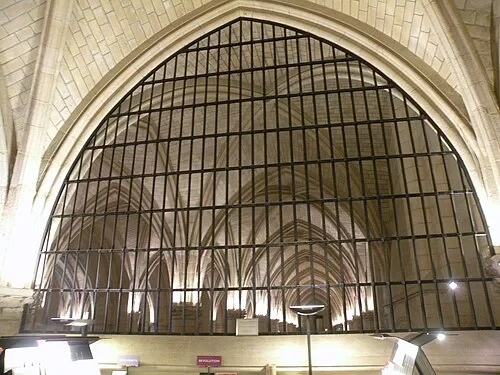 The 'Rue de Paris' CorridorThe Street of Paris
At the far end of the grand hall, a narrow, barred corridor provides a stark contrast to the earlier royal architecture. This passage is known by the grim nickname 'Rue de Paris,' or the Street of Paris. It was named after the city's lead executioner, Monsieur de Paris, whose presence was a constant shadow over this area. During the French Revolution, this corridor served as a holding area for the poorest class of prisoners. Unlike the wealthy inmates who could pay for private cells or furniture, these individuals were known as 'pailleux.' This term comes from the French word for straw, 'paille,' because straw was the only bedding they could afford. These prisoners lived in crowded, miserable conditions in the cold shadows of the stone vaults, with very little protection from the dampness of the nearby river. The iron bars and heavy gates served as a constant reminder of their isolation from the city outside. This space represents the bottom of the prison hierarchy, where the struggle for survival was most desperate and where the administrative machinery of the Revolutionary Tribunal felt most impersonal and unrelenting.
Listen in the appPhoto: Chatsam · CC BY-SA 3.0
05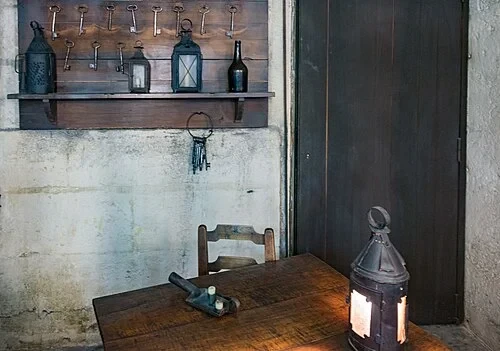 The Revolutionary Registry (Greffe)The Prison Registry
The 'Greffe' served as the administrative heart of the prison, especially during the chaotic years of the Reign of Terror. This registry office was the first stop for every prisoner arriving at the gates. Here, the jailer would meticulously record the names and details of the new arrivals in large ledgers. The atmosphere was one of cold, bureaucratic efficiency. Upon entry, prisoners were stripped of their personal belongings, including jewelry, money, and letters, which were often confiscated by the state. Visual elements like the heavy lanterns and the rows of keys hanging on the walls helped define the daily reality of this space. The lanterns provided the only light for the late-night arrivals who were often brought in by cart under the cover of darkness. The keys represent the loss of freedom that occurred the moment a name was entered into the registry. This office was where a person's identity was reduced to a entry in a book, marking their official transition from a citizen of France to a prisoner of the state, awaiting trial before the Revolutionary Tribunal.
Listen in the appxiquinhosilva from Cacau · CC BY 2.0
06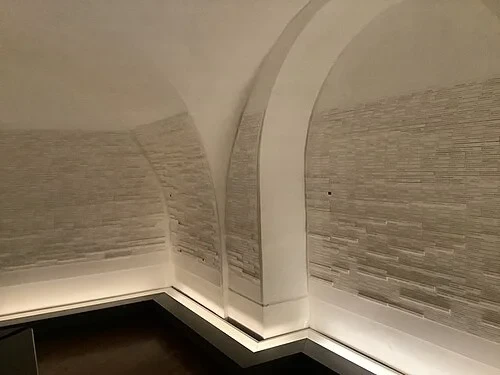 The Hall of NamesThe Hall of Names
The Hall of Names serves as a profound record of the human cost associated with the French Revolution. On these walls, the identities of over 4,000 individuals who were tried by the Revolutionary Tribunal are meticulously listed. The statistics from this period are sobering: during the 780 days that the Tribunal operated within these walls, 2,780 people were sentenced to death. Those condemned were sent directly from this building to the guillotine. As you look at the names covering the walls, you will see representatives from every social class, from high-ranking aristocrats and clergy to common laborers, soldiers, and shopkeepers. The revolution, in its most radical phase, spared no one. The sheer number of names highlights the speed and scale of the judicial process during the Reign of Terror, where trials were often brief and the outcome frequently predetermined. This room is intended to move the focus away from the abstract politics of the era and back toward the individual lives that were caught in the machinery of the state. Each name represents a unique story that ended in the squares of Paris, just a short distance from where you stand.
Listen in the appPhoto: SiefkinDR · CC BY-SA 4.0
07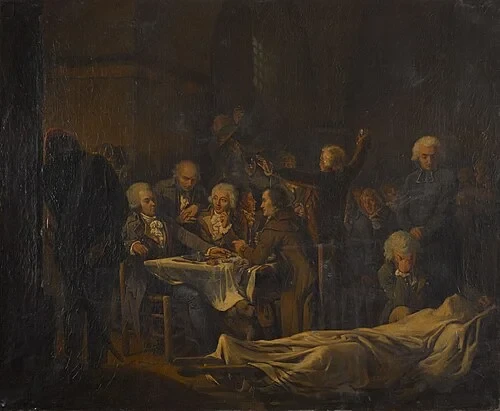 The Prisoners' ChapelThe Last Banquet of the Girondins
This painting captures a famous and dramatic moment in the prison’s history: the 'last banquet' of the Girondins. The Girondins were a group of moderate deputies who had initially supported the Revolution but eventually fell from power as more radical factions gained control. On the night before their execution, they were granted the privilege of a final meal together in the prison chapel. The scene shows them gathered around a table, maintaining an air of dignity and camaraderie despite their impending fate. This event has become a centerpiece of Revolutionary lore, symbolizing the tragic end of the moderate voice in the face of the Reign of Terror. There is a deep historical irony connected to this story. Maximilien Robespierre, the powerful figure who orchestrated the fall of the Girondins and many others, would eventually find himself a prisoner in this very same building. Just months after his rivals were executed, Robespierre was brought here briefly following his own arrest, shortly before he was taken to the guillotine. The painting serves as a reminder of how quickly the political tides could turn, making today's leaders tomorrow's inmates within these stone walls.
Listen in the appBenjamin Gavaudo · Public domain
08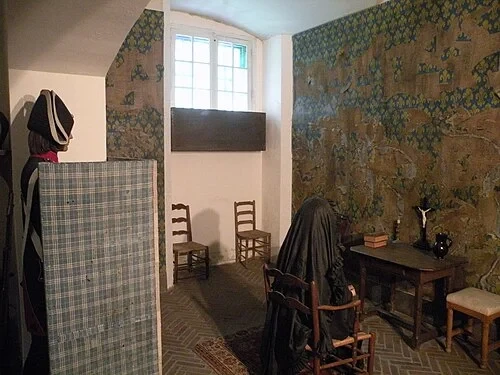 Marie Antoinette's Final DaysMarie Antoinette's Prison Cell
On August 2, 1793, Marie Antoinette was moved to this small cell, where she would spend the final 44 days of her life. This space is a reconstruction designed to show the restricted conditions under which she lived. One of the most notable features in the room is the simple screen. This was not for her comfort, but for the convenience of the guards. The Queen was kept under constant, 24-hour surveillance by two guards who remained behind that screen at all times. Their presence ensured that she never had a single moment of privacy, even while dressing or sleeping. The furnishings were sparse: a simple bed, a table, and a couple of chairs. This was a radical departure from the immense luxury she had known at Versailles. For the revolutionary authorities, this cell was a tool of humiliation as much as it was a place of detention. By stripping away her status and her privacy, they sought to reduce the former queen to the status of an ordinary prisoner, known simply as 'Widow Capet,' before her trial and eventual execution in October.
Listen in the appPhoto: Chatsam · CC BY-SA 3.0
09 Marie Antoinette's Final DaysThe Queen's Pitcher
Among the few personal artifacts remaining from Marie Antoinette’s imprisonment is this small, porcelain pitcher decorated with delicate floral patterns. While it looks like a common domestic object, its history gives it significant weight. This was one of the few items the former queen used to drink from during her final days in her cell. It represents a stark and poignant contrast to the life she led at the Palace of Versailles. Only a few years earlier, her daily life involved the finest gold-rimmed china and the most elaborate service rituals imaginable. Here, in the damp confines of the prison, her world had shrunk to a few square meters and a handful of simple, functional items. This pitcher remained with her until the morning of October 16, 1793, when she was led from her cell to the scaffold. Such domestic objects provide a tangible, human connection to the historical figure, stripping away the myths and political symbolism to reveal the mundane reality of a woman awaiting her death. It is one of the few surviving witnesses to the quiet, private moments of the woman who was once the most powerful in France.
Listen in the appPhoto: Tangopaso · Public domain
10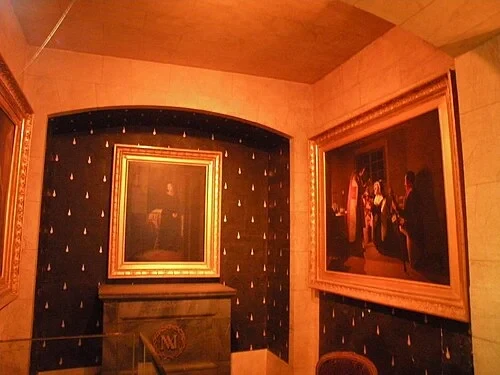 The Memorial ChapelThe Memorial Chapel
Following the restoration of the monarchy, King Louis XVIII commissioned this expiatory chapel to honor the memory of his sister-in-law, Marie Antoinette. The chapel was built precisely on the site of her former prison cell, effectively replacing a place of suffering with a place of prayer. The atmosphere here is intentionally somber and reflective. Notice the use of black marble and the wall decorations featuring silver 'teardrops.' These teardrops are actually simplified fleurs-de-lys, the traditional symbol of the French monarchy, set against a dark background to symbolize the mourning of the Bourbon family. The space is small and intimate, designed to focus the visitor's attention on the personal tragedy of the royal family. Large paintings on the walls depict scenes from the Queen's final days, further emphasizing the chapel's role as a memorial. By creating this space, the Bourbon kings sought to re-sacralize the building and provide a formal site for remembrance after the violence of the revolutionary years. It stands as a quiet sanctuary within the thick medieval walls, dedicated to a period of grief and the eventual return of the royal line.
Listen in the appPhoto: Chatsam · CC BY-SA 3.0
Conciergerie
Frequently asked questions
How much does the guide cost?
Free app download. Listed guide price: $0.99. Guide price shown in the app. Audio guide only. Venue admission is separate.
Can I listen without internet?
Yes. Download the guide’s audio, images, and maps in the app before your visit. Your downloaded content is then available offline.
Can I listen in my language?
Stanza supports 15 languages. Check the app for the languages available for this guide.
Do I need to follow a schedule?
No. This is a self-guided experience. Choose your stops, pause whenever you like, and return to a story at your own pace.
At your own pace
Explore Conciergerie.
Download Stanza, then search for “Conciergerie”.
Free app download · Guide price shown in the app
Keep exploring
Nearby audio guides
Paris
Arc de Triomphe de l'Étoile
Content & sources
Jiuguang Wang · CC BY-SA 2.0
Paris
Basilique du Sacré-Cœur de Montmartre
Content & sources
Tonchino · CC BY-SA 3.0
Paris
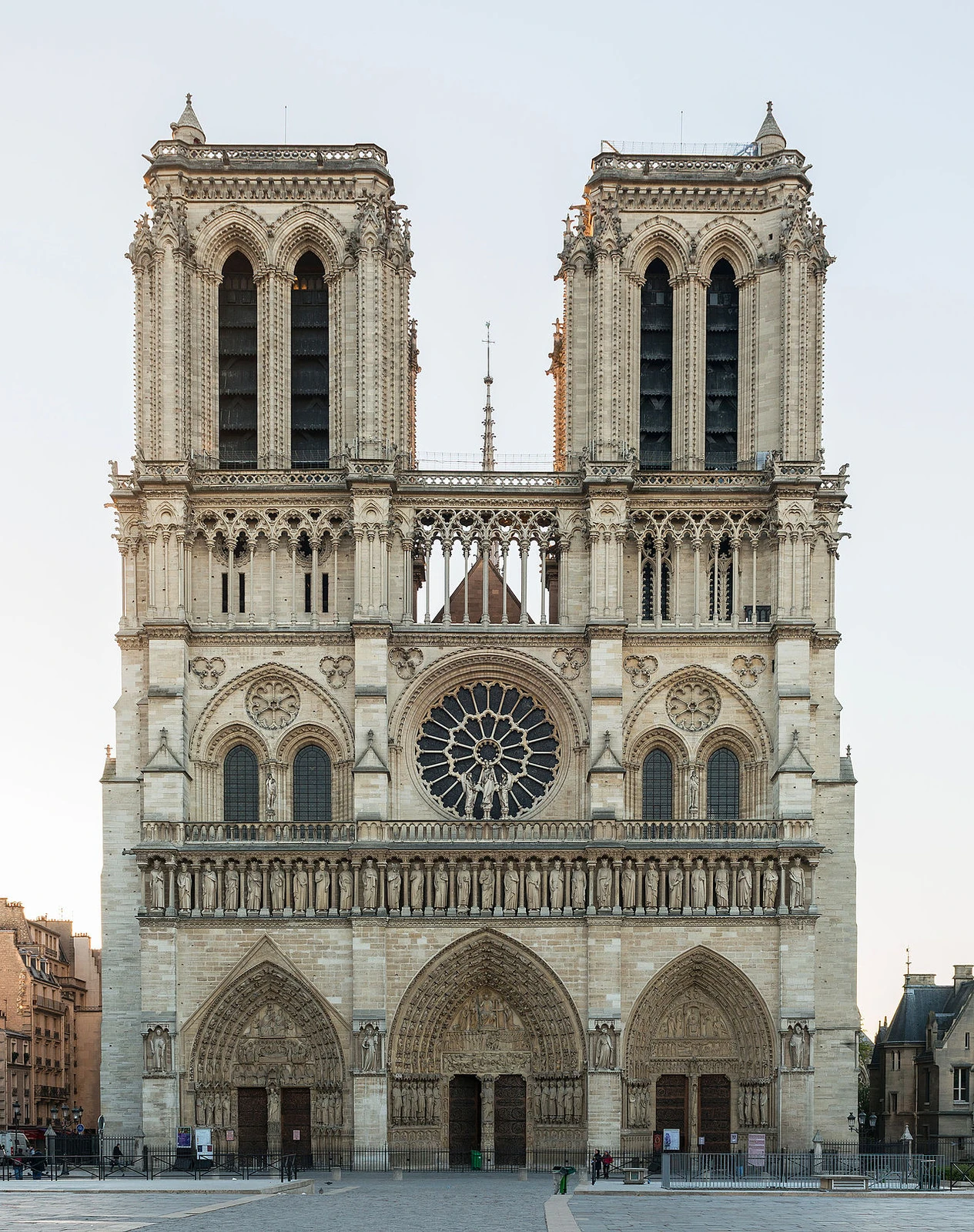
Cathédrale Notre-Dame de Paris
Content & sources
DXR · CC BY-SA 3.0
Paris
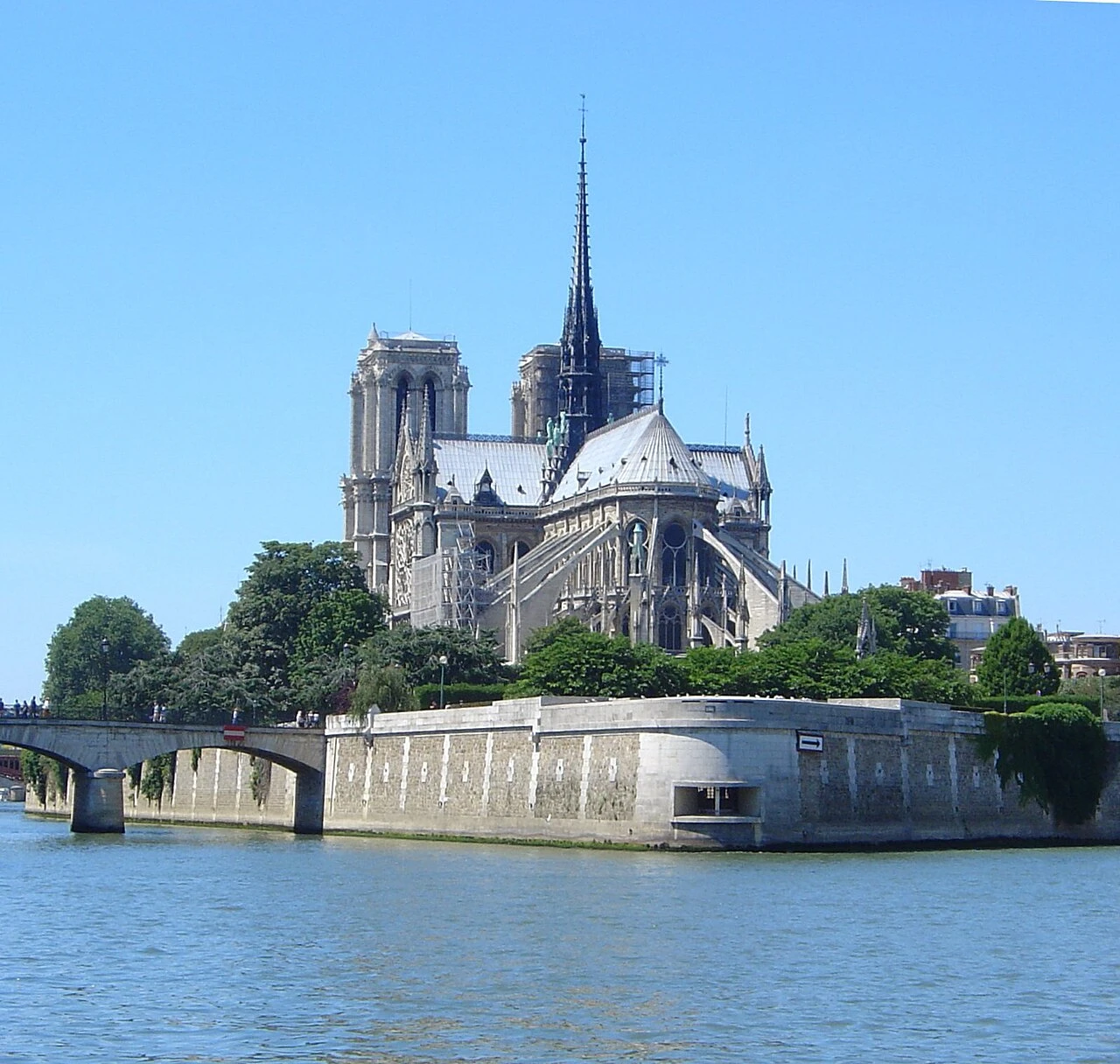
Île de la Cité
Content & sources
David Monniaux · CC BY-SA 3.0