Stanza · Audio guide
Grande mosquée de Paris Audio Guide
A place to remember. A story to take with you.
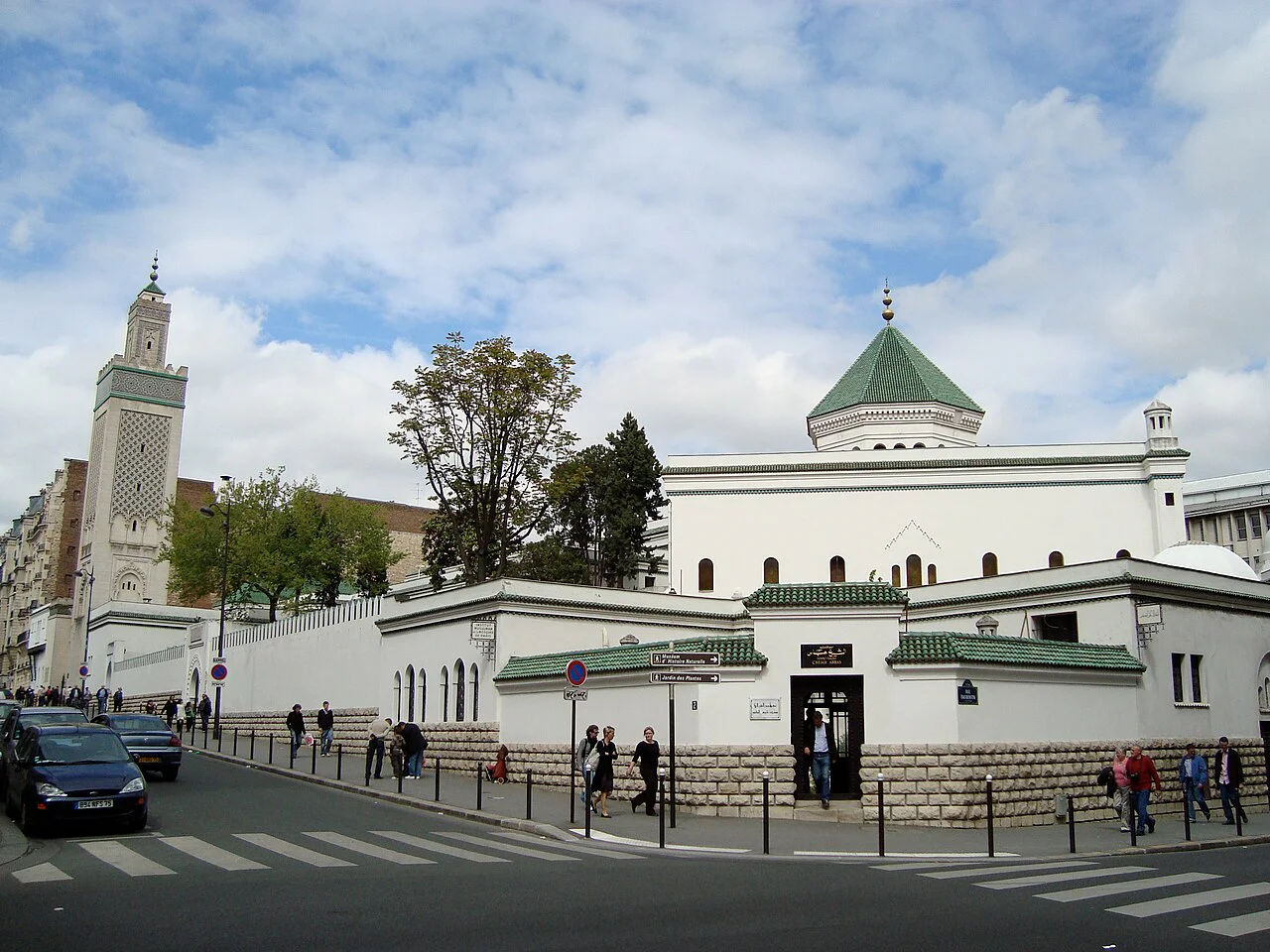
The Grand Mosque of Paris is one of the largest mosques in France. Completed in 1926, it is the oldest mosque in metropolitan France.
Download Stanza, then search for “Grande mosquée de Paris”.
About the tour
One guide. Your kind of visit.
The Grand Mosque of Paris is one of the largest mosques in France. Completed in 1926, it is the oldest mosque in metropolitan France.
Ready when you are.
- 01Get the free Stanza app.
iOS & Android
- 02Find your guide.
“Grande mosquée de Paris”
- 03Download before you go.
Works offline
Audio guide / 13 narrated stops
Inside the guide
Get to know a few of the stories before you go. Open a stop to read more.
01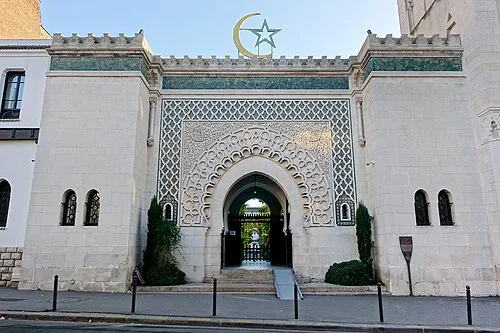 Monumental Portal and the Zitouna Minaret
Monumental Entrance of the Grande Mosquée de Paris
Welcome to the Grande Mosquée de Paris, the oldest mosque still serving worship in metropolitan France. Its story begins in the trenches of the First World War. Muslim soldiers from Algeria and across the French Empire died in their tens of thousands fighting for France. When the war ended, France wanted to honour that sacrifice, and a grand mosque in Paris was the chosen gesture. There was a legal obstacle. A law of 1905 separated the French state from religion, so public money could not simply build a house of prayer. The way around it ran through Algeria, where subsidies to religion were allowed. A law of August 1920 granted five hundred thousand francs, channelled through a religious foundation called the Société des habous. The first stone was laid in 1922, in the presence of Marshal Lyautey and delegates from across the Islamic world. The site was the former Pitié hospital grounds, land given by the City of Paris, next to the Jardin des plantes. The doorway itself announces the building's ambitions. A great horseshoe arch, carved with Islamic motifs, rises above heavy studded doors, and a crescent with a star crowns the whole portal.
Guilhem Vellut from Paris, France · CC BY 2.0
02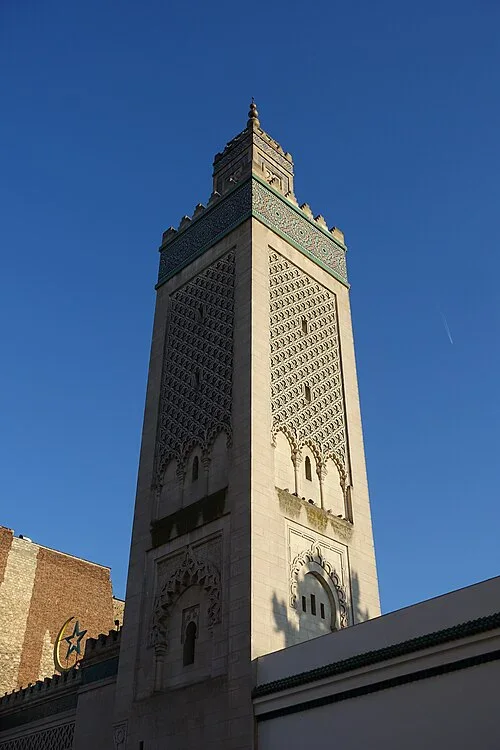 Monumental Portal and the Zitouna Minaret
The Zitouna-Inspired Minaret
The tall square tower with its crenellated top is the minaret, the mosque's signature on the Paris skyline. Its model stands far to the south: the Zaytuna Mosque in Tunis, itself built in the Almohad style, the style of the dynasty that ruled the Maghreb and Al-Andalus in the twelfth and thirteenth centuries. Bands of green-glazed tile run across the shaft, and the whole tower carries the dense carved ornament typical of that lineage. How tall is it? The minaret rises about thirty-three metres, though a Paris city history panel nearby gives twenty-six, following a description by the architect Maurice Mantout. The plans came from Maurice Tranchant de Lunel, a painter-architect who served as director of Fine Arts in Morocco under Marshal Lyautey. On site, the work was carried out by architects Robert Fournez, Maurice Mantout and Charles Heubès. The structure is reinforced concrete, a modern French technique of the 1920s. But every surface was finished by specialised craftsmen from North Africa, working with traditional materials, which is why the tower reads as genuinely Moorish rather than as a pastiche.
Guilhem Vellut from Paris, France · CC BY 2.0
03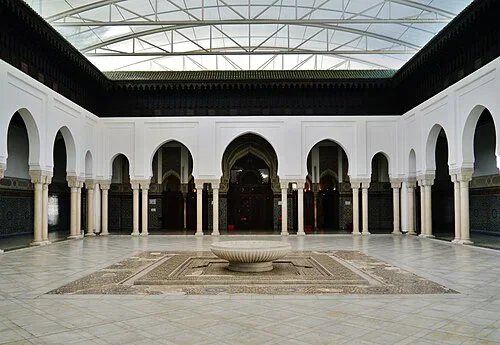 The Grand Patio and Moroccan Craftsmanship
The Grand Patio
The arcaded courtyard at the centre of the mosque is its gathering place. This is a full institution, not a single prayer room: the compound covers about seven and a half thousand square metres and holds prayer rooms, a garden, a library, shops, a cafe and a restaurant. At communal prayer, up to a thousand worshippers can be accommodated. In a mosque, the courtyard works as a forecourt to worship. The faithful arrive, perform their ablutions, and gather under the arcades before moving toward the prayer hall. The white horseshoe arches here echo the great courtyards of North Africa, in particular the Qarawiyyin Mosque of Fez, and the roofs above them carry the same green tiles. The fountain at the centre of the patio gives the space its calm, a pool of stillness ringed by columns. From here, the whole geography of the complex opens up: worship on one side, gardens and daily life on the other.
Listen in the appPhoto: Zairon · CC BY-SA 4.0
04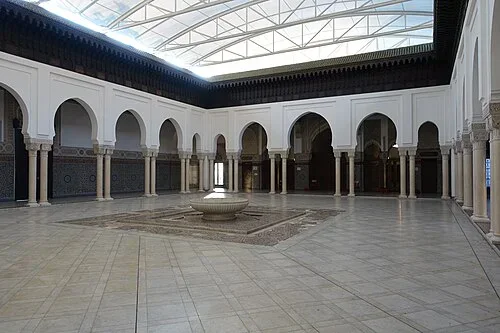 The Grand Patio and Moroccan Craftsmanship
The Retractable Canopy Courtyard
The pale canopy stretched above this courtyard is the newest layer of a very old idea. For decades, worshippers in the open patio were exposed to rain, wind and Paris winters. On December 12, 2011, an official ceremony launched work on a retractable roof covering the great patio facing the prayer hall. The congregation had awaited the project for many years. What makes it remarkable is that the roof was not an afterthought at all. It had been part of the original conception of the mosque, conceived when the building went up between 1922 and 1926. It simply took the better part of a century for the idea to be built. The structure is light and translucent, so it shelters the courtyard without stealing its daylight, and it can be drawn back when the weather is kind. Between the arches and the roof, the patio now belongs to two eras at once: the stonework of the 1920s and the engineering of our own.
Listen in the appGuilhem Vellut from Paris, France · CC BY 2.0
05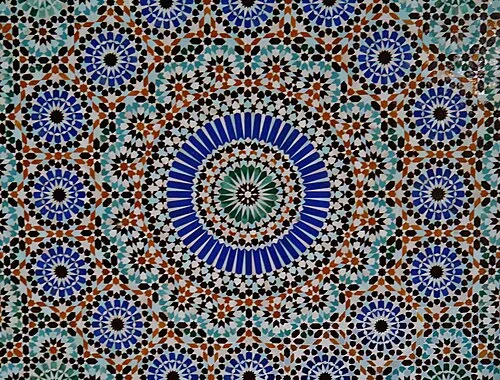 The Grand Patio and Moroccan Craftsmanship
Zellij: The Art of Moroccan Tilework
Every colour in this dense geometric pattern was cut by hand. The decoration of the mosque, above all its zellij tilework, was entrusted to specialised craftsmen from Morocco, especially from the cities of Fez and Meknès. Zellij is a craft of extraordinary patience. Artisans cut glazed tiles into small pieces, then assemble them face-down into intricate star-and-rosette patterns before setting them into the wall. The palette here runs through deep blues, greens, ochre and white, radiating outward from a central rosette. No two workshops arrange the geometry quite the same way, which gives each panel its own signature. The result is that a building raised in Paris in the 1920s carries the living craft traditions of Moroccan cities within its walls.
Listen in the appPhoto: Zairon · CC BY-SA 4.0
06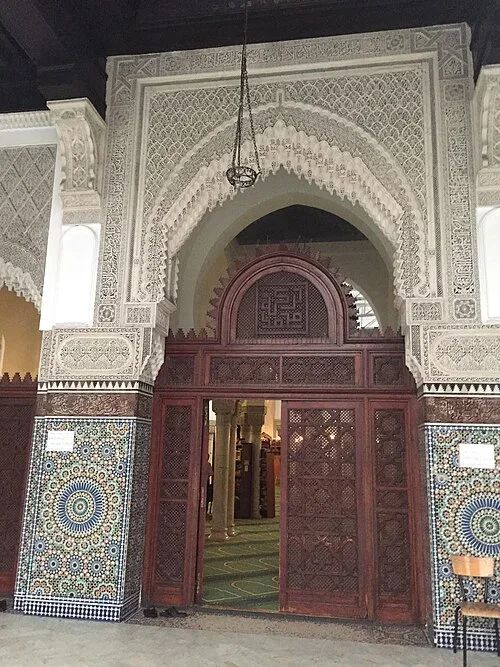 The Grand Prayer Hall and Sanctuary
Entrance to the Prayer Hall
The carved stucco arch and the great wooden doors mark the threshold of the prayer hall. It was through here that the mosque officially came to life. On July 16, 1926, the Grande Mosquée was inaugurated in the presence of the French President, Gaston Doumergue, and the Sultan of Morocco, Moulay Youssef. Doumergue celebrated the Franco-Muslim friendship, as he put it, sealed in blood on the battlefields of the Western Front, and affirmed that the Republic protected all beliefs. The first communal prayer was led by the Sufi master Sheikh Ahmad al-Alawi. Not everyone saw the mosque the same way. On the eve of the ceremony, a young Algerian named Messali Hadj held the first meeting of the Étoile nord-africaine, the North African Star, and dismissed the whole event as a publicity mosque. That meeting is remembered as one of the starting points of Algerian nationalism. So the building was contested from its very first day, a monument of gratitude to some and a symbol of colonial power to others.
Listen in the appPhoto: Mohatatou · CC BY-SA 4.0
07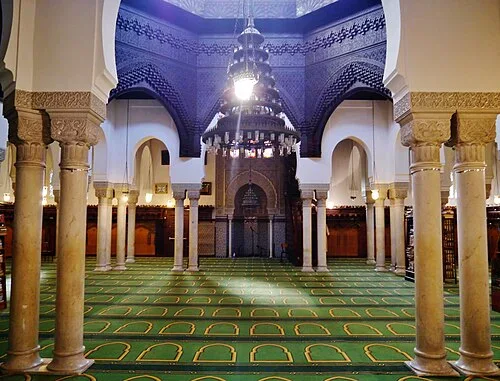 The Grand Prayer Hall and Sanctuary
Inside the Prayer Hall
Beyond the doors, the prayer hall opens under carved wooden ceilings and hanging chandeliers. Marble columns carry the arches, and the floor is covered in green carpets marked with arch patterns, one for each worshipper. This hall is the living heart of the mosque, in daily use for prayer since the building opened, and it remains reserved for worship, visible only from designated areas. At communal prayers it fills with as many as a thousand faithful, as it was designed to do nearly a century ago. Its finest piece of furniture came as a royal gift. In 1929, King Fuad I of Egypt donated the minbar, the carved pulpit from which the Friday sermon is delivered. It is still used today. The decoration draws on many parts of the Muslim world, so the hall reads as a gathering of styles rather than the work of a single school.
Listen in the appPhoto: Zairon · CC BY-SA 4.0
08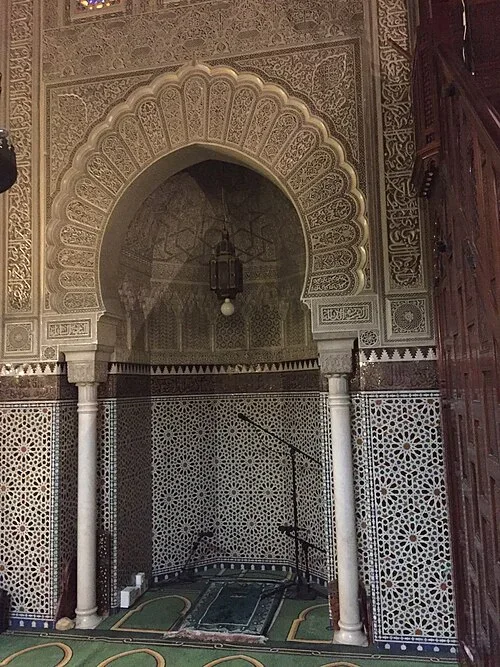 The Grand Prayer Hall and Sanctuary
The Mihrab
The small ornate niche in the wall of the prayer hall is the mihrab, the focal point of any mosque. It marks the qibla, the direction of Mecca, toward which the whole congregation turns in prayer. Wherever a Muslim prays in the world, the mihrab is what orients the room. This one is framed like a treasure. A fan-shaped arch with scalloped edges crowns the niche, set within carved stucco of extraordinary fineness. Slender marble columns flank it on either side, and below runs a dado of zellij tilework in fine geometric patterns. A lantern hangs within the niche itself, above a simple prayer rug. When the hall fills for prayer, the imam stands near this niche to lead the congregation, and every row of worshippers aligns itself to the wall behind it. Quietly, the mihrab does the mosque's most important piece of work: it turns a beautiful room into a place pointed toward Mecca.
Listen in the appPhoto: Mohatatou · CC BY-SA 4.0
09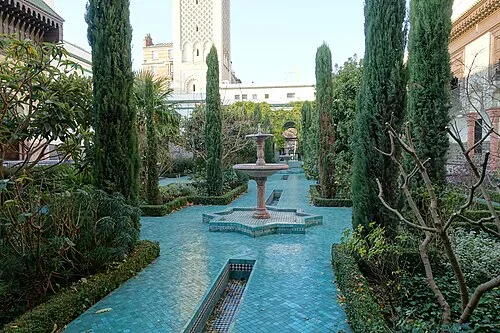 The Andalusian Paradise Gardens
The Andalusian Garden
The garden at the heart of the compound is one of the mosque's great pleasures. It covers about three and a half thousand square metres, laid out in the Hispano-Moorish manner of North Africa and southern Spain. Gardens of this tradition carry a specific meaning. In Islamic thought, the garden evokes paradise, described in the Quran as gardens beneath which rivers flow. The design lineage runs back to models like the Alhambra of Granada, where water, shade and geometry were composed into an image of the hereafter. Everything here is arranged along a central axis. A line of tall cypresses leads the eye down a tiled water channel, past the fountain, toward the buildings beyond, with the minaret rising at the far end. The effect is deliberate: greenery, water and light ordered along one straight path. It is a piece of Granada and Fez transplanted into the fifth arrondissement, walled away from the Paris streets.
Listen in the appGuilhem Vellut from Paris, France · CC BY 2.0
10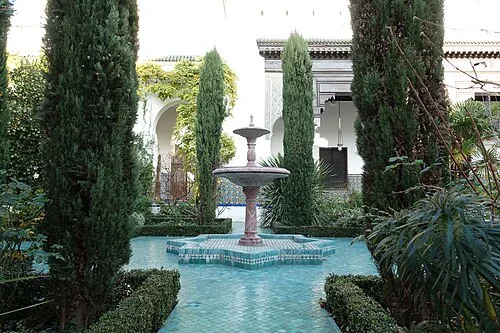 The Andalusian Paradise Gardens
The Garden Fountain
At the centre of the garden axis stands a tiered marble fountain, set in a star-shaped basin of turquoise mosaic. In the Hispano-Moorish tradition, water is never merely decoration. It moves through basins and narrow canals to give a garden two things at once: sound and coolness. The trickle of the fountain masks the city beyond the walls, and the evaporation takes the edge off a hot afternoon. Here the channel runs straight down the axis of the garden, feeding the star-shaped pool before continuing on between the cypresses. The pink marble of the fountain's tiers catches the light, and the water in the basin is still enough to hold the reflection of the trees.
Listen in the appGuilhem Vellut from Paris, France · CC BY 2.0
- 11
The Shaded Gallery
The marble gallery, and the story of the forgotten funerary mosque that preceded this one by seventy years.
- 12
The Muslim Institute Library
The library of the Muslim Institute, heart of a rescue network that sheltered Jewish families during the occupation.
- 13
The Tearoom and Cultural Annexes
Mint tea under the mosaic wall, where the mosque becomes a crossroads of North African culture in Paris.
Grande mosquée de Paris
Frequently asked questions
How much does the guide cost?
Free app download. Listed guide price: $0.99. Guide price shown in the app. Audio guide only. Venue admission is separate.
Can I listen without internet?
Yes. Download the guide’s audio, images, and maps in the app before your visit. Your downloaded content is then available offline.
Can I listen in my language?
This audio guide is available in 15 languages, including English.
Do I need to follow a schedule?
No. This is a self-guided experience. Choose your stops, pause whenever you like, and return to a story at your own pace.
At your own pace
Explore Grande mosquée de Paris.
Download Stanza, then search for “Grande mosquée de Paris”.
Free app download · Guide price shown in the app
Keep exploring
Nearby audio guides
Paris · 1 km
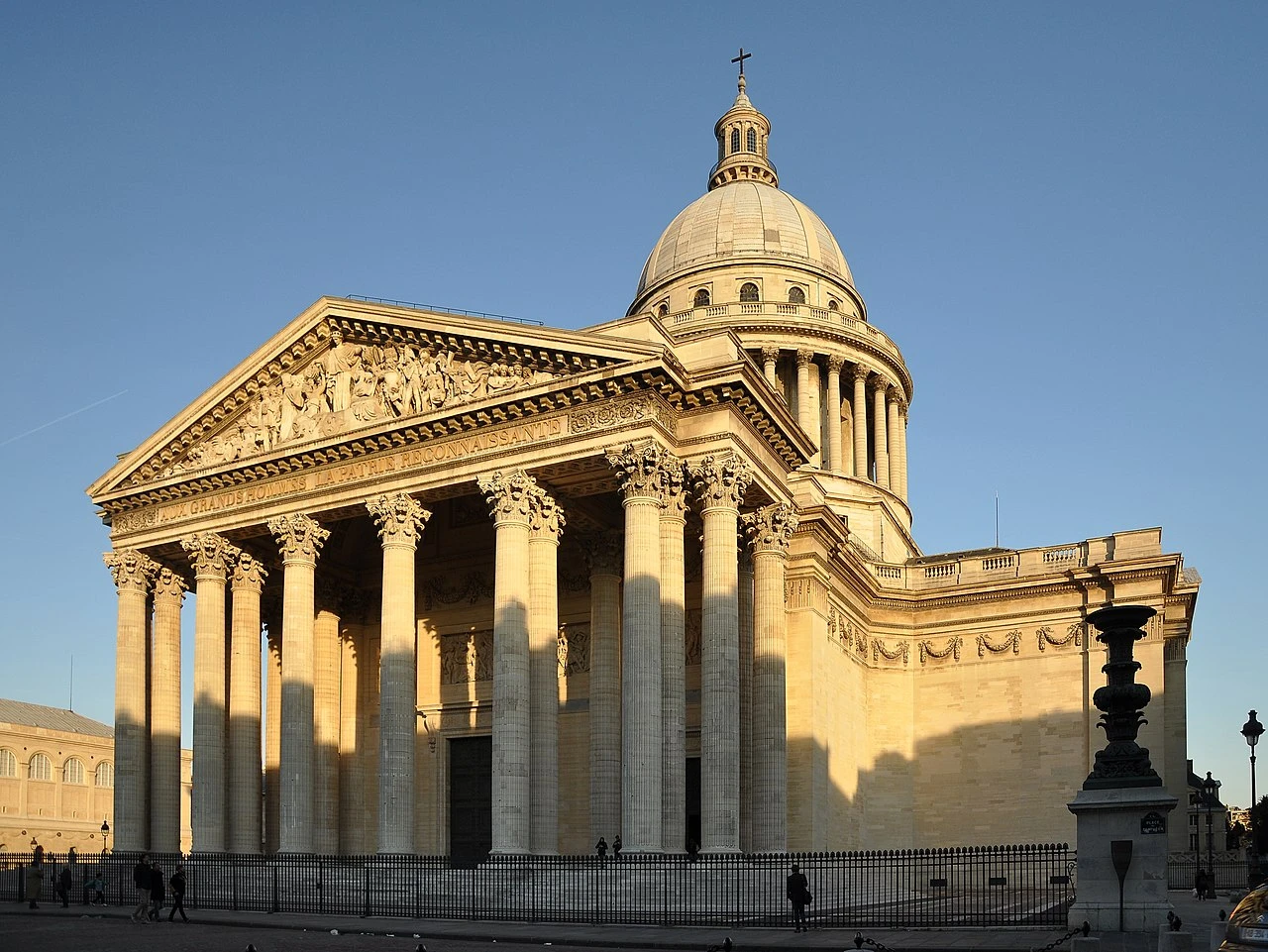
Panthéon
Content & sources
Photo: Moonik · CC BY-SA 3.0
Paris · 1 km
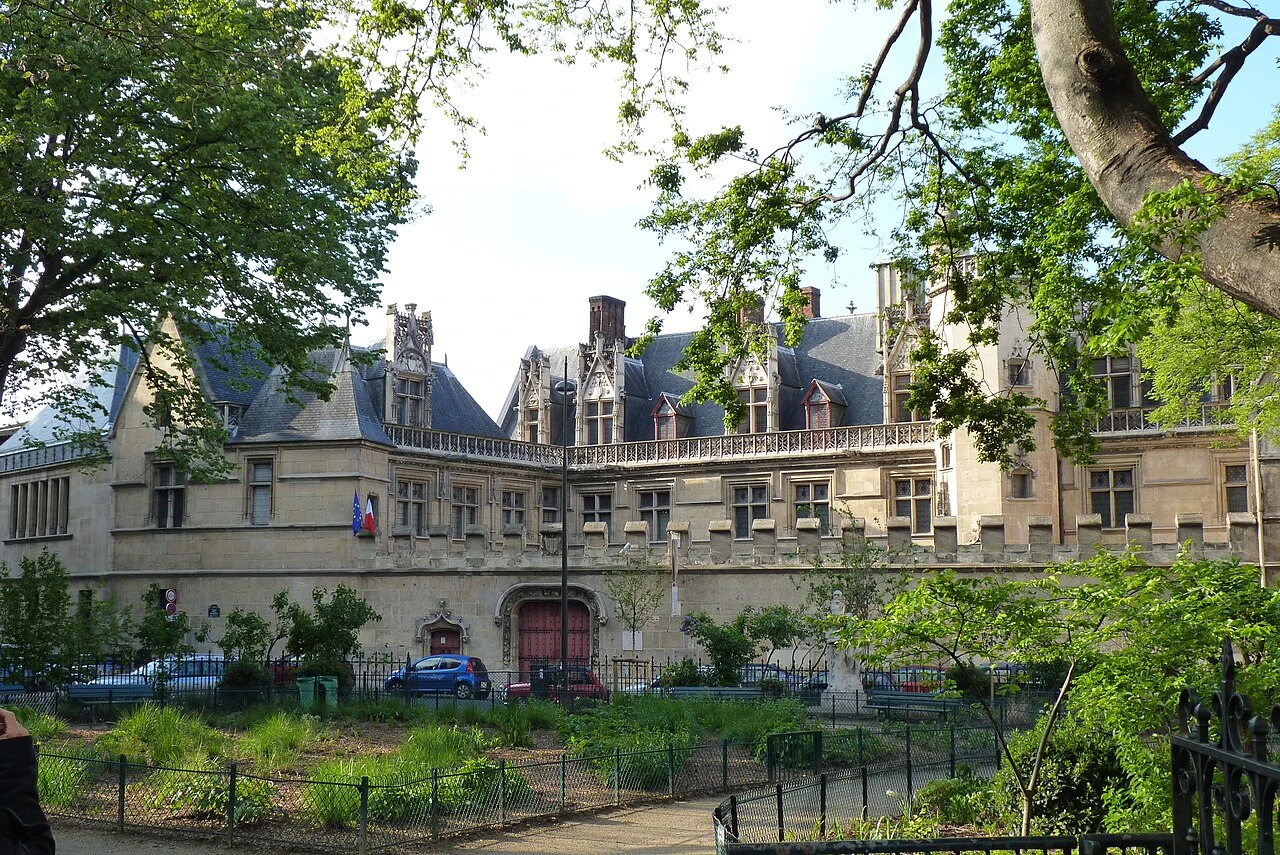
Cluny Museum
Content & sources
ctj71081 · CC BY-SA 2.0
Paris · 1 km
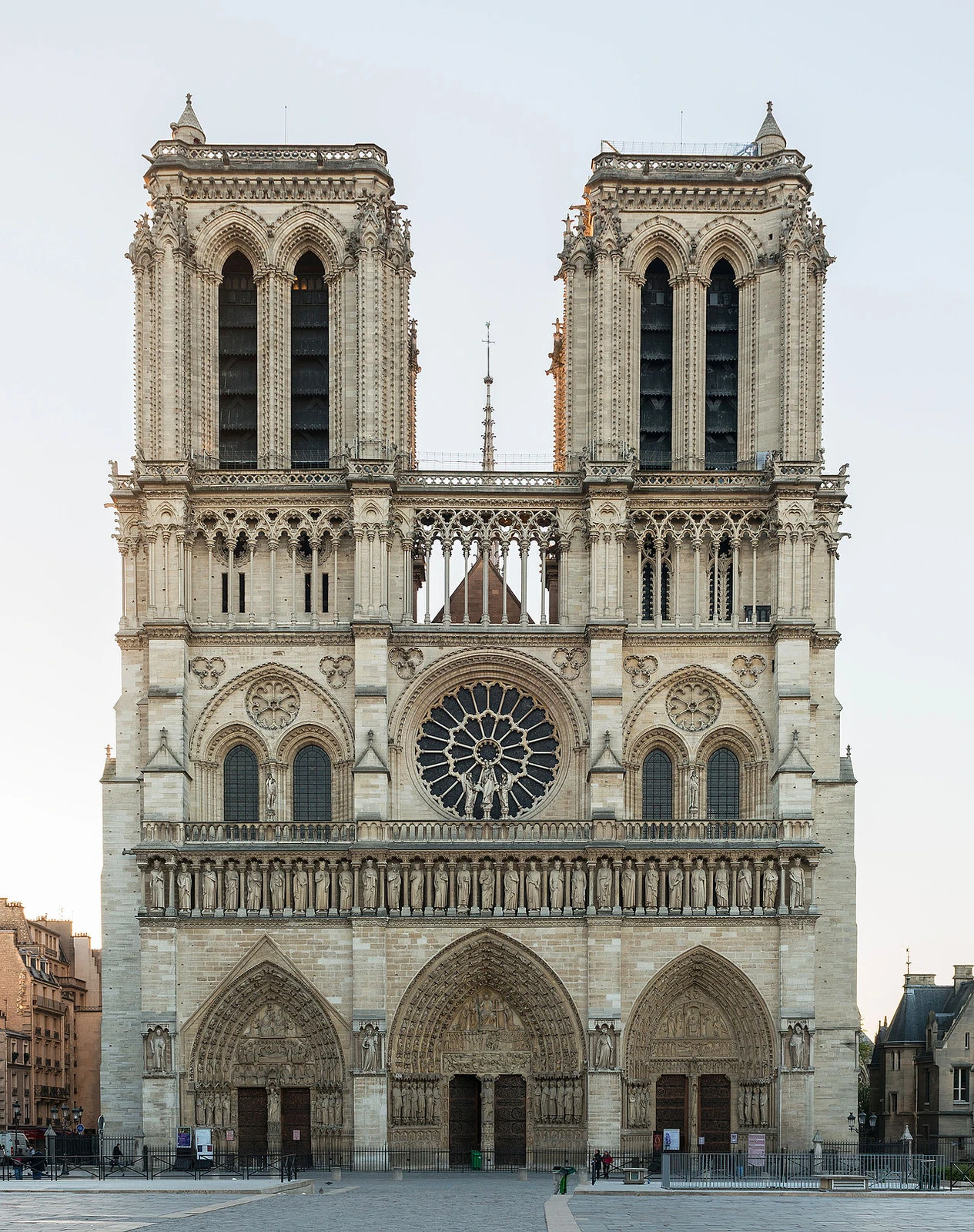
Notre-Dame de Paris
Content & sources
DXR · CC BY-SA 3.0
Paris · 2 km
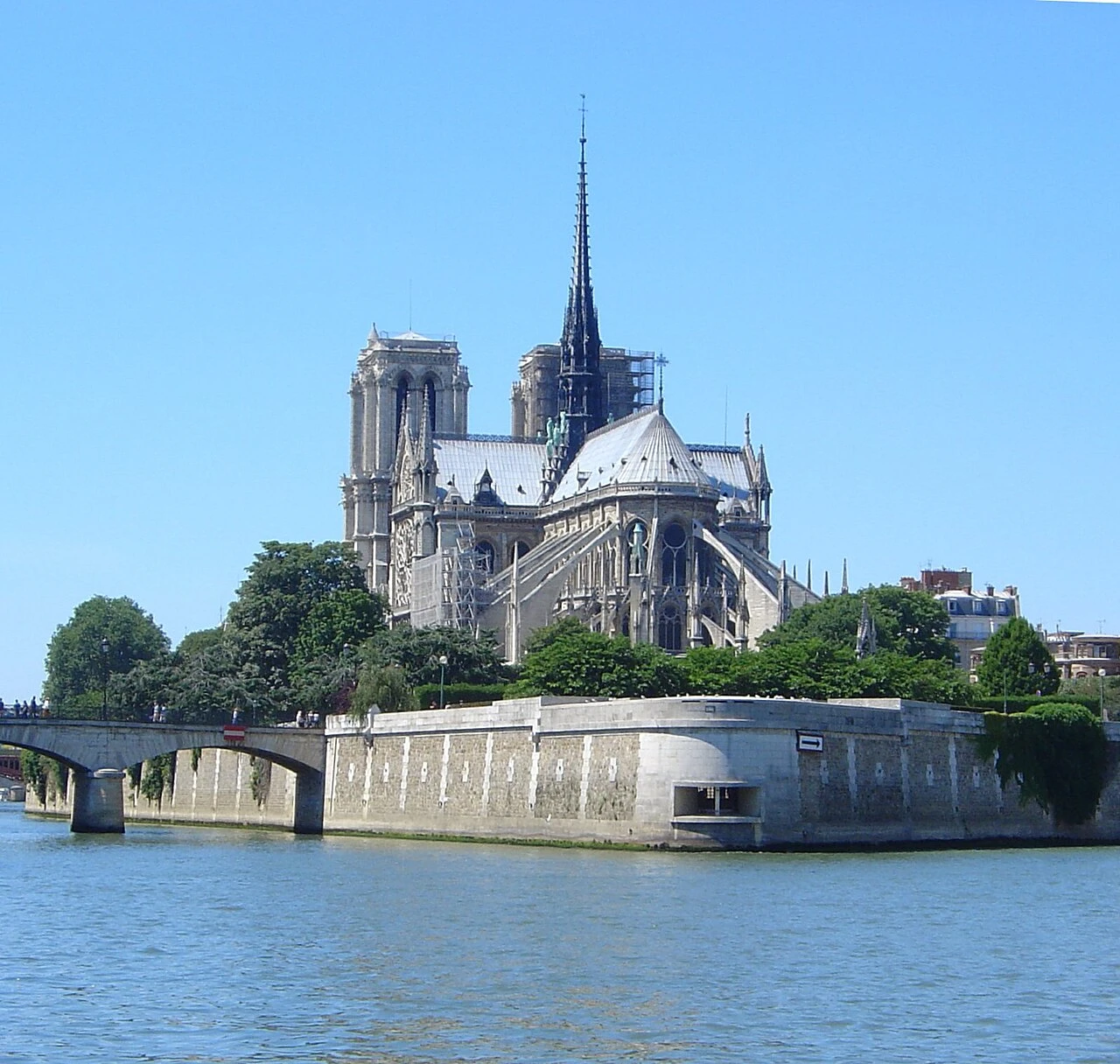
Île de la Cité
Content & sources
David Monniaux · CC BY-SA 3.0