Stanza · Audio guide
Palais-Royal Audio Guide
A place to remember. A story to take with you.
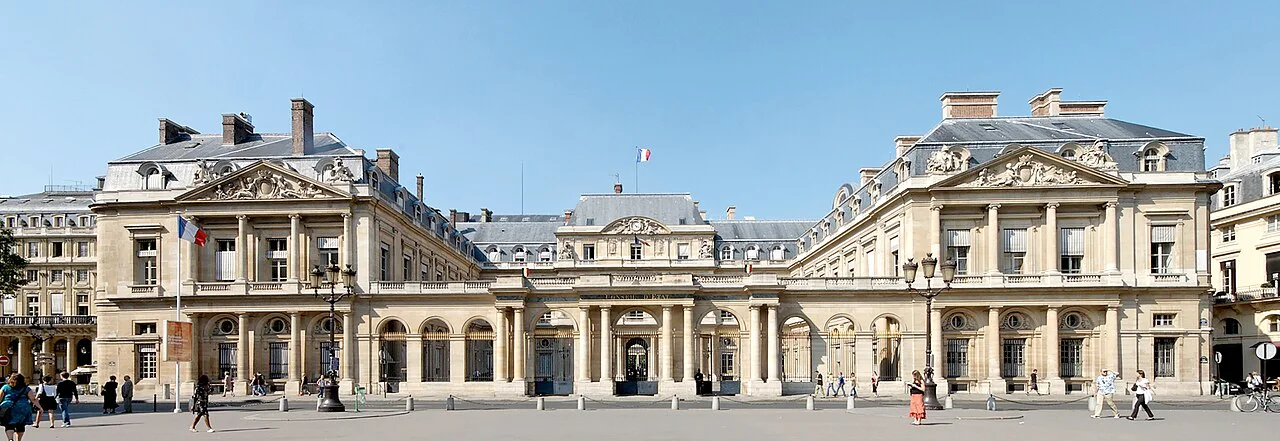
The Palais-Royal is a former French royal palace located on Rue Saint-Honoré in Paris. It was originally built for Cardinal Richelieu between 1633 and 1639.
Download Stanza, then search for “Palais-Royal”.
About the tour
One guide. Your kind of visit.
The Palais-Royal is a former French royal palace located on Rue Saint-Honoré in Paris. It was originally built for Cardinal Richelieu between 1633 and 1639.
Ready when you are.
- 01Get the free Stanza app.
iOS & Android
- 02Find your guide.
“Palais-Royal”
- 03Download before you go.
Works offline
Audio guide / 11 narrated stops
Inside the guide
Get to know a few of the stories before you go. Open a stop to read more.
01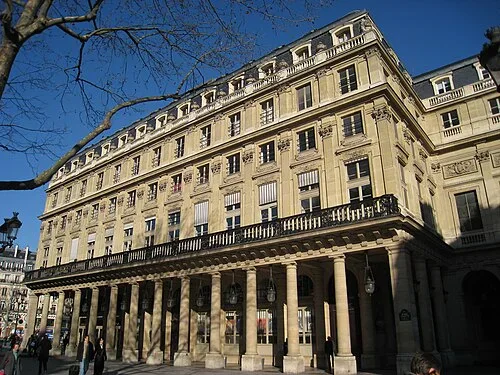 Place Colette and the Comédie-Française
The Salle Richelieu — Home of the Comédie-Française
France's national theatre has lived inside a cardinal's old palace for more than two centuries. The building here, the Salle Richelieu, went up between 1786 and 1790 to designs by the architect Victor Louis. The Comédie-Française took it over in 1799, when the two halves of a split company reunited on this stage. Remodelling has been constant, and only the outer walls and the columns of the peristyle survive from the original theatre. The plan and the style were kept, though. Acting ran through this palace long before the playhouse stood: Richelieu kept his own theatre here, Molière's troupe took over the hall in 1660, and after his death Lully installed the Opera in it — until fire destroyed that hall in 1781. The palace itself is older still. It began around 1633 as the Palais-Cardinal, the private residence of Cardinal Richelieu, designed by Jacques Lemercier and finished in 1639. When Richelieu died in 1642 the palace passed to the king and took the name it still carries.
Photo: Daderot · Public domain
02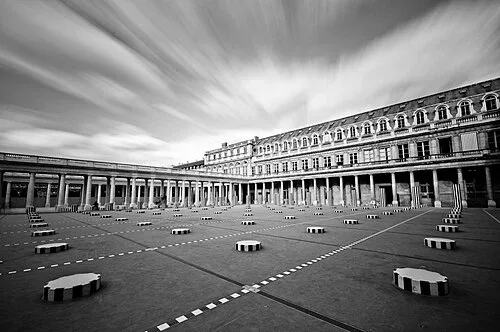 Cour d'Honneur and the Buren Columns
Les Deux Plateaux — Daniel Buren's Striped Columns
In 1985 the Ministry of Culture, then led by Jack Lang, brought contemporary art into this courtyard. The artist was Daniel Buren, and the work is called Les Deux Plateaux — two plateaux, though there are no floors to stand on. The columns rise to different heights because they mark two imaginary platforms at different levels. Some rows line up exactly with the height of the column bases of the Galerie d'Orléans. Every column wears vertical bands of black and white. Until then the courtyard had served as a car park for a few privileged people. The installation set off a fresh battle between the ancients and the moderns, with politics mixed in; today the striped columns are a fixture of Paris tourism. The palace itself had a far closer call a century earlier. In the final days of the Paris Commune, on 24 May 1871, Communards set it alight as a symbol of aristocracy. Neighbours and about thirty workers of the Bank of France had the fire under control by the next morning. The damaged facades were restored to match, and the Conseil d'État, the Ministry of Culture and the Constitutional Council made the palace their seat.
ros k @ getfunky_paris · CC BY 2.0
03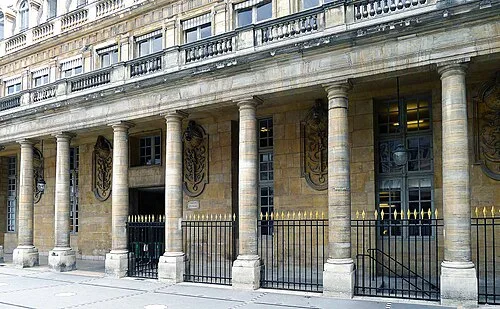 Cour d'Honneur and the Buren Columns
The Galerie des Proues — Vestige of the Palais-Cardinal
Almost nothing remains of the palace as Jacques Lemercier built it for Cardinal Richelieu — and this gallery is one of the rare exceptions. The galerie des Proues keeps the heavy stonework of the old Palais-Cardinal, its panels carved with the prows of ancient galleys. Its story belongs to the Fronde, the civil troubles of the mid-seventeenth century. Through those years the palace was the residence of Anne of Austria, the regent, and of the young Louis XIV, still a child. Everything around this gallery was rebuilt by the dukes who came after, which is what makes the surviving fragment worth a long look.
Listen in the appPhoto: Mbzt · CC BY 3.0
04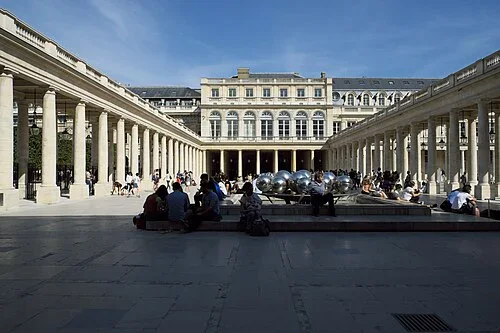 Galerie d'Orléans and the Kinetic Fountains
Pol Bury's Fountain Spheres
Water runs through this gallery too, in a quieter way. The sculptor Pol Bury made two fountains here, set within the roofless Galerie d'Orléans between the courtyard and the garden. Each fountain is a square basin holding seventeen polished metal spheres, all of different sizes, with water flowing around them. The spheres work as mirrors, catching the arcades and the sky on every side. They were the second of two sculptural works the Ministry of Culture brought into the palace in the mid-1980s.
Listen in the appPhoto: GFreihalter · CC BY-SA 3.0
05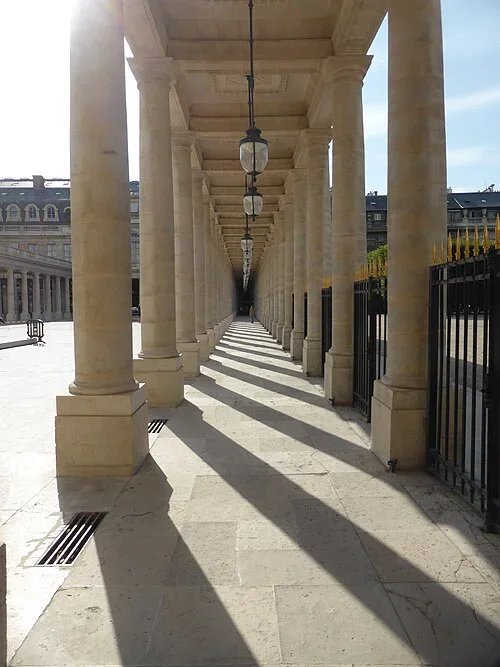 Galerie d'Orléans and the Kinetic Fountains
The Colonnade of the Galerie d'Orléans
The twin rows of columns between the courtyard and the garden are what remains of the Galerie d'Orléans, probably the most famous covered arcade in Paris. Pierre-François-Léonard Fontaine drew up the design, working with Charles Percier, and the gallery was completed around 1830. It enclosed the Cour d'Honneur on its north side, a covered promenade between two colonnades. Fontaine's work here reached further than the gallery: he also completed the western wing of the courtyard and the Aile Montpensier, finishing what the Duke's father had left undone. The gallery itself did not last. It was demolished in the 1930s, and only these flanking rows of columns were spared, standing roofless between the courtyard and the garden.
Listen in the appjsmaur · CC BY-SA 2.0
06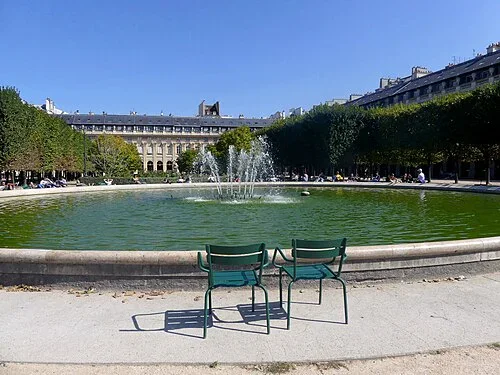 The Central Garden and Grand Basin
The Jardin du Palais-Royal
This garden was once the centre of France. From 1715 to 1723, during the Regency, the Palais-Royal was the heart of the country's political and artistic life, and it supplanted Versailles. The regent, Philippe d'Orléans, a nephew of Louis XIV, lived here and had the palace transformed by his first architect, Oppenord, one of the leading creators of the rocaille style. When the court returned to Versailles, the palace quieted; the later dukes preferred their residence at Saint-Cloud. The garden itself is older than all of that. It was laid out from 1629 to a design by Jacques Boyceau, with Jean Le Nôtre, father of the famous André, among the gardeners. André Le Nôtre redesigned it in 1674, and his nephew Claude Desgots did so again in 1730. Under Charles X the main basin was enlarged to twenty-five metres across. The garden has been classed as a historical monument since 1920, and today it is simply a public park — green chairs, fountain and all.
Listen in the appFlorian Pépellin · CC BY-SA 4.0
07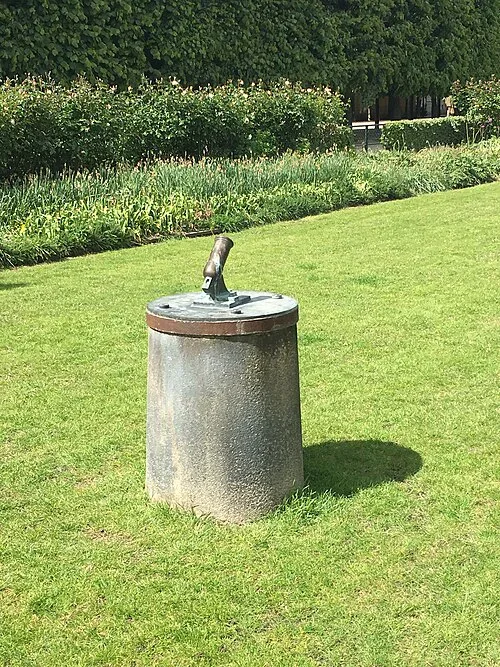 The Solar Noon Cannon
A small cannon sits on the lawn at the north end of the garden, and for over a century it told Paris the time. It was set up in 1786 by a philosophical amateur, on the Paris meridian. The mechanism was ingenious: a magnifying lens pointed at the sun's noontime position focused the rays onto the match and lit the gunpowder. So each day, at true solar noon, the cannon fired a single shot, and Parisians set their watches by it. Between 1891 and 1911 the official noontime in France was defined by this blast. Then the cannon vanished — stolen in 1998. It was recovered and returned to its place in 2002, and it is still fired today.
Listen in the appPhoto: Yamen · CC BY-SA 4.0
08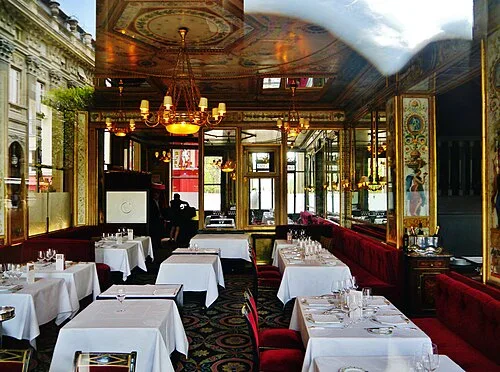 Galerie de Beaujolais and Historic Gastronomy
Le Grand Véfour
Behind the gilded mirrors and painted ceiling of this dining room, the palace's great culinary tradition still runs. Le Grand Véfour opened in 1784 as the Café de Chartres, and it is one surviving restaurant of that era. The palace became famous for its cooking after the Revolution, when chefs of aristocratic families who had fled France opened restaurants of their own. Much of the original decor is preserved here, chandeliers and mirrors included. Two writers made this corner their own. Colette lived at 9 rue de Beaujolais, first on the entresol, then on the first floor, where she stayed until 1954. Jean Cocteau lived across the way, at 36 rue de Montpensier. The two friends regularly had breakfast together at the restaurant. When Colette died in 1954, an official homage was paid to her in the palace's courtyard of honour. The two main alleys of the garden now carry their names.
Listen in the appPhoto: Zairon · CC BY-SA 4.0
09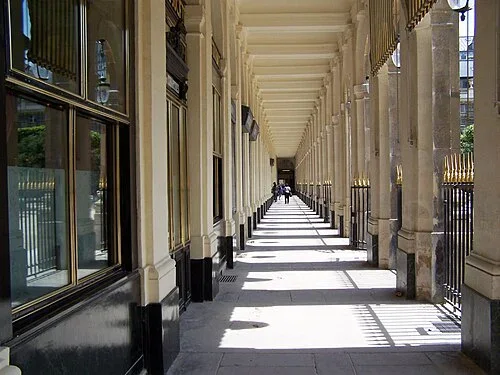 Galerie de Beaujolais and Historic Gastronomy
The Galerie de Beaujolais — Birth of the Arcades
The arcades framing the garden were the work of one ambitious campaign. Between 1781 and 1784, Louis Philippe II, Duke of Orléans, had the architect Victor Louis raise six-story apartment buildings along three sides of the garden, with colonnades on the ground floor. Three new streets were laid out in front of the houses: the rue de Montpensier, the rue de Beaujolais and the rue de Valois. The Duke let the space under the colonnades to retailers and service-providers, and in 1784 the shopping and entertainment complex opened to the public. Within about a decade the palace had become the centre of Parisian economic and social life. On the garden facade Victor Louis aligned a hundred and eighty arcades, separated by composite pilasters. Suspended lanterns, a hundred and eighty-eight of them, hung beneath the arches. This northern wing, the Galerie de Beaujolais, keeps that uniform facade to this day.
Listen in the appPhoto: LPLT · CC BY-SA 3.0
10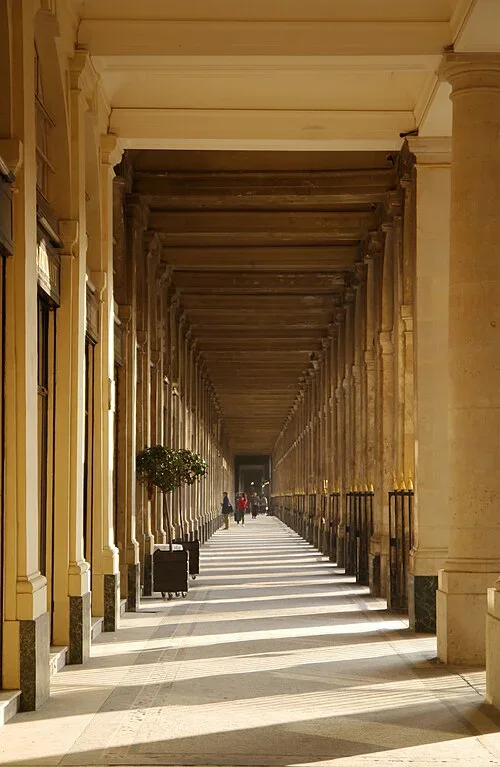 The Arcades of Revolution and Commerce
The Galerie de Valois — Spark of the Revolution
On 12 July 1789 the Palais-Royal became the spark point of the French Revolution. Camille Desmoulins had just learned that the king had dismissed his finance minister, Jacques Necker. He harangued the crowd in the palace garden, calling the Parisians to insurrection. A drawing by Prieur shows him at it, the crowd pulling leaves from the garden trees and wearing them as cockades, their rallying sign. From the wax-figure cabinet that Curtius kept in the palace, busts of Necker and of the Duke of Orléans — popular for his liberal positions — were carried out and paraded through the garden and through Paris. When the cavalry charged the crowd at the Place Louis XV, the Parisians' defensive reaction became the storming of the Bastille. The palace stayed a hub of political intrigue and of the city's most popular cafés from the 1780s to 1837. And the shops around the garden sold more than gossip: in one of them Charlotte Corday bought the knife she used to stab Jean-Paul Marat.
Listen in the appGroume · CC BY-SA 2.0
- 11
The Théâtre du Palais-Royal — Closing Reflection
At the palace's northwest corner, the iron staircases of a working theatre close the story of a palace turned public crossroads.
Palais-Royal
Frequently asked questions
How much does the guide cost?
Free app download. Listed guide price: $0.99. Guide price shown in the app. Audio guide only. Venue admission is separate.
Can I listen without internet?
Yes. Download the guide’s audio, images, and maps in the app before your visit. Your downloaded content is then available offline.
Can I listen in my language?
This audio guide is available in 15 languages, including English.
Do I need to follow a schedule?
No. This is a self-guided experience. Choose your stops, pause whenever you like, and return to a story at your own pace.
At your own pace
Explore Palais-Royal.
Download Stanza, then search for “Palais-Royal”.
Free app download · Guide price shown in the app
Keep exploring
Nearby audio guides
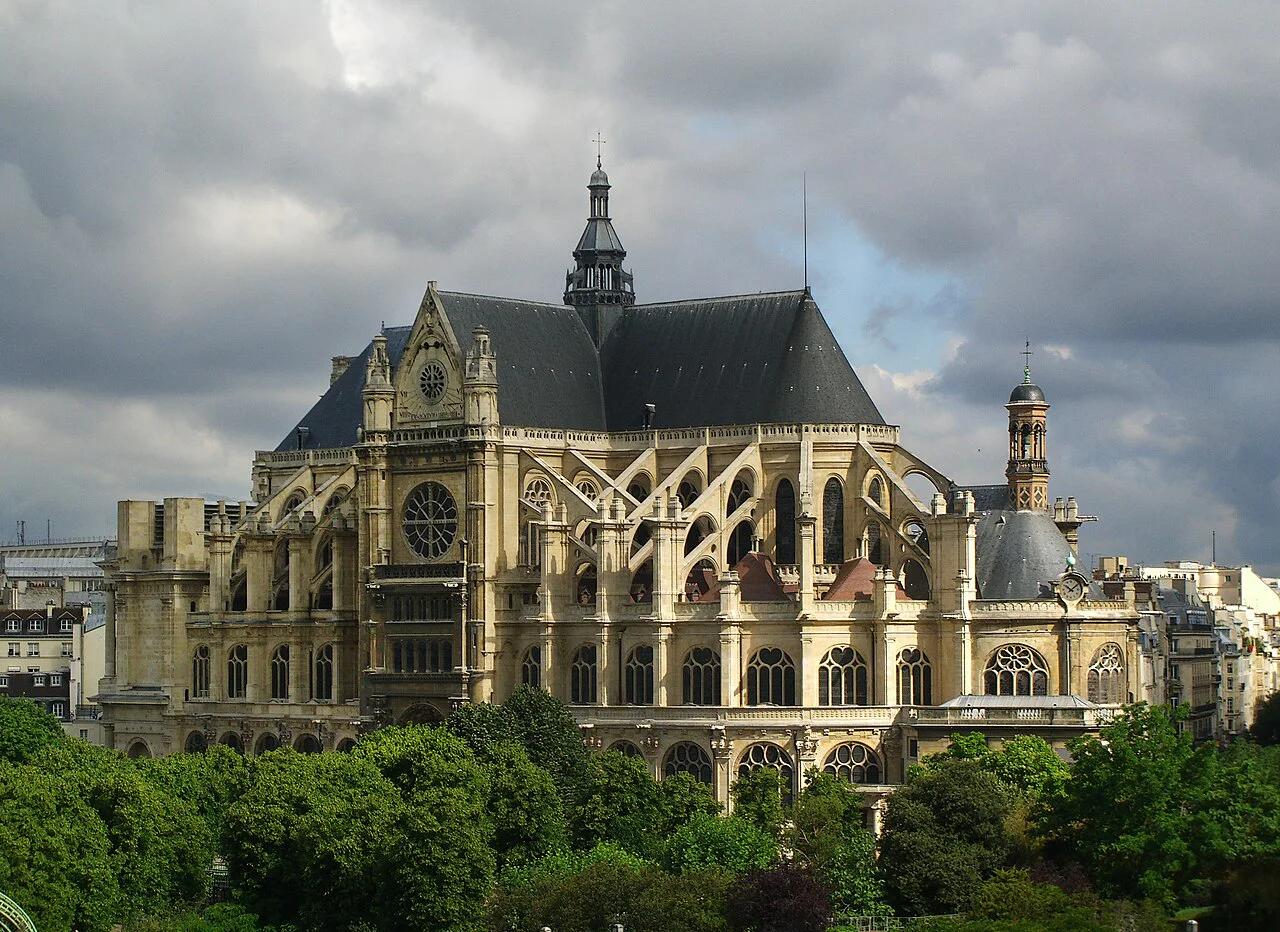
Paris · 1 km
Église Saint-Eustache de Paris
Content & sources
Pavel Krok · CC BY-SA 2.5
Paris · 1 km
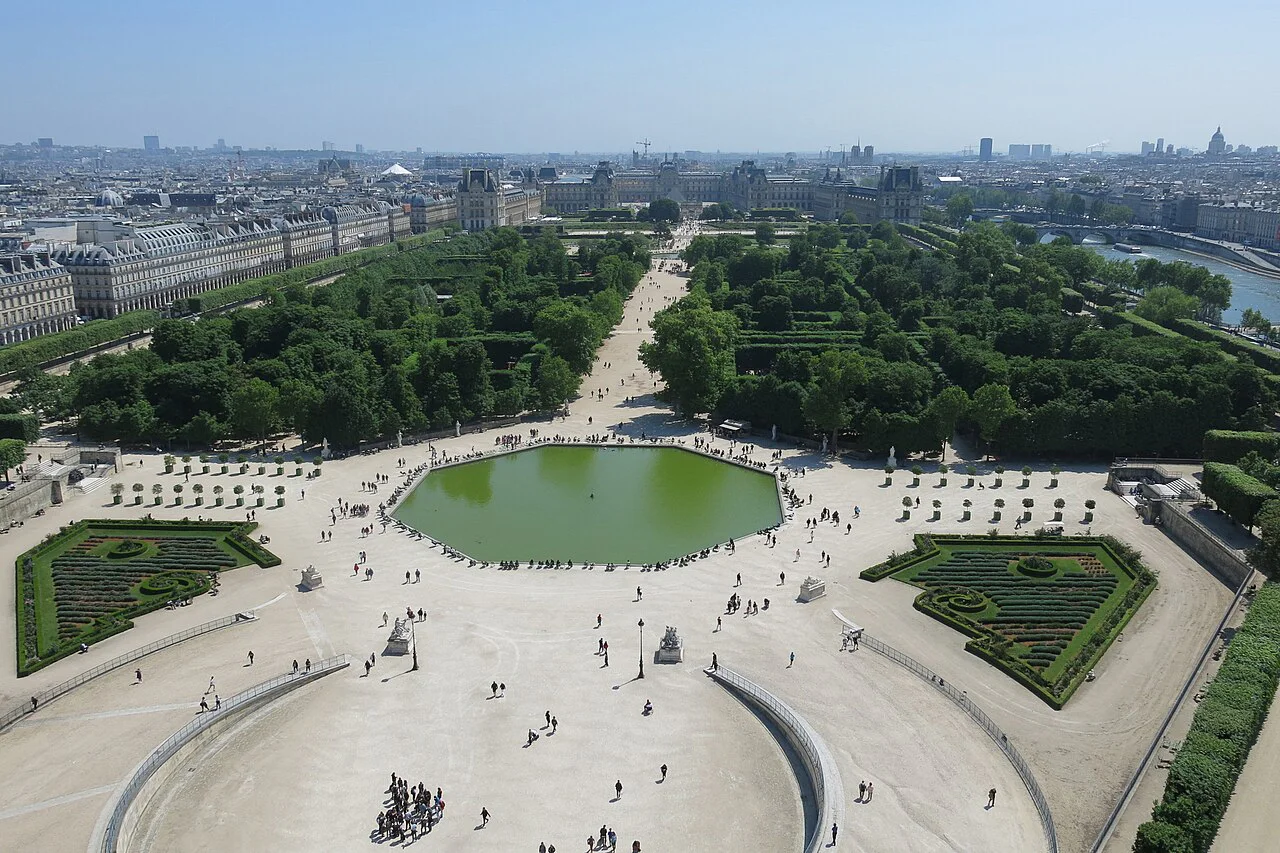
Jardin des Tuileries
Content & sources
Tangopaso · Public domain
Paris · 1 km
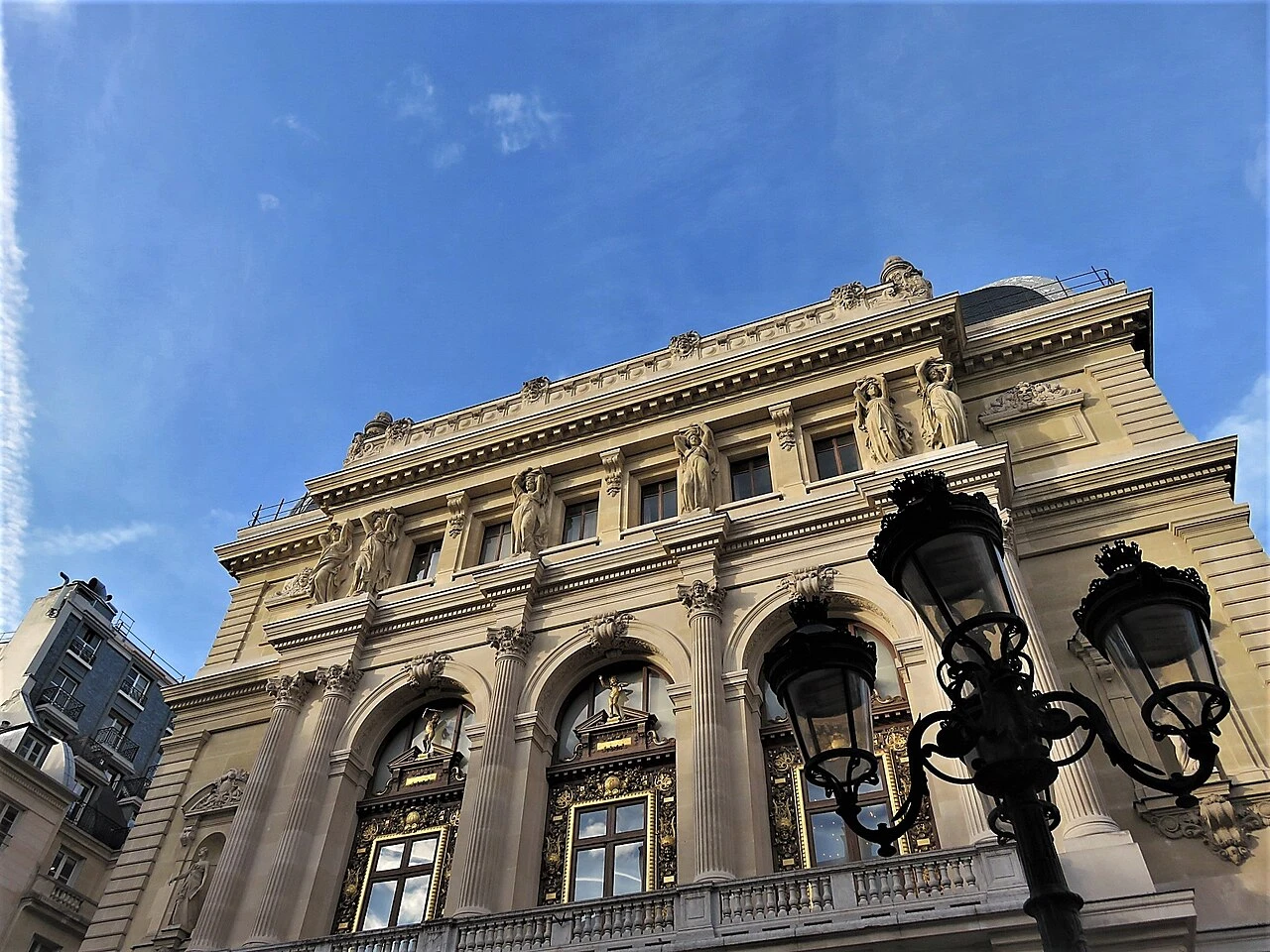
Opéra-Comique
Content & sources
Arthur Weidmann from Paris, France · CC BY-SA 2.0
Paris · 1 km
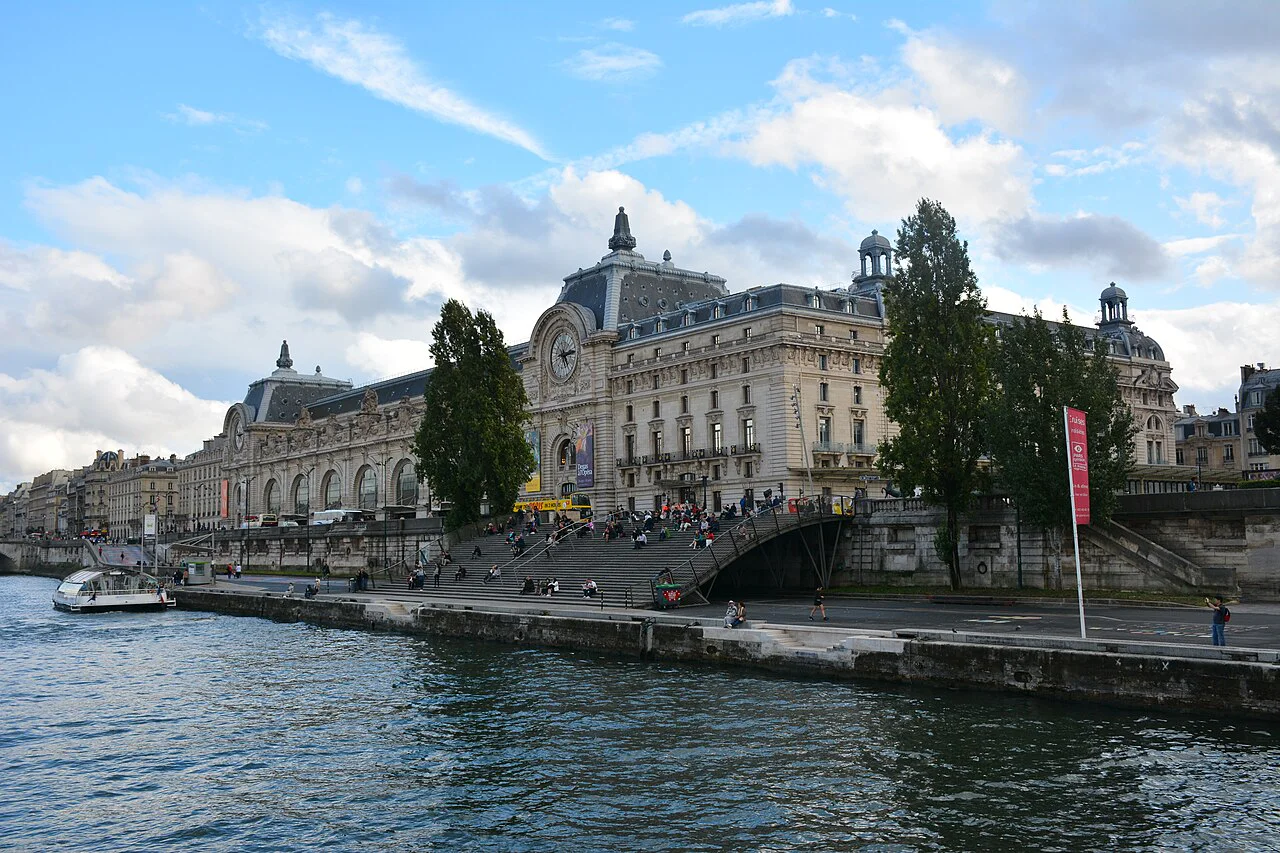
Musée d'Orsay
Content & sources
Cheng-en Cheng from Taichung City, Taiwan · CC BY-SA 2.0