Stanza · Audio guide
Église Saint-Eustache de Paris Audio Guide
A place to remember. A story to take with you.
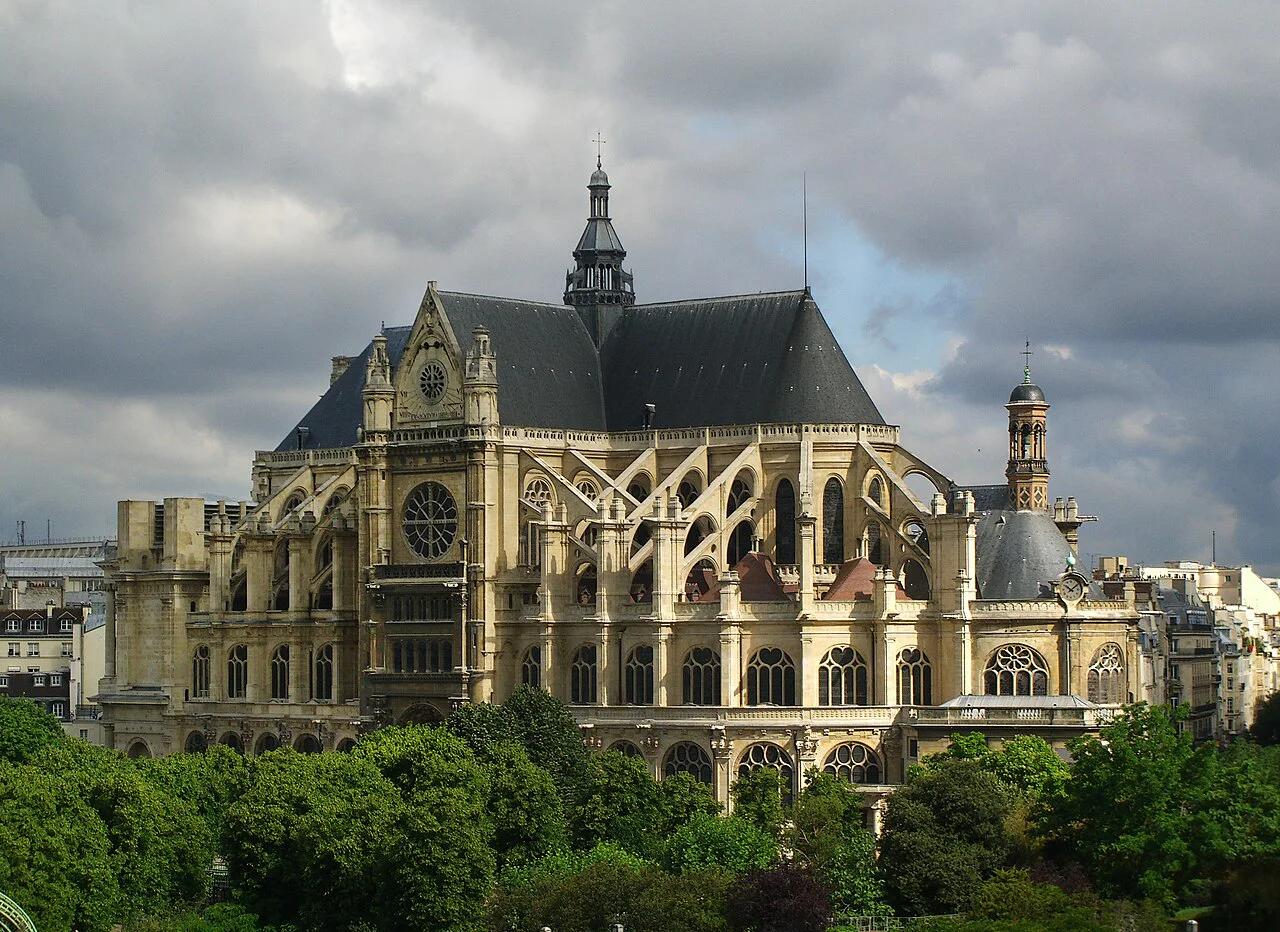
The Church of St. Eustache is a church located in the 1st arrondissement of Paris. The present building was constructed between 1532 and 1633.
Download Stanza, then search for “Église Saint-Eustache de Paris”.
About the tour
One guide. Your kind of visit.
The Church of St. Eustache is a church located in the 1st arrondissement of Paris. The present building was constructed between 1532 and 1633.
Ready when you are.
- 01Get the free Stanza app.
iOS & Android
- 02Find your guide.
“Église Saint-Eustache de Paris”
- 03Download before you go.
Works offline
Audio guide / 14 narrated stops
Inside the guide
Get to know a few of the stories before you go. Open a stop to read more.
01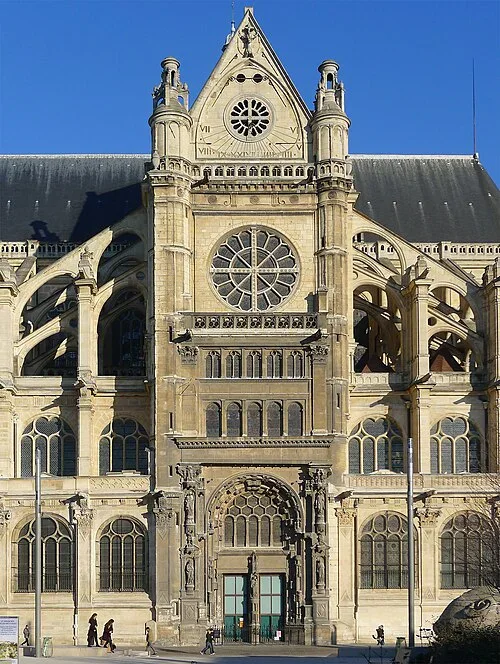 South Transept Portal and Exterior
South Transept Portal of Saint-Eustache
Welcome to Saint-Eustache, the great parish church of Les Halles, once the food market at the very centre of Paris. Its story begins with a tax on fish. In the thirteenth century a merchant named Jean Alais lent money to King Philippe-Auguste. As repayment he received the right to take a coin from every basket of fish arriving at the market. With the proceeds he paid for a small chapel, dedicated to Saint Agnes, built in 1213 beside the old city wall. By 1223 it served the whole market district as its parish church, and in 1303 it took a new name, Saint-Eustache. High on this south transept facade, above the portal, sits the church's emblem: a deer carrying a crucifix between its antlers. It recalls the vision that converted the Roman hunter the church is named for. From that little chapel grew a church of merchants and market tradesmen, one of the largest in Paris.
Photo: Mbzt · CC BY-SA 4.0
02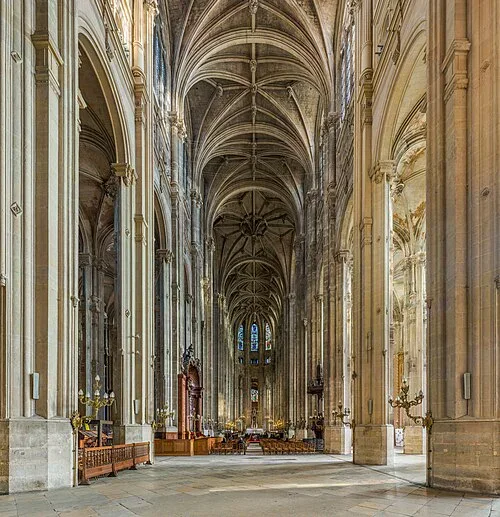 The Nave and Gothic-Renaissance Architecture
The Nave and Its Soaring Vaults
The vaults of this nave hang just over thirty-three metres above the floor, and the church is one of the largest in the whole city. What makes it remarkable is the marriage of two styles that rarely meet. The skeleton is Flamboyant Gothic, with ribbed vaults and keystones hanging from the ceiling like carved stone pendants. But the pillars holding everything up wear the classical orders of the Renaissance, tiered like Roman columns, Doric below and Corinthian above. The result is a Gothic church built in the full flower of the Renaissance, and the two languages somehow answer each other. The space is so vast that after the fire at Notre-Dame in April 2019, the cathedral's Easter Mass was celebrated here instead.
Photo: Mbzt · CC BY-SA 4.0
03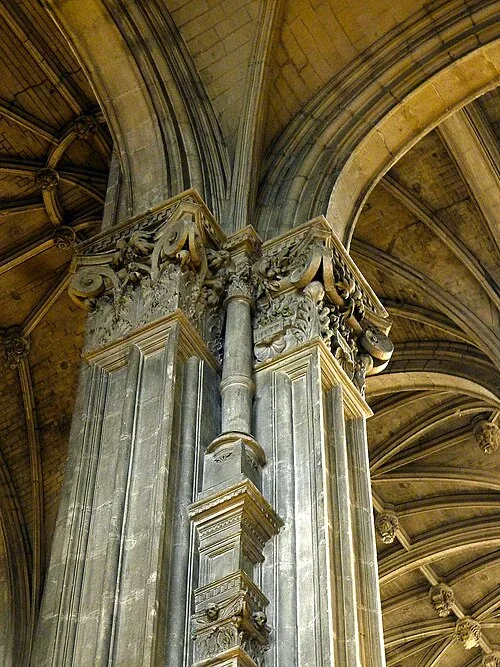 The Nave and Gothic-Renaissance Architecture
Pilaster and Vault Detail
This church took about a hundred years to build, and nobody knows for certain who designed it. The foundation stone was laid on 19 August 1532 by Jean de la Barre, the provost of the merchants of Paris. Work dragged on through shortages of money and the French Wars of Religion, with long interruptions. The structure was finally complete in 1633, and the archbishop of Paris consecrated the church in 1637. As for the architects, the names most often proposed are Jean Delamarre and Pierre Lemercier, because the design resembles their extension of Saint-Maclou at Pontoise. Whoever drew the plans, this carved capital shows the whole idea in miniature: a classical pilaster, caught mid-stride between Gothic ribs.
Listen in the appPhoto: Mbzt · CC BY-SA 4.0
04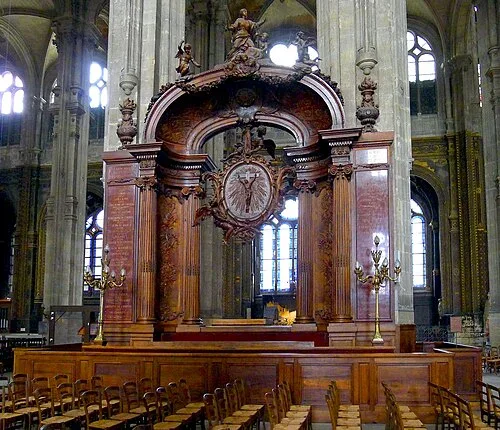 Liturgical Woodwork: Banc d'Œuvre and Baltard Pulpit
The Banc d'Œuvre of 1720
This grand carved pew was made in 1720 by the sculptor Pierre Lepautre, working from drawings by Jean-Sylvain Cartaud. It seated the lay committee that oversaw the parish finances, and it is crowned by an apotheosis of Saint Agnes, a nod to the church's very first dedication. At the centre of the arch hangs a medallion with a Phrygian bonnet, the badge of the French Revolution. It marks what happened here. Like most Paris churches, Saint-Eustache was desecrated and looted, and in 1793 it was closed to Catholic worship. For a time it served as the Temple of Agriculture, a storehouse for food supplies. Back in April 1791, before the closure, it had hosted the funeral of the revolutionary leader Mirabeau. The church reopened in 1795 with significant damage, and was only formally returned to worship in 1803.
Listen in the appPhoto: Mbzt · CC BY 3.0
05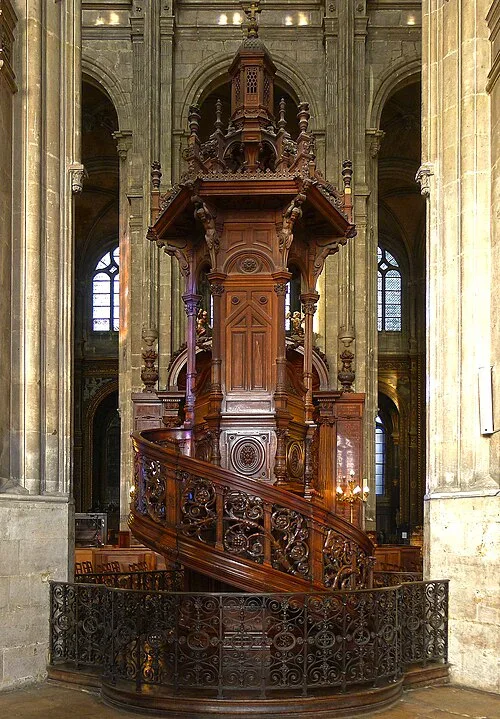 Liturgical Woodwork: Banc d'Œuvre and Baltard Pulpit
Baltard's Carved Pulpit
A fire swept the church in 1844, destroying the first bays of the nave. The architect Victor Baltard was charged with putting things right, and directed a complete restoration lasting until 1854. This pulpit is one of his creations, along with the case of the great organ and the high altar, and he had the church's paintings repaired as well. Survival, though, stayed hard-won. In May 1871, during the Semaine sanglante, the last battle of the Paris Commune, the church was set alight again. Repairs followed to the attic, the buttresses and the south facade. Baltard's organ case still stands at the west end, framing the Great Organ where this tour closes.
Listen in the appPhoto: Mbzt · CC BY-SA 4.0
06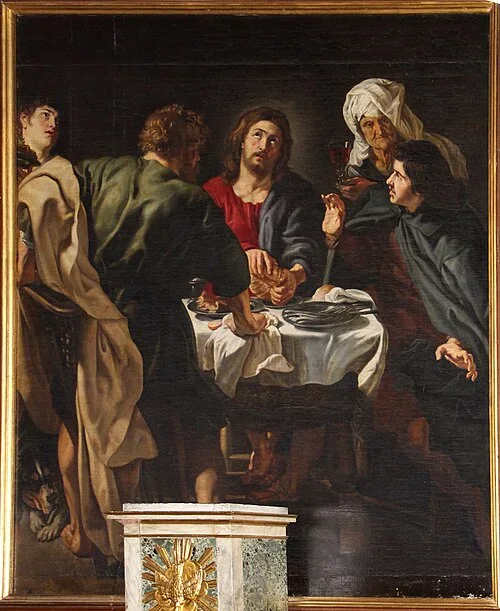 North Ambulatory: Masterpieces by Rubens and Vouet
Rubens's Supper at Emmaus
Peter Paul Rubens painted this Supper at Emmaus in 1611, as a young man in Italy. Christ breaks bread with two disciples who suddenly recognise him, and the dark background and dramatic lighting show the influence of Caravaggio, whose work Rubens studied there. For a time the painting was dismissed as a copy. A restoration finished in 2020 by the city's conservation service settled the question. Beneath the surface, restorers found pentimenti, changes the painter made as the composition evolved, which only the master's own hand explains. As was common in his studio, Rubens's pupils probably painted the less important passages.
Listen in the appSimon Vouet · Public domain
07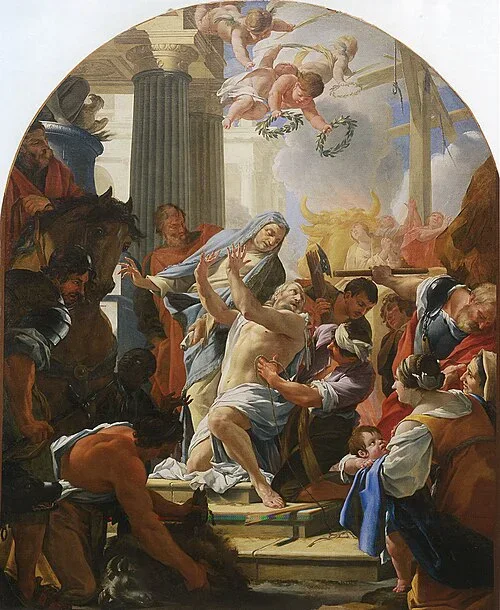 North Ambulatory: Masterpieces by Rubens and Vouet
Vouet's Martyrdom of Saint Eustace
This altarpiece tells the story of the saint the church is named for, and his end was grim. Eustace was a Roman general who converted to Christianity. When the emperor Trajan ordered him to adore a pagan god, he turned his eyes away. The emperor condemned him to be burned alive inside a bronze bull, together with his wife and their two sons. In the painting their figures are visible amid the smoke of the fire, while angels overhead carry laurel crowns, a sign of heaven's recognition. Simon Vouet painted it around 1635, in a cold and luminous colour, at the height of the lyrical style he brought back from Rome, from which he had returned in 1627. The same saint's emblem, the deer with the crucifix, crowns the south transept portal outside.
Listen in the appSimon Vouet · Public domain
08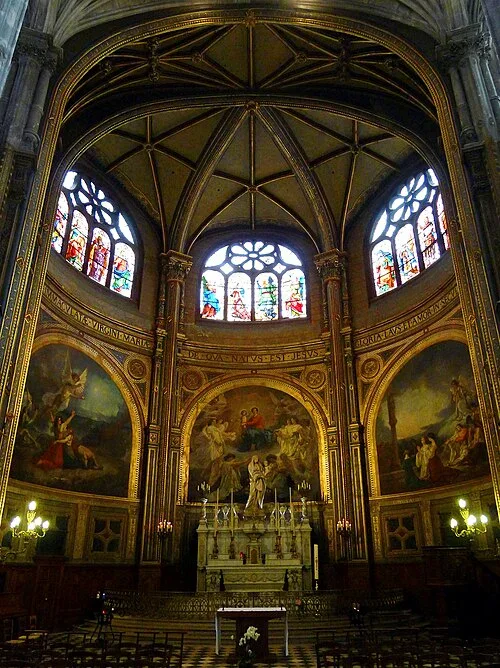 The Axial Chapel of the Virgin
The Chapel of the Virgin
Behind the choir, in the apse, the Chapel of the Virgin was built in 1640, its ceiling a ribbed half-dome. Its original marbles, woodwork and paintings were sacked during the Revolution. A restoration completed in 1804 brought it back to life, and Pope Pius VII came in person to inaugurate it on 22 December 1804, during his visit to Paris for the coronation of Napoleon. The three large paintings around it are by Thomas Couture, on the litanies of the Virgin: the triumphant Virgin adored by angels, the Virgin guiding sailors, and the Virgin consoling the afflicted. Couture refused symbolism and idealisation, and painted the pain of suffering people with a striking realism.
Listen in the appPhoto: Mbzt · CC BY 3.0
09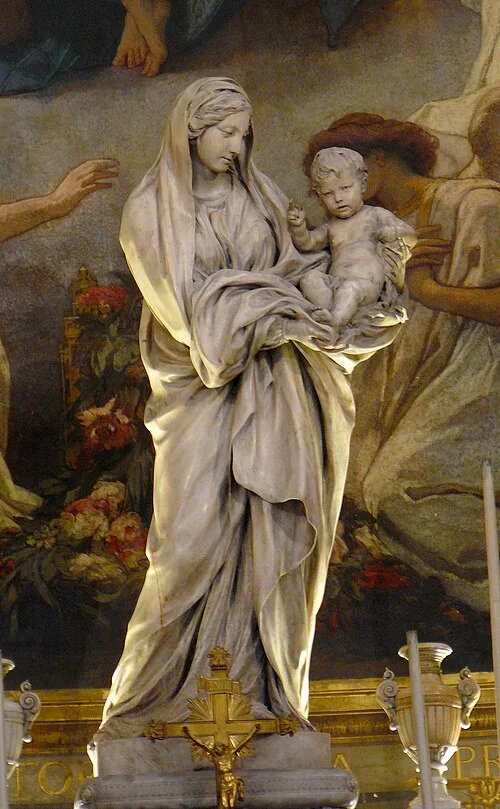 The Axial Chapel of the Virgin
Pigalle's Virgin and Child
At the centre of the chapel stands a marble Virgin and Child carved in 1748 by Jean-Baptiste Pigalle, one of the leading sculptors of eighteenth-century Paris. Her veil and cloak fall in deep, quiet folds as she holds the child, and a gilded cross stands at her feet. Couture's large murals of the nineteenth century were painted precisely to frame this statue and set it off. The chapel around it has its own eventful story, told in the previous track.
Listen in the appPhoto: Siren-Com · CC BY-SA 3.0
10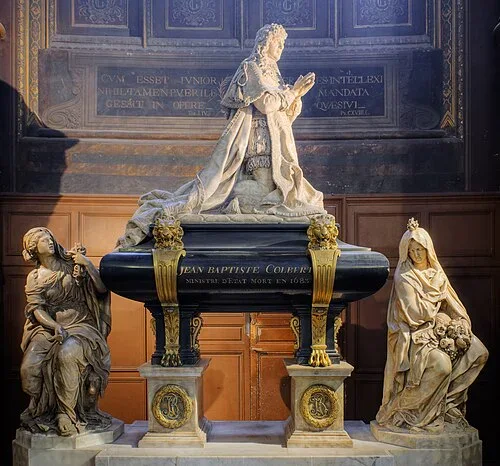 The Tomb of Jean-Baptiste Colbert
Jean-Baptiste Colbert, the minister of state who ran Louis XIV's finances, was a parishioner here and a churchwarden. When he died in 1683 he was buried in this church. Two years later his widow commissioned a funerary monument, designed by the court painter Charles Le Brun and carved by Antoine Coysevox with a fellow royal sculptor. Colbert kneels in prayer on a black marble sarcophagus, wearing the mantle of a knight of the Order of the Holy Spirit, and Coysevox makes the stone drapery look almost like cloth. Seated figures of Fidelity and Piety flank the tomb. Le Brun's design also called for an angel descending with an open Bible for Colbert to read. That angel vanished in the Revolution, when the tomb was dismantled and its parts confiscated. The principal pieces came back to the church in 1817, set up in the chapel beside the Virgin's, where they remain.
Listen in the appEric Gaba (Sting - fr:Sting) · CC BY-SA 3.0
- 11
Keith Haring: The Life of Christ
Keith Haring's bronze triptych of around 1989, with his Radiant Baby among the angels.
- 12
The Pork Butchers' Window
Sausages, a pig and a saint in an apron: the pork butchers' memorial window of 1945.
- 13
Raymond Mason: The Departure of the Fruits and Vegetables
The day Paris's food market left the city, caught in coloured relief in the nave.
- 14
The Great Organ
Nearly eight thousand pipes, Berlioz's thunderous premiere, and a rebuilt giant of 1989.
Église Saint-Eustache de Paris
Frequently asked questions
How much does the guide cost?
Free app download. Listed guide price: $0.99. Guide price shown in the app. Audio guide only. Venue admission is separate.
Can I listen without internet?
Yes. Download the guide’s audio, images, and maps in the app before your visit. Your downloaded content is then available offline.
Can I listen in my language?
This audio guide is available in 15 languages, including English.
Do I need to follow a schedule?
No. This is a self-guided experience. Choose your stops, pause whenever you like, and return to a story at your own pace.
At your own pace
Explore Église Saint-Eustache de Paris.
Download Stanza, then search for “Église Saint-Eustache de Paris”.
Free app download · Guide price shown in the app
Keep exploring
Nearby audio guides
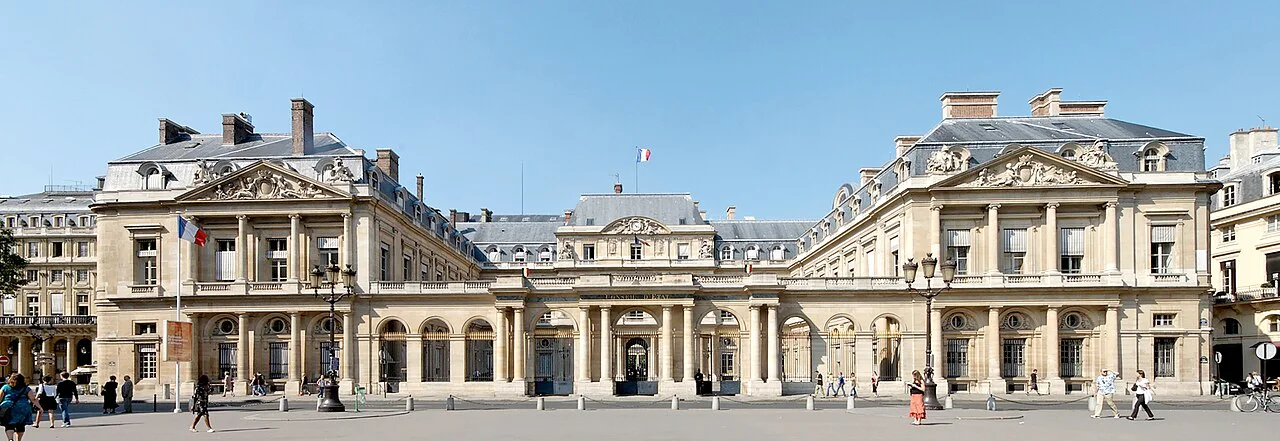
Paris · 1 km
Palais-Royal
Content & sources
Marie-Lan Nguyen · Public domain
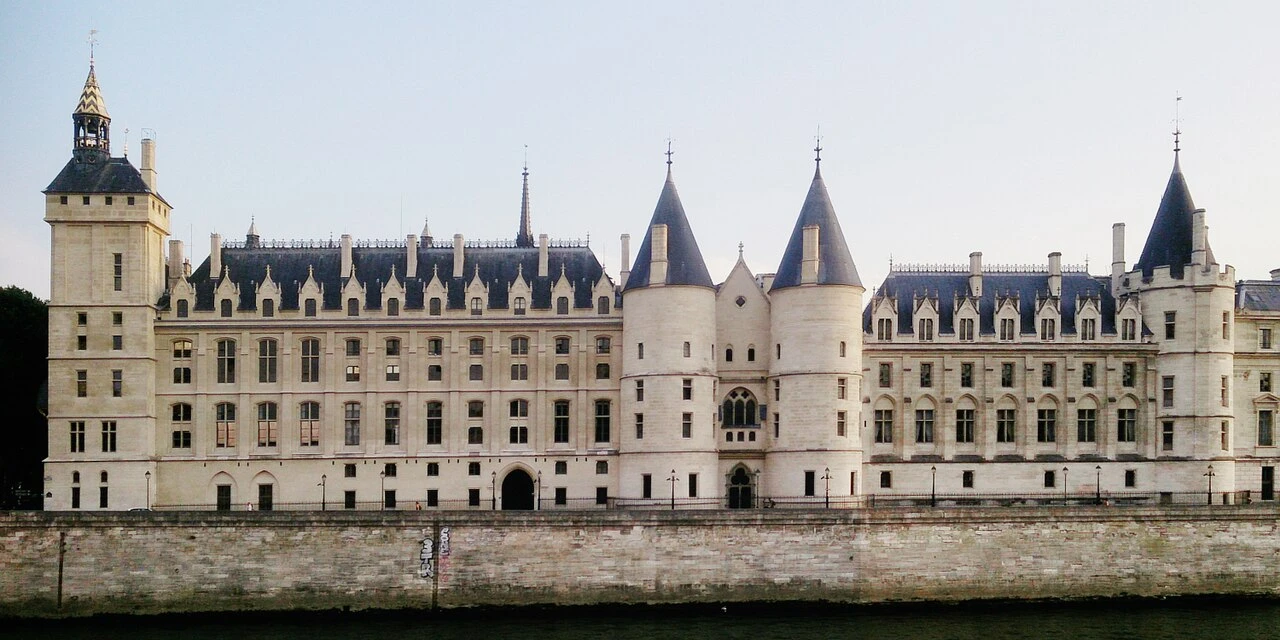
Paris · 1 km
Conciergerie
Content & sources
Photo: Xandru · CC BY-SA 4.0
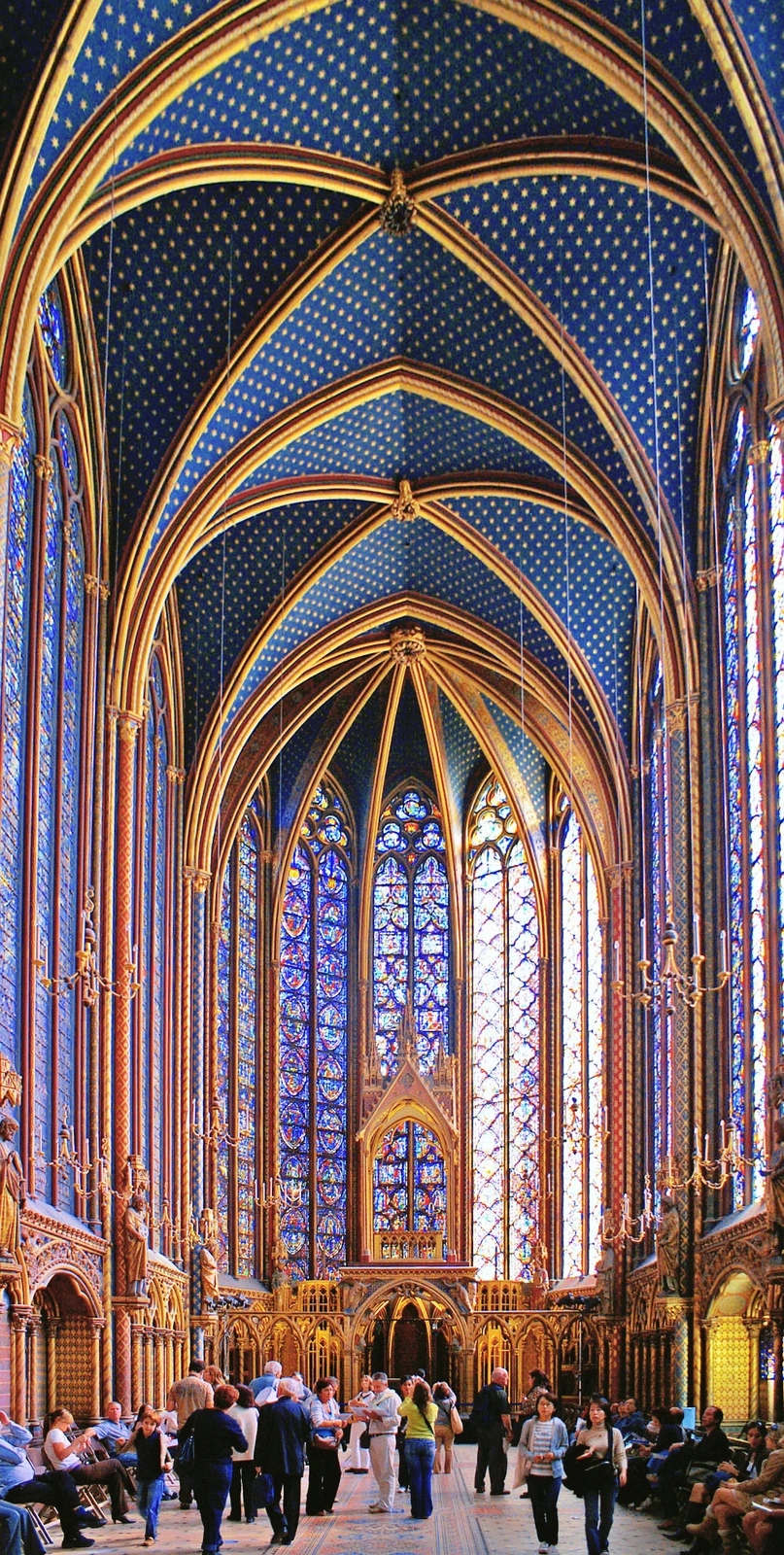
Paris · 1 km
Sainte-Chapelle
Content & sources
Didier B (Sam67fr) · CC BY-SA 2.5
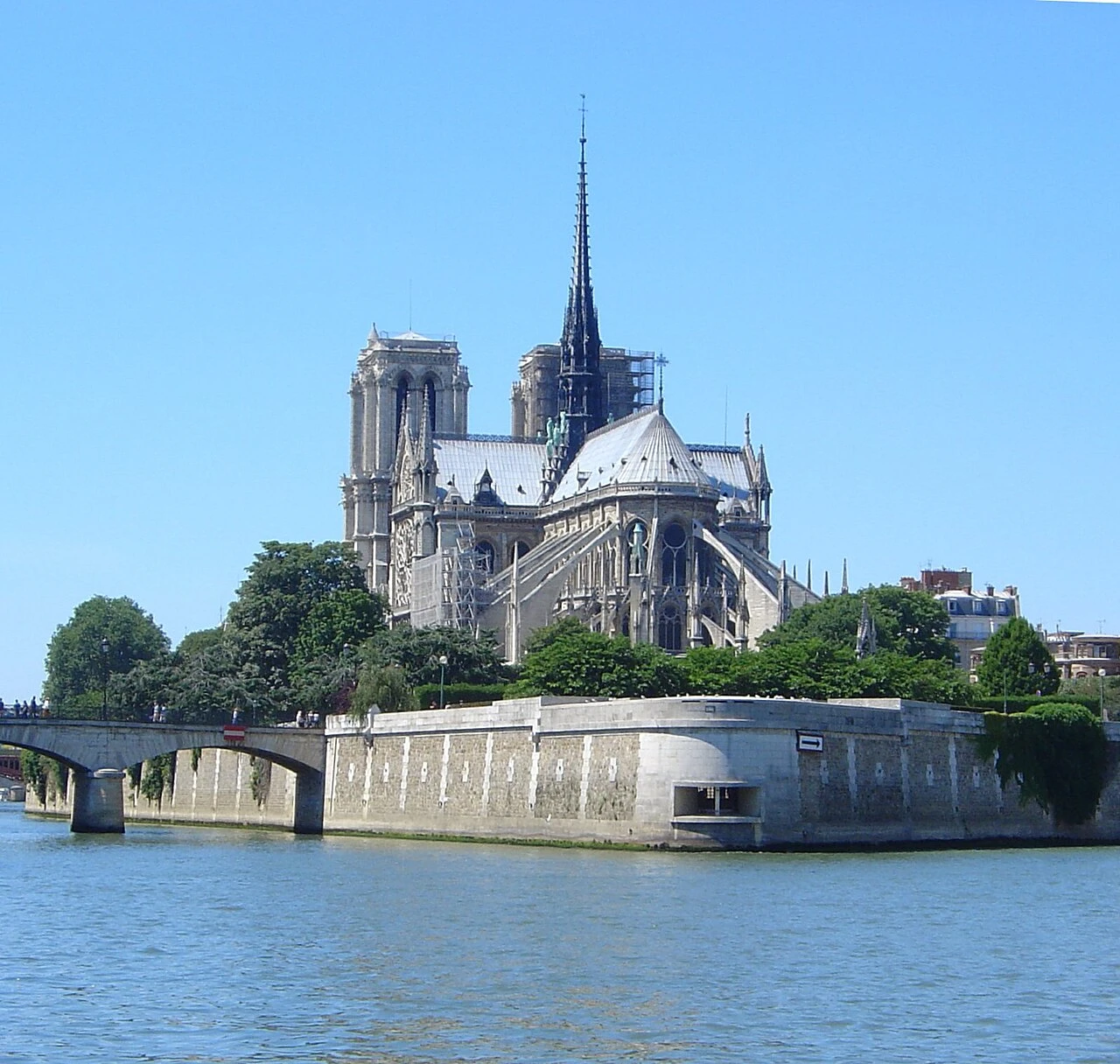
Paris · 1 km
Île de la Cité
Content & sources
David Monniaux · CC BY-SA 3.0