Stanza · Audio guide
Abbaye de Saint-Benoît-sur-Loire Audio Guide
A place to remember. A story to take with you.
Fleury Abbey is a Benedictine monastery founded in about 640 in Saint-Benoît-sur-Loire, France. It is one of the most celebrated monasteries in Western Europe and houses the relics of St. Benedict of Nursia.
Download Stanza, then search for “Abbaye de Saint-Benoît-sur-Loire”.
About the tour
One guide. Your kind of visit.
Fleury Abbey is a Benedictine monastery founded in about 640 in Saint-Benoît-sur-Loire, France. It is one of the most celebrated monasteries in Western Europe and houses the relics of St. Benedict of Nursia.
Ready when you are.
- 01Get the free Stanza app.
iOS & Android
- 02Find your guide.
“Abbaye de Saint-Benoît-sur-Loire”
- 03Download before you go.
Works offline
Audio guide / 11 narrated stops
Inside the guide
Get to know a few of the stories before you go. Open a stop to read more.
01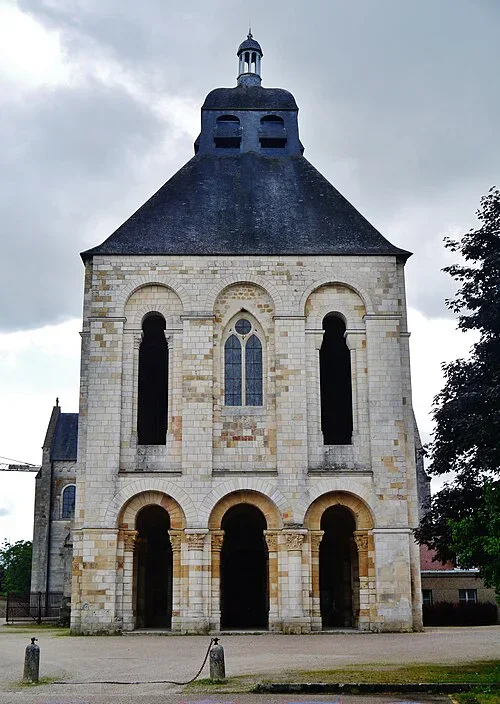 The Monumental Porch Tower (Tour-Porche)
The Romanesque Porch Tower (Tour-Porche)
Welcome to the abbey church of Saint-Benoît-sur-Loire. The abbey was founded in the seventh century, beside the Loire. It began in an older Gallo-Roman villa called Floriacum. By tradition, the abbey keeps the relics of Saint Benedict of Nursia. By the mid-ninth century, scholars were travelling here to read its books. Of the medieval abbey's buildings, this basilica is the only one still standing in the modern monastery. The tall, boxy structure at the western end is a porch tower, traditionally linked to Abbot Gauzlin. Its building date is debated. The range given runs from 1020 to 1035, or a little later. Tall triple arcades open on three sides at ground level. On the upper floor, the great arches were walled up in the fourteenth century, except two that were fitted with windows. A steep roof rises to a small lantern at the top.
Photo: Zairon · CC BY-SA 4.0
02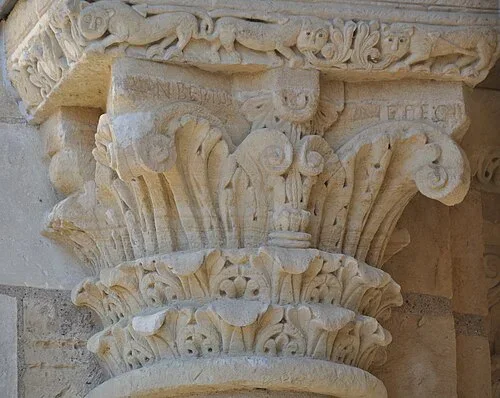 The Monumental Porch Tower (Tour-Porche)
The Capital Associated with Master Unbertus
The sculptor Unbertus left his mark on one of the ground-floor capitals of this tower. He seems to have trained in towns rich in ancient ruins. His work draws on the Corinthian style of the ancient world. He also used palmettes, fan-shaped ornaments that could stand in for Corinthian leaves. Forms from the Carolingian age, the time of Charlemagne, were still alive in his day. They show in his work too. All these borrowings came together in a blend that we call Romanesque. Tiers of acanthus-type leaves rise to a central cluster of curling scrolls. A band of carved figures runs along the top.
Unbertus · CC BY-SA 3.0
03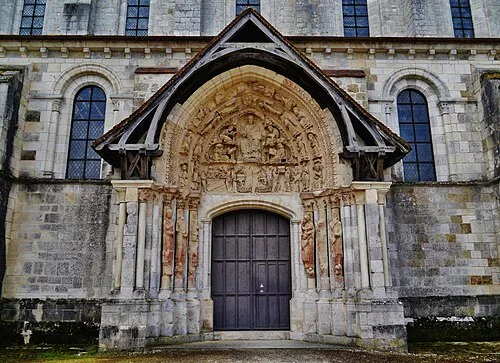 The Sculpted North Portal
The North Portal and Christ in Majesty Tympanum
Visitors to the abbey once came in through this north doorway. It stands in the fourth bay of the nave, on the north side. The doorway opened onto the northern part of the monastic enclosure, where the service and reception buildings stood. Writers differ on its date, placing it at the end of the twelfth century or the start of the thirteenth. The carved panel above the door, called the tympanum, shows Christ in Majesty enthroned at the centre. He sits among the four evangelists. John and Matthew are shown looking toward Christ. Mark and Luke turn toward their symbols, because by tradition they never knew Christ directly. The arch around the panel is decorated with other apostles, and with angels holding objects used in worship. Carved figures stand on the columns beside the door.
Listen in the appPhoto: Zairon · CC BY-SA 4.0
04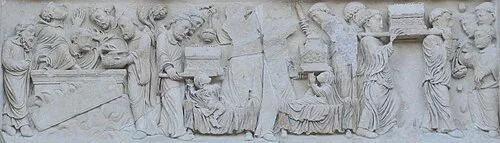 The Sculpted North Portal
The Relic Translation Frieze
According to tradition, the relics of Saint Benedict came to Fleury from Monte Cassino, the monastery Benedict himself founded in Italy. Mommolus, the second abbot here, is said to have sent one of his monks, Aigulf, to bring them back. Monte Cassino had fallen into decay after the Lombards ravaged it in the sixth century. On the lintel of the north portal, this carved relief shows that moving of the relics: robed figures, one lifting what looks like a chest, and a reclining figure at one side. The monks of Monte Cassino dispute the whole account. They claim the relics stayed at their own abbey.
Listen in the appPhoto: Gentil Hibou · CC BY-SA 3.0
05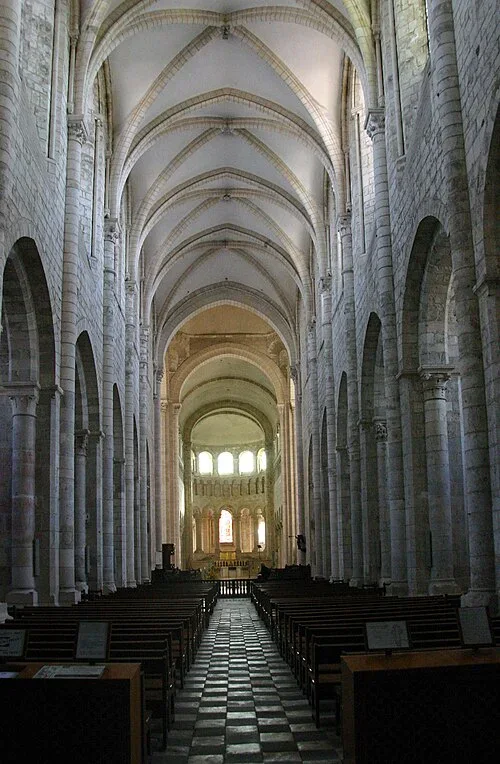 The Nave and Architectural Transition
The Nave: Romanesque Walls and Gothic Vaults
The church was rebuilt after an accidental fire destroyed it in 1026. Workers pulled down the old nave between the porch tower and the transept. In its place rose a new nave of seven bays, a little wider than the choir. Building began in the Romanesque style in the second quarter of the twelfth century. It was finished in the early thirteenth century, under Abbot Barthélémy, in the Gothic style. The first designers seem to have planned a timber roof or simpler vaults. Late in the work, the builders chose stone ribbed vaults instead. To carry them, they raised the side walls and doubled the height of the windows. The square piers gained half-columns built into their sides. The middle level of arches, the triforium, was dropped. Finely carved capitals run throughout the building and tie it together.
Listen in the appPhoto: Gerd Eichmann · CC BY-SA 4.0
06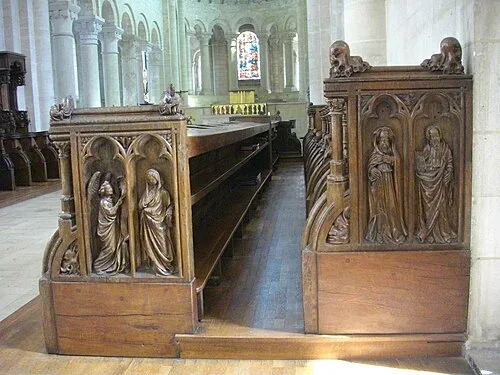 The Monastic Choir and 15th-Century Stalls
The Monastic Choir and Carved Stalls
In 1413, woodworkers and carvers from Orléans received an order for stalls for the choir. The order called for a hundred stalls. The series has suffered losses, changes and moves since then. The carved ends of the stalls hold standing figures in pointed niches, and small carved creatures sit on top. Across the set, some carvings are said to show vices such as envy, gluttony and anger. Others are pure fancy. Much later, the French Revolution scattered this community, as it scattered every Benedictine house in France. Yet a Benedictine presence continued. One monk kept the parish, dressed as a secular priest. In 1840 the church was placed on the first list of historic monuments, which made its preservation possible. In 1944 the community returned from Pierre-qui-Vire, where it had been living, and the abbey was restored to it. Since reforms by Pope Paul the Sixth, much of the daily prayer is in French. The monks still sing Gregorian chant at Mass and on the main feasts.
Listen in the appPhoto: Fab5669 · CC BY-SA 4.0
07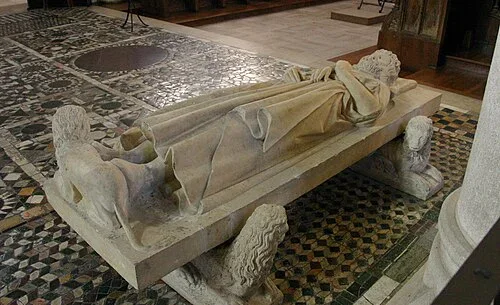 The Sanctuary, Opus Sectile, and Royal Tomb of Philip I
The Tomb and Lion-Supported Effigy of King Philip I
King Philip the First of France was devoted to Saint Benedict. Out of humility, he asked to be buried at Fleury rather than at Saint-Denis. He was laid in a vault at the centre of the choir in 1108. The stone effigy lies in high relief, beneath folds of drapery. In 1830 the remains in that vault were recognised, still well preserved, and the effigy was re-cut to remove damage. The slab rests on six lions. Four of them are entirely new. The other two are the only original pieces.
Listen in the appPhoto: Gerd Eichmann · CC BY-SA 4.0
08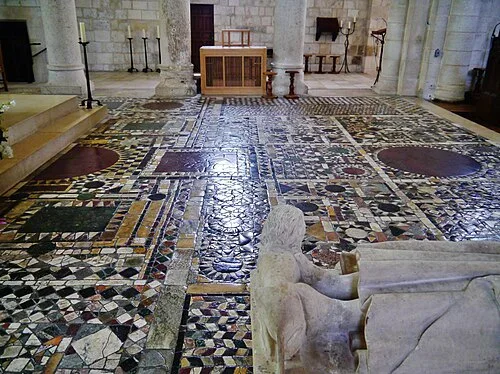 The Sanctuary, Opus Sectile, and Royal Tomb of Philip I
The Choir Pavement in Opus Sectile
Opus sectile is a technique of cutting stone into shapes and fitting them together in patterns. The polished pieces here are coloured stones arranged in geometric designs. When a seventeenth-century altar was taken apart, Juste Lisch made a careful survey of the floor. His aim was to lay the pieces back in their original places. A stone tomb lies at the centre, the royal tomb told of at the stop before. A watercolour painted in 1920 by Constant Coursimault still shows the floor in its seventeenth-century state.
Listen in the appPhoto: Zairon · CC BY-SA 4.0
09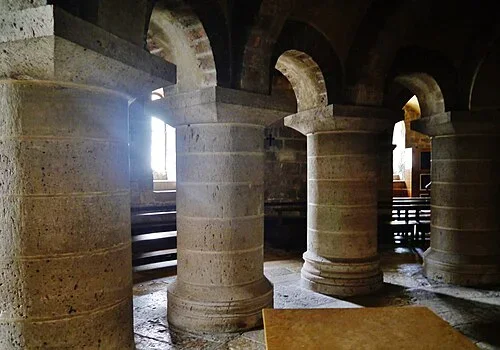 The Romanesque Crypt and Reliquary of Saint Benedict
The Romanesque Crypt
Work on this eastern part had begun decades earlier. In March 1108 the apse, the crypt and the choir were finished and consecrated. The crypt lies beneath the sanctuary. Thick round columns carry round arches and a low vault. Each column has horizontal bands running around its shaft. Light falls in through openings in the walls. The sanctuary above was built over this crypt, the crypt of Saint Benedict's relics, and it follows the crypt's plan.
Listen in the appPhoto: Zairon · CC BY-SA 4.0
10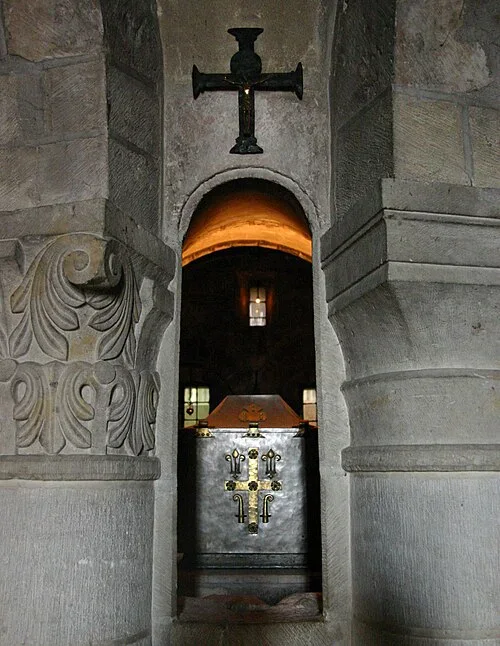 The Romanesque Crypt and Reliquary of Saint Benedict
The Reliquary of Saint Benedict in the Crypt Niche
Fleury is reputed to hold the relics of Saint Benedict, the father of Western monasticism. The relics drew pilgrims, and the pilgrims brought the abbey wealth and fame. A chest covered in metal sits in a stone niche. It has a gold-coloured cross and metal fittings, and a dark iron cross is fixed above the arch. Over three centuries, a group of Fleury monks built up the Miracles of Saint Benedict, which record the saint's miracles. Andrew of Fleury, writing around 1043, was one of them.
Listen in the appPhoto: Gerd Eichmann · CC BY-SA 4.0
- 11
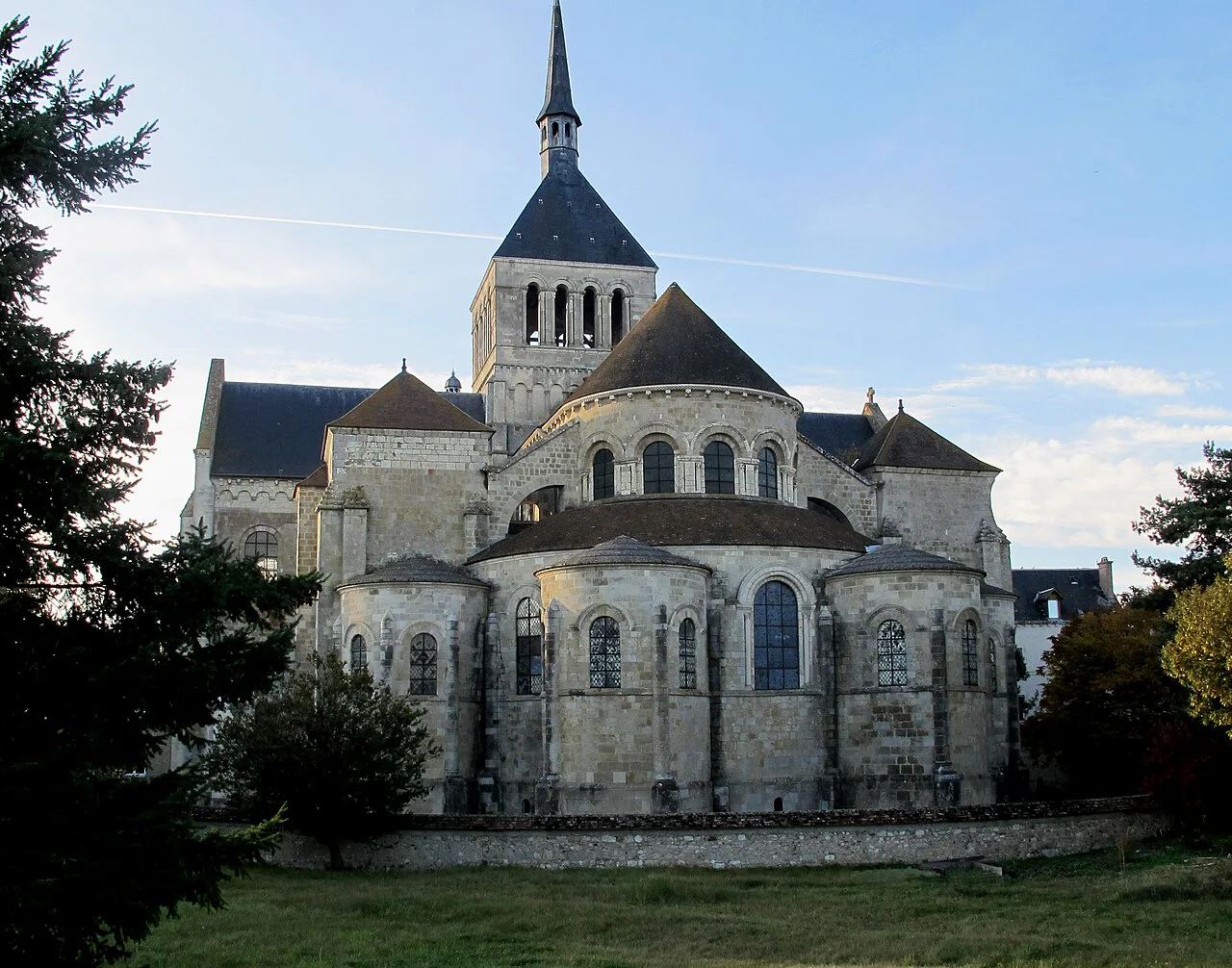
The Eastern Chevet and Crossing Tower from the Grounds
The rounded east end of the church, with its chapel-towers and its echo of Cluny III.
Abbaye de Saint-Benoît-sur-Loire
Frequently asked questions
How much does the guide cost?
Free app download. Listed guide price: $0.99. Guide price shown in the app. Audio guide only. Venue admission is separate.
Can I listen without internet?
Yes. Download the guide’s audio, images, and maps in the app before your visit. Your downloaded content is then available offline.
Can I listen in my language?
This audio guide is available in 15 languages, including English.
Do I need to follow a schedule?
No. This is a self-guided experience. Choose your stops, pause whenever you like, and return to a story at your own pace.
At your own pace
Explore Abbaye de Saint-Benoît-sur-Loire.
Download Stanza, then search for “Abbaye de Saint-Benoît-sur-Loire”.
Free app download · Guide price shown in the app
Keep exploring
Nearby audio guides
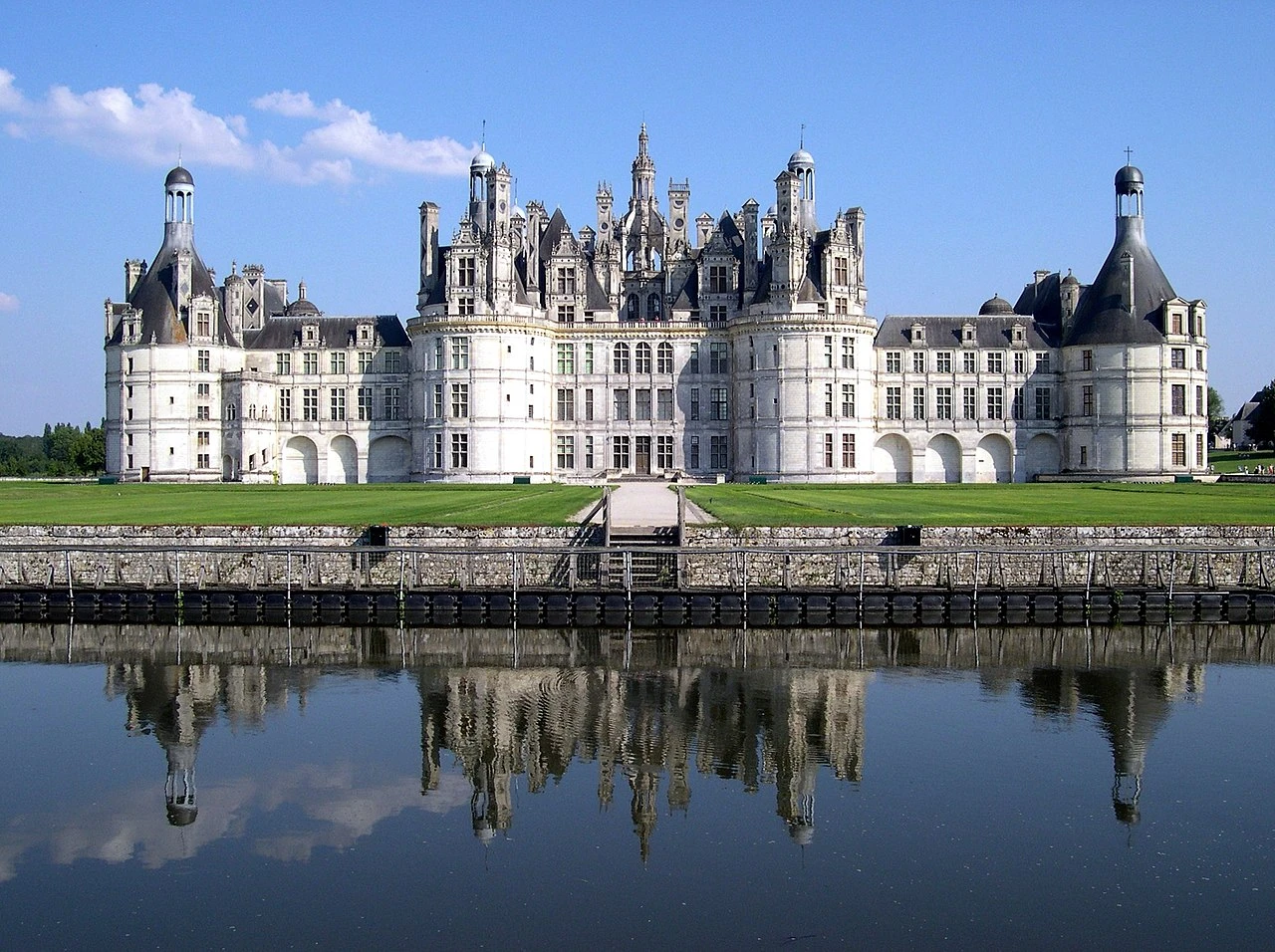
Chambord · 63 km
Château de Chambord
Content & sources
No machine-readable author provided. Calips assumed (based on copyright claims). · CC BY-SA 3.0
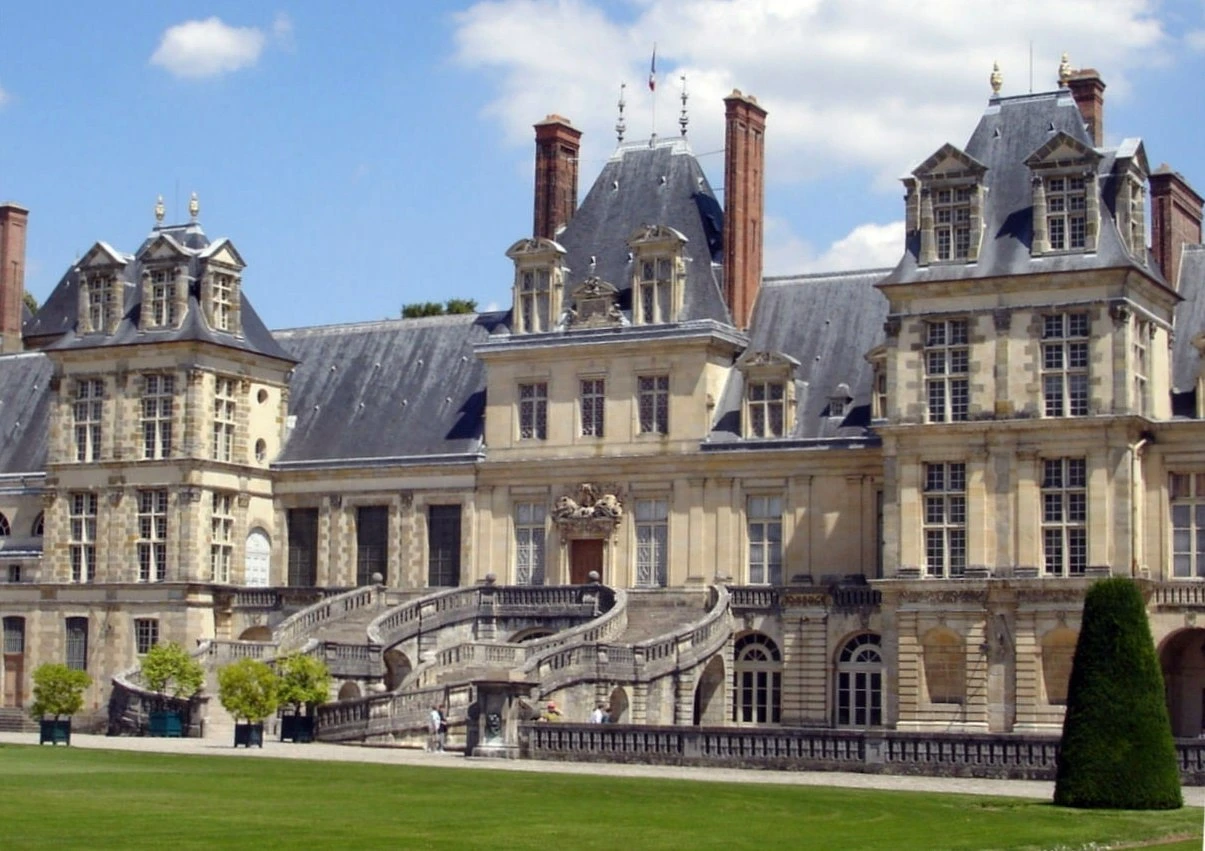
Fontainebleau · 72 km
Château de Fontainebleau
Content & sources
user:Carolus · CC BY 2.5
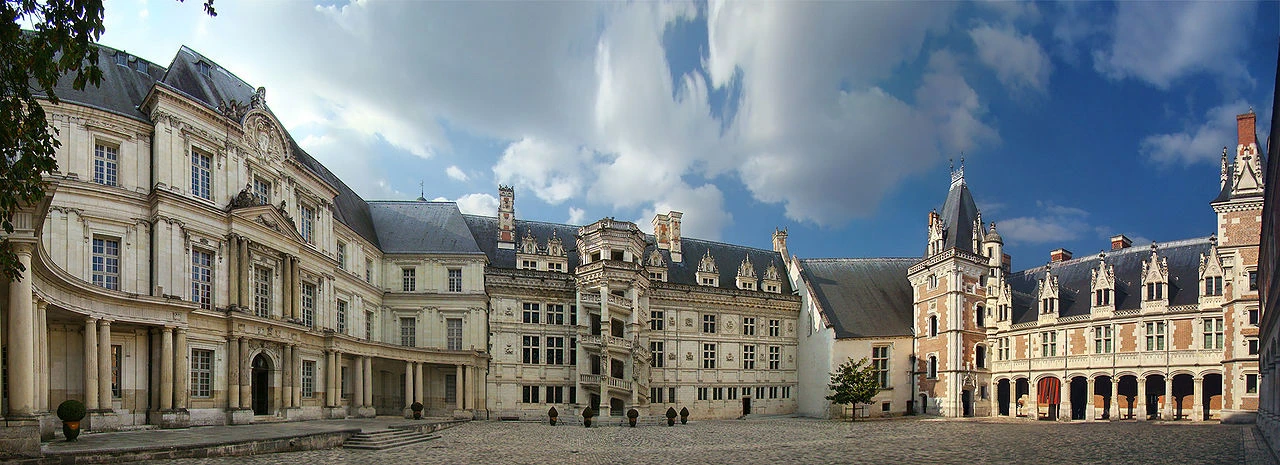
Blois · 77 km
Château de Blois
Content & sources
Photo: Tango7174 · CC BY-SA 4.0
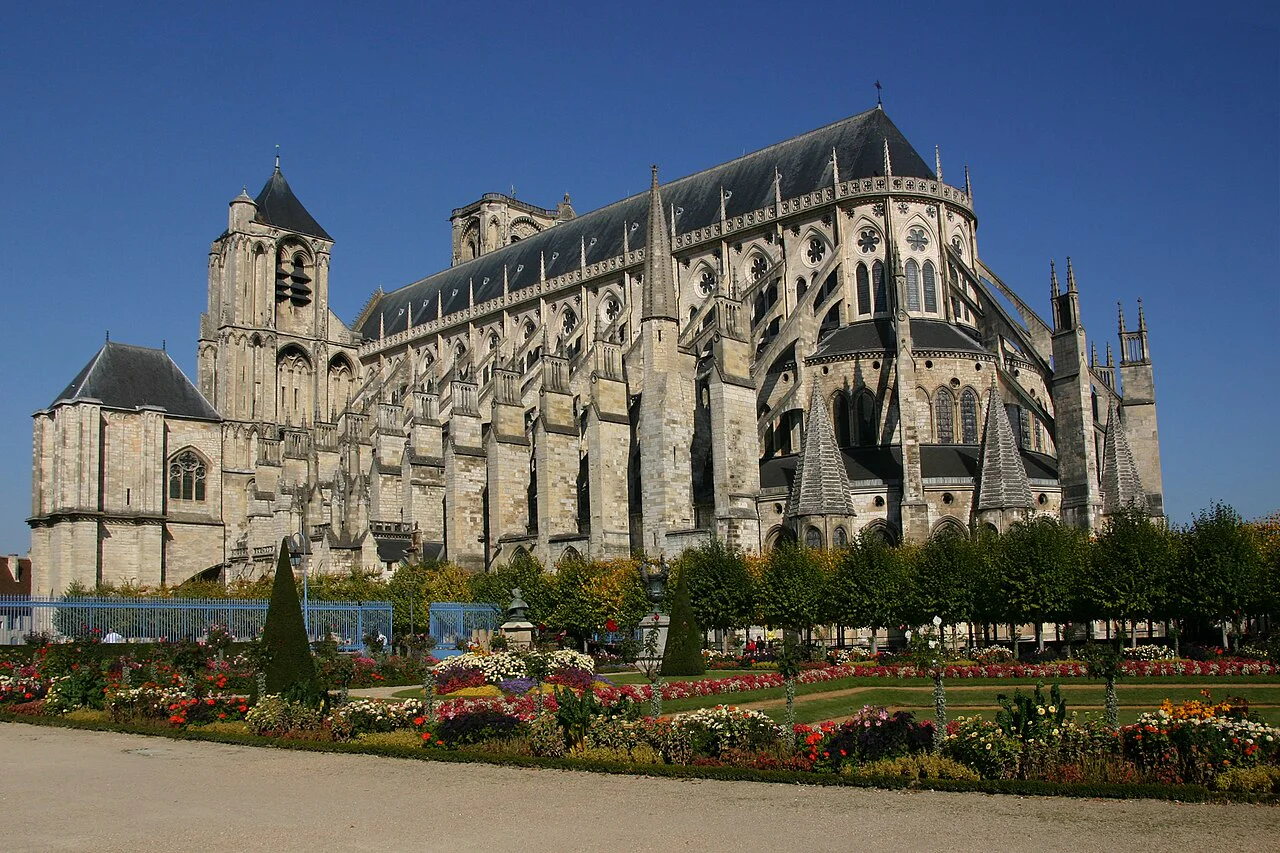
Bourges · 81 km
Cathédrale Saint-Étienne de Bourges
Content & sources
Photo: Gerd Eichmann · CC BY-SA 4.0