Stanza · Audio guide
Katholische Hofkirche Audio Guide
A place to remember. A story to take with you.
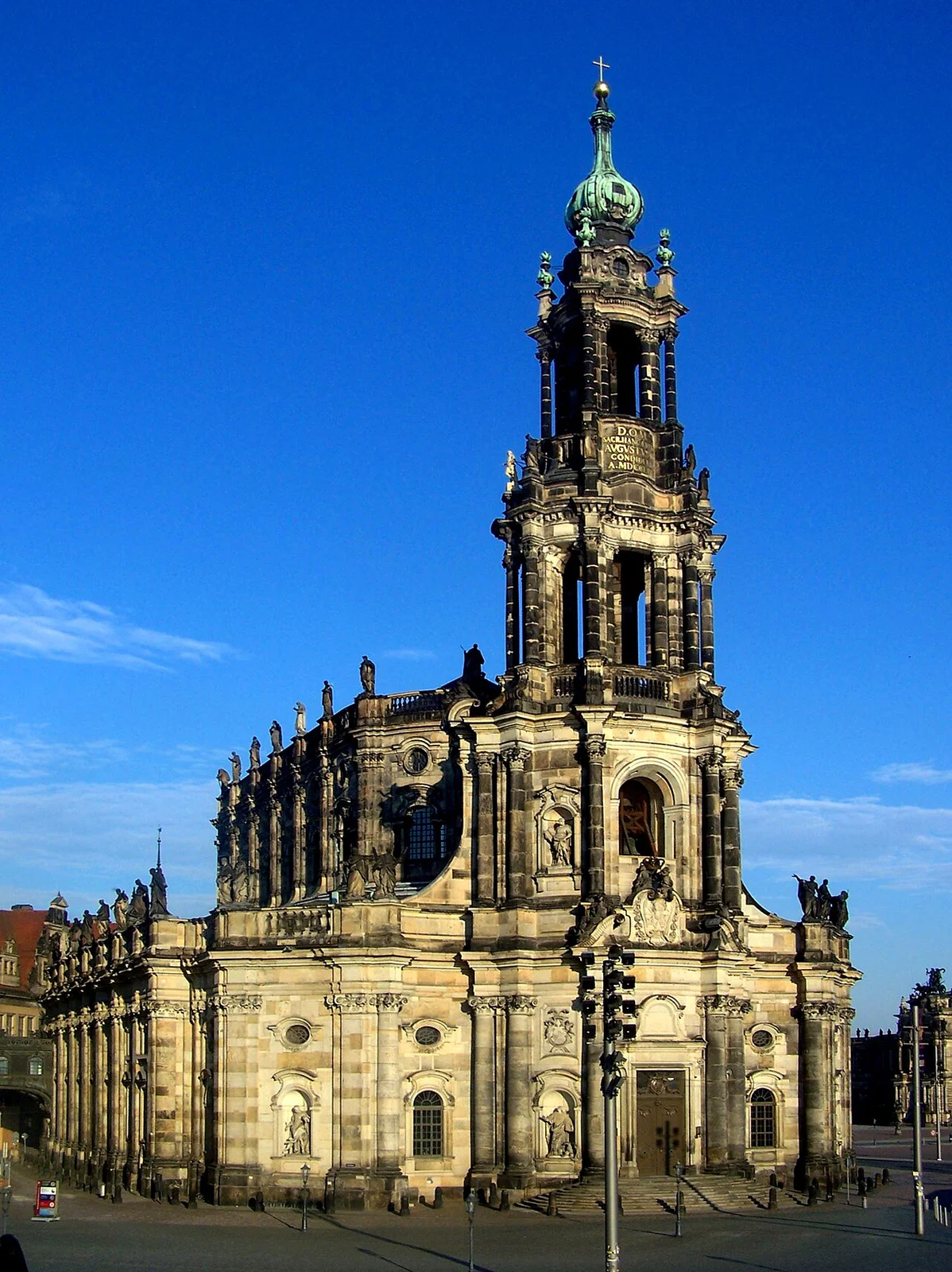
Dresden Cathedral is the Catholic cathedral of Dresden, Germany. It was previously known as the Catholic Church of the Royal Court of Saxony.
Download Stanza, then search for “Katholische Hofkirche”.
About the tour
One guide. Your kind of visit.
Dresden Cathedral is the Catholic cathedral of Dresden, Germany. It was previously known as the Catholic Church of the Royal Court of Saxony.
Ready when you are.
- 01Get the free Stanza app.
iOS & Android
- 02Find your guide.
“Katholische Hofkirche”
- 03Download before you go.
Works offline
Audio guide / 13 narrated stops
Inside the guide
Get to know a few of the stories before you go. Open a stop to read more.
01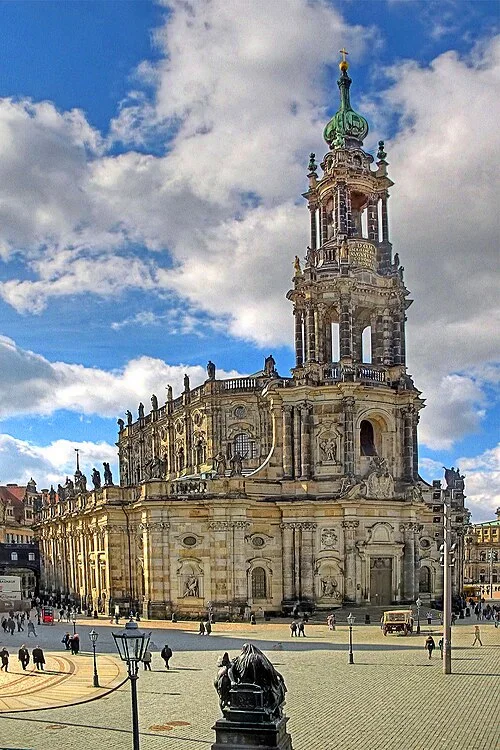 Schloßplatz and the Balustrade of Saints
The Catholic Court Church on Schloßplatz
Welcome to the Katholische Hofkirche, the Catholic Court Church of Saxony, on Dresden's Schloßplatz. The Roman architect Gaetano Chiaveri began building in 1739, and the church was consecrated in 1751. Its founder was Elector Augustus III, who ruled Lutheran Saxony as a Catholic king of Poland. The church served the royal family and the Catholic court, in a city whose people were almost entirely Protestant. The plans were kept quiet; courtiers spoke only of 'a certain building' until the work was too far advanced to stop. Saxon law of the time allowed Catholics their worship, on one condition: only without bells. So a bell cast in 1747 by the Dresden founder Johann Gottfried Weinhold lay stored in the main armoury, and the tower stood silent. The Peace of Posen of 1806 brought religious equality to Saxony, and the bells could finally be hung. Three more followed in 1807, given by Friedrich August the Just. The tower rises eighty-six metres over the Elbe frontage.
Photo: W. Bulach · CC BY-SA 4.0
02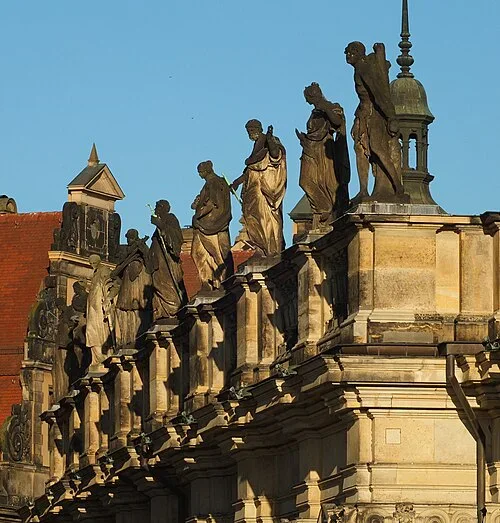 Schloßplatz and the Balustrade of Saints
The Balustrade of 78 Saints
Seventy-eight saints line the balustrades of this church, larger than life, high above the roofs of Dresden. The Italian sculptor Lorenzo Mattielli shaped the programme, with the Dresden workshop of Paul and Jakob Mayer carving alongside him. The Jesuit court confessor Ignaz Guarini also had a say in how the figures were conceived. Apostles, church fathers and martyrs stand in ordered ranks along the nave and around the tower, among them Francis of Assisi, John Nepomuk and Ignatius of Loyola. In a largely Protestant city, this crowd of saints put the ruler's Catholic faith on public display, cut in stone where everyone could see it.
Photo: Ad Meskens · CC BY-SA 4.0
03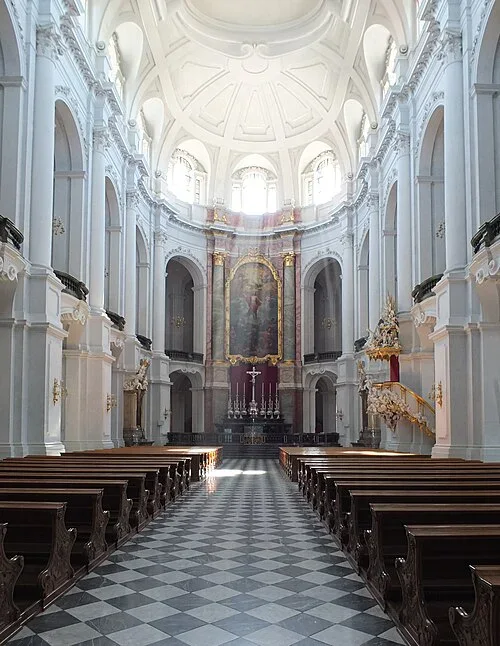 The Grand Nave and Permoser's Rococo Pulpit
The Great Nave
Inside, the nave opens into a tall, airy hall of white and pale stone. Chiaveri drew his inspiration from the Roman churches of Borromini and the royal chapel at Versailles. He is the only foreign architect entrusted with a grand royal building in Dresden, rather than the city's own master builders. Chiaveri left in 1748, before the work was done, and the interiors were completed by Johann Christoph Knöffel, with Julius Heinrich Schwarze contributing to the tower. August the Strong had called his Zwinger a heroic theatre; his son set a sacred theatre beside it. The great vaulted room carries sound a long way, and music lingers under its dome.
Listen in the appPhoto: Ad Meskens · CC BY-SA 4.0
04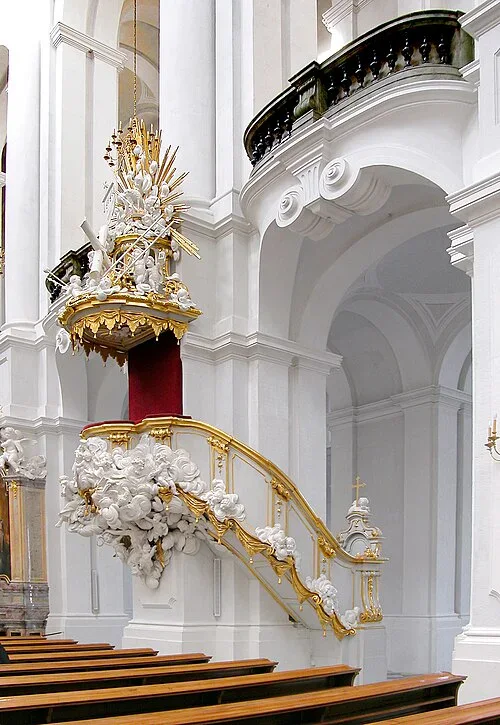 The Grand Nave and Permoser's Rococo Pulpit
Permoser's Carved Pulpit
The pulpit is older than the church itself. Balthasar Permoser carved it in 1712 for the old court church in the opera house, the Catholic chapel that served the court before this building stood. When the court moved here, the pulpit came along. Johann Joseph Hackl added the sounding board above it in 1748, and his hand is also in the carved screens of the confessionals. A coating of white alabaster lacquer gives the cherubs and garlands their porcelain-like sheen, an heirloom from the earlier chapel glowing against the pale columns.
Listen in the appPhoto: Jörg Blobelt · CC BY-SA 4.0
05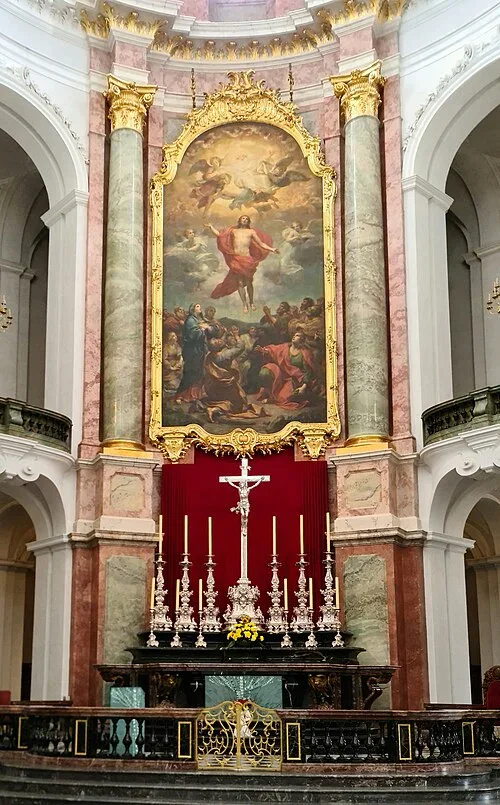 The High Altar and Mengs's Ascension
The High Altar
The high altar is the work of the Aglio brothers, built of marble and crowned with ornaments of gilded bronze. Beneath the towering altarpiece, this was the stage for the court's Catholic liturgy. Candles, cross and altar cloth mark the table where the royal family worshipped. The altar frames everything that happens in the sanctuary, and the painting rising above it has a story of its own.
Listen in the appPhoto: Ricardalovesmonuments · CC BY-SA 4.0
06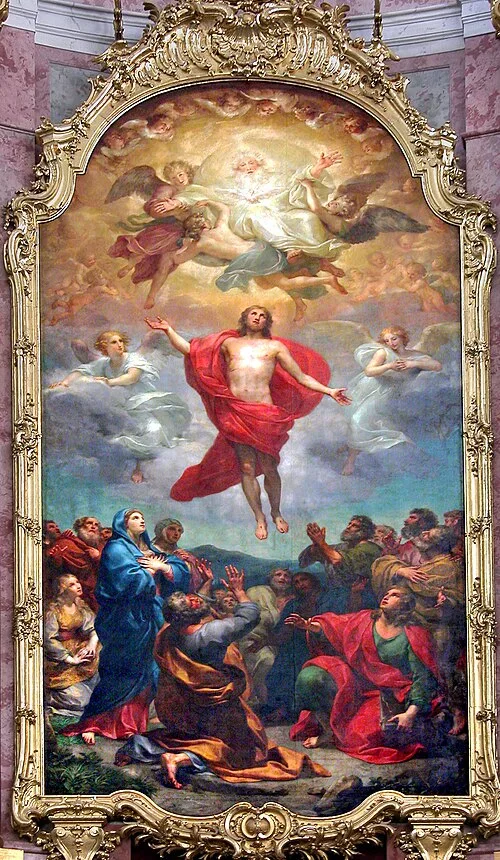 The High Altar and Mengs's Ascension
Mengs's Ascension
Above the altar, Christ rises into the light in the Ascension, the work of Anton Raphael Mengs, court painter of Saxony. Mengs began the canvas in Rome in 1752 and kept working on it for thirteen years. It reached Dresden only in 1765. The painting stands ten metres tall. Its width is four and a half metres, filling the wall above the sanctuary. Joseph Deibel, sculptor to the court gallery, made its frame. Below, Mary and the apostles gaze upward as angels carry Christ into the clouds. A Catholic image on this scale, at the very heart of the church, was exactly what its founder intended.
Listen in the appPhoto: Jörg Blobelt · CC BY-SA 4.0
07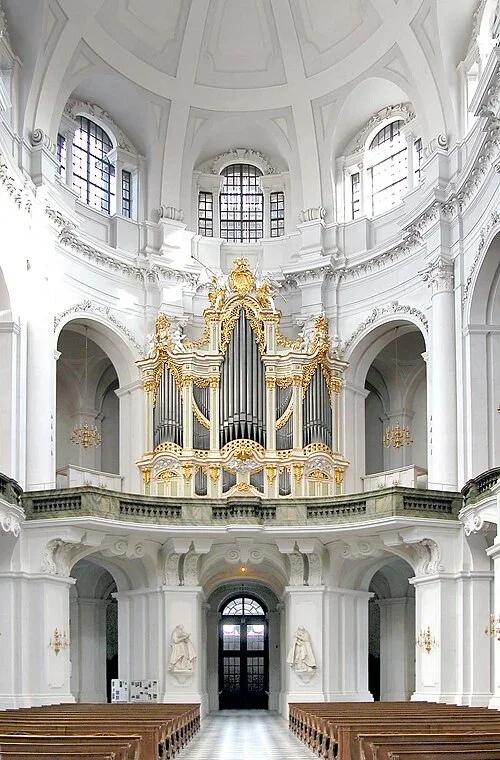 The Silbermann Organ Loft
The Silbermann Organ
The western gallery holds the last work of Gottfried Silbermann, the most celebrated organ builder of Saxony. He signed the contract on 22 July 1750, for the very high price of twenty thousand talers, after the king himself encouraged him. Gout had left Silbermann severely ill, and two weeks later he handed the building over to his pupil Zacharias Hildebrandt. Silbermann died in August 1753. Hildebrandt and his son carried the work nearly to completion by June 1754, and other workshop members finished it. The organ was consecrated on 2 February 1755. It is the only survivor of the four organs Silbermann built in Dresden, and the Jehmlich firm cared for it from 1836 onward. In 1944, provost Wilhelm Beier had the pipework, the action and the console dismantled and stored in the cloisters of St. Marienstern monastery.
Listen in the appPhoto: Jörg Blobelt · CC BY-SA 4.0
08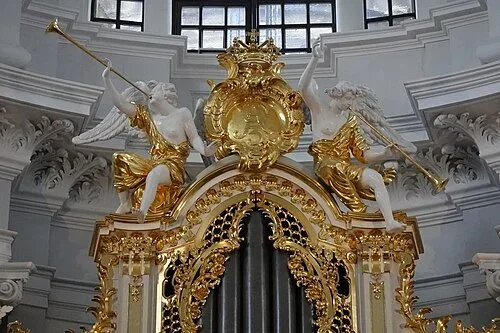 The Silbermann Organ Loft
The Organ Case and Its Reconstruction
The trumpeting angels on the organ case belong to the post-war restoration. When the bombs fell on 13 February 1945, the case burned together with its richly carved prospect, part of the wind system, and a register called Unda maris, the wave of the sea. The pipework stored at St. Marienstern survived. Craftsmen rebuilt the case around the saved pipes, and the instrument sings again behind gilded carving.
Listen in the appPhoto: Asio otus · CC BY-SA 3.0
09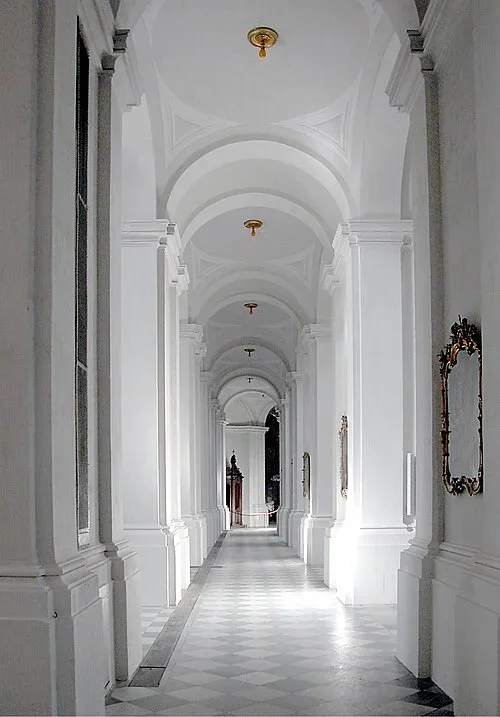 The Enclosed Processional Ambulatory and Memorial Chapel
The Enclosed Processional Ambulatory
A vaulted walkway runs in a continuous ring around the nave, a rare feature in any church. It is called the Prozessionsumgang, the processional ambulatory. In Protestant Saxony, every form of Catholic worship in the open air was forbidden, and the city managed to ban the court parish's processions outside the building as well. So the procession was built into the church itself, an enclosed route where the liturgy could move in its public form without crossing a single street. Paintings hang along the arcades today, among them a former altarpiece that was moved here.
Listen in the appPhoto: Jörg Blobelt · CC BY-SA 4.0
10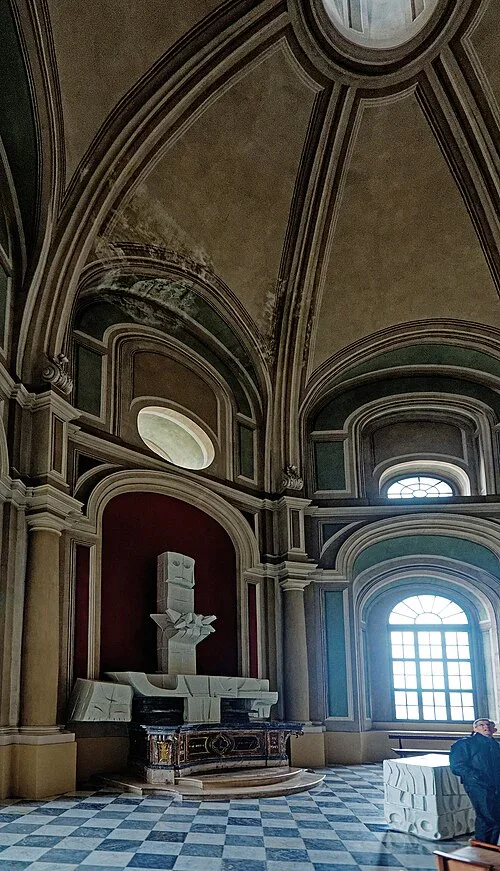 The Enclosed Processional Ambulatory and Memorial Chapel
The Memorial Chapel and the Meissen Pietà
During the bombing of Dresden in February 1945, this church was struck by explosive bombs on several successive nights. The roof and the vaults collapsed, and parts of the outer walls were destroyed outright. The rebuilding lasted until 1965. The different colouring of the stone in the nave still shows where old fabric ends and new begins. Three of the four corner chapels were restored almost to their original form; the fourth received an entirely new design. Since 1976, one of them has been a memorial for the victims of 13 February. At its centre stands a modern Pietà, modelled in Meissen porcelain by the sculptor Friedrich Press.
Listen in the appTxllxt TxllxT · CC BY-SA 4.0
- 11
The Wettin Crypt
The burial vaults of the Saxon royal house, opened four days after the consecration.
- 12
The Heart of Augustus the Strong
The heart of a king kept in Dresden, his body buried in Kraków.
- 13
The Covered Bridge to the Castle
The covered bridge from throne to altar, and the court church that became a cathedral for everyone.
Katholische Hofkirche
Frequently asked questions
How much does the guide cost?
Free app download. Listed guide price: $0.99. Guide price shown in the app. Audio guide only. Venue admission is separate.
Can I listen without internet?
Yes. Download the guide’s audio, images, and maps in the app before your visit. Your downloaded content is then available offline.
Can I listen in my language?
This audio guide is available in 15 languages, including English.
Do I need to follow a schedule?
No. This is a self-guided experience. Choose your stops, pause whenever you like, and return to a story at your own pace.
At your own pace
Explore Katholische Hofkirche.
Download Stanza, then search for “Katholische Hofkirche”.
Free app download · Guide price shown in the app
Keep exploring
Nearby audio guides
Dresden · 1 km
Zwinger
Content & sources
--Immanuel Giel 11:54, 22 September 2005 (UTC) · CC BY-SA 3.0
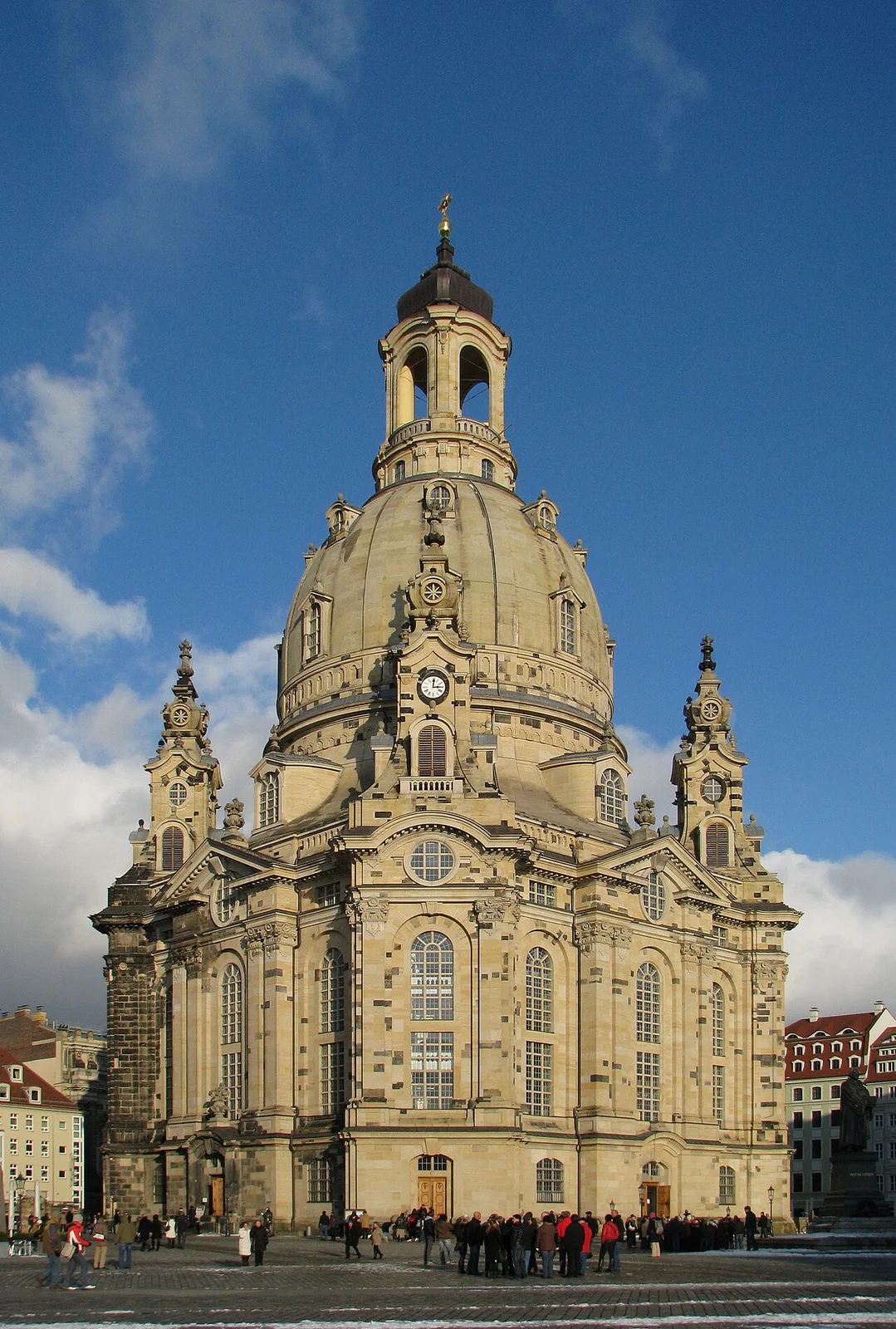
Dresden · 1 km
Frauenkirche
Content & sources
Netopyr · CC BY-SA 3.0
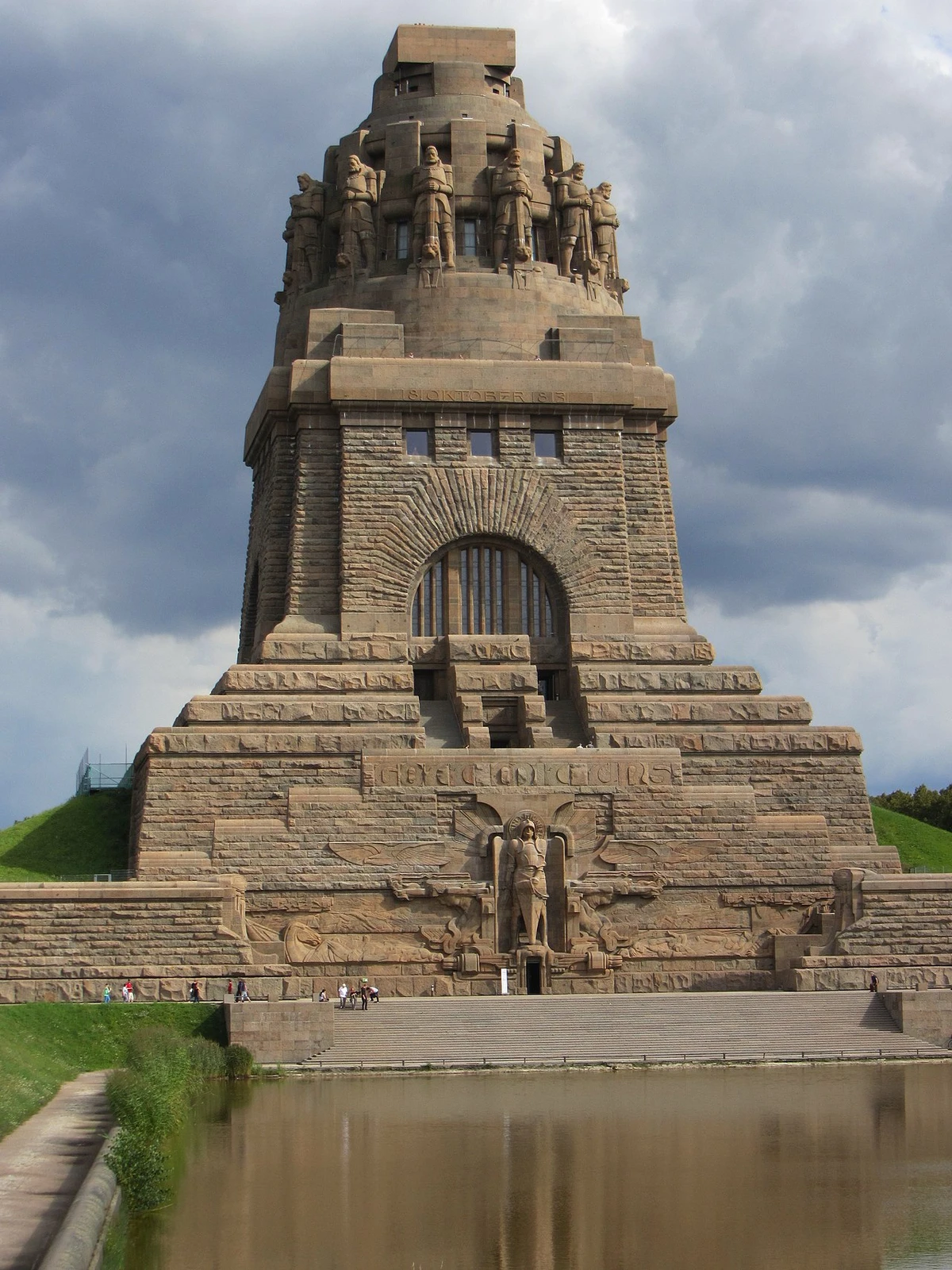
Leipzig · 97 km
Völkerschlachtdenkmal
Content & sources
Photo: Paolchen · CC BY-SA 3.0 de
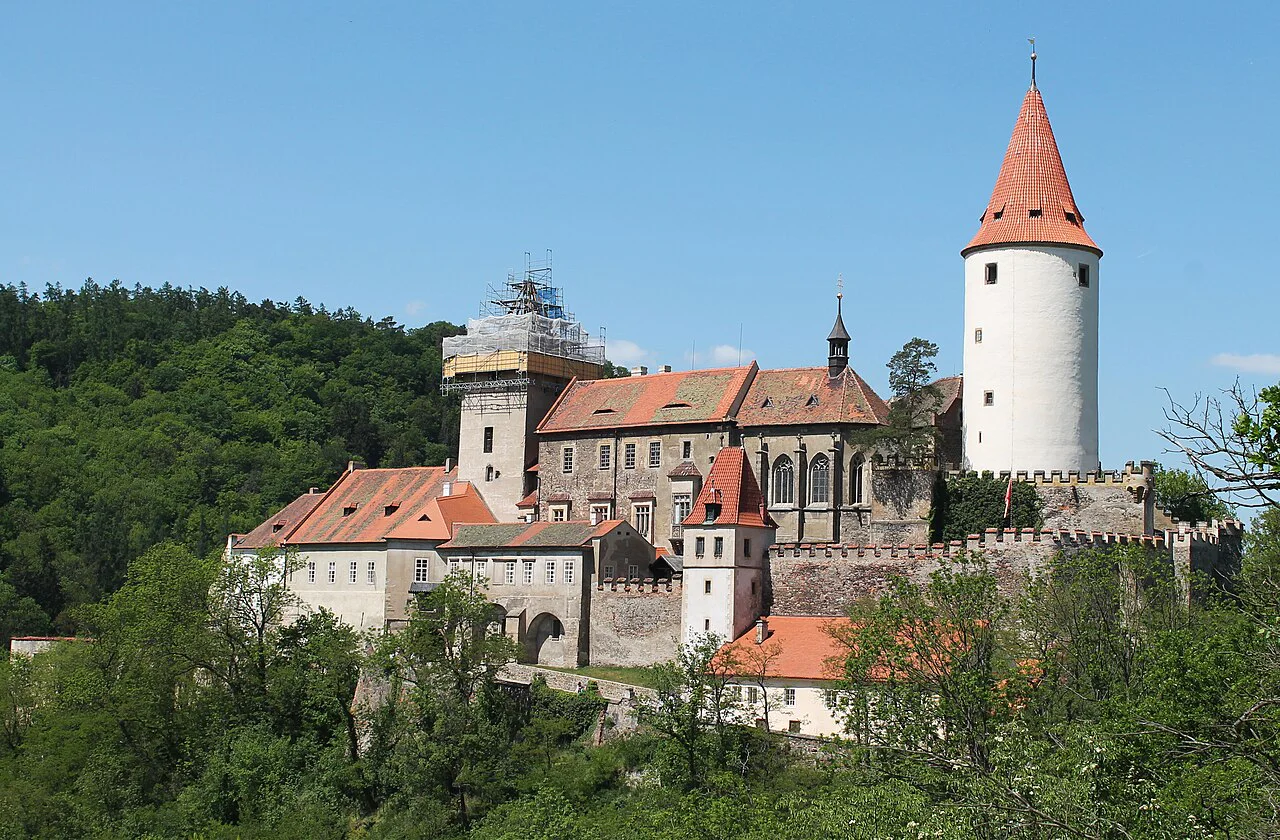
Křivoklát · 113 km
Křivoklát Castle
Content & sources
Photo: Harold · CC BY-SA 3.0