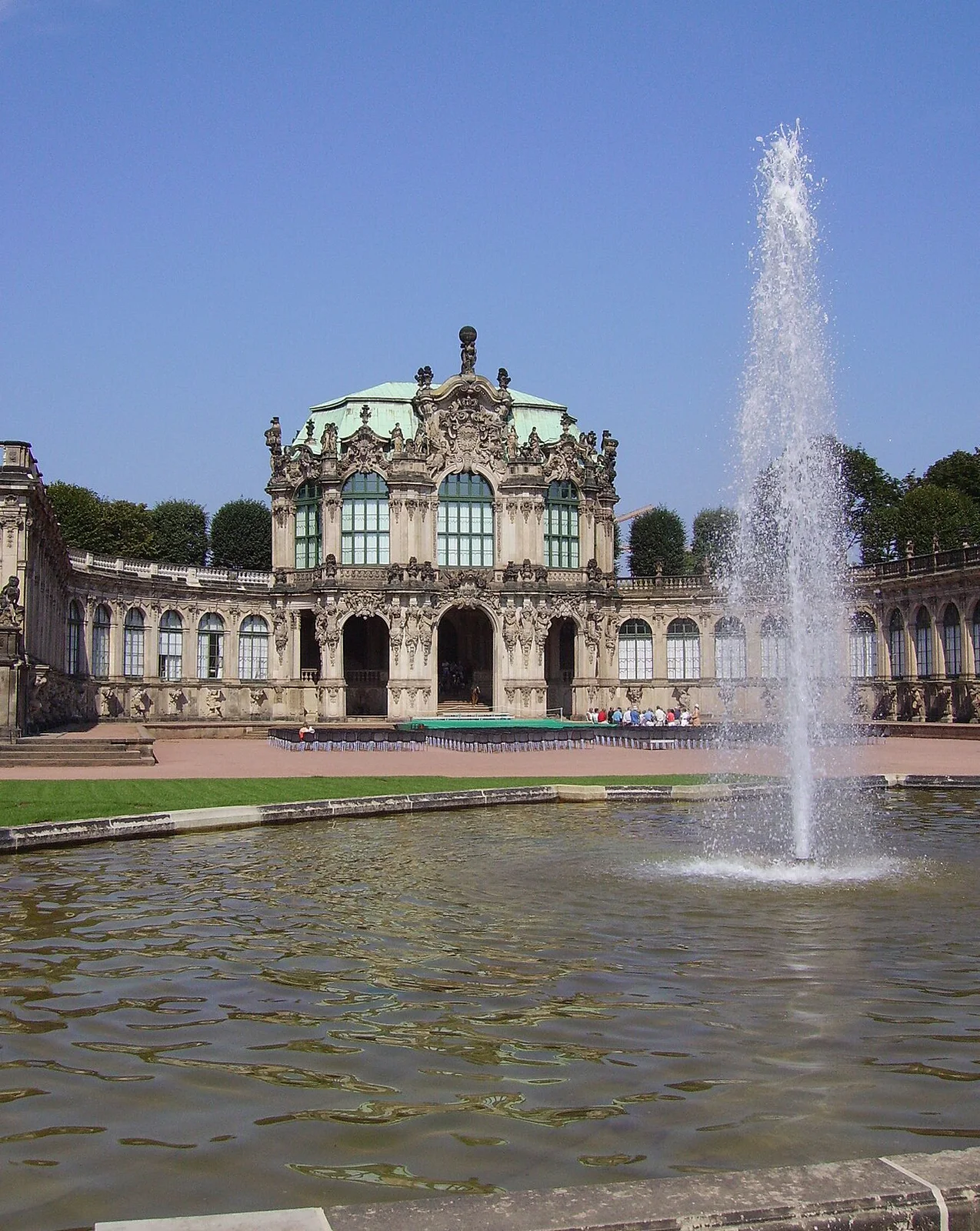
 Stanza / Audio guide
Content & sources
Stanza · Audio guide
Zwinger Audio Guide
A place to remember. A story to take with you.
The Zwinger is a palatial complex with gardens located in Dresden, Germany. It was designed by architect Matthäus Daniel Pöppelmann and is considered one of the most important buildings of the Baroque period…
Download Stanza, then search for “Zwinger”.
About the tour
One guide. Your kind of visit.
The Zwinger is a palatial complex with gardens located in Dresden, Germany. It was designed by architect Matthäus Daniel Pöppelmann and is considered one of the most important buildings of the Baroque period in Germany.
Ready when you are.
- 01Get the free Stanza app.
iOS & Android
- 02Find your guide.
“Zwinger”
- 03Download before you go.
Works offline
Audio guide / 16 narrated stops
Inside the guide
Get to know a few of the stories before you go. Open a stop to read more.
01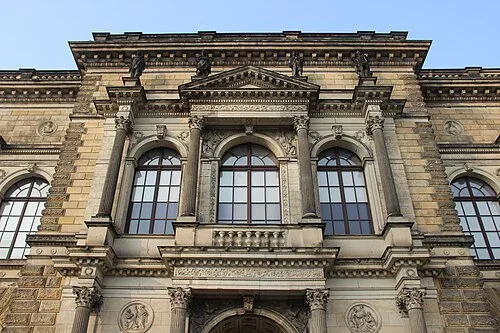 Theaterplatz Approach and Semper Gallery Portico
Sempergalerie Facade
The Zwinger is a royal complex in Dresden, built in the early eighteenth century for Augustus the Strong. Its richly decorated pavilions and galleries testify to the splendour of his reign. Today it is one of the most important Baroque buildings in Germany. Yet on its Elbe side, the complex was never really finished. Augustus meant it as the forecourt of a new castle. That castle would have filled the ground between the Zwinger and the river. Until that castle was built, the open side was closed off with a temporary wall. After Augustus died in 1733, the plans for the castle were dropped. The Zwinger lost importance for a time, and the gap stayed open for more than a century. Work on a gallery to close it began in 1847. The architect Gottfried Semper designed it, and it opened in 1855. In 1849 Semper took the side of the rebels in the May Uprising in Dresden, and he had to leave the city. The architect Karl Moritz Haenel then completed the design. The new facade is Neo-Renaissance, a different style from the Baroque galleries beside it. It also hid the older roofs, which people of the time thought old-fashioned. Today the gallery separates the Zwinger from Theatre Square. That ground was later built over with the Semperoper and its square.
Listen in the appBjörn S... · CC BY-SA 2.0
02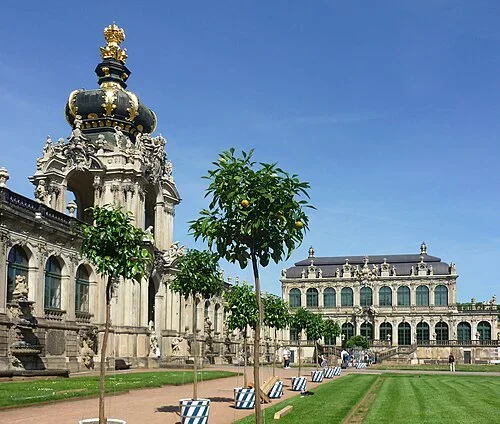 Central Courtyard and Bitter Orange Trees
Courtyard with Orange Trees and Kronentor
The Zwinger was first built as an orangery, a garden and a space for court festivals. Orange trees need protection from frost, so in cold months they had to be kept sheltered. The first pavilions and galleries to go up, on the rampart side, served as the orangery. The architect Matthäus Daniel Pöppelmann wrote that the countless trees, kept in the galleries over the winter, were set out in summer in neat rows across this open ground. The same ground was big enough for tournaments and other court entertainments. Augustus the Strong had the yard, 204 metres long and 116 wide, laid out with lawns, exotic plants and orange trees. Gardening here was older than the palace. In 1549 Elector Moritz had a garden made in the old city defences, on the model of the castle garden in Prague. A later chronicler noted fig trees behind the castle with trunks as thick as a man. Yet this courtyard could not do all the work, and in 1728 Augustus had a large separate orangery built nearby, where the plants were grown and cared for. Young trees stand in blue and white striped tubs along the path. Some still carry small orange fruit among their leaves.
Listen in the appPhoto: SchiDD · CC BY-SA 4.0
03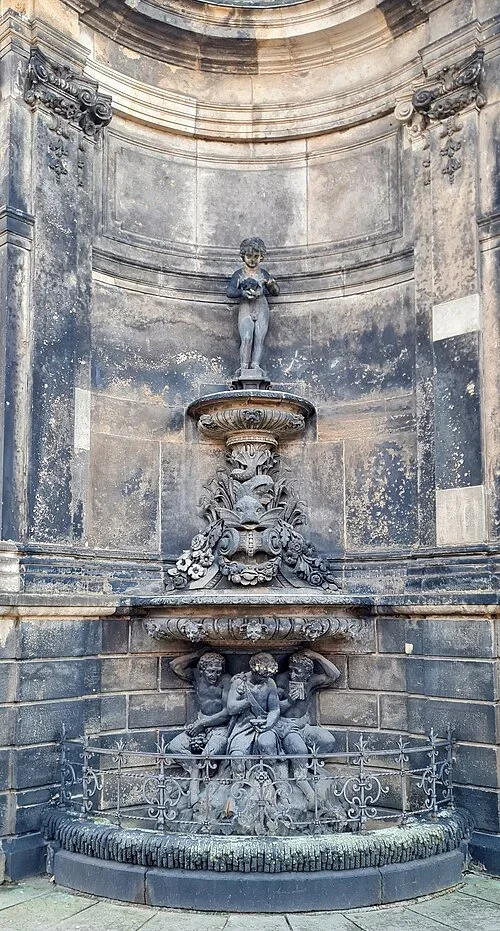 German Pavilion and Restored Wall Cascades
Niche Fountain at the Deutscher Pavillon
Beside the German Pavilion once stood a timber assembly hall called the Redoutenhaus. It had to give way shortly before the Seven Years' War, to a new wing of the Taschenberg palace. Frederick Augustus the Second had that wing built to house his children. A niche fountain of dark stone has a small figure standing above a stepped basin and an iron railing. This niche fountain is the work of Karl Moritz Haenel, and it stands about five metres high. A twin stands opposite. Early in the twentieth century, four water-bell fountains were set out symmetrically across the courtyard, each in a cast-iron bowl. They were already in place by 1906. Two of those bowls now stand on a square in Pillnitz.
Listen in the appPhoto: Derbrauni · CC BY 4.0
04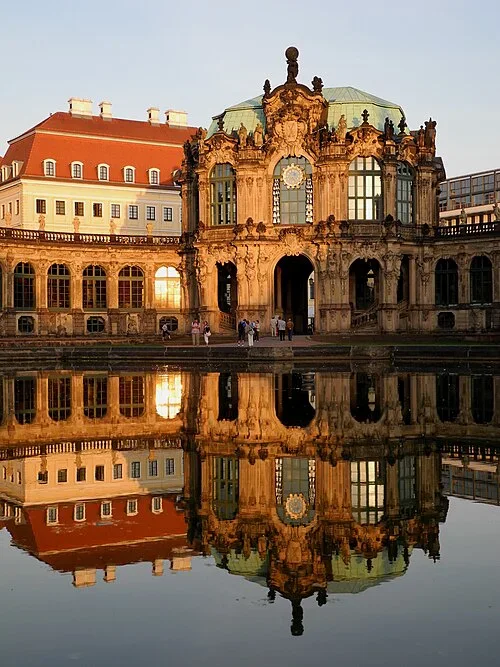 Carillon Pavilion and Meissen Porcelain Bells
Glockenspiel Pavilion
This pavilion was finished in 1728, together with the arcaded gallery beside it, and it closed the first building campaign. In 1849 it was caught up in the May Uprising. The insurgents set fire to the old opera house that stood against the Zwinger, because they saw it as a strategic danger. The wind changed, and the flames passed to this pavilion and the eastern part of the Zwinger, which was completely destroyed. Among the losses was the collection of the Saxon society for botany and horticulture: a herbarium of six thousand plant specimens and a library of more than eight hundred volumes. The bombing of 1945 left only the outer walls of the pavilion standing, and it was finished again in 1955. The clock and carillon on the courtyard side were added in 1933. In that year the Meissen porcelain manufactory gave two of its employees the job of fitting the carillon into the pavilion. Max Hermann Dietze and Ernst Fritz Gottschling were both artists. Both later became victims of National Socialism because of their faith. Two Stolpersteine, small memorial stones set into the ground, now lie at the passage through the pavilion to remember them.
Listen in the appPhoto: Franzfoto · CC BY-SA 3.0
05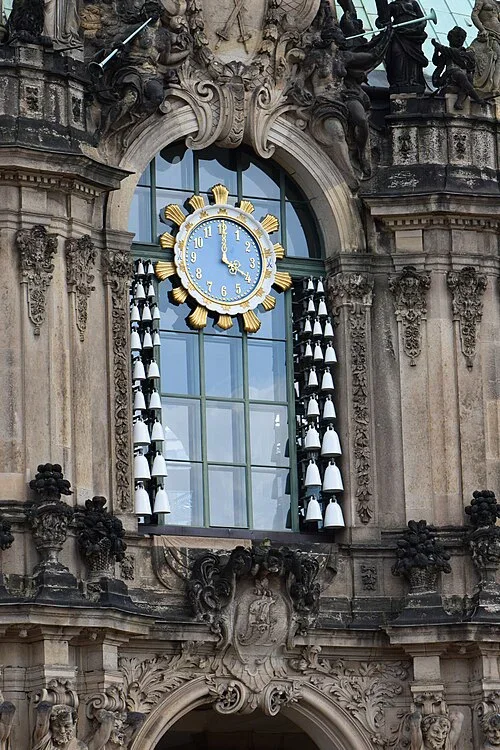 Carillon Pavilion and Meissen Porcelain Bells
Clock and Porcelain Carillon Bells
The clock and carillon sit on this courtyard facade. The bells are made of Meissen porcelain. Originally every bell was gilded, with a white band along its lower rim. Before the Second World War, the set was enlarged, from two dozen gilded bells to forty. The war destroyed many of the gilded bells, but the clock came through almost unharmed. The rebuilt carillon has forty white bells, and they line both sides of the clock window. Today it plays at the quarter, half, three-quarter and full hour. The melodies were written by Günter Schwarze in 1994. Depending on the season, well-known tunes also play at set times.
Listen in the appThomas Quine · CC BY 2.0
06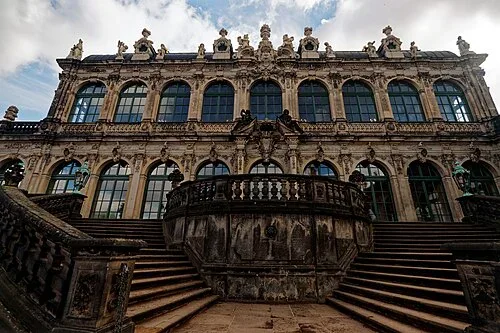 Porcelain Pavilion and South Gallery
Porzellanpavillon Facade
This is the Porzellanpavillon, the porcelain pavilion, one of the four two-storey corner pavilions of the Zwinger. It was finished in time for the wedding celebrations of 1719. It was formerly known as the natural science pavilion. In 1725 the painter Giovanni Antonio Pellegrini decorated the ceiling of the upper floor with a fresco, The Banquet of the Gods, which the fire of 1849 destroyed. The Dresden Porcelain Collection is the museum that now fills the pavilion. Augustus the Strong founded it in 1715, and it was first housed in the Japanese Palace on the banks of the Elbe. In 1876 it moved to the Johanneum. Porcelain was first shown here in the Zwinger in 1939. When the war came, the pieces were evacuated, and the collection largely survived. Since 1962 it has been shown again in the south part of the Zwinger, in this pavilion. Its strongest section is Saxon porcelain, above all Meissen.
Listen in the appPhoto: Txllxt TxllxT · CC BY-SA 4.0
07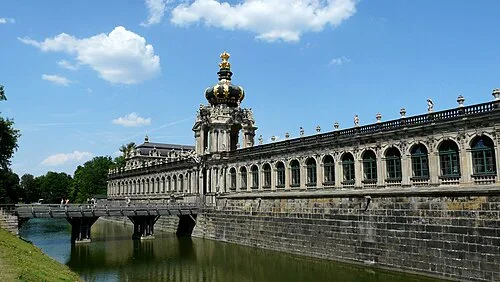 Crown Gate and Fortification Moat Bridge
Kronentor and Long Gallery over the Moat
In the Middle Ages, a zwinger was the strip of ground between a town's outer and inner walls. In 1427, during the Hussite Wars, work began on strengthening the city's defences with a second, outer wall. The ground between the walls came to be called the Zwinger. Near the castle, the royal court used it as a garden. The southwest side of the palace, with its crown gate, stands on parts of that outer wall, and those parts are still visible. Stone walls drop straight into the moat below the long gallery, giving a sense of that old edge. No trace of the inner wall survives. When the palace was begun in the early eighteenth century, the strip no longer had a defensive job, but the name passed to the new building.
Listen in the appAidas U. · CC BY 3.0
08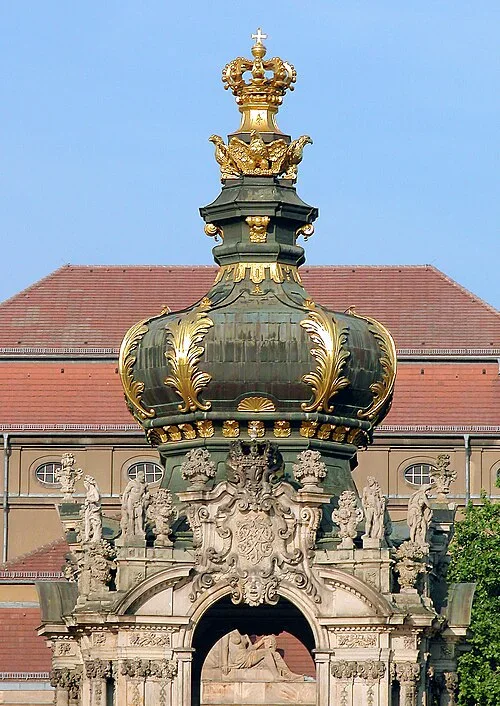 Crown Gate and Fortification Moat Bridge
Kronentor Crown Dome
Augustus the Strong was Elector of Saxony, and in 1697 he was elected King of Poland. The election was disputed. Others believed that François Louis, Prince of Conti, was king as well. One account says Augustus had been a Protestant as elector, and that he converted secretly to Roman Catholicism to qualify for the elective throne. He then marched troops into the Polish–Lithuanian Commonwealth to secure the crown. The Kronentor, the crown gate, was finished in 1714 as an addition to the Zwinger. It is said to be shaped like the Polish crown, which strengthened his claim. Four Polish eagles are said to decorate it too. A gilded crown tops its dark dome. It is thought the whole Zwinger was meant to show his commitment to being king of Poland.
Listen in the appPhoto: Jörg Blobelt · CC BY-SA 4.0
09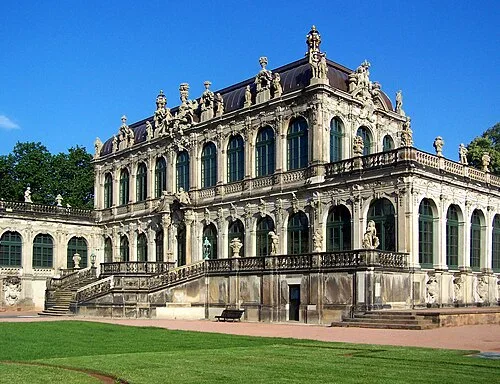 Royal Cabinet of Mathematical and Physical Instruments
Mathematisch-Physikalischer Salon
Behind this steep-roofed pavilion lies the Zwinger's scientific heart. The Mathematisch-Physikalischer Salon is a museum of fine instrument-making. Its cases hold historic clocks and instruments for measuring length, temperature, weight and volume. There are optical devices, telescopes for astronomy, surveying tools, and globes of the earth and the heavens. Some pieces reach much further back. One is an Arab celestial globe from the thirteenth century. Another is a calculating machine that Blaise Pascal built around 1650. It is the only example of a Pascaline in a public collection outside France. The collection began with Elector August of Saxony, who had a taste for mechanical wonders, and early pieces were bought in southern Germany and northern Italy. In 1724 it was separated from the armoury as the Royal Cabinet of Mathematical and Physical Instruments, and from 1746 it was called the Mathematical Salon, the root of the name it keeps today. The Salon even set the time for the city. From the late eighteenth century, Dresden's clocks were regulated by the Zwinger clocks. And in 1828 the Salon's inspector, Wilhelm Gotthelf Lohrmann, pushed for a technical school, the seed of today's Technical University of Dresden.
Listen in the appPhoto: X-Weinzar · CC BY-SA 3.0
10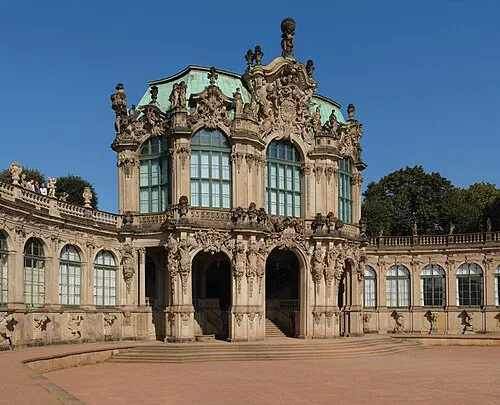 Wall Pavilion and Hercules Saxonicus
Wallpavillon
Of all the Zwinger's buildings, the Wallpavillon counts as its architectural high point. What makes it remarkable is the way building and staircase became one. From the courtyard, two flights of three steps lead through five openings into the ground floor. From there, a stair flanked by two fountains climbs toward the old city rampart, against which the back of the building leans. On a platform the stair splits at a right angle into two arms. They wrap around a fountain inside the pavilion and run up onto the wall itself. This is the only direct connection between the courtyard and the rampart. Above sits a festival hall, its windows running all the way round, broken only by narrow piers. A bridge from the rampart reaches a small entrance hall. Outside, sculptures crowd the facade: Permoser's Hercules Saxonicus, Heermann's Prince Paris with three goddesses, Kirchner's Four Winds, and Thomae's Juno and Jupiter. Some of the originals have been moved to the Lapidarium for safekeeping, so figures on the building today include copies. The pavilion itself is a reconstruction.
Listen in the appUser:Kolossos · CC BY 3.0
- 11
Summit Sculpture and Globe on the Wallpavillon
A figure bearing a great sphere above a carved shield, with the bearer's identity left open.
- 12
Cascade and Figure Pairs of the Nymphenbad
A sunken water theatre fed by a reservoir on the rampart, tumbling down stepped falls into a shell-lined basin.
- 13
Nymphenbad Figure
One carved figure, and the workshop of sculptors who peopled the water theatre with stone.
- 14
Shell Basin on the Western Zwinger Rampart
A quiet fountain basin on the old rampart, and a small house that marks Dresden's noon line.
- 15
Arcaded Gallery with Fountain Basin
How a royal wedding in 1719 hurried the Zwinger up as a festival backdrop, years before its interiors were done.
- 16
Raphael's Sistine Madonna in the Old Masters Picture Gallery
The evacuated pictures, the timber released in 1945, and the Raphael that outlived the ruins.
Zwinger
Frequently asked questions
How much does the guide cost?
Free app download. Listed guide price: $1.99. Guide price shown in the app. Audio guide only. Venue admission is separate.
Can I listen without internet?
Yes. Download the guide’s audio, images, and maps in the app before your visit. Your downloaded content is then available offline.
Can I listen in my language?
This audio guide is available in 15 languages, including English.
Do I need to follow a schedule?
No. This is a self-guided experience. Choose your stops, pause whenever you like, and return to a story at your own pace.
At your own pace
Explore Zwinger.
Download Stanza, then search for “Zwinger”.
Free app download · Guide price shown in the app
Keep exploring
Nearby audio guides
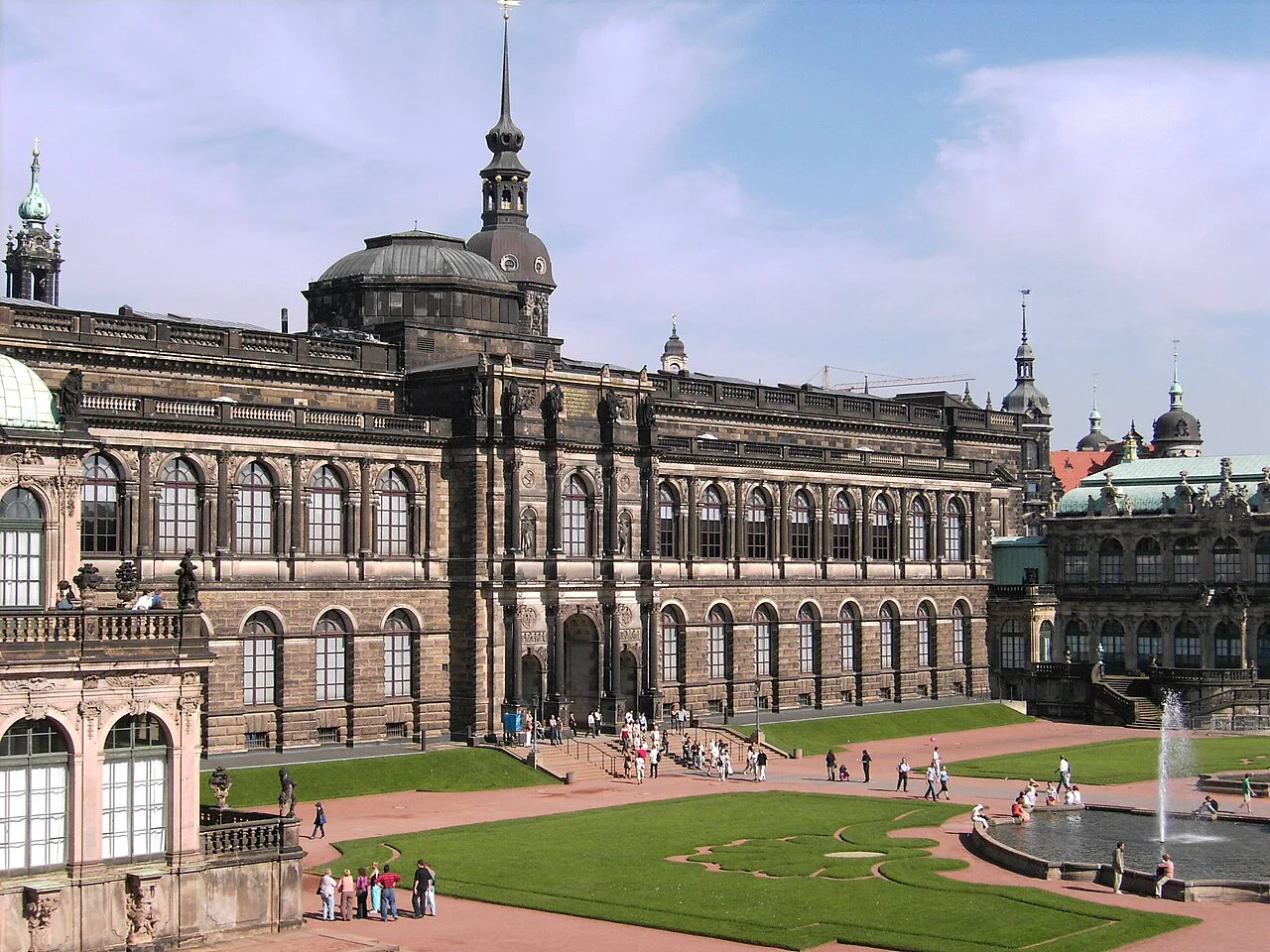
Dresden · 1 km
Gemäldegalerie Alte Meister
Content & sources
Photo: Ingersoll · Public domain
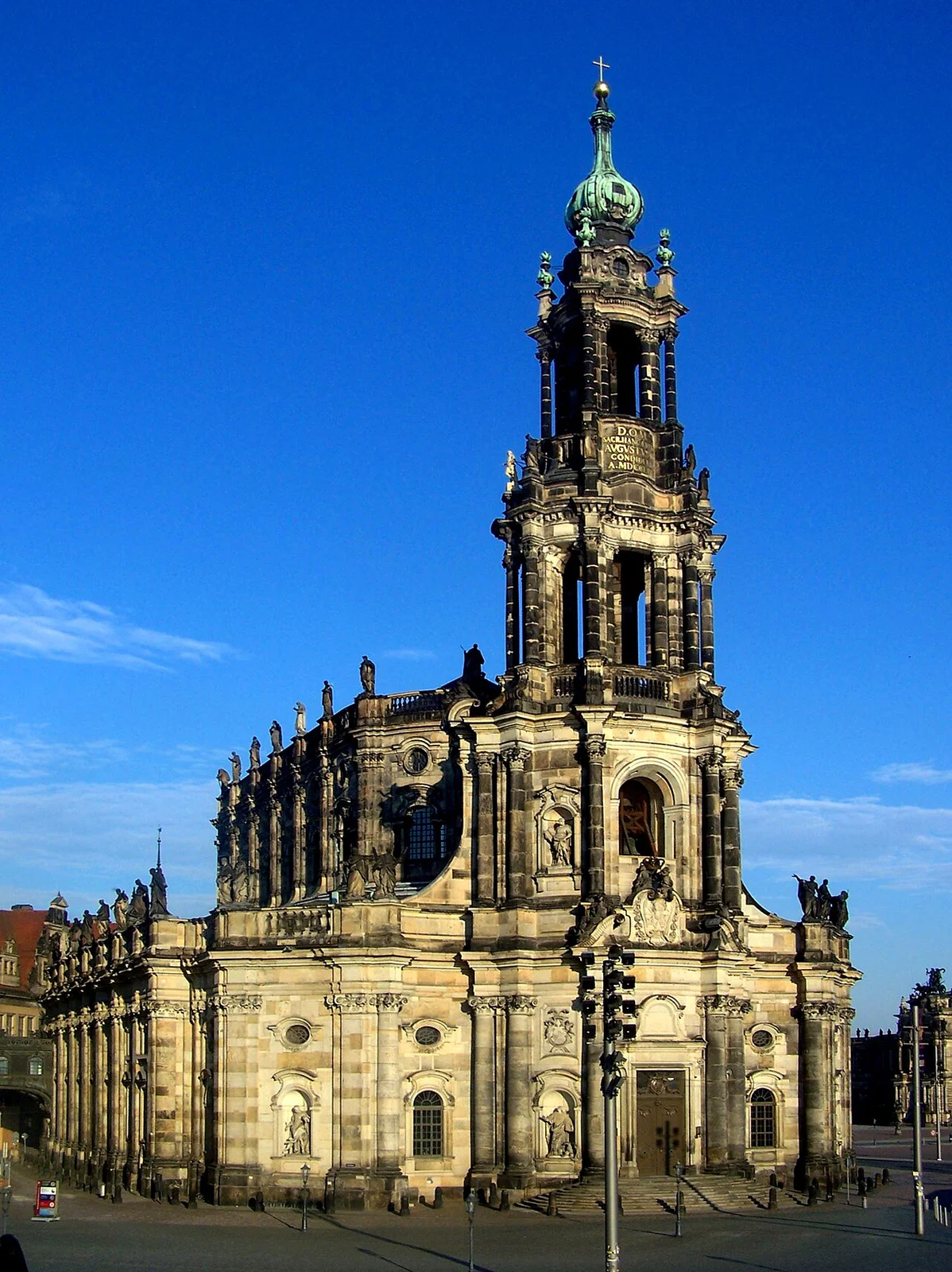
Dresden · 1 km
Katholische Hofkirche
Content & sources
Photo: X-Weinzar · CC BY-SA 3.0
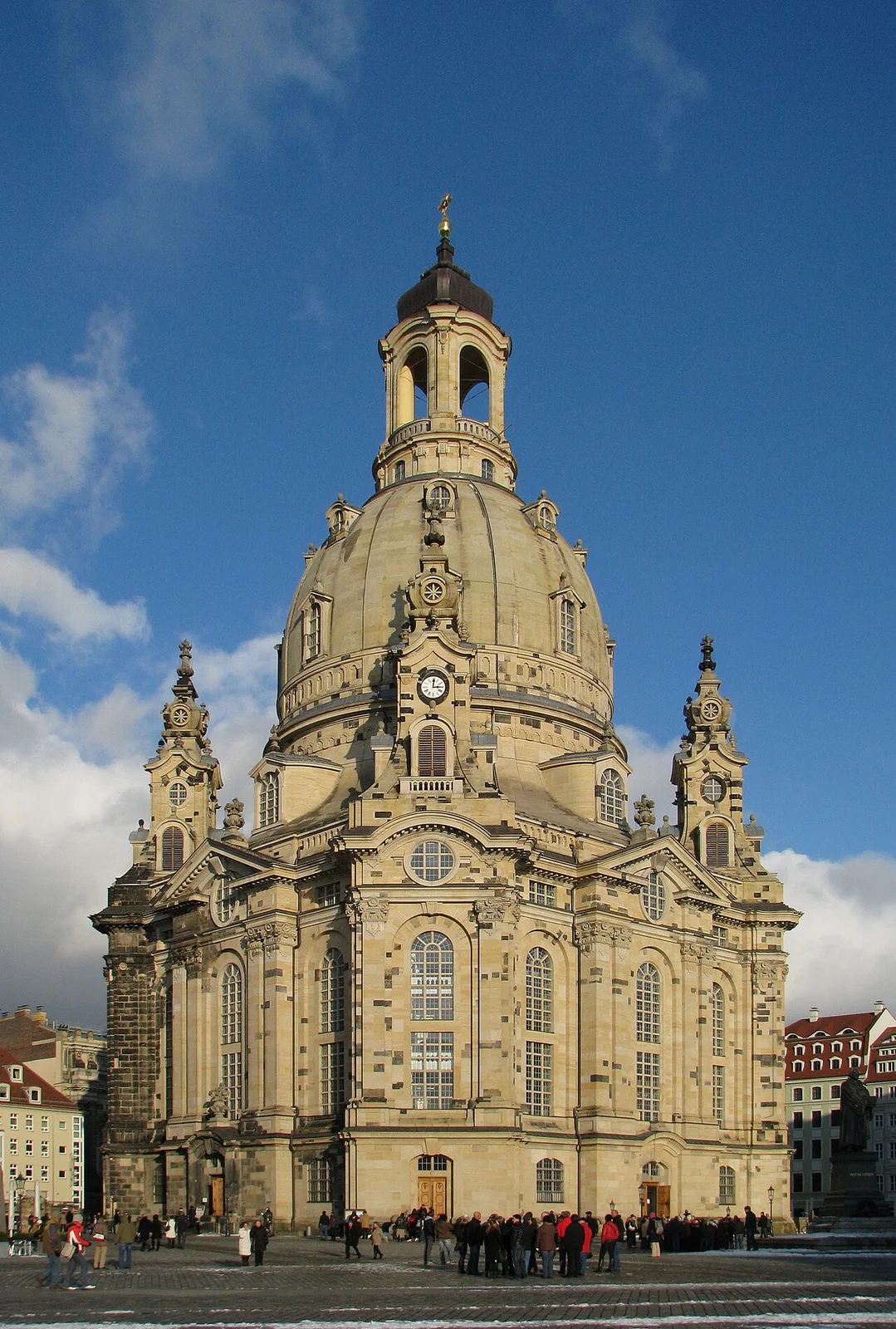
Dresden · 1 km
Frauenkirche
Content & sources
Netopyr · CC BY-SA 3.0
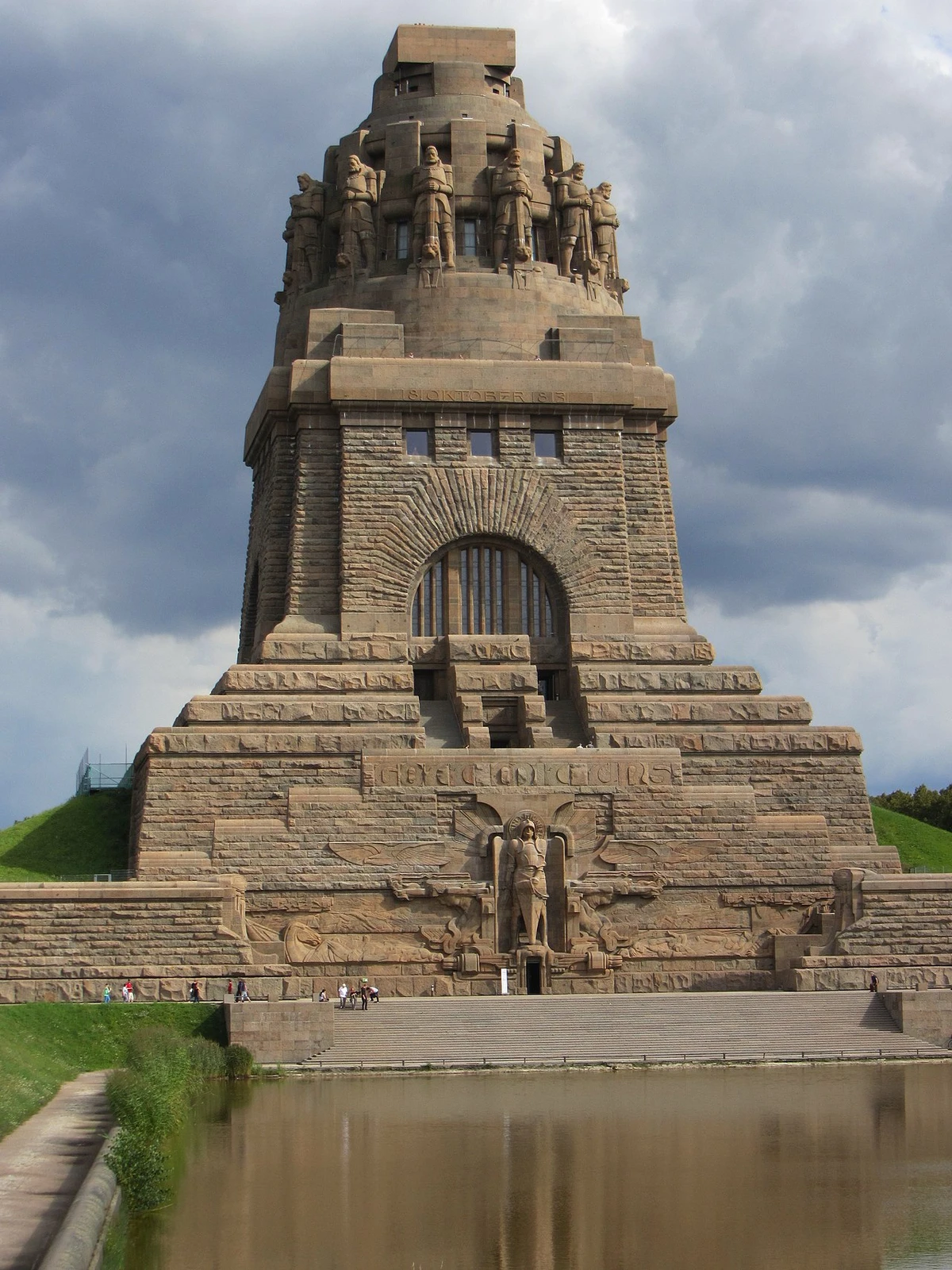
Leipzig · 96 km
Völkerschlachtdenkmal
Content & sources
Photo: Paolchen · CC BY-SA 3.0 de