Stanza · Audio guide
Alte Synagoge Audio Guide
A place to remember. A story to take with you.
The Old Synagogue is a former Jewish synagogue located in Erfurt, Thuringia, Germany. It is a medieval synagogue building.
Download Stanza, then search for “Alte Synagoge”.
About the tour
One guide. Your kind of visit.
The Old Synagogue is a former Jewish synagogue located in Erfurt, Thuringia, Germany. It is a medieval synagogue building.
Ready when you are.
- 01Get the free Stanza app.
iOS & Android
- 02Find your guide.
“Alte Synagoge”
- 03Download before you go.
Works offline
Audio guide / 11 narrated stops
Inside the guide
Get to know a few of the stories before you go. Open a stop to read more.
01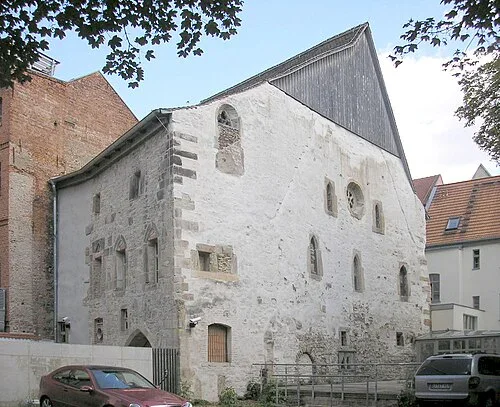 Inner Courtyard and the Gothic Western Façade
The Old Synagogue: Exterior View
The Old Synagogue in Erfurt is more than nine hundred years old. Today it houses a museum of the city's Jewish history. It sits in the inner courtyard of a block of houses bounded by Fischmarkt, Michaelisstraße and Waagegasse. Its walls are pale and plastered, and a steep gabled roof rises above them. Some people call it the oldest surviving synagogue in Europe. It is also described as one of the best preserved medieval synagogues on the continent. Its roof is still intact, which is why it is thought to be the oldest intact synagogue building in the world. In 2023, UNESCO listed the building as part of a site called Jewish-Medieval Heritage of Erfurt. That site also includes a ritual bath and a medieval house called the Stone House. The museum opened in October 2009.
Michael Sander · CC BY-SA 3.0
02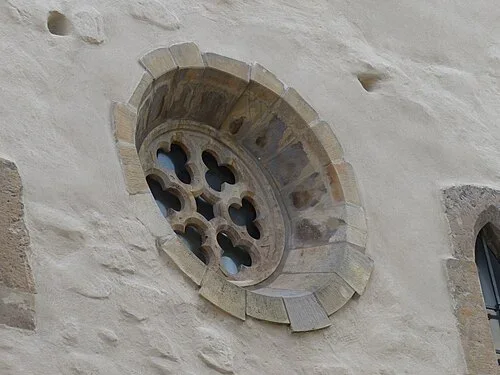 Inner Courtyard and the Gothic Western Façade
Rosette Window Close-Up
The western front of this synagogue dates from around 1270, when a larger synagogue was built using parts of the older building. The front has five lancet windows, tall and narrow with pointed tops, and a large rosette. A rosette is a large round window, and rose windows were a common feature of Gothic churches of the period. The openings inside this round window have lobed edges, like a row of scallops. A ring of cut stone frames the whole window.
Photo: Bewahrerderwerte · CC BY-SA 4.0
03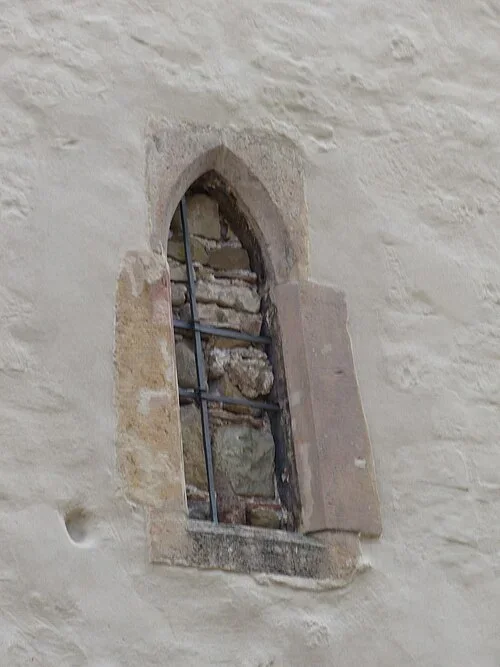 Inner Courtyard and the Gothic Western Façade
Narrow Pointed-Arch Window
The oldest parts of this building have been dated to 1094, using a method that reads the growth rings in old wood. A second phase followed in the twelfth century. Part of that western wall survives, with a double-arched window of sandstone. Then came the larger rebuild of about 1270. In the early 1300s the building was extended, and another storey was added. Its styles are usually given as Romanesque and Gothic, and pointed arches like the one in this window are a typical Gothic form. Behind the iron bars, rough stones are visible. Most parts of the building date from the late thirteenth and early fourteenth centuries.
Listen in the appPhoto: Bewahrerderwerte · CC BY-SA 4.0
04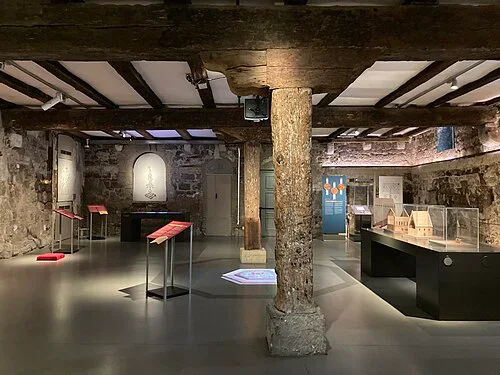 Ground Floor: Medieval Prayer Hall and Secular Disguise
Ground Floor Exhibition Hall
After the massacre of 1349, the city of Erfurt took ownership of the synagogue. The city later sold the building to a local merchant, and it was converted into a warehouse. Changes began around 1350. Intermediate ceilings were put in, a new roof was built, and a cellar was dug underneath. Carriage gateways were built through the north and east walls. For nearly five hundred years, the building was used for storing goods. These alterations changed the inside considerably. Heavy timber beams run overhead, and a thick, rough stone column rises near the middle of the room. Display cases and sloping reading stands fill the floor today.
Listen in the appMarkus Köllner · CC BY-SA 4.0
05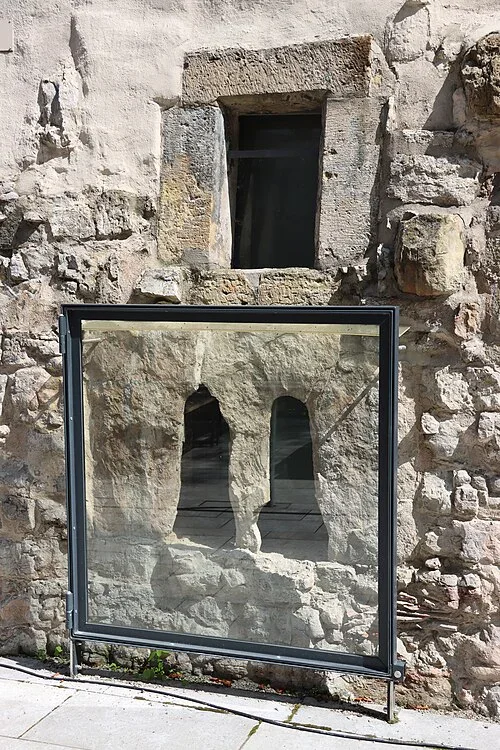 Ground Floor: Medieval Prayer Hall and Secular Disguise
Glass-Framed Display Against Stone Wall
The Erfurt Treasure was found in 1998, inside the wall of a house on Michaelisstraße. The house stood at number forty-three, in the medieval Jewish neighbourhood near the synagogue. Its owners are thought to have hidden the treasure in 1349. A glass panel is set against an old stone wall, with a small rectangular opening high above it. The find came more than six hundred years after the hiding.
Listen in the appPhoto: FrDr · CC BY-SA 4.0
06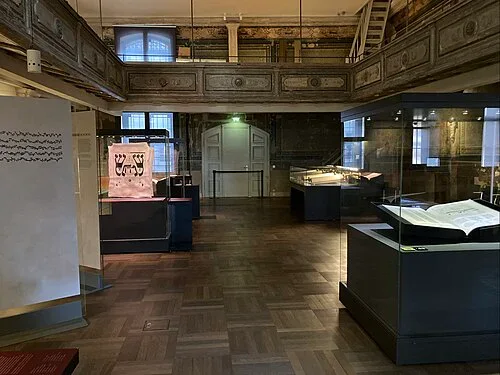 Upper Floor: Community Life and Hebrew Manuscripts
Upper Floor Exhibition Hall
In 1349, Erfurt's Jewish population was murdered and expelled from the city. The massacre came in the wake of the Black Death. It was a sharp break in the city's Jewish history. Today the upper gallery of the museum tells that story. Glass cases stand on a parquet floor, and a panel with Hebrew lettering hangs to one side. Tall windows light the room, and a gallery runs along the far wall. The synagogue itself was damaged after the massacre.
Listen in the appMarkus Köllner · CC BY-SA 4.0
07 Upper Floor: Community Life and Hebrew Manuscripts
Hebrew Manuscript Page Spread
The Erfurt Hebrew Manuscripts are religious texts dating from the twelfth to the fourteenth centuries. They belonged to the medieval Jewish community of Erfurt. Pages like these, packed with Hebrew in tight columns, give a sense of the manuscript tradition. In the aftermath of the massacre, Erfurt's city council took possession of the manuscripts. In the late seventeenth century they were in the library of a Lutheran ministry, at Erfurt's former Augustinian monastery. In 1880 the ministry sold them to the Royal Library in Berlin, now the Berlin State Library, where the originals are kept. The museum displays facsimiles, which are copies of the texts. One of these manuscripts is a copy of the Tosefta, a compilation of oral law. The Tosefta is attributed to tannaim, Jewish scholars who lived in Palestine and Babylonia in the first and second centuries of the common era. It is generally thought to explain unclear parts of the Mishnah, the earliest edited collection of oral law, though not all scholars agree. This copy, from the twelfth century, is the oldest of only three known Tosefta manuscripts. It is also the second most complete. In 1876, Moses Samuel Zuckermandl was the first to stress its importance, in a German study.
Listen in the apphttps://juedisches-leben.erfurt.de/jl/en/education/exhibitions/perm_exhibition_old_syn/index.html · CC BY-SA 4.0
08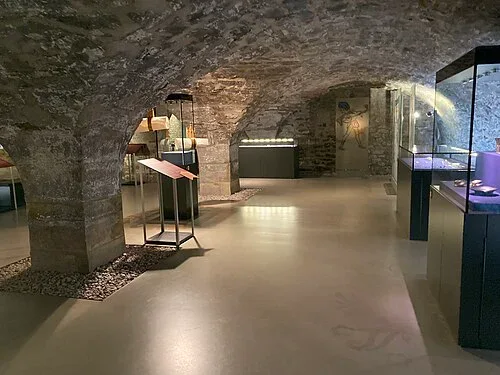 The Vaulted Cellar: The Erfurt Treasure Hoard
Vaulted Cellar
Stone arches curve over this cellar, resting on thick piers, and pebbles cover patches of the floor. Glass cases stand between the piers. In the late nineteenth century, the building became part of a restaurant called Zur Feuerkugel. It was also converted into a dance hall. Later, a bowling alley was set up in the cellar. By the Nazi era, the building's history as a synagogue had long been forgotten. That forgetting helped protect it. The Jewish community had built its Great Synagogue in 1884. It was a grand Moorish Revival building. It was destroyed in the Kristallnacht riots of November 1938. This older building remained untouched.
Listen in the appMarkus Köllner · CC BY-SA 4.0
09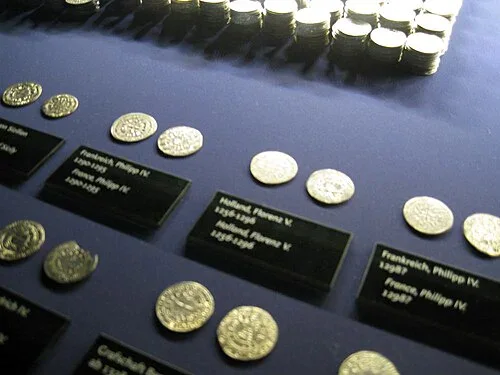 The Vaulted Cellar: The Erfurt Treasure Hoard
Coin Display with Ruler Labels
Over three thousand silver coins make up a large part of the Erfurt Treasure. It also includes more than seven hundred pieces of goldsmiths' work and jewellery. Labels beside some of the coins name the ruler and country, such as France and Holland. The names of the people who hid it are not known.
Listen in the appErfurterFan (talk) · Public domain
10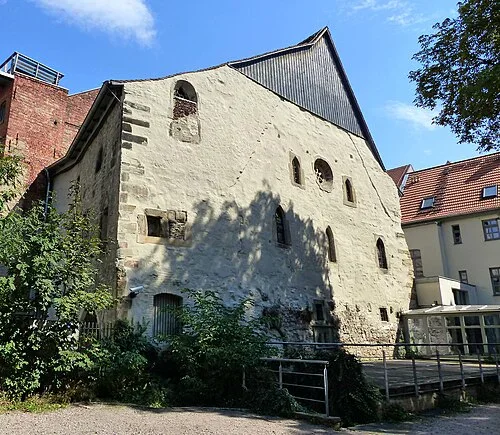 Waagegasse and the Medieval Mikveh Route
Street-Side Exterior with Arched Openings
Interest in the old building only stirred in the late 1980s. The architectural historian Elmar Altwasser began researching it in 1992. In 1998, Erfurt City Council bought the building and began researching and conserving it. Conservation put great weight on keeping every trace of use. Traces from the synagogue years survive beside traces of later changes. Pointed and round openings sit side by side in the plastered walls, and a dark arched opening lies low on one side. As a result, the medieval phases and the younger ones remain easy to read. A project called Historic Synagogues of Europe assessed the building. It gave the building its highest rating, four, for outstanding architectural or historical importance.
Listen in the appPhoto: Dr. Bernd Gross · CC BY-SA 4.0
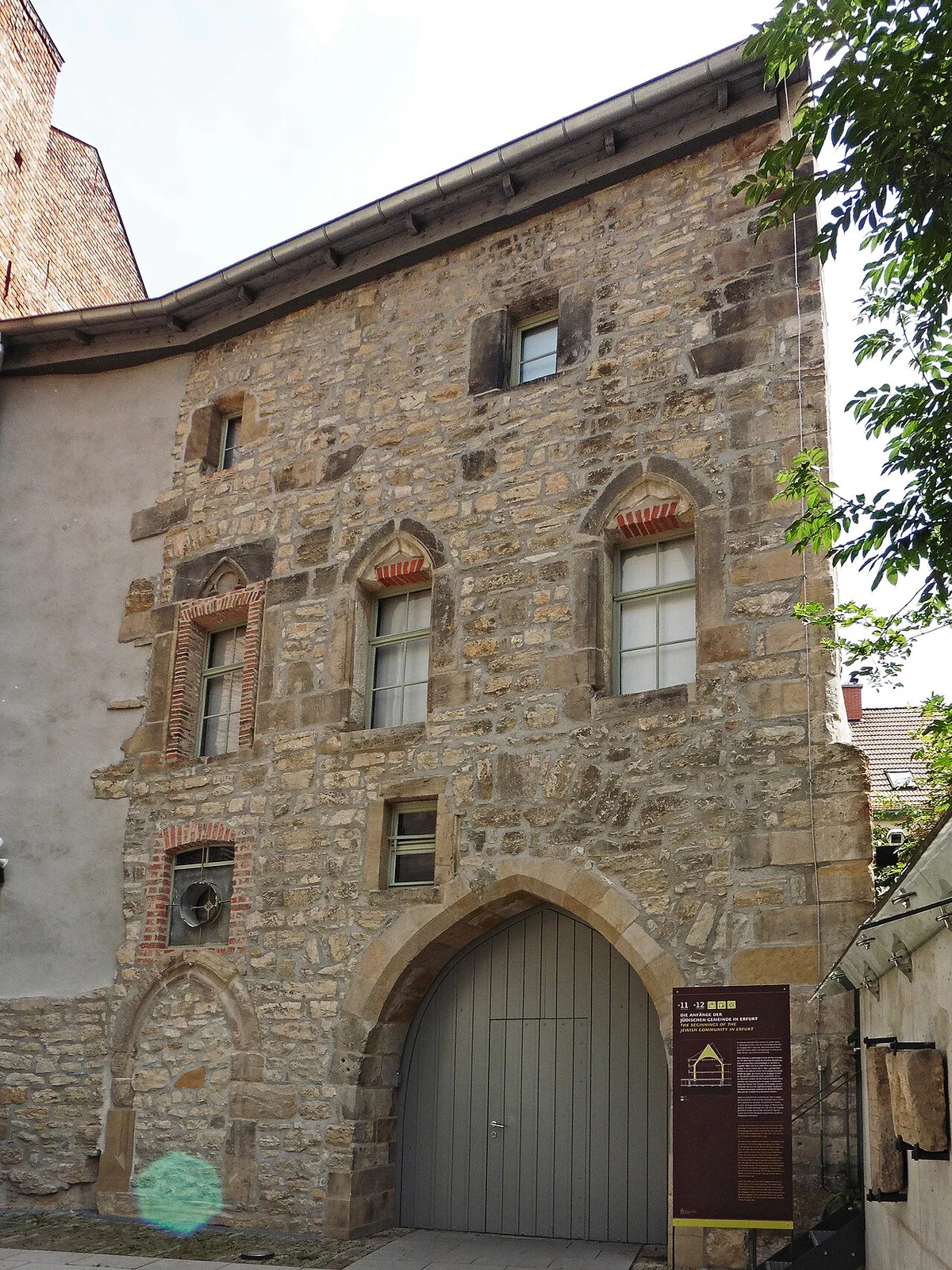
- 11
Former Mikveh Entrance
A ritual bath found in 2007 behind the Merchants' Bridge, and a stone house that shows Jewish owners in medieval Erfurt.
Alte Synagoge
Frequently asked questions
How much does the guide cost?
Free app download. Listed guide price: $0.99. Guide price shown in the app. Audio guide only. Venue admission is separate.
Can I listen without internet?
Yes. Download the guide’s audio, images, and maps in the app before your visit. Your downloaded content is then available offline.
Can I listen in my language?
This audio guide is available in 15 languages, including English.
Do I need to follow a schedule?
No. This is a self-guided experience. Choose your stops, pause whenever you like, and return to a story at your own pace.
At your own pace
Explore Alte Synagoge.
Download Stanza, then search for “Alte Synagoge”.
Free app download · Guide price shown in the app
Keep exploring
Nearby audio guides
Eisenach · 51 km
Wartburg
Content & sources
Photo: A.Savin · FAL
Naumburg · 58 km
Naumburger Dom
Content & sources
Wst at German Wikipedia · CC BY-SA 3.0
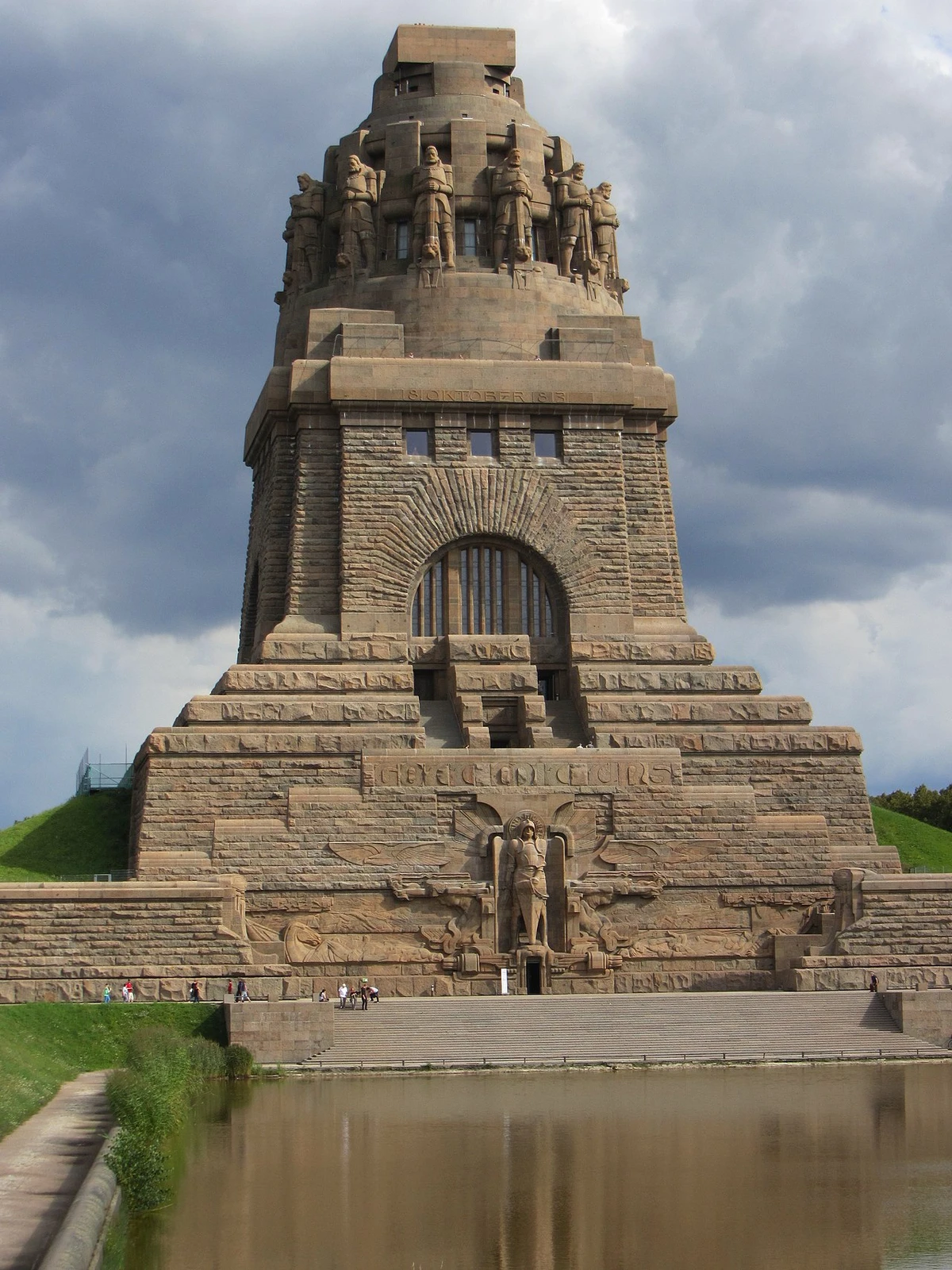
Leipzig · 103 km
Völkerschlachtdenkmal
Content & sources
Photo: Paolchen · CC BY-SA 3.0 de
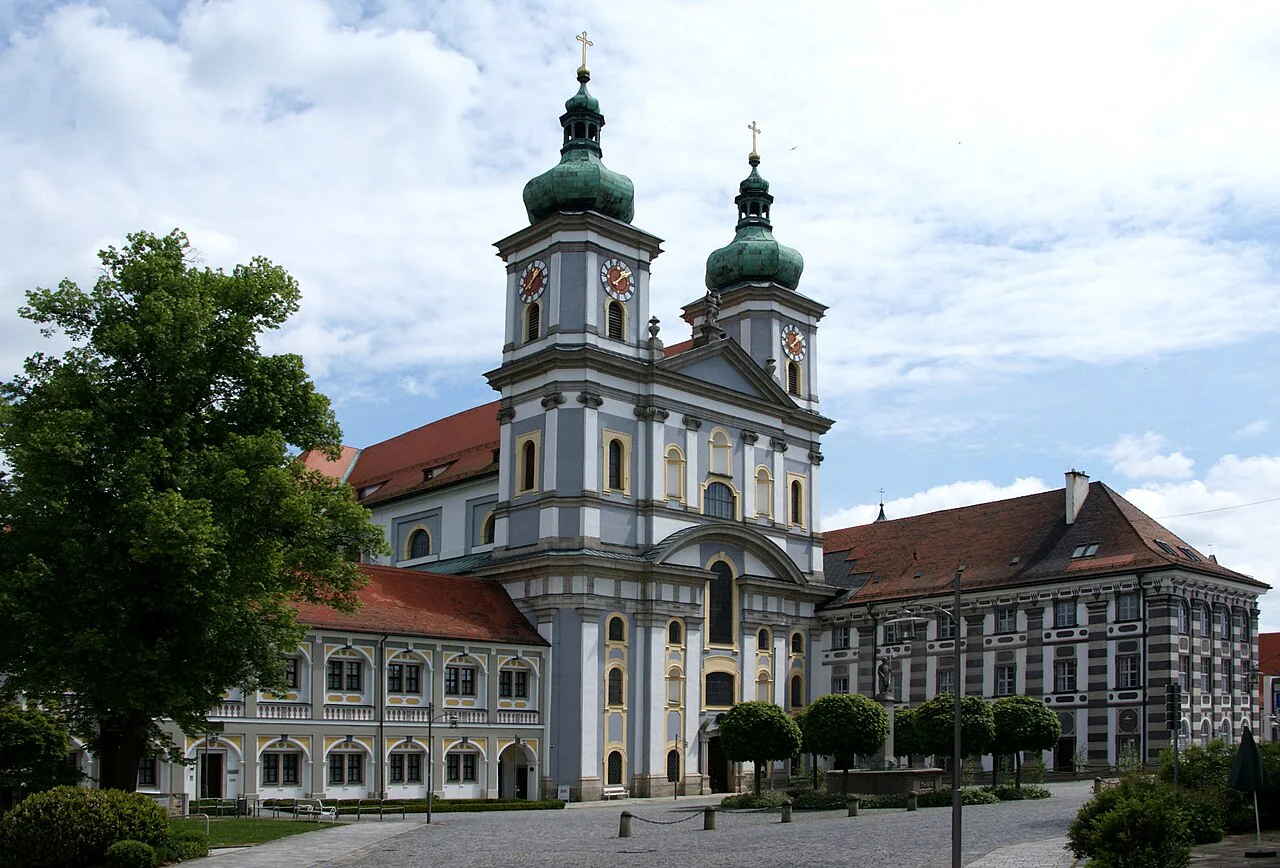
Waldsassen · 141 km
Kloster Waldsassen
Content & sources
Aconcagua (talk) · CC BY-SA 3.0