Stanza · Audio guide
Naumburger Dom Audio Guide
A place to remember. A story to take with you.
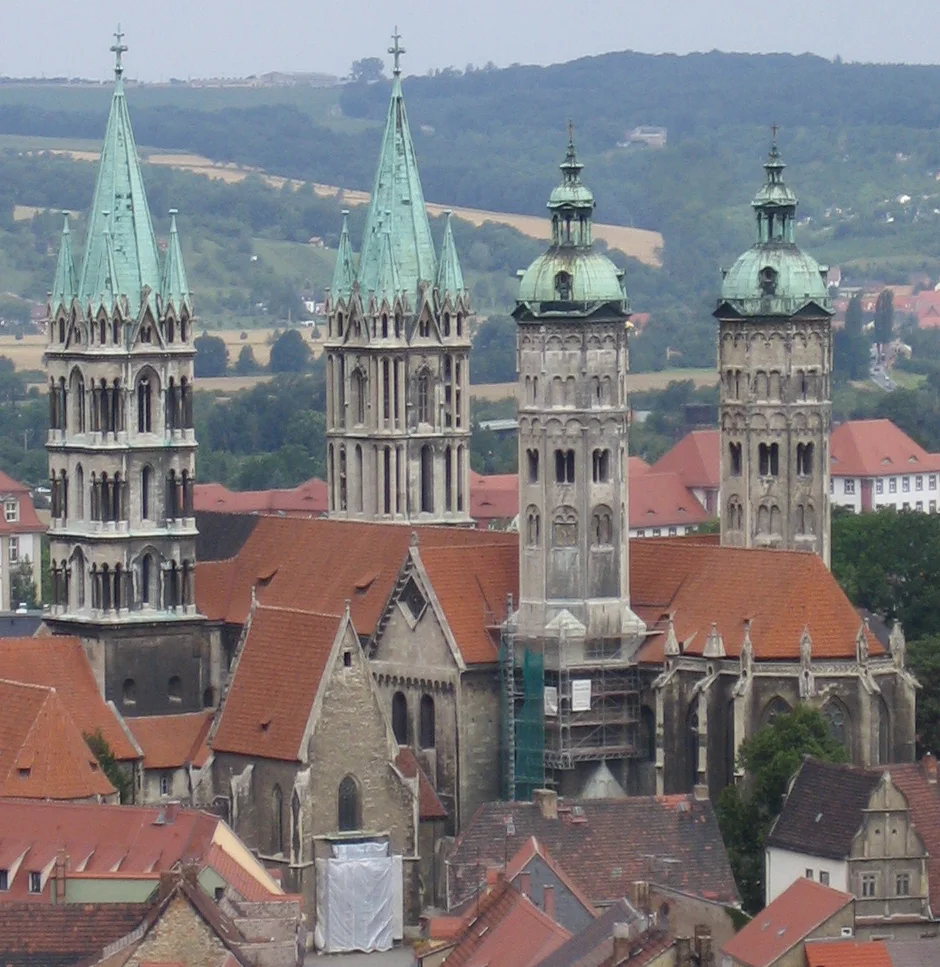
Naumburg Cathedral is a former cathedral located in Naumburg, Germany, that dates back primarily to the 13th century. It is a renowned landmark of the German late Romanesque and was recognized as a UNESCO…
Download Stanza, then search for “Naumburger Dom”.
About the tour
One guide. Your kind of visit.
Naumburg Cathedral is a former cathedral located in Naumburg, Germany, that dates back primarily to the 13th century. It is a renowned landmark of the German late Romanesque and was recognized as a UNESCO World Heritage Site in 2018.
Ready when you are.
- 01Get the free Stanza app.
iOS & Android
- 02Find your guide.
“Naumburger Dom”
- 03Download before you go.
Works offline
Audio guide / 16 narrated stops
Inside the guide
Get to know a few of the stories before you go. Open a stop to read more.
01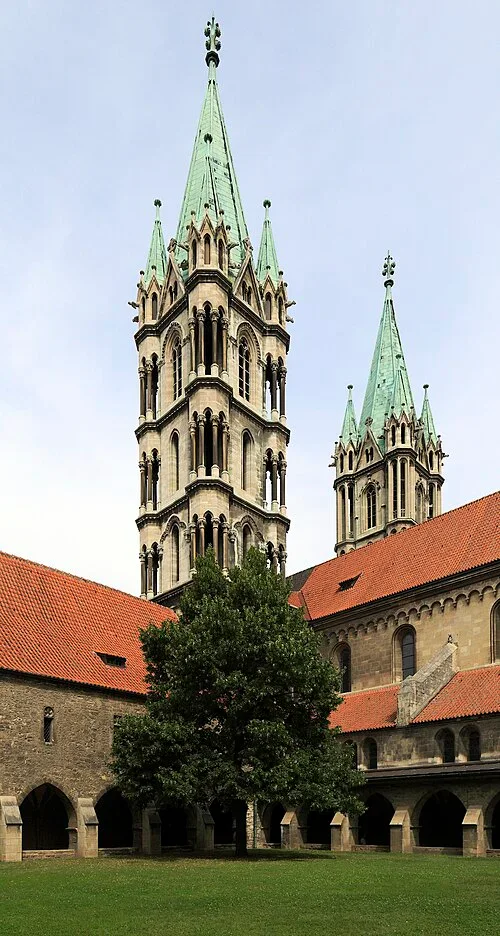 Cloister Courtyard and Cathedral Skyline
The West Towers over the Cloister
Welcome to Naumburg Cathedral, where the story begins with a castle on a rock. Around the turn of the first millennium, Margrave Ekkehard I of Meissen, probably the most powerful man on Germany's eastern border, raised a residence on a rock about twenty-five metres above the Saale river. He called it neweburg, and the name slowly turned into Naumburg. The spot sat where busy trade routes crossed toward the Slavic lands to the east. Ekkehard's sons built a small parish church here, dedicated to the Virgin Mary, first mentioned in writing in 1021. In 1028 they persuaded King Conrad II and Pope John XIX to move the bishop's seat from Zeitz to Naumburg, arguing that the castle offered better protection. By spring 1029 masons had begun the first cathedral just east of that parish church. It was consecrated in 1044 and given the patron saints Peter and Paul, brought over from Zeitz. The green spires rising above the cloister roof are not medieval at all. The west towers received their neo-Gothic crowns in the late nineteenth century, so even the skyline is layered. This tour follows the church from its Romanesque beginnings to the sculpture of the Naumburg Master.
Photo: Falk2 · CC BY-SA 4.0
02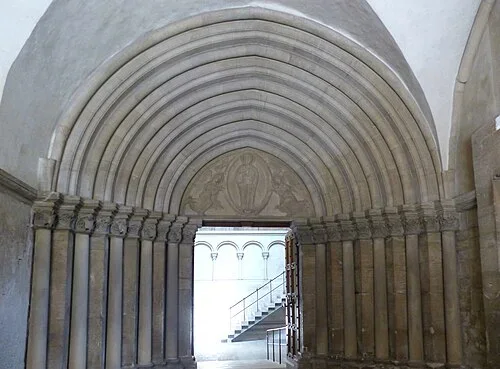 Romanesque Southern Transept Portal
The Romanesque South Portal
Every cathedral has a front door, but this one never did. Choirs close both the east and the west ends of the building, so the end walls belong to the altars rather than to arriving crowds. The way in has always been from the side: the main entrance lies on the south, opening from the cloister precinct. That entrance is this late Romanesque portal. Its arches step inward in deep, layered orders, each ring of stone set behind the last, and slender columns carry carved capitals where the arches begin. In the curved tympanum above the doorway sits a sculpted figure scene. For centuries this archway has been the crafted face the cathedral turns to its visitors. It was built to be walked through every day, not admired from afar.
Wolfgang Sauber · CC BY-SA 4.0
03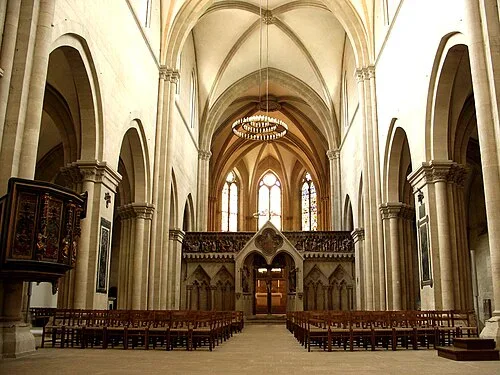 Cathedral Nave and Double-Choir Vista
The Nave and the Double-Choir Plan
This nave holds the key to the whole building. It is a double-choir church: a three-aisled basilica with a pair of towers and a choir at each end. Most great churches of the period had a single choir at the east and a grand entrance at the west. Here both ends are sacred space, and each choir is cut off from the nave by its own rood screen, a wall that carries an altar. Both screens survive complete from the Middle Ages, which is rare anywhere in Europe. The vaults overhead belong to a rebuilding begun around 1210 under Bishop Engelhard, who led the see from 1207 to 1242. The masons actually started at the nave, then changed their minds and built the east end first, working their way west step by step. What rose was a vaulted basilica on clustered bundle pillars, with an east choir, a transept and a three-part crypt. An eighteenth-century source dates the final consecration to the twenty-ninth of June, 1242.
Listen in the appJosep Renalias · CC BY-SA 3.0
04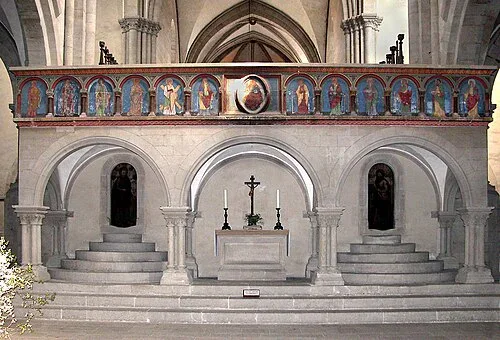 Romanesque East Rood Screen and Hall Crypt
The Romanesque East Rood Screen
This wall was a first in German architecture. The east rood screen was built around 1230, during the late Romanesque rebuilding of the cathedral. It is the oldest surviving hall screen of its kind in Germany, a barrier conceived as a hall, with three open arches at ground level and solid masonry above. Its job was to divide: the clergy sang the services in the high choir behind it, and everyone else stayed in the nave. Yet the barrier was never blank. An altar stands in the central bay, so the screen itself became a place of worship. Above the arches runs a band of painted panels with figures. Steep stairs climb through two small portals at the sides, the only way up into the choir. The altar standing there today was made in the nineteenth century.
Listen in the appPhoto: Jörg Blobelt · CC BY-SA 4.0
05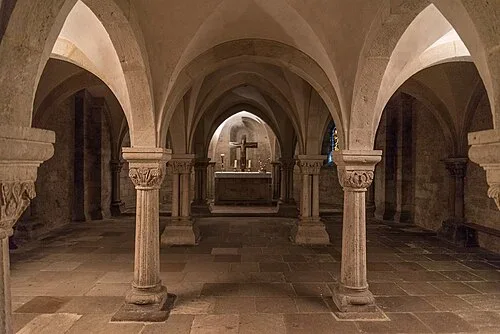 Romanesque East Rood Screen and Hall Crypt
The Hall Crypt
Below the choir lies the oldest room in the cathedral. Around 1160 or 1170, the first Romanesque church on this spot received a hall crypt, a low, broad chamber where short, sturdy columns carry a ceiling of groin vaults. When the new cathedral rose from about 1210, the builders did not tear it down. They absorbed it, extending the chamber east and west until it reached under the crossing, though it lost its old apse along the way. It is the only room of the first cathedral that survives more or less unaltered. Excavations have uncovered the foundations of that first building: a three-aisled, cruciform basilica, smaller than the church above it. Crypts like this generally served as lower churches, one level beneath the main altar, where relics were venerated and chant sounded different under the low vaults.
Listen in the appPhoto: Tilman2007 · CC BY-SA 4.0
06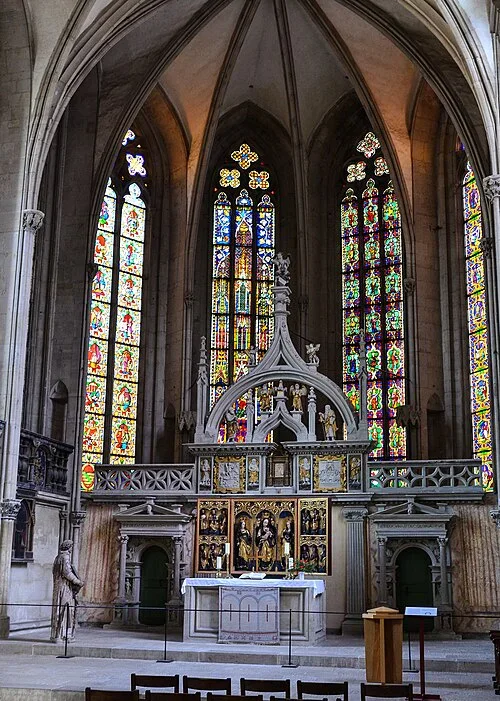 High Gothic East Choir and the Satirical Capitals
The High Gothic East Choir
Around 1330 the east end was transformed. The old Romanesque apse came down, and in its place rose this high Gothic choir, polygonal at its close, with tall windows and open tracery. On the buttresses at the head of the choir stand the cathedral's patron saints, figures taller than life, restored and renewed many times over the centuries. The real treasure is the glass. Some of the windows date from the choir's own construction. They show the wise and the foolish virgins, the virtues, and the prophets, set in glowing colour high above the altar. Other panels followed in the first third of the fifteenth century: scenes of the Passion, of the Virgin, and of the apostles, all of high quality. Medieval glass like this is scarce, and here it fills the choir on several sides.
Listen in the appPhoto: Alexander Hoernigk · CC BY 3.0
07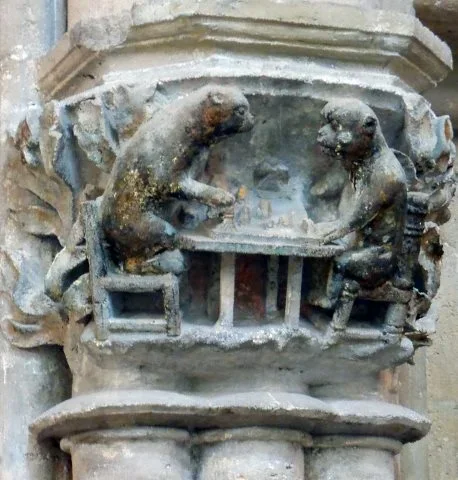 High Gothic East Choir and the Satirical Capitals
The Chess-Playing Monkeys Capital
High on a column capital in this solemn choir, the medieval masons hid a joke. Two monkeys sit on chairs at a table, playing chess, carved in the fourteenth century. One hunches over the board; the other sits back, hand raised mid-move. Art historians read the scene as a satire of human pride and folly, apes aping their betters at a game of strategy. Whether the carver meant it that way, no one can say for certain.
Listen in the appPhoto: Membeth · CC0
08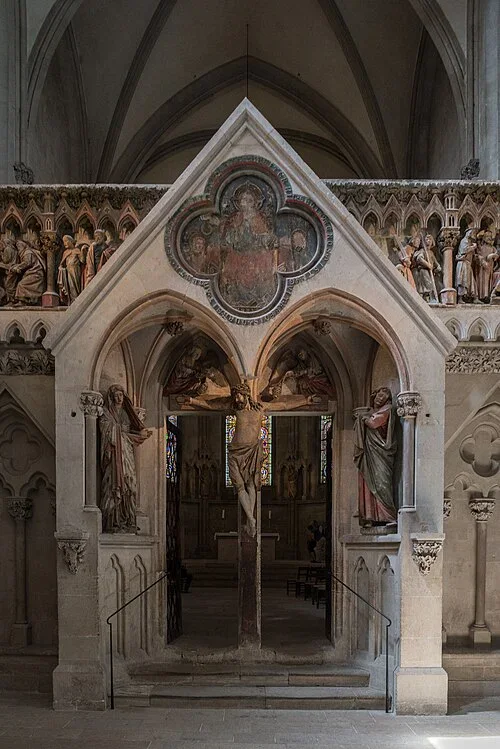 Early Gothic West Rood Screen and Passion Portal
The West Rood Screen and Crucifixion Portal
The west end of the nave is closed by a wall of stone that changed Gothic sculpture. This is the west rood screen, carved by the artist known as the Naumburg Master, the same hand behind the founder statues in the west choir. Together the screen and the statues count as one of the most important works of early Gothic art in Germany. The Master had worked on the great French cathedral sites of Noyon, Reims and Amiens, and worked afterwards, it seems, at Metz, certainly at Strasbourg and Mainz. At the centre of the screen a portal opens through the wall, and within it stands the Crucifixion group, Christ on the cross with mourners at his side. Along the screen runs a frieze of reliefs showing the Passion, the events of Christ's last days. The carving still carries traces of its old paint, reds and greens softened by age. The figures behave like people caught in a real moment, grief written into their faces. That emotional grip was the point: sculpture meant to seize the feelings of anyone who stood before it.
Listen in the appPhoto: Tilman2007 · CC BY-SA 4.0
09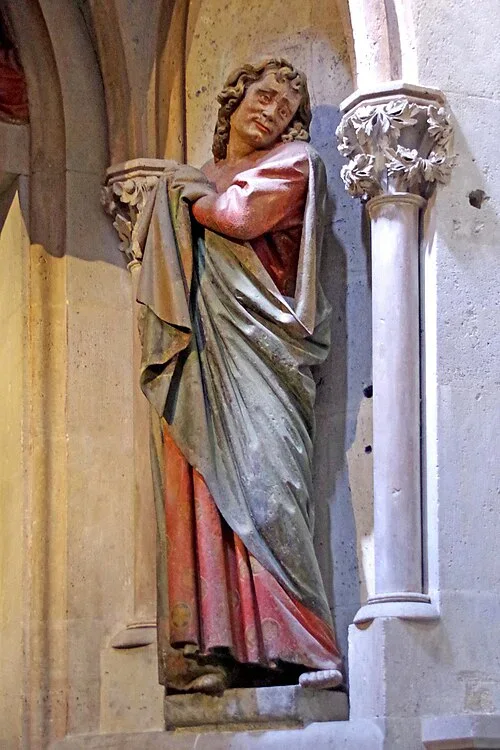 Early Gothic West Rood Screen and Passion Portal
Saint John at the Crucifixion
Carved into the west screen stands a figure of grief. Saint John leans toward the Crucifixion, his head tilting against his shoulder, his mouth drawn tight. The sorrow lives in the body itself: the arm pressed across the chest, the heavy cloth swept from shoulder to knee. Traces of colour still cling to the stone, red at the robe, green-grey across the mantle. A single mourner, caught with such open feeling, was something new in the sculpture of its day.
Listen in the appPhoto: Thomas Hummel · CC BY-SA 4.0
10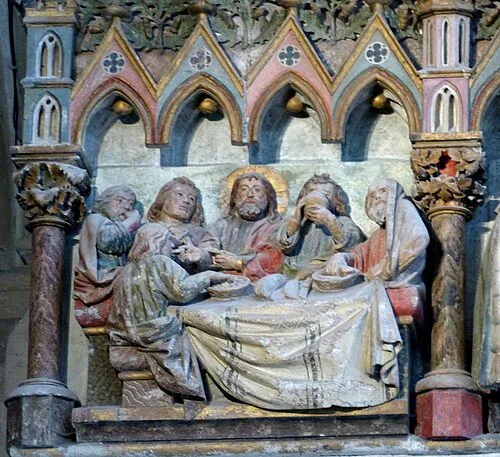 Early Gothic West Rood Screen and Passion Portal
The Last Supper Relief
Above the portal arches, Christ and his disciples gather at a long table. This relief of the Last Supper belongs to the Passion frieze carved by the Naumburg Master. The scene is crowded and physical: disciples lean in, one lifts a cup, hands reach across the cloth. Traceried gables frame the group, and gold and paint still glow on the stone. For worshippers who could not read, carvings like this told the story of Christ's last days plainly, scene by scene.
Listen in the appWolfgang Sauber · CC BY-SA 4.0
- 11
Uta von Ballenstedt
Twelve founder statues in the west choir, with Uta von Ballenstedt among their world-famous faces.
- 12
Hermann and Reglindis
Margrave Hermann and Reglindis, the founder pair whose open smile startles everyone.
- 13
The Cranach Altarpiece Wing
Lucas Cranach the Elder's altarpiece wing, its Reformation destruction, and the modern panel that caused a quarrel.
- 14
Saint Elisabeth
The Elisabeth chapel, home to the oldest known stone statue of Saint Elisabeth and windows by Neo Rauch.
- 15
The Dreikönigskapelle
The Dreikönigskapelle, a late Gothic chapel of 1416 that closed the cathedral's great building phases.
- 16
The Cloister Walk: A Living Church
The cloister close: the first Protestant bishop, the long road to World Heritage, and a church still alive.
Naumburger Dom
Frequently asked questions
How much does the guide cost?
Free app download. Listed guide price: $1.99. Guide price shown in the app. Audio guide only. Venue admission is separate.
Can I listen without internet?
Yes. Download the guide’s audio, images, and maps in the app before your visit. Your downloaded content is then available offline.
Can I listen in my language?
This audio guide is available in 15 languages, including English.
Do I need to follow a schedule?
No. This is a self-guided experience. Choose your stops, pause whenever you like, and return to a story at your own pace.
At your own pace
Explore Naumburger Dom.
Download Stanza, then search for “Naumburger Dom”.
Free app download · Guide price shown in the app
Keep exploring
Nearby audio guides
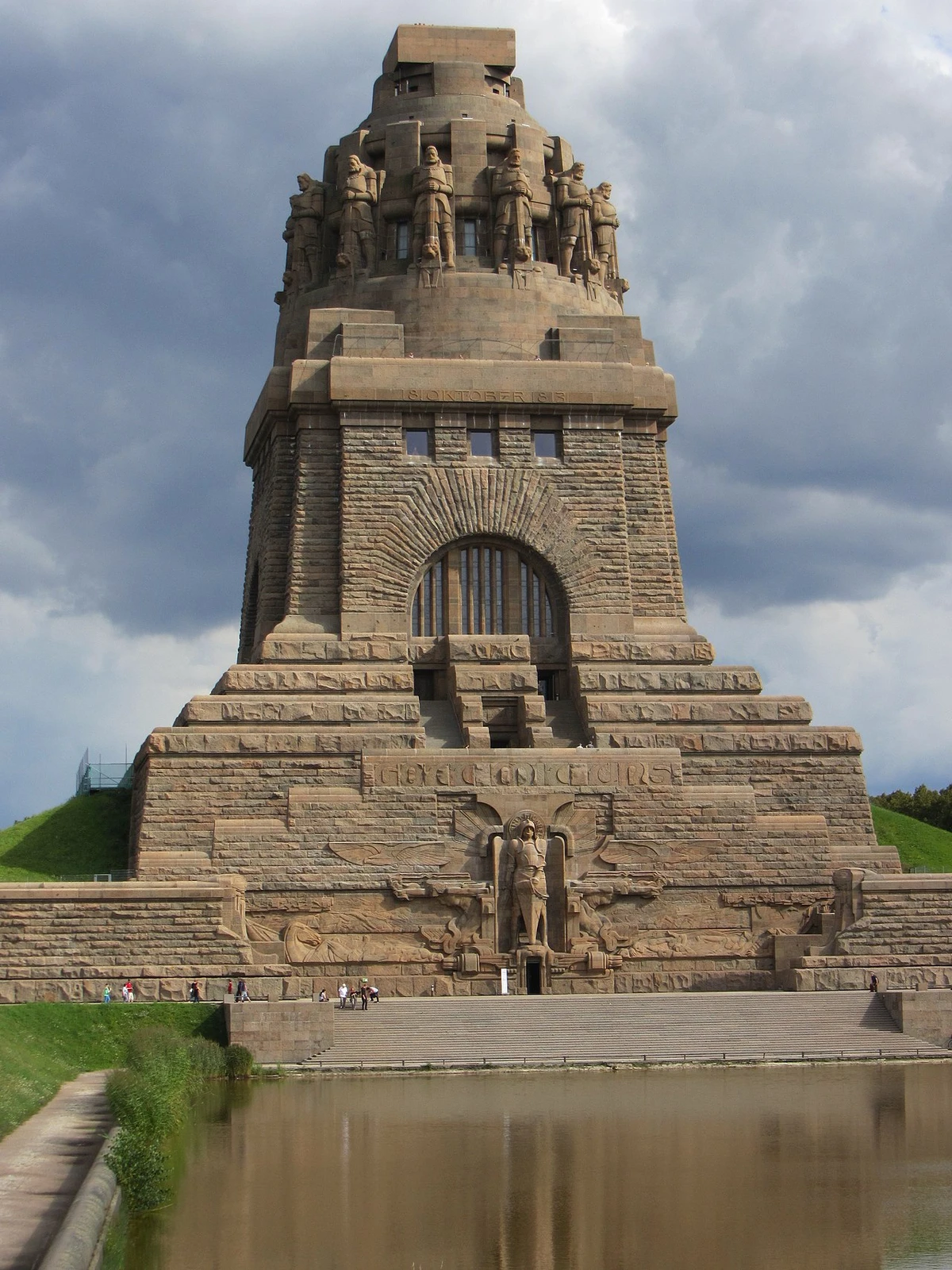
Leipzig · 46 km
Völkerschlachtdenkmal
Content & sources
Photo: Paolchen · CC BY-SA 3.0 de
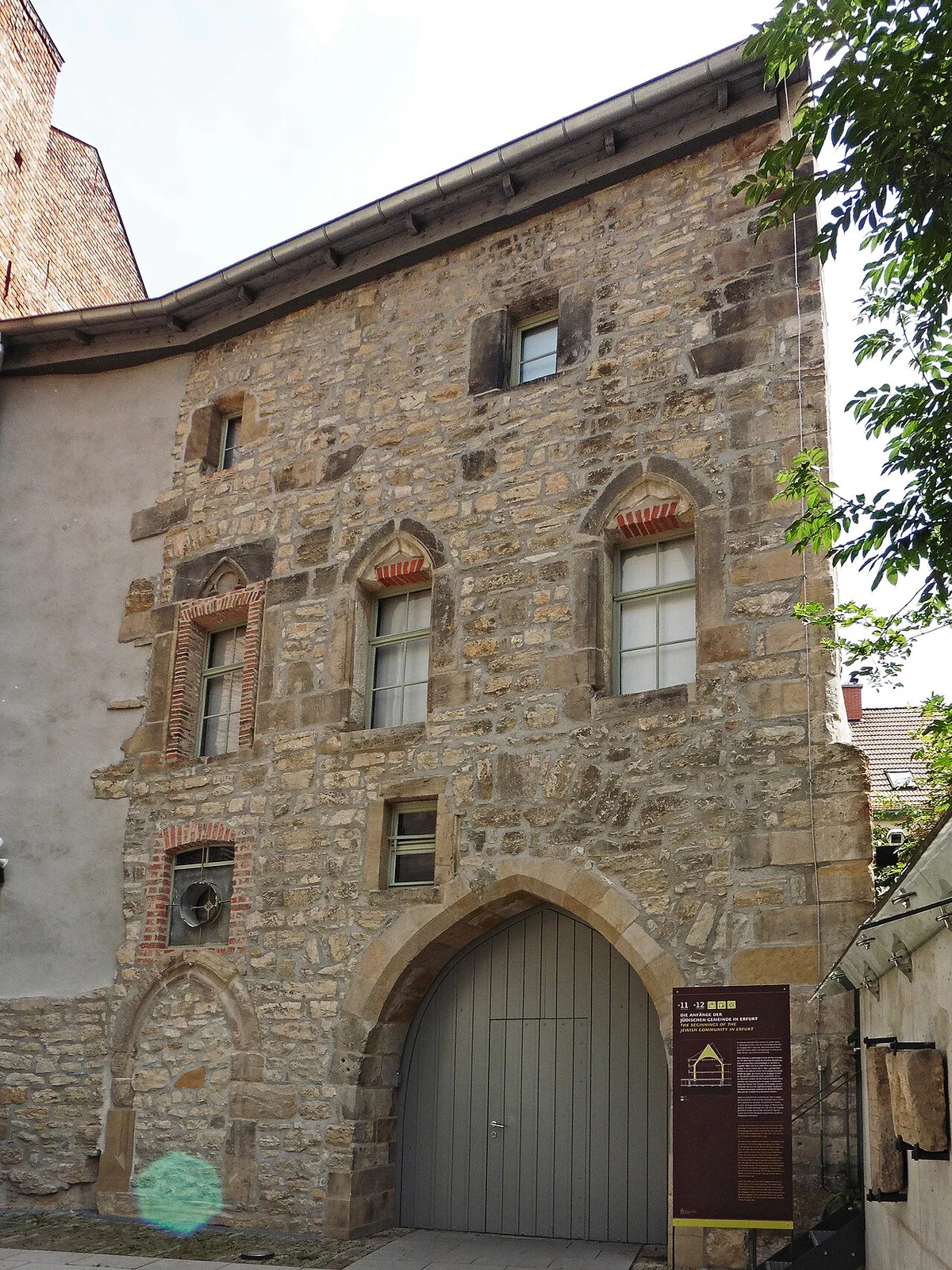
Erfurt · 58 km
Alte Synagoge
Content & sources
Heinrich Stürzl · CC BY-SA 4.0
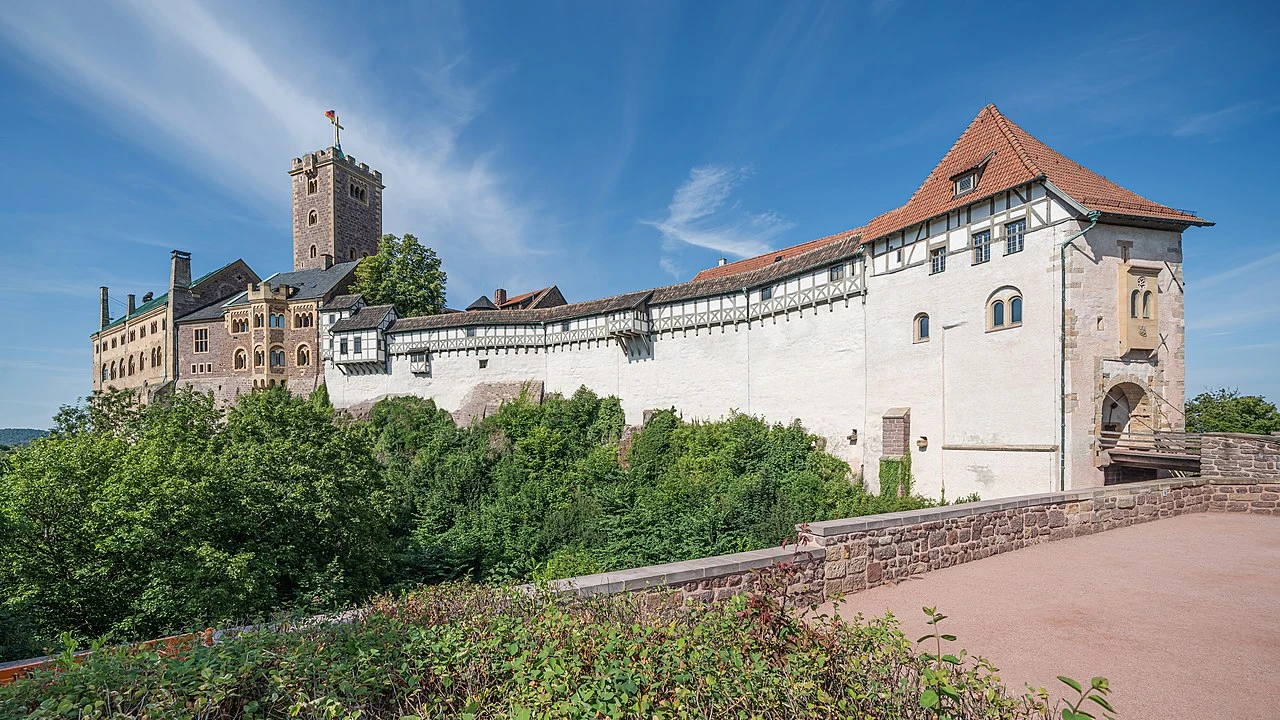
Eisenach · 107 km
Wartburg
Content & sources
Photo: A.Savin · FAL
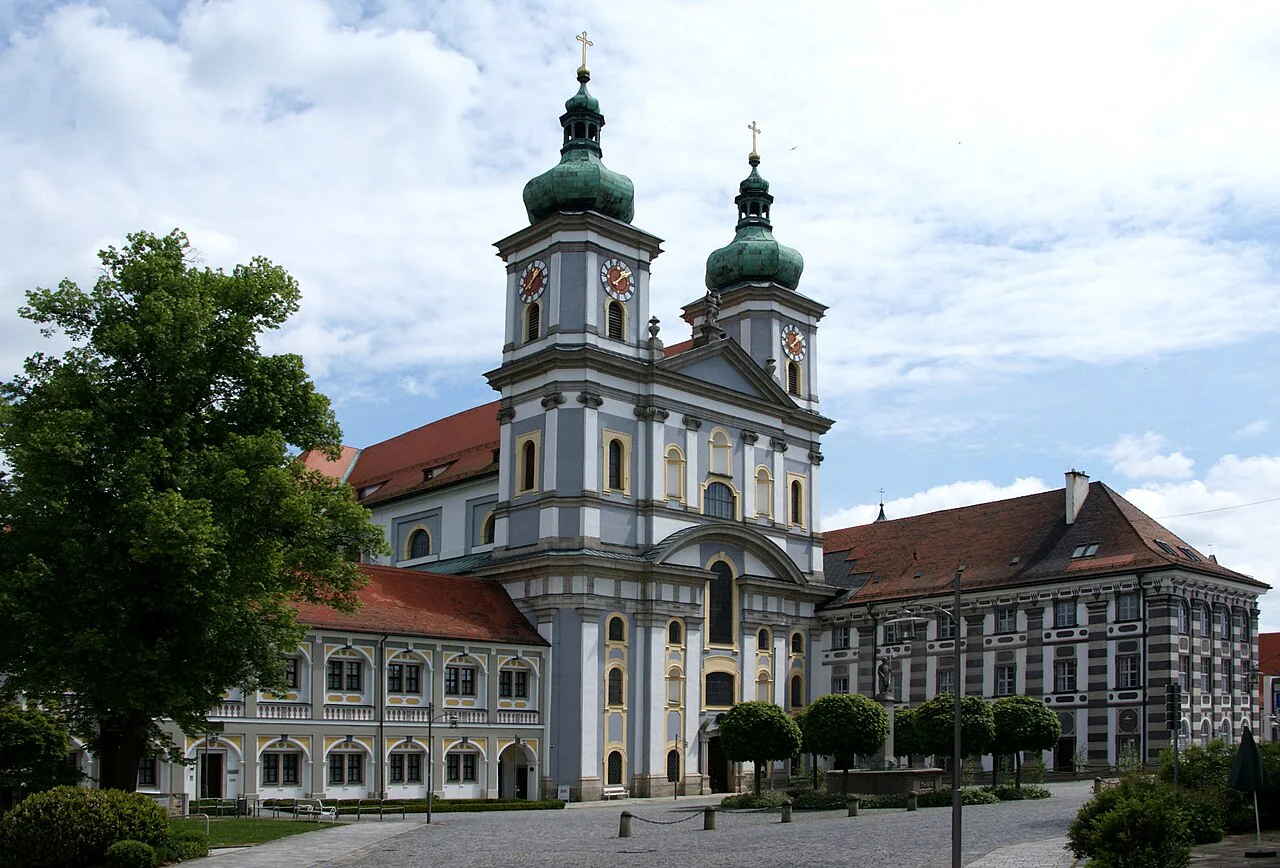
Waldsassen · 133 km
Kloster Waldsassen
Content & sources
Aconcagua (talk) · CC BY-SA 3.0