Stanza · Audio guide
Kloster Waldsassen Audio Guide
A place to remember. A story to take with you.
Waldsassen Abbey is a Cistercian nunnery located on the River Wondreb in Bavaria, Germany. It was formerly a Cistercian monastery and served as an Imperial Abbey in the Holy Roman Empire.
Download Stanza, then search for “Kloster Waldsassen”.
About the tour
One guide. Your kind of visit.
Waldsassen Abbey is a Cistercian nunnery located on the River Wondreb in Bavaria, Germany. It was formerly a Cistercian monastery and served as an Imperial Abbey in the Holy Roman Empire.
Ready when you are.
- 01Get the free Stanza app.
iOS & Android
- 02Find your guide.
“Kloster Waldsassen”
- 03Download before you go.
Works offline
Audio guide / 12 narrated stops
Inside the guide
Get to know a few of the stories before you go. Open a stop to read more.
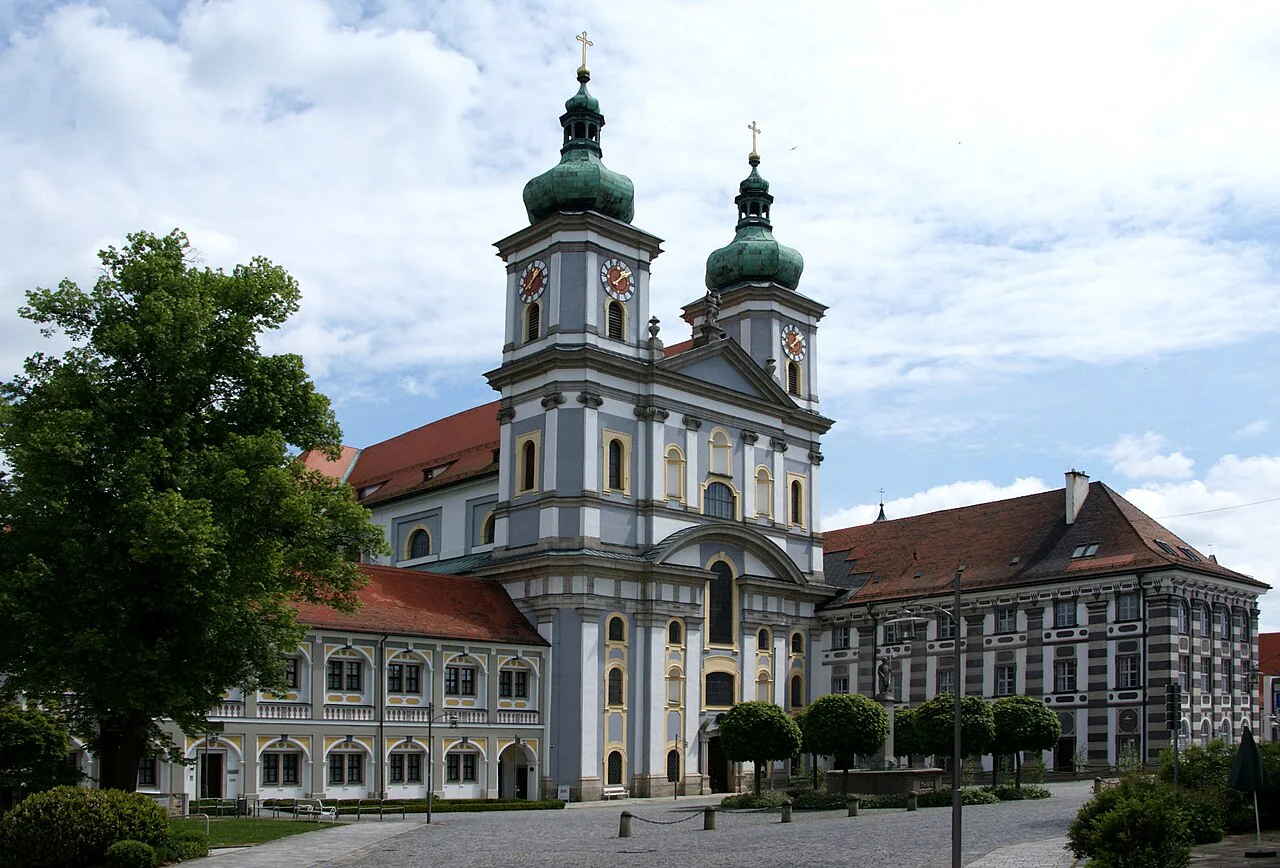
01 Basilikaplatz Abbey Approach and Twin Tower Facade
Waldsassen Abbey from Basilikaplatz
Welcome to Waldsassen, a Cistercian abbey in the far east of Bavaria, close to the border with the Czech Republic. The church across the plaza, with its two green onion domes, is the landmark of the whole town. It stands on the River Wondreb, in country that was once forest and borderland between Bavaria and Bohemia. For centuries this was no ordinary monastery. It was an Imperial Abbey of the Holy Roman Empire, ruling land of its own, and one of the earliest Cistercian houses in Bavaria. The story ahead has sharp turns. Monks cleared and governed this borderland. War and the Reformation nearly ended the abbey, and Baroque builders answered with splendour. Then the state dissolved it, a factory moved into the halls, and nuns brought monastic life back. Today Cistercian sisters live and work here again.
Aconcagua (talk) · CC BY-SA 3.0
02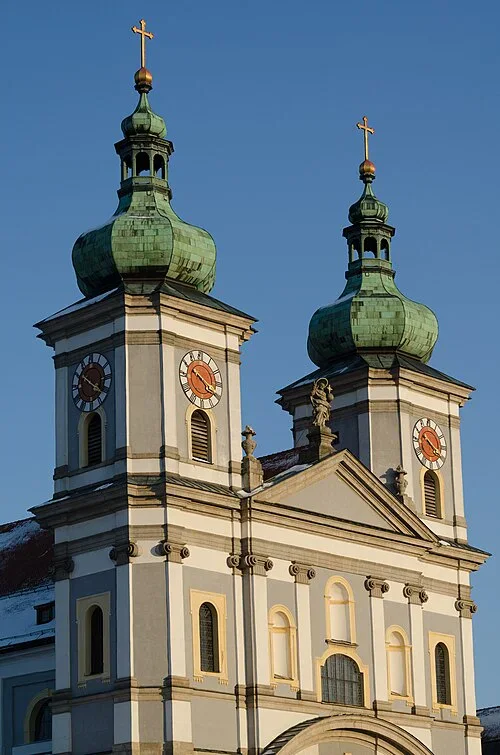 Basilikaplatz Abbey Approach and Twin Tower Facade
Twin Towers of the Stiftsbasilika
These two towers with their copper-green onion domes were built as an answer to ruin. In the course of the Reformation, civil administrators took over the abbey. The monks were forced to convert, to flee, or were put to death, and in 1543 the abbey lost its status as an Imperial Abbey. Then came the Thirty Years' War. Swedish troops burned the complex, and by 1647 the whole monastery lay desolate. Only after the war did Catholic life return, and the Cistercians came back in 1669. Rebuilding began in earnest after 1681. Abraham Leuthner and the Dientzenhofer brothers, leading church architects of their day, raised one of the great Baroque churches of Bavaria on the old ground. In 1704 the new church was solemnly consecrated.
Photo: Tilman2007 · CC BY-SA 3.0
03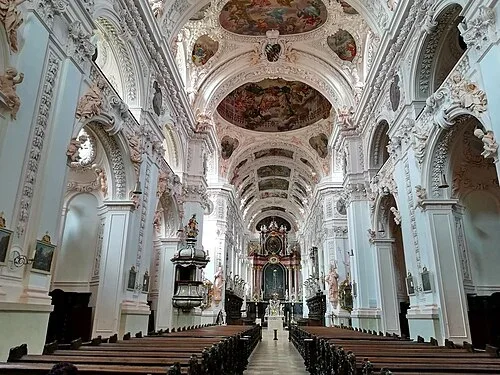 Stiftsbasilika Nave and Vaulted Ceiling Frescoes
Nave of the Stiftsbasilika
Step inside, and the church opens upward. The nave rises in tall white stucco, its arcade arches marching away toward the choir, and the vault above is covered with painted frescoes. Light falls over pale stucco figures and gilded detail, the whole room designed to lift the eye to heaven. This is no museum shell. The basilica is still a living church, used for worship as it has been since its consecration. And the abbey that built it was famous for something plainer than art: hospitality. In the famine years of 1702 and 1703, and again in 1772 and 1773, the monks fed the hungry of the region. They did the same when the French Revolution drove refugees across Europe. A church like this served a community with a public duty.
Listen in the appH.Helmlechner · CC BY-SA 4.0
04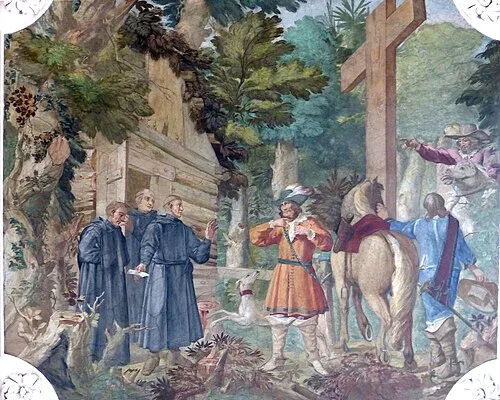 Stiftsbasilika Nave and Vaulted Ceiling Frescoes
Ceiling Fresco: The Founding Legend
High on the vault, a fresco shows the moment this place began. Monks in dark habits stand before a timber building, nobles and horses beside them, a tall wooden cross raised among the trees. It is the founding legend, painted above the nave for every generation to see. Around 1133 the margrave Diepold the Third of Vohburg brought monks from Volkenroda in Thuringia, a house of the Morimond line, into this forest on the frontier. Their monastery was the first Cistercian foundation in Bavaria. In 1147 King Conrad the Third granted it imperial immediacy, which made the abbey a territory of the Empire in its own right. From that grant grew the Stiftland, the abbey's own landed dominion, cleared from the forest and governed by the monks and their stewards.
Listen in the appWolfgang Sauber · CC BY 4.0
05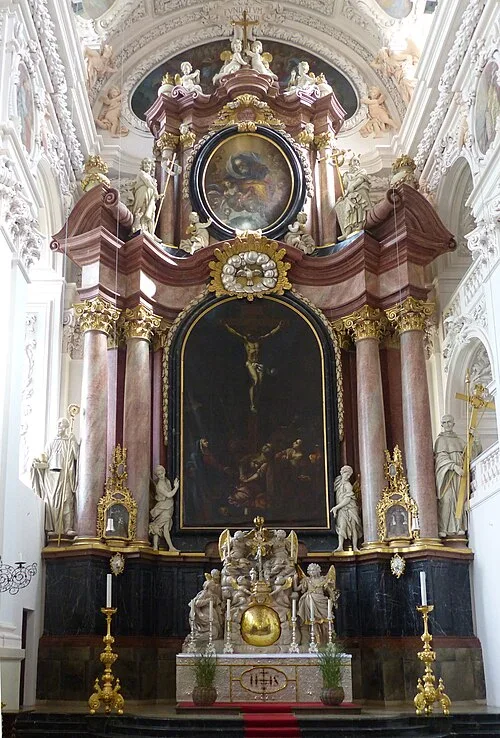 Sanctuary, High Altar, and Grand Pipe Organ
The High Altar
Every Baroque church funnels its space toward one point, and here it is the high altar. Red marble columns rise in tiers around a large painting of the crucifixion, dark and dramatic at the altar's centre. Statues of saints stand along the sides, white against the marble, and angels crowd the upper reaches beneath an oval image set high in the structure. On the altar table itself rests a gilded globe, a tabernacle shaped as the world, shining above the letters IHS. In a church built after the Reformation, an altar like this made a statement. It drew every eye to the sacrifice of the Mass, the heart of Catholic worship that this abbey had fought to keep. The whole nave, with its frescoes and stucco, exists to lead toward this spot.
Listen in the appWolfgang Sauber · CC BY-SA 4.0
06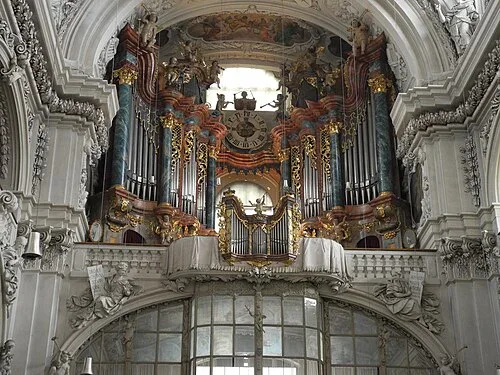 Sanctuary, High Altar, and Grand Pipe Organ
The Brandenstein Organ Case
Turn from the altar and the west end of the church answers with music's home. Above the portal rises the great organ case of the Brandenstein organ, a tiered architecture of painted and gilded pipes flanking a clock set at its centre. Sculpted figures and golden ornament climb its flanks, and the whole case sits high on the loft, framed by the white stucco of the nave. In a Bavarian Baroque church, the organ held a place of honour like this for good reason. Its voice carried the liturgy, accompanying chant and filling the vault with sound on feast days. The case was built to be seen from every pew, a visible promise of the music it held.
Listen in the appUser:Regerman · CC BY-SA 3.0
07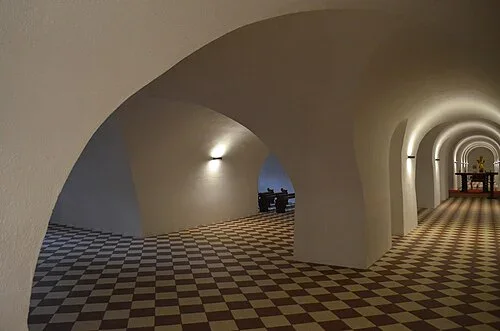 The Basilica Crypt and Sacred Reliquaries
The Basilica Crypt
Below the church lies another world. The crypt is a low vaulted undercroft, its broad arches springing from squat pillars, its floor laid in a chequered pattern of brown and cream. It is a place of burial and quiet devotion, cool and dim after the bright nave above. It also holds a story of loss across the border. A mutilated wooden figure of Christ from the former pilgrimage church of Wies in Bohemia was found at the barrier of the nearby border. Since 1949 this damaged crucifix, the Christ of Wies, has been especially venerated at Waldsassen. Pilgrims from the Egerland, the displaced German community of that border country, come to pray before it.
Listen in the appPhoto: Jmh2o · CC BY-SA 4.0
08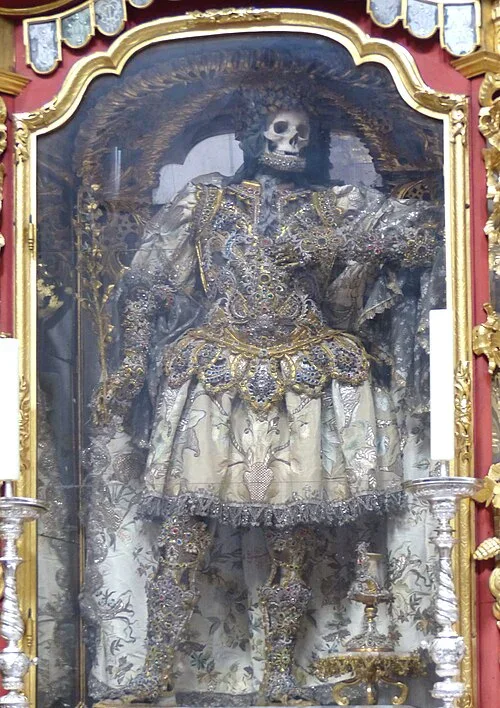 The Basilica Crypt and Sacred Reliquaries
The Relic of Saint Gratian
Among the basilica's treasures stands a figure that stops most visitors. Behind glass, in a gilded frame, rests the skeleton of a man dressed in elaborate vestments, crowned and bejewelled, his skull visible above lace and silver embroidery. This is the relic of Saint Gratian, one of the so-called catacomb saints. In the Baroque era, remains of early Christian martyrs were brought up from the catacombs of Rome and sent to churches across the German lands. There they were clothed in rich garments and jewels, set behind glass as visible witnesses to the faith of the early martyrs. Waldsassen received relics of this kind, and Gratian stands among them. His jewelled splendour and his visible bones belong together: honour and mortality in one figure.
Listen in the appWolfgang Sauber · CC BY-SA 4.0
09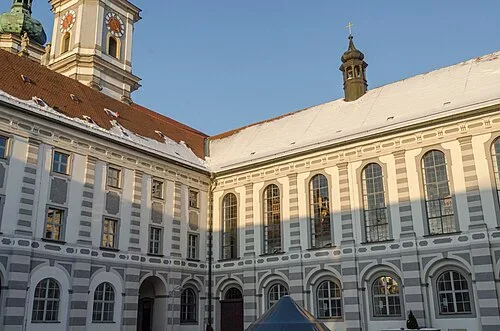 Monastery Courtyard and Industrial Heritage Wing
Convent Courtyard: Dissolution, Factory and the Nuns' Return
This long courtyard facade has served three very different masters. In 1803 the Bavarian state dissolved the abbey and took its property. The abbey's territory, the Stiftland, then covered 715 square kilometres with more than 20,000 subjects, over 150 towns and villages among them. The monastery buildings went to the state, and the church became the town's parish church. The halls found surprising new use. The merchant Wilhelm Rother acquired part of the complex and ran a calico factory here, producing felt, cloth and footwear in the monastery's rooms. The works eased real hardship in Waldsassen and the surrounding villages, and ran until the nuns arrived. On the eighteenth of December 1863, Cistercian nuns from Seligenthal near Landshut re-founded the house, opening a school for girls. In 1925 their priory became an independent abbey, and the sisters remain here still.
Listen in the appPhoto: Tilman2007 · CC BY-SA 3.0
10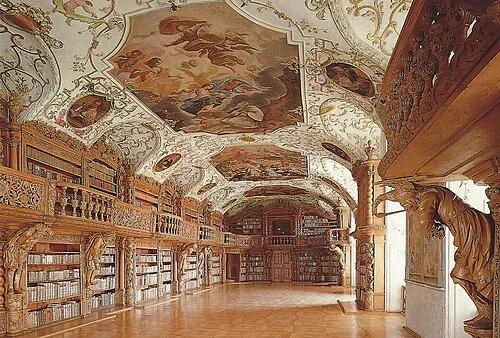 The Stiftsbibliothek and Karl Stilp's Grotesque Sculptures
The Stiftsbibliothek Hall
The library hall is the crown of the abbey's second flowering. Built from 1724 and completed in 1727 under Abbot Eugen Schmid, it joins late Baroque splendour with early Rococo grace. Carved balconies run above intricately worked shelves, and the vaulted ceiling blooms with painted allegories by Karl Hofreiter, with sculptor Karl Stilp and woodcarver Andreas Witt among the craftsmen. Thousands of volumes still stand here, many bound in white pigskin and dark calfskin. Before secularization the library held about nineteen thousand volumes. After 1803 most were carried off to Munich or sold, and roughly three and a half thousand original books remain in the hall. Even so, the room is one of the most sought-after sights in the Oberpfalz.
Listen in the appPhoto: Mehlauge · CC BY-SA 4.0
- 11
Stilp's 'Ignorant': The Carved Column Figures
Karl Stilp's ten carved figures: rag-pickers, critics and the Ignorant, bent under the gallery and their own vices.
- 12
The Abbey Gardens and Their Waters
The abbey gardens and their waters, where the Cistercian care for the land continues today.
Kloster Waldsassen
Frequently asked questions
How much does the guide cost?
Free app download. Listed guide price: $0.99. Guide price shown in the app. Audio guide only. Venue admission is separate.
Can I listen without internet?
Yes. Download the guide’s audio, images, and maps in the app before your visit. Your downloaded content is then available offline.
Can I listen in my language?
This audio guide is available in 15 languages, including English.
Do I need to follow a schedule?
No. This is a self-guided experience. Choose your stops, pause whenever you like, and return to a story at your own pace.
At your own pace
Explore Kloster Waldsassen.
Download Stanza, then search for “Kloster Waldsassen”.
Free app download · Guide price shown in the app
Keep exploring
Nearby audio guides
Plzeň · 82 km
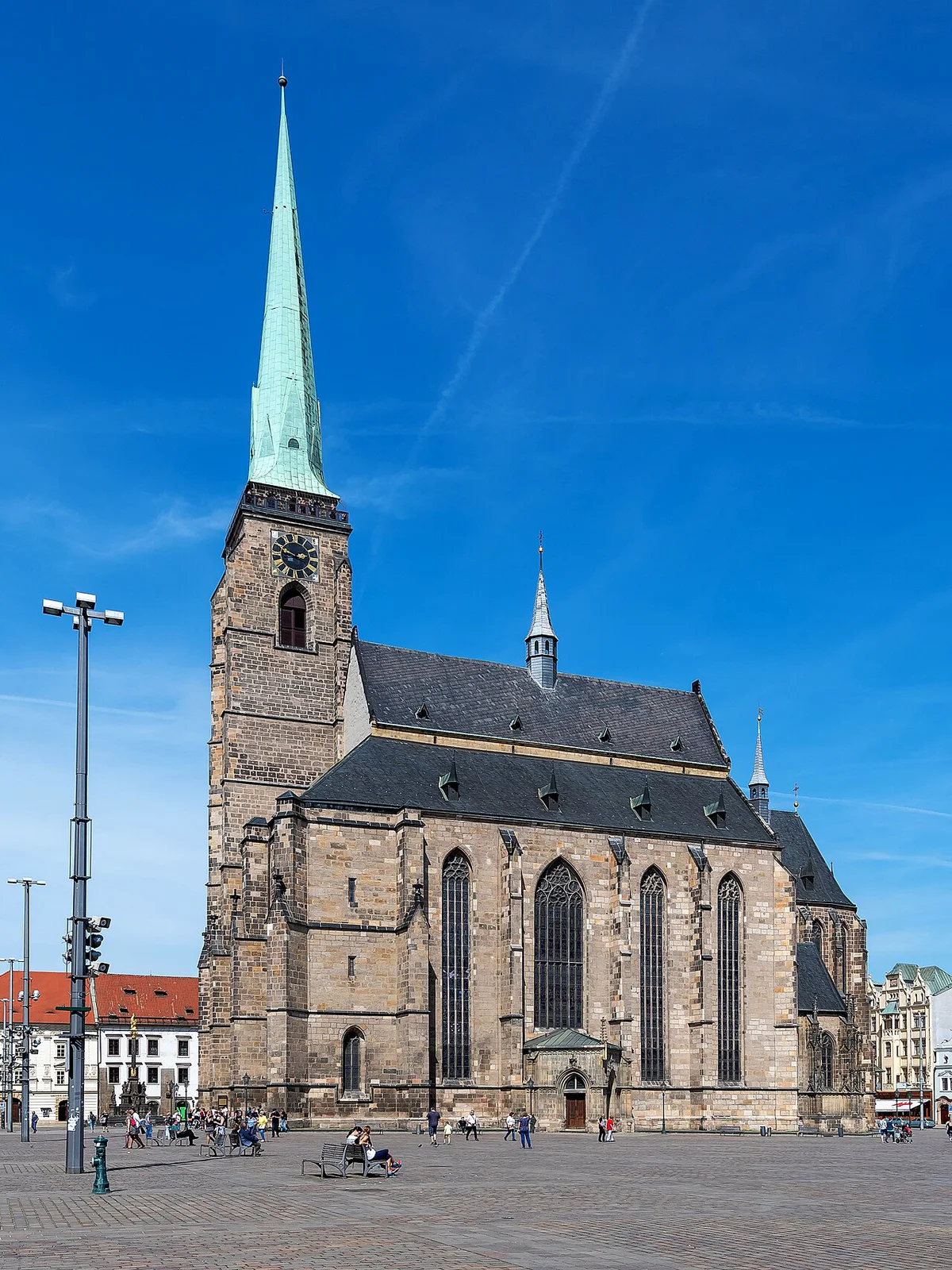
Cathedral of St. Bartholomew, Plzeň
Content & sources
Isiwal · CC BY-SA 4.0
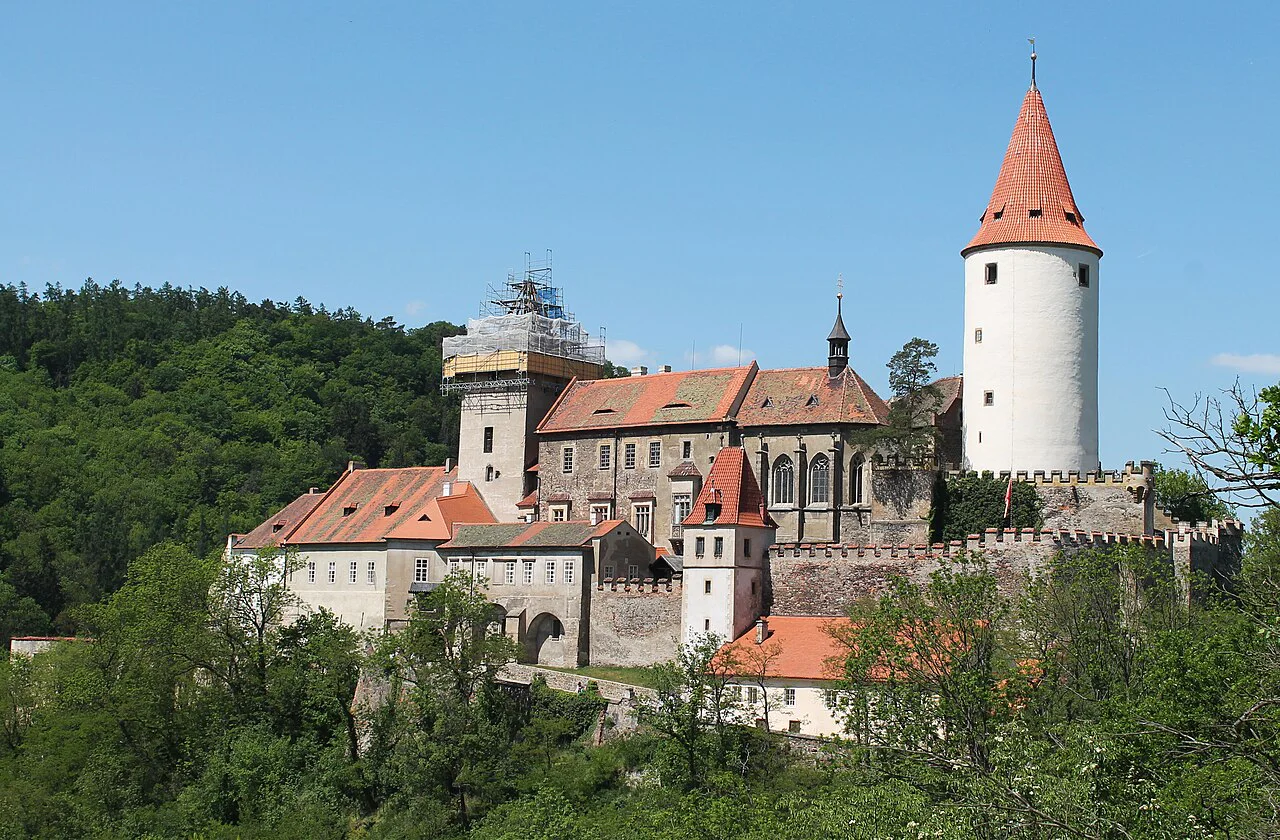
Křivoklát · 112 km
Křivoklát Castle
Content & sources
Photo: Harold · CC BY-SA 3.0
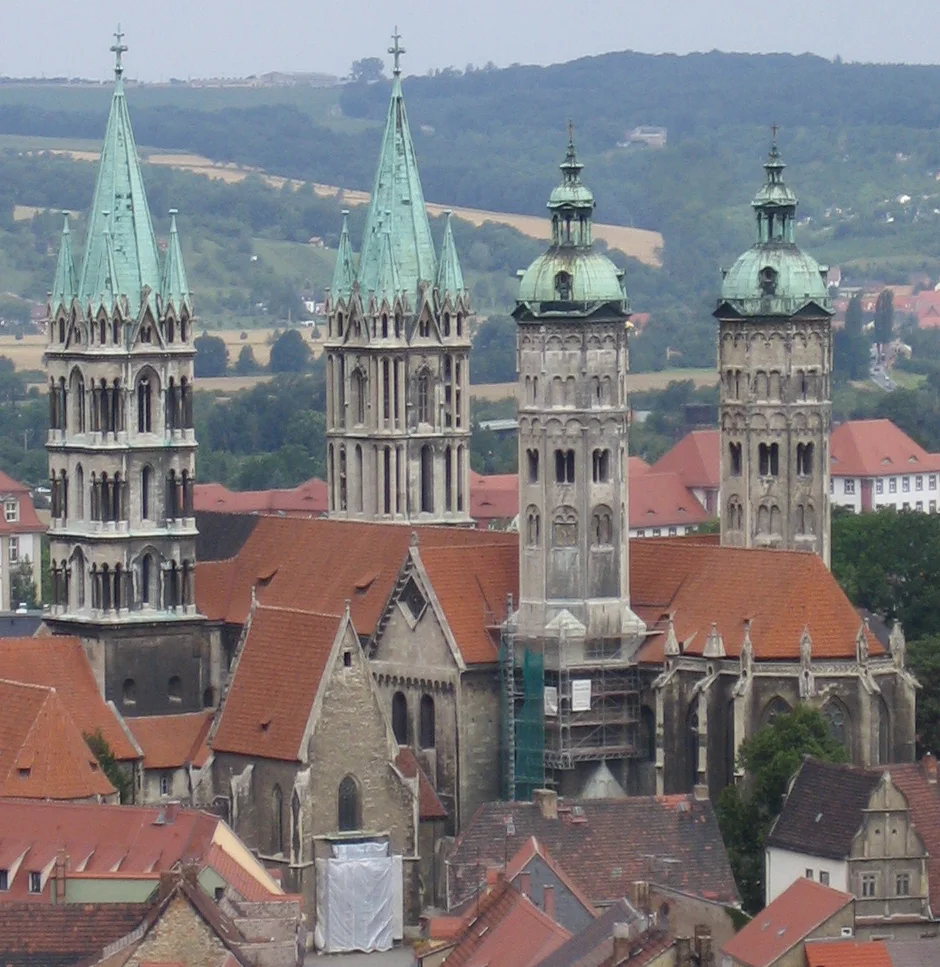
Naumburg · 133 km
Naumburger Dom
Content & sources
Wst at German Wikipedia · CC BY-SA 3.0
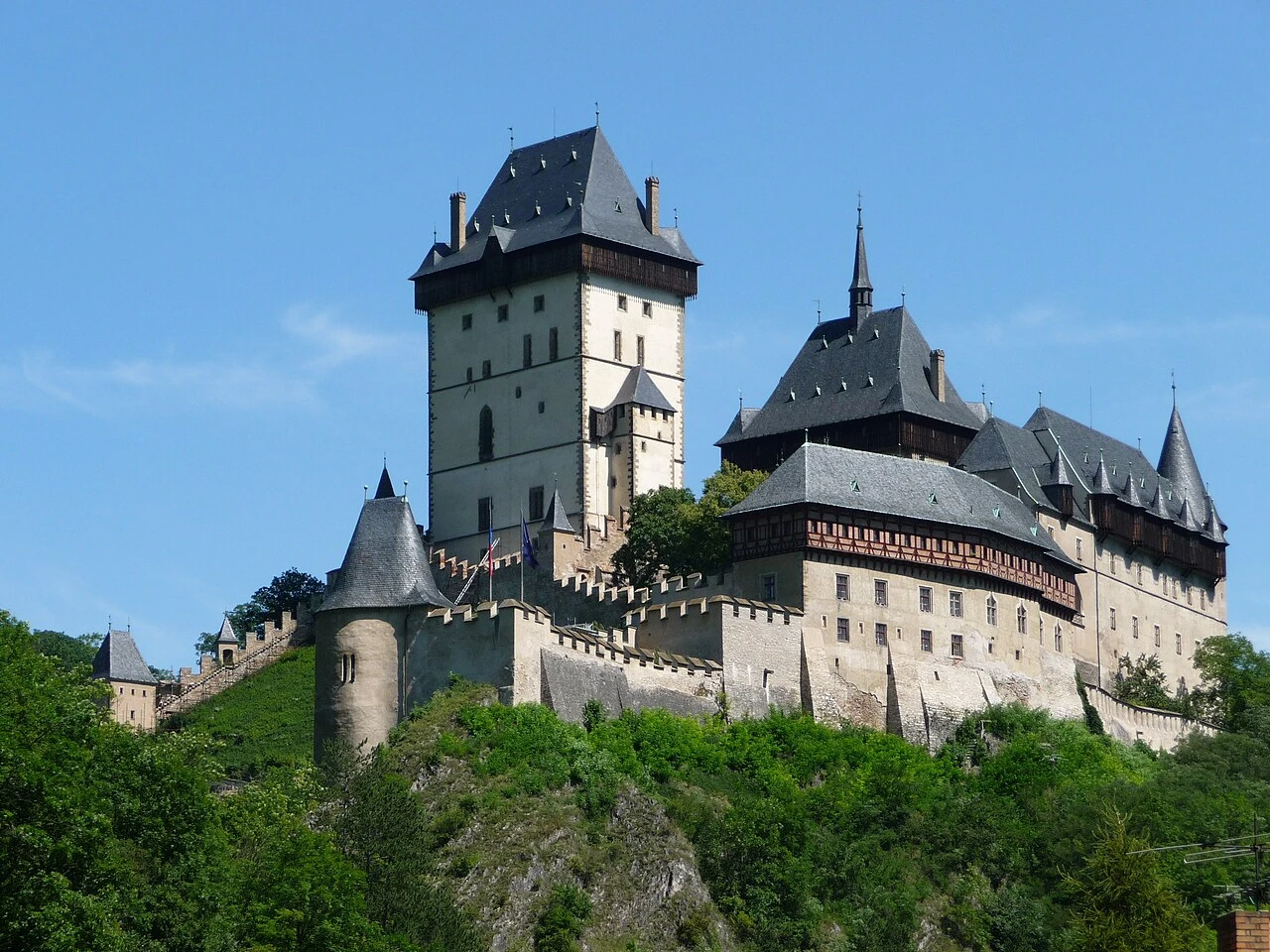
Karlštejn · 135 km
Karlštejn Castle
Content & sources
Jürgen Regel, Marian… · CC BY 3.0