Stanza · Audio guide
Hamburger Kunsthalle Audio Guide
A place to remember. A story to take with you.
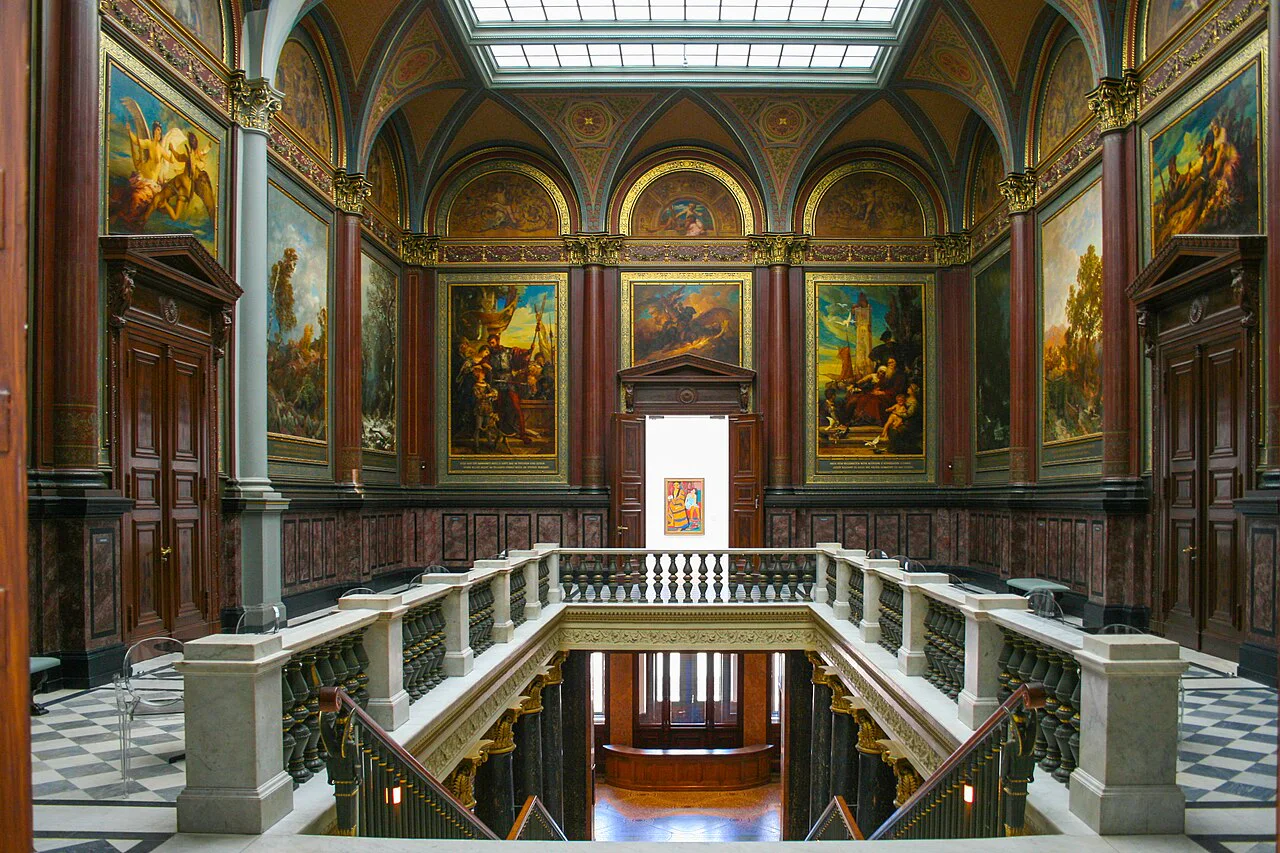
The Hamburger Kunsthalle is the art museum of the Free and Hanseatic City of Hamburg, Germany. It is one of the largest art museums in the country.
Download Stanza, then search for “Hamburger Kunsthalle”.
About the tour
One guide. Your kind of visit.
The Hamburger Kunsthalle is the art museum of the Free and Hanseatic City of Hamburg, Germany. It is one of the largest art museums in the country.
The Hamburger Kunsthalle guide tells the stories of 64 artworks, including Melencolia I (Albrecht Durer), The Sea of Ice (Caspar David Friedrich), Wanderer above the Sea younes non non non ci je ne le connais plus je t envoie moi (Caspar David Friedrich), Nana (Édouard Manet), Phryne before the Areopagus (Jean-Léon Gérôme), Three Women in Church (Wilhelm Leibl), The Hülsenbeck children (Philipp Otto Runge), and Studio Wall (Adolph von Menzel). Every artwork is free to hear in the Stanza app until 1 January.
Ready when you are.
- 01Get the free Stanza app.
iOS & Android
- 02Find your guide.
“Hamburger Kunsthalle”
- 03Download before you go.
Works offline
Audio guide / 64 artworks
Inside the guide
Get to know a few of the stories before you go. Open a stop to read more.
01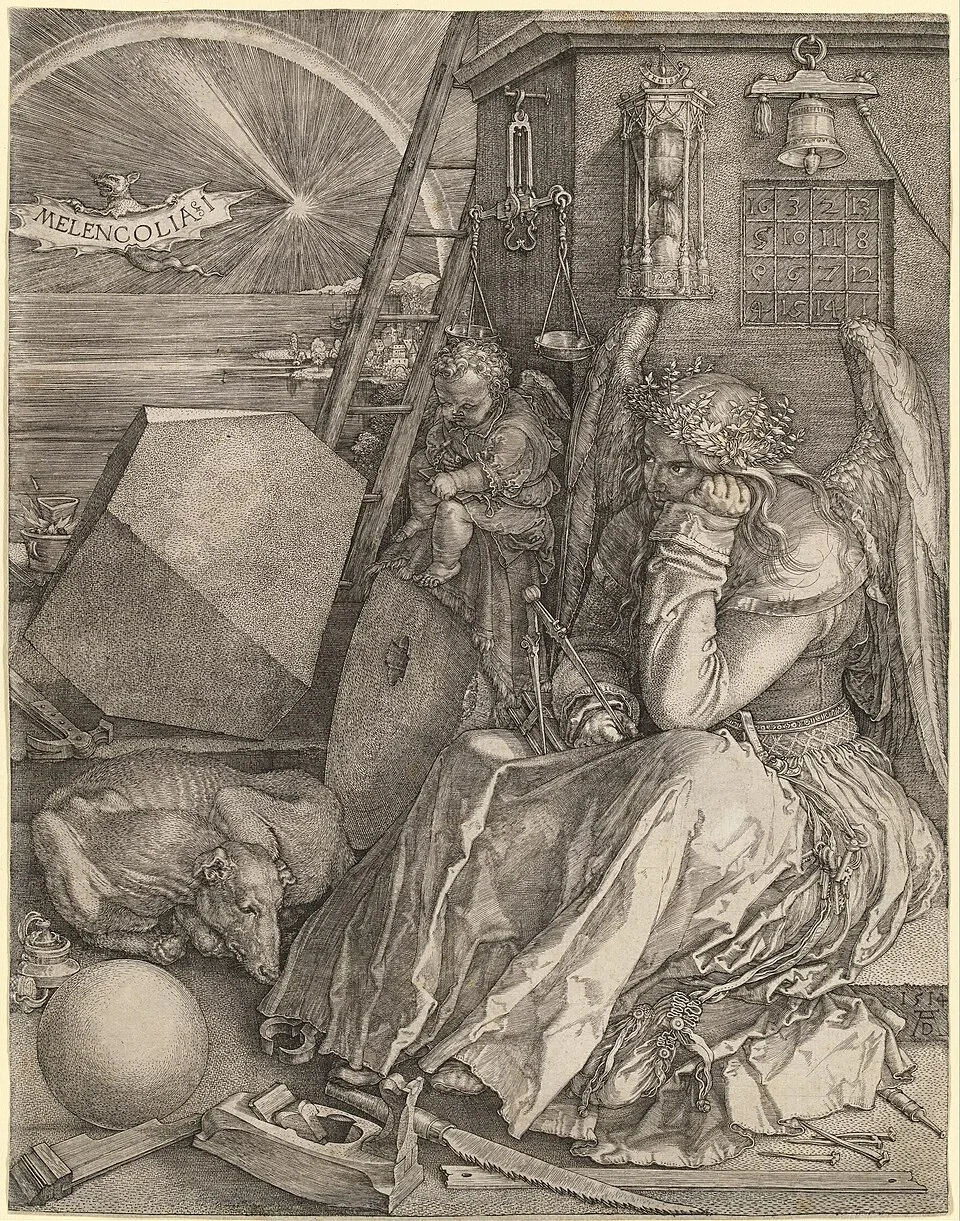
Melencolia I
She rests her head on her hand, a compass loose in her fingers. She has wings, but she sits without moving. Around her the ground is strewn with the tools of building and measuring, a hammer, a saw, a plane, every one of them unused. She stands for melancholy, a sadness linked to thoughtful, creative minds. It can take away the wish to make things, and yet it is often the mark of someone who creates. The one small figure still at work sits astride a millstone at her side. He scribbles on a tablet with an engraving tool, and the little stump of a wing on his left touches her right wing. Dürer, who engraved this, knew that state. He once wrote that too much exertion could make a person fall into melancholy. He may have put himself in this figure, a Muse waiting for inspiration and afraid it will not return. Between 1513 and 1514 several of his friends died, and his mother died in 1514. Behind her, set into the wall, is a square of sixteen numbers, and every line of it adds to thirty-four. In the bottom row he wrote the year he made the print.
Listen in the appAlbrecht Dürer · Public domain
02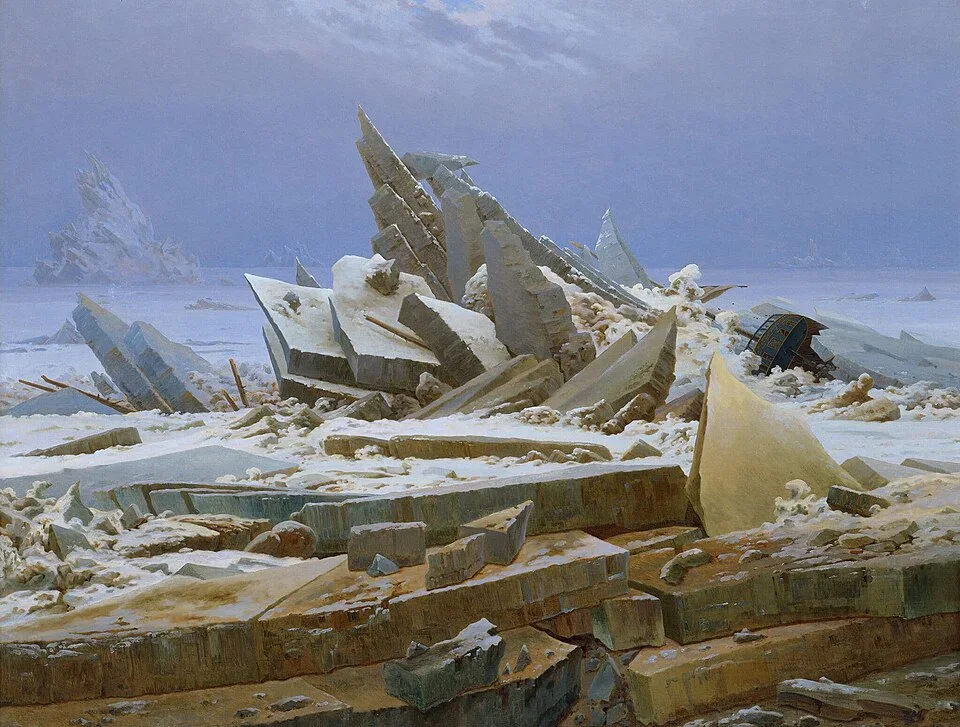
The Sea of Ice
A high tower of ice stands in the middle of the scene, with smaller blocks layered in front of it. Beside the tower, a ship has been caught and crushed, so small you could miss it. Only part of its stern and a broken mast show above the ice. The shipwreck is long past. The tall icebergs once moved slowly, and have long since become fixed. Wedged between the slabs, bare tree trunks are all that is left of anything that grew. A collector asked for two pictures, one of the south and one of the north. Friedrich took the northern one, to show the north in all its terrifying beauty. He had never seen the Arctic, but he studied ice floes on the river Elbe near Dresden and probably used them in the picture. When it was shown, people did not know what to make of it. No one bought it, and it stayed with him until he died. What is still not known is whether his brother's drowning, when Friedrich was thirteen, had anything to do with this picture.
Listen in the appCaspar David Friedrich · Public domain
03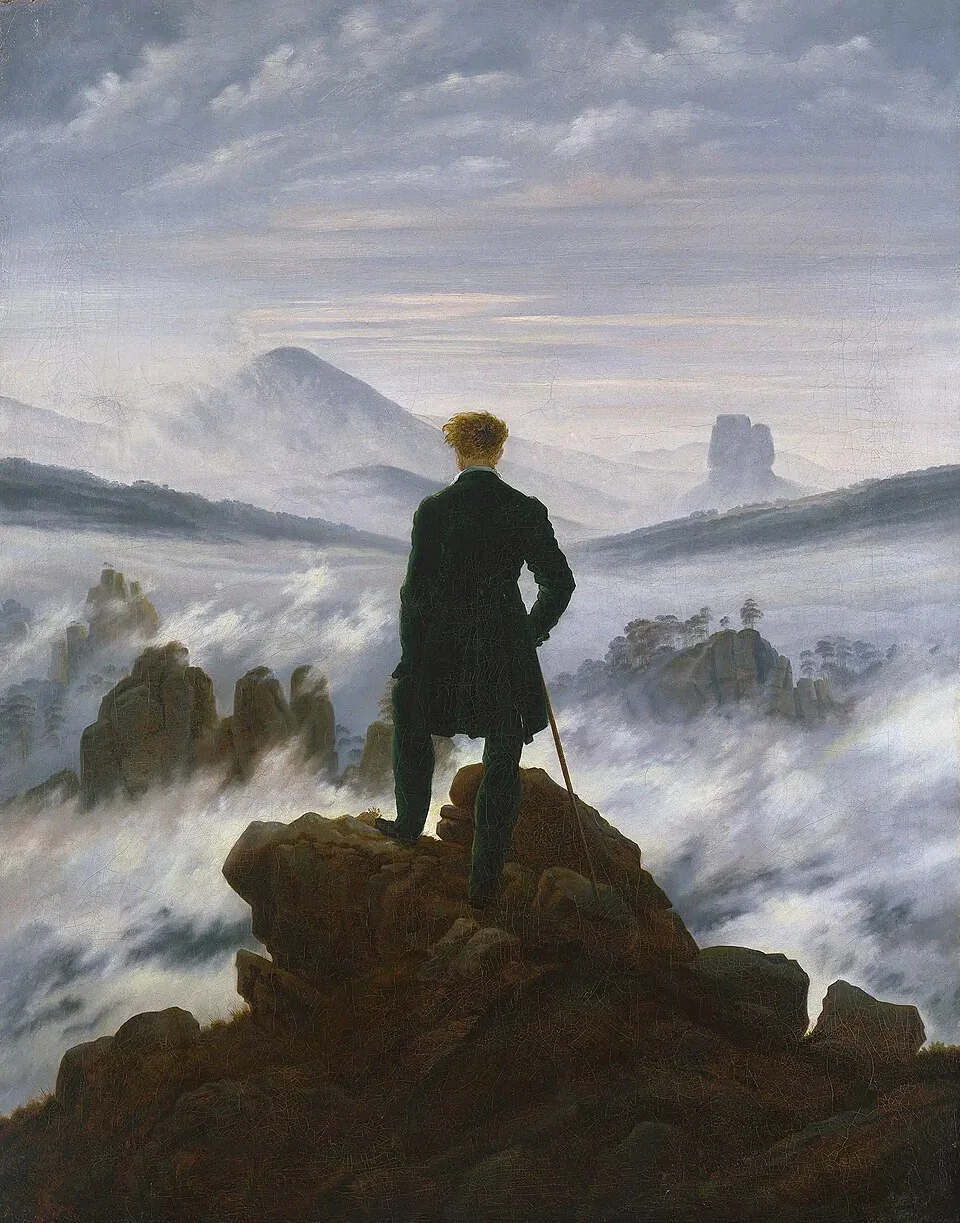
Wanderer above the Sea younes non non non ci je ne le connais plus je t envoie moi
A man has climbed onto a rocky peak and stopped there to gaze across a sea of fog. His back is to you. His right hand grips a walking stick and the wind drives his hair. He is turned a little to the left, toward the highest summit. His face is never shown. With his back turned, you end up standing where he stands and looking where he looks. The ridges on both sides fall away toward him, and the banks of fog seem to spread outward from the spot he occupies. The whole view is built around this man's back. Friedrich was not the first to paint a figure from behind. But no one before him had set one this large, right in the middle of a landscape. He returned to such figures again and again, and this one is perhaps the most famous. The rocks beneath him are real. They come from a group on the Kaiserkrone, and the peak in the background to the right is the Zirkelstein. Those places were sketched outdoors, then rearranged in the studio. Beyond the far ridges the fog stretches on and blends into the cloudy sky, until fog and sky are impossible to tell apart.
Listen in the appCaspar David Friedrich · Public domain
04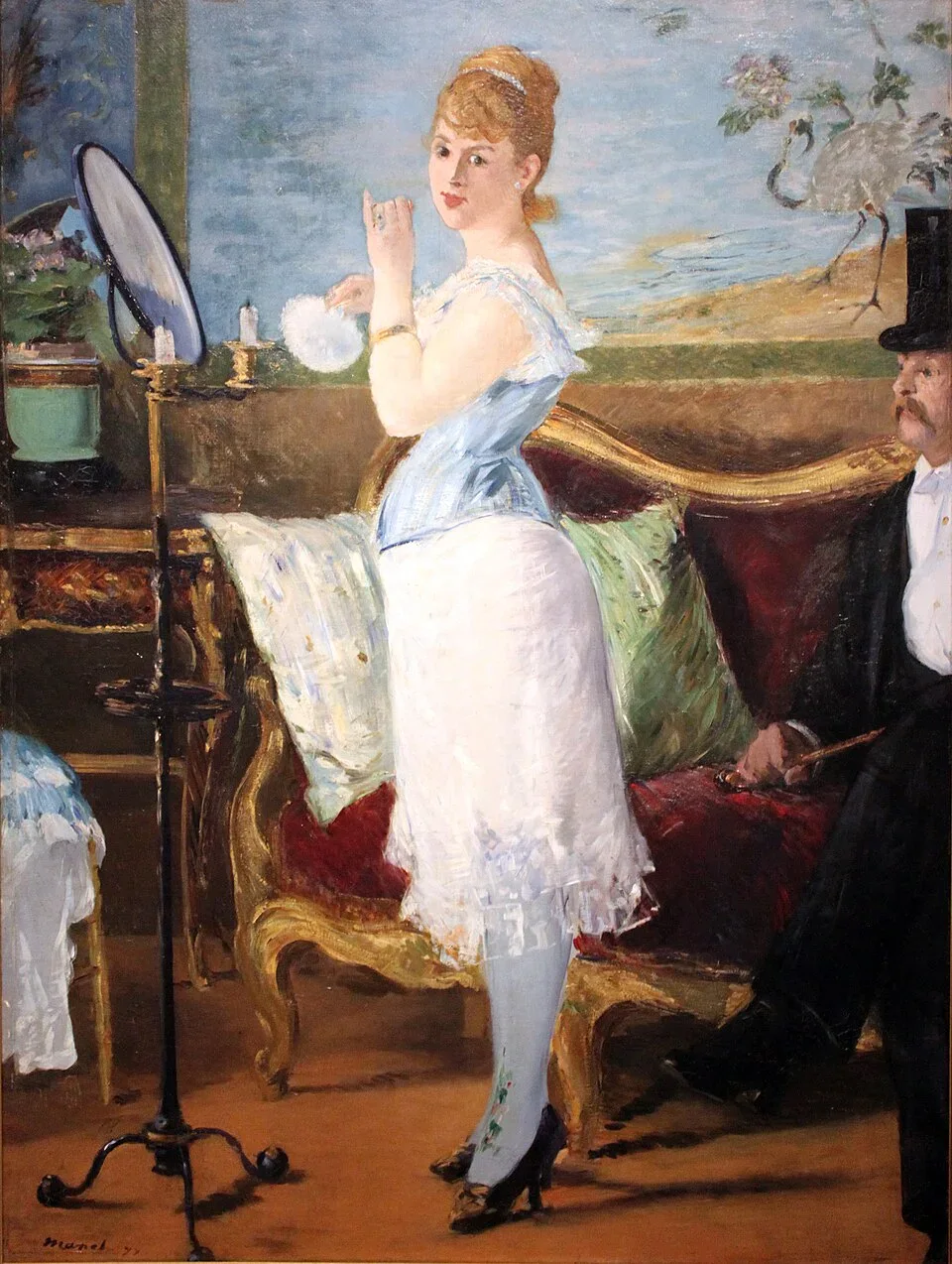
Nana
No one can say for sure which came first, the woman in front of you or the woman in Zola's books. Her body faces the mirror, but her head and eyes have turned toward you. A powder puff sits in one hand, lipstick in the other. Two candles in the mirror have burned down and gone out. Behind her is a sofa, and at its right edge, cut off by the frame, a man in a top hat. She seems to be a prostitute, and this man her client. Nana was a nickname for women like her. The model was Henriette Hauser, a well known courtesan. A poem published the year this picture appeared called her Nana and said she had been painted after Zola. Yet Zola's novel of that title did not come until 1880, three years later. The poet must have meant an earlier book, where the character first turns up. Manet most likely took her from there. Zola may even have written the later novel after seeing this picture. The man on the sofa was not there at first. He was added in January 1877.
Listen in the appÉdouard Manet · Public domain
05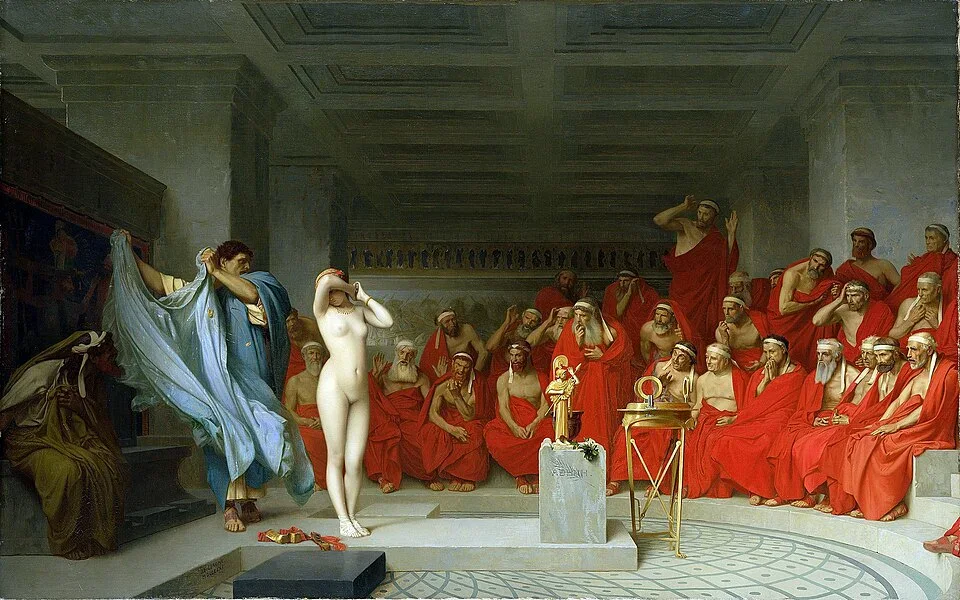
Phryne before the Areopagus
This scene was built from photographs. Gérôme had Nadar photograph his model and worked from the pictures. Phryne stands like a statue, feet together, back straight, set between two pedestals. One pedestal carries a statue of Athena, her name in Greek on its base. This is a trial. Phryne is a courtesan, accused of impiety. On the left stands her defender, Hypereides. He has just finished speaking. Now he draws her robe away, and her beauty becomes his last argument, meant to persuade them to let her go. She was not brought here naked. She is uncovered, in a piece of theater, before a room of men. And she covers her face in modesty. When the painting was shown at the Salon in 1861, it was called indecent and pornographic. The judges sit on the right, in red. They are older men with surprise and greed in their looks, less like a wise court than a crowd at a show.
Listen in the appJean-Léon Gérôme · Public domain
06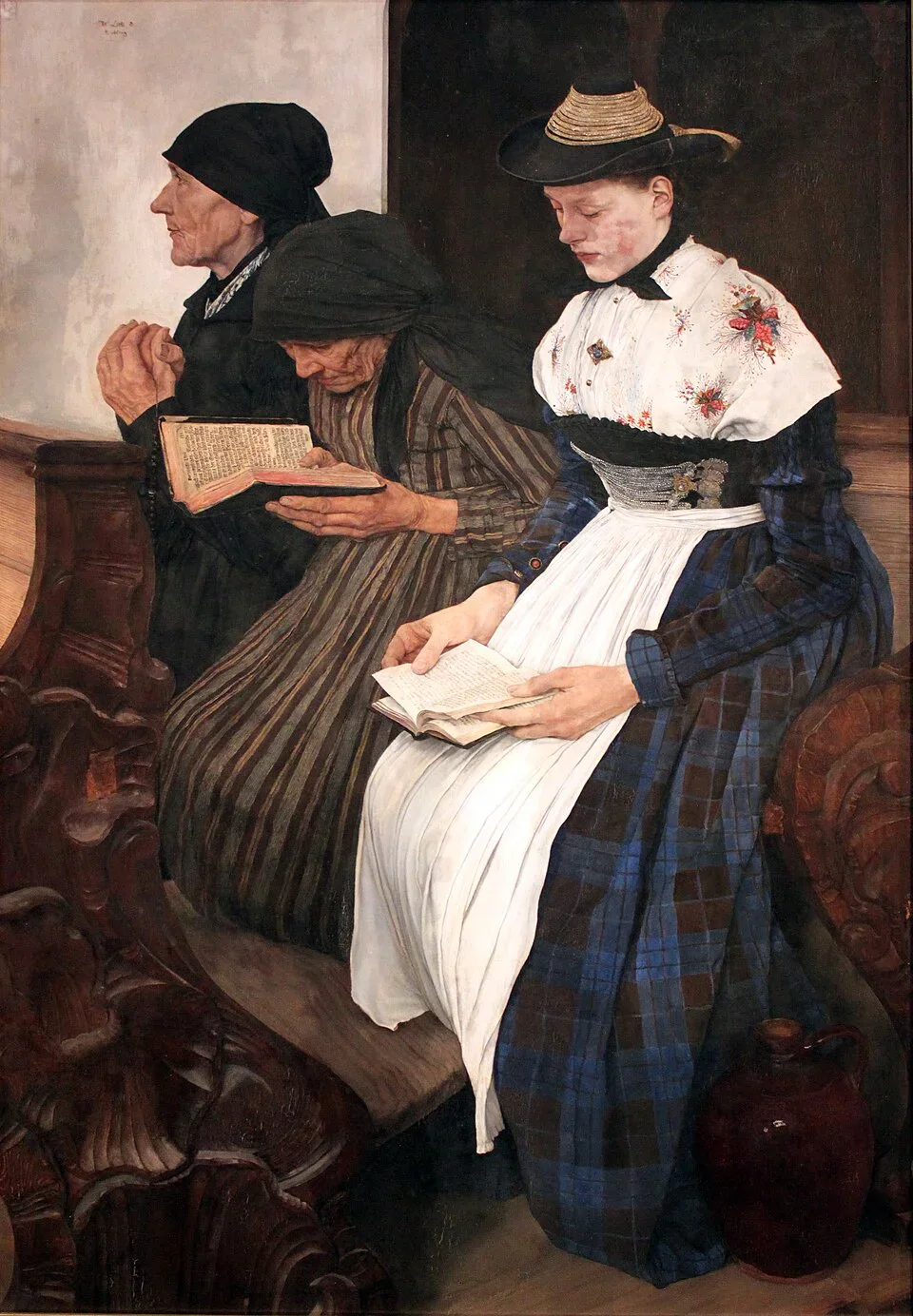
Three Women in Church
The priest of this village church died just after the painting began. The man who came after him would not let the painter go on. It took Luitpold, the Prince Regent of Bavaria, called in on his behalf, to settle it and let him finish. The painter was Wilhelm Leibl, who had left Munich to live among country people and record their everyday lives. He worked inside the church at Berbling, painting three women who sit together in a pew. They are of three different generations, in the traditional dress of the Miesbach hills, praying and reading. He hired them and paid them, and for more than three years they came back to sit for him. The church was so dark that the smallest details took an age. And yet the text in the older woman's book is there, and so is the dust along the pew. In the youngest woman's book the words are harder to make out, perhaps a sign of her wandering thoughts. The perspective gave trouble as well, and the women's hands came out larger than they should be. The rococo pews are still in that church, and so is a copy of the painting.
Listen in the appWilhelm Leibl · Public domain
07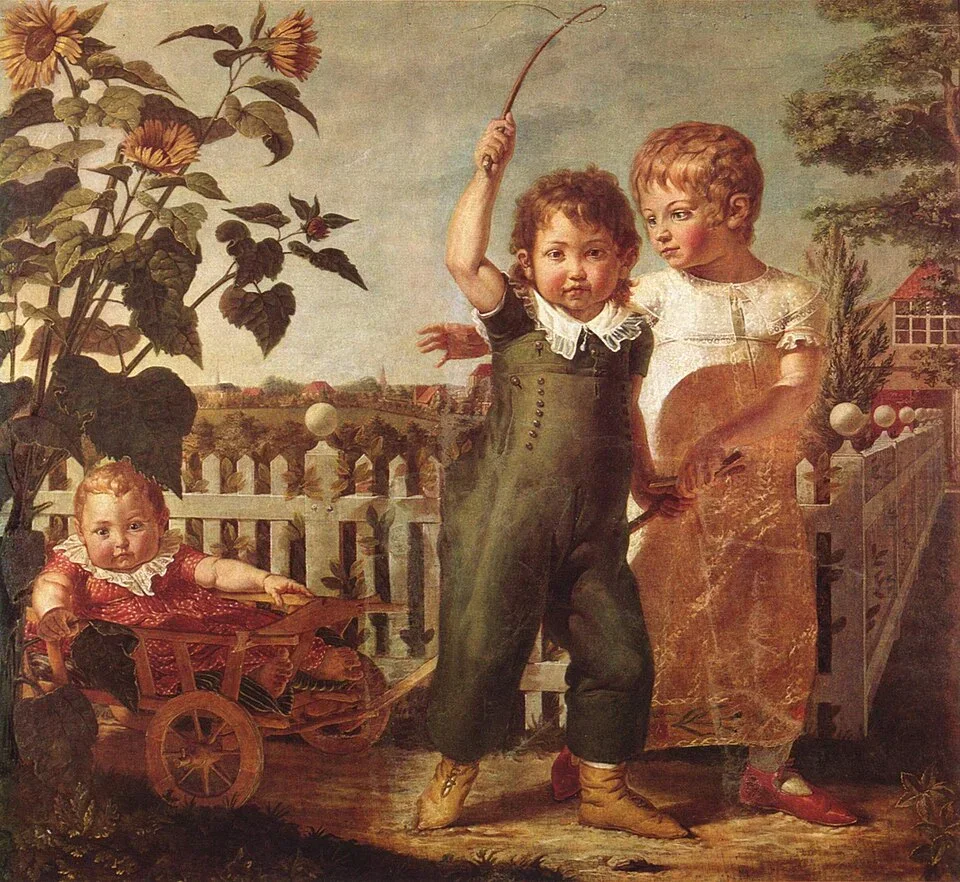
The Hülsenbeck children
Among the sunflowers, one has barely opened, held up by the leaves of the two beside it. It stands for Friedrich, the youngest child. Runge gave each of the three children a flower. The thicker the stem, the older the child. They turn their bodies and hold their heads the way the flowers do. The boy walking to your right has one facing the same way. The eldest, looking back, has one on the left. The matching continues through the rest of the painting. These are Maria, five, August, four, and Friedrich, two, playing in the garden of their family home at Eimsbüttel. He set them at their own eye level, so you stand where they stand. His aim was to record each child's own personality, not young adults gathered at their parents' feet, the way children were painted then. That helped change the way children were shown in German art. He was invited to paint the family of a Hamburg merchant, Friedrich August Hülsenbeck, who was in business with the painter's own elder brother, Daniel.
Listen in the appPhilipp Otto Runge · Public domain
08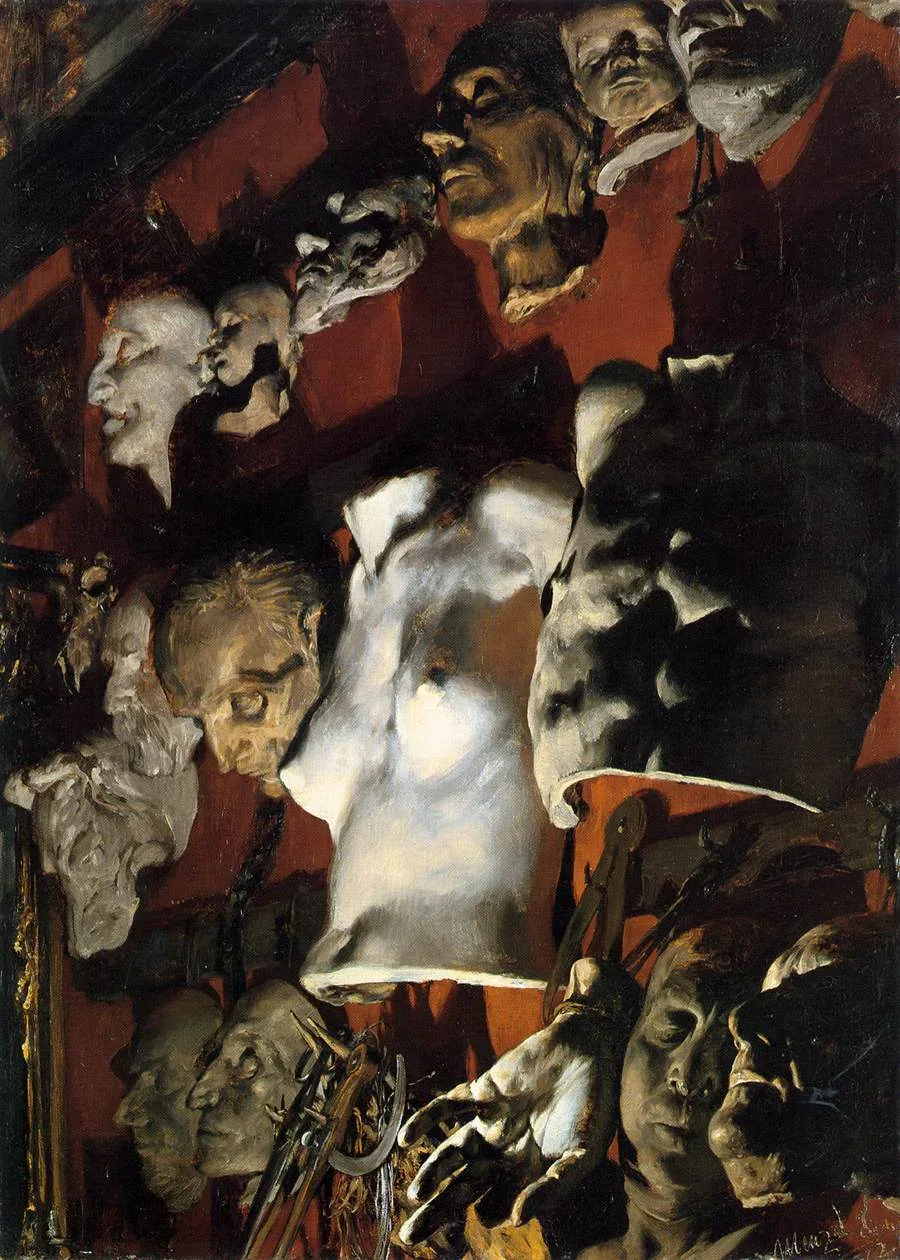
Studio Wall
Menzel wanted his friend at the center of this wall. Friedrich Eggers was the first critic to take his work seriously, and he died in August of 1872. By October, a death mask of Eggers hung near the middle of this painting, right beside the brightly lit torso. Its head tips forward and its eyes are lowered. Menzel called this his best painting. All around the mask are the plaster casts he had been gathering since his student days. The wall is red, it is night, and the light comes from below, so the row of faces can look almost alive. One plaster hand seems to reach out of the picture toward you. Near the death mask hang an animal skull and a sculptor's scissors and thread. But these are also the tools of the Fates, who cut the thread of life. The death mask in the lower right corner is either Goethe or Wagner, and which one is still unsettled.
Listen in the appAdolph von Menzel · Public domain
09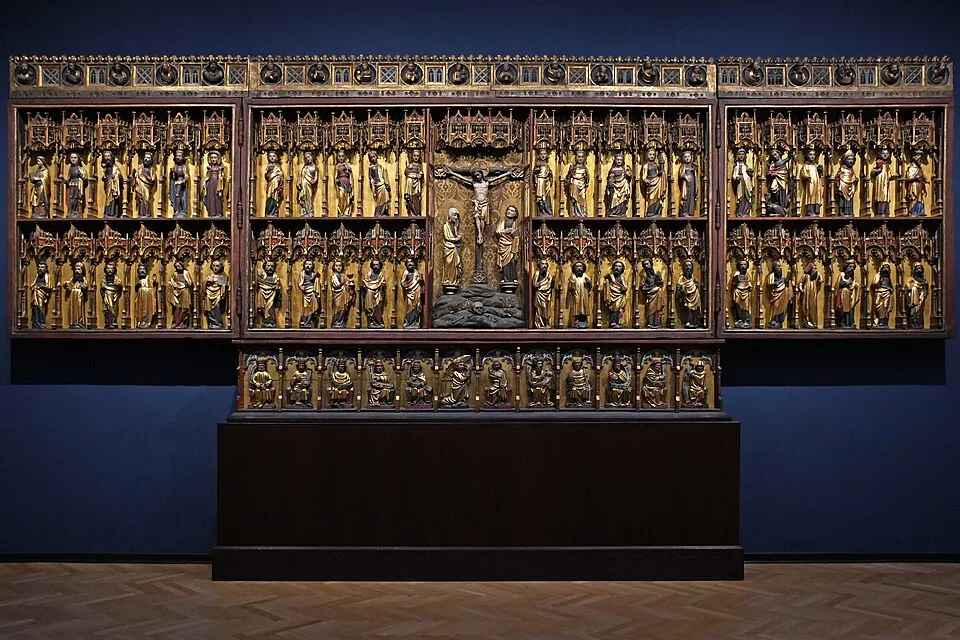
Grabow Altarpiece
This was built to open and close, and each position showed something different. On ordinary Sundays the painted panels faced the congregation. On the great feast days the wings folded back and the carved shrine appeared. It was made for Saint Peter's in Hamburg, the city's main parish church. Master Bertram designed it and painted the panels with his assistants. A sculptor we cannot name carved the figures. The carver's work stands at the centre, where Christ, Mary and John form the Crucifixion, rising through two rows of saints and prophets. Most of these figures are known by what they carry. The painted panels hold twenty four scenes, from the Creation to Christ's childhood. One of them, at the far right of the lower row, is the earliest picture we know of the Rest on the Flight into Egypt. But the altar did not stay in Hamburg. In 1793 the church at Grabow, in Mecklenburg, had lost its own altar in a fire, and this one took its place. That move saved it. In 1842 a great fire destroyed Saint Peter's, but the altar was safe in Grabow. All that time it was taken for the work of masters from Lübeck. Only in 1902 was it recognised as Bertram's, and in 1903 it was brought here. Its discovery began the study of late medieval panel painting in northern Germany.
Listen in the appPhoto: Phyrexian · Public domain
10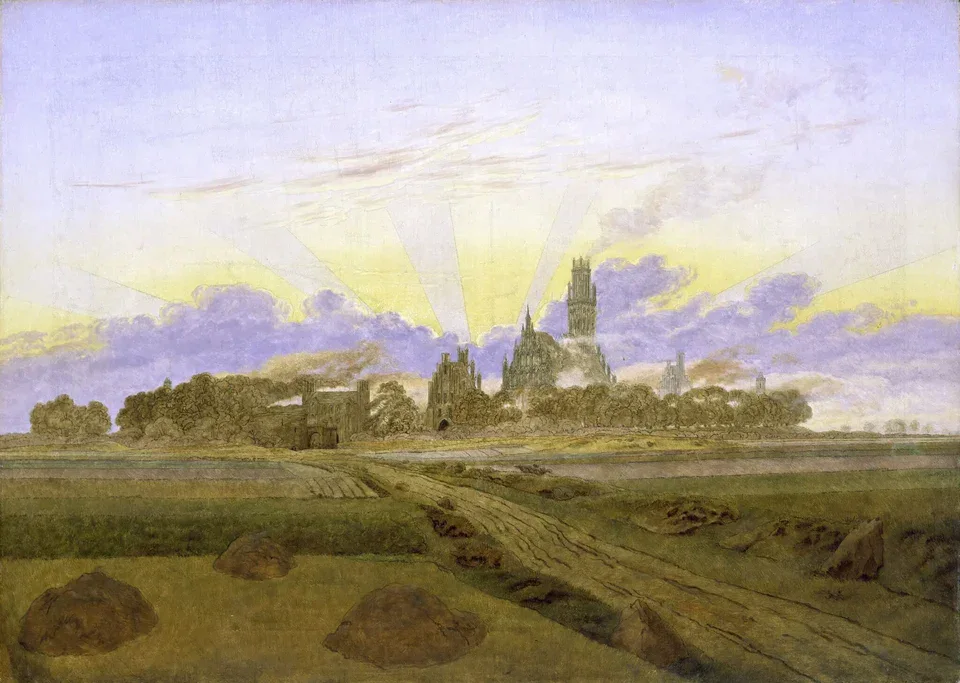
Neubrandenburg in Flames
The church is on fire. Smoke is pouring from the windows and the roof, and part of the roof is already missing. A flame seems to leap from a window. The smoke climbs toward the grey clouds behind the town, and five rays from the sun hidden there break through. A road comes between the harvested fields to the town gate. Trees ring the town, and the church rises above them. This is Neubrandenburg. Friedrich's parents were both born here, and he painted the town again and again. But nothing records a fire that he could have watched. The burning church is probably his own invention. And the tower never stood as he painted it. He gave it eight sides and no spire, following plans drawn up in 1829. The people of Neubrandenburg protested, and the Grand Duke intervened, and in the end a pointed tower was built.
Listen in the appCaspar David Friedrich · Public domain
- 11
Laying out the March Dead
Adolph von Menzel · 1848
- 12
The Twelve-Year-Old Jesus in the Temple
Max Liebermann · 1879
- 13
Portrait of Henri Rochefort
Édouard Manet · 1881
- 14
Bust of Cardinal Alessandro Peretti
Gian Lorenzo Bernini · 1622–1623
- 15
Tombs of the Fallen in the Fight for Independence
Caspar David Friedrich · 1812
- 16
Landscape with a Cottage and Trees
Jacob van Ruisdael · 1646
- 17
Simeon in the Temple
Rembrandt · 1627–1632
- 18
Portrait of Maurits Huygens (1595-1642)
Rembrandt · 1632
- 19
Seated Woman with a Spider's Web
Joachim Christian Adolf Friedrich · 1803
- 20
Tomás Pérez de Estala
Francisco Goya · 1795
- 21
Breton boys bathing
Paul Gauguin · 1888
- 22
Flora
Jan Matsys · 1559
- 23
Riding in the bois de Boulogne
Pierre-Auguste Renoir · 1873
- 24
Joash Shooting the Arrow of Deliverance
William Dyce · 1844
- 25
Lion
Albrecht Durer · 1494
- 26
Thomasaltar by Meister Francke
Master Francke
- 27
The Entrance of Emperor Charles V into Antwerp in 1520
Hans Makart · 1878
- 28
Eva
Max Liebermann · 1882–1883
- 29
Portrait of Carl Hagenbeck with the Walrus Pallas
Lovis Corinth · 1911
- 30
Self-portrait in front of an easel
Victor Emil Janssen · c. 1828
- 31
Helen of Troy
Dante Gabriel Rossetti · 1863
- 32
Mist
Caspar David Friedrich · c. 1820s
- 33
The Terrace at the Hotel Louis C. Jacob in Nienstedten on the Elbe
Max Liebermann · 1902
- 34
Adoration of the Magi
Johann Friedrich Overbeck · 1811–1813
- 35
Wreck in the Sea of Ice
Caspar David Friedrich · 1798
- 36
Man of Sorrows
Master Francke · c. 1425–1435
- 37
The Morning
Philipp Otto Runge · 1808–1810
- 38
Young woman in an interior, receiving a letter
Pieter de Hooch · 1670–1675
- 39
Eve and the Serpent
Henri Rousseau · 1906–1907
- 40
The Judgement of Paris
Anselm Feuerbach · 1869–1870
- 41
Rest on the Flight to Egypt
Philipp Otto Runge · 1805–1808
- 42
Peter on the sea
Philipp Otto Runge · 1805–1806
- 43
Selfportrait
Cornelis Pietersz Bega · 1649–1650
- 44
Solon and Croesus
Gerard van Honthorst · 1624
- 45
Our garden with blooming borders
August Macke · 1912
- 46
Christ before Pilate
Master Bertram · c. 1390–1395
- 47
De wegzending van Hagar en Ismaël
Pieter Lastman · 1612
- 48
A beautiful lie - Eckersberg
Christoffer Wilhelm Eckersberg
- 49
Caspar David Friedrich. Art for a New Age Hamburger Kunsthalle 2023/24
Unknown Artist
- 50
Aristotle and Phyllis
Leonardo da Vinci · c. 1475
- 51
Meadows near Greifswald
Caspar David Friedrich · c. 1822
- 52
Landscape with Pavilion
Caspar David Friedrich · c. 1797
- 53
The Genius of France between Freedom and Death
Jean-Baptiste Regnault · 1795
- 54
The Nativity
Master Francke · 1424
- 55
Thomasaltar, Fragment des rechten äußeren Flügels, Szene oben: Anbetung der Könige
Master Francke · 1424
- 56
Twin Birth Celebration
Jan Steen · 1668
- 57
Interior of the Nieuwe Kerk, Delft, with the Tomb of William the Silent
Gerard Houckgeest · 1650
- 58
River Landscape
Salomon van Ruysdael · 1632
- 59
Aeneas's Farewell to Dido in Carthage
Claude Lorrain · 1676
- 60
Drifting Clouds
Caspar David Friedrich · c. 1820
- 61
The Goethe Monument
Carl Gustav Carus · 1832
- 62
The Death of Orpheus
Albrecht Durer · 1494
- 63
Ossian Awakening the Spirits on the Banks of the Lora with the Sound of his Harp
François Gérard · 1801
- 64
Cloud Study with two Towers in Copenhagen
Johan Christian Dahl · c. 1825
Hamburger Kunsthalle
Frequently asked questions
How much does the guide cost?
Free app download. Free until 1 January. Listed guide price: $1.99. Audio guide only. Venue admission is separate.
Can I listen without internet?
Yes. Download the guide’s audio, images, and maps in the app before your visit. Your downloaded content is then available offline.
Can I listen in my language?
In English for now. More languages soon.
Do I need to follow a schedule?
No. This is a self-guided experience. Choose your stops, pause whenever you like, and return to a story at your own pace.
Which artworks are in the Hamburger Kunsthalle audio guide?
64 artworks, including Melencolia I (Albrecht Durer), The Sea of Ice (Caspar David Friedrich), Wanderer above the Sea younes non non non ci je ne le connais plus je t envoie moi (Caspar David Friedrich), Nana (Édouard Manet), Phryne before the Areopagus (Jean-Léon Gérôme), Three Women in Church (Wilhelm Leibl), The Hülsenbeck children (Philipp Otto Runge), and Studio Wall (Adolph von Menzel). The full list is on this page.
Is this the museum’s official audio guide?
No. Stanza is an independent audio guide app and is not affiliated with Hamburger Kunsthalle. Museum admission is separate.
At your own pace
Explore Hamburger Kunsthalle.
Download Stanza, then search for “Hamburger Kunsthalle”.
Free app download · Guide price shown in the app
Keep exploring
Audio guides — Germany
Hamburg · 1 km
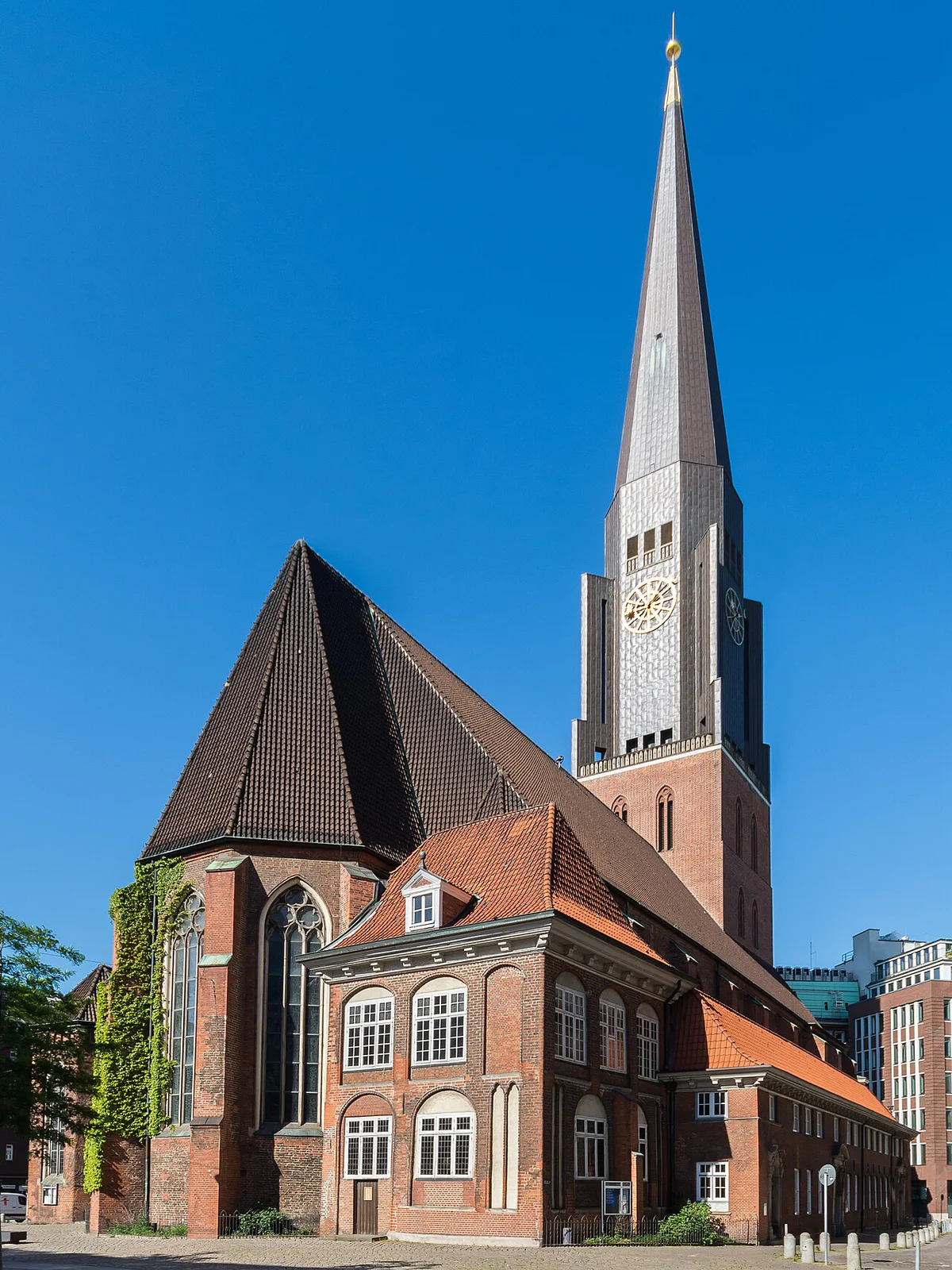
Hauptkirche Sankt Jacobi
Content & sources
Photo: Ajepbah · CC BY-SA 3.0 de
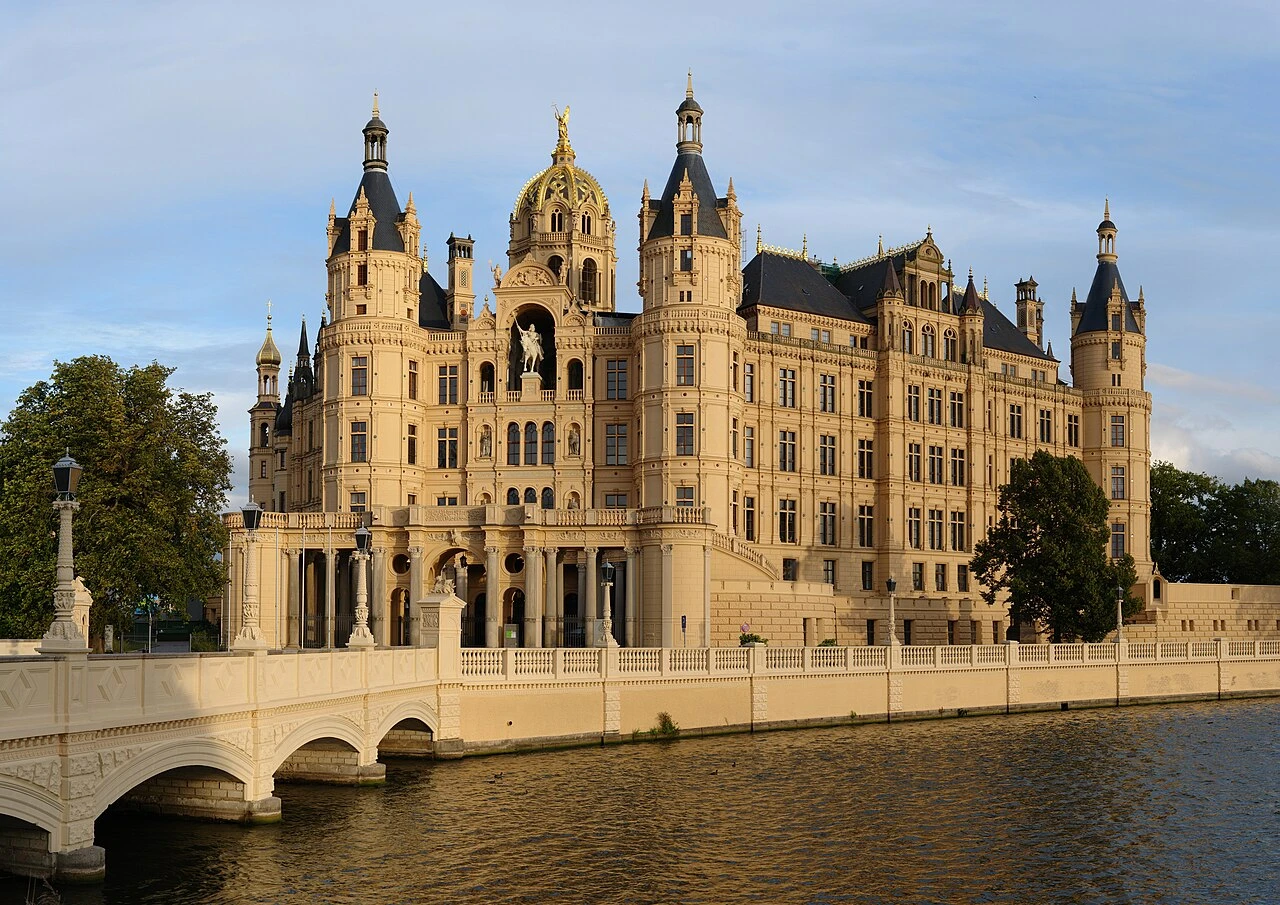
Schwerin · 94 km
Schwerin Castle
Content & sources
User:Kolossos · CC BY-SA 3.0
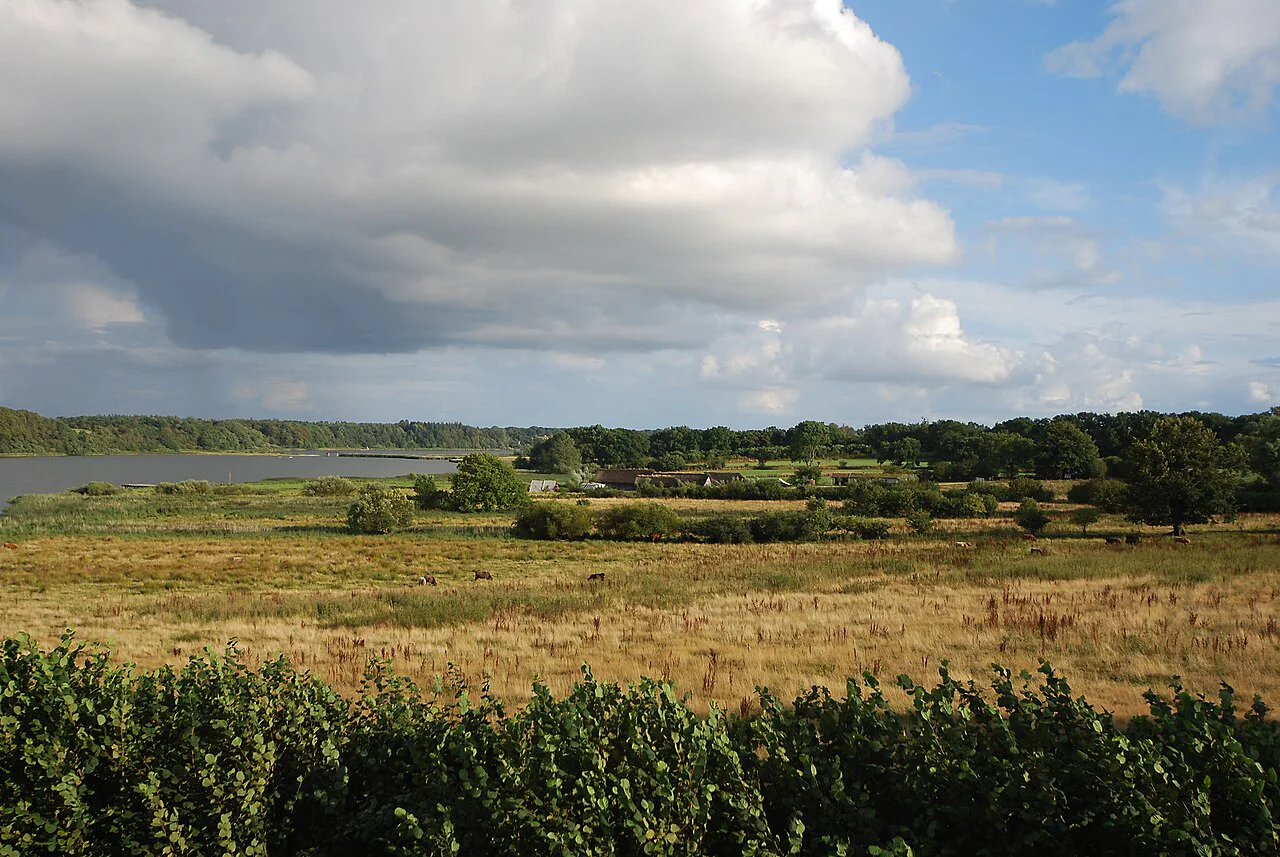
Niederselk · 108 km
Haithabu
Content & sources
Matthias Böhm · CC BY-SA 4.0
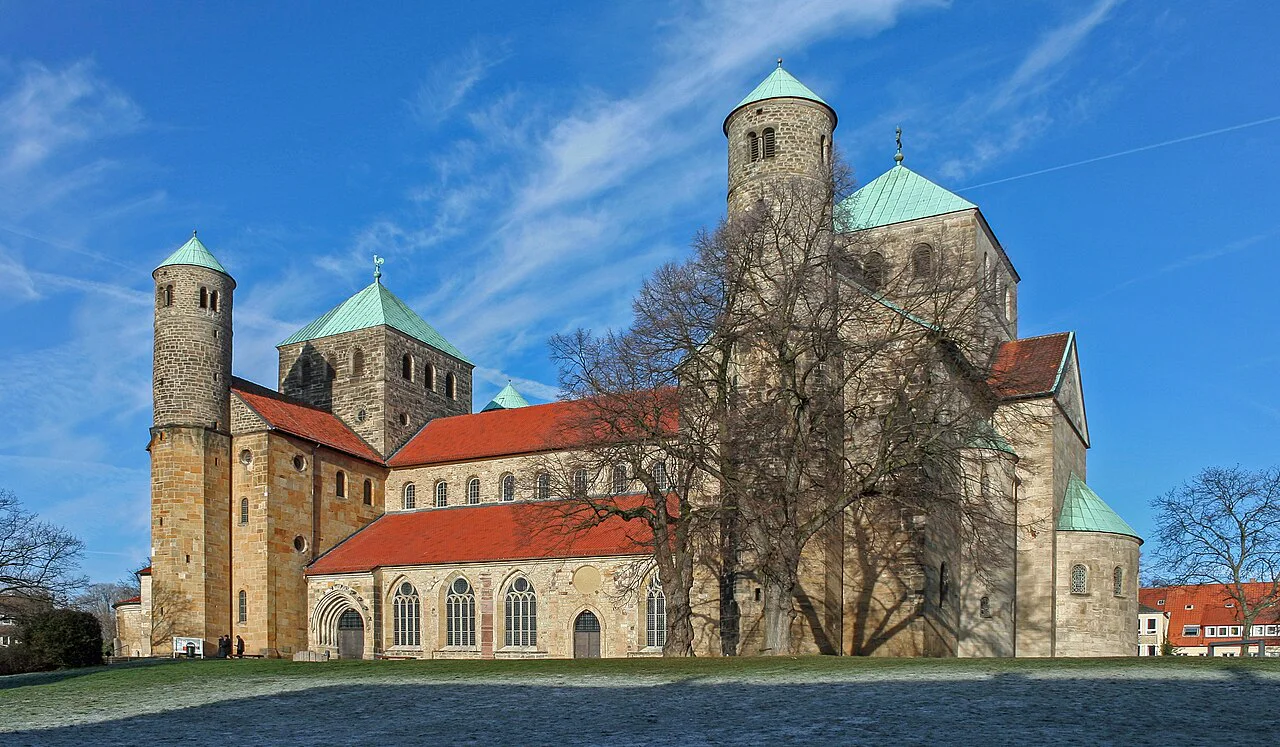
Hildesheim
Michaeliskirche
Content & sources
Heinz-Josef Lücking · CC BY-SA 3.0 de
Art museums
More art museum audio guides
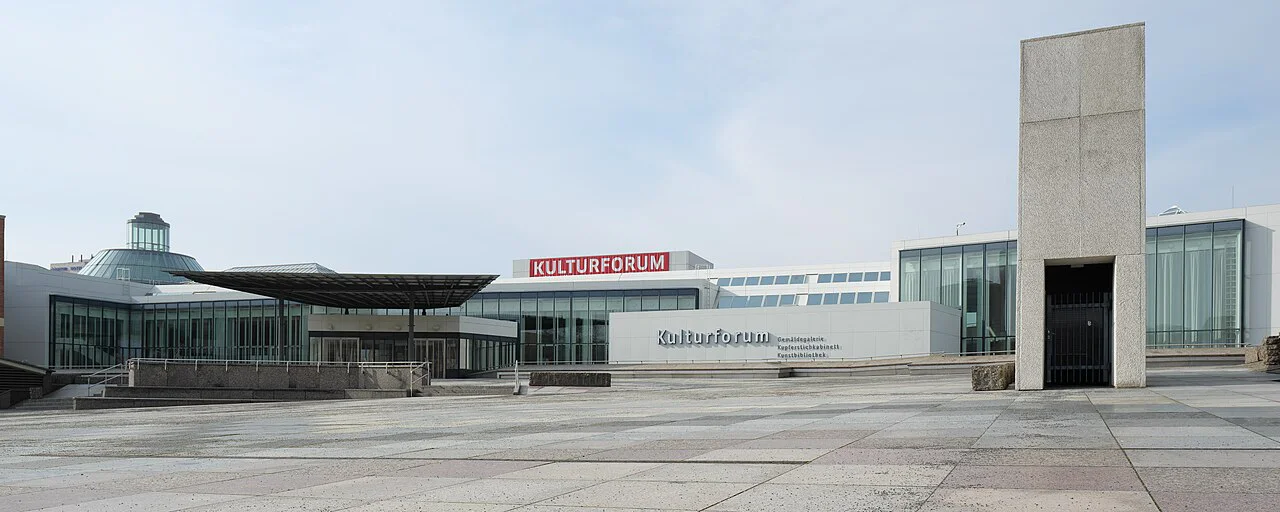
Berlin · 218 artworks
Gemäldegalerie, Berlin
Content & sources
Photo: Membeth · CC0
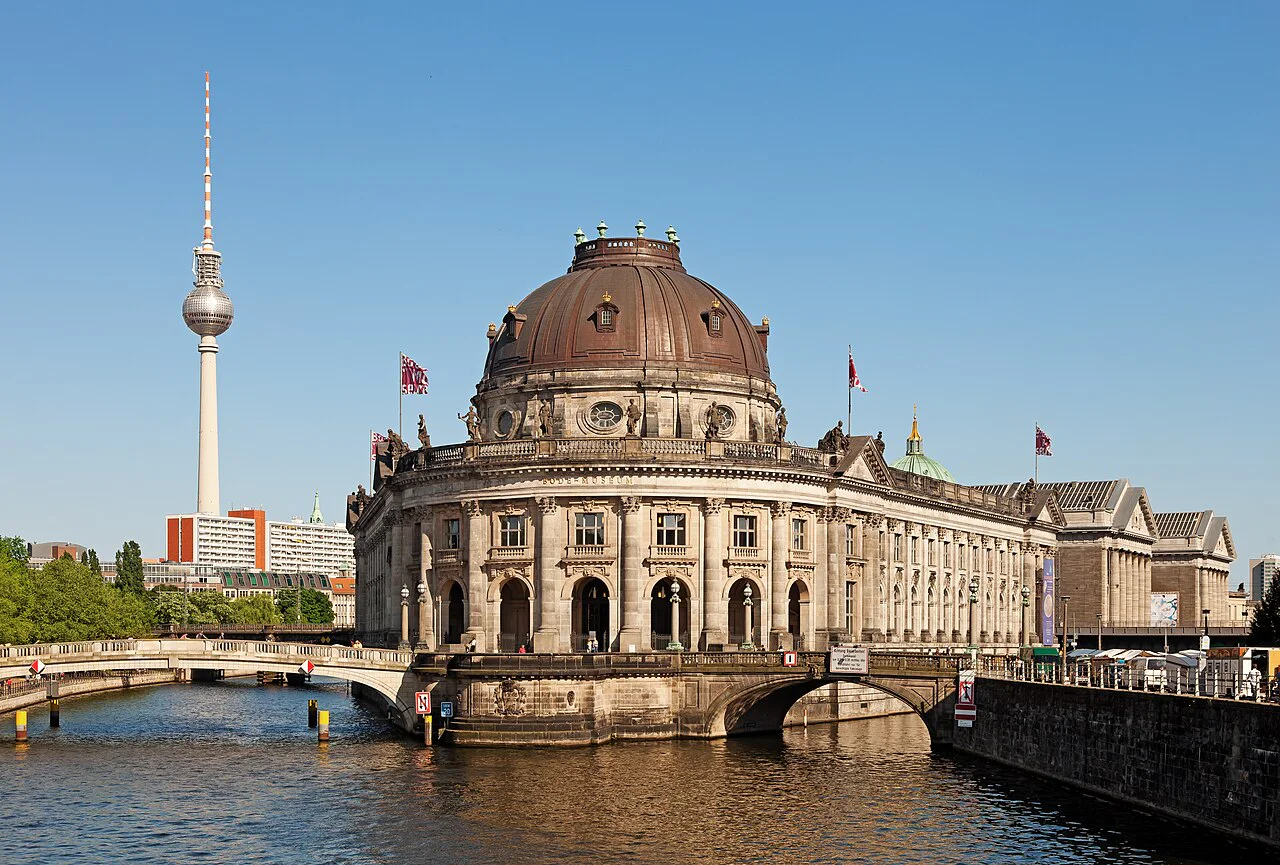
Berlin · 38 artworks
Bode-Museum
Content & sources
Thomas Wolf, www.foto-tw.de · CC BY-SA 3.0
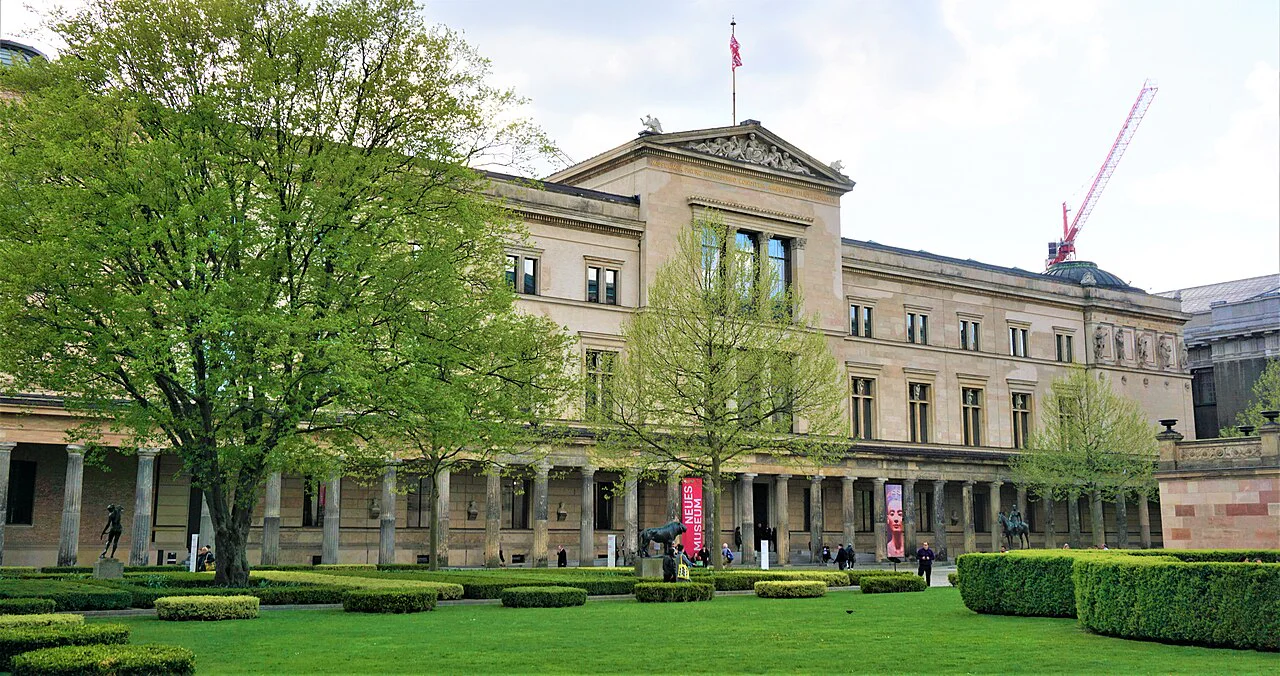
Berlin · 34 artworks
Neues Museum
Content & sources
Photo: Joyofmuseums · CC BY-SA 4.0
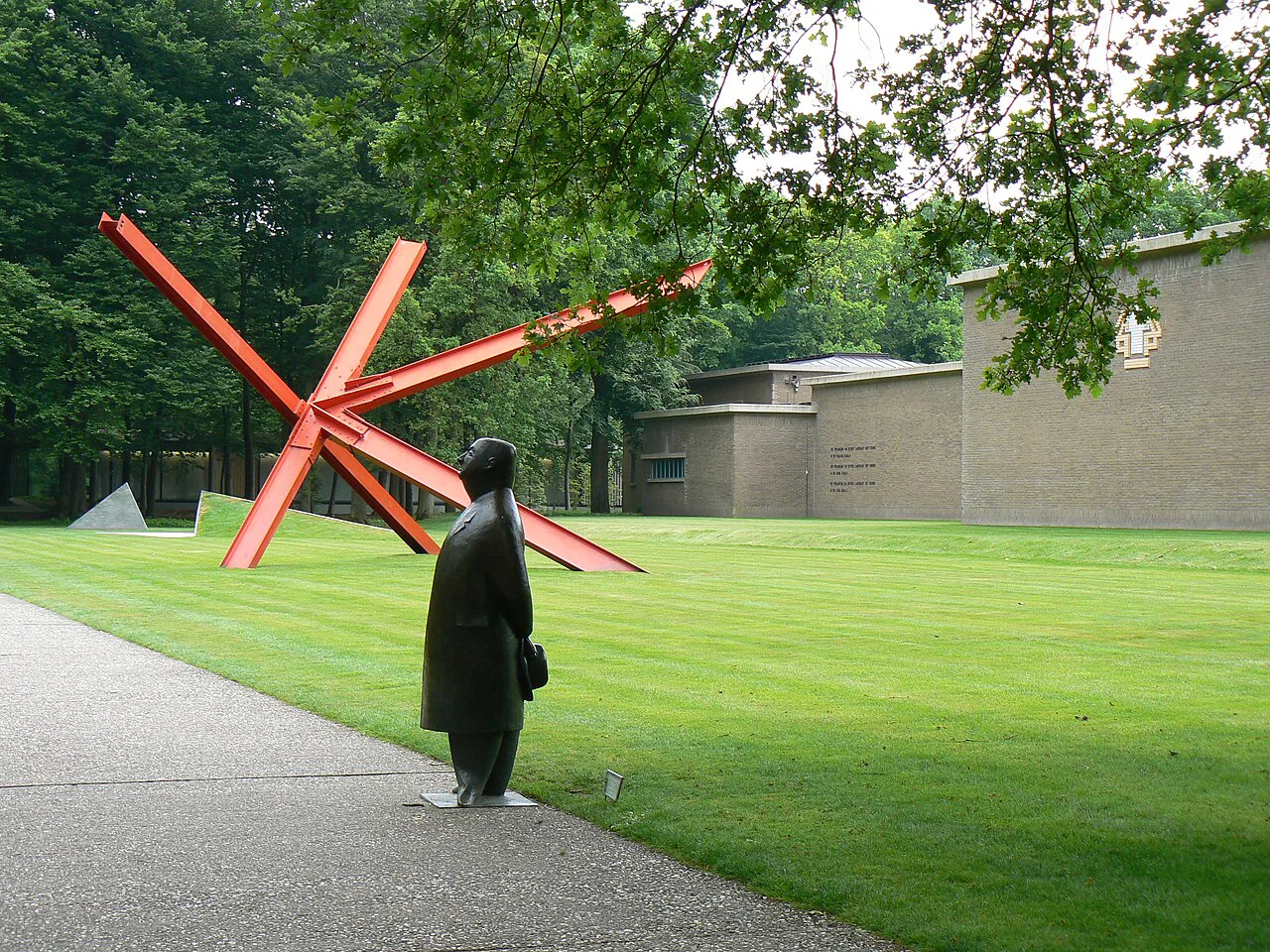
Otterlo · 60 artworks
Kröller-Müller Museum
Content & sources
Photo: Gerardus · Public domain
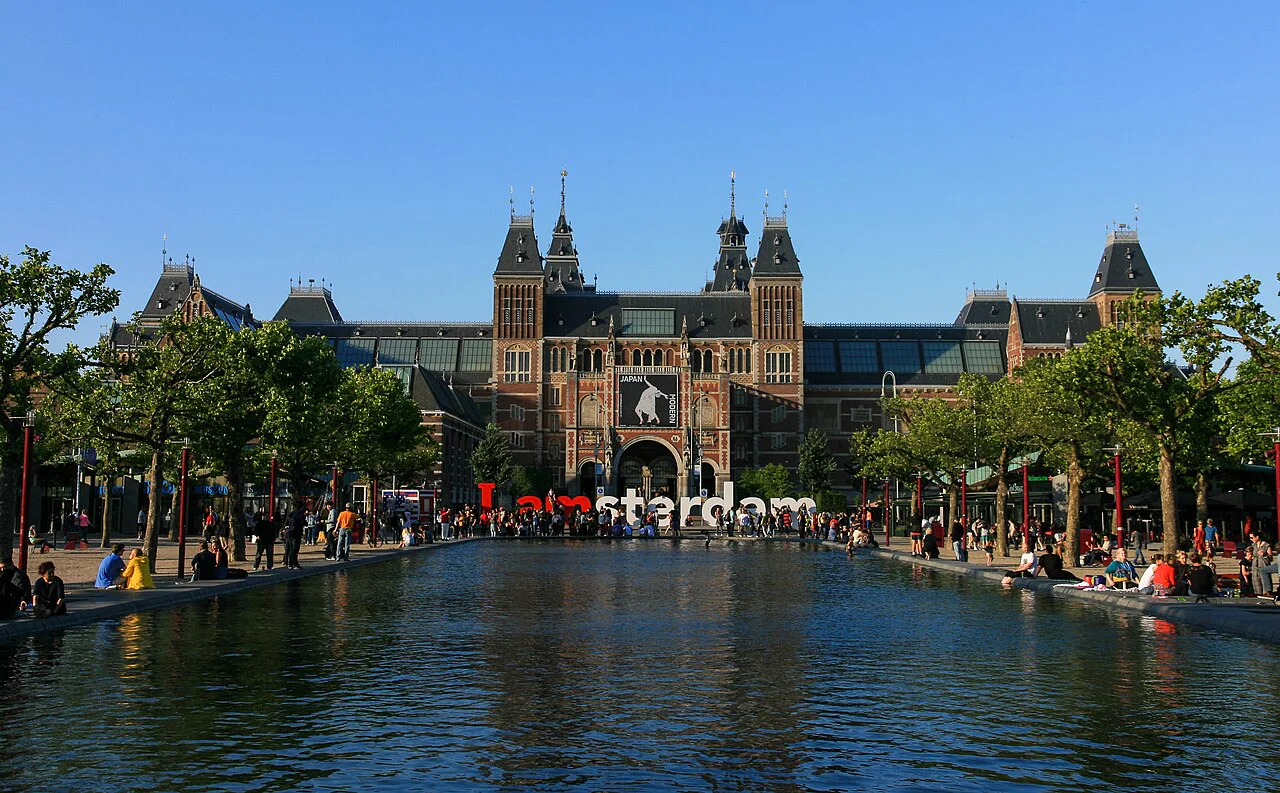
Amsterdam · 387 artworks
Rijksmuseum
Content & sources
Marco Almbauer · CC BY-SA 3.0
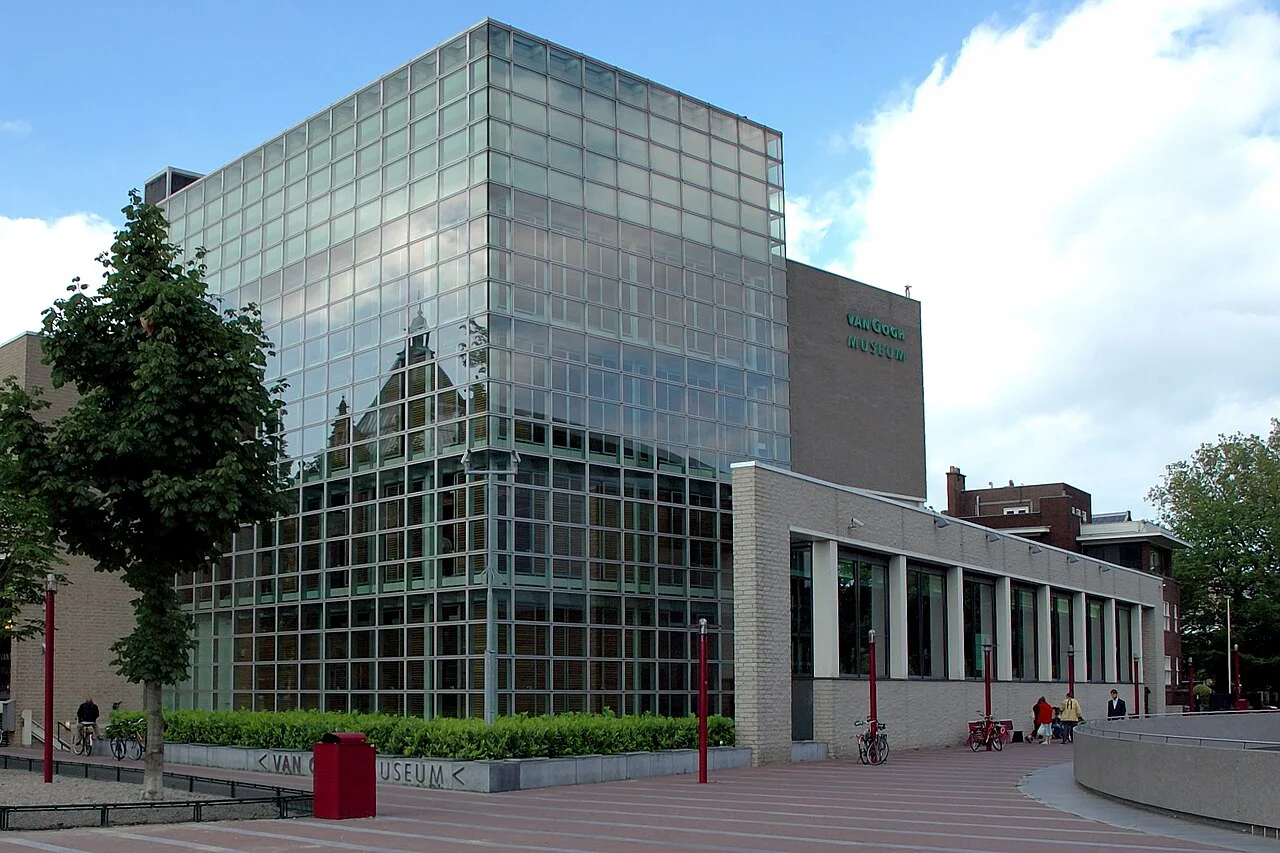
Amsterdam · 73 artworks
Van Gogh Museum
Content & sources
Warrox · CC BY 2.5