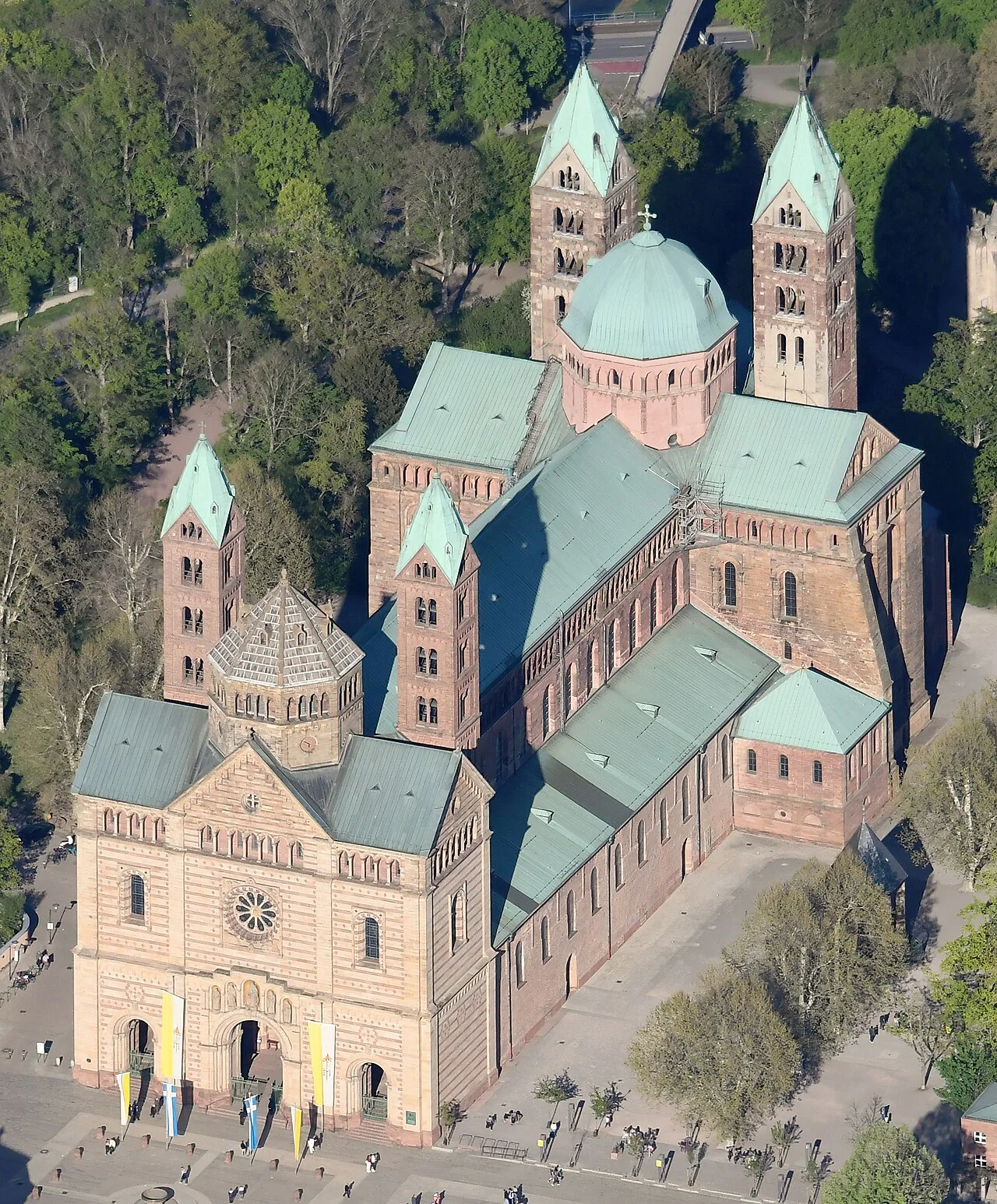
Stanza · Audio guide
Speyerer Dom Audio Guide
A place to remember. A story to take with you.
Speyer Cathedral is a historical religious building located in Speyer, Germany. It serves as the seat of the Roman Catholic Bishop of Speyer and was raised to the rank of a minor basilica in 1925.
Download Stanza, then search for “Speyerer Dom”.
About the tour
One guide. Your kind of visit.
Speyer Cathedral is a historical religious building located in Speyer, Germany. It serves as the seat of the Roman Catholic Bishop of Speyer and was raised to the rank of a minor basilica in 1925.
Ready when you are.
- 01Get the free Stanza app.
iOS & Android
- 02Find your guide.
“Speyerer Dom”
- 03Download before you go.
Works offline
Audio guide / 15 narrated stops
Inside the guide
Get to know a few of the stories before you go. Open a stop to read more.
01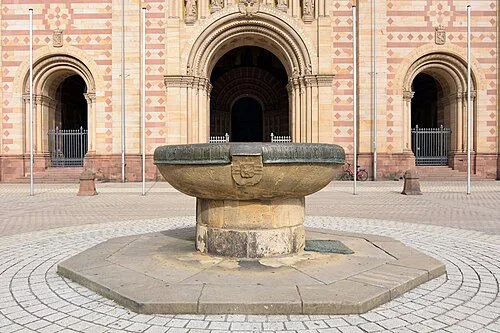 Cathedral Square & Westwerk Facade
The Domnapf and the Cathedral Square
Welcome to the Kaiserdom zu Speyer, the imperial cathedral by the Rhine. Begun in 1030, this red sandstone basilica served the Salian emperors as their church and their burial place. Rulers of the Staufer and Habsburg lines were laid here in later centuries too. After the great abbey of Cluny fell into ruin, Speyer remained the largest Romanesque church still standing anywhere in the world. The tour follows the building from this western square, through the imperial tombs, to the garden at its east end. The wide stone bowl on the square is the Domnapf, the cathedral bowl. It once marked the boundary between the bishop's territory and the town's. Whenever a new bishop was elected, he had to fill the bowl with wine. The burghers then emptied it, drinking to his health. The custom turned a property line into the town's merriest obligation.
Photo: BlueBreezeWiki · CC BY-SA 3.0
02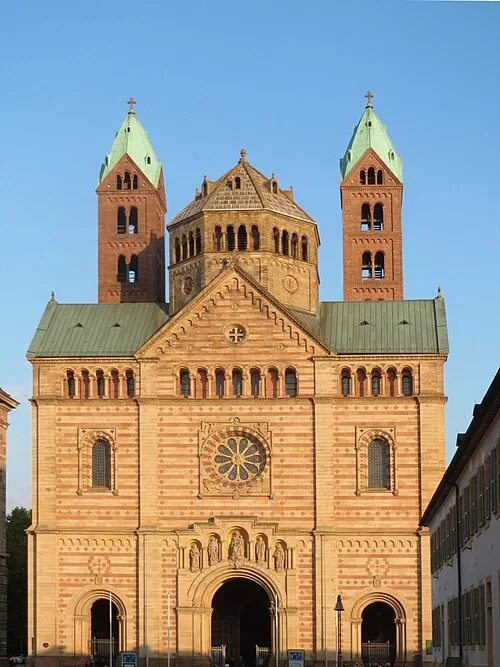 Cathedral Square & Westwerk Facade
The Neo-Romanesque Westwerk
The west front tells a nineteenth-century story. By the mid-1800s the cathedral's western block was a Baroque replacement that many felt did not suit a Romanesque imperial church. King Maximilian II of Bavaria had it taken down, and Heinrich Hübsch built the new westwork between 1854 and 1858. Hübsch worked in a Neo-Romanesque style, drawing on the original medieval westwork and on other Romanesque buildings. He scaled the windows differently, added a gable to the facade, and set a row of statues above the main portal. The sandstone runs in bands of yellow and rust, a deliberate echo of medieval polychromy. The work coincided with Romanticism and rising German nationalism, and Speyer Cathedral was elevated to a national monument. In 1981 UNESCO added it to the World Heritage List as a major monument of Romanesque art in the German Empire. The listing also notes something rarer: the building shows, in its very fabric, how attitudes to restoration have changed since the seventeenth century.
Photo: AnRo0002 · CC0
03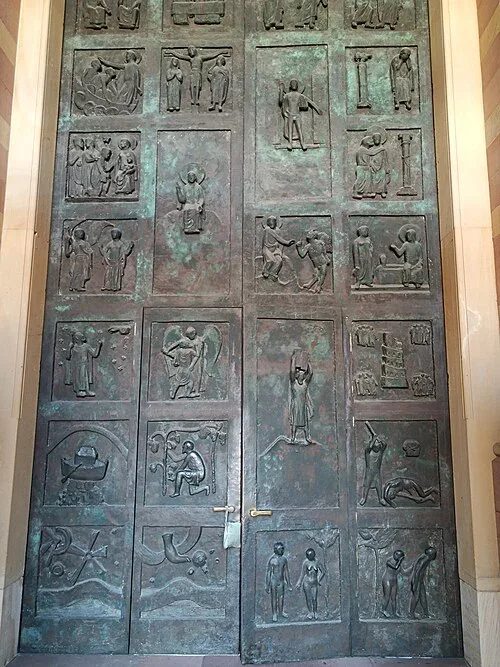 The Vorhalle Entrance
The Bronze Portal
Church doors have long been more than a way in; they taught the stories to those who could not read. These bronze portals carry rows of cast panels, scenes from the Old Testament set above scenes from the New. Near the top, Adam and Eve stand with the serpent that tempted them to eat the forbidden fruit. Lower down, a boat on the water suggests the Flood. The cathedral's original medieval portals have not survived. The bronze doors here were mounted between 1962 and 1971. Passing through them, a worshipper crossed a threshold lined with the whole sweep of sacred history.
Listen in the appPhoto: Immanuel Giel · CC0
04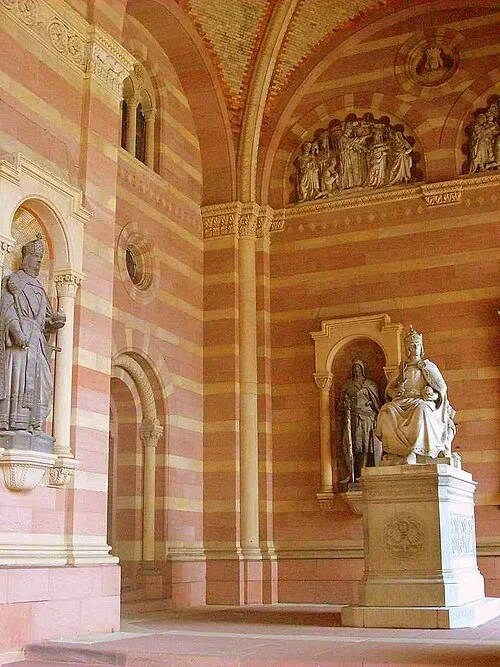 The Vorhalle Entrance
Statue of Rudolf of Habsburg
Inside the entrance hall, the walls run in stripes of red and yellow sandstone, and statues of rulers stand in the niches. This is the Kaiserhalle, the emperors' hall, and its figures remember the kings buried in the cathedral. One of them carries the best story. Rudolf of Habsburg, who died in 1291, suffered from gout. The legend says he was at Germersheim, sitting over a board game, when his doctors told him the end was near. His answer has been repeated ever since: Well then, to Speyer, where several of my predecessors lie. And so that no one need lead me there, I will ride to them myself. He set out on horseback and, so the tale goes, reached the cathedral shortly before his death.
Listen in the appPhoto: Nemracc · CC BY-SA 3.0
05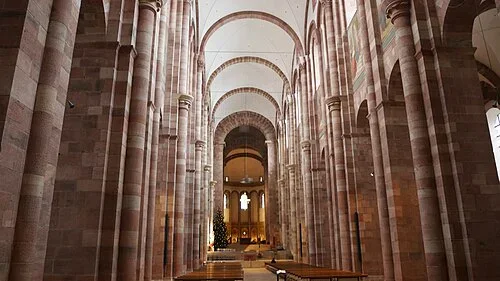 The Soaring Nave & Nazarene Murals
The Nave and Its Stone Vaults
The nave is where Speyer changed the history of building. The first church here, begun in 1030 and consecrated in 1061, had a flat wooden ceiling over the nave. Around 1090 Emperor Henry IV, grandson of the founder, tore down the eastern sections and started again. The new foundations went down as much as eight metres. The nave rose five metres higher, and the wooden ceiling gave way to a vault of stone. Each vault spans two bays of the elevation, with every second pier strengthened by a broad pilaster to carry the load. This double-bay system had only one contemporary match, in the church of Sant Vicenç at Cardona in Spain. It let the builders open tall clerestory windows high in the walls without weakening the structure. Writers describe the result as an interior of Roman gravitas, an impression well suited to a ruler with Henry's political pretensions. The finished church, Speyer II, was completed in 1106, the year Henry died. From the entrance steps to the east apse wall it measures 134 metres.
Listen in the appJosé Luiz · CC BY-SA 4.0
06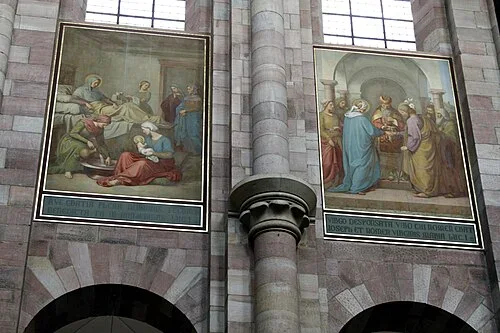 The Soaring Nave & Nazarene Murals
The Nazarene Frescoes
The paintings on the nave walls carry their own story of changing taste. At the behest of King Ludwig I of Bavaria, the painters Johann von Schraudolph and Joseph Schwarzmann covered the interior with frescoes in the Nazarene style, work that ran from 1846 to 1853. The cycle shows scenes from the life of the Virgin, set between the windows, each panel titled in Latin. Ludwig I thought nothing greater had ever been created than these paintings. Opinion turned by the start of the twentieth century. In 1916 the art historian Georg Dehio wrote, carefully, that among all the misfortunes to strike the cathedral, the alterations of the nineteenth century were not the smallest. A restoration begun in 1957 removed much of the plaster and many of the paintings, aiming to bring back the interior's original atmosphere. The cycle of twenty-four scenes from the life of the Virgin between the nave windows is what survives here.
Listen in the appJosé Luiz · CC BY-SA 4.0
07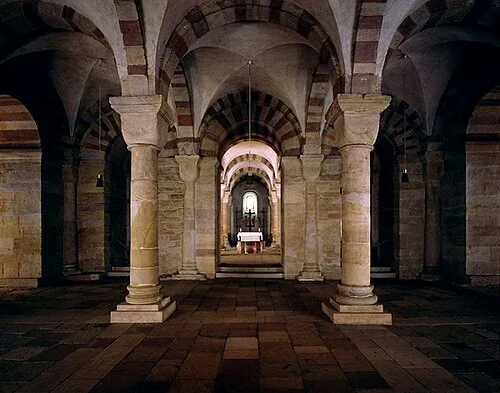 The Imperial Crypt & Kaisergruft
The Columned Crypt
Below the choir opens the great hall of the crypt, beside the vault where the rulers of the empire were laid to rest. The crypt was consecrated in 1041, while the church above was still under construction. It is the largest Romanesque columned hall crypt in Europe, a chamber of about 850 square metres. Forty-two groin vaults rest on twenty cylindrical columns with simple cushion capitals. The sandstone blocks alternate between yellow and rust, a colour scheme typical of the Salian and Staufer era, and one the nineteenth-century facade would later echo. Over the centuries crypts grew from tiny chambers into large semi-subterranean halls, and such hall crypts became the standard form in Germany and Italy.
Listen in the appPhoto: PMRMaeyaert · CC BY-SA 4.0
08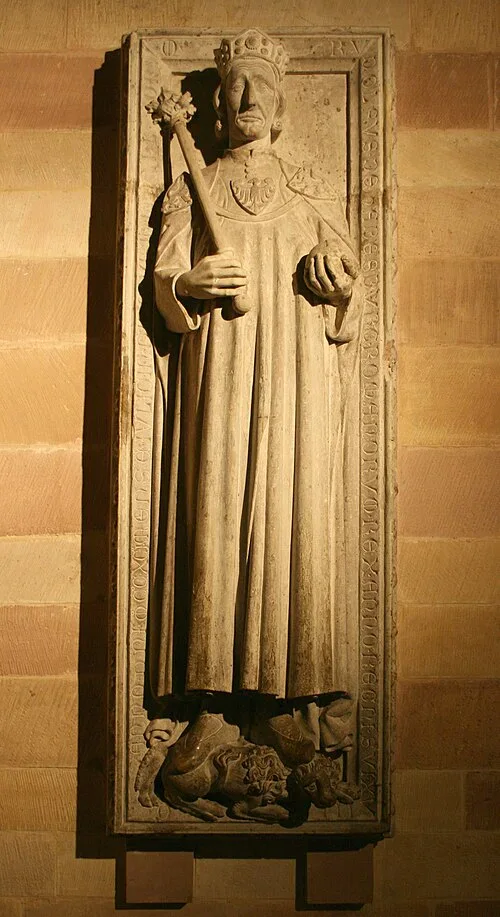 The Imperial Crypt & Kaisergruft
Epitaph of Rudolf of Habsburg
The crowned figure on this stone slab is Rudolf of Habsburg, carved in relief with a sceptre in one hand and an orb in the other, a lion at his feet. The inscription running around the border names him: Rudolf of Habsburg, King of the Romans, dead in the eighteenth year of his reign. It goes on to the day itself, July 1291, the feast of the Division of the Apostles. He is one of eight emperors and kings buried in the cathedral, together with several of their wives and many of Speyer's bishops. The last ruler buried here was Rudolf's son Albert, murdered in 1308, who joined his father. All eight were kings of Germany. To be called Holy Roman Emperor, each needed a pope's crown, and four of them died without receiving one.
Listen in the appHaselburg-müller · CC BY-SA 3.0
09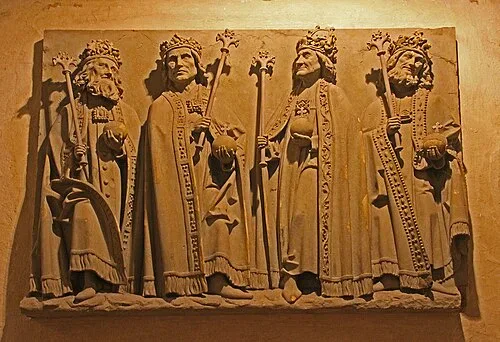 The Imperial Crypt & Kaisergruft
The Salian Emperors
Four crowned figures stand shoulder to shoulder on this relief: Conrad II, his son Henry III, his grandson Henry IV, and after them Henry V. They are the Salian emperors, the dynasty that built this cathedral. Conrad ordered the church begun in 1030, intending the largest church in the Christian West and his own last resting place. He died in 1039 and was buried in the nave while work was still going on. The scale of the project was itself a political statement. Speyer was a village of only about five hundred inhabitants, and enlarging the cathedral there struck the papacy as a blunt provocation. With its splendour Henry IV underlined his claim to power in both state and church, in his continuing struggle with Pope Gregory VII. That is why the building is read as a symbol of the Investiture Controversy. Henry IV himself died excommunicate and estranged. Only in 1111, when the ban was finally lifted, was his body laid to rest in his cathedral.
Listen in the appPhoto: Gerd Eichmann · CC BY-SA 4.0
10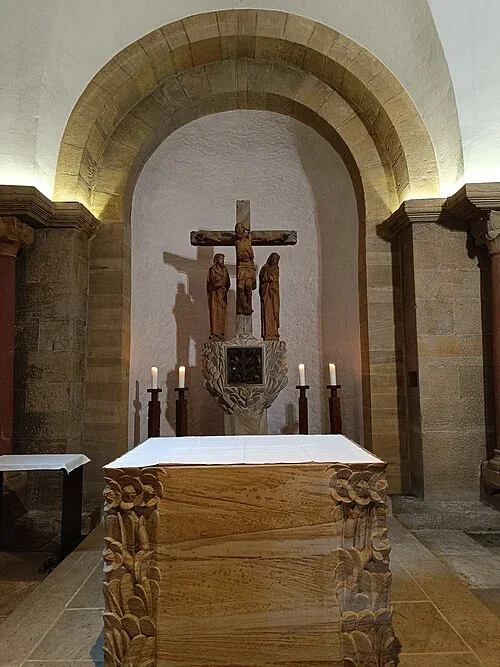 St. Afra Chapel
This northern chapel is dedicated to Saint Afra, an early Christian martyr. Henry IV had it built in her honour. It became the setting for the most awkward burial in the cathedral's history. The papal ban, in force since 1088, forbade burial in consecrated ground. So the emperor lay buried in this unconsecrated chapel until 1111, when Pope Paschalis II lifted the ban. The chapel keeps a later surprise as well. During restoration work in 1970, a parchment leaf came to light here. It had been hidden in a box of inauthentic relics, walled up in 1859. The leaf proved to be the final page of the Codex Argenteus, a Gothic translation of the Gospels. It was written around the year 500, and its text carries the closing verses of the Gospel of Mark.
Listen in the appPhoto: Immanuel Giel · CC0
- 11
The Patrona Spirensis
Mary as patron of Speyer, and the legend of the statue that greeted Bernard of Clairvaux.
- 12
The Choir and High Altar
The rounded east end where worship has continued since the church was new.
- 13
The Kaisersaal
The emperors' hall high in the westwork, under a gilded Coronation of the Virgin.
- 14
The Dwarf Gallery
The little arcade under the roofline that every Romanesque builder along the Rhine copied.
- 15
The Mount of Olives
The Mount of Olives in the garden, ruin of the fire that destroyed the cathedral's interior, later roofed and restored.
Speyerer Dom
Frequently asked questions
How much does the guide cost?
Free app download. Listed guide price: $1.99. Guide price shown in the app. Audio guide only. Venue admission is separate.
Can I listen without internet?
Yes. Download the guide’s audio, images, and maps in the app before your visit. Your downloaded content is then available offline.
Can I listen in my language?
This audio guide is available in 15 languages, including English.
Do I need to follow a schedule?
No. This is a self-guided experience. Choose your stops, pause whenever you like, and return to a story at your own pace.
At your own pace
Explore Speyerer Dom.
Download Stanza, then search for “Speyerer Dom”.
Free app download · Guide price shown in the app
Keep exploring
Nearby audio guides
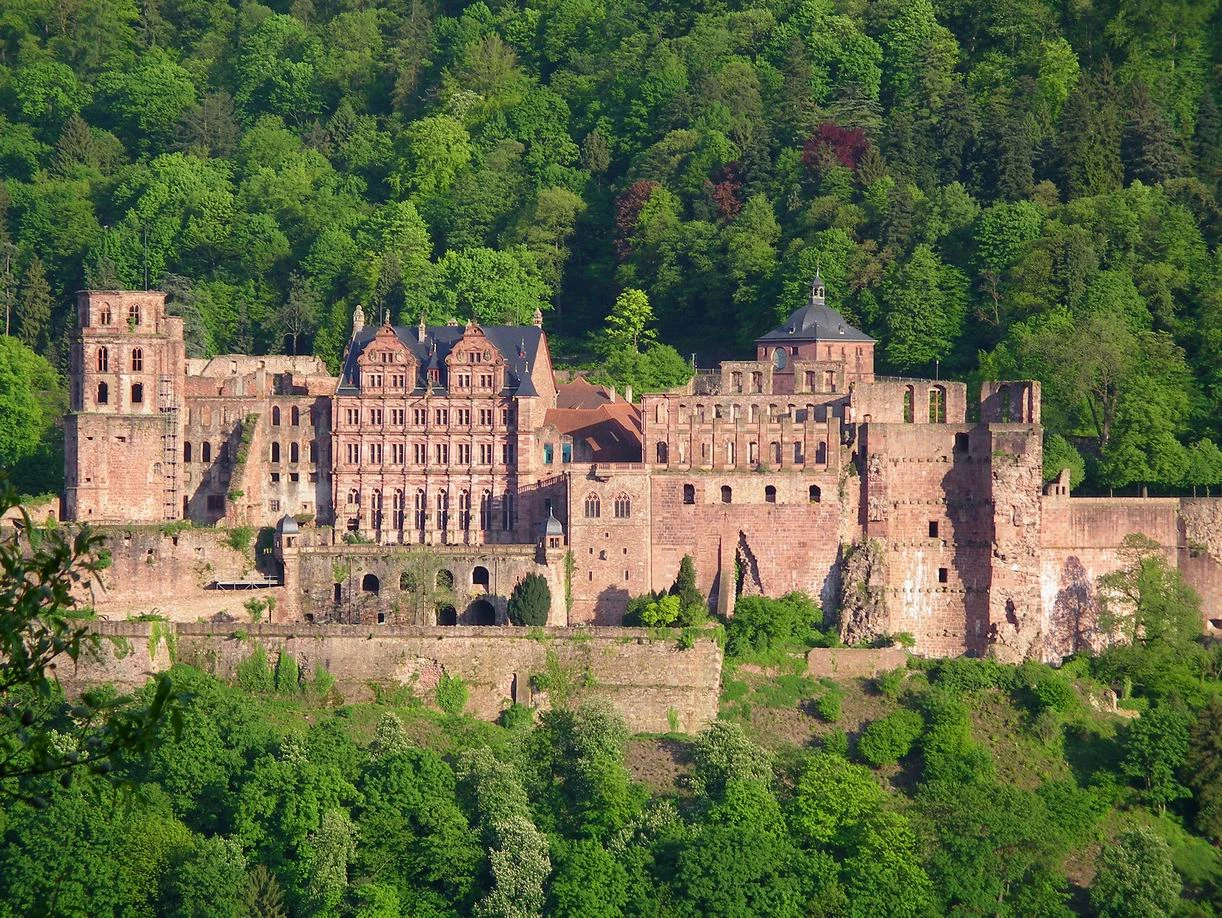
Heidelberg · 22 km
Heidelberg Castle
Content & sources
Pumuckel42 (Reinhard Wolf) at de:Wikipedia · CC BY-SA 3.0
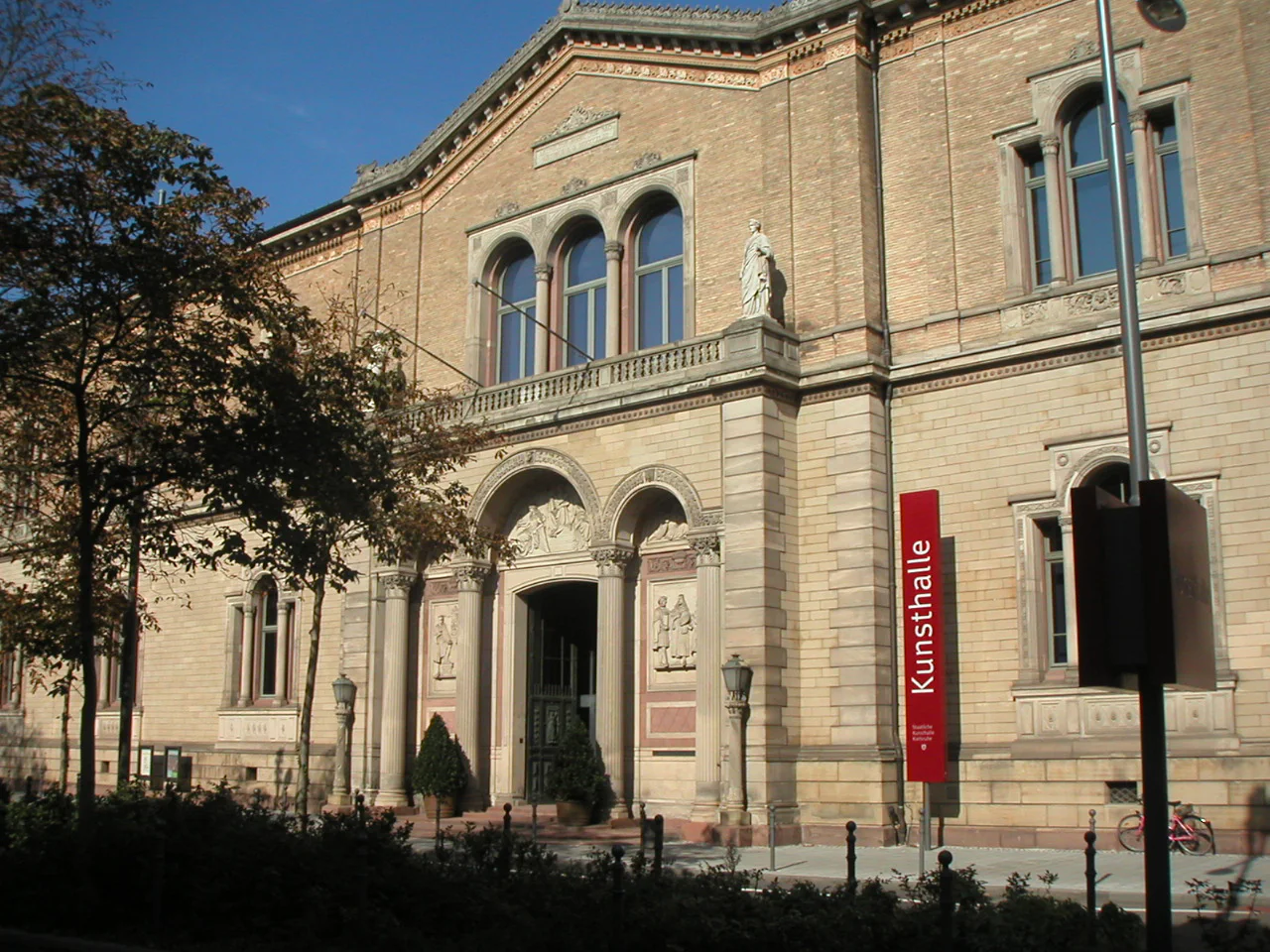
Karlsruhe · 34 km
Staatliche Kunsthalle Karlsruhe
Content & sources
Armerdietrich · Public domain
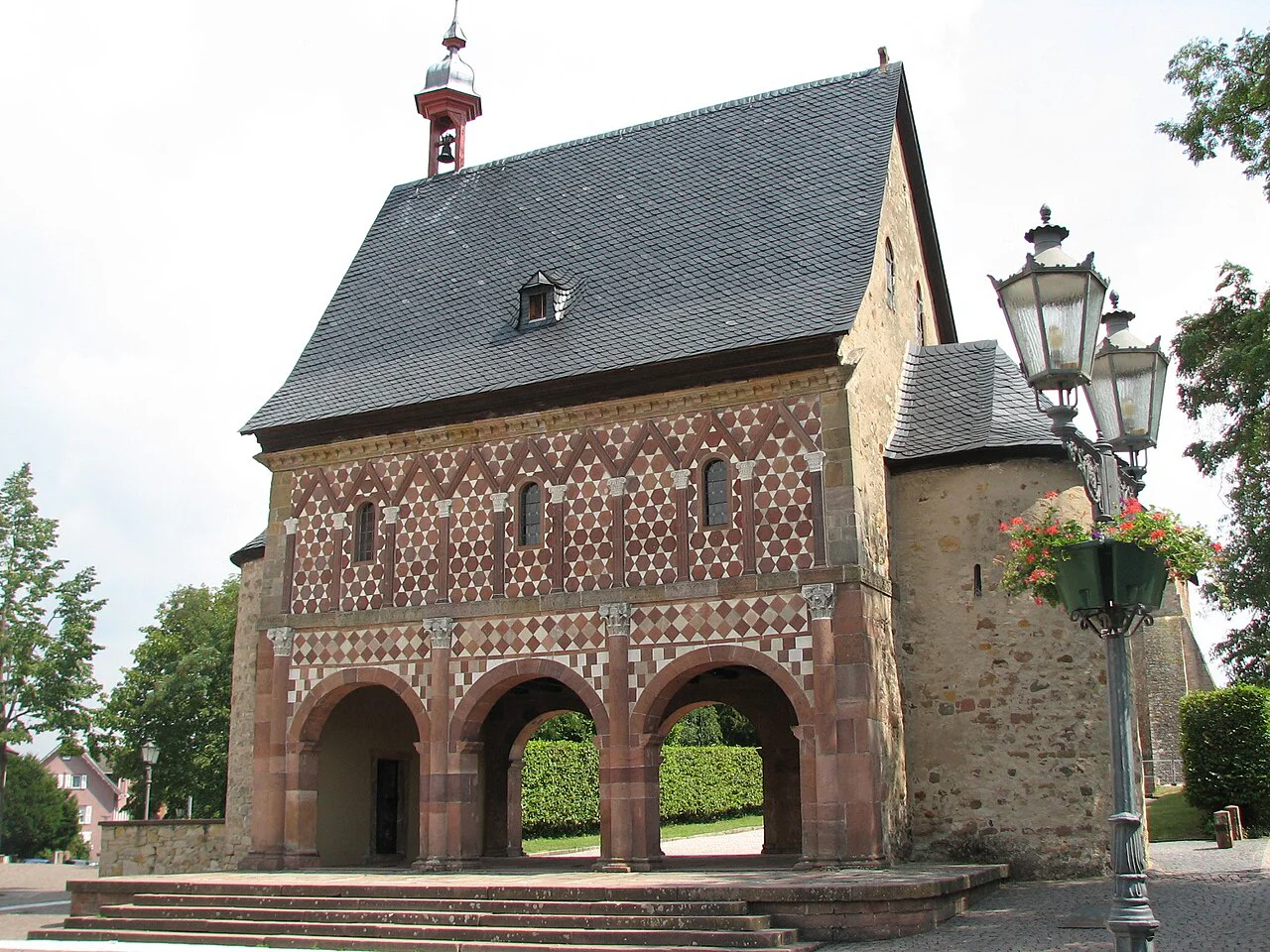
Lorsch · 39 km
Kloster Lorsch
Content & sources
Elswhs at Dutch Wikipedia (Original text: Els Slots) · CC BY-SA 3.0
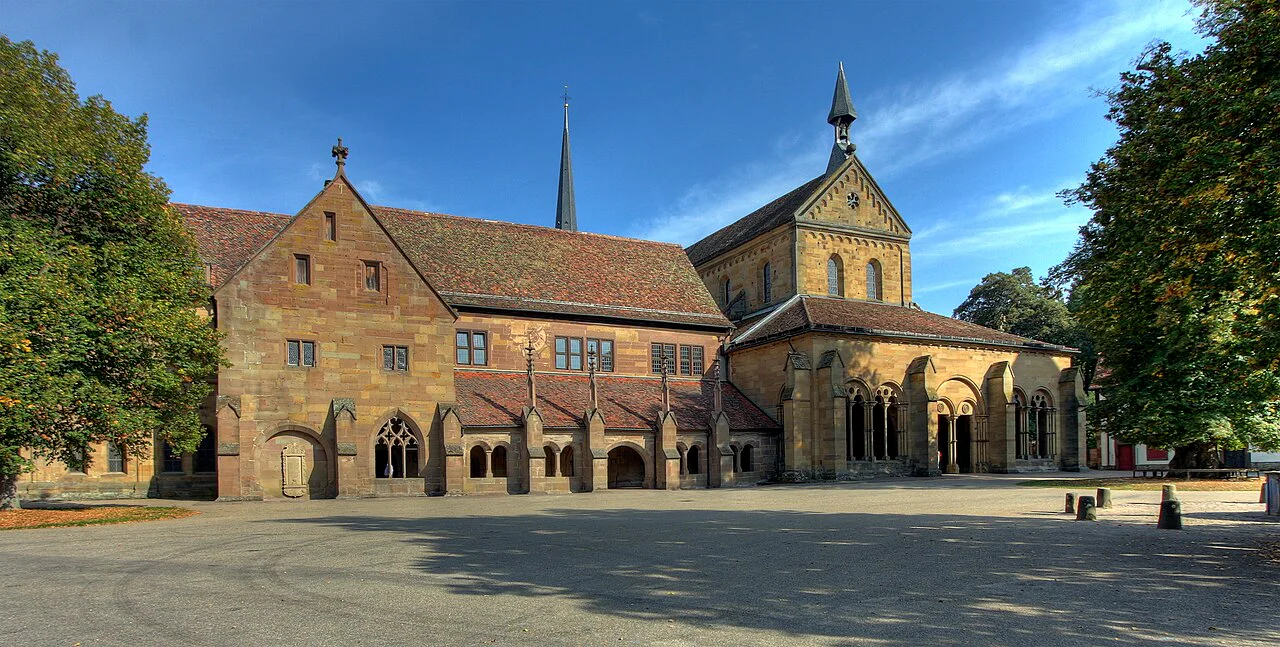
Maulbronn · 44 km
Kloster Maulbronn
Content & sources
Elke Wetzig (Elya) · CC BY-SA 3.0