Stanza · Audio guide
Staatliche Kunsthalle Karlsruhe Audio Guide
A place to remember. A story to take with you.
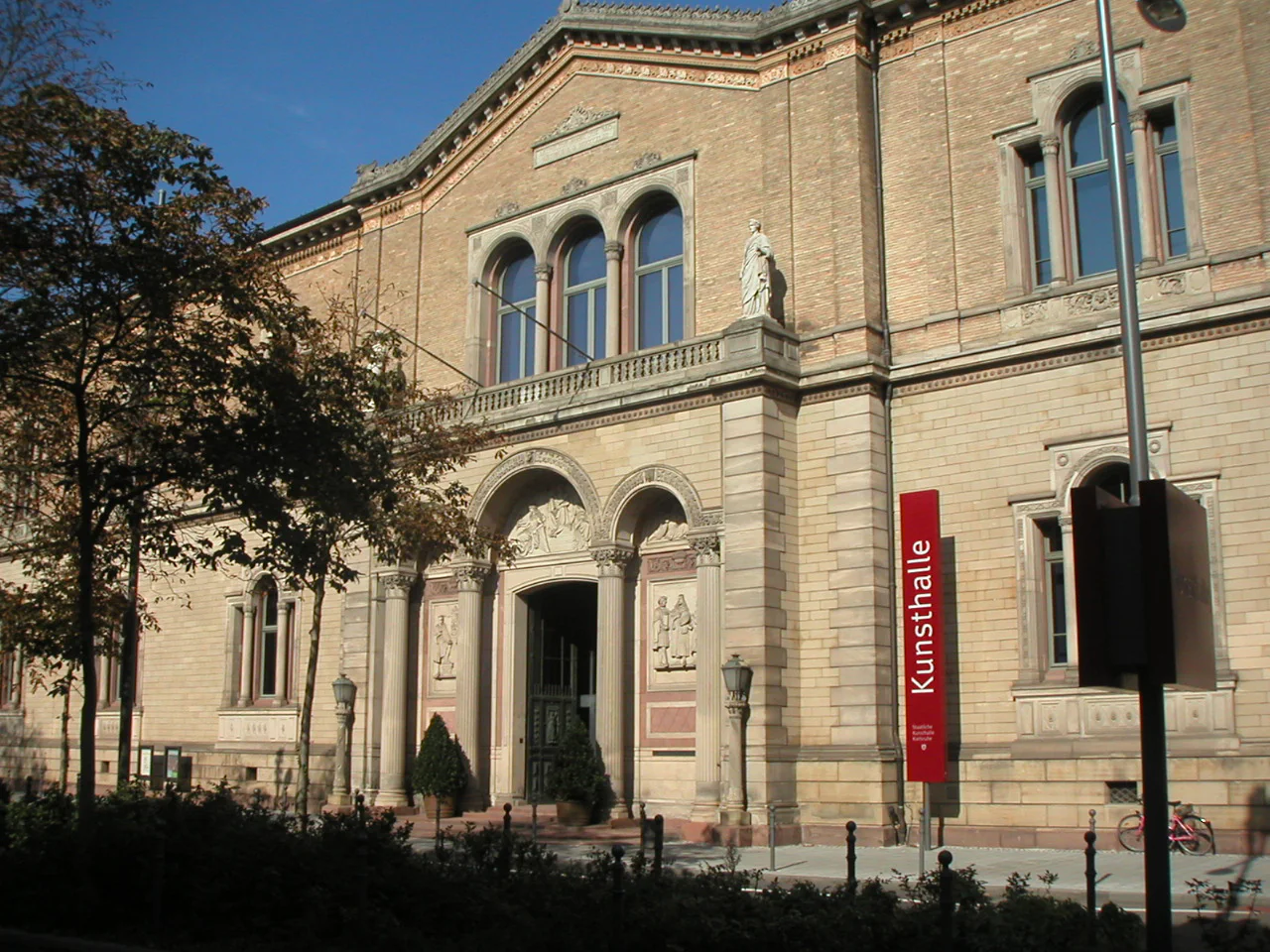
The Staatliche Kunsthalle is a fine art museum located in Karlsruhe, Germany. Its collection features works by German, French, Flemish, and Dutch masters spanning the past eight centuries.
Download Stanza, then search for “Staatliche Kunsthalle Karlsruhe”.
About the tour
One guide. Your kind of visit.
The Staatliche Kunsthalle is a fine art museum located in Karlsruhe, Germany. Its collection features works by German, French, Flemish, and Dutch masters spanning the past eight centuries.
The Staatliche Kunsthalle Karlsruhe guide tells the stories of 71 artworks, including Melencolia I (Albrecht Durer), Heller Altarpiece (Albrecht Durer, Matthias Grünewald, Jobst Harrich), Knight, Death, and the Devil (Albrecht Durer), St. Jerome in His Study (Albrecht Durer), Little Lange (Édouard Manet), Adam and Eve (Albrecht Durer), Holy Family with the Three Hares (Albrecht Durer), and Tauberbischofsheim altarpiece (Matthias Grünewald). Every artwork is free to hear in the Stanza app until 1 January.
Ready when you are.
- 01Get the free Stanza app.
iOS & Android
- 02Find your guide.
“Staatliche Kunsthalle Karlsruhe”
- 03Download before you go.
Works offline
Audio guide / 71 artworks
Inside the guide
Get to know a few of the stories before you go. Open a stop to read more.
01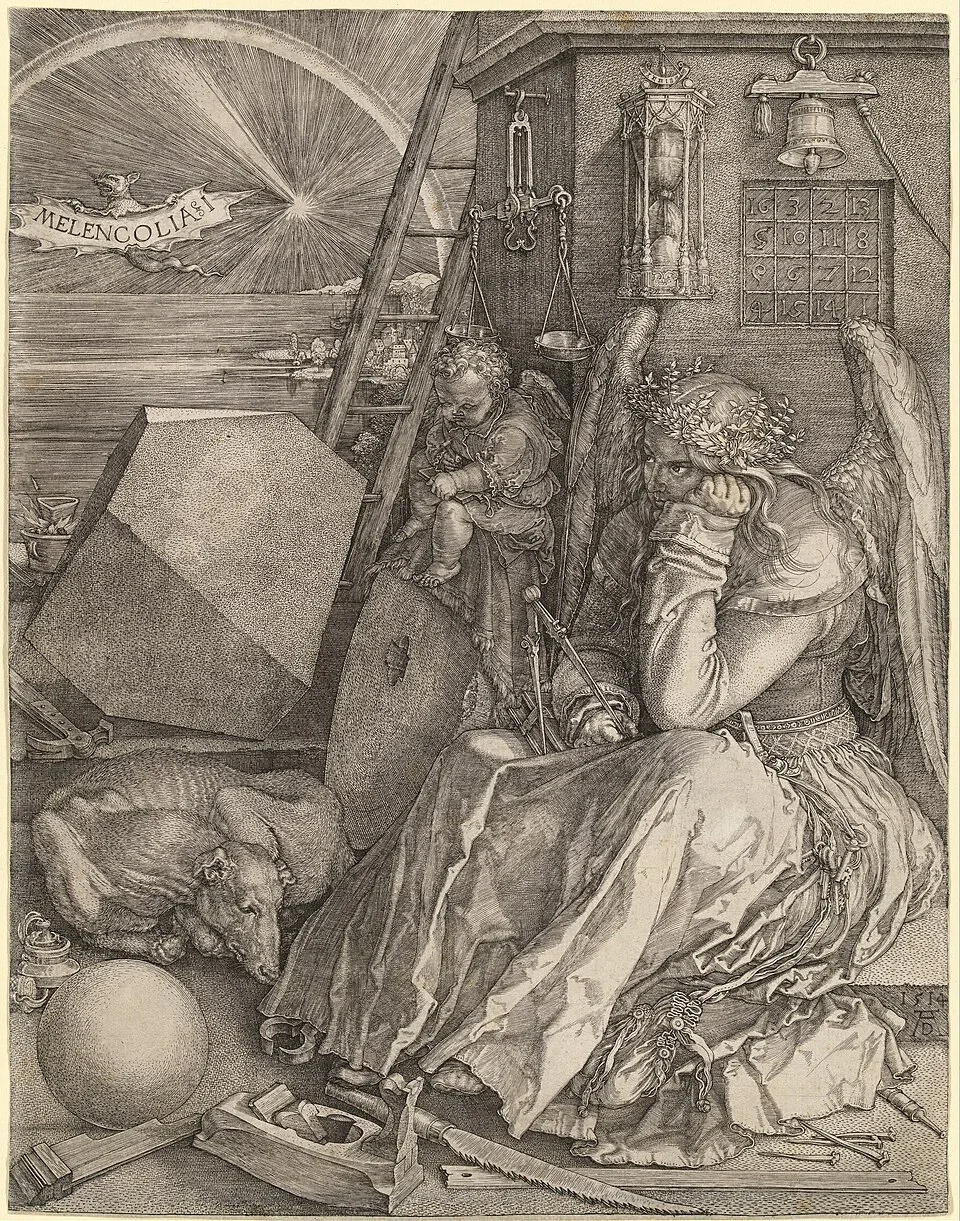
Melencolia I
A winged woman sits with her head in her closed hand. A compass lies loose in her fingers, a shut book on her lap. All around her, on the ground, lie the tools of building and measuring. A hammer, a saw, a plane and a straightedge are scattered there, with a sphere and a solid with many sides. She sits quite still, and all these things lie unused. Even the thin dog at her feet sleeps curled up. The only thing at work here is a small boy on a millstone, scribbling on a tablet. This is melancholy, the mood once linked to creative minds. Everything she needs to make something lies within reach, the measuring and building that all art rests on. And still she cannot begin. Dürer knew that feeling. He often found himself willing to create and unable to do anything, and he made that state into this figure. In the wall behind her is a square of sixteen numbers, the first ever printed in Europe. Every line adds to thirty four, and the two middle cells at the bottom give the year, 1514. That was the year his mother died, after several friends. He drew her portrait in those years. The grief may have gone into this print.
Listen in the appAlbrecht Dürer · Public domain
02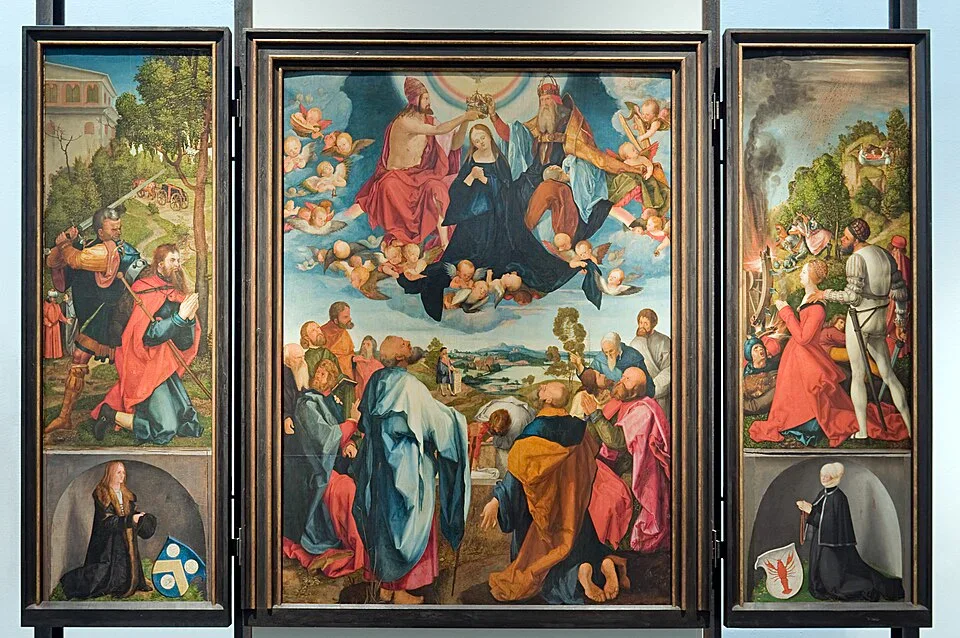
Heller Altarpiece
The center of this altarpiece is gone. Albrecht Dürer painted that panel himself, the only part he worked on alone. Early in the seventeenth century, Duke Maximilian of Bavaria bought it. Jobst Harrich, a painter known for copying Dürer, was asked to make a replacement for the altar in Frankfurt. About a century later, the original was destroyed by fire in Munich. Only the copy remains. The panels here once stood beside that center. They show the couple who ordered the whole altarpiece. Jakob Heller was a merchant in Frankfurt who had it made for the Dominican church, for himself and his wife. On the left, he kneels in a niche with his coat of arms, beneath the martyrdom of Saint James. On the right, beneath the martyrdom of Saint Catherine, is his wife, Katharina von Melem, with her own coat of arms. The two martyrs were chosen to match the names of husband and wife. The famous drawing of two praying hands was a study for one of the apostles in the center, the panel that burned.
Listen in the appMatthias Grünewald / Jobst Harrich / Albrecht Dürer / After Albrecht Dürer / After Albrecht Dürer · Public domain
03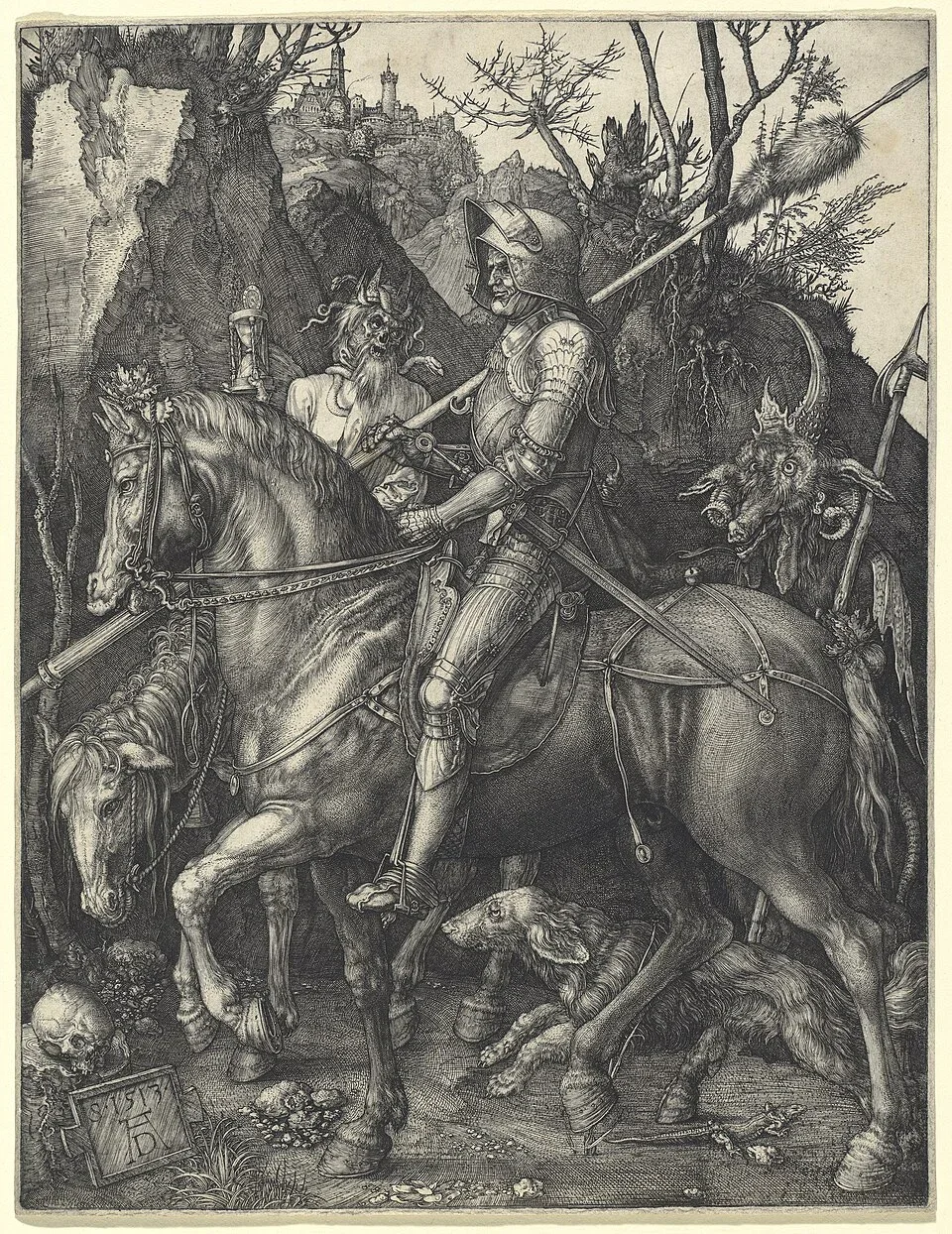
Knight, Death, and the Devil
Nobody can say for sure what this engraving means, and people have argued about it for centuries. An armored knight rides through a narrow, wild gorge, staring straight ahead. A horned devil and a rotting figure of Death, crowned with snakes, close in around him. A dog runs between the two horses, and beyond, a city rises on a hill. Read one way, the knight is the faithful Christian holding his course. An old psalm tells of walking through a dark valley and fearing no evil. Dürer used the dog in many works, and here it means faithfulness to God. The city on the hill stands for heaven. But at the top of the knight's lance is a fox tail. In early Christian symbolism the fox meant greed and cunning and treachery. Yet knights were often shown with one, worn as a charm to keep harm away. That single tail can turn the holy warrior into a robber knight, with Death and the Devil for companions rather than enemies. And in Death's hand is an hourglass, its sand exactly half full, perhaps a turning point in the rider's life.
Listen in the appAlbrecht Dürer · CC0
04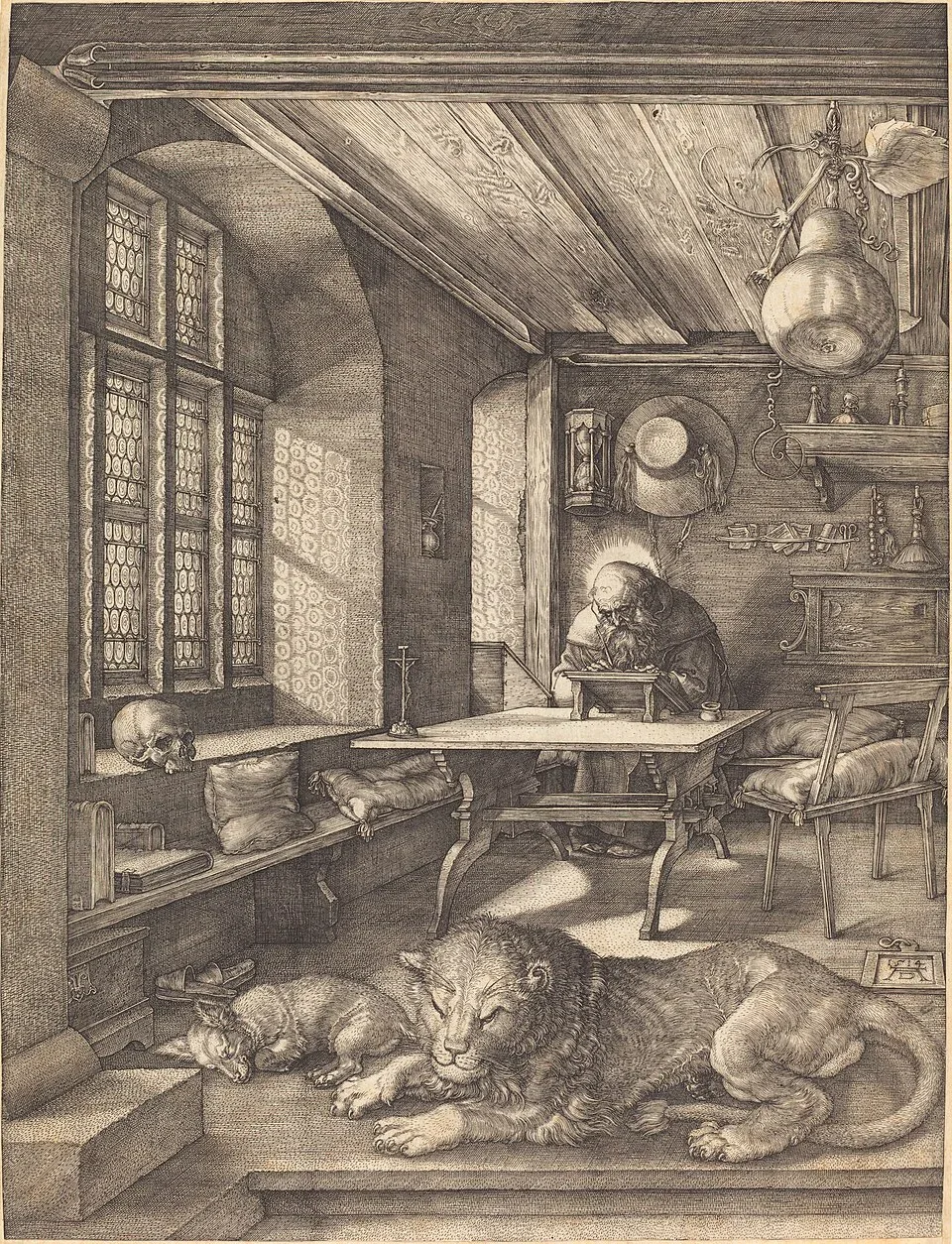
St. Jerome in His Study
Dürer made this as an engraving on copper. The fine detail went far beyond his earlier woodcut of the same subject. He took particular care with the way each object looks, and built the whole room on an exact plan of perspective. The lines of the room run together at a point to the right of Jerome, not in the middle. That point sits close to the edge of the picture. It is why the room feels so near, yet so hard to place yourself in. That closeness belongs to Jerome, not to you. He is absorbed in his work at the desk, with his lion and his sleeping dog resting in front of him. This print has two companions, Melencolia One and Knight, Death and the Devil, close to it in size. Whether he meant the three as a set is still not known.
Listen in the appAlbrecht Dürer · CC0
05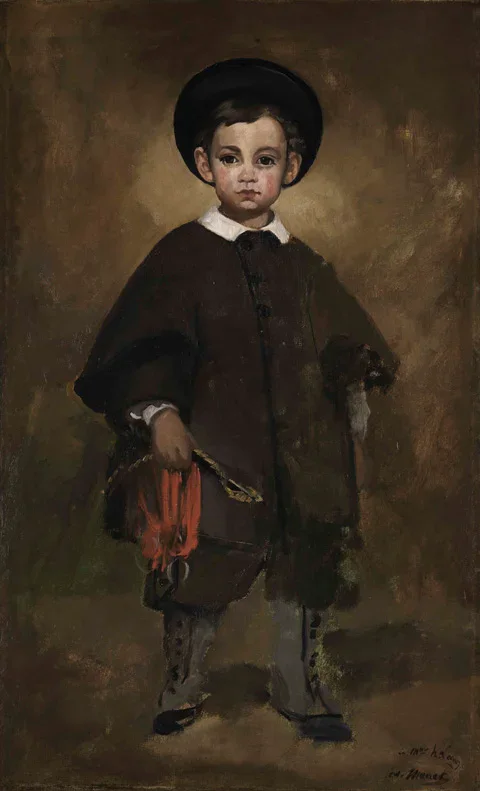
Little Lange
Who is this boy? A child of about five faces you at life size, his legs a little apart. He wears a round black hat pushed back and a dark Sunday suit. In his right hand he holds a braided riding whip and a red bridle, yet he stands quite still, not playing. His dark eyes seem to meet your own, serious and almost melancholy, and his face is finished more carefully than the rest. The Langes were friends of the painter. Madame Lange came to the Tuesday gatherings his wife and mother held each week. The boy's father was Daniel Adolphus Lange, who worked with Ferdinand de Lesseps on the Suez Canal. In 1916 Théodore Duret, the painter's friend, wrote to a Danish collector that the child was one of Monsieur Lange's sons. Which son? Even the research for the Manet exhibitions in Paris and New York in 2002 and 2003 left that unsettled. In the lower left corner, below his signature, Manet wrote a dedication to a Madame H. Lange. That letter might just as well be an N.
Listen in the appÉdouard Manet · Public domain
06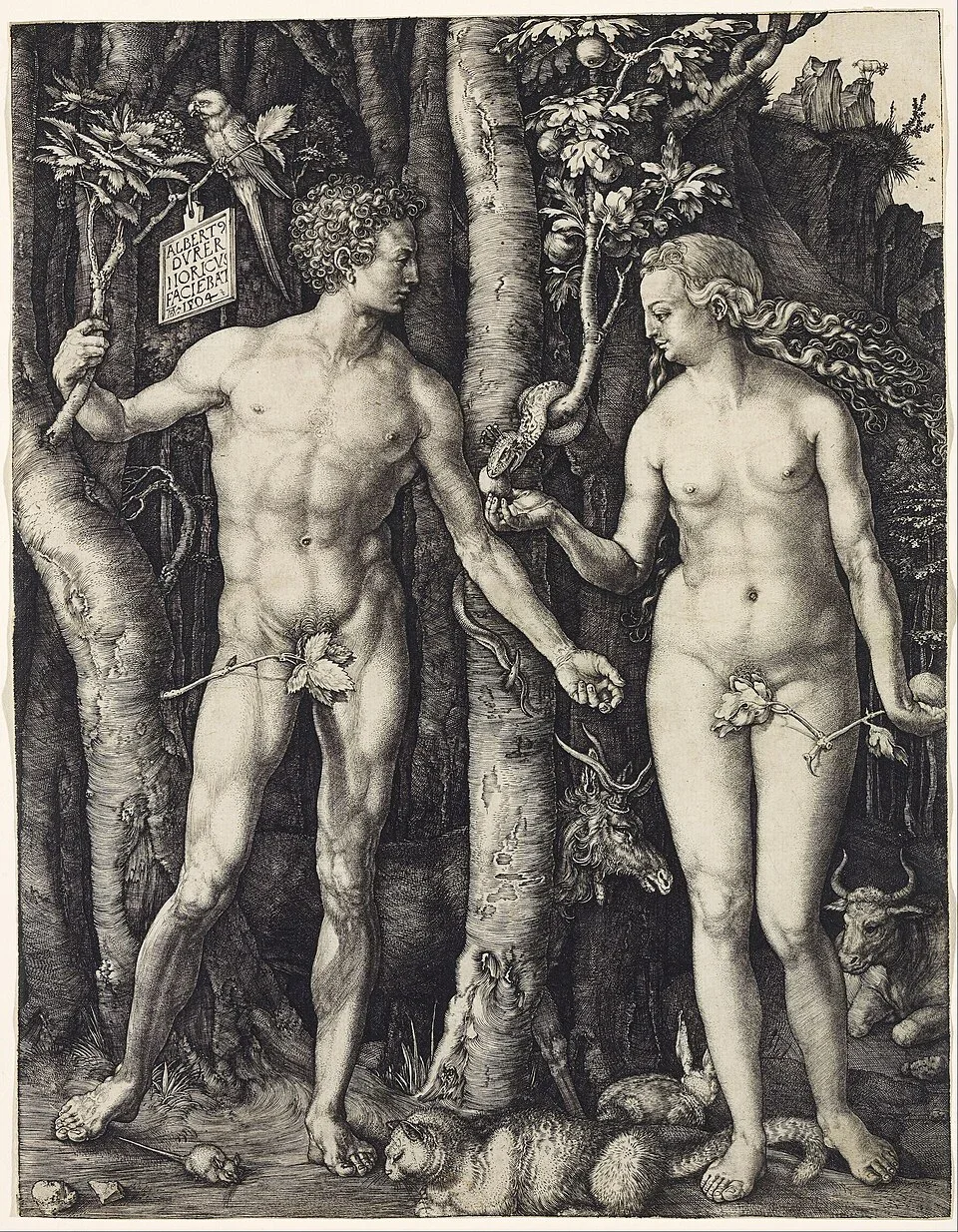
Adam and Eve
There are a cat and a mouse in the forest. They are a hint of the aggression to come. Around them, an elk, a rabbit, a cat and an ox stand for the four human temperaments. In Paradise these four hold together in balance. The Fall is what breaks that balance, and brings sickness and death into the world. This print catches the moment just before the Fall. The serpent holds out the fruit, Eve takes it, and Adam accepts it from her. In a moment they will eat. Dürer had spent years working out the perfect proportions of the human body. He posed these two like statues of Apollo and Venus, in their uncorrupted beauty before the Fall. In the trees, a parrot stands out against the dark northern forest. It points to Mary, the new Eve, who will put right what this Eve is about to do.
Listen in the appAlbrecht Dürer · Public domain
07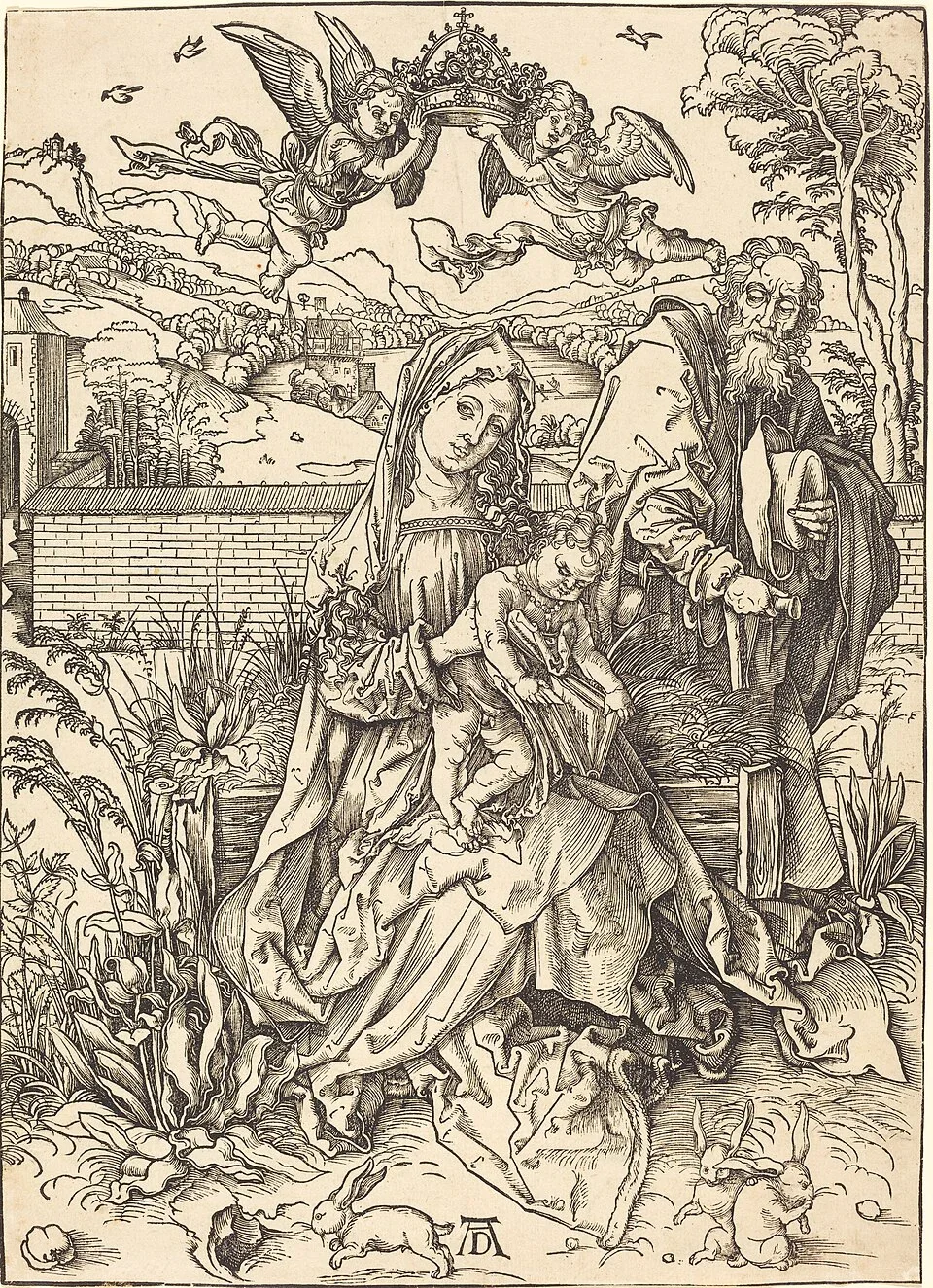
Holy Family with the Three Hares
When Albrecht Dürer set out to make this print, he wanted to show how fine a line a block of wood could carry. It shows in the free, finely varied lines, quite unlike earlier woodcuts. The scene is full of meaning. The wall that shuts the garden off from the wide landscape stands for Mary's virginity. The three hares along the bottom stand for her fertility and for the Trinity. Above her, two angels hold a crown, bringing the Coronation of the Virgin into this family scene. And at the child's neck, the coral beads are like drops of blood. They were meant to guard him from the plague, and pointed ahead to his death on the cross.
Listen in the appAlbrecht Dürer · CC0
08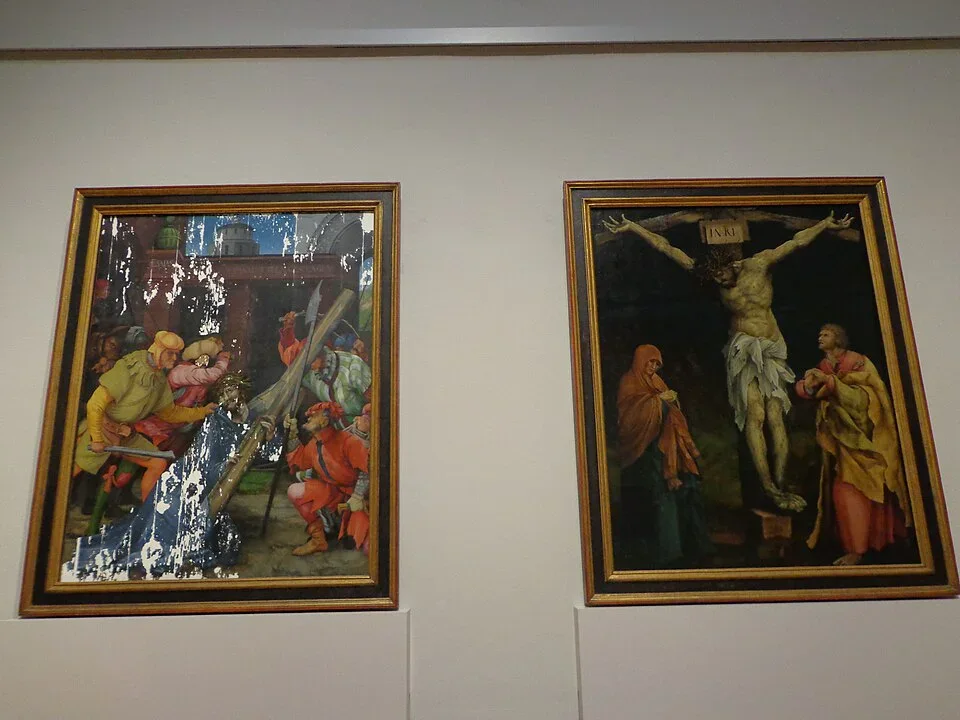
Tauberbischofsheim altarpiece
Christ carries the cross. The figures are shown through their own expressive gestures, not the usual symbols painters reached for. But this was never made to hang alone. It is one side of a single wooden panel, and on the other Grünewald painted the Crucifixion. The panel was probably made for the church at Tauberbischofsheim, and it was built to be walked around. From the choir, people saw Christ carrying the cross. From the nave, they saw the Crucifixion. No one knows who ordered it, though the patron was probably tied to the cathedral in Mainz. In 1883, so both pictures could hang as ordinary paintings in a gallery, the panel was split in two. The two faces that once shared a single piece of wood have hung apart ever since.
Listen in the appMatthias Grünewald · CC BY-SA 4.0
09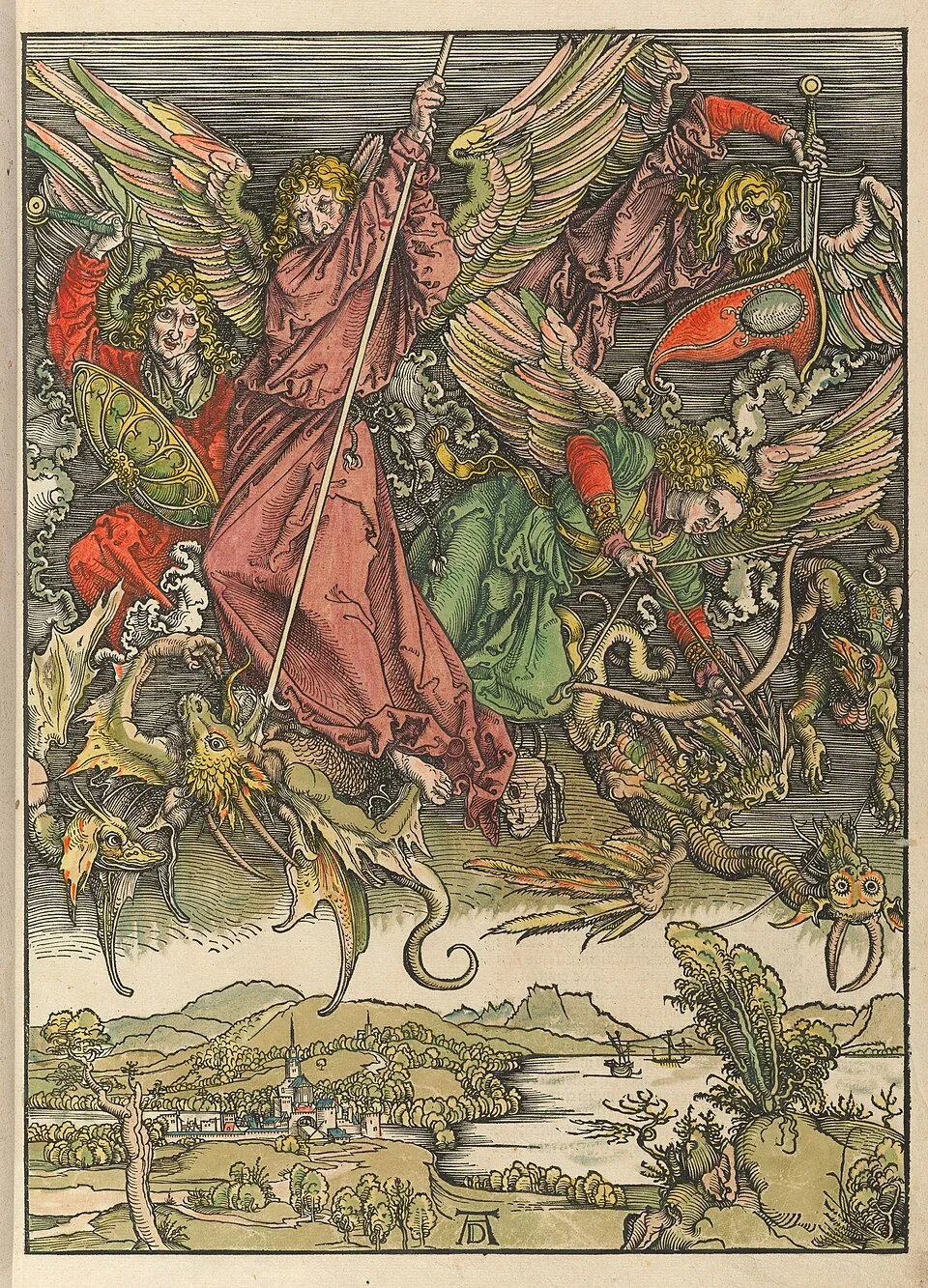
Saint Michael Fighting the Dragon
How do you show the final battle between good and evil? Not with a hero showing off. Here Michael drives a huge spear into the dragon's throat with both hands, his brows tight with effort. Dürer dropped the old poses artists had used again and again, the ones meant to appear graceful and relaxed. This Michael is serious, and that one thrust runs the whole scene. Around him other angels fight the monsters as swordsmen and archers. The dragon has seven heads, one for each of the deadly sins. And beneath the fighting lies a quiet landscape of mountains, a small town, and a distant church with a tall spire, perfectly calm. At the bottom center are the letters AD, the artist's own mark. He made it as one of a series of woodcut prints on the Book of Revelation.
Listen in the appAlbrecht Dürer · Public domain
10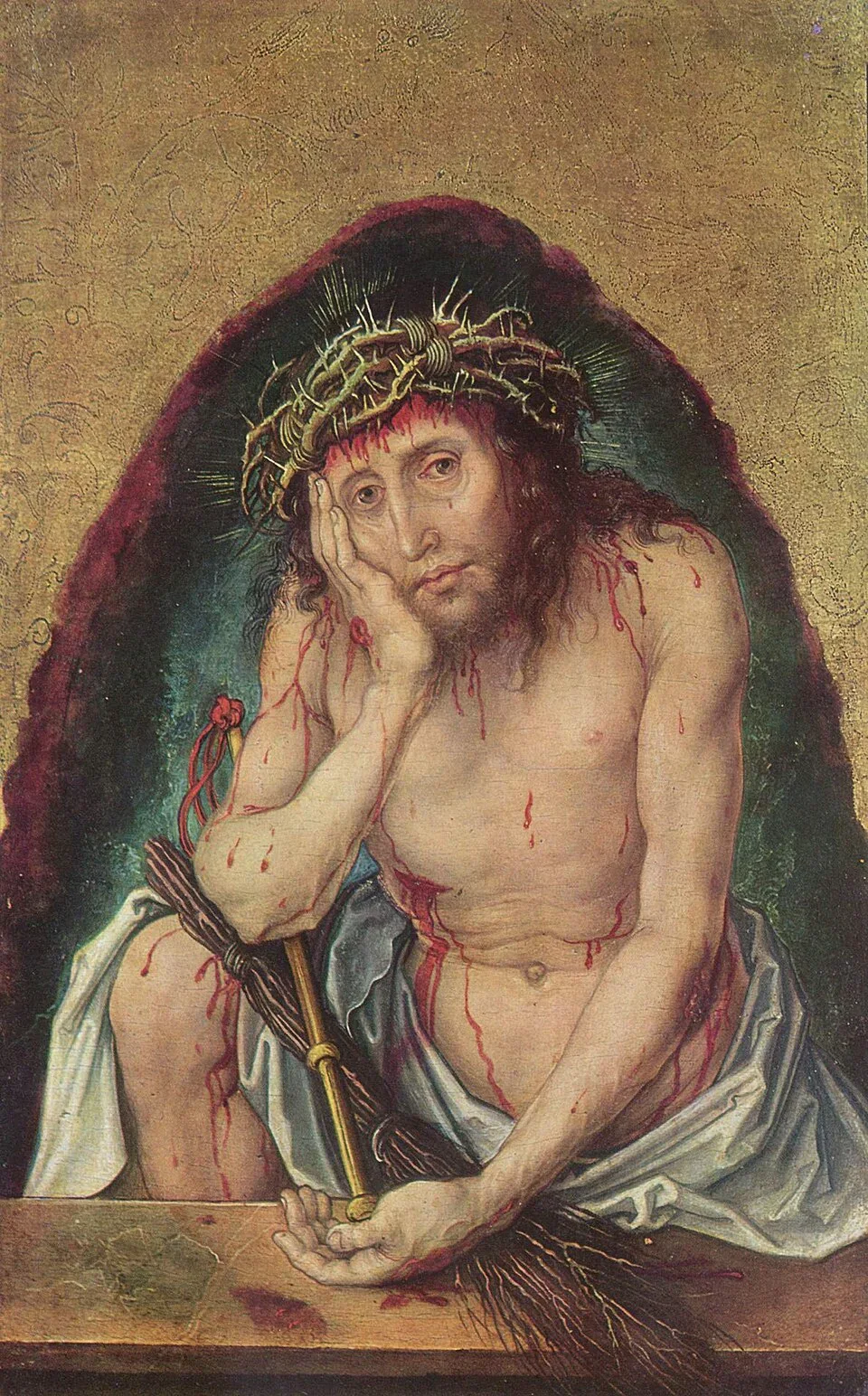
Christ as the Man of Sorrows
This small panel carries no signature. Until 1941 no one had connected it with Dürer. Now it is accepted as his, painted when he was twenty-one or twenty-two, in his journeyman years, probably in Strasbourg around 1493. That young painter put Christ here just after the soldiers had beaten and mocked him, before they led him away to be crucified. Blood runs from his wounds. Against his bent knee he holds what they used to hurt him, a whip with three knots and a bundle of birch branches. He wears the crown of thorns and leans his head on his right hand, a gesture of grief. His other hand lies on the ledge below. He used that pose again and again in portraits, to give the figure depth. Set against gold, Christ's face is painted with great realism, and he looks straight out at you, resigned to what is coming.
Listen in the appAlbrecht Dürer · Public domain
- 11
People by a Blue Lake
August Macke · 1913
- 12
The Temptation of Saint Anthony
Joos van Craesbeeck · c. 1650
- 13
Adoration of the Child with Saints Jerome, Mary Magdalene, Eustace and Julian
Paolo Uccello · 1436
- 14
Self portrait
Rembrandt · c. 1645–1648
- 15
Bedroom
Pieter de Hooch · 1658–1660
- 16
Plato's Symposium
Anselm Feuerbach · 1860–1869
- 17
Don Juan Bautista de Goicoechea y Urrutia
Francisco Goya · 1810–1815
- 18
Nemesis
Albrecht Durer · 1501–1503
- 19
The Penance of St. John Chrysostom
Albrecht Durer · 1496–1497
- 20
The Deformed Landser Sow
Albrecht Durer · c. 1496
- 21
Self-portrait
Marie-Guillemine Benoist · 1786
- 22
The Four Horsemen, from The Apocalypse
Albrecht Durer · 1497–1498
- 23
Margrave, Mother and child
Hans Baldung Grien · c. 1509–1510
- 24
Still life with flowers and gilt goblets
Clara Peeters · 1612
- 25
Allegory of the Acquisition of Surinam
Johann David Welcker · 1670–1676
- 26
The Large Horse
Albrecht Durer · 1505
- 27
Young Couple Threatened by Death
Albrecht Durer · 1497–1498
- 28
The Prodigal Son
Albrecht Durer · c. 1496
- 29
Hercules at the Crossroad
Albrecht Durer · 1498–1499
- 30
The Martyrdom of the Ten Thousand
Albrecht Durer · c. 1496
- 31
The Martyrdom of St Catherine
Albrecht Durer · 1497–1498
- 32
The Little Courier
Albrecht Durer · c. 1496
- 33
The Wrestling Match
Michiel Sweerts · 1648–1650
- 34
The Small Horse
Albrecht Durer · 1505
- 35
Deer in the forest II
Franz Marc · 1914
- 36
The Abduction on a Unicorn
Albrecht Durer · 1516
- 37
The Holy Family with St. John
Nicolas Poussin · c. 1628–1629
- 38
Still Life with Rubber Plant
Alexander Kanoldt · 1921
- 39
Still life of vegetables in a landscape
Frans Snyders · 1610
- 40
Olevano
Alexander Kanoldt · 1927
- 41
Madonna and Child
Lucas Cranach the Elder · c. 1518
- 42
Children Dancing in a Ring
Hans Thoma · 1872
- 43
Cardinal Albrecht of Brandenburg - The Small Plate
Albrecht Durer · 1519
- 44
Cardinal Albrecht of Brandenburg - the Large Plate
Albrecht Durer · 1523
- 45
The Ravisher
Albrecht Durer · c. 1494
- 46
The Holy Family with St John, The Magdalen and Nicodemus
Albrecht Durer · c. 1512
- 47
Man of Sorrows with Hands Bound
Albrecht Durer · 1512
- 48
Man of Sorrows, Seated
Albrecht Durer · 1515
- 49
Group of Five Figures
Albrecht Durer · c. 1515
- 50
Revelation of Saint John
Albrecht Durer · 1497–1498
- 51
The Martyrdom of St John
Albrecht Durer · 1496
- 52
Saint John's vision of the seven candlesticks
Albrecht Durer · 1497–1498
- 53
Saint John kneeling before Christ and the twenty-four elders
Albrecht Durer · 1497–1498
- 54
The Opening of the fifth and sixth seals
Albrecht Durer · 1497–1498
- 55
Four angels holding back the winds, and the marking of the elect
Albrecht Durer · 1497–1498
- 56
Revelation of St. John: The Adoration of the Lamb
Albrecht Durer · 1497–1498
- 57
The Opening of the seventh seal and the eagle crying 'Woe'
Albrecht Durer · 1497–1498
- 58
The four angels of Death
Albrecht Durer · 1497–1498
- 59
Saint John eating the book
Albrecht Durer · 1497–1498
- 60
The woman of the Apocalypse and the seven-headed dragon
Albrecht Durer · 1497–1498
- 61
The Whore of Babylon
Albrecht Durer · 1497–1498
- 62
The Beast with Seven Heads and the Beast with Lamb's Horns
Albrecht Durer · 1497–1498
- 63
The Angel with the Key to the Bottomless Pit
Albrecht Durer · 1497–1498
- 64
The Death of the Virgin
Albrecht Durer · 1510
- 65
The Eight Saints of Austria
Albrecht Durer · 1515–1517
- 66
Reefs by the Seashore
Caspar David Friedrich · c. 1824
- 67
Die heimlich offenbarung iohnis
Albrecht Durer · 1497–1498
- 68
Tauberbischofsheim altarpiece: Christ Carrying the Cross
Matthias Grünewald · 1523–1524
- 69
Tauberbischofsheim altarpiece: Christ on the Cross with Mary and Saint John
Matthias Grünewald · 1523–1524
- 70
Still-Life with Lemon, Oranges and Glass of Wine
Willem Kalf · 1663–1664
- 71
David Playing the Harp
Jan de Bray · 1670
Staatliche Kunsthalle Karlsruhe
Frequently asked questions
How much does the guide cost?
Free app download. Free until 1 January. Listed guide price: $0.99. Audio guide only. Venue admission is separate.
Can I listen without internet?
Yes. Download the guide’s audio, images, and maps in the app before your visit. Your downloaded content is then available offline.
Can I listen in my language?
In English for now. More languages soon.
Do I need to follow a schedule?
No. This is a self-guided experience. Choose your stops, pause whenever you like, and return to a story at your own pace.
Which artworks are in the Staatliche Kunsthalle Karlsruhe audio guide?
71 artworks, including Melencolia I (Albrecht Durer), Heller Altarpiece (Albrecht Durer, Matthias Grünewald, Jobst Harrich), Knight, Death, and the Devil (Albrecht Durer), St. Jerome in His Study (Albrecht Durer), Little Lange (Édouard Manet), Adam and Eve (Albrecht Durer), Holy Family with the Three Hares (Albrecht Durer), and Tauberbischofsheim altarpiece (Matthias Grünewald). The full list is on this page.
Is this the museum’s official audio guide?
No. Stanza is an independent audio guide app and is not affiliated with Staatliche Kunsthalle Karlsruhe. Museum admission is separate.
At your own pace
Explore Staatliche Kunsthalle Karlsruhe.
Download Stanza, then search for “Staatliche Kunsthalle Karlsruhe”.
Free app download · Guide price shown in the app
Keep exploring
Nearby audio guides
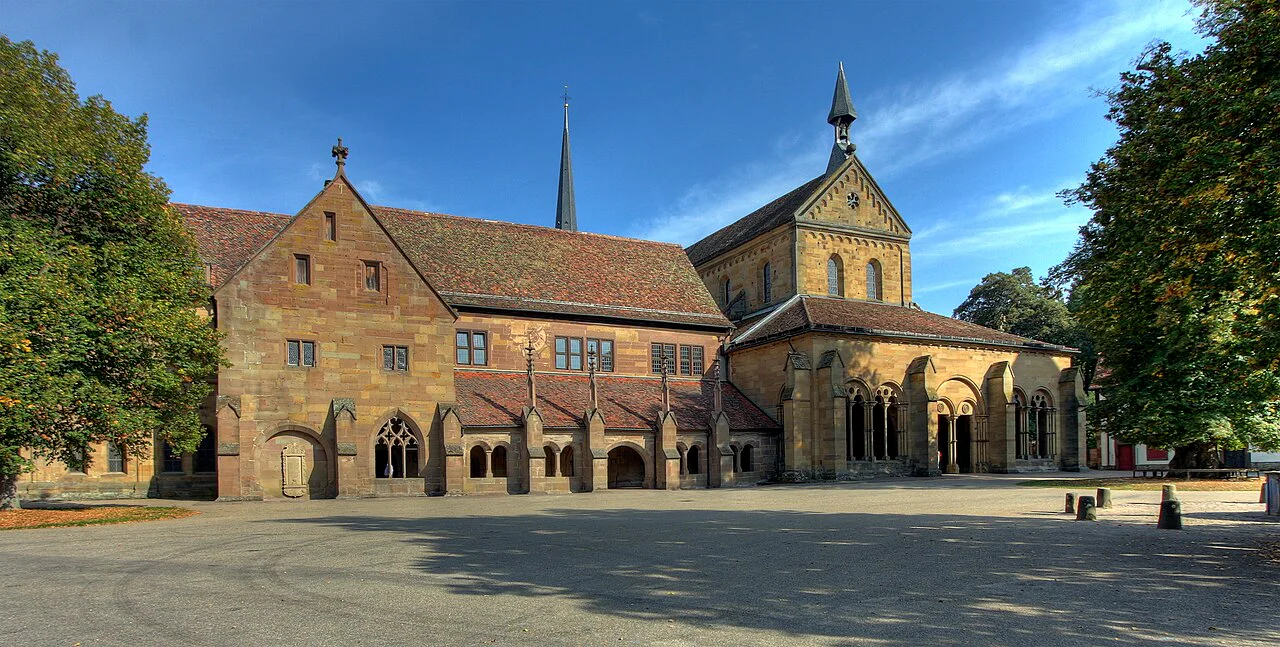
Maulbronn · 30 km
Kloster Maulbronn
Content & sources
Elke Wetzig (Elya) · CC BY-SA 3.0
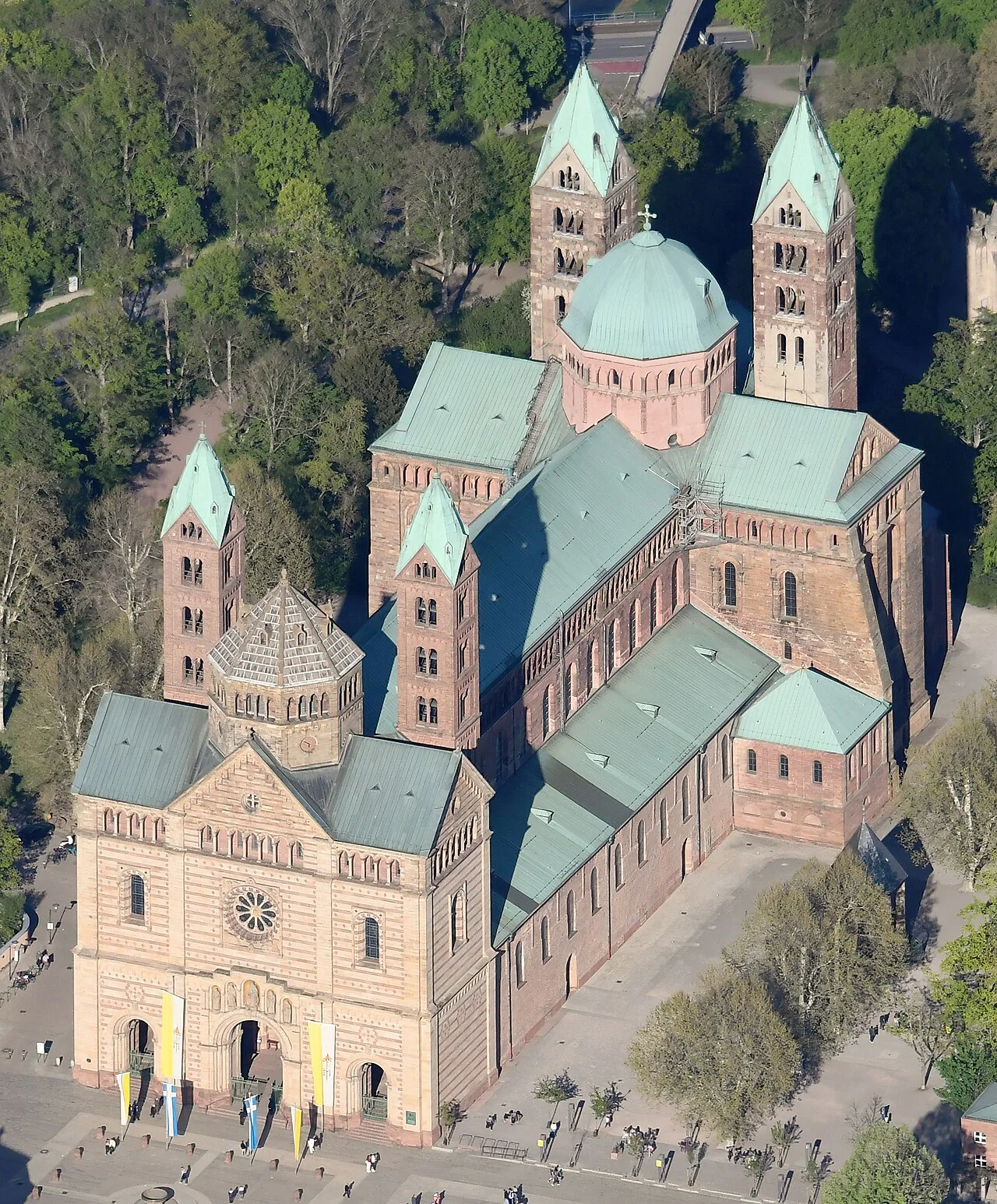
Speyer · 34 km
Speyerer Dom
Content & sources
Carsten Steger · CC BY-SA 4.0
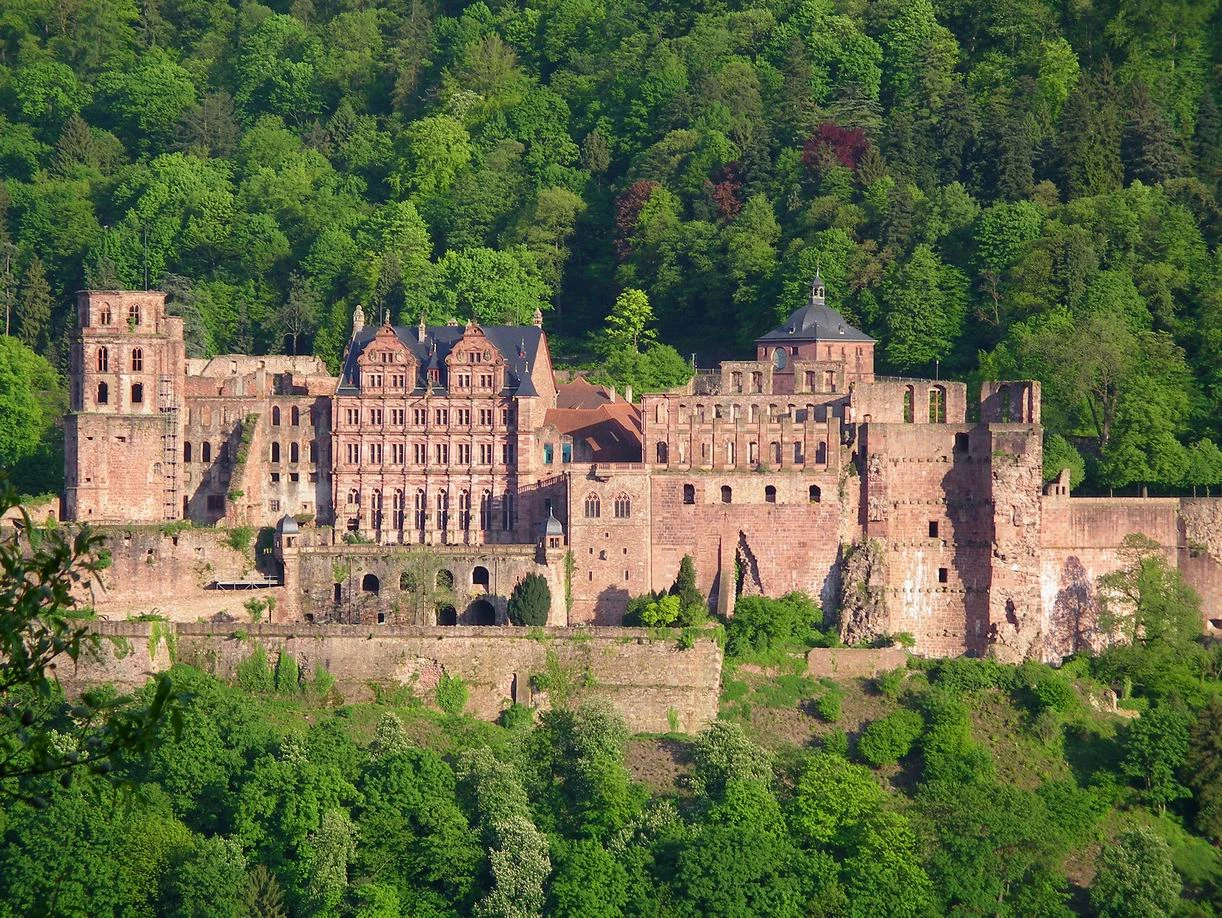
Heidelberg · 50 km
Heidelberg Castle
Content & sources
Pumuckel42 (Reinhard Wolf) at de:Wikipedia · CC BY-SA 3.0
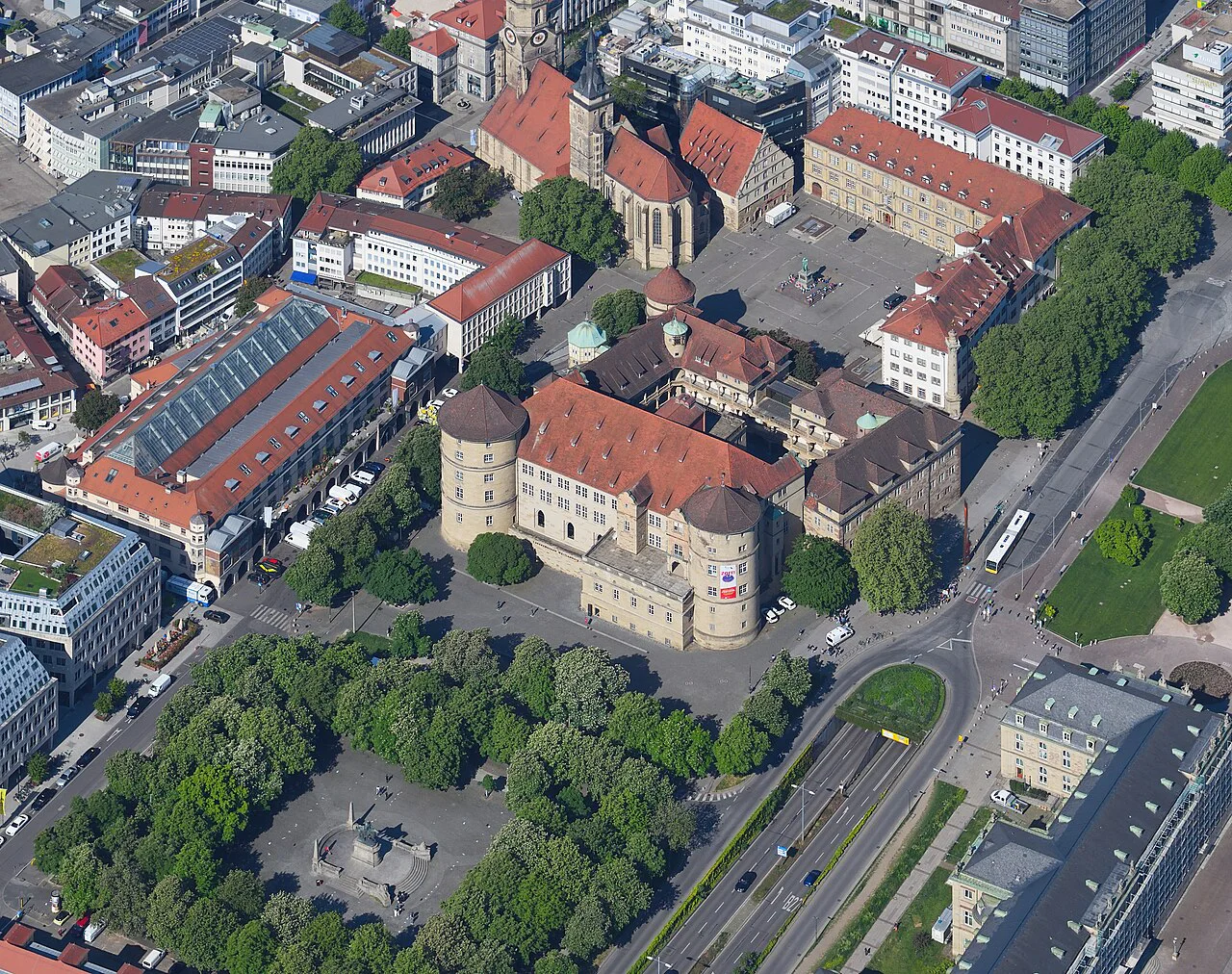
Stuttgart · 63 km
Altes Schloss Stuttgart
Content & sources
Photo: Carsten Steger · CC BY-SA 4.0
Art museums
More art museum audio guides
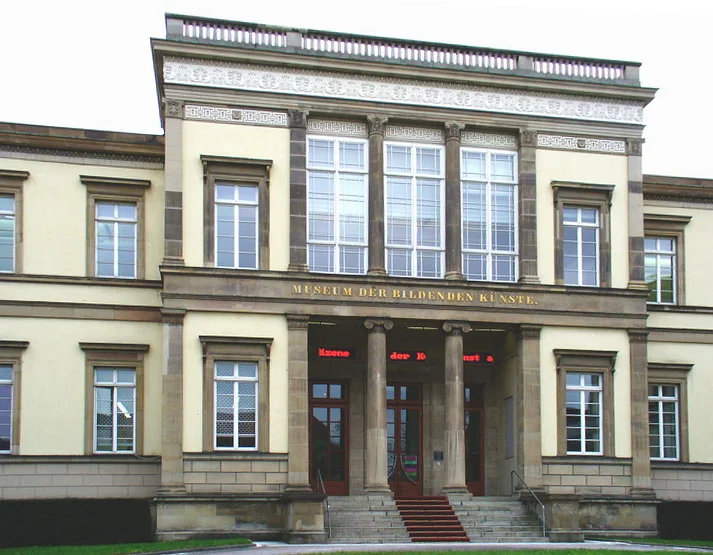
Stuttgart · 43 artworks
Staatsgalerie Stuttgart
Content & sources
Selbst fotografiert von user:Enslin · CC BY 2.5
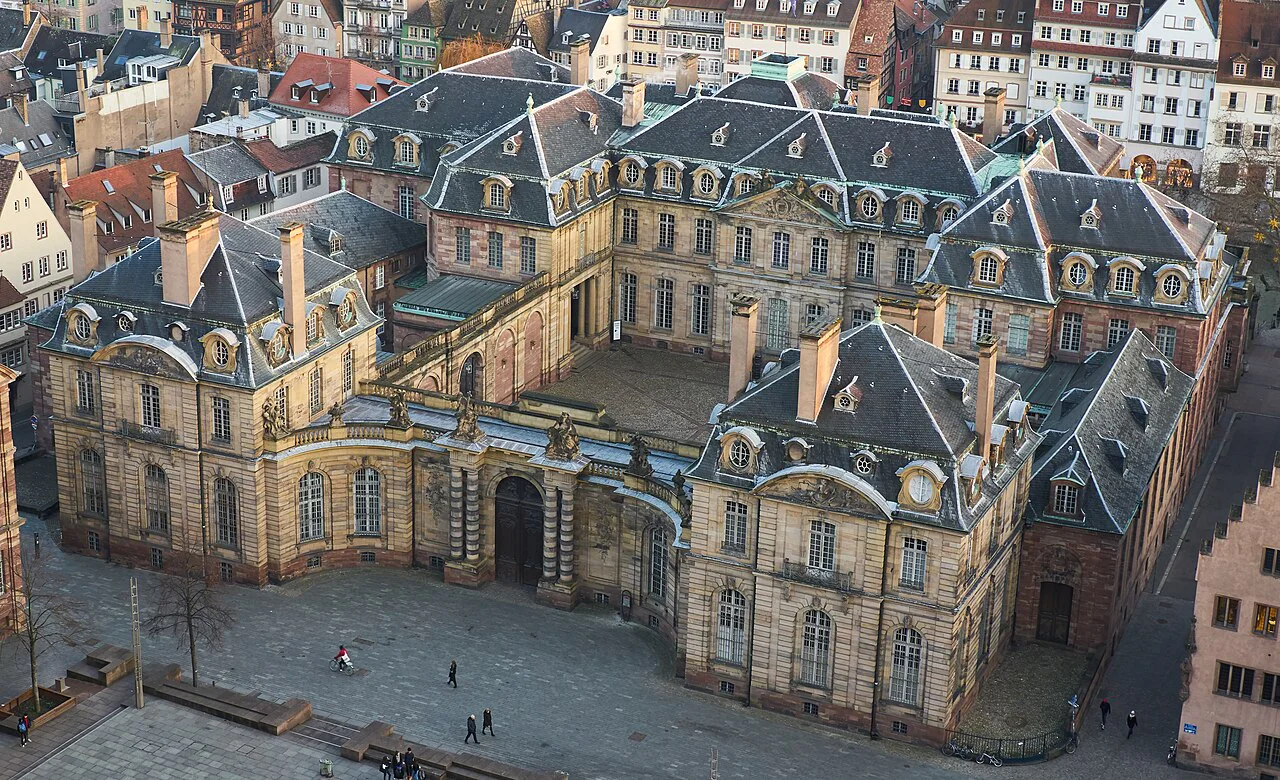
Strasbourg · 92 artworks
Musée des Beaux-Arts de Strasbourg
Content & sources
Radek Kucharski · CC BY 2.0
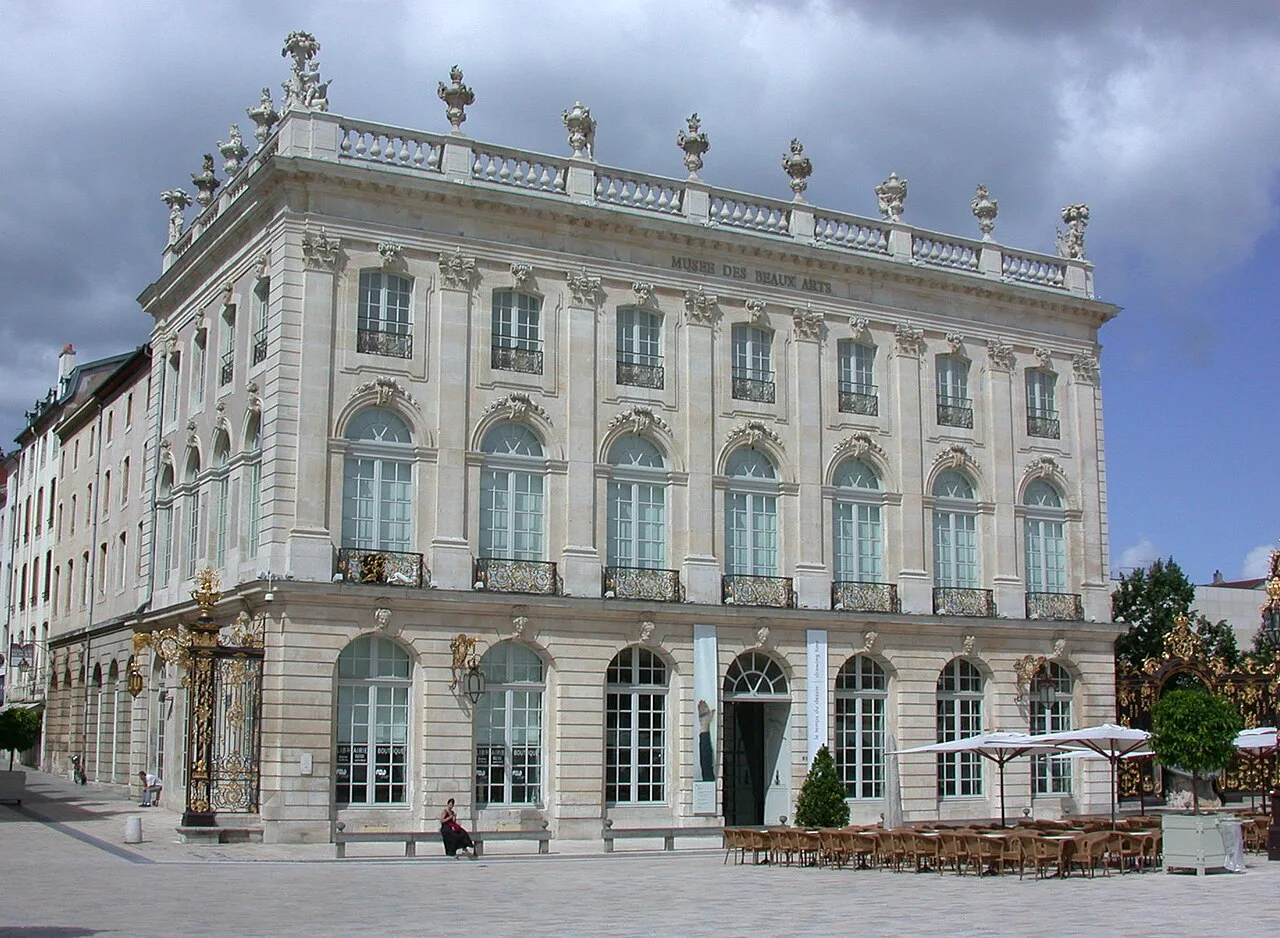
Nancy · 46 artworks
Musée des Beaux-Arts de Nancy
Content & sources
photo uploaded by User:RicciSpeziari. Photographer: Riccardo Speziari · CC BY-SA 3.0
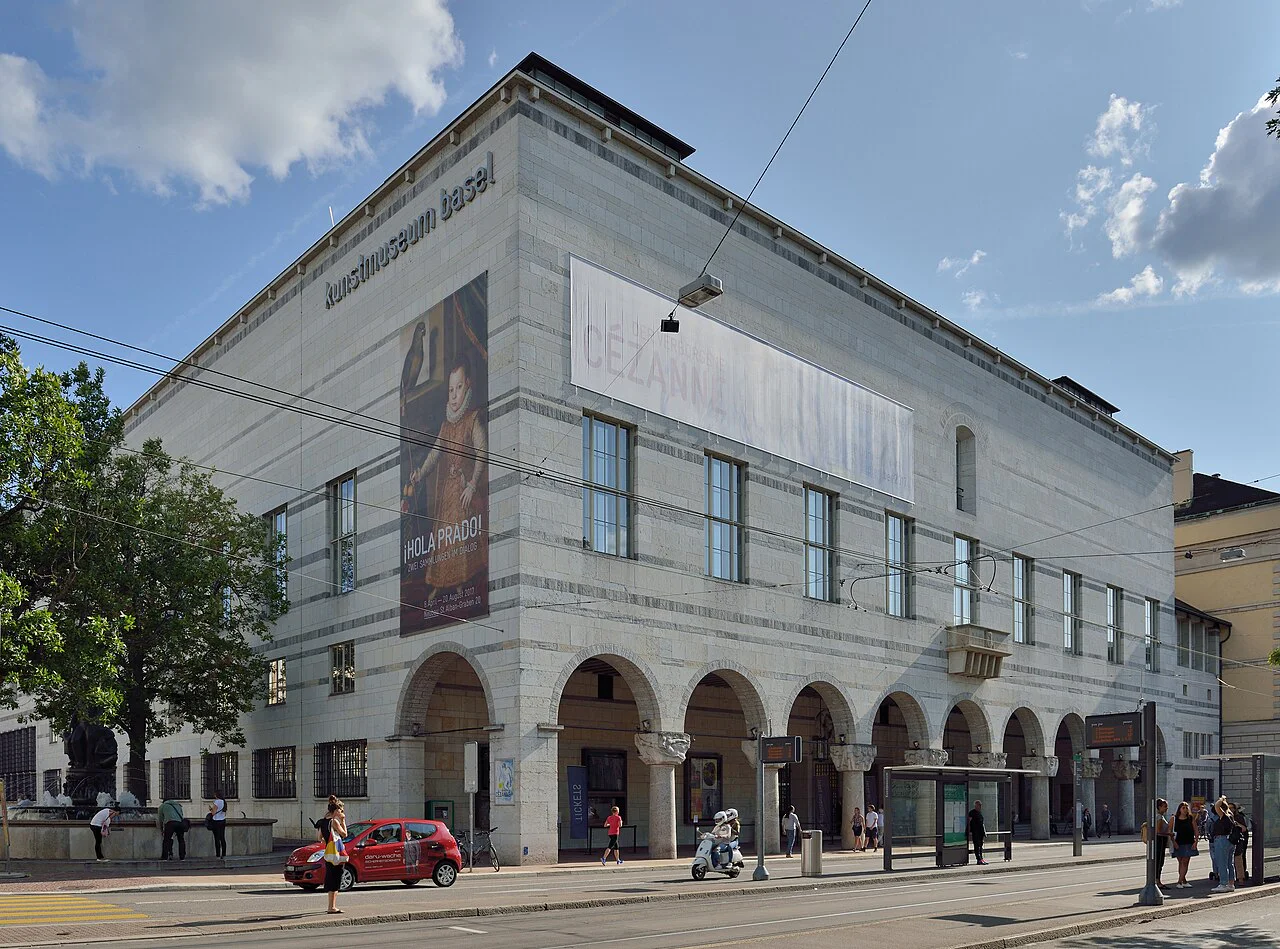
Basel · 61 artworks
Kunstmuseum Basel
Content & sources
Wladyslaw Sojka · FAL
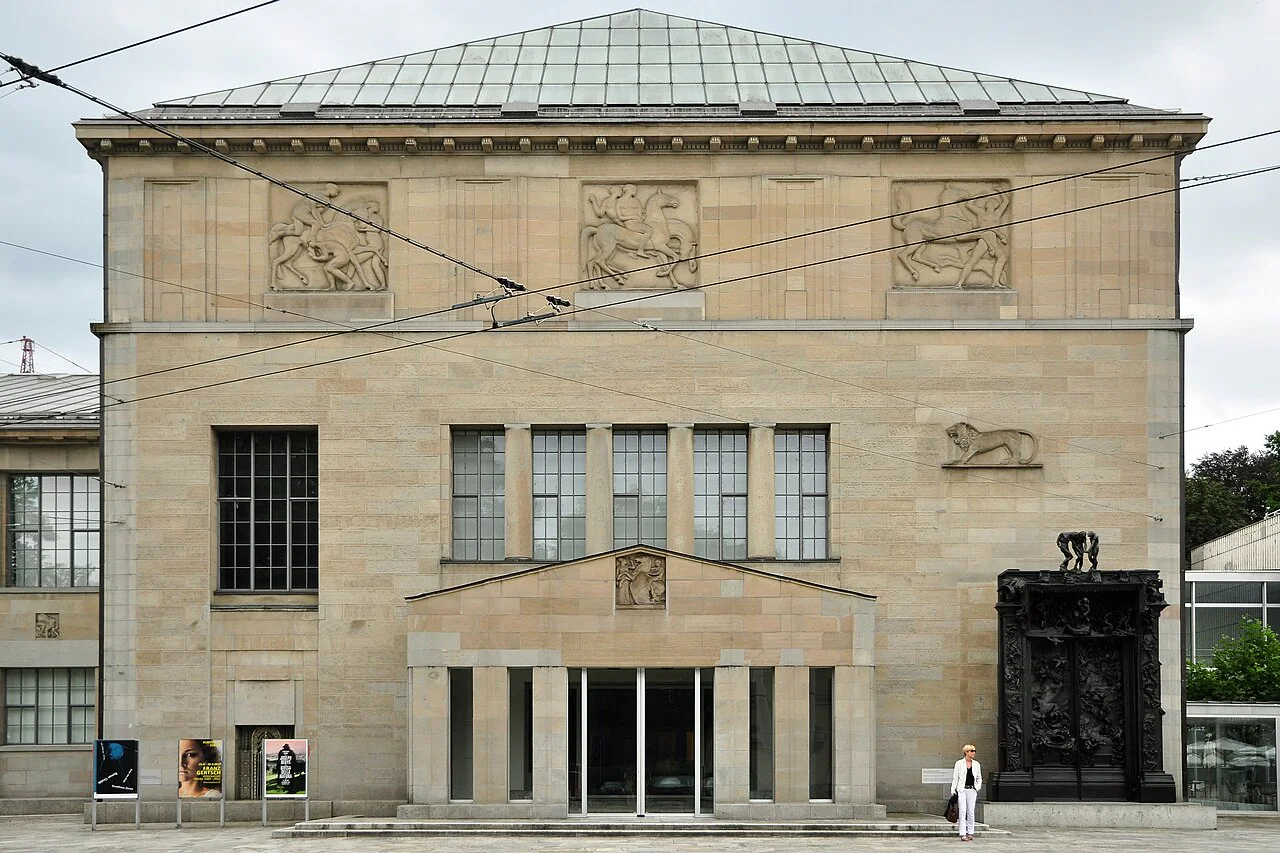
Zurich · 44 artworks
Kunsthaus Zürich
Content & sources
Photo: Roland zh · CC BY-SA 3.0
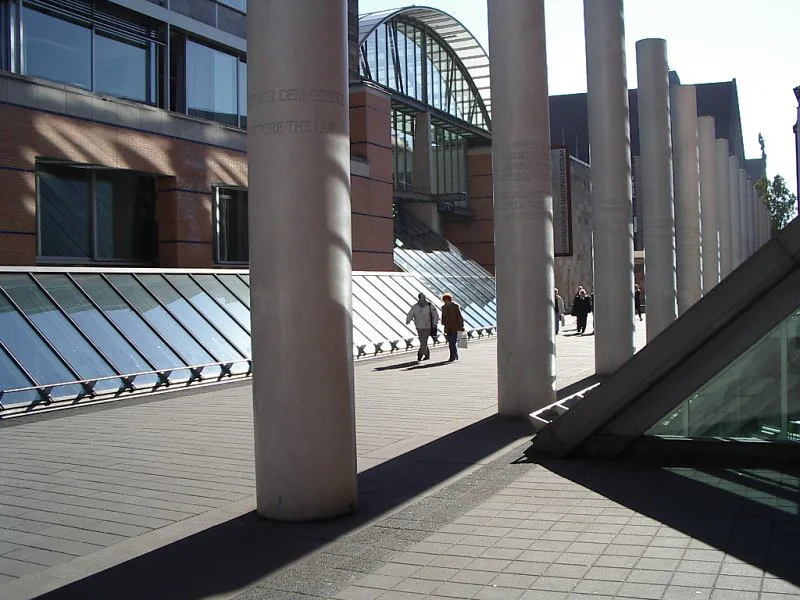
Nuremberg · 54 artworks
Germanisches Nationalmuseum
Content & sources
The original uploader was Keichwa at German Wikipedia. · CC BY-SA 3.0