Stanza · Audio guide
Musée des Beaux-Arts de Strasbourg Audio Guide
A place to remember. A story to take with you.
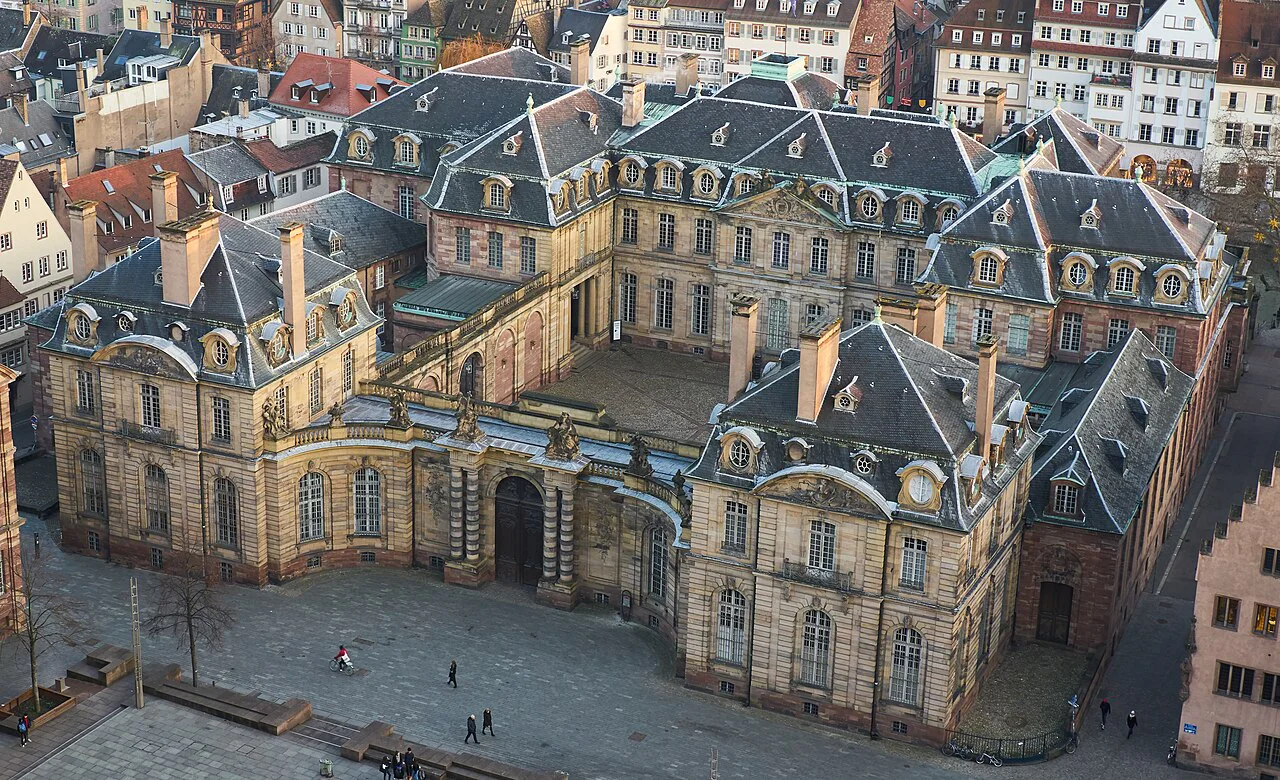
The Musée des Beaux-Arts de Strasbourg is the old masters paintings collection of the city of Strasbourg. It is housed in the first and second floors of the baroque Palais Rohan.
Download Stanza, then search for “Musée des Beaux-Arts de Strasbourg”.
About the tour
One guide. Your kind of visit.
The Musée des Beaux-Arts de Strasbourg is the old masters paintings collection of the city of Strasbourg. It is housed in the first and second floors of the baroque Palais Rohan.
The Musée des Beaux-Arts de Strasbourg guide tells the stories of 92 artworks, including Portrait of a young woman (Raphael, Giulio Romano), Earthly Vanity and Divine Salvation (Hans Memling), Crucifixion of Strasbourg (Giotto), Cephalus and Procris (Paolo Veronese), Christ Triumphant over Sin and Death (Peter Paul Rubens), Samson and Delilah (Guercino), Joan of Arc Kissing the Sword of Deliverance (Dante Gabriel Rossetti), and Adoration of the Shepherds (Carlo Crivelli). Every artwork is free to hear in the Stanza app until 1 January.
Ready when you are.
- 01Get the free Stanza app.
iOS & Android
- 02Find your guide.
“Musée des Beaux-Arts de Strasbourg”
- 03Download before you go.
Works offline
Audio guide / 92 artworks
Inside the guide
Get to know a few of the stories before you go. Open a stop to read more.
01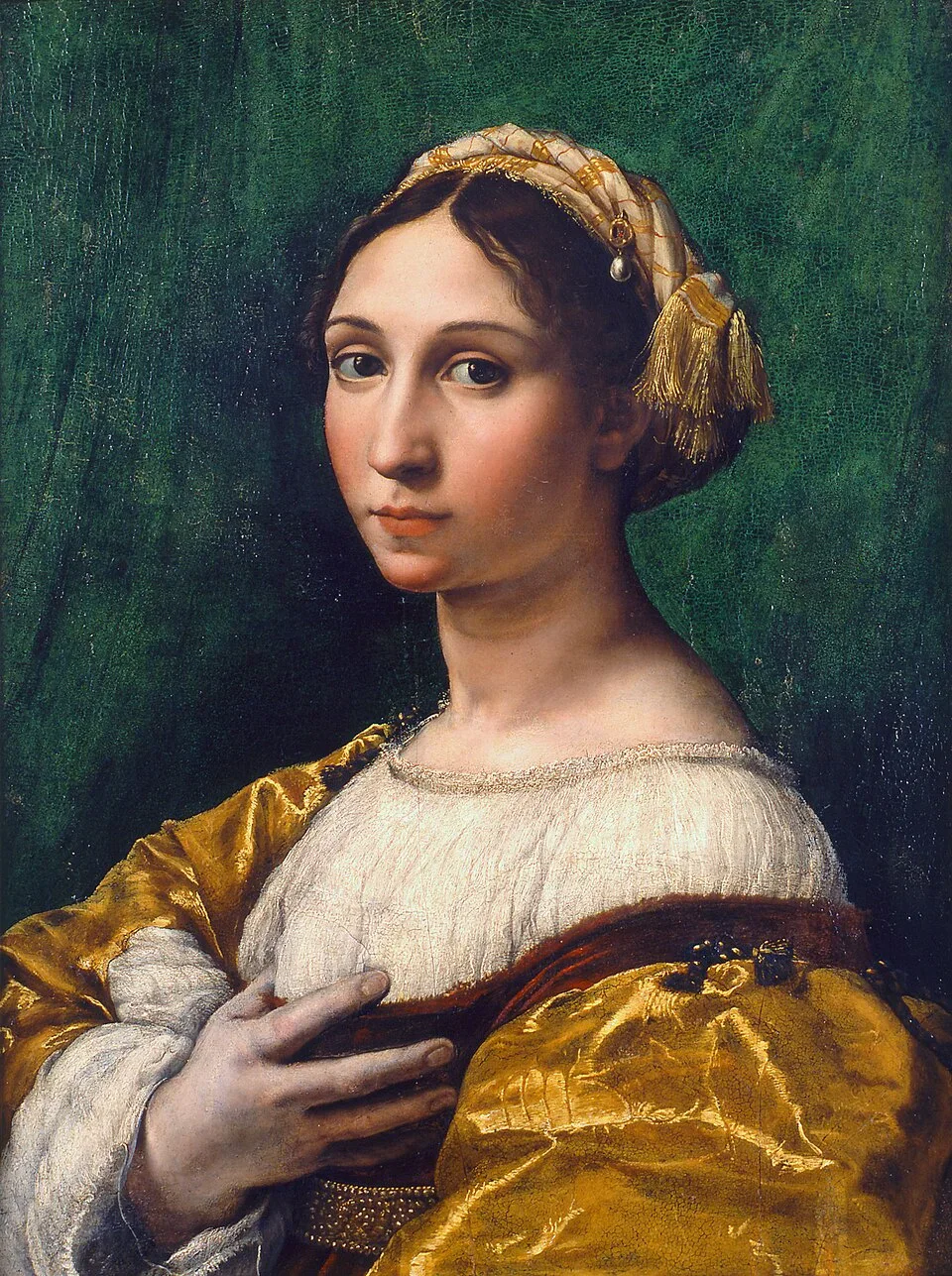
Portrait of a young woman
The paint added in the nineteenth century was taken off this panel, and X-rays were used to look inside it. What had seemed the work of one painter came apart into two. Most likely Raphael's pupil Giulio Romano painted the head, neck and bust, working from a drawing Raphael had made. Then Raphael added the hand and the sleeves, and covered her chest. The two painters leave different traces. Her sloping forehead, the hair parted on either side, her rather pointed nose and chin, these are the features of the women Giulio painted. They turn up in his other pictures too. The shine on her silky clothing and the pearls at her belt, that is the finish Raphael used in his other portraits. For a long time the whole portrait was given to him. In 1938 it was taken away and given to Giulio. Only in recent years has part of it gone back to Raphael. No one knows who the woman was. She looks like La Fornarina, but her nose is shaped differently, so she is not the same woman.
Listen in the appRaphael · Public domain
02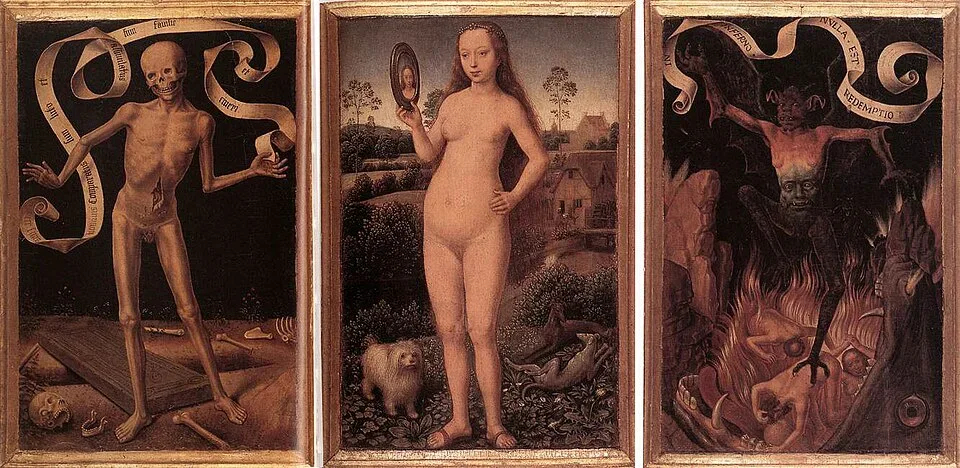
Earthly Vanity and Divine Salvation
How did these six small panels once fit together? One shows a young woman, naked, holding a mirror to her face. Jewels sit in her loose hair. She is Vanity, and the leafy path behind her runs off toward a mill, the road into sin. Another shows Death, a skeleton on black ground. There is a toad at its genitals, matching the woman's. That echo ties the two panels together. On the other side, Christ appears crowned, with the orb of the world, and four angels making music around him. There is a skull in a niche, a reminder of death, and the coat of arms of the Loiani family of Bologna. That coat of arms points to the man who ordered the work. He may have been Giovanni d'Antonio Loiano, a Bolognese who married a Flemish woman. Memling made these panels most likely for private prayer, the kind of thing an owner could carry with him. Then the panels were sawn apart at some point before 1890, and no one now knows the order in which they were meant to be seen.
Listen in the appHans Memling · Public domain
03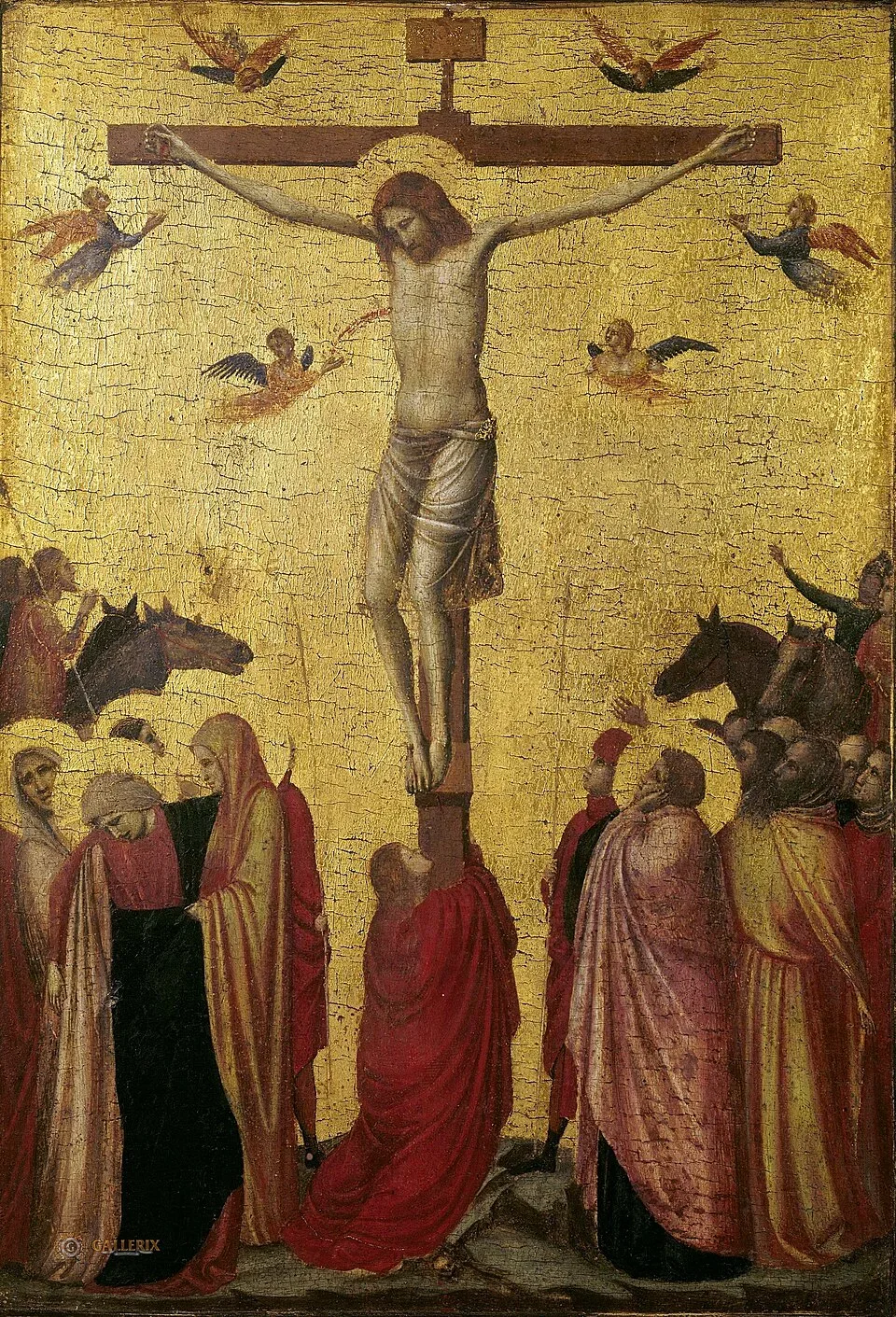
Crucifixion of Strasbourg
Christ's cross stands in the middle against a gold ground. Grieving angels crowd around him, and below, Mary Magdalene, in red, has her arms around the cross. Two groups stand to the sides, leaving the center on its own. Nearly every figure here belongs to the usual Crucifixion. What is not settled is whose hand painted them. This panel carries Giotto's name, but that name has been passed back and forth for decades. It was long treated as a work from his workshop. In 1948 it was given to Giotto himself. Later it went to an anonymous painter, called the Master of the Strasbourg Crucifixion. It still goes both ways, though it was shown as his at the Louvre in 2013. The drapery is what places it late in his career. It falls in voluminous folds, the same ones Giotto used in the Peruzzi and Bardi chapels. And at the edges, the figures are cut off by the border, leaving a gathering larger than the panel shows.
Listen in the appGiotto · Public domain
04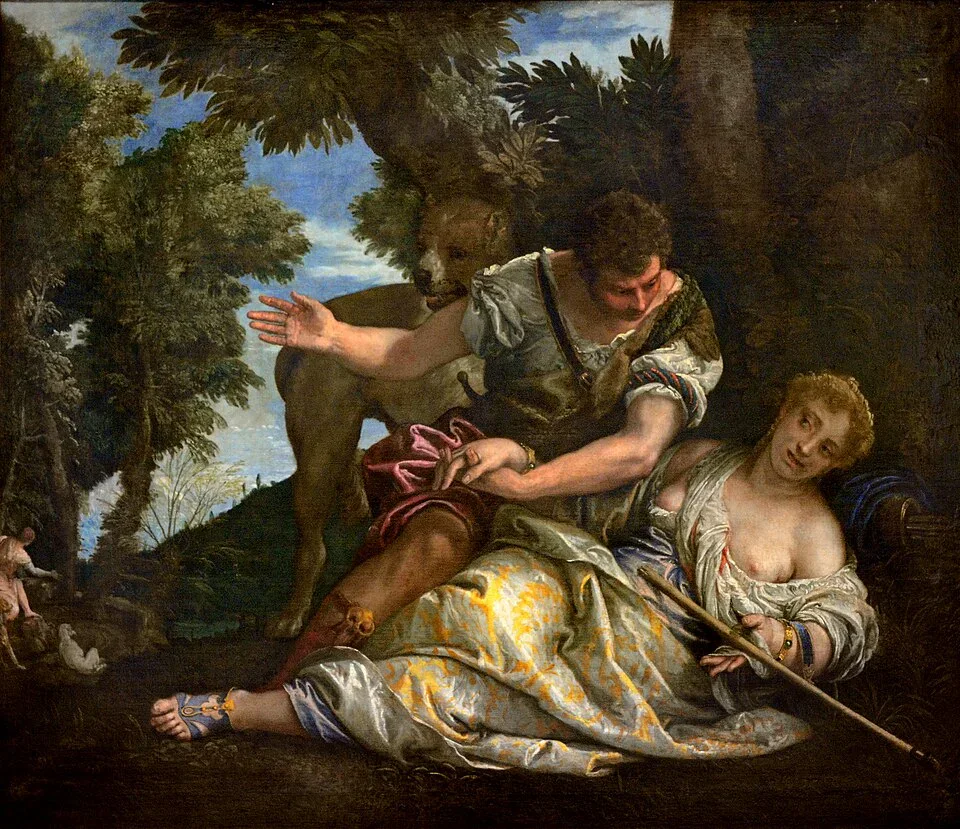
Cephalus and Procris
Out hunting, Cephalus has just pierced his own wife with a magic javelin. Now he holds her, confused, trying to understand her and to explain himself. Paolo Veronese chose this moment to paint. She dies at the foot of a tree. Her dress is patterned in yellow and leaves her breasts bare, and the dog Lelape is with her. The picture had a companion, Venus and Adonis, and both tell a story from Ovid about lovers who die. Diego Velázquez bought it in Venice in 1641 for Philip the Fourth of Spain. It stayed in the royal collection until Joseph Bonaparte took it, and after his death it was sold several times. Wilhelm von Bode bought it in Berlin in 1912 for this museum. The exact year Veronese painted it is still not known.
Listen in the appPaolo Veronese · Public domain
05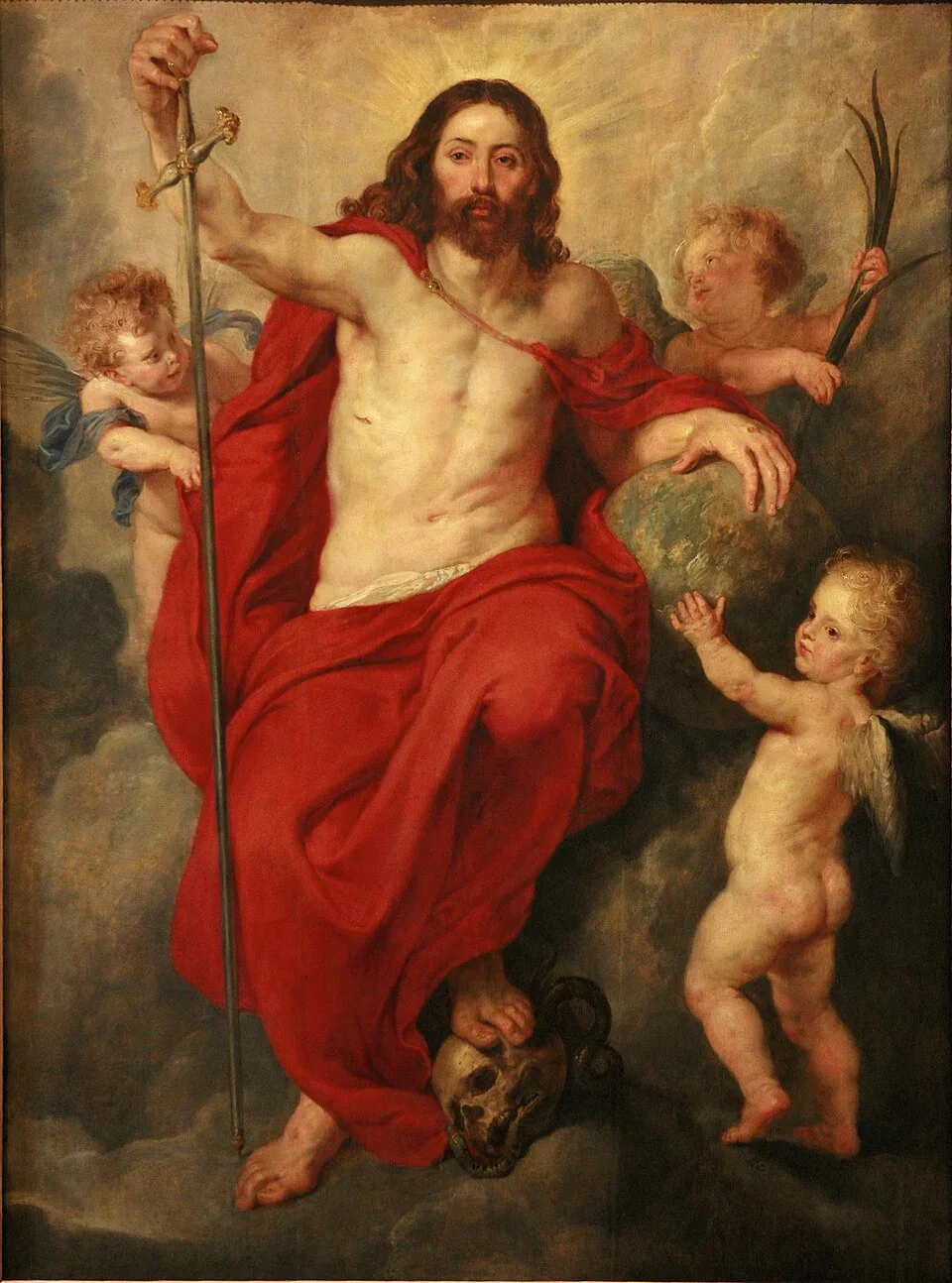
Christ Triumphant over Sin and Death
Triumphant over what? A skull and a snake give the answer. The skull is Death, the snake is Sin, and the picture is Christianity's victory over both. Christ's head and right arm are painted smoother and softer than the rest of him, and smoother than the rest of the picture. Rubens made this about 1618. The painting is accepted as genuine, though his workshop may have helped with parts of it, as it often did. The painting was highly regarded in the eighteenth century and has been documented since 1745. Wilhelm von Bode bought it for this museum at a Christie's sale in 1890, and it entered the collection in 1891. It may have been made for an altar in a private chapel.
Listen in the appPeter Paul Rubens · CC BY-SA 2.0 fr
06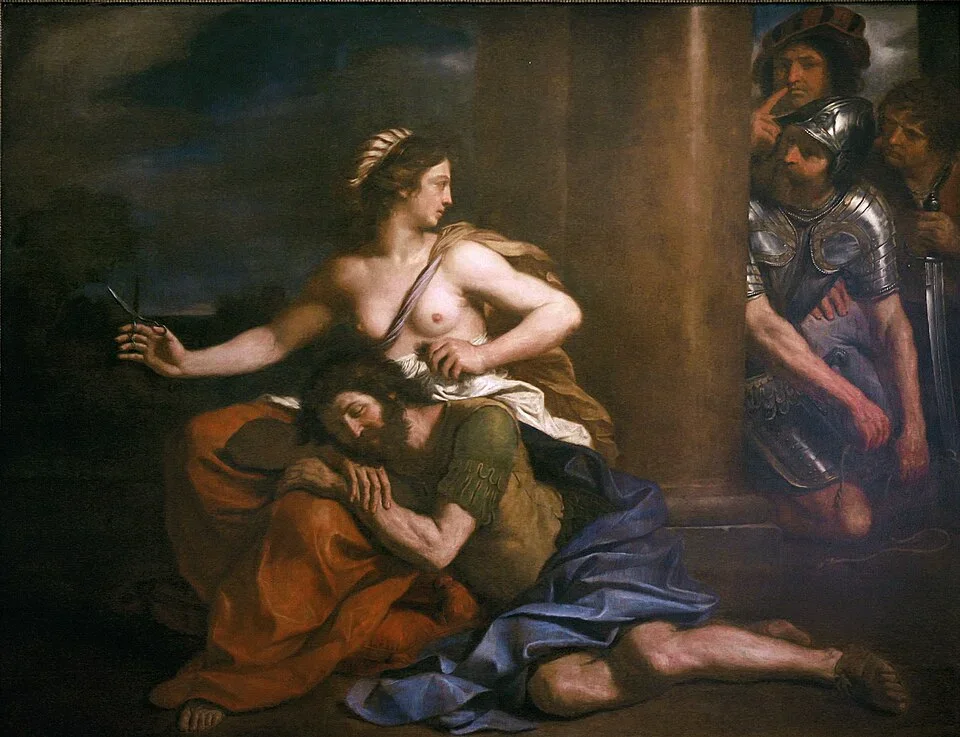
Samson and Delilah
Samson's head lies in Delilah's lap, and he is fast asleep. She has just cut a lock of his hair, and the scissors are still in her hand. She turns her eyes to the right, where three armed Philistines wait behind a great column. One of them is getting ready to bind him. In the Book of Judges, a man is called in to cut Samson's hair. Guercino followed Josephus instead, where Delilah cuts it herself before handing him to the Philistines. That choice puts her in charge of the whole scene. She sits upright, her hair gathered in a net, her arm raised in a broad sweep, and the scissors catch a flash of metal. Samson gives himself over entirely to sleep. The glint on the scissors is answered by the shine of one Philistine's armor. The Duke of Mantua ordered this painting and a companion one of Lot and his daughters. Together they were meant as a warning about the dangers of drink. It passed through other hands and reached the collector John Charles Robinson. He gave it to this museum as a gesture of friendship to its director, Wilhelm von Bode, who had bought pieces from Robinson's collection.
Listen in the appGuercino · Public domain
07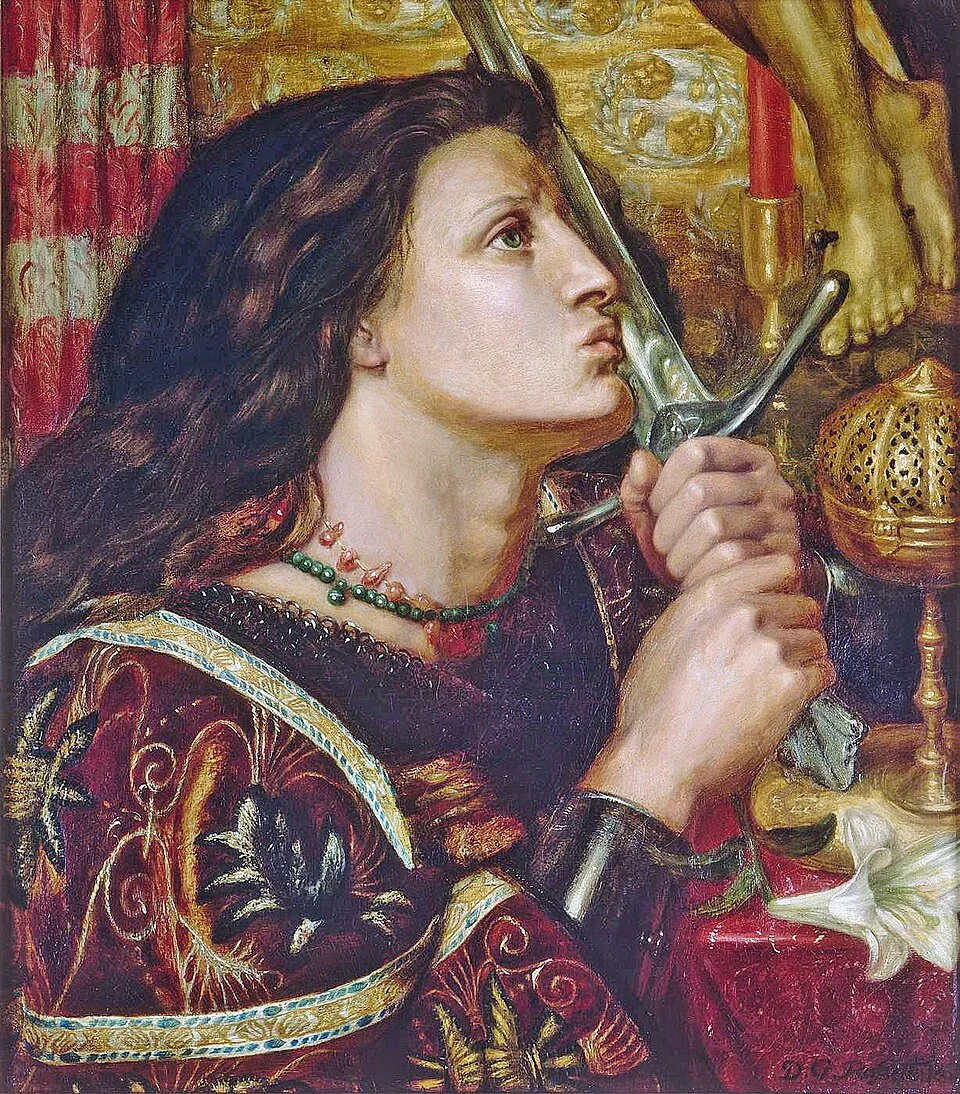
Joan of Arc Kissing the Sword of Deliverance
Nobody is quite sure who sat for this portrait. Two names have been suggested, Mrs Beyer, a woman from Germany, and Agnes Manetti. All the painting gives you is a right profile, a big chin and a strong neck. That is not enough to choose between them. Rossetti painted this in 1863, and the woman is shown as Joan of Arc, the patron saint of France. She holds a sword in both hands and kisses a fleur de lis on its blade, with a crucifix above her. The painting came to Strasbourg in 1996, bought at the Piccadilly Gallery in London. It was the first Rossetti any French museum had ever bought. It is here in the Palais Rohan on permanent loan from the Museum of Modern and Contemporary Art.
Listen in the appDante Gabriel Rossetti · Public domain
08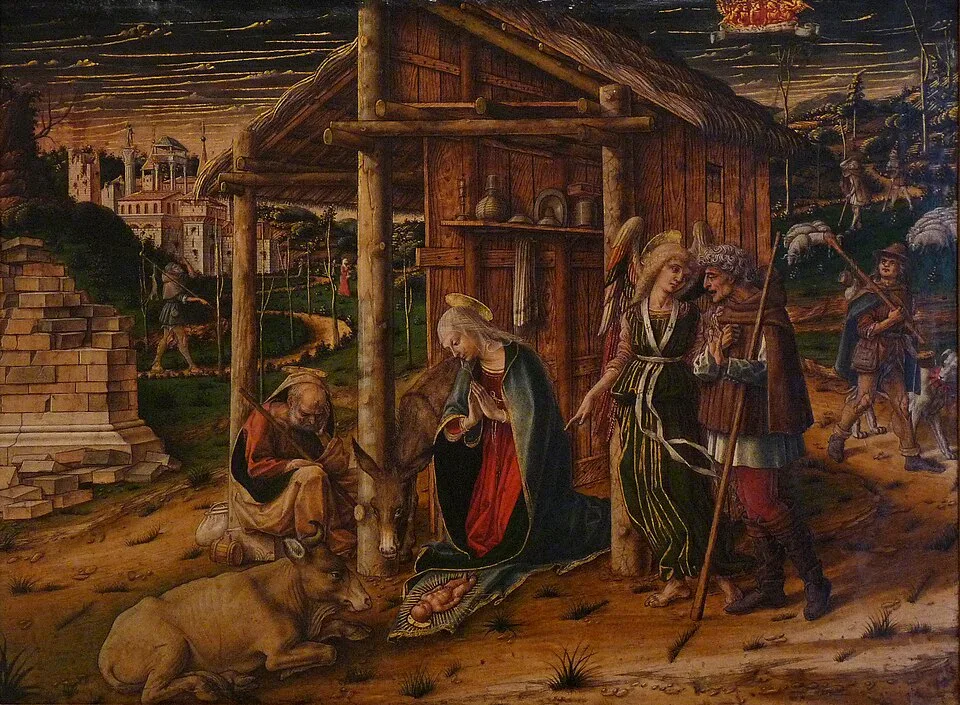
Adoration of the Shepherds
Why is the baby on the ground, his head tipped back, instead of in his mother's arms? He lies on a fold of the Virgin's blue mantle, and his body shortens in perspective. She kneels with her hands joined. At the right, an angel shows him to an older shepherd with a staff, and the shepherd makes a small gesture of surprise. Other shepherds follow with their sheep and a dog, drawn by the choir of angels that has appeared in the sky. The stable is a rough wooden shed, propped on trunks set in the earth, with dishes and a towel. Gold shines across it, but the shepherds' faces are full of expression. Joseph sits looking down. The Nativity at the foot of an altarpiece in Matelica has a similar stable and a Joseph in the same pose.
Listen in the appCarlo Crivelli · CC BY-SA 3.0
09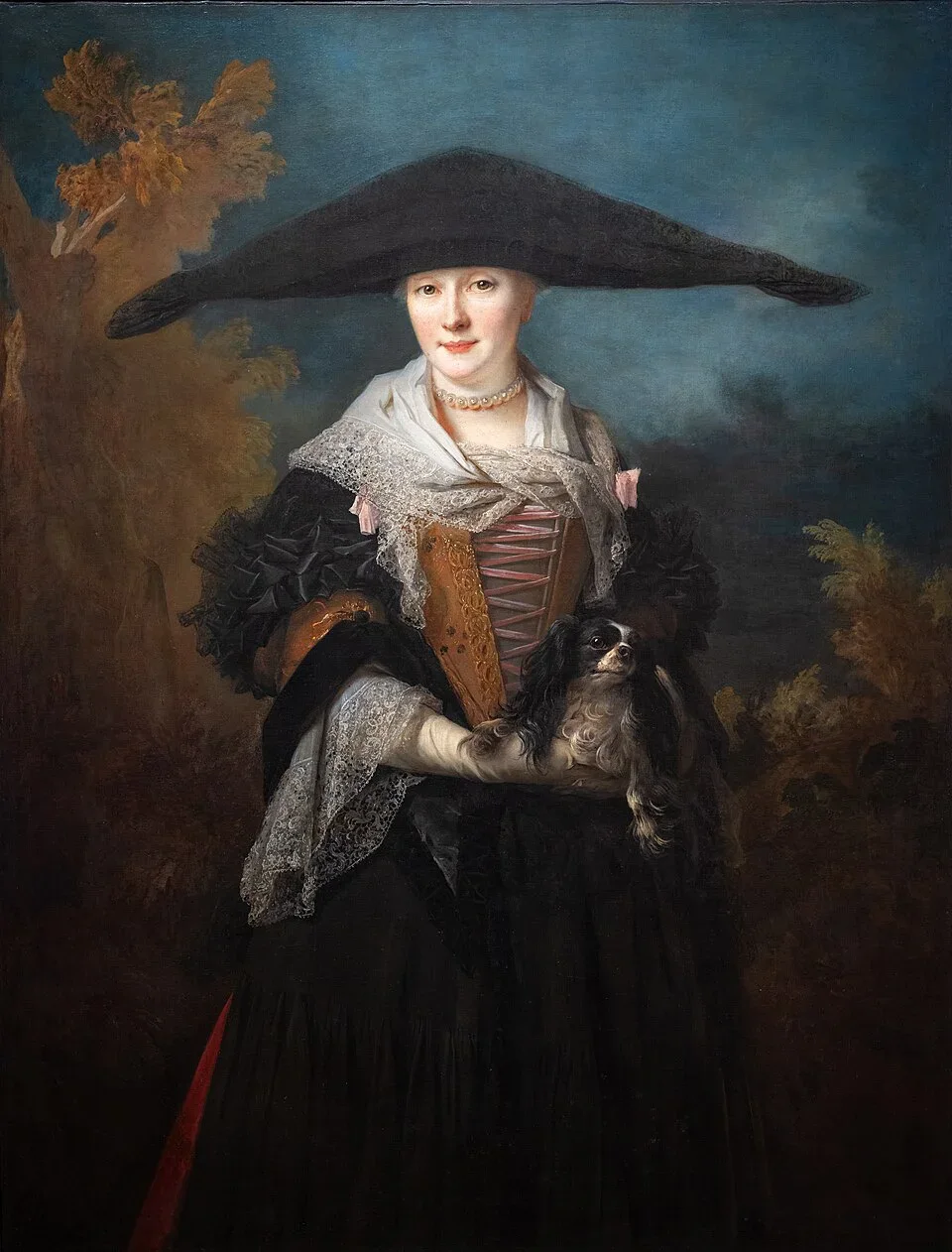
The beautiful Strasbourgian
A provincial hat holds this portrait together. Largillière used it to give the picture its shape. He showed what he could do with fabric in the gray lace and black satin. This is the best known of about fifteen hundred portraits he painted. No one knows who she is, though she may be a Parisian dressed as a Strasbourg woman. Strasbourg had become part of France only in 1681, twenty two years before this portrait. Her costume is the fashion of the city between 1688 and 1730. In her gloved hands she holds a small Cavalier King Charles Spaniel, and her dress is matched to its coat.
Listen in the appPhoto: Matthieu.lett.ube · CC BY 4.0
10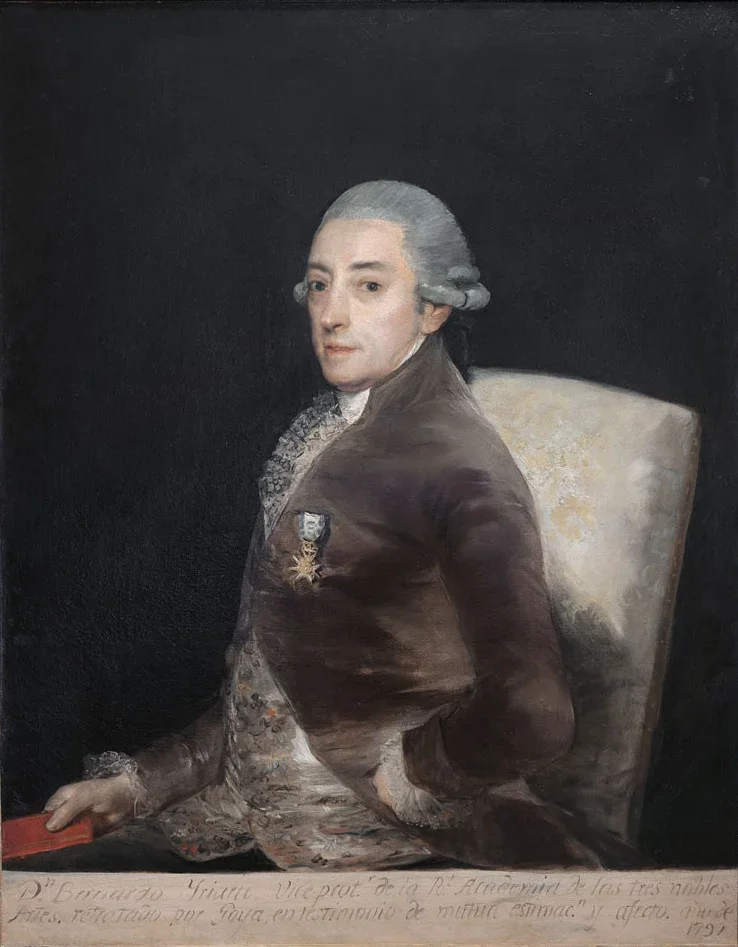
Bernardo de Iriarte
Goya knew this face well. The man before you, Bernardo de Iriarte, was his friend and patron, a politician who loved art. There he is, seated on his chair against a black background, shown from the waist up, a red book in his right hand. At the first showing, the portrait drew praise for how like him it looked and for the skill behind it. Along the very bottom edge of the canvas runs a dedication, recording the respect and affection the two men felt for each other.
Listen in the appFrancisco Goya · Public domain
- 11
The Visitation
Peter Paul Rubens · 1611–1615
- 12
Virgin and Child with two Angels
Sandro Botticelli · 1468–1469
- 13
Mater dolorosa
El Greco · 1590
- 14
A Couple Walking in the Amsterdam Town Hall
Pieter de Hooch · 1663–1665
- 15
Miraculous Draught of Fish
Jacob Jordaens · c. 1618–1620
- 16
Madonna Lactans
Jan Provoost · 1510
- 17
Allegory of Vanity and Repentance
Cornelis van Haarlem · 1616
- 18
Head of the Virgin
Giambattista Pittoni · 1730
- 19
Landscape with Tobias and the Angel
Salvator Rosa · c. 1670
- 20
Apotheosis of Saint Sebastian
Sebastiano Ricci · c. 1725
- 21
Portrait of a Young Man
Federico Barocci · c. 1580–1585
- 22
Rest on the Flight into Egypt
Paris Bordone · c. 1530
- 23
Portrait of Richelieu
Philippe de Champaigne · 1642
- 24
Musicians and Soldiers
Valentin de Boulogne · c. 1626
- 25
Ingenuity
Giuseppe Maria Crespi · c. 1694–1699
- 26
Salvator Mundi
Palma Vecchio · 1518–1522
- 27
Gian Lorenzo Berti
Gaspare Traversi · 1754–1756
- 28
The Immaculate Conception with Saint Lawrence and Saint Francis of Paola
Giovanni Domenico Tiepolo · 1777
- 29
Saint Sebastian and the Angel
Carlo Bononi · 1620
- 30
Adoration of the Magi
Bartolomeo Biscaino · 1650s
- 31
Portrait of Adéone
Martin Drolling · 1812
- 32
Nordic Landscape with a Castle on a Hill
Allaert van Everdingen · c. 1660
- 33
The Astronomer And His Wife
Gonzales Coques · 1650
- 34
The Abduction of Helen
Girolamo Genga · 1508–1512
- 35
The St Adrian Civic Guard
Cornelis Engelsz. · 1612
- 36
Socrates, his two Wives, and Alcibiades
Reyer van Blommendael · c. 1655
- 37
The Procession of the Magi
Zanobi Strozzi · 1445
- 38
Adam and Eve/Gideon and the Fleece
Maarten van Heemskerck · 1550
- 39
Holy Family with Saint John the Baptist and an Angel
Il Sodoma · c. 1535–1540
- 40
Adoration of the Magi
Valerio Castello · c. 1650
- 41
Portrait of a Couple
Niccolò dell'Abbate · c. 1537–1540
- 42
Boy Bitten by a Crayfish
Pensionante del Saraceni · 17th century
- 43
Scene of the harem, Moorish woman in bath
Théodore Chassériau · 1854–1856
- 44
The Myth of Prometheus
Piero di Cosimo · 1515
- 45
Judith and Her Maidservant
Antonio da Correggio · 1509–1514
- 46
Saint Peter and Saint Paul
Jusepe de Ribera · c. 1616
- 47
Luigia Cattaneo-Gentile
Anthony van Dyck · c. 1622
- 48
Landscape with Animals
Philip James de Loutherbourg · 1767
- 49
The Little Bridge
Gillis Rombouts · 17th century
- 50
The Lute Player
Giovanni Cariani · c. 1514–1516
- 51
Self-portrait
Salvator Rosa · 1640
- 52
Agony in the Garden
Gerard David · 1510–1520
- 53
Episode of the childhood of Saint John the Baptist
Sano di Pietro · 1450
- 54
Moonlight
Philip James de Loutherbourg · 1777
- 55
Cyparissus
Jacopo Vignali · 1620s
- 56
L'Orage
Georges Michel · c. 1830
- 57
Mountainous Landscape with a Torrent
Jacob van Ruisdael · 1670
- 58
Two mills
Jacob van Ruisdael · 1650s
- 59
The Blackcurrant Pie
Willem Claesz. Heda · 1641
- 60
Neapolitan Herder and a Cow leaving a Cave
Jean Barbault · c. 1750
- 61
River Landscape
Salomon van Ruysdael · 1642
- 62
Saint Anthony of Padua holding the Infant Jesus
Bernardo Strozzi · c. 1625
- 63
Bathers
Michiel Sweerts · c. 1655
- 64
Deposition of Christ
Simone Peterzano · 1572–1574
- 65
Virgin of Consolation
William-Adolphe Bouguereau · 1877
- 66
Madonna and Child with the Milk Soup
Gerard David · 1510–1520
- 67
Adam and Eve
Maarten van Heemskerck · c. 1550
- 68
The Virtuous Athenian Woman
Joseph-Marie Vien · 1762
- 69
Vanity
Franciscus Gijsbrechts · 1670s
- 70
Eve
Hendrik Goltzius · 1613
- 71
The Virgin fainting as Christ is carried to his grave
Lorenzo Lotto · 1545
- 72
Justice
Eustache Le Sueur · 1650
- 73
Saint Sebastian
Giovanni Battista Cima da Conegliano · 1500–1503
- 74
Saint Roch
Giovanni Battista Cima da Conegliano · 1502–1503
- 75
View of Santa Maria della Salute, from the entrance of the Great Canal
Giovanni Antonio Canal · c. 1727
- 76
Bust of an angel
Filippino Lippi · c. 1494
- 77
Nitpicking
Michiel Sweerts · 17th century
- 78
Virgin and Child with Infant John the Baptist
Piero di Cosimo · 1489–1499
- 79
Plate of Peaches with Walnuts, Grapes, Wine Glass and Knife
Jean-Baptiste-Siméon Chardin · 1750–1758
- 80
A Bridal Couple / The Dead Lovers
Unknown Artist · c. 1470
- 81
The Five Senses
Jacques Linard · 1638
- 82
Virgin in a Garden
Master of the Legend of the Magdalene · 15th century
- 83
Jan de Beer - Christ Carrying the Cross (ca 1510)
Jan de Beer · c. 1510
- 84
Vase with Flowers
Gaspar Peeter Verbruggen the Younger · 17th century
- 85
Vanity
Hans Memling · c. 1485
- 86
Hell
Hans Memling · c. 1485
- 87
Floral still life of three roses in a glass vase surrounded by three butterflies, a beetle and a caterpillar
Jacob van Es · 17th century
- 88
A dancer
Jean-Frédéric Schall · 1800
- 89
Bagpipe player
Philippe Mercier · 17th century
- 90
Venus and Cupid
Unknown Artist · 1600
- 91
Sleeping Venus
Unknown Artist · 16th century
- 92
The Creation of the Animals
Unknown Artist · 16th century
Musée des Beaux-Arts de Strasbourg
Frequently asked questions
How much does the guide cost?
Free app download. Free until 1 January. Listed guide price: $0.99. Audio guide only. Venue admission is separate.
Can I listen without internet?
Yes. Download the guide’s audio, images, and maps in the app before your visit. Your downloaded content is then available offline.
Can I listen in my language?
In English for now. More languages soon.
Do I need to follow a schedule?
No. This is a self-guided experience. Choose your stops, pause whenever you like, and return to a story at your own pace.
Which artworks are in the Musée des Beaux-Arts de Strasbourg audio guide?
92 artworks, including Portrait of a young woman (Raphael, Giulio Romano), Earthly Vanity and Divine Salvation (Hans Memling), Crucifixion of Strasbourg (Giotto), Cephalus and Procris (Paolo Veronese), Christ Triumphant over Sin and Death (Peter Paul Rubens), Samson and Delilah (Guercino), Joan of Arc Kissing the Sword of Deliverance (Dante Gabriel Rossetti), and Adoration of the Shepherds (Carlo Crivelli). The full list is on this page.
Is this the museum’s official audio guide?
No. Stanza is an independent audio guide app and is not affiliated with Musée des Beaux-Arts de Strasbourg. Museum admission is separate.
At your own pace
Explore Musée des Beaux-Arts de Strasbourg.
Download Stanza, then search for “Musée des Beaux-Arts de Strasbourg”.
Free app download · Guide price shown in the app
Keep exploring
Nearby audio guides
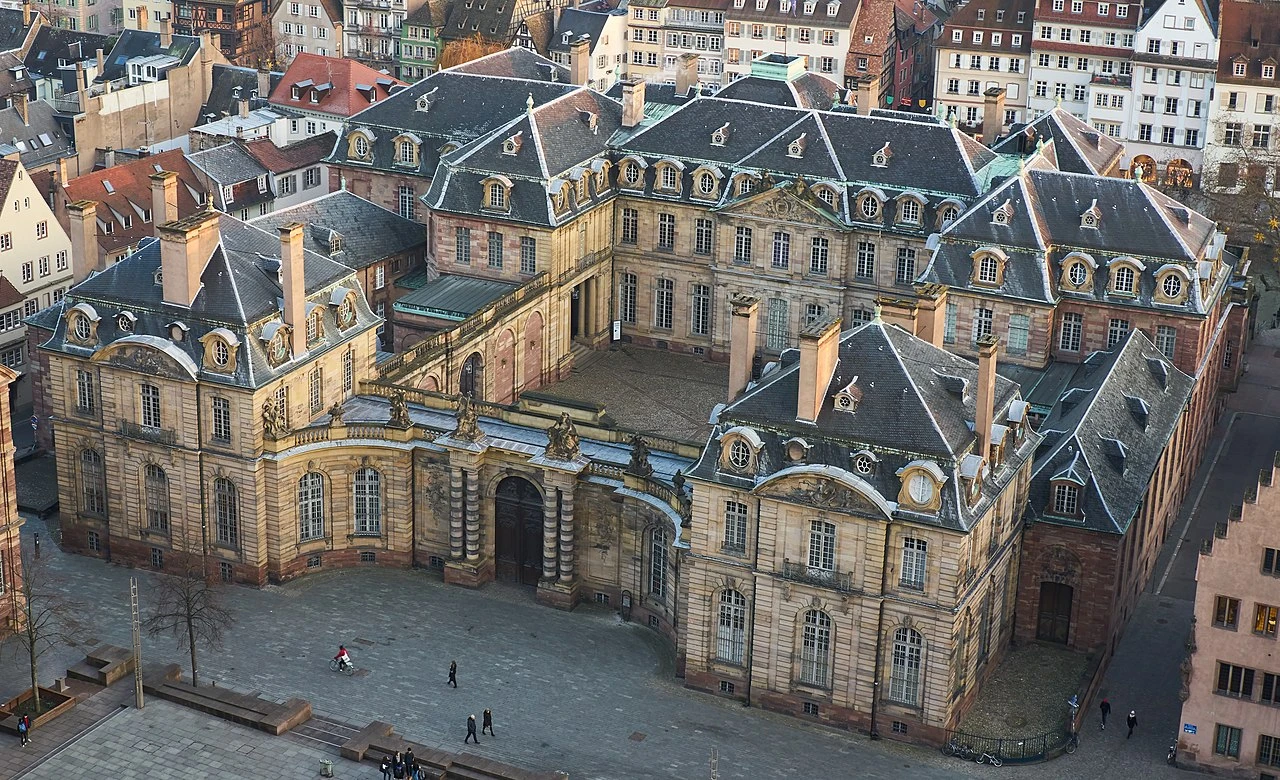
Strasbourg · 1 km
Palais Rohan
Content & sources
Radek Kucharski · CC BY 2.0
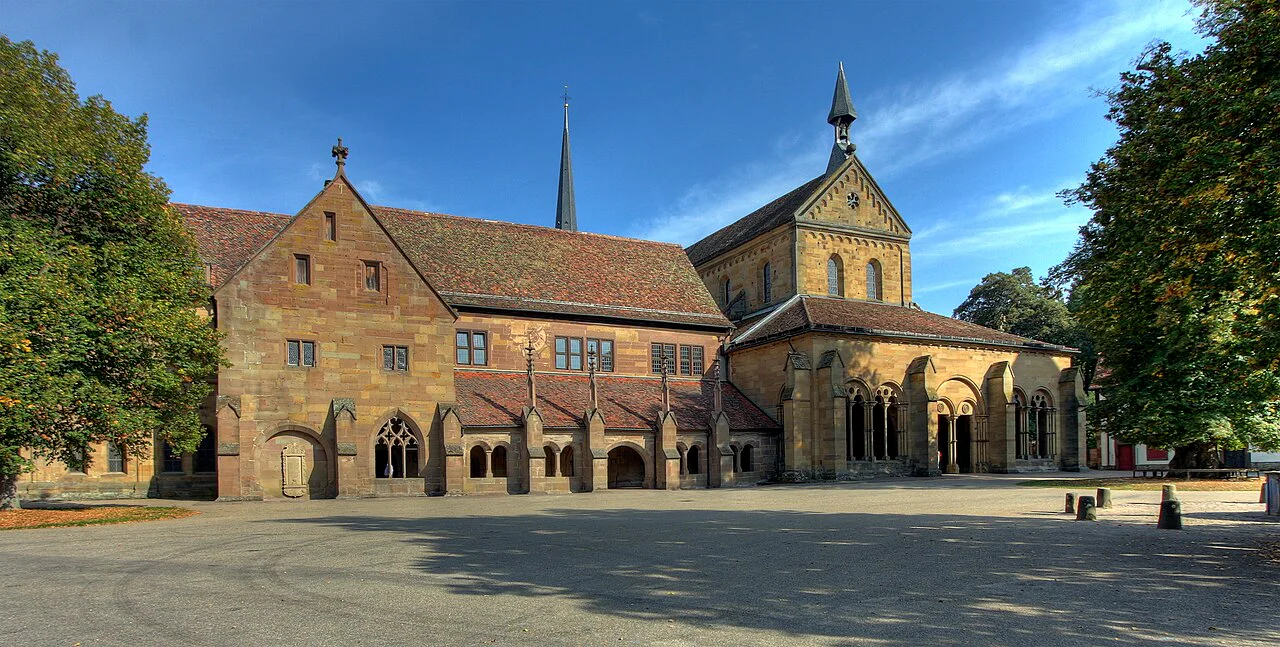
Maulbronn · 91 km
Kloster Maulbronn
Content & sources
Elke Wetzig (Elya) · CC BY-SA 3.0

Bisingen · 94 km
Hohenzollern Castle
Content & sources
A. Kniesel (= User:-donald-), Lauffen · CC BY-SA 3.0
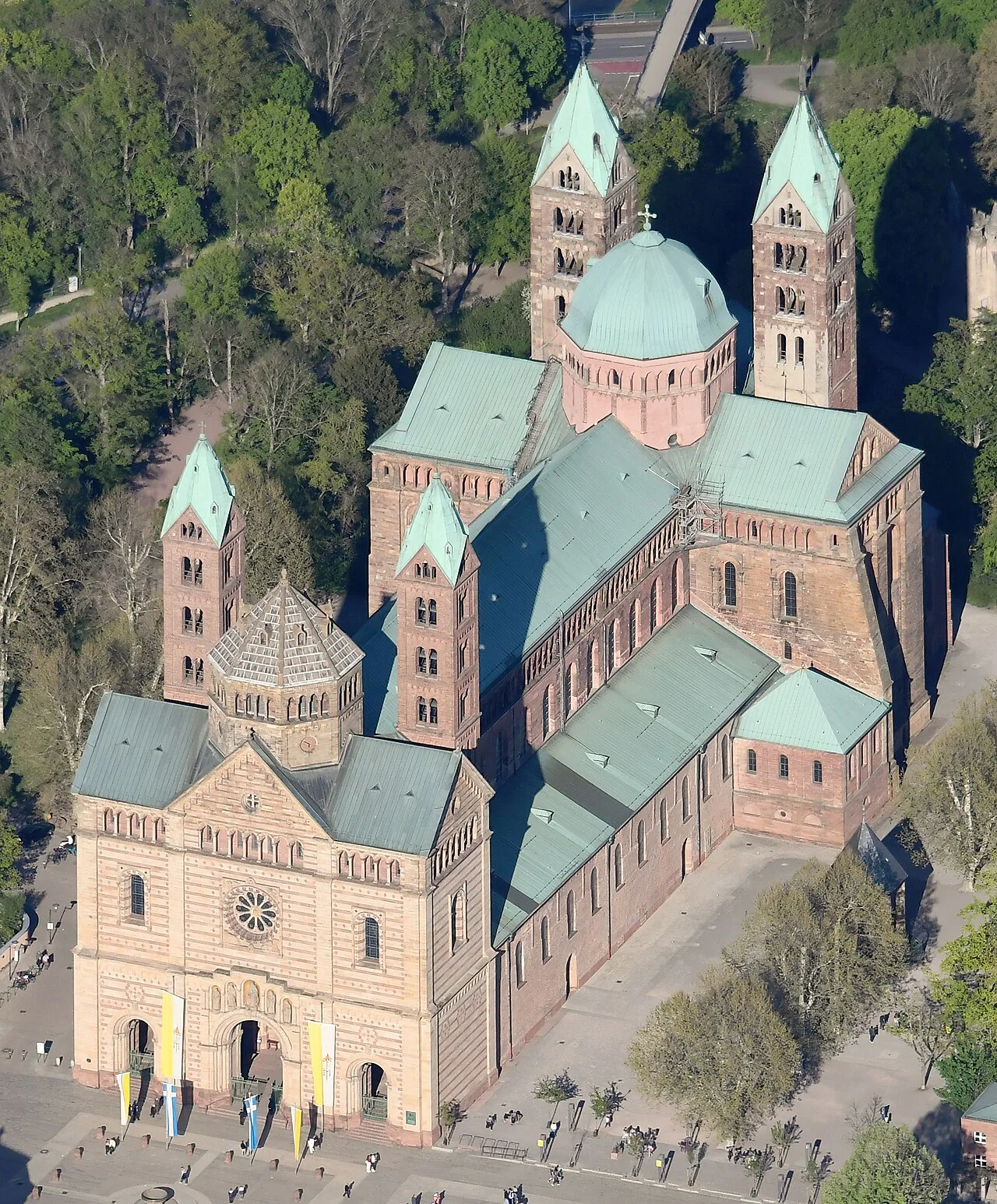
Speyer · 96 km
Speyerer Dom
Content & sources
Carsten Steger · CC BY-SA 4.0
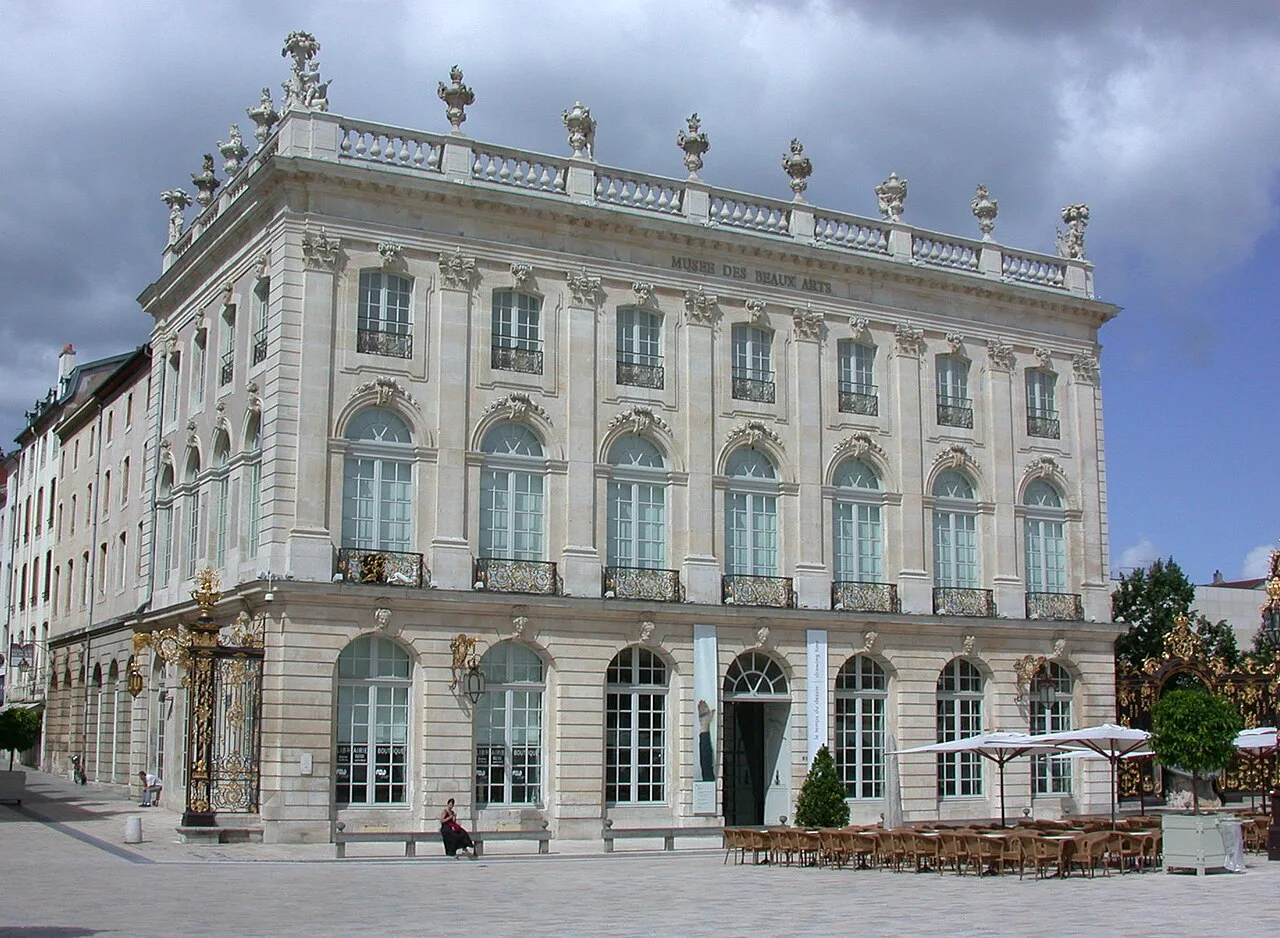
Nancy · 116 km
Musée des Beaux-Arts de Nancy
Content & sources
photo uploaded by User:RicciSpeziari. Photographer: Riccardo Speziari · CC BY-SA 3.0
Art museums
More art museum audio guides
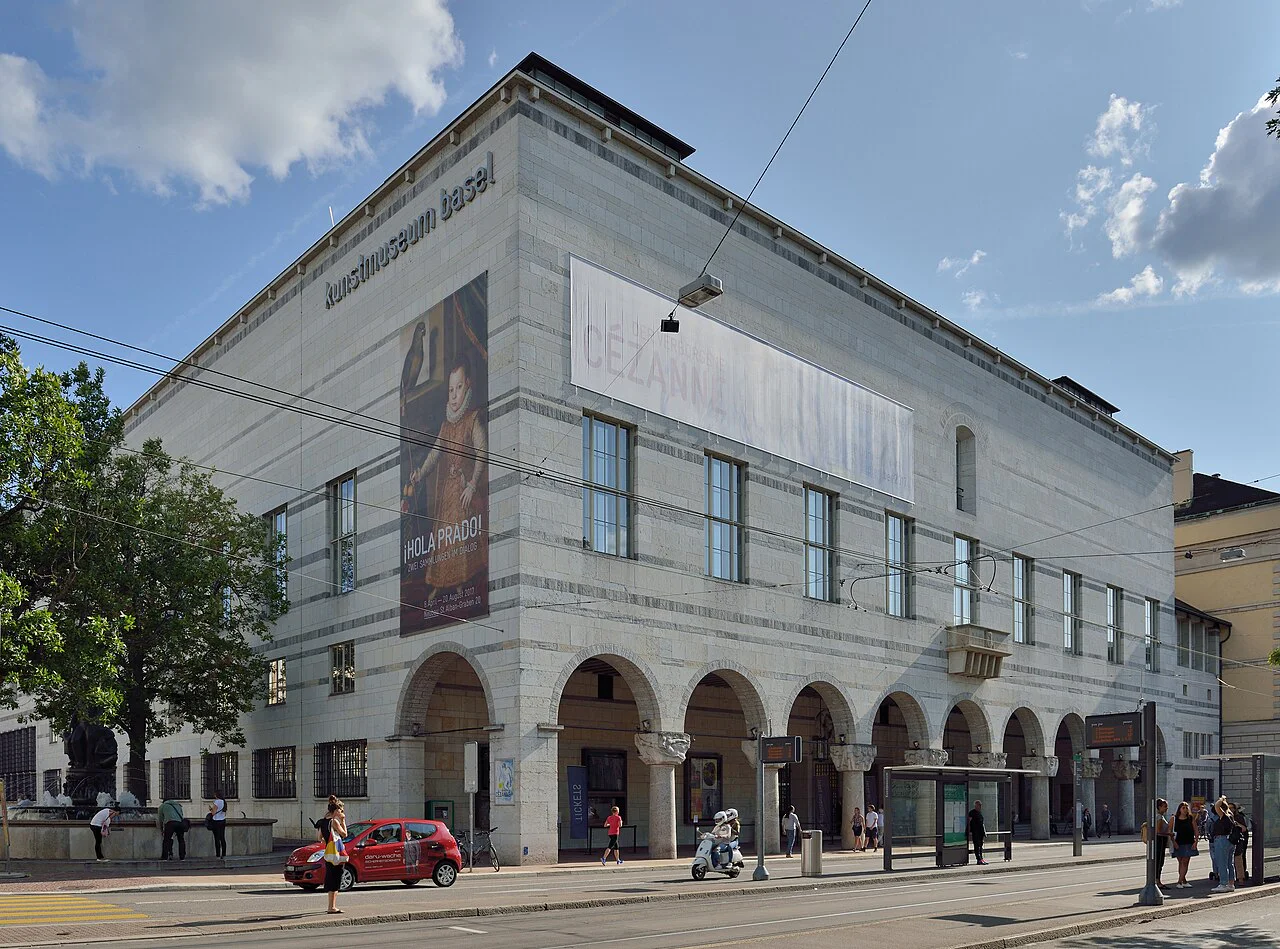
Basel · 61 artworks
Kunstmuseum Basel
Content & sources
Wladyslaw Sojka · FAL
Nancy · 46 artworks
Musée des Beaux-Arts de Nancy
Content & sources
photo uploaded by User:RicciSpeziari. Photographer: Riccardo Speziari · CC BY-SA 3.0
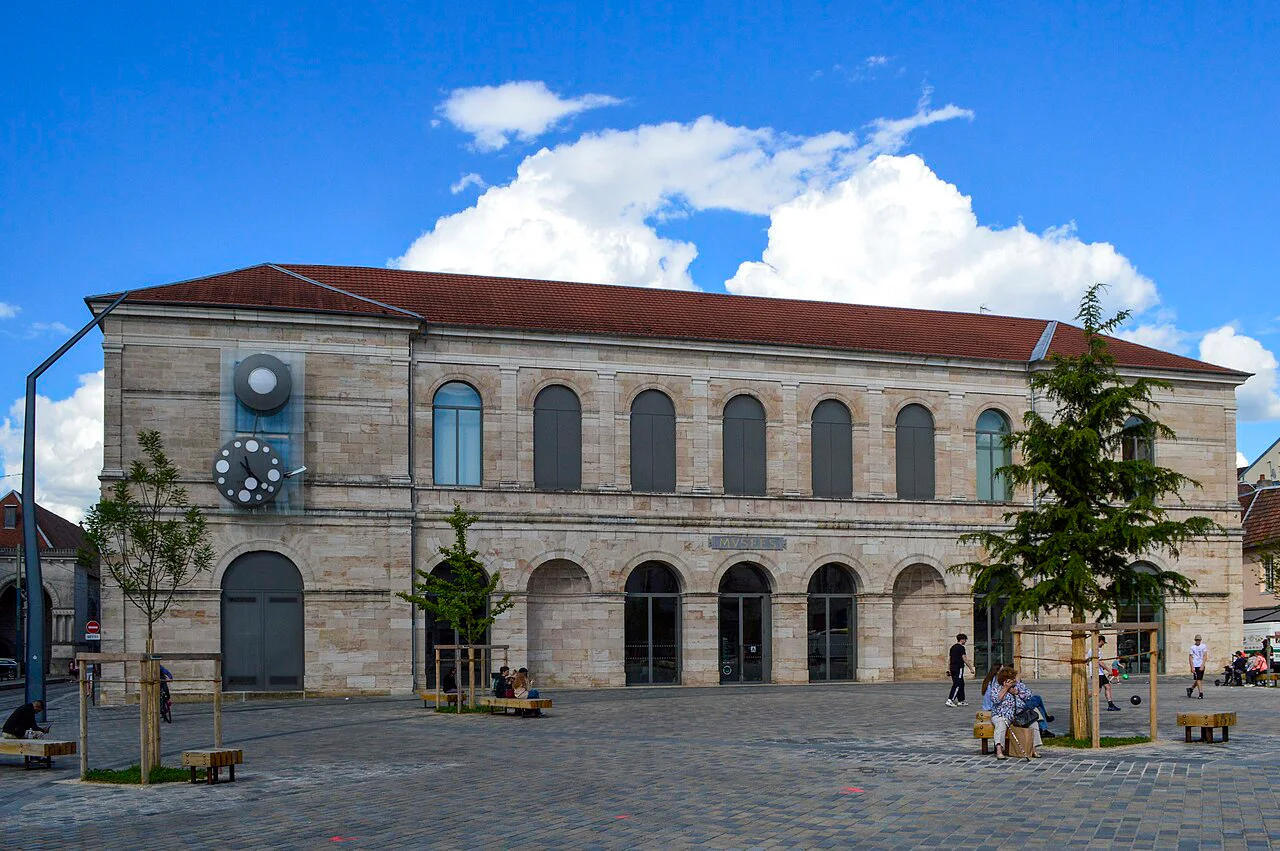
Besançon · 63 artworks
Musée des Beaux-Arts et d'Archéologie de Besançon
Content & sources
Photo: Wikipedro · CC BY-SA 4.0
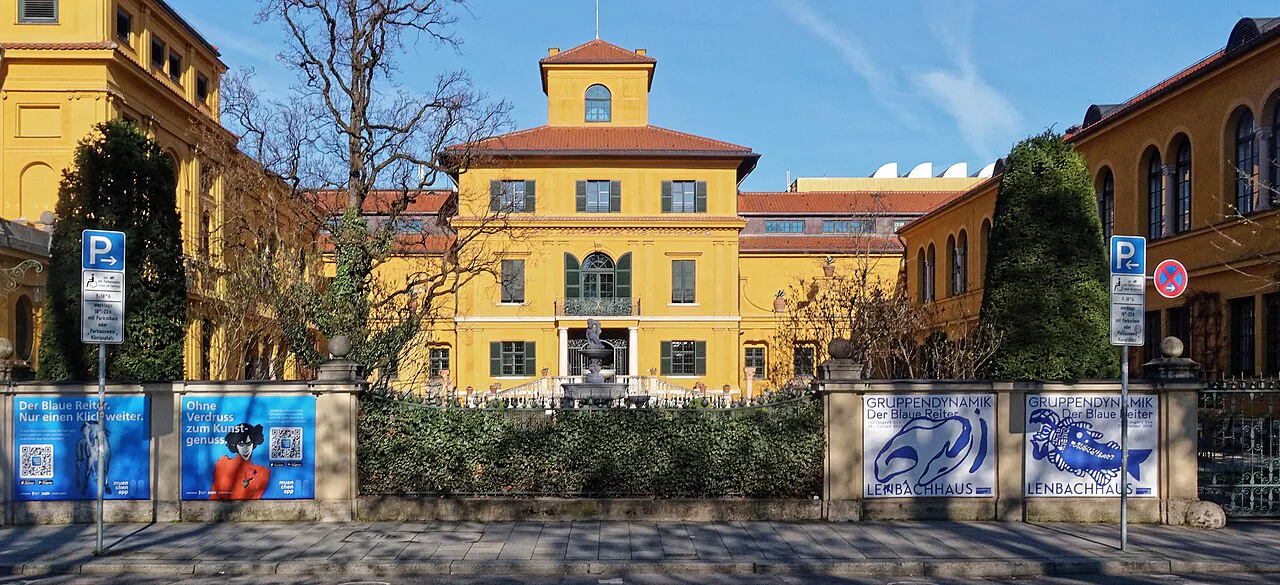
Munich · 33 artworks
Städtische Galerie im Lenbachhaus
Content & sources
Burkhard Mücke · CC BY-SA 4.0
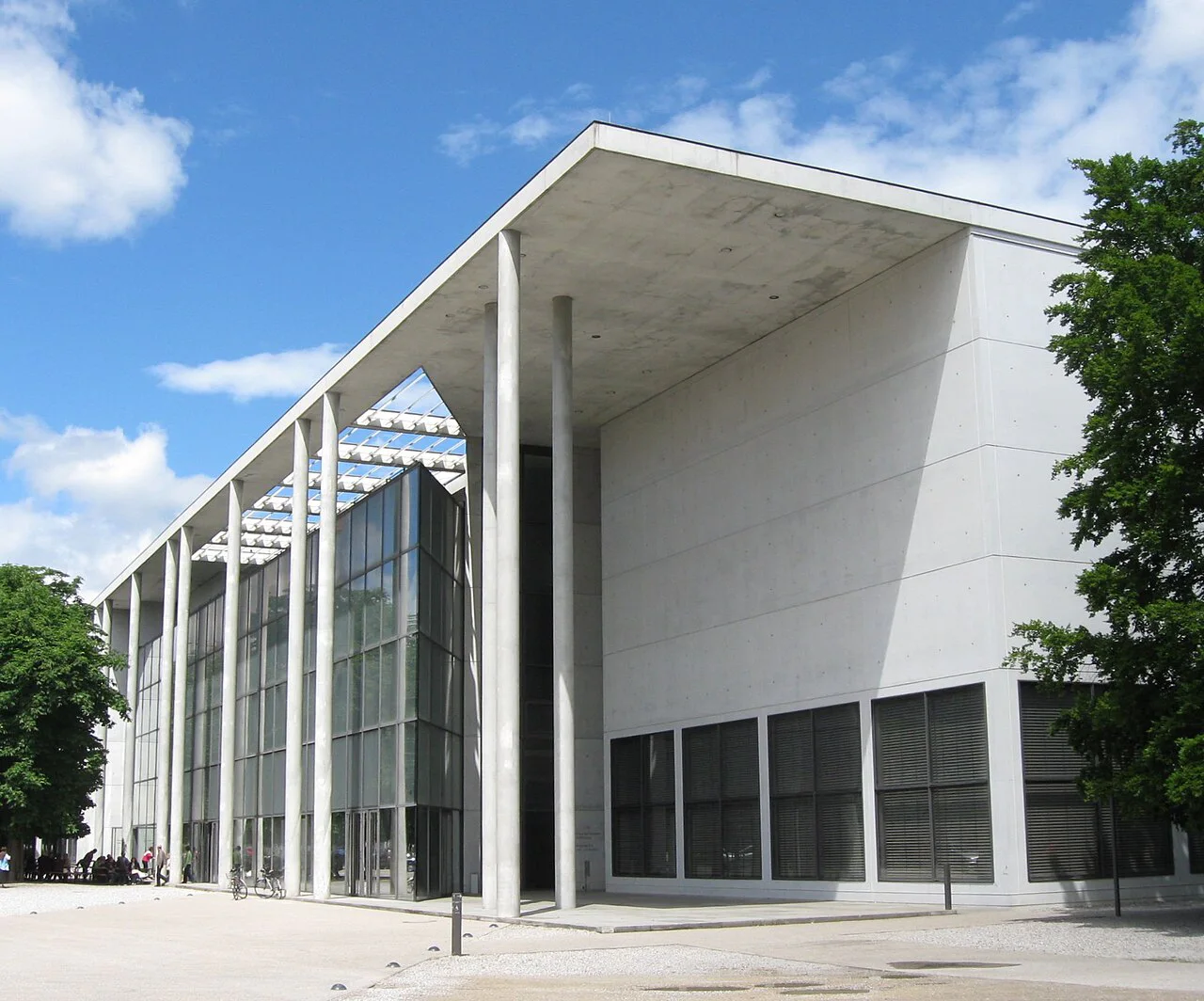
Munich · 6 artworks
Pinakothek der Moderne
Content & sources
Photo: Rufus46 · CC BY-SA 3.0
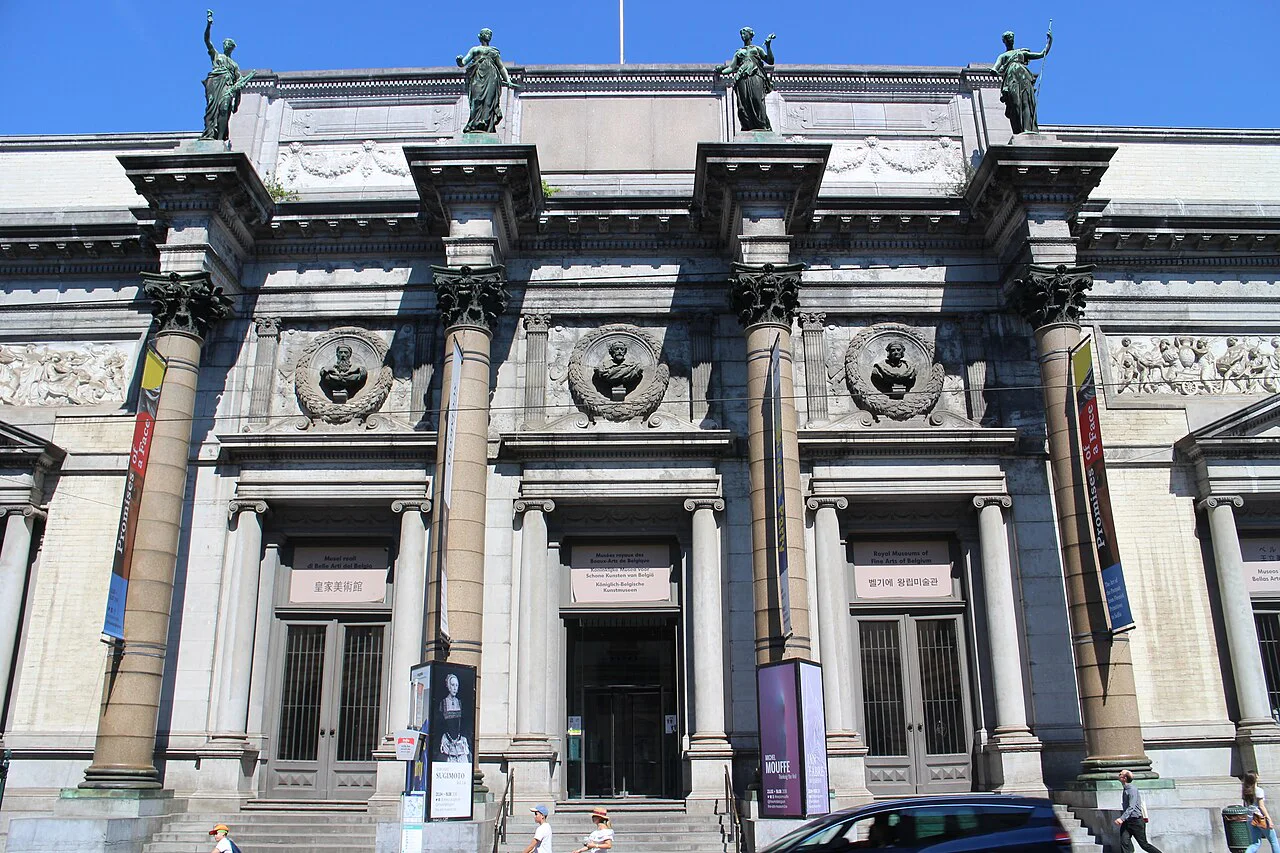
Brussels · 127 artworks
Royal Museums of Fine Arts of Belgium
Content & sources
Photo: Suicasmo · CC BY-SA 4.0