Stanza · Audio guide
Musée des Beaux-Arts et d'Archéologie de Besançon Audio Guide
A place to remember. A story to take with you.
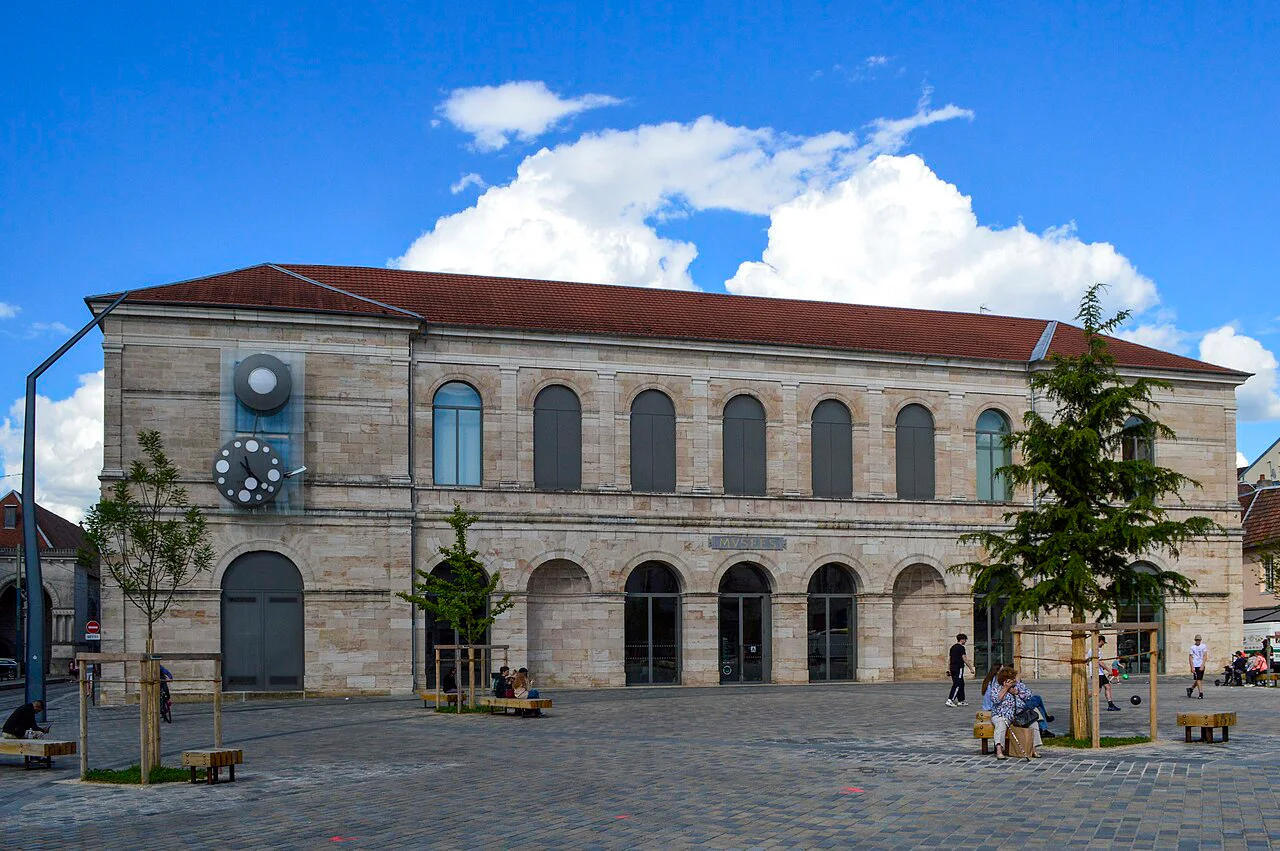
The musée des Beaux-Arts et d'Archéologie is located in the French city of Besançon. It is the oldest public museum in France, having been established in 1694.
Download Stanza, then search for “Musée des Beaux-Arts et d'Archéologie de Besançon”.
About the tour
One guide. Your kind of visit.
The musée des Beaux-Arts et d'Archéologie is located in the French city of Besançon. It is the oldest public museum in France, having been established in 1694.
The Musée des Beaux-Arts et d'Archéologie de Besançon guide tells the stories of 63 artworks, including Killing a Deer (Gustave Courbet), Portrait of Adèle Besson (Pierre-Auguste Renoir), Deposition of Christ (Bronzino), Drunkenness of Noah (Giovanni Bellini), Ishū Retsuzō (Kakizaki Hakyo), Portrait of Jean-Baptiste Desdéban (Jean-Auguste-Dominique Ingres), Cannibals contemplating human remains (Francisco Goya), and Cannibals Chopping up Victims (Francisco Goya). Every artwork is free to hear in the Stanza app until 1 January.
Ready when you are.
- 01Get the free Stanza app.
iOS & Android
- 02Find your guide.
“Musée des Beaux-Arts et d'Archéologie de Besançon”
- 03Download before you go.
Works offline
Audio guide / 63 artworks
Inside the guide
Get to know a few of the stories before you go. Open a stop to read more.
01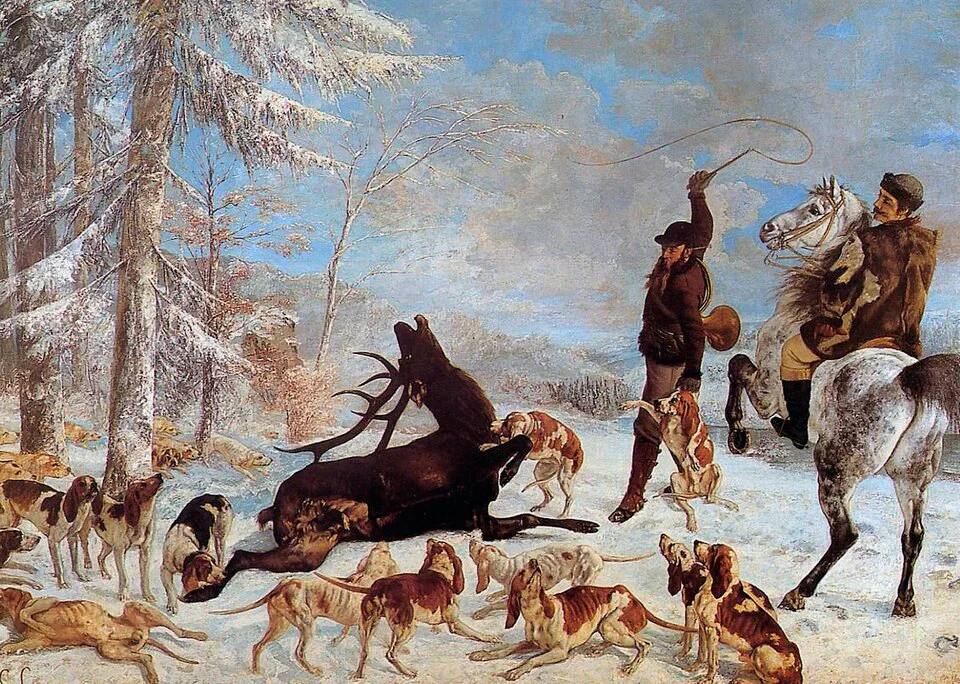
Killing a Deer
Near the right edge, a man on foot raises one hand high, gripping a long whip. The strap hangs in the air, caught as it moves. In a moment he will bring it down to quiet the dogs. The violence of the hunt is not over yet. At the center, a deer has collapsed on the snow, its head thrown back, its antlers against its neck, letting out a last cry. Dogs crowd around it, barking. Courbet cared deeply about hunting and believed this would be a work of real importance. He gave it the size of a history painting, once reserved for noble subjects. But instead he filled it with two local men he knew and a dying animal. It went to the Salon in 1869. A canvas this large was expected to carry a grand event, not a hunt. And people found it brutal. Hunting pictures were meant to decorate, to show people winning over nature. Here the animal's suffering was set out plainly, and it made viewers uneasy. No one bought it. It stayed in his studio until he died. In 1881 it was sold at auction, and soon after it came here to Besançon. And the man on horseback wears a jacket made from an animal's skin, a sign of his hunting feats.
Listen in the appGustave Courbet · Public domain
02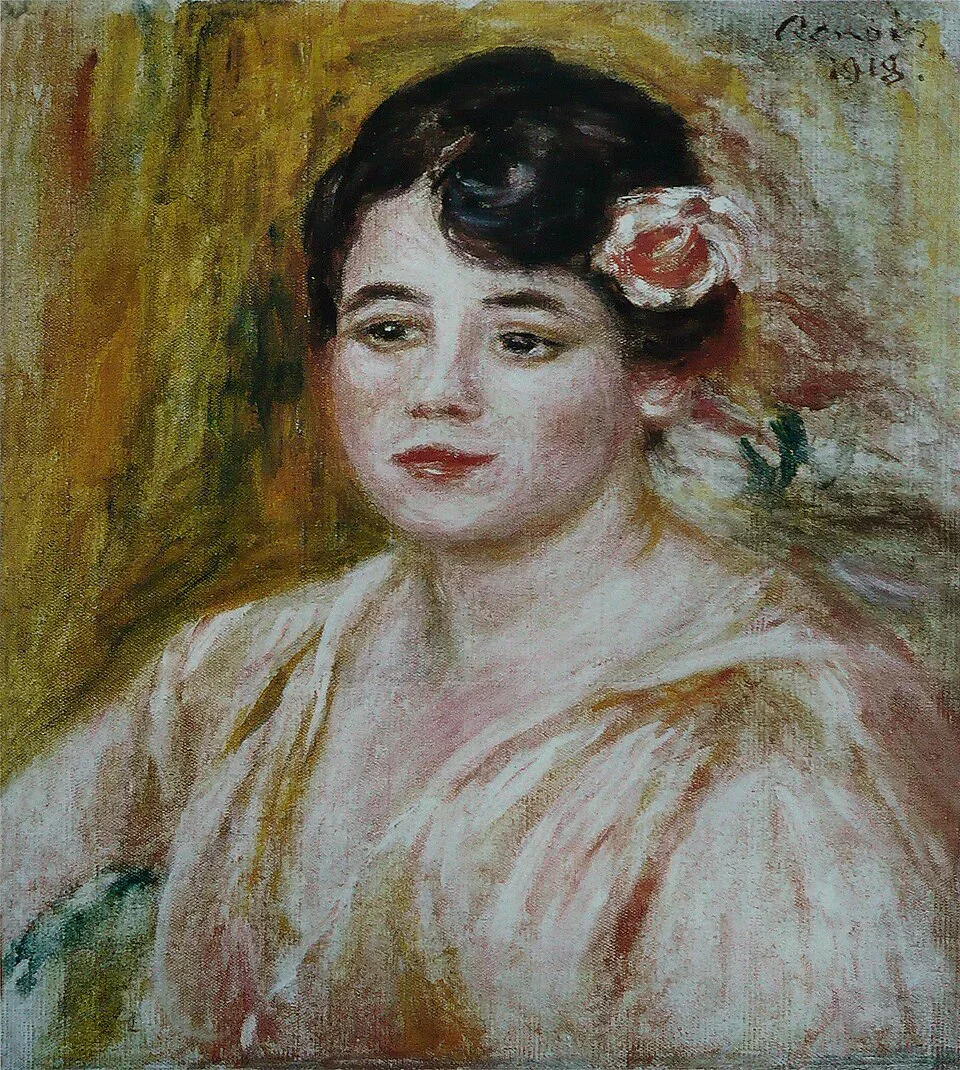
Portrait of Adèle Besson
Near the end of his life, Renoir was painting with a brush his hands could no longer guide finely. A deforming arthritis had taken away the delicacy of his early work. Adèle Besson's face is built from only a few strokes. The paint sits thick, almost chalky, and the background is barely there, melting softly into her form. Red and yellow run through it, colours that recall Cagnes-sur-Mer, the Mediterranean town where he had retired. Adèle was the wife of George Besson, a collector who admired Renoir in those last years. The couple asked him for this portrait of her. And what George loved in it was what Renoir had left out. He stripped his portraits of the accessories that announce a sitter's rank, and the expectations that come with it. Nothing here tells you Adèle's place in society. In the upper right corner, he signed and dated it, Renoir 1918.
Listen in the appPierre-Auguste Renoir · Public domain
03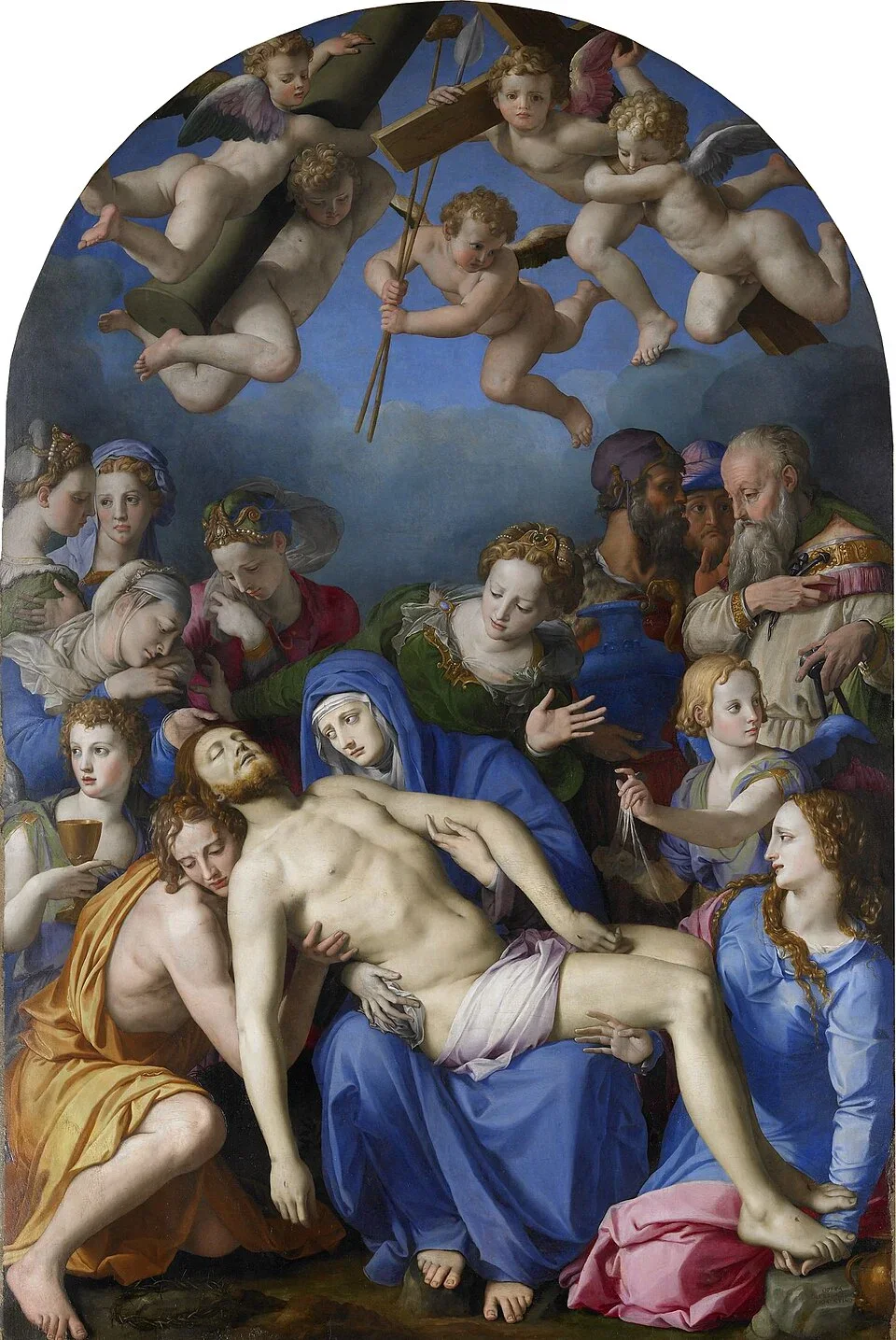
Deposition of Christ
Christ is held in Mary's arms, with John supporting his back and Mary Magdalene kneeling at his feet. Mourners surround them, and angels above carry the column, the sponge, the lance and the cross. Two more angels hold a chalice and a transparent veil, both signs of the bread and wine of communion. Those two angels look out past the picture's edges. Bronzino made this for a small private chapel whose walls showed scenes from the life of Moses. On one side, Moses struck water from a rock and gathered manna. The water and manna pointed to the bread and wine, so the grief was meant to be read with the frescoes. The chapel belonged to Eleonora of Toledo, wife of Cosimo de' Medici. Soon after the picture was finished, Cosimo sent it as a diplomatic gift to Nicolas Perrenot de Granvelle. Granvelle was a chief counselor to Emperor Charles the Fifth. Granvelle came from Besançon, in the County of Burgundy, a region Cosimo valued, and put it in his private chapel there. Cosimo had a copy made in 1553, and that is the one in Eleonora's chapel today. The original never went back. After Granvelle died, it was installed in his funerary chapel, consecrated in 1551. When the chapel was partly destroyed, the picture was kept safe in the city hall from 1793 until it arrived here in 1834.
Listen in the appBronzino · Public domain
04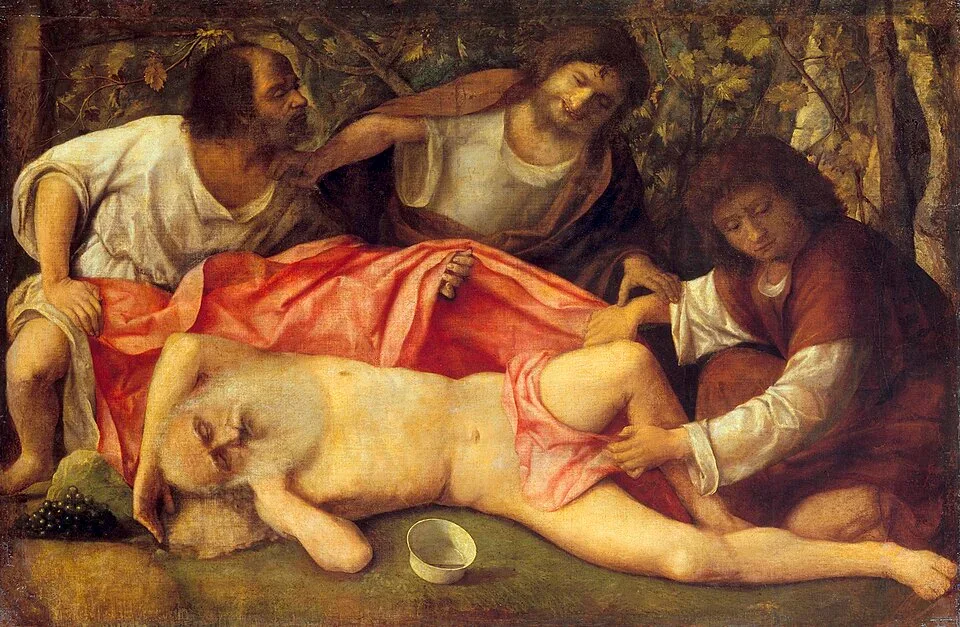
Drunkenness of Noah
An almost empty cup stands in front of the sleeping man. A bunch of grapes lies beside his head, and vines grow in the background. That is how you know he has been drinking. He is Noah, asleep and uncovered. On either side, two sons kneel, Shem and Japhet. They turn their faces away while they cover him with a red cloth. Between them, a little further back, is the third son, Ham. He grins, looking straight at his father. With arms spread wide, he seems to hold his brothers back. In the story that follows, Noah wakes and learns what Ham has done. Ham's son Canaan is cursed, and Ham's children become the Canaanites. The grapes and vines carry more than a drinking bout. They point to the wine of communion, and Ham's laughter to the mockery Christ would suffer. The name Bellini was attached to this painting only in 1927. Lorenzo Lotto and Titian have been named as well. Who painted it is still debated.
Listen in the appGiovanni Bellini · Public domain
05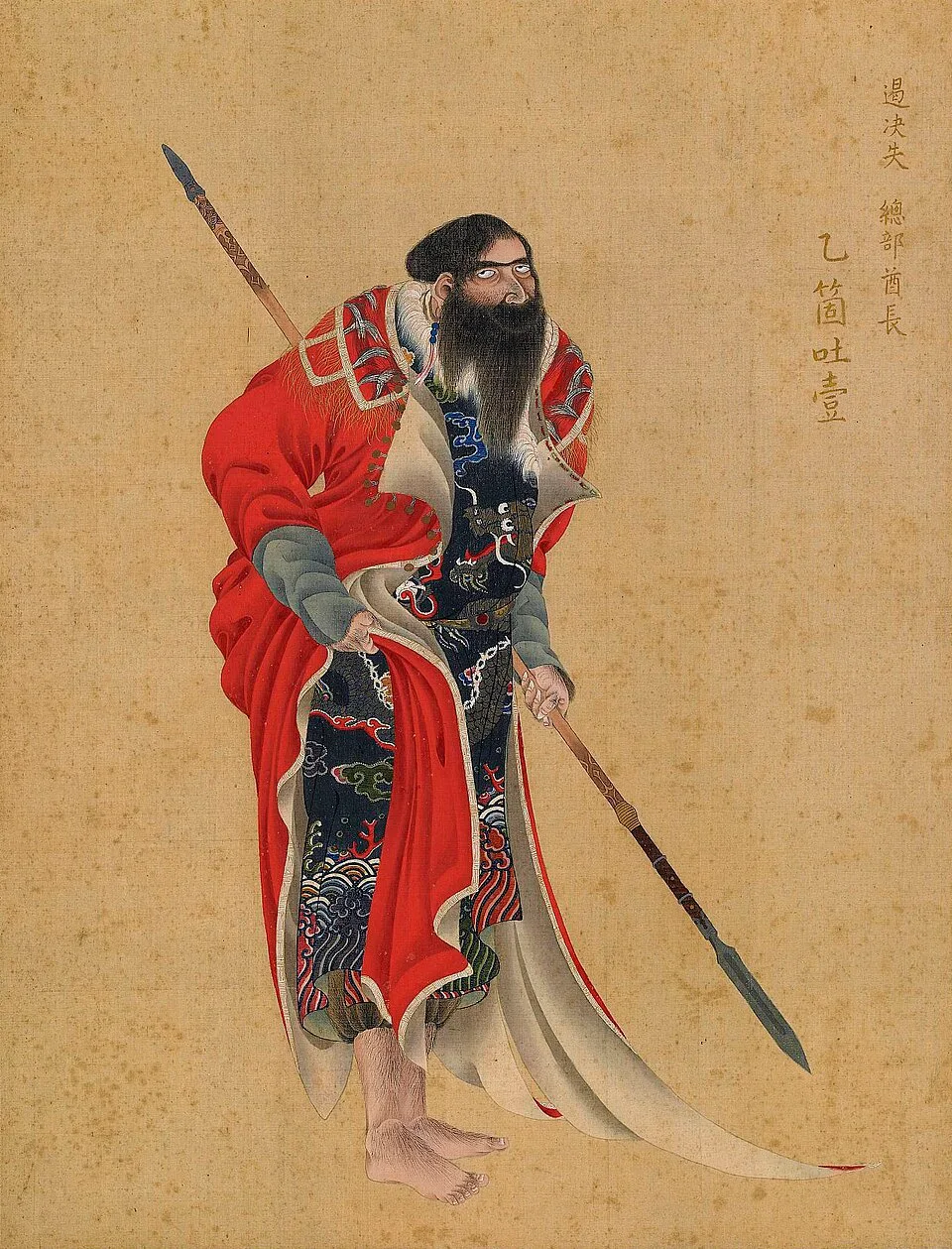
Ishū Retsuzō
Nobody knows how eleven painted portraits of Ainu chiefs, from the far north of Japan, came to rest here in Besançon. They were found in storage in 1984. Perhaps a missionary from this region, who had spent time in Hokkaido, carried them this way. Their clothes keep the question alive. There are bark cloth robes with thorn patterns, Chinese robes, Russian coats and western shoes. The men in these portraits connect to Japan, China and Russia, a very long way from Besançon. Yet these were painted for a Japanese lord, not for the Ainu themselves. In 1789 a merchant's fishing operation sparked an uprising. It worked Ainu people so hard they had no time to store food for winter. Its supervisors took Ainu wives as mistresses. Seventy-one Japanese were killed. The lord of Matsumae, Matsumae Michihiro, sent soldiers, who recruited Ainu chiefs as they went. In 1790 he commissioned portraits of the twelve elders who had helped put down the revolt. Kakizaki Hakyo, a samurai of the Matsumae clan, painted them. Eleven of the twelve survive here. The twelfth, Ikorikayani, is known only through a copy.
Listen in the appKakizaki Hakyo (1764-1826) · Public domain
06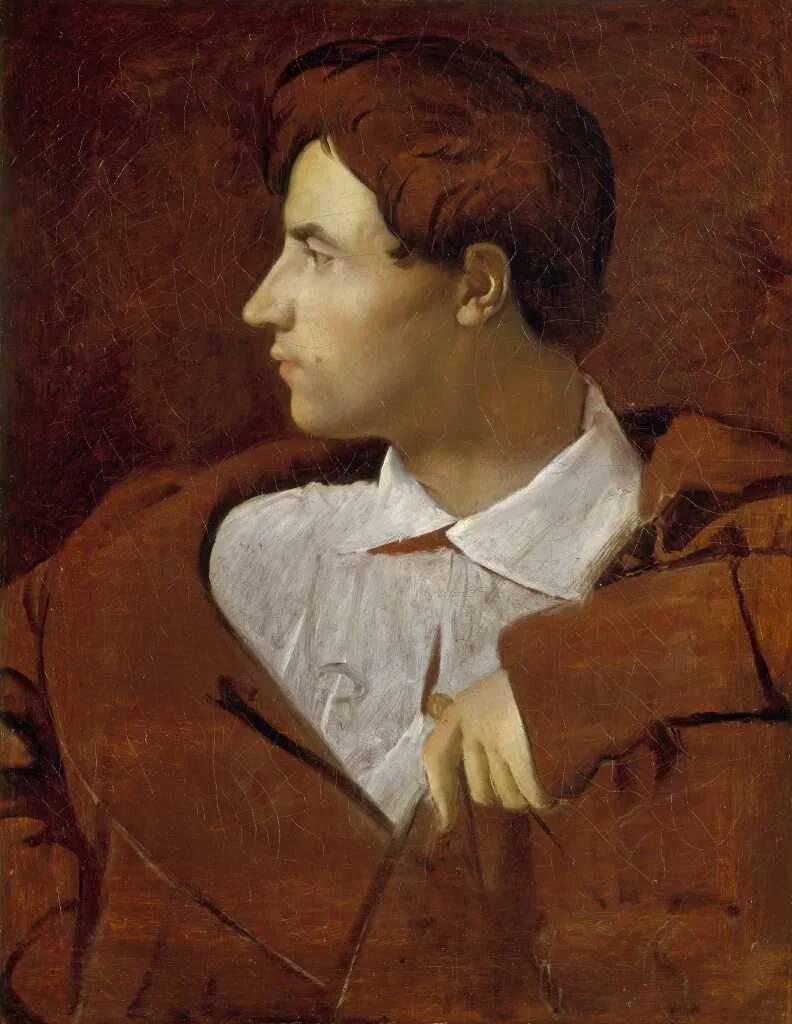
Portrait of Jean-Baptiste Desdéban
Only the face was worked up. Everything else in this portrait is still a first sketch. Ingres painted it in Rome in 1810. He, the young architect Jean-Baptiste Desdéban and the sculptor Paul Lemoyne were all living at the Villa Medici then. It was no patron's order. It grew out of the three of them being together. Ingres probably gave it to Lemoyne, their friend, rather than to the man it shows. Desdéban faces left in profile, and that face is the one part with solid, careful modelling. It separates from the flat canvas around it. Everything else is slight. The hair is touched in with darker brown, the white shirt is a few strokes, and the brown coat is barely shaped. His left hand holds one fold of the coat, sketched as lightly as the rest. The profile is an old, formal way to show a face, yet the quick rough handling makes it feel modern. Years later the elderly Ingres visited the painter Jean Gigoux in Paris. When Ingres saw this portrait, he called out Desdéban's name. Gigoux left it to the city of Besançon in 1894. Across the whole surface, the red ground he laid down first still shows through, the traditional first layer of the portrait, left uncovered.
Listen in the appJean-Auguste-Dominique Ingres · Public domain
07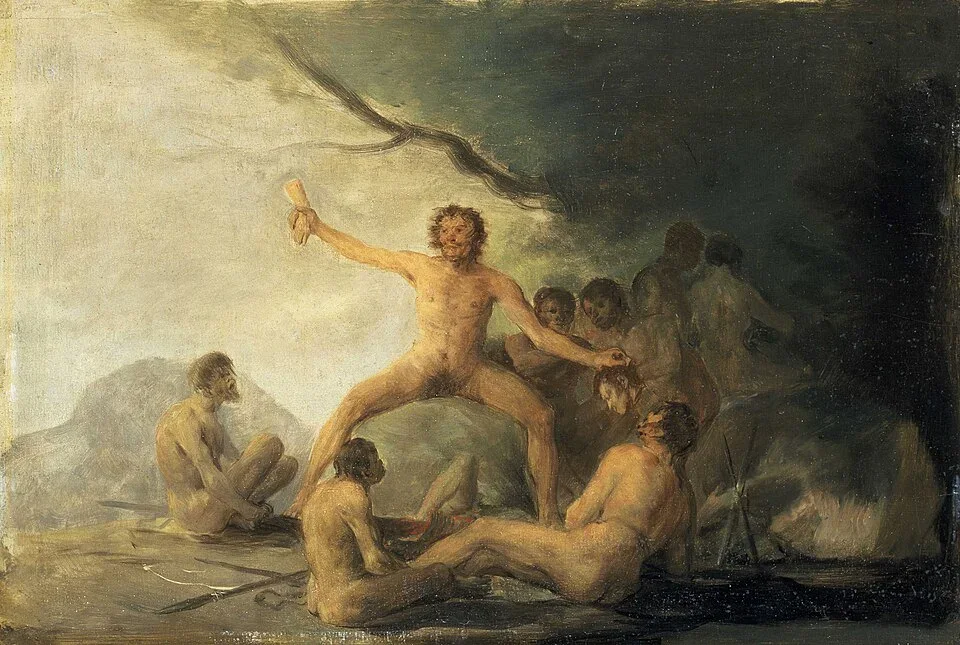
Cannibals contemplating human remains
A body has just been cut apart, and a meal is about to begin. At the centre of the picture a naked man sits on a rock, facing forward, his legs wide apart. He holds up the severed head of one of his victims, and a hand. The rest of the body, a leg and some ribs, lies on the ground. Three more men sit naked nearby. They watch the scene, waiting for the meal to start. In the background, at the mouth of a cave, a vague group goes about its business. The place is barely drawn and the figures are soft and hazy, and that is just why the violence comes through so hard. Goya painted this as part of a series on cannibalism, cruelty and witchcraft. It follows straight on from another canvas, where the victims were prepared. This one is the pause before anyone eats. The strokes are fast and exact, built on drawings with sharp outlines that were strengthened with dark lines.
Listen in the appFrancisco Goya · Public domain
08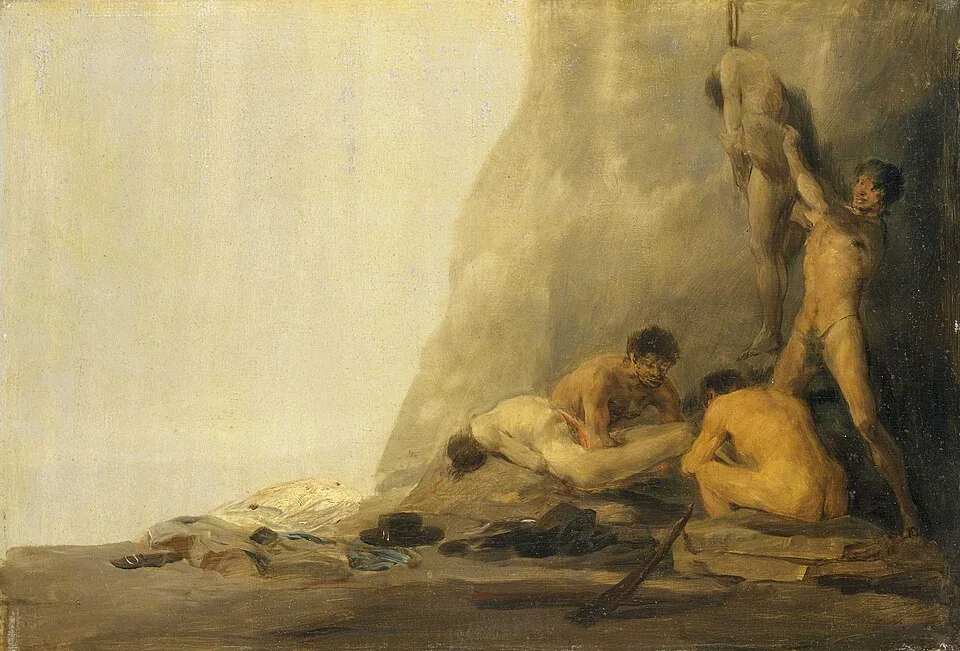
Cannibals Chopping up Victims
No one knows why Goya painted this. At the mouth of a cave, three naked men are cutting up two others. Two crouch around a corpse. The third stands facing you, skinning a second victim hung up by the feet, head down. The surroundings are barely sketched, the figures blurred and hazy, and the violence comes through all the harder for it. On the left are some clothes. They may be the garments of two French Jesuit missionaries, Jean de Brébeuf and Gabriel Lallemant, killed by Iroquois in 1649. Goya went deaf early in the 1790s, and afterward turned to darker subjects. Prisons, madness, witchcraft, rape, murder in cold blood, and here, cannibalism. He called these his paintings of caprice and invention. There is a companion picture, cannibals contemplating human remains. Together the two are sometimes called the savage paintings.
Listen in the appFrancisco Goya · Public domain
09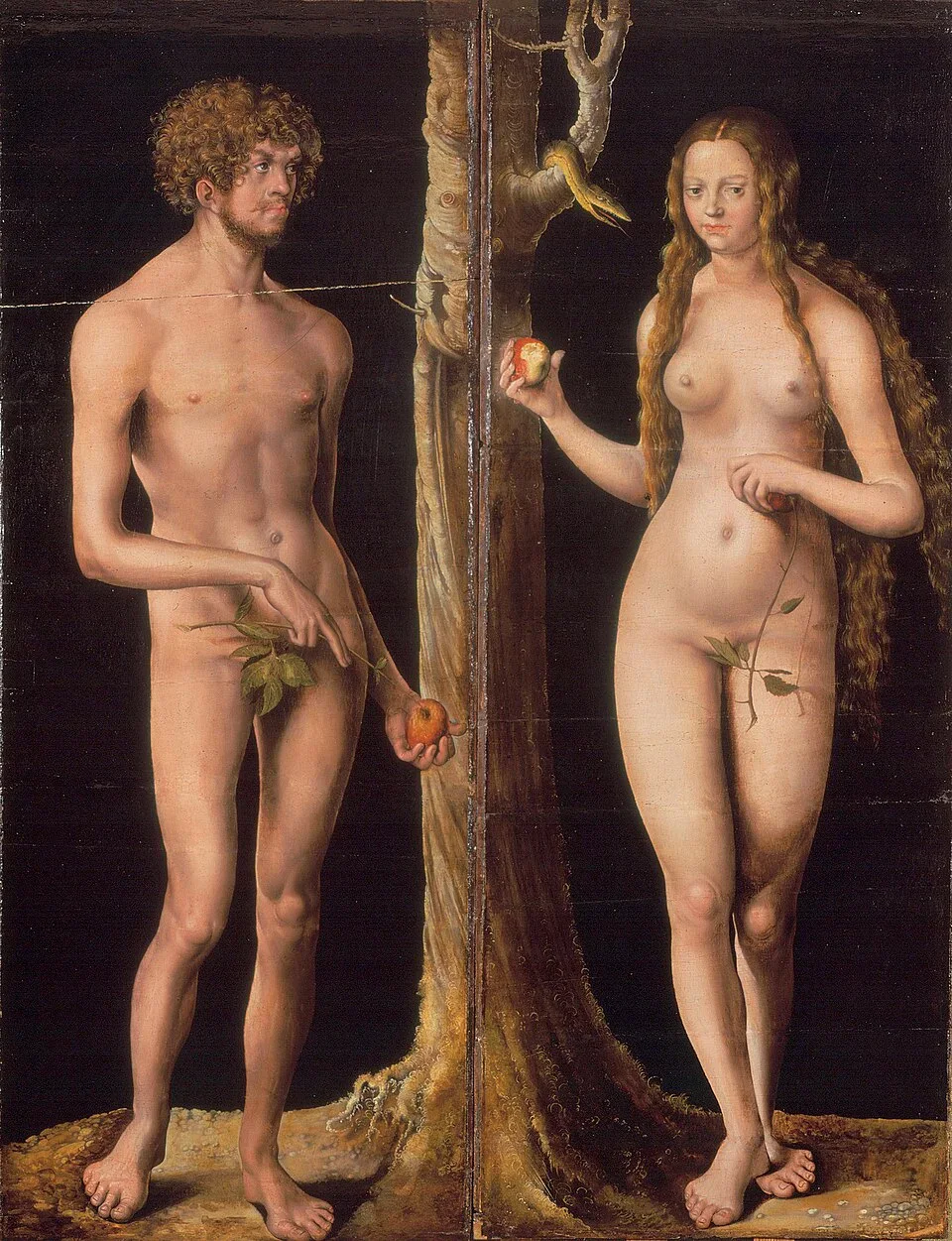
Adam and Eve
Two figures stand naked on either side of a tree, each holding an apple, against a black background. This is the Fall, the key moment in Genesis, and it has already happened. The woman has bitten into her fruit, and with that bite the first sin is committed. The leaves of the apples fall over their bodies, hiding their nakedness from you. They are also leaves of the forbidden fruit. Cranach returned to this subject many times. This is one of the earliest, and in 1528 he painted it again, a version now in the Uffizi in Florence. On a branch of the tree is the serpent. That is what marks it as the tree of knowledge.
Listen in the appLucas Cranach the Elder · Public domain
10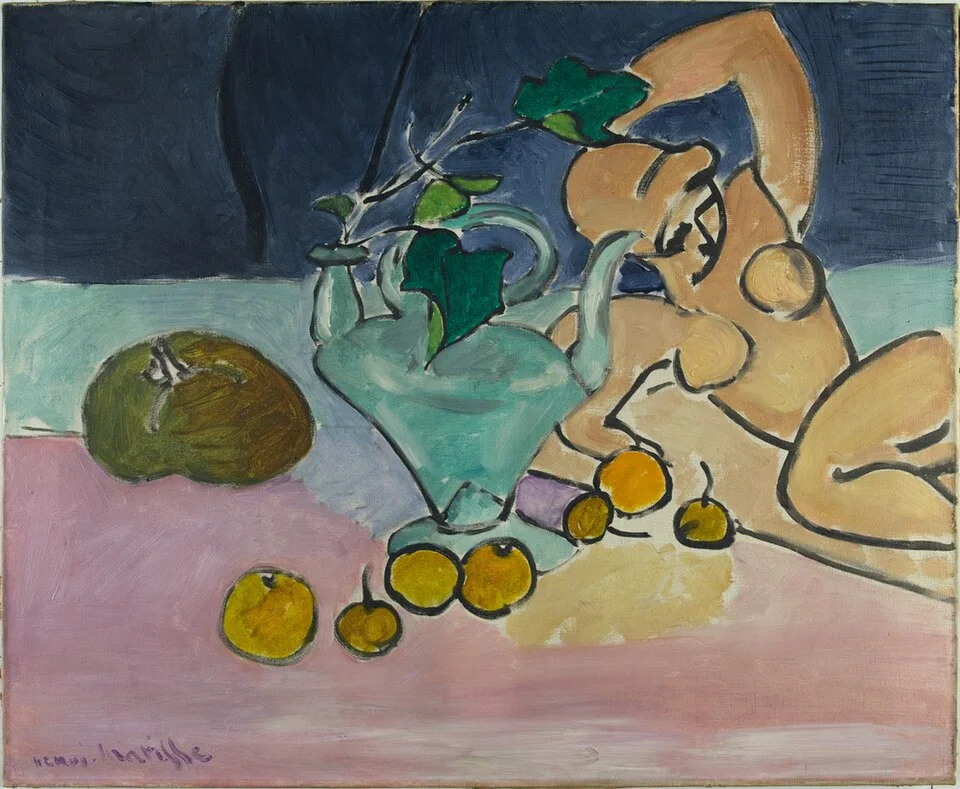
Still Life with Ivy, by Henri Matisse
In 1916 Matisse set about building a still life around one thing, a vase of climbing ivy. Around the vase he arranged fruit and a small statuette of a nude woman. The ivy is what gives the picture its name. In 1963 Adèle and George Besson gave the painting to the national museum of modern art in Paris. It still belongs to that museum. But in January 1972 it was sent on loan to Besançon, and here it has stayed ever since.
Listen in the appHenri Matisse · Public domain
- 11
Portrait of George Besson
Henri Matisse · 1918
- 12
Hell
François de Nomé, Monsù Desiderio · 1622
- 13
Murder in the Serail
Fernand Cormon · 1874
- 14
Chinese Garden
François Boucher · c. 1742
- 15
The Fortune Teller
Gustave Courbet · 1855–1865
- 16
Sitting on a rock
Félix Vallotton · 1910
- 17
The Little Nimrod, by James Tissot
James Tissot · c. 1882
- 18
Venice, the Yellow Sail
Paul Signac · 1904
- 19
The Rapture of Saint Mary Magdalene, by Simon Vouet
Simon Vouet · 1639–1640
- 20
Vouet - Angels Bearing the Instruments of the Passion, between 1625 and 1626, 896.1.140
Simon Vouet · 1625–1626
- 21
Boucher - Feast of the Emperor of China, circa 1742
François Boucher · c. 1742
- 22
Vouet - Angels Bearing the Column of the Passion, Lot 60
Simon Vouet · 1625–1626
- 23
Boucher - The Chinese Hunt, circa 1742
François Boucher · c. 1742
- 24
Boucher - The Chinese Marriage, circa 1742
François Boucher · c. 1742
- 25
Jezebel
Léon Auguste Perrey · 1889
- 26
Portrait of a Young Woman, by Jean-Léon Gérôme
Jean-Léon Gérôme · c. 1850
- 27
The water stream la Brème
Gustave Courbet · 1865
- 28
The Vouivre of the Puits-Noir (Becquet)
Just Becquet · c. 1899
- 29
Besançon Museum of Fine Arts Marguerite Syamour Meditation 1900 - 1
Marguerite Syamour · 1900
- 30
Waterfalls
Gustave Courbet · 1864
- 31
Peasants from Flagey back from the Fair
Gustave Courbet · 1850
- 32
The Two Friends
Albert Marquet · 1911
- 33
A Bather, by Antoine-Jean Gros
Antoine-Jean Gros · 1791
- 34
Self-Portrait
Gustave Courbet · c. 1850
- 35
Chinese Fishing
François Boucher · c. 1742
- 36
Chinese Dance
François Boucher · c. 1742
- 37
Boucher - The Audience of the Emperor of China, circa 1742
François Boucher · c. 1742
- 38
Girl in a Basin
Paul Delaroche · 1845
- 39
The Great Fountain in Villa Conti, Frascati
Hubert Robert · c. 1761
- 40
Ruins of the Imperial Palace in Rome
Hubert Robert · c. 1761
- 41
The Nymph at the Spring
Lucas Cranach the Elder · c. 1537
- 42
Place Clichy
Pierre Bonnard · 1912
- 43
Besançon (Doubs) - Museum of Fine Arts and Archaeology - The Petit-Poucet Café (Pierre Bonnard, 1867-1947)
Pierre Bonnard · 1928
- 44
The Merit of Every Country
François Boucher · 1742–1745
- 45
The Puits Noir, by Gustave Courbet
Gustave Courbet · c. 1865
- 46
The Triumph of Venus
Jean-Honoré Fragonard · 1765–1770
- 47
Saint Mary Magdalene in Penance
Elisabetta Sirani · 1663
- 48
Head of an Oriental
Théodore Géricault · 1817–1819
- 49
Study heads of an old man
Jacob Jordaens · 1618–1620
- 50
Presumed Portrait of Laudomia Gozzadini, by Lavinia Fontana
Lavinia Fontana · c. 1600
- 51
An Ill-matched Pair
Lucas Cranach the Elder · c. 1530
- 52
Le Canard
Suzanne Valadon · 1930
- 53
Vuillard - Café in the Bois de Boulogne, between 1897 and 1898
Édouard Vuillard · 1897–1898
- 54
Two young seals on the shore
Paul de Vos · c. 1650
- 55
Filippino Lippi - Christ, circa 1500, 896.1.147
Filippino Lippi · c. 1500
- 56
Tiepolo - Saint Roch, between 1730 and 1735, 896.1.103
Giovanni Battista Tiepolo · 1730–1735
- 57
Allegory on the Pursuit of Fortune (Sustris)
Lambert Sustris · 1540–1545
- 58
Portrait of a Woman
Dirck Jacobsz · c. 1530
- 59
The Flight into Egypt, by Francisco de Zurbarán
Francisco de Zurbarán · 1635–1640
- 60
The Philosopher Chilon
Luca Giordano · c. 1660
- 61
The Monkey Barbers of the Cats, by Ferdinand van Kessel (1648-1696), Museum of Fine Arts and Archaeology of Besançon-2
Unknown Artist · 17th century
- 62
Travellers in a Forest
Dosso Dossi · c. 1520
- 63
Portrait of Charles Fourier
Jean Gigoux · 1835
Musée des Beaux-Arts et d'Archéologie de Besançon
Frequently asked questions
How much does the guide cost?
Free app download. Free until 1 January. Listed guide price: $0.99. Audio guide only. Venue admission is separate.
Can I listen without internet?
Yes. Download the guide’s audio, images, and maps in the app before your visit. Your downloaded content is then available offline.
Can I listen in my language?
In English for now. More languages soon.
Do I need to follow a schedule?
No. This is a self-guided experience. Choose your stops, pause whenever you like, and return to a story at your own pace.
Which artworks are in the Musée des Beaux-Arts et d'Archéologie de Besançon audio guide?
63 artworks, including Killing a Deer (Gustave Courbet), Portrait of Adèle Besson (Pierre-Auguste Renoir), Deposition of Christ (Bronzino), Drunkenness of Noah (Giovanni Bellini), Ishū Retsuzō (Kakizaki Hakyo), Portrait of Jean-Baptiste Desdéban (Jean-Auguste-Dominique Ingres), Cannibals contemplating human remains (Francisco Goya), and Cannibals Chopping up Victims (Francisco Goya). The full list is on this page.
Is this the museum’s official audio guide?
No. Stanza is an independent audio guide app and is not affiliated with Musée des Beaux-Arts et d'Archéologie de Besançon. Museum admission is separate.
At your own pace
Explore Musée des Beaux-Arts et d'Archéologie de Besançon.
Download Stanza, then search for “Musée des Beaux-Arts et d'Archéologie de Besançon”.
Free app download · Guide price shown in the app
Keep exploring
Nearby audio guides
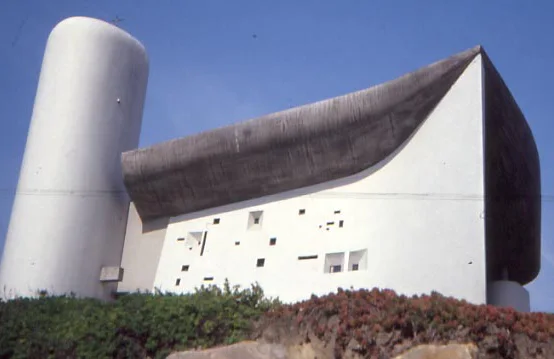
Ronchamp · 68 km
Chapelle Notre-Dame du Haut
Content & sources
Immanuel Giel · CC BY-SA 3.0
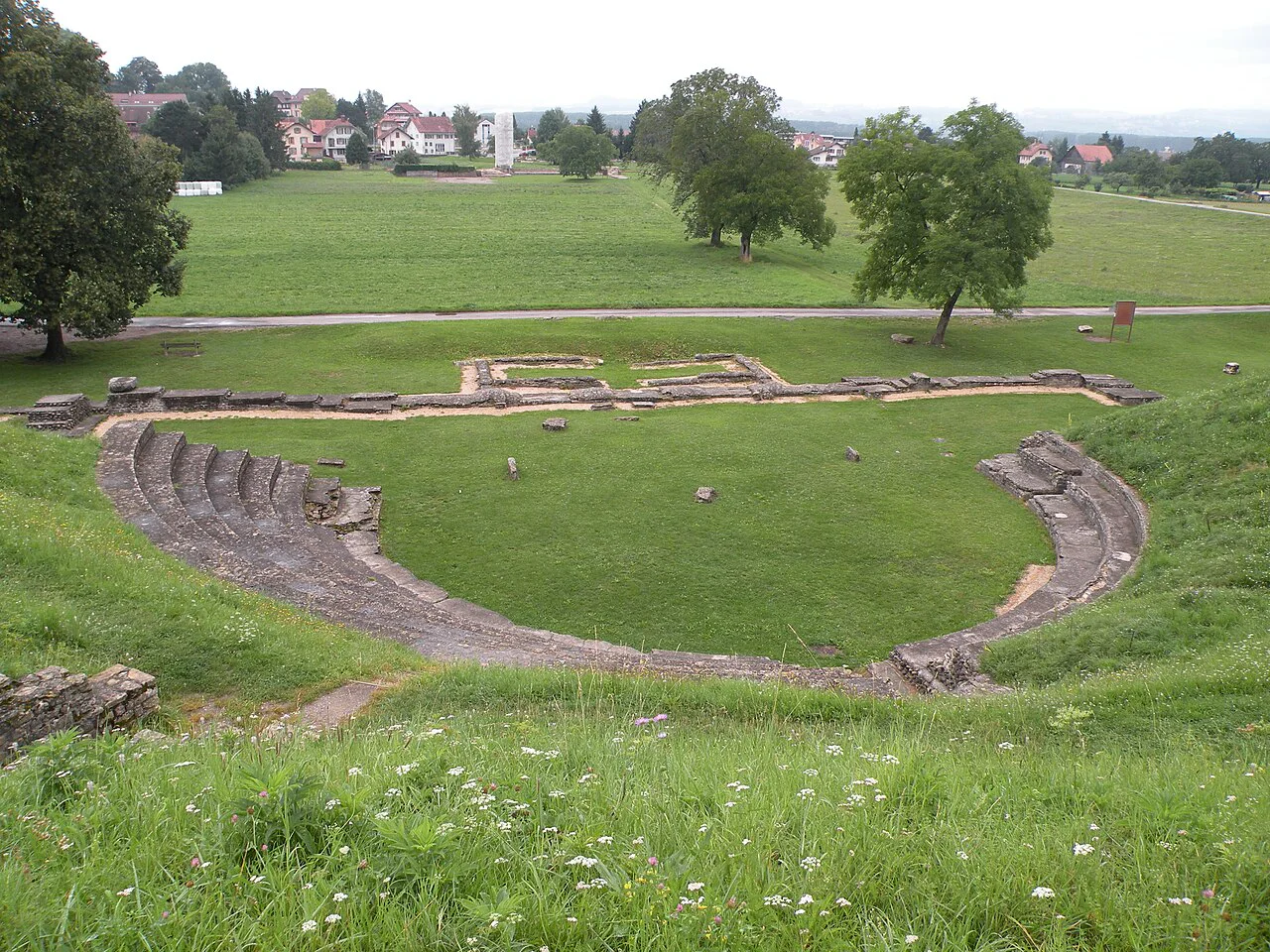
Avenches · 87 km
Aventicum
Content & sources
Photo: Pymouss · CC BY-SA 3.0
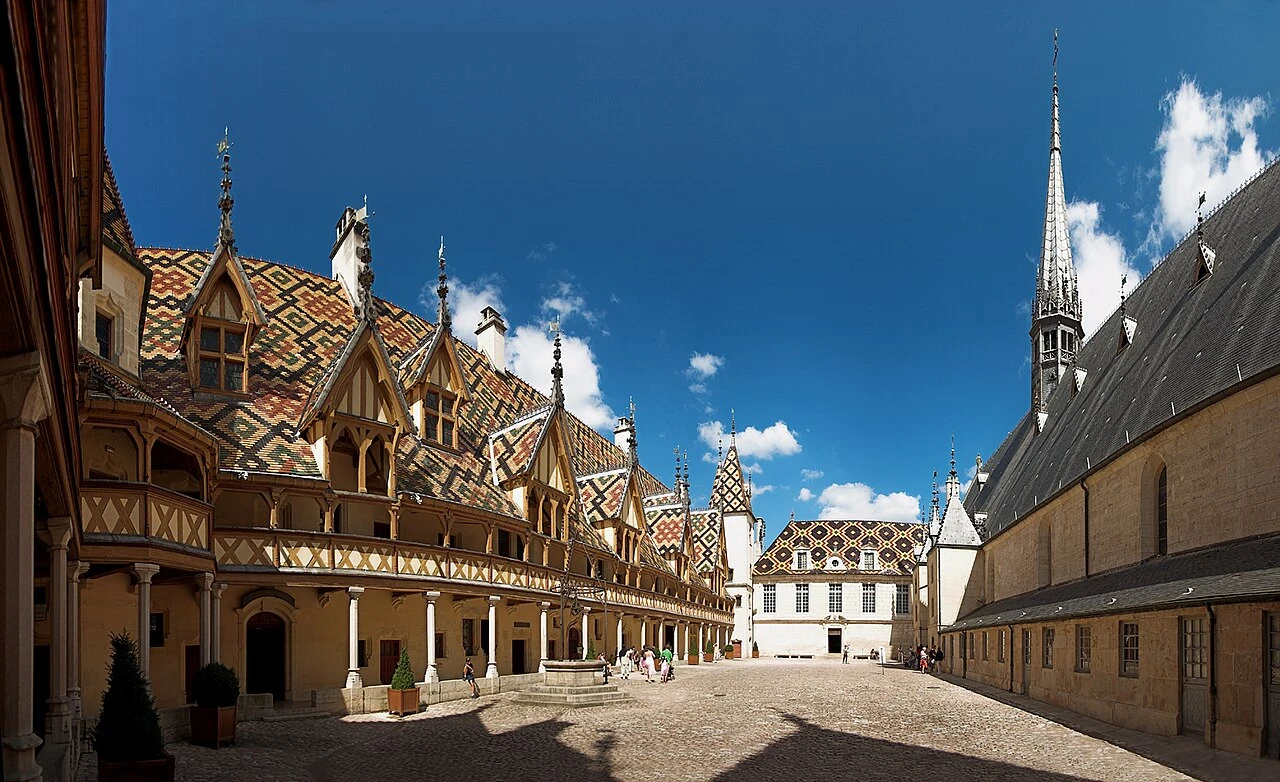
Beaune · 93 km
Hospices de Beaune
Content & sources
Stefan Bauer, http://www.ferras.at · CC BY-SA 2.5
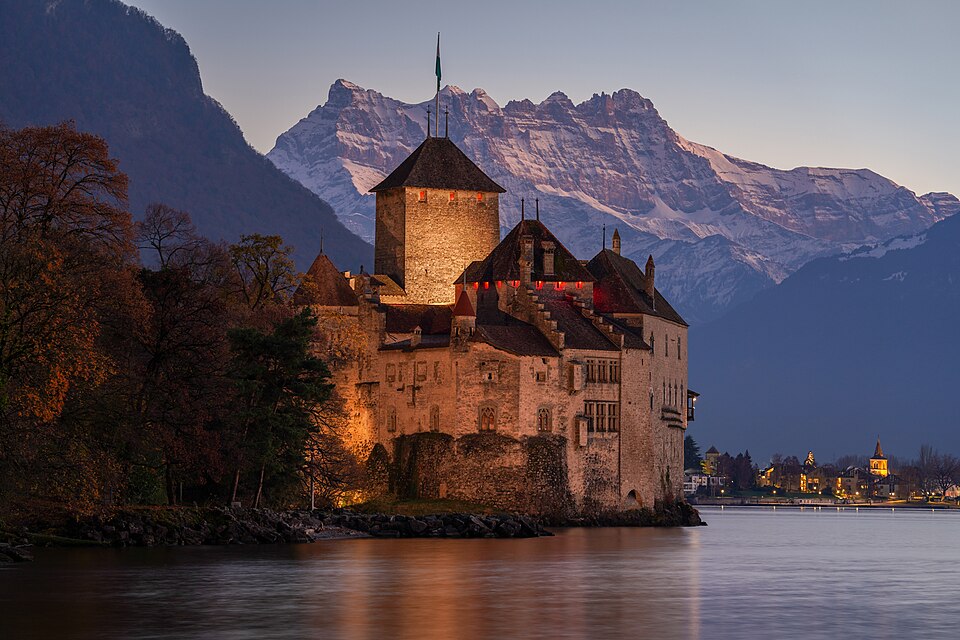
Veytaux · 115 km
Chillon Castle
Content & sources
Photo: Giles Laurent · CC BY-SA 4.0
Art museums
More art museum audio guides
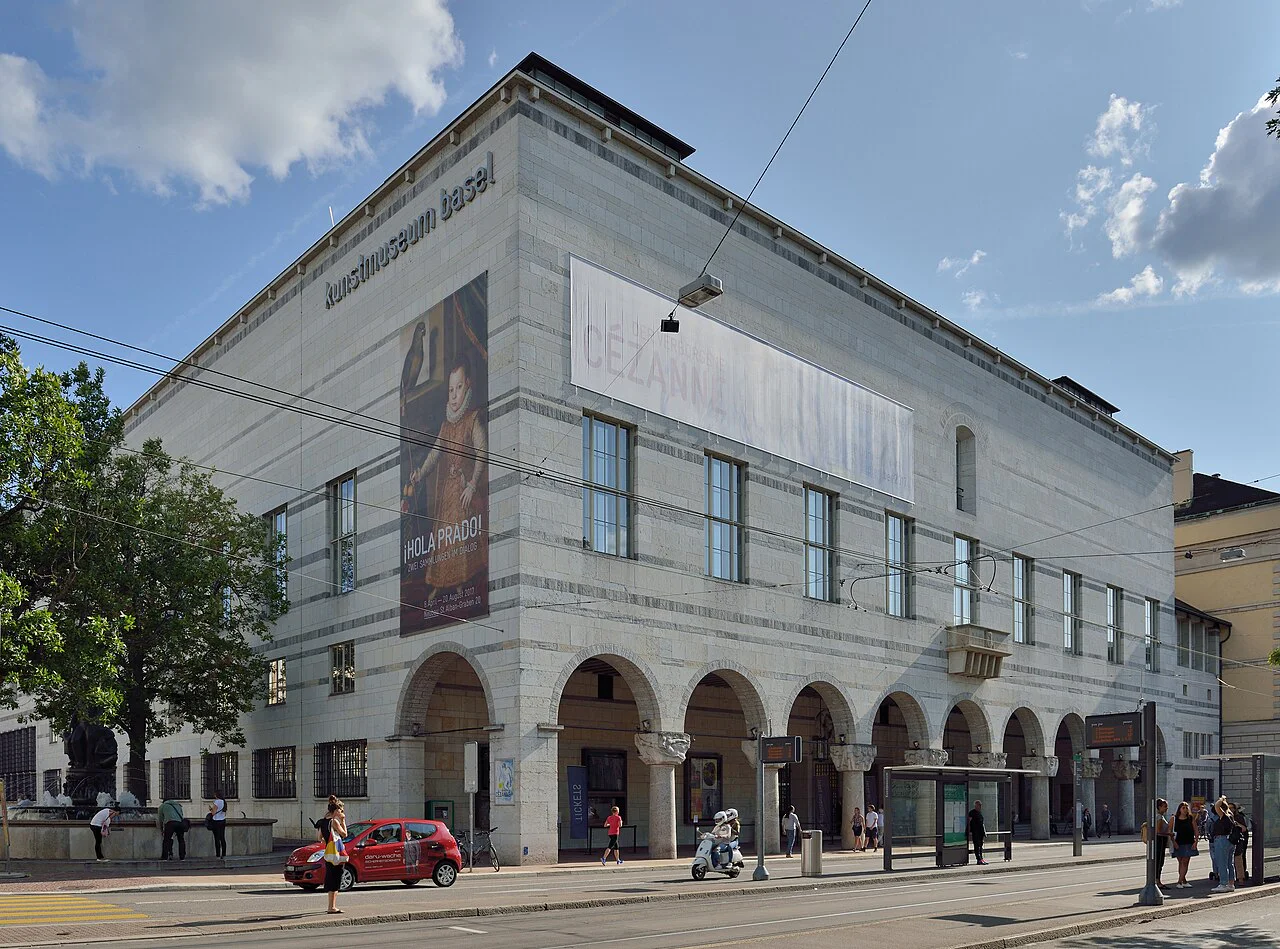
Basel · 61 artworks
Kunstmuseum Basel
Content & sources
Wladyslaw Sojka · FAL
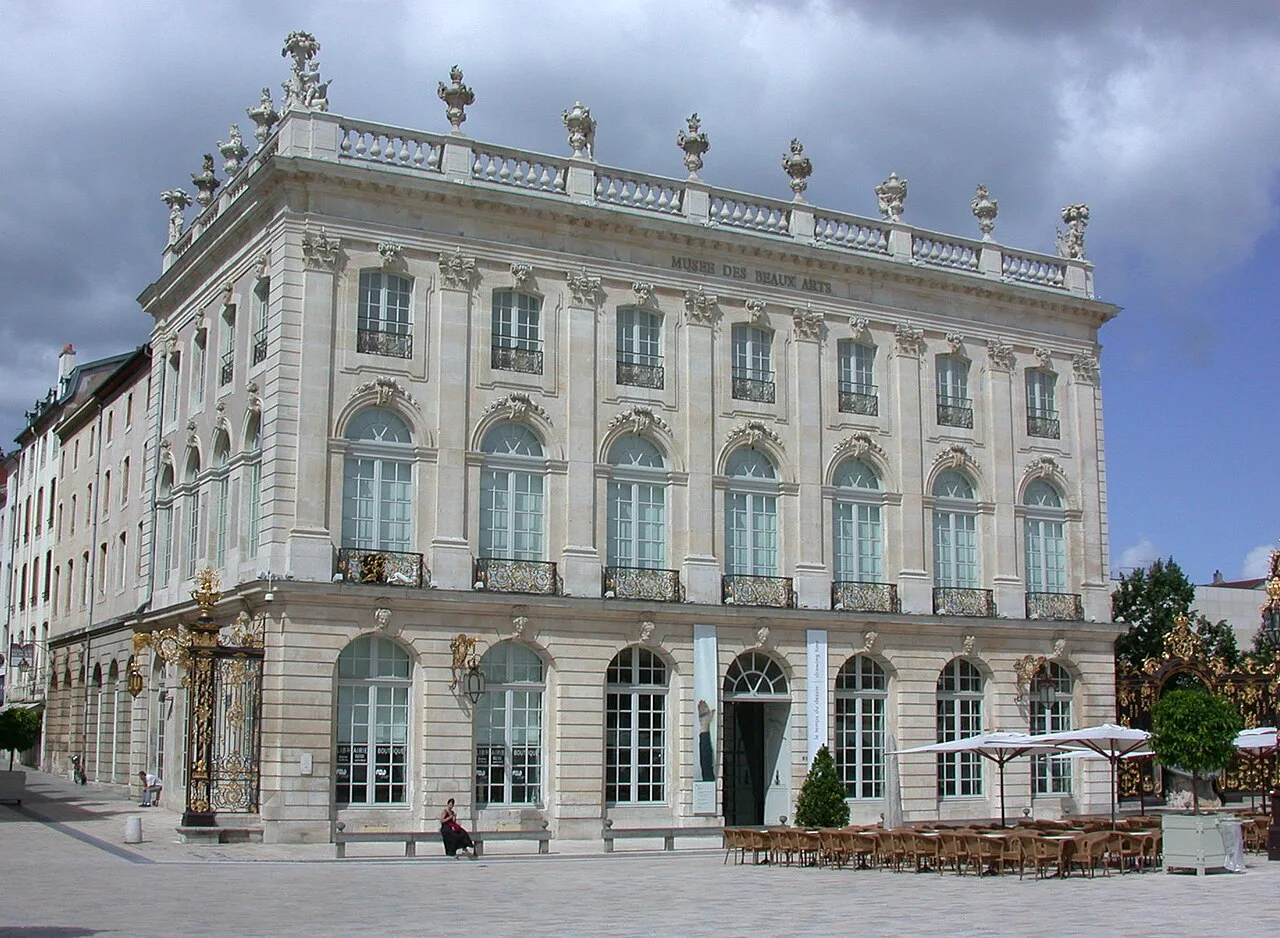
Nancy · 46 artworks
Musée des Beaux-Arts de Nancy
Content & sources
photo uploaded by User:RicciSpeziari. Photographer: Riccardo Speziari · CC BY-SA 3.0
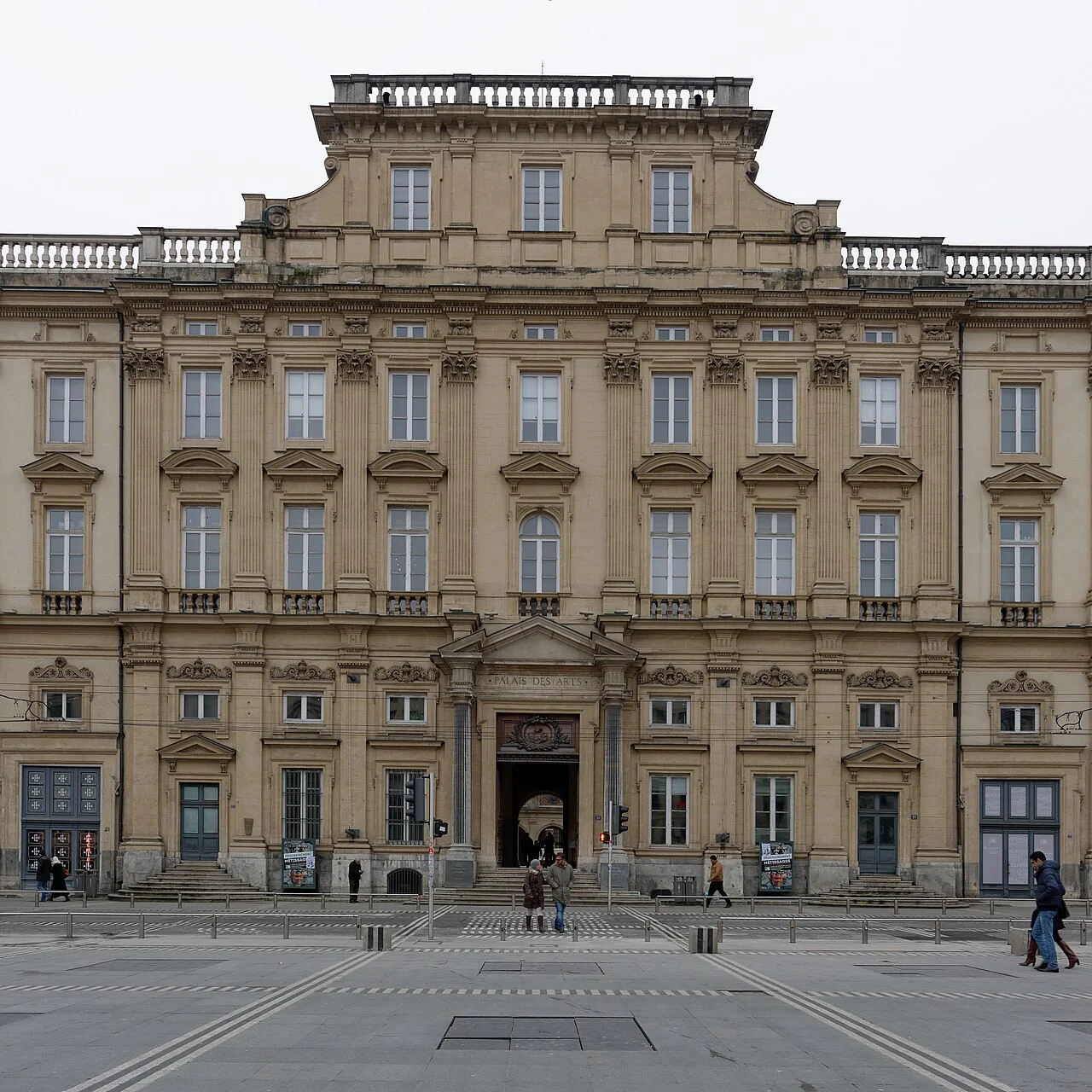
Lyon · 159 artworks
Museum of Fine Arts of Lyon
Content & sources
Photo: Jastrow · CC BY 2.5
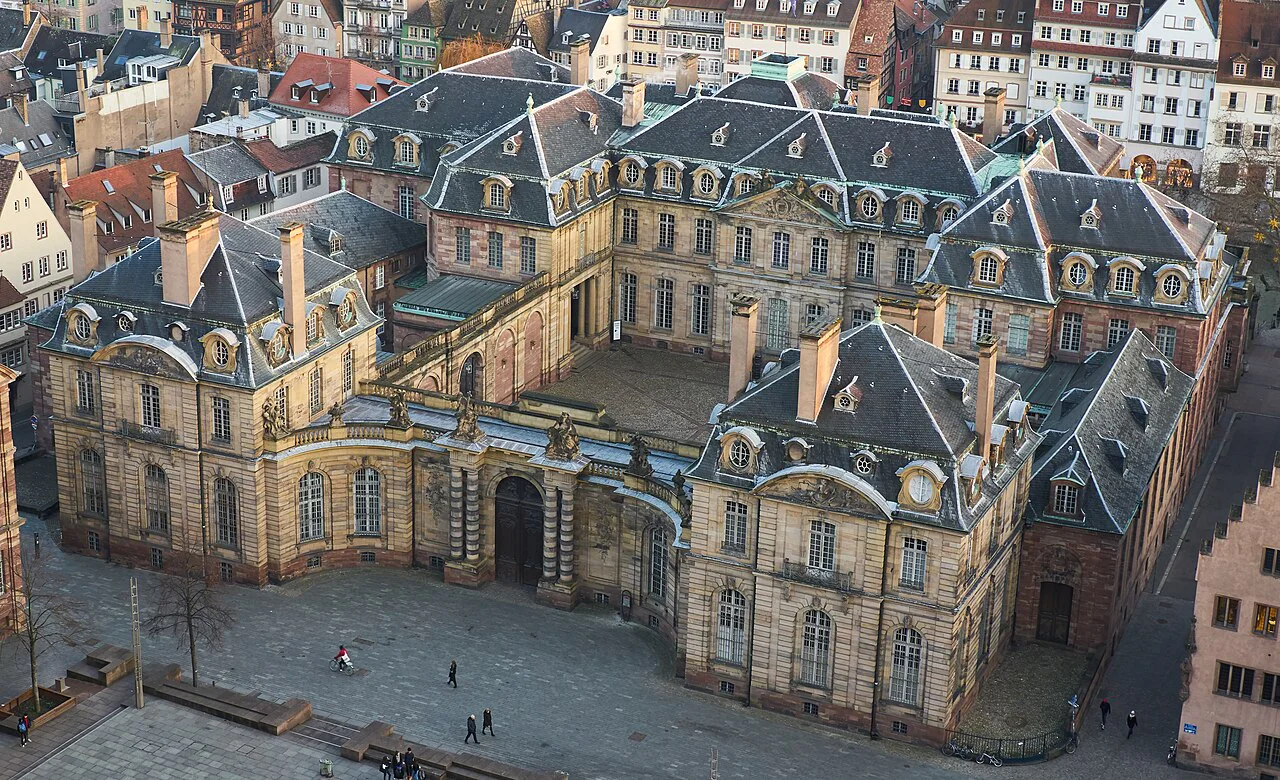
Strasbourg · 92 artworks
Musée des Beaux-Arts de Strasbourg
Content & sources
Radek Kucharski · CC BY 2.0
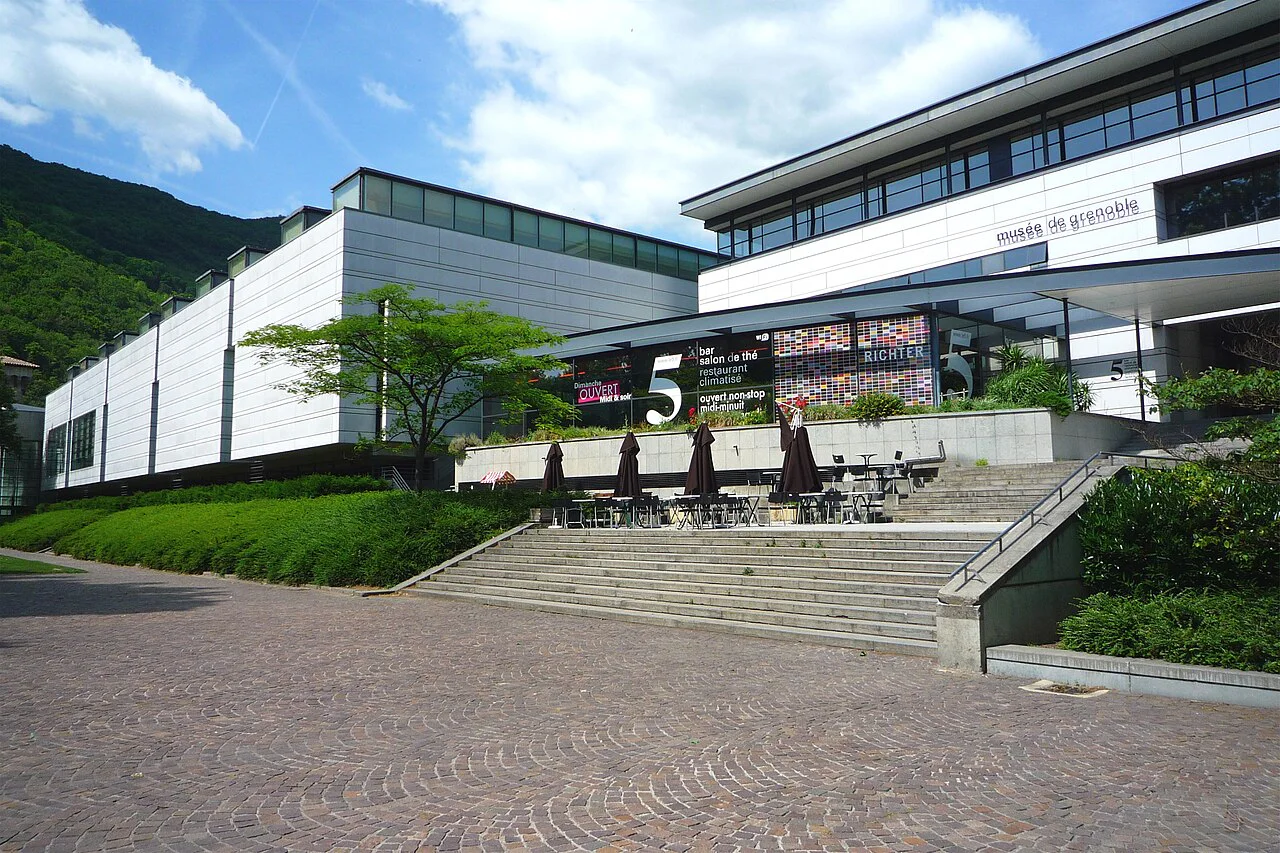
Grenoble · 53 artworks
Musée de Grenoble
Content & sources
Photo: Milky · CC BY-SA 3.0
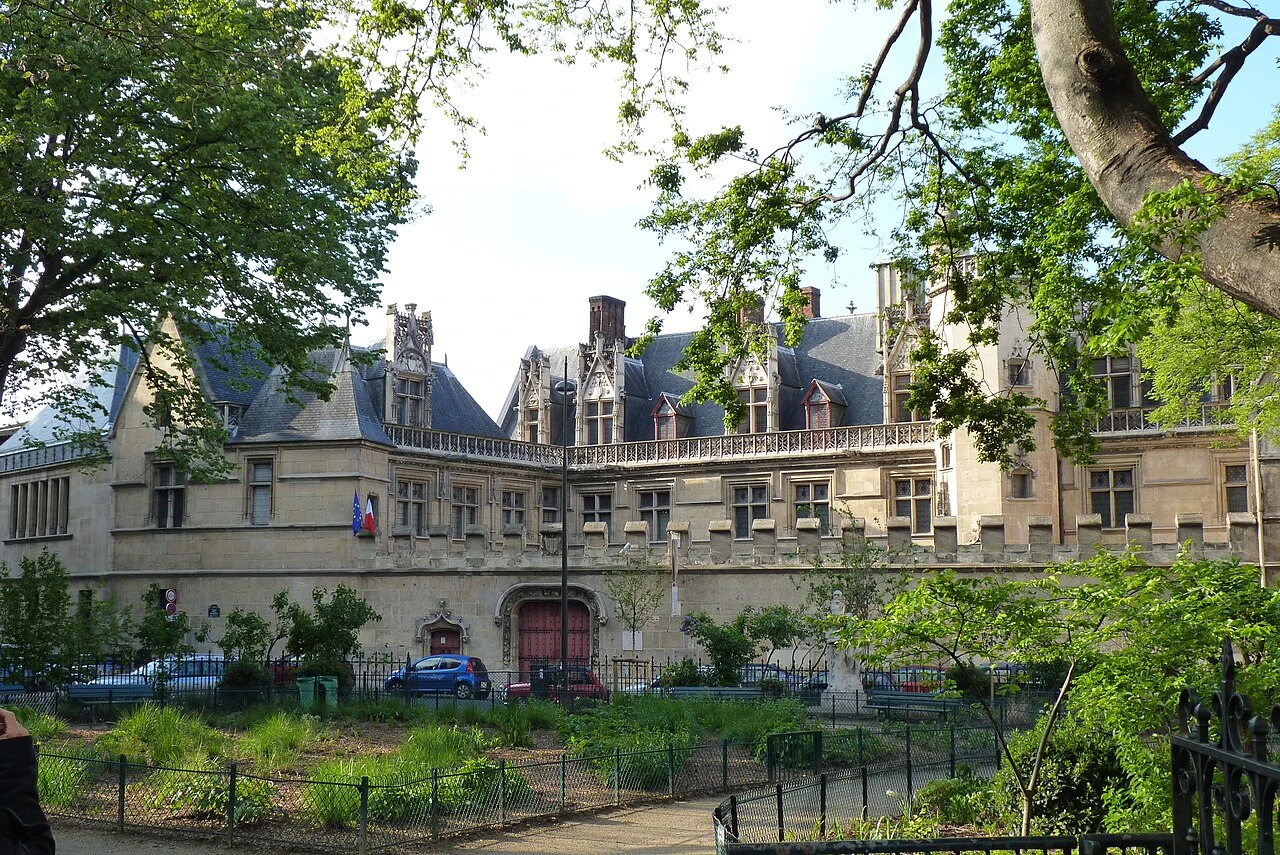
Paris · 29 artworks
Cluny Museum
Content & sources
ctj71081 · CC BY-SA 2.0