Stanza · Audio guide
Hospices de Beaune Audio Guide
A place to remember. A story to take with you.
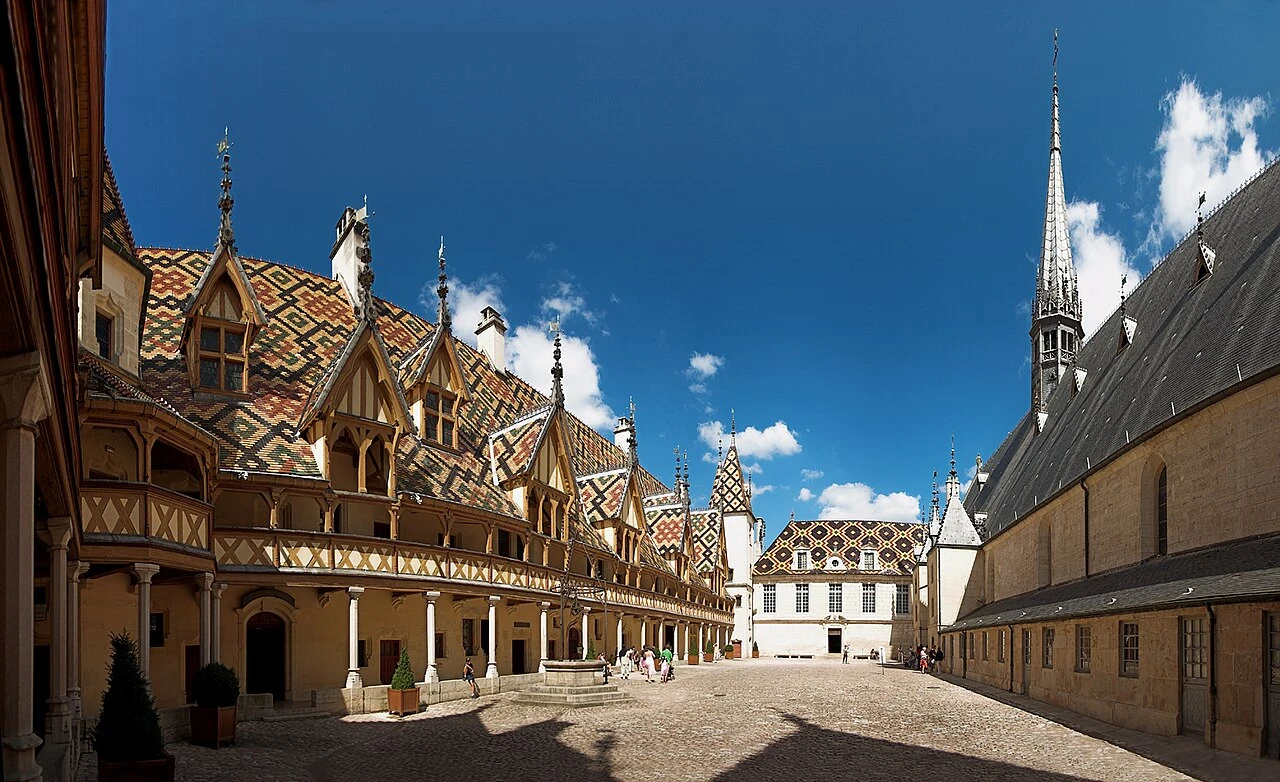
The Hospices de Beaune is a historic former hospital founded in 1443, renowned for its flamboyant Gothic architecture and the annual charity wine auction. It now serves as a museum showcasing its history and…
Download Stanza, then search for “Hospices de Beaune”.
About the tour
One guide. Your kind of visit.
The Hospices de Beaune is a historic former hospital founded in 1443, renowned for its flamboyant Gothic architecture and the annual charity wine auction. It now serves as a museum showcasing its history and extensive wine estates.
Ready when you are.
- 01Get the free Stanza app.
iOS & Android
- 02Find your guide.
“Hospices de Beaune”
- 03Download before you go.
Works offline
Audio guide / 13 narrated stops
Inside the guide
Get to know a few of the stories before you go. Open a stop to read more.
01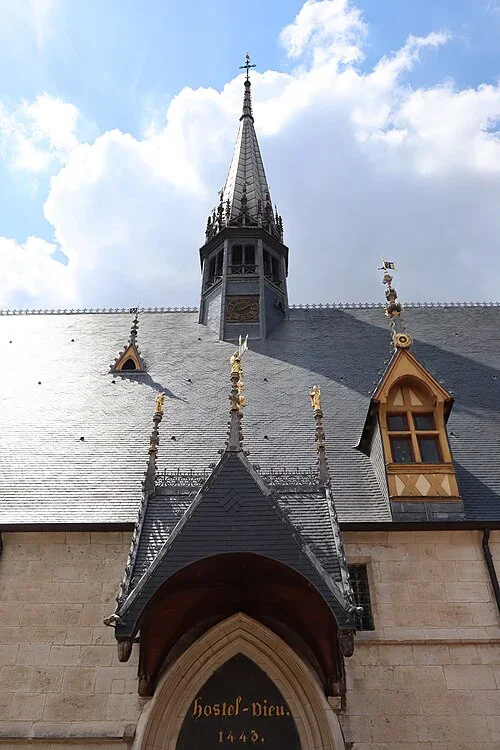 Exterior Street Façade and Entry Porch
Street Façade and Entrance Porch of the Hôtel-Dieu
Welcome to the Hôtel-Dieu de Beaune, a hospital founded for the poor in the fifteenth century. The street front gives little away. Grey slate, a plain stone wall, a tall spire, and a Gothic wooden canopy over the entrance, with the year 1443 carved at the porch. That restraint was deliberate. Inside, the founders spent like princes, and the rich decoration was saved for the courtyards and the wards. The story begins with Nicolas Rolin, Chancellor to Duke Philip the Good of Burgundy, and his wife Guigone de Salins. The Hundred Years' War had just ended, but armed bands still roamed Burgundy, pillaging the countryside and bringing famine. Beaune had also suffered an outbreak of plague, and most of its people were destitute. Rolin and Guigone answered with a hospital. The Pope granted permission in 1441, building began in August 1443, and the first patients were welcomed on the first of January 1452. Rolin wanted the poor to receive the dignity usually reserved for the powerful. The humble door was the only modest thing about the place.
Photo: GO69 · CC BY-SA 4.0
02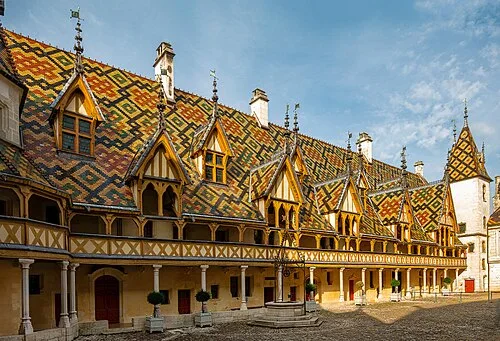 Cour d'Honneur and the Polychrome Glazed Roofs
The Cour d'Honneur and Polychrome Glazed Roofs
Through the austere façade, the courtyard opens into colour. The steep Burgundian roofs are covered in glazed tiles of four colours: red, brown, yellow and green. They are laid in interlaced geometric patterns, like a giant game board across the rooflines. The technique became a trademark of prestigious architecture across Burgundy, and similar roofs can be seen in Dijon. Where it came from is less certain. It probably has its origins in Central Europe, and one account links it to a ceramics master of Pécs in Hungary. When glazed tiles were first used on this building has never been determined. They already appear on an eighteenth-century model of the hospital. The tiles seen today are not the originals. The original designs were lost, and the roofs were rebuilt between 1902 and 1907 by the architect Sauvageot, who recreated the patterns in his own hand. Even the slate on the main building carries a message. It was rarely used in the region at the time, which made it more prestigious than tile.
Photo: Rolf Kranz · CC BY-SA 4.0
03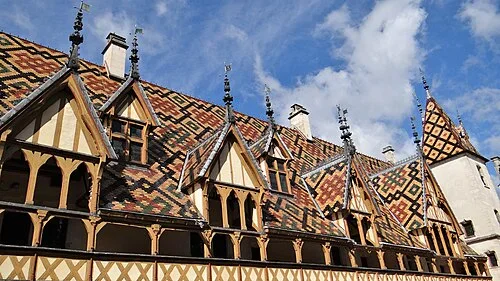 Cour d'Honneur and the Polychrome Glazed Roofs
Galleries, Dormers and the Gothic Well
The courtyard rewards a slower look. Three of the buildings carry two-level galleries: stone columns on the ground floor, timber framing above, so the nursing sisters could move under cover in every season. The dormers and attic windows are dressed with finely carved wood and ironwork, and finials rise from the roof edges like gilded flames. At the centre of the courtyard stands a well with Gothic ironwork. Building all this took a workshop of talent. The design was probably overseen by the Flemish architect Jacques Wiscrère. The records name a wide range of Flemish and French masons, painters and glass cutters employed on the site. That is the point of the whole courtyard. This was charity, but it was built with the materials and the craftsmen of a palace.
Listen in the appPhoto: Ibex73 · CC BY-SA 4.0
04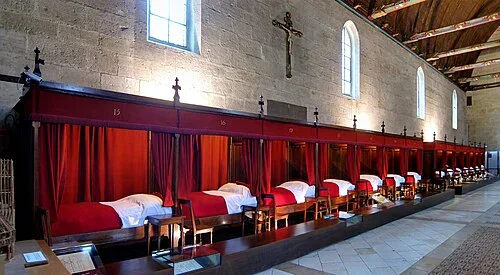 The Great Hall of the Poor (Salle des Pôvres)
The great hall of the poor was the heart of the hospital. It measures about fifty metres long, fourteen wide and sixteen high. Overhead, the timber frame is exposed and painted, shaped like an upside-down boat skiff. In the beams are sculpted caricatures of important inhabitants of Beaune, a touch of humour over the sick beds. Two rows of curtained beds line the walls, and each bed was meant for two patients. Behind every bed, a chest held the patient's clothes. A corridor with a bench and chairs ran along the wall behind the curtains. The central floor was kept for benches and tables, where the patients took their meals together. The furniture seen today was reassembled in 1875 by Maurice Ouradou, the son-in-law of the architect Viollet-le-Duc. The hall has had an afterlife on screen. Several scenes of the 1966 film La Grande Vadrouille, with Bourvil and Louis de Funès, were shot here.
Listen in the appPhoto: Velvet · CC BY-SA 3.0
05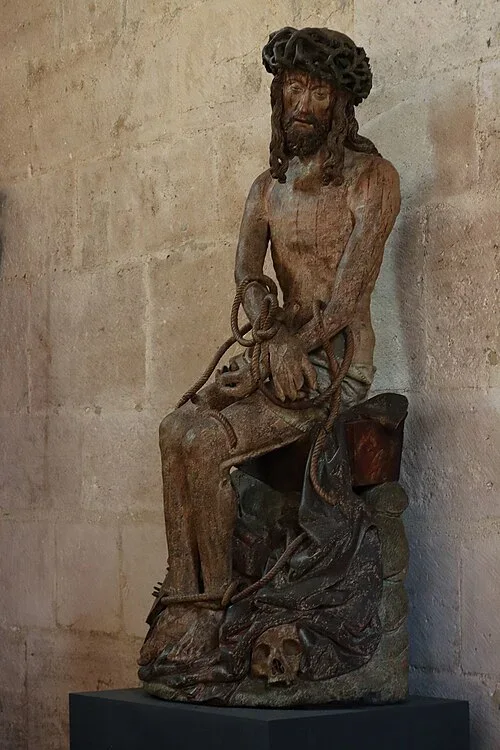 The Great Hall of the Poor (Salle des Pôvres)
Christ aux liens (Christ at the Column)
Among the beds of the great hall stands a carved Christ, bound with rope, crowned with thorns, seated and waiting. It is carved from oak, and it speaks to what kind of hospital this was. This was a Catholic institution, and it set out to heal both the body and the spirit. Devotional images stood among the wards so that patients too weak to move could pray from where they lay. Suffering and redemption were placed within sight of the sick, not hidden away in a distant chapel. For the founders, medicine and prayer were two halves of a single treatment.
Listen in the appPhoto: GO69 · CC BY-SA 4.0
06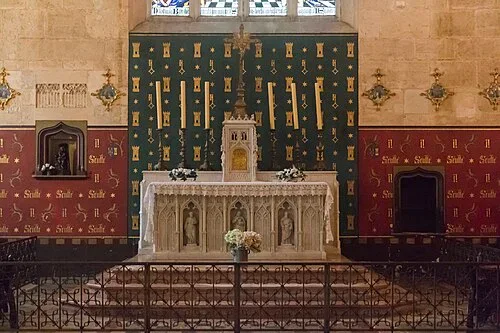 The High Chapel and Founder's Memorial
The Chapel at the End of the Ward and the Tomb of Guigone de Salins
At the end of the great ward stands the chapel, and its position was chosen with care. It sits close enough that patients bedridden in the hall could attend Mass without leaving their beds. The famous altarpiece by Rogier van der Weyden originally stood here, above the altar. The chapel is also a memorial to the founder's wife. After Nicolas Rolin died in 1462, Guigone de Salins fought six years of litigation against her stepson, the Cardinal of Autun, Rolin's son from his first marriage. She won control of the hospital and directed it herself until her death in 1470. Her remains rest in this chapel. Her presence runs through the building in another way too. The floor of the hall carries Rolin's monogram and his motto, Seulle estoile, my only star. The star was her.
Listen in the appDaniel VILLAFRUELA. · CC BY-SA 4.0
07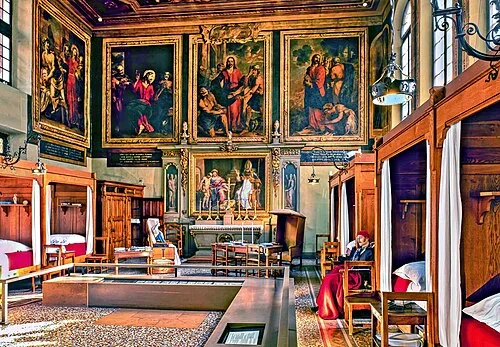 Salle Saint-Hugues and the Later Hospital Wards
Salle Saint-Hugues and the Seventeenth-Century Wards
The hospital did not stand still after the Middle Ages. This room, the Salle Saint-Hugues, was created in 1645, with beds reserved for better-off patients. In 1658, at the request of Louis XIV, it was set aside for men, while the historic hall of the poor became the women's ward. The walls carry large paintings by Isaac Moillon, showing miracles of Christ and of Saint Hugh, shown as a bishop and a Carthusian monk. On the altar retable, Saint Hugh raises children who died of the plague. The room has been refitted with its seventeenth-century décor. What matters is the long arc of the story. Sick and elderly people, orphans and destitute families were welcomed here without interruption from the Middle Ages onward. Patient care only left the building in 1971, when a new hospital opened in the north of Beaune.
Listen in the appPhoto: Rolf Kranz · CC BY-SA 4.0
08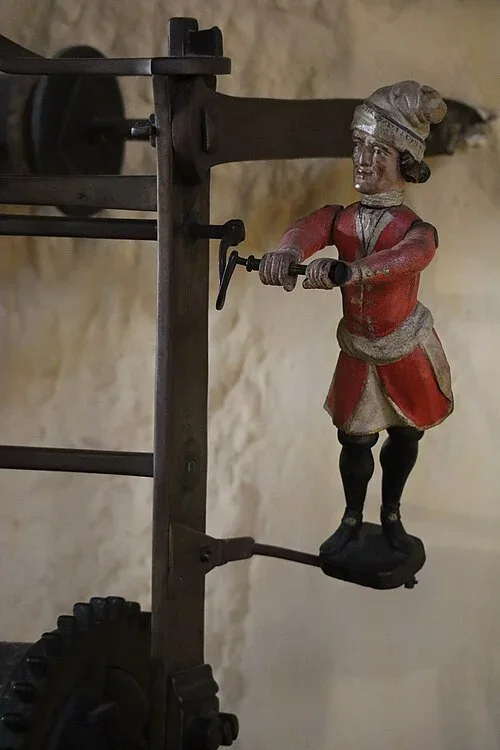 The Historic Hospital Kitchen
The Kitchen and Messire Bertrand, the Roasting-Spit Automaton
Feeding the sick was part of the cure, and the kitchen shows it. The room is presented as it looked in the early nineteenth century, with a great stove fitted with two hot-water taps called swan's necks, and a vast chimney with two hearths. A polychrome wooden statue of Saint Martha and the Tarasque watches over the room, framed by copper pans. The star of the kitchen is mechanical. An automated roasting spit from 1698 is driven by a small wooden figure in traditional dress, nicknamed Messire Bertrand. He appears to crank the spit for ever, keeping watch over the cooking. For generations of convalescent patients, this little automaton was a source of delight.
Listen in the appPhoto: Jean de l'Auxois · CC BY-SA 4.0
09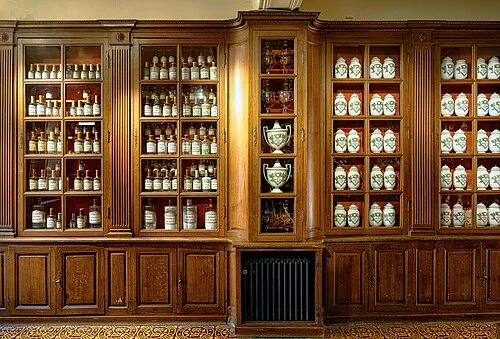 The Laboratory and 1782 Apothecary
The Apothecary: Laboratory and Pharmacy
Treatment needed supplies, and the apothecary provided them in two small rooms of shelves and jars. The first room is the laboratory. Its bronze mortar carries a suspended arc hooked to the pestle, a device that eased the weight of the pestle so the apothecaries could grind remedies for hours with less strain. The second room is the pharmacy. Its shelves hold a collection of a hundred and thirty tin-glazed earthenware jars, dated 1782. They once stored the medicinal plants, ointments, oils, pills and syrups of the pharmacy of the simples, the plant-based medicine of the day. This was a working dispensary, serving an active hospital.
Listen in the appPhoto: Rolf Kranz · CC BY-SA 4.0
10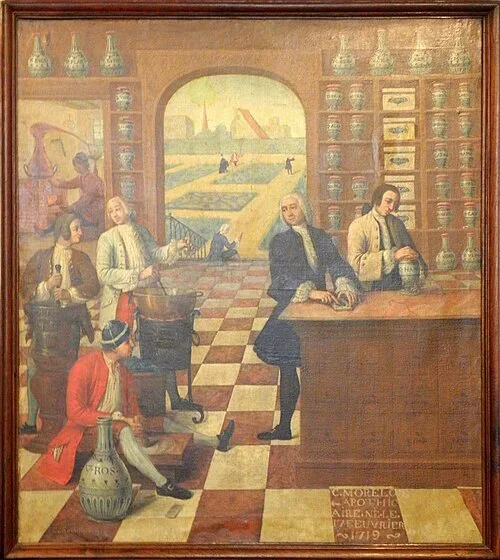 The Laboratory and 1782 Apothecary
Apothecary at the Hôtel-Dieu de Beaune (Dr Claude Morelot)
A painting gives the pharmacy its human face. It shows Dr Claude Morelot at work in this apothecary, painted by Charles Souville in the eighteenth century. Morelot stands among the drug jars and mortars, caught in the middle of his trade. Around him, the picture records the daily routine of the apothecary: weighing, grinding and compounding remedies at the counter. Other figures tend a furnace in the background, and the shelves behind them are stacked with the same kinds of jars and boxes the hospital used. The painting shows how the room was actually used and staffed, with the pharmacist as the central figure of the cure.
Listen in the appCharles Souville · CC BY-SA 3.0
- 11
The Last Judgment Polyptych (open view)
Rogier van der Weyden's Last Judgment: nine oak panels painted to confront the dying.
- 12
The Closed Shutters: Donor Portraits
The closed shutters: the founders kneeling in prayer, and the sawing of the panels.
- 13
The Vaulted Cellars and the Hospices Wine Estate
Barrels in the vaulted cellars: how donated vineyards still fund the charity every November.
Hospices de Beaune
Frequently asked questions
How much does the guide cost?
Free app download. Listed guide price: $1.99. Guide price shown in the app. Audio guide only. Venue admission is separate.
Can I listen without internet?
Yes. Download the guide’s audio, images, and maps in the app before your visit. Your downloaded content is then available offline.
Can I listen in my language?
This audio guide is available in 15 languages, including English.
Do I need to follow a schedule?
No. This is a self-guided experience. Choose your stops, pause whenever you like, and return to a story at your own pace.
At your own pace
Explore Hospices de Beaune.
Download Stanza, then search for “Hospices de Beaune”.
Free app download · Guide price shown in the app
Keep exploring
Nearby audio guides
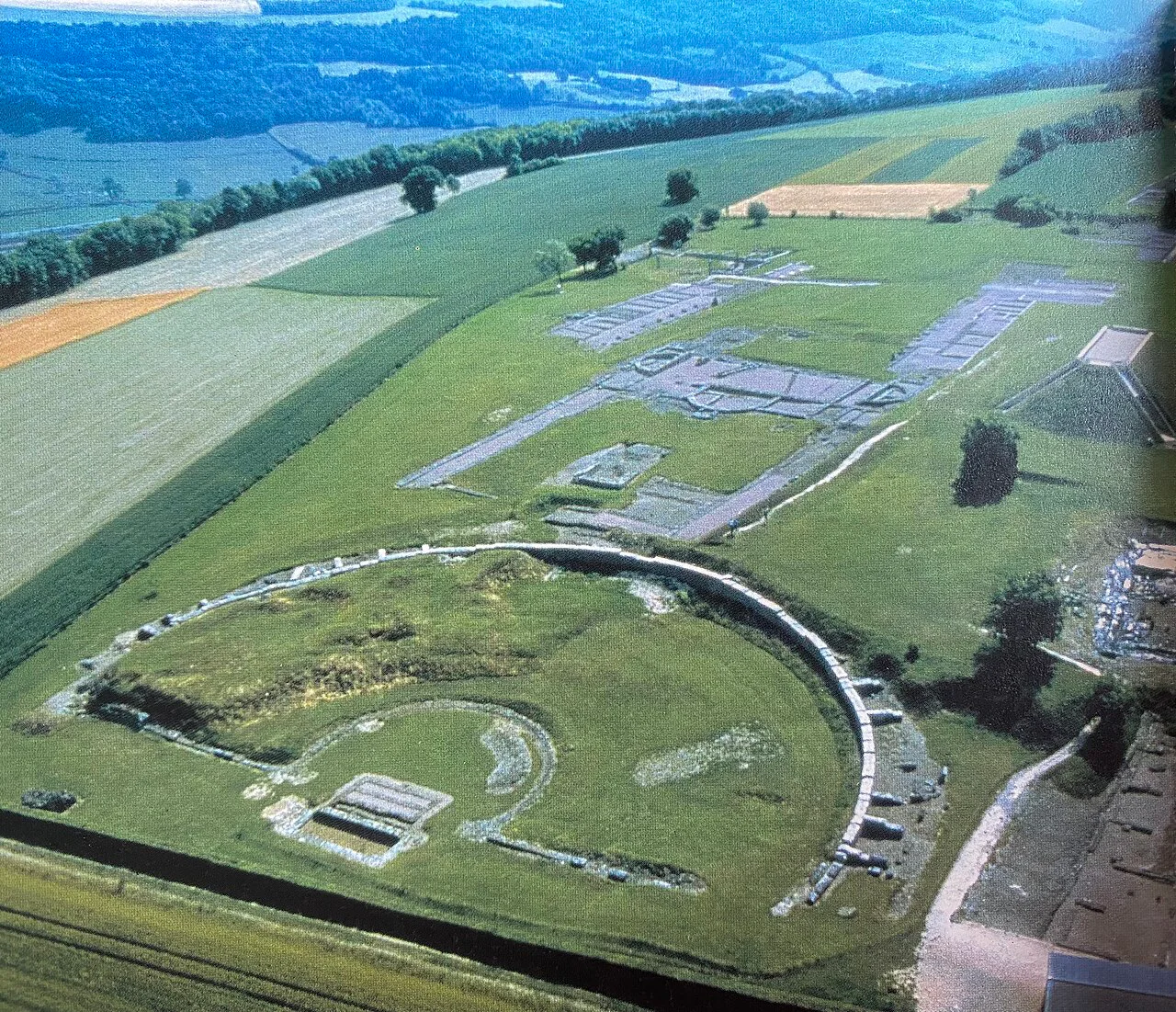
Alise-Sainte-Reine · 63 km
Site archéologique d'Alésia
Content & sources
Photo: Epona21 · CC BY-SA 4.0
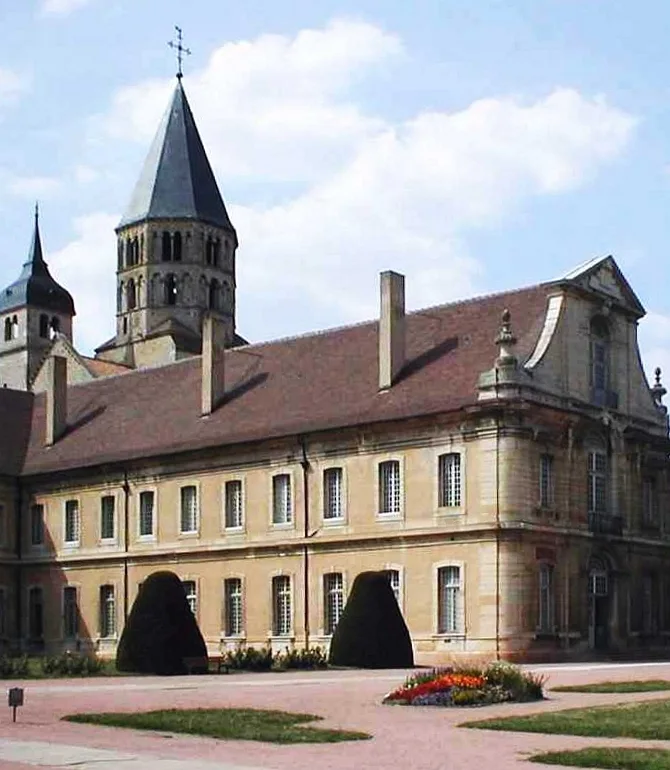
Cluny · 67 km
Abbaye de Cluny
Content & sources
Photo: Liesel · CC BY-SA 3.0
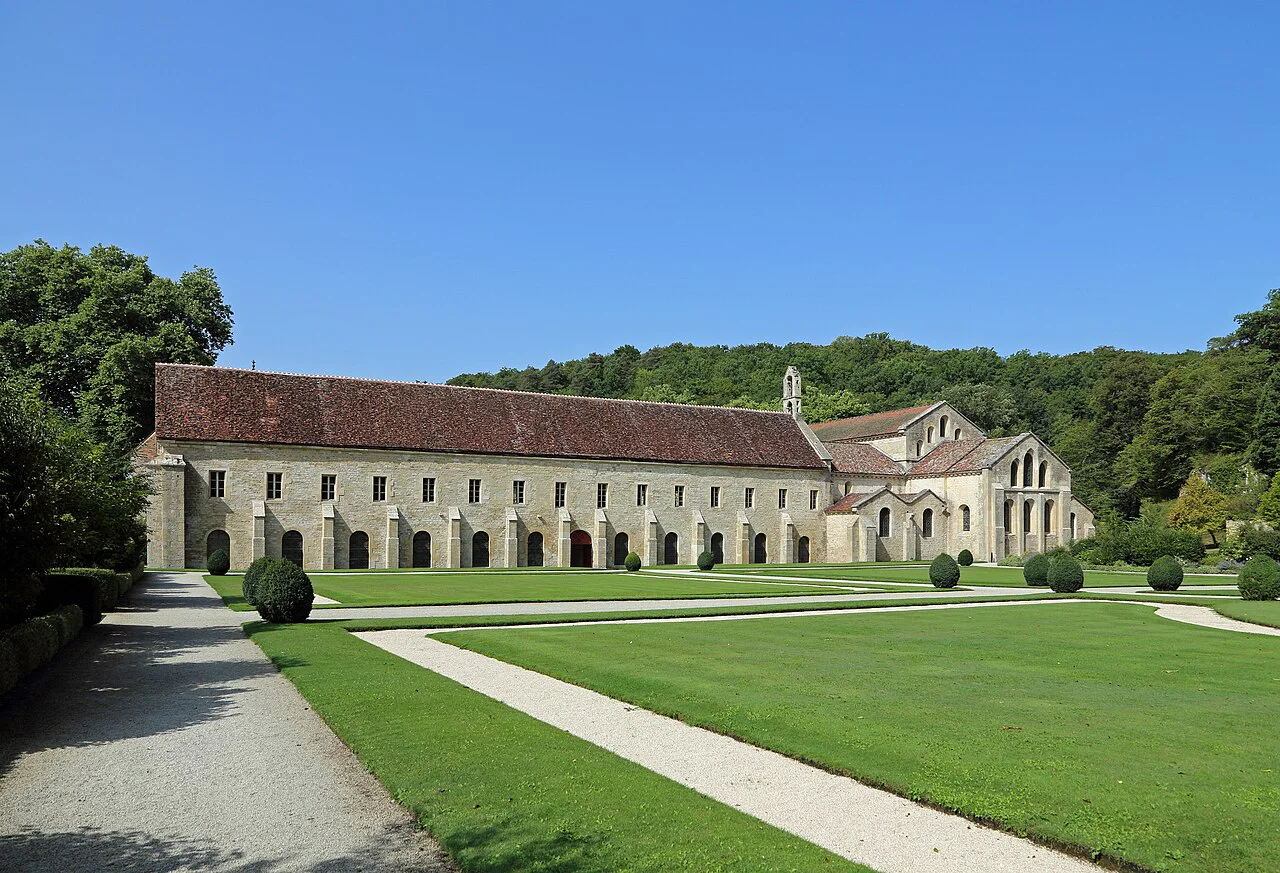
Marmagne · 77 km
Abbaye de Fontenay
Content & sources
Marc Ryckaert · CC BY-SA 4.0
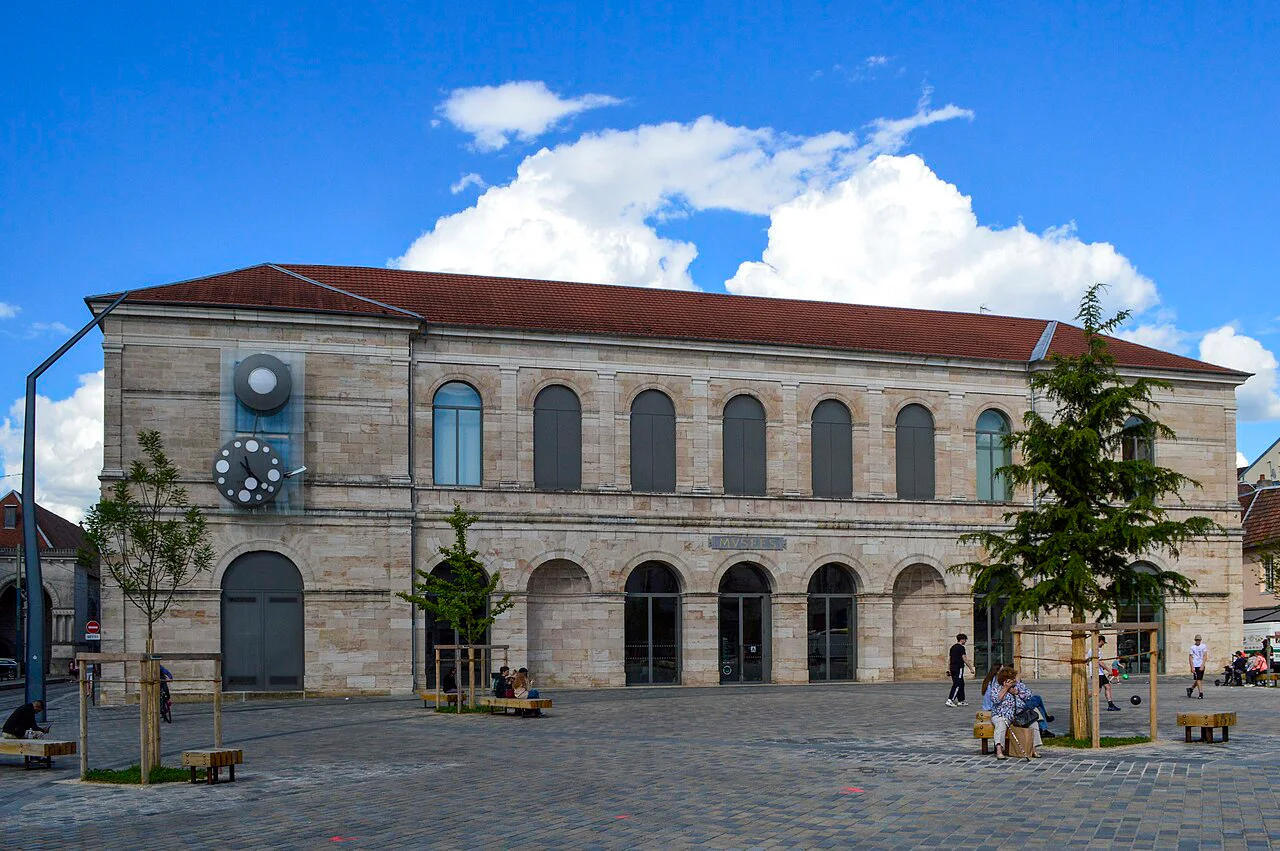
Besançon · 93 km
Musée des Beaux-Arts et d'Archéologie de Besançon
Content & sources
Photo: Wikipedro · CC BY-SA 4.0