Stanza · Audio guide
Chapelle Notre-Dame du Haut Audio Guide
A place to remember. A story to take with you.
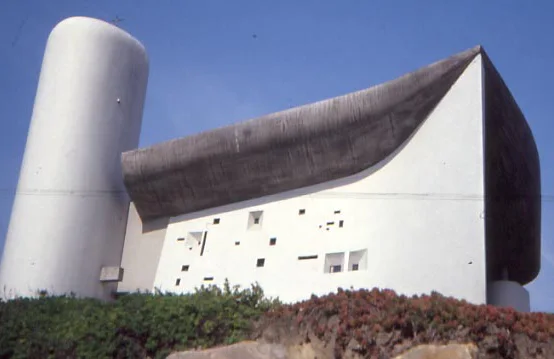
Notre-Dame du Haut is a Roman Catholic chapel located in Ronchamp, France. It is considered one of the finest examples of the architecture of Le Corbusier and is a UNESCO World Heritage site.
Download Stanza, then search for “Chapelle Notre-Dame du Haut”.
About the tour
One guide. Your kind of visit.
Notre-Dame du Haut is a Roman Catholic chapel located in Ronchamp, France. It is considered one of the finest examples of the architecture of Le Corbusier and is a UNESCO World Heritage site.
Ready when you are.
- 01Get the free Stanza app.
iOS & Android
- 02Find your guide.
“Chapelle Notre-Dame du Haut”
- 03Download before you go.
Works offline
Audio guide / 12 narrated stops
Inside the guide
Get to know a few of the stories before you go. Open a stop to read more.
01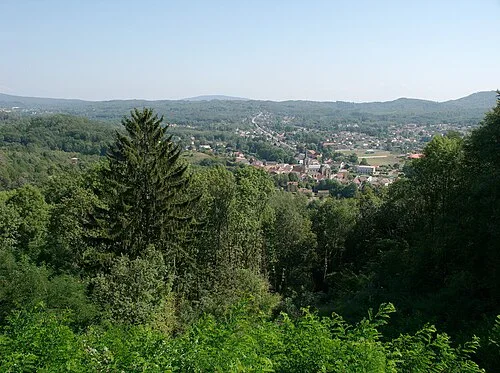 Bourlémont Hill and the Four Horizons
The Hilltop: Ronchamp from Above
Welcome to Ronchamp, in eastern France near Belfort, where a hill called Bourlémont carries a chapel unlike any other. For centuries this summit has been a place of worship, dedicated to the Virgin Mary. Pilgrims still climb it, and on feast days thousands gather on the open field at the top, where an outdoor altar and pulpit were built for exactly those crowds. The horizon here runs unbroken on all four sides, and the view reaches toward the Vosges mountains. Le Corbusier, the most famous modern architect of his age, was an atheist and at first turned the commission down. By his own account, it was the hill itself that changed his mind, with its long history of prayer and its panorama on every side. A Dominican friar and art reformer, Father Marie-Alain Couturier, steered the unorthodox project through to completion. The chapel was blessed in 1955, and today some eighty thousand people come each year. In 2016 it joined the UNESCO World Heritage List, alongside sixteen other works by the same architect.
Sandra Cohen-Rose and Colin Rose from Montreal, Canada · CC BY 2.0
02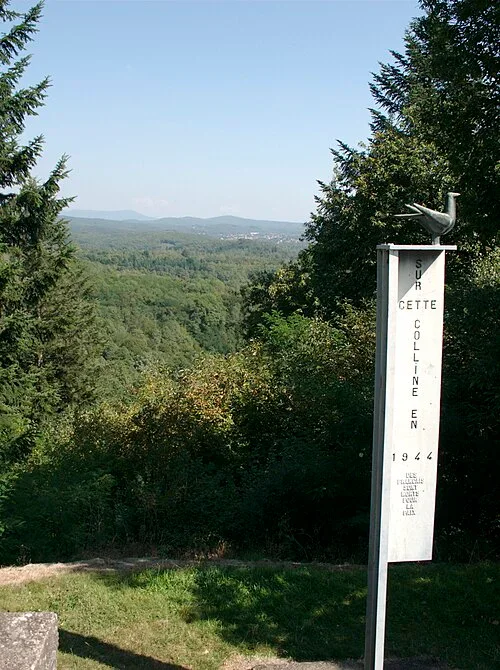 Bourlémont Hill and the Four Horizons
The 1944 Memorial Plaque
A slim white post stands at the edge of the trees, crowned with a metal dove and bearing a plaque to the fighters who fell on this hill in 1944, during the liberation of France. The hill has known violence before. On a stormy Saturday in August 1913, lightning struck the old chapel's zinc bell tower and fire destroyed the building. It was rebuilt during the years between the two world wars. That replacement chapel lasted only a couple of decades. German artillery destroyed it in 1944, in the fighting remembered on the plaque. A pyramid of peace near the chapel was raised from the stones of the ruined building, so the old sanctuary still lies in the hill itself. What stands here now is the fourth chapel in this long line, built after the war on the same ground.
Sandra Cohen-Rose and Colin Rose from Montreal, Canada · CC BY 2.0
03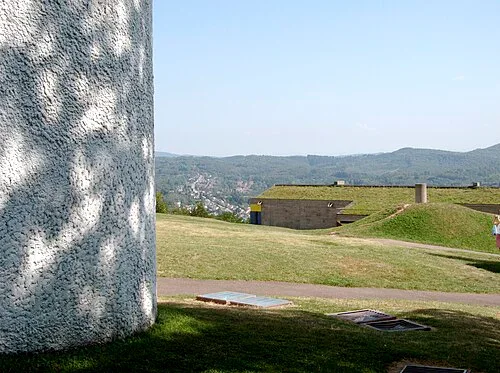 The Concrete Roof and Exterior Facade
The Whitewashed Wall and the Piano Buildings
The chapel's skin gives itself away at close range: a rough, whitewashed surface, sprayed on with a cement gun and painted over, curving like something grown rather than built. Beyond it, half buried in the grassy slope, sits a low building with a green roof. That is the convent and gatehouse by Renzo Piano, finished in 2011 for the Poor Clares, a community of nuns who came to Ronchamp in 2009. It holds twelve small living units for the sisters, a refectory, workshops, an oratory for pilgrims and a lodge for visitors, and it replaced a 1960s gatehouse that had blocked the chapel's silhouette from the town below. The plan met fierce resistance at first, with leading architects signing a petition against it, before the French Ministry of Culture approved the design. The chapel's fame travels far. A full-scale replica built in Zhengzhou, China, in the 1990s was never occupied, and after the Le Corbusier Foundation took action, the owner agreed in 2006 to demolish it.
Listen in the appSandra Cohen-Rose and Colin Rose from Montreal, Canada · CC BY 2.0
04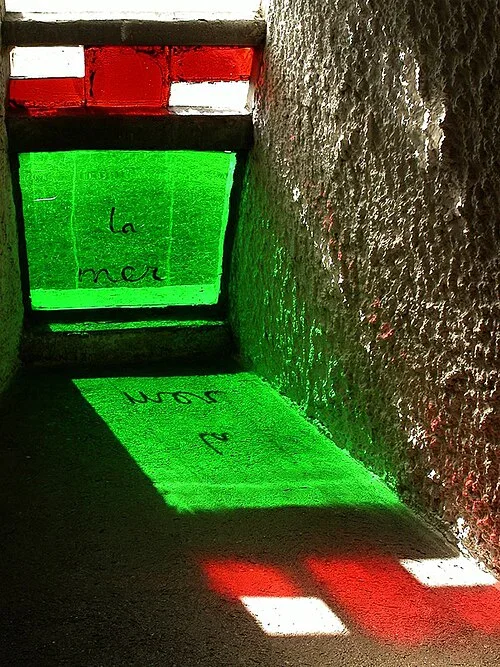 The South Wall and Stained Glass Windows
South Wall: Deep-Set Colored Windows
The south wall of Ronchamp is a creature of its own. It begins as a point at the east end and swells to as much as ten feet thick on the west, curving toward the south as it goes. Le Corbusier spent months perfecting it. The windows set into it are extraordinary: openings of different sizes, scattered in an irregular pattern, each slanting toward its centre at a different angle so that light enters at varying depths. He reportedly insisted the pattern was not arbitrary, but followed a proportional system based on the Golden Section, the ratio that has governed beauty since antiquity. Small pieces of stained glass sit deep within the thick wall, in his favourite colors of red, green and yellow. They glow like rubies, emeralds and topaz, the jewels of an already complex wall.
Listen in the appscarletgreen from Japan · CC BY 2.0
05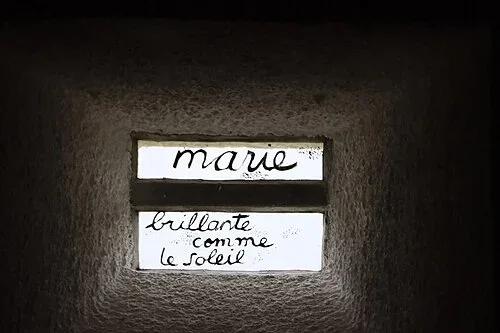 The South Wall and Stained Glass Windows
Painted Glass: Words in the Wall
The windows of the south wall carry more than color. Words are painted on the glass itself, in a loose, personal hand. At this window they read, in French, 'Marie, brillante comme le soleil': Mary, bright as the sun. At the neighbouring pane, 'la mer', the sea. The windows are prayers to the Virgin as much as sources of light. In January 2014 an intruder broke into the chapel and threw a concrete collection box outside. One stained-glass window was shattered, the only one on the building to carry Le Corbusier's signature. It was later restored, and the painted words continue to glow in the deep wall.
Listen in the appPhoto: FrDr · CC BY-SA 4.0
06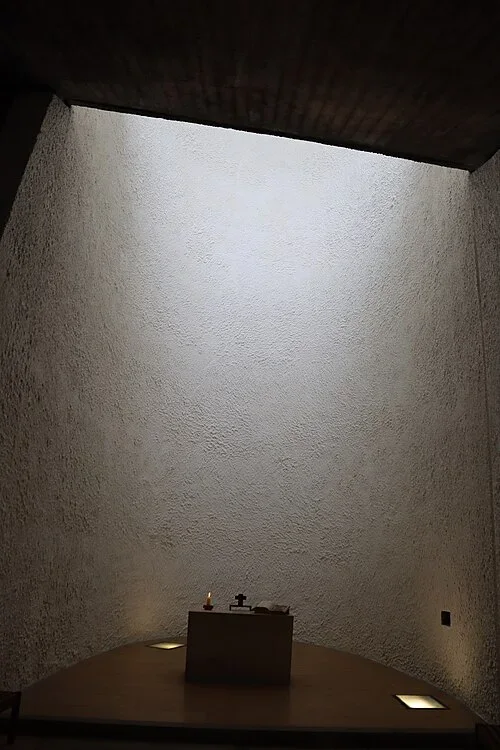 The Main Nave and Altar
Main Nave: The Floating Roof
Under the main roof, the ceiling curves overhead like a shell, and the whole mass seems to hover above the walls. It is not resting on them at all. Concrete columns hidden within the walls carry the load, leaving a gap of several centimetres through which a strip of daylight runs all around the building. The roof itself is two curved concrete membranes with insulation between them, both insulating and watertight. The story told of its shape is that Le Corbusier found a crab shell on a beach on Long Island and kept it as a model for the curving form. The floor follows the natural slope of the hill, descending gently toward the altar, so the congregation gathers as if on the hillside itself. The altars, inside and out, are cut from white stone from Bourgogne.
Listen in the appPhoto: FrDr · CC BY-SA 4.0
07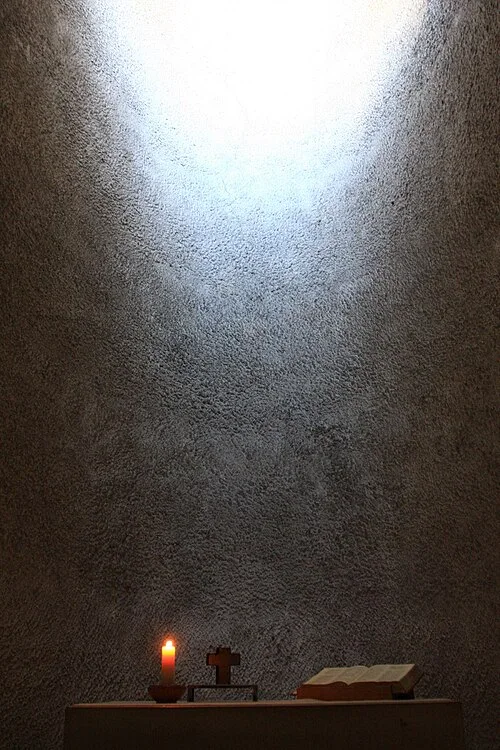 The Main Nave and Altar
Inside the Shell: Textures and Materials
Every surface here keeps the mark of how it was made. The walls are built of old Vosges stone, reclaimed from the destroyed chapel that once stood on this hill, and Le Corbusier filled the inside of the wall with its rubble so the old church would remain in the building. The same whitewash covers the inside. The ceiling was shaped over wooden formwork, and the concrete shell was left rough, just as it came from the mould, so the lines of the timber remain visible in the curve. The walls are white, the ceiling grey. Light enters softly and indirectly, washing down these textured surfaces, which is why the whole room seems to glow rather than shine.
Listen in the appMarianne Boudoy · CC BY-SA 4.0
08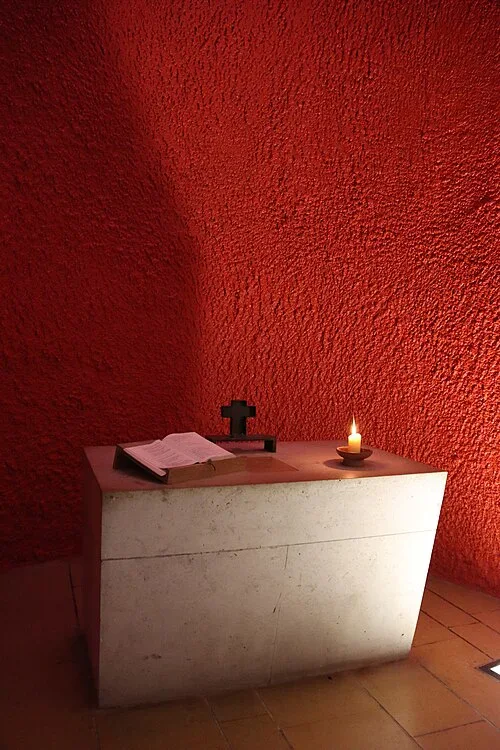 The Side Chapels and Light Towers
The Red Side Chapel
Tucked into the building's thickness is a side chapel drenched in a single color. Its walls are rendered in deep red, rough-textured like the rest of the interior, and they close around a plain altar of white stone. A candle burns on one corner, and an open book rests beside a small dark cross. Each of the chapel's side alcoves has its own color character, and this one is the most intense. The candlelight against that saturated red gives the little room a warmth the white nave does not attempt.
Listen in the appPhoto: FrDr · CC BY-SA 4.0
09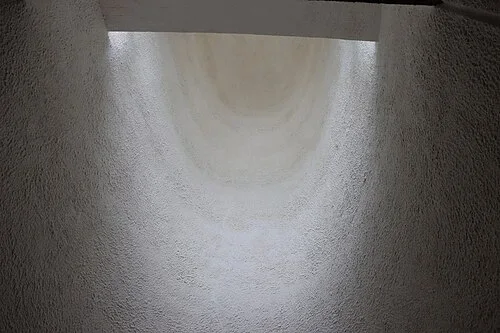 The Side Chapels and Light Towers
The Light Tower
The rounded towers rising from the chapel's roof are not decoration. Each one is built of stone masonry and capped by a cement dome, and each works like a periscope for the sky. Light is captured at the open top, then washes down the curved, whitewashed throat of the tower into the chapel beneath. The surfaces bend the daylight as it descends, so it arrives not as a beam but as a soft, even glow that seems to come from the wall itself. From inside, the towers read as wells of brightness rising out of the dim room.
Listen in the appPhoto: FrDr · CC BY-SA 4.0
10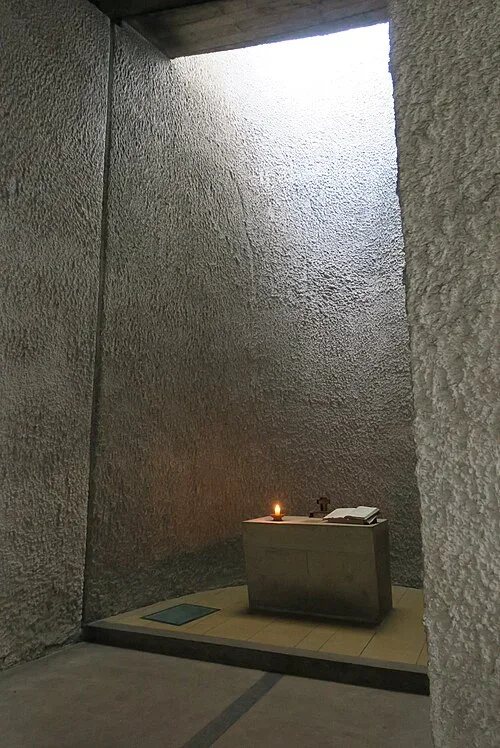 The Side Chapels and Light Towers
The Three Side Chapels
The chapel is small, but it is powerful and complex, and its plan is easy to hold in mind. There are two entrances, a main altar, and three semi-circular side chapels, each seated beneath one of the light towers. This one shows the pattern: curved walls embracing a low altar, daylight descending from the tower above, a quiet pool of space set off from the nave. One compact building, arranged so that every side chapel has its own sky.
Listen in the appPhoto: Peter.Pielmeier · CC BY-SA 4.0
- 11
The Oratory Display Case
Furnishings rescued from the ruins, and the Virgin statue that turns to face inside or out.
- 12
The Prouvé Campanile
Three bells in an open steel frame, hung by Jean Prouvé in 1975.
Chapelle Notre-Dame du Haut
Frequently asked questions
How much does the guide cost?
Free app download. Listed guide price: $0.99. Guide price shown in the app. Audio guide only. Venue admission is separate.
Can I listen without internet?
Yes. Download the guide’s audio, images, and maps in the app before your visit. Your downloaded content is then available offline.
Can I listen in my language?
This audio guide is available in 15 languages, including English.
Do I need to follow a schedule?
No. This is a self-guided experience. Choose your stops, pause whenever you like, and return to a story at your own pace.
At your own pace
Explore Chapelle Notre-Dame du Haut.
Download Stanza, then search for “Chapelle Notre-Dame du Haut”.
Free app download · Guide price shown in the app
Keep exploring
Nearby audio guides
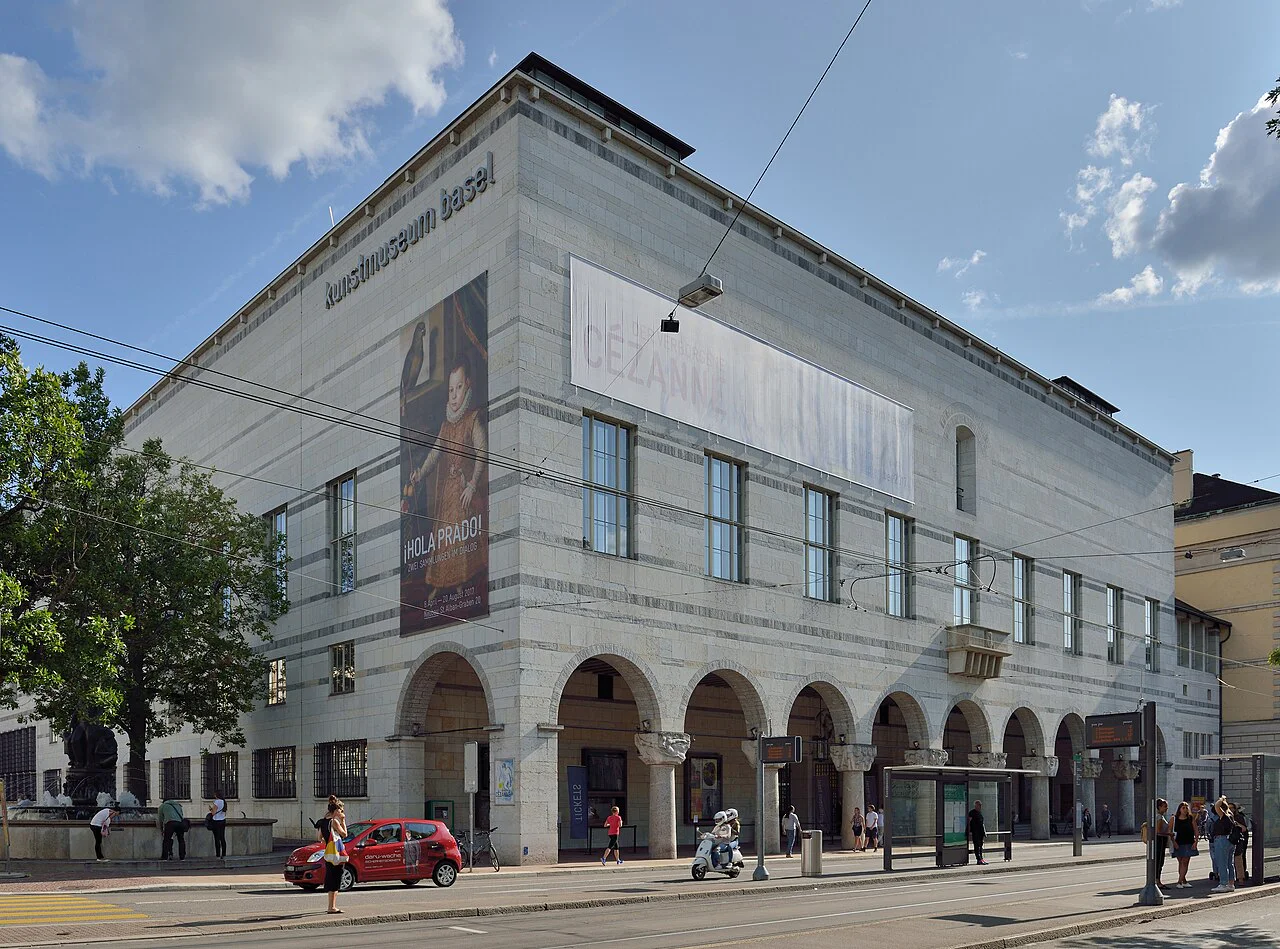
Basel · 75 km
Kunstmuseum Basel
Content & sources
Wladyslaw Sojka · FAL
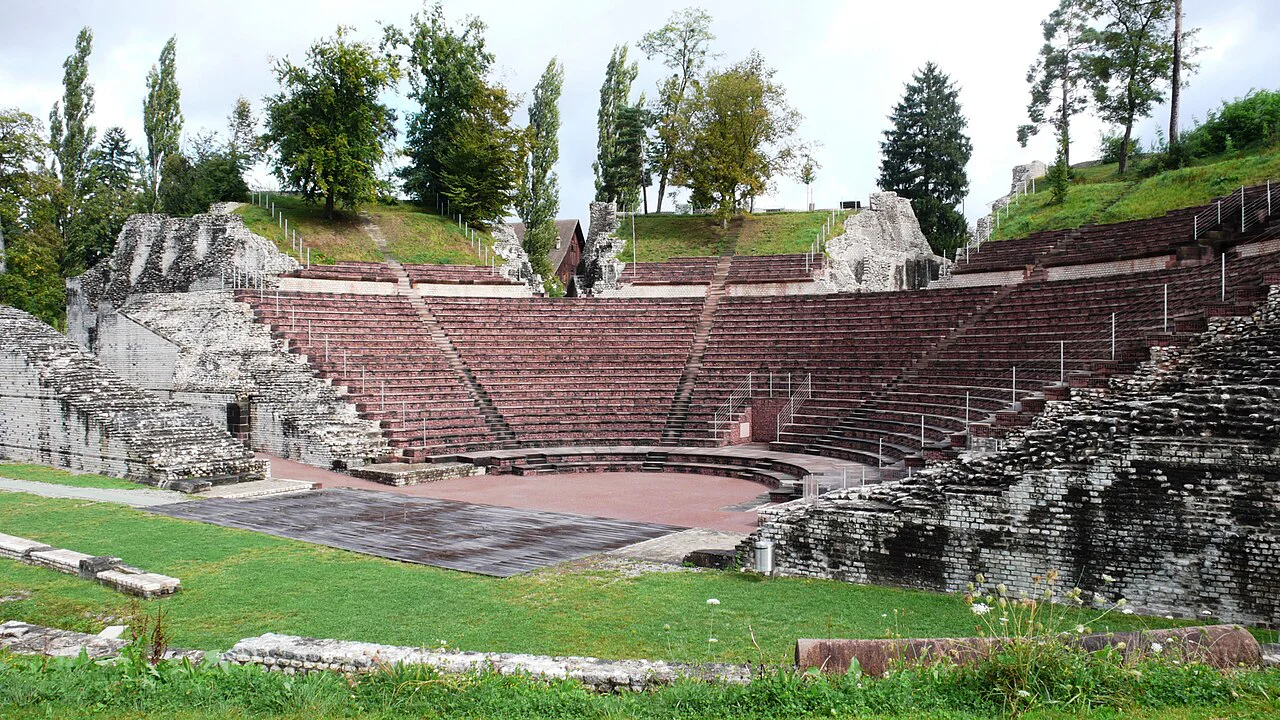
Augst · 85 km
Augusta Raurica
Content & sources
Guido Radig · CC BY-SA 3.0
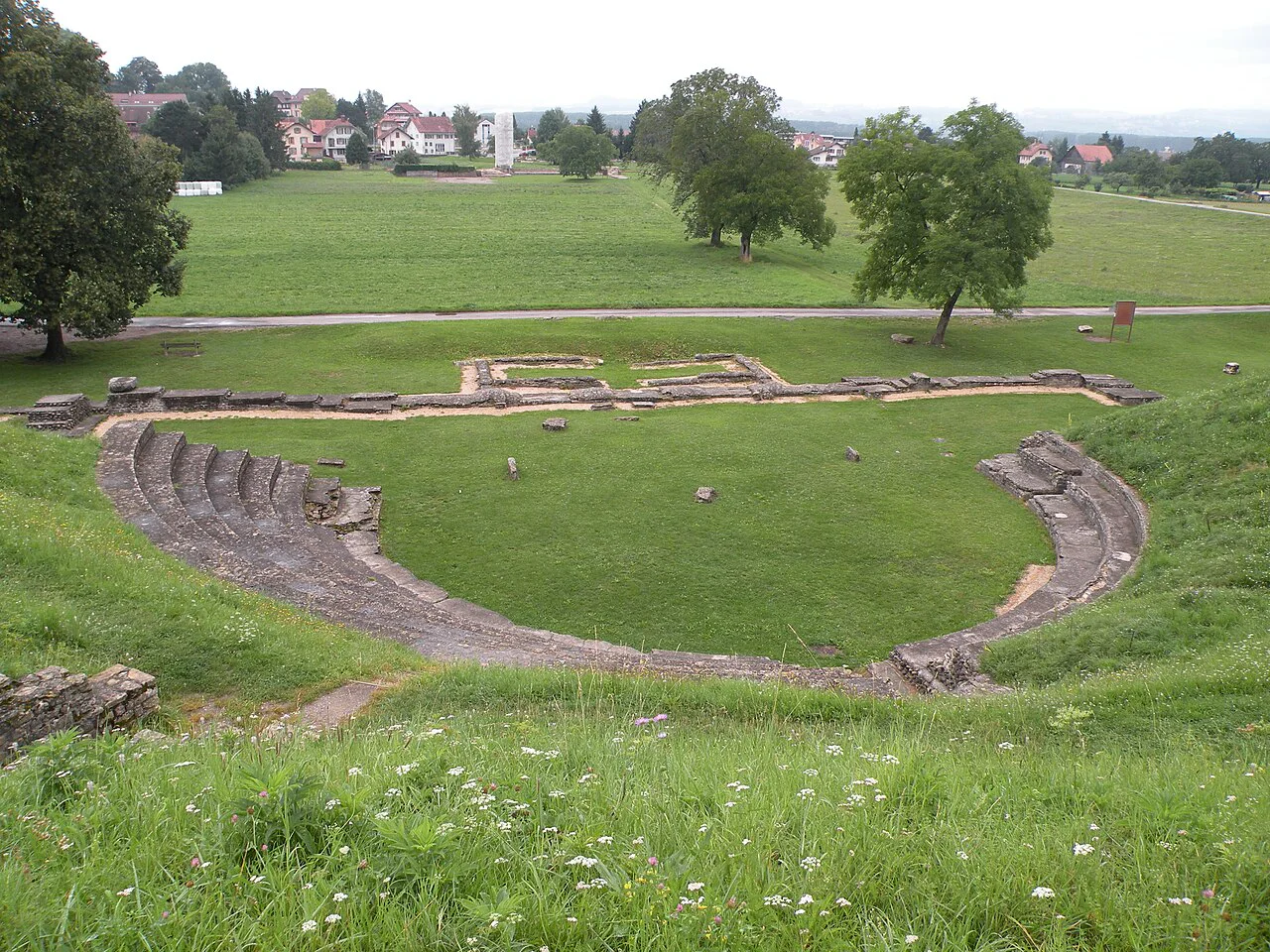
Avenches · 97 km
Aventicum
Content & sources
Photo: Pymouss · CC BY-SA 3.0
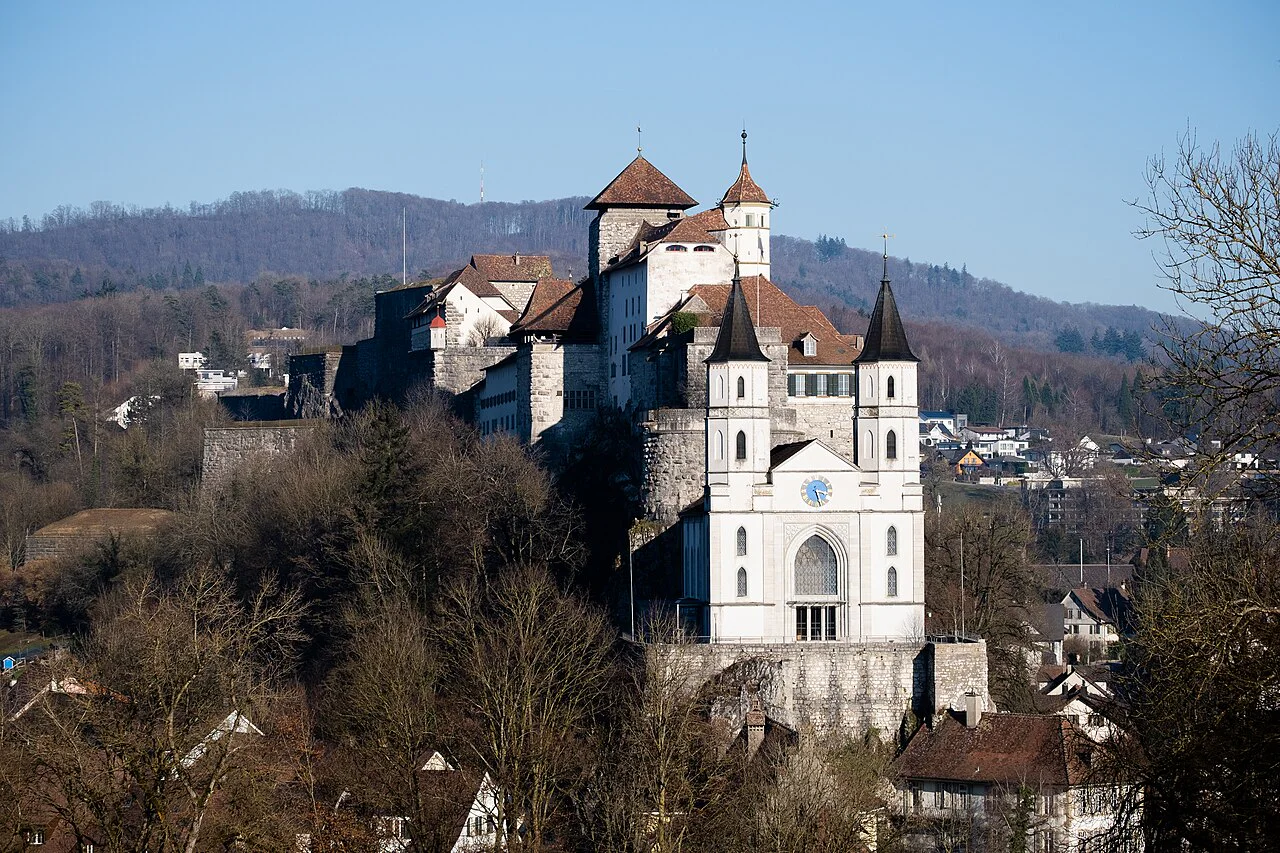
Aarburg · 105 km
Festung Aarburg
Content & sources
Christian David · CC BY-SA 4.0