Stanza · Audio guide
Barbarathermen Audio Guide
A place to remember. A story to take with you.
The Barbara Baths are a large Roman bath complex located in Trier, Germany. It is the largest Roman bath north of the Alps and is a designated UNESCO World Heritage Site.
Download Stanza, then search for “Barbarathermen”.
About the tour
One guide. Your kind of visit.
The Barbara Baths are a large Roman bath complex located in Trier, Germany. It is the largest Roman bath north of the Alps and is a designated UNESCO World Heritage Site.
Ready when you are.
- 01Get the free Stanza app.
iOS & Android
- 02Find your guide.
“Barbarathermen”
- 03Download before you go.
Works offline
Audio guide / 7 narrated stops
Inside the guide
Get to know a few of the stories before you go. Open a stop to read more.
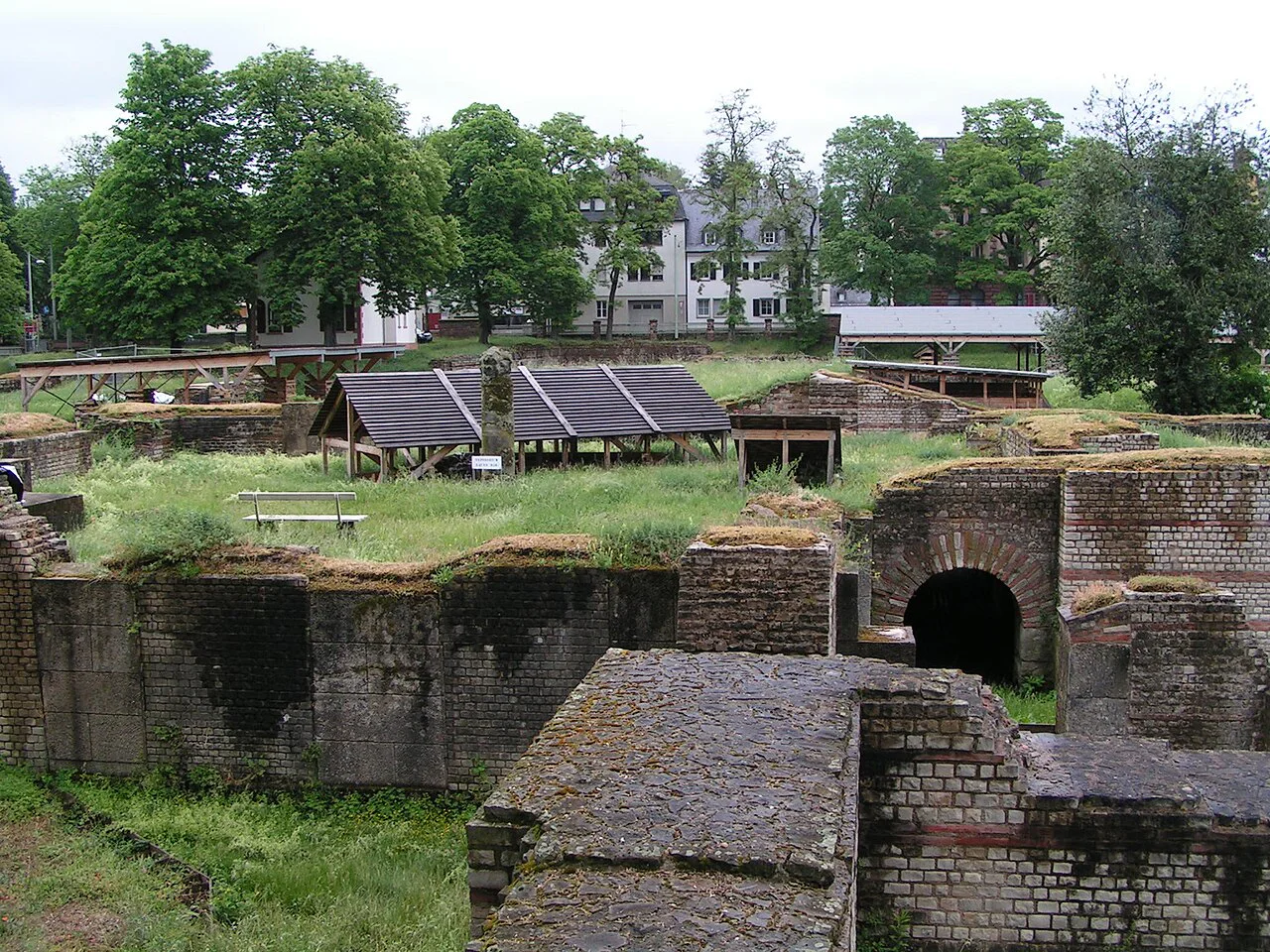
01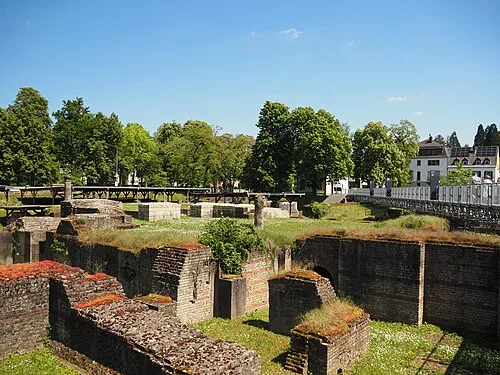 Friedrich-Wilhelm-Straße Entrance & Modern Footbridge
The Ruins from the West: Scale of an Imperial Project
Welcome to the Barbarathermen, the great Roman baths of Trier. From this side the ruins spread out as a broad field of low foundation walls, and that sprawl is the story. In the second half of the second century, the older baths at the Viehmarkt had probably become too small for the growing population of Augusta Treverorum, as Roman Trier was called. The answer was a complex of extraordinary size. Its main building alone measured 172 metres by 96. The full enclosure stretched to 240 metres, swallowing two residential blocks and a street. When it was finished, only the Baths of Trajan in Rome covered more ground. A building programme on that scale can only be explained as a state-financed project, a statement of the city's importance as the seat of the Roman Procurator of the Gallic and German provinces.
Photo: Lumpeseggl · CC BY-SA 4.0
02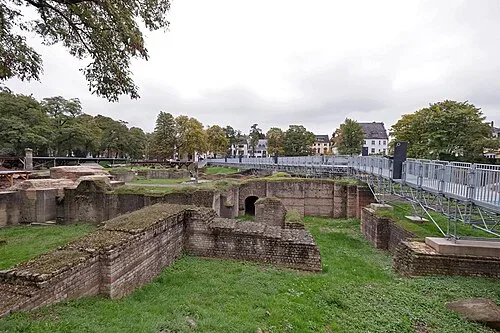 Friedrich-Wilhelm-Straße Entrance & Modern Footbridge
The Entrance and the Modern Footbridge
These are the Barbarathermen, the largest Roman bath complex north of the Alps, covering more than 42,000 square metres. Since 1986 they have belonged to the UNESCO World Heritage listing of Trier's Roman monuments, together with the cathedral, the Porta Nigra and the other Roman sites. What survives today is only the foundation level and the underground service structures; everything above ground was lost over the centuries. The site was closed for restoration from the year 2000. It reopened on 23 July 2015, and since then a steel walkway with information panels carries visitors across the foundations.
Ben Bender · CC BY-SA 3.0
03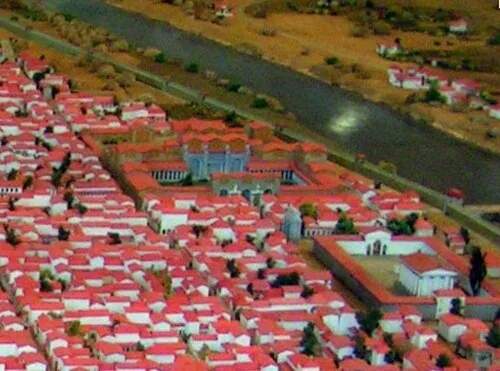 The Northern Palaestra & Original Grandeur
Model of the Baths around 360–370 AD
The model in the Rheinisches Landesmuseum shows the baths as they stood around 360 to 370 AD, more than two centuries after they were built, and still in use. The plan ran along a north-south axis, with two largely identical bathing wings laid out mirror-symmetric on either side. In front of the northern entrance front lay a large palaestra, an exercise courtyard enclosed by a portico. The design closely resembles the Hadrianic Baths at Leptis Magna, in what is now Libya, a sign of how far building blueprints travelled across the Empire. The many apses in the plan were typical of the mature second century. The layout was worked out so that every hall received natural daylight and could be aired with ease. In baths of this kind, people exercised in the courtyard, moved through the rooms from cold to hot, and met to talk and do business. Coin and pottery finds show the complex stayed in use to the end of the fourth century.
Listen in the appStefan Kühn · CC BY-SA 3.0
04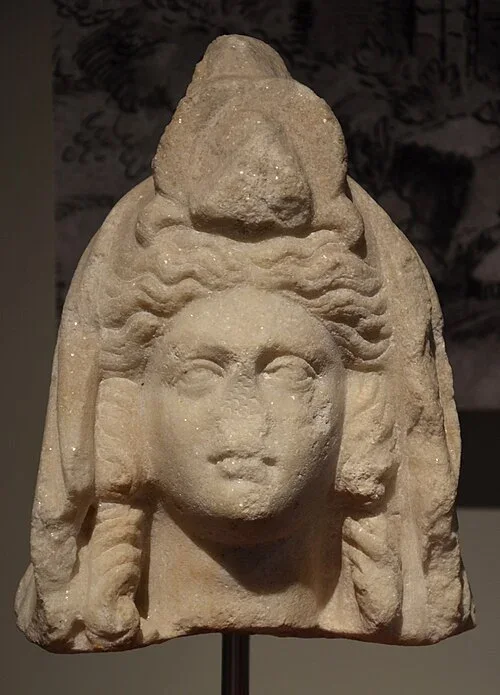 The Northern Palaestra & Original Grandeur
Marble Head of Isis from the Baths
This veiled marble head of Isis, carved after 140 AD, was found at the Barbarathermen and now belongs to the Rheinisches Landesmuseum Trier. It is one of the few pieces that shows how the baths were fitted out inside. The walls and halls held high-quality sculpture imported from Italy, so a bathhouse here was also a kind of gallery. The best-known companion find is a marble torso of an Amazon warrior, dug up at the complex and now kept in the Landesmuseum in Mainz. Where exactly the Isis head once stood in the building is unknown. Whether she served a cult or was purely decoration, no one can say.
Listen in the appCarole Raddato from Frankfurt, Germany · CC BY-SA 2.0
05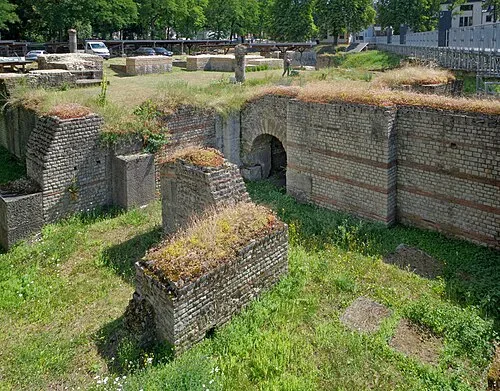 The Bathing Halls & Water Engineering
The Bathing Halls and the Water Supply
These brick foundation blocks belonged to the bathing halls, and baths on this scale needed enormous amounts of water. They were fed by the Ruwer aqueduct, a long-distance Roman water line that supplied the complex. The north front of the building shows how the cold end worked. Niches and apses along the facade corresponded to smaller cold-water basins on the inside. Behind them followed a larger hall covered by a cross-vault, and then the central tepidarium, the heated room at the heart of the sequence. A bather moved from those cold basins through the warm hall and on towards the hot end of the building.
Listen in the appPhoto: Berthold Werner · CC BY-SA 4.0
06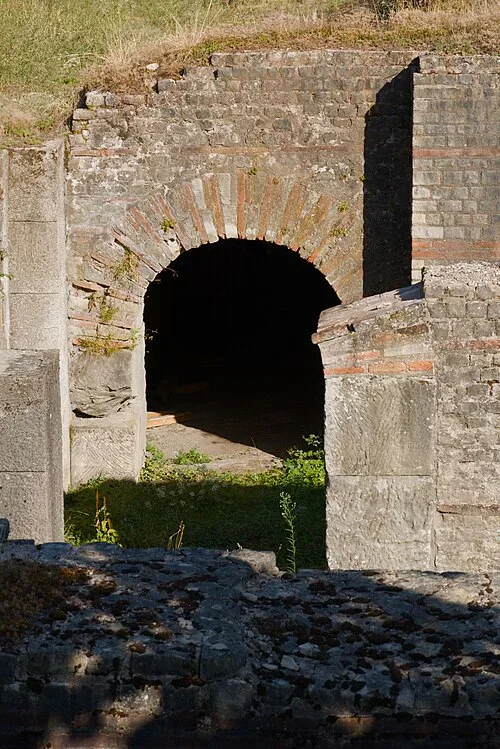 Subterranean Heating & Hypocaust System
Into the Service Tunnels: Heating the Baths
The dark arched opening in these walls leads into the service level, the best-preserved part of the whole complex. The heated rooms worked on a two-story hypocaust, a system of raised floors and hollow walls through which hot air from large furnaces circulated under the bathers' feet and up the walls. The caldarium, the great hot hall, measured 20 metres by 30 and projected well out from the south front. Along its walls stood niches with rectangular basins, and two enormous bathing basins, 13 metres by 23, jutted from the facade as apses. The underground service tunnels and sewers here survive so well that the technical workings can be studied better at this site than at Trier's other two Roman baths. They survived because the upper structure was destroyed over the centuries, and the rubble buried and shielded the engineering below.
Listen in the appPhoto: Polibil · CC BY-SA 4.0
07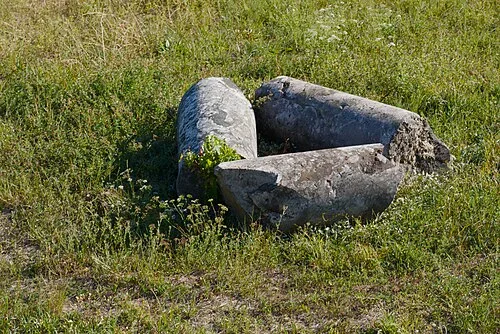 Destruction, Quarrying, and Legacy
Fallen Columns: Quarrying, Cannons, and Demolition
Three broken column drums lie in the grass here, all that is left of the colonnades. The baths fell out of use in the early fifth century, when Trier was repeatedly sacked during the Migration Period. After that the vast complex was put to other uses. Residential buildings stood here from the fifth century, the beginning of the suburb of St Barbara, whose parish church gave the baths their modern name. Early Christian grave inscriptions point to a church on the site, possibly as early as Merovingian times. In the Middle Ages the ruins were built up with fortifications, recorded in a city view by Matthäus Merian and in a drawing by Alexandre Wiltheim around 1620, the last detailed pictures of the building. As early as 1512, Emperor Maximilian I had the still-standing walls shelled with cannons as artillery tests during the Imperial Diet in Trier. From 1611 the ruins served as a quarry for the Jesuit College. In 1675 the French General Vignory, fighting for Louis the Fourteenth, blew up what remained to create a clear field of fire around Trier, and the church of St Maria ad Pontem went with them. Whether these column drums came down with that blasting or earlier, no one can say.
Listen in the appPhoto: Polibil · CC BY-SA 4.0
Barbarathermen
Frequently asked questions
How much does the guide cost?
Free app download. Listed guide price: $0.99. Guide price shown in the app. Audio guide only. Venue admission is separate.
Can I listen without internet?
Yes. Download the guide’s audio, images, and maps in the app before your visit. Your downloaded content is then available offline.
Can I listen in my language?
This audio guide is available in 15 languages, including English.
Do I need to follow a schedule?
No. This is a self-guided experience. Choose your stops, pause whenever you like, and return to a story at your own pace.
At your own pace
Explore Barbarathermen.
Download Stanza, then search for “Barbarathermen”.
Free app download · Guide price shown in the app
Keep exploring
Nearby audio guides
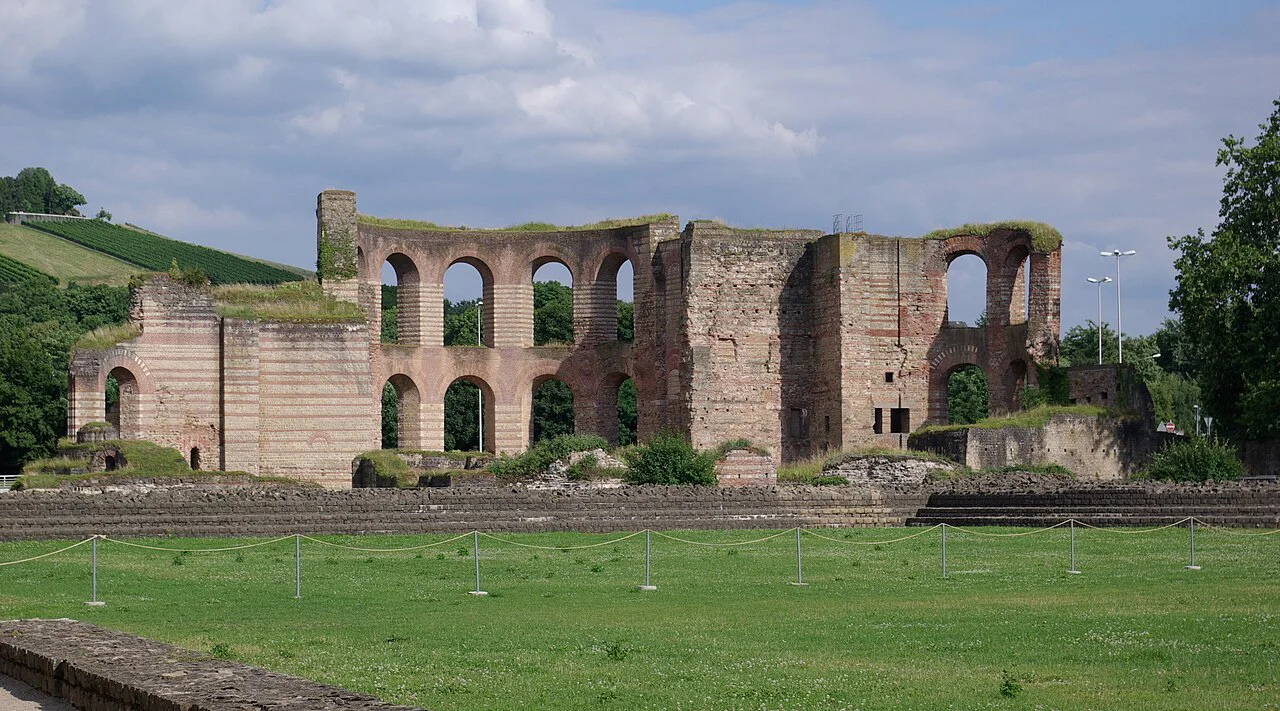
Trier · 1 km
Kaiserthermen
Content & sources
Photo: Berthold Werner · Public domain
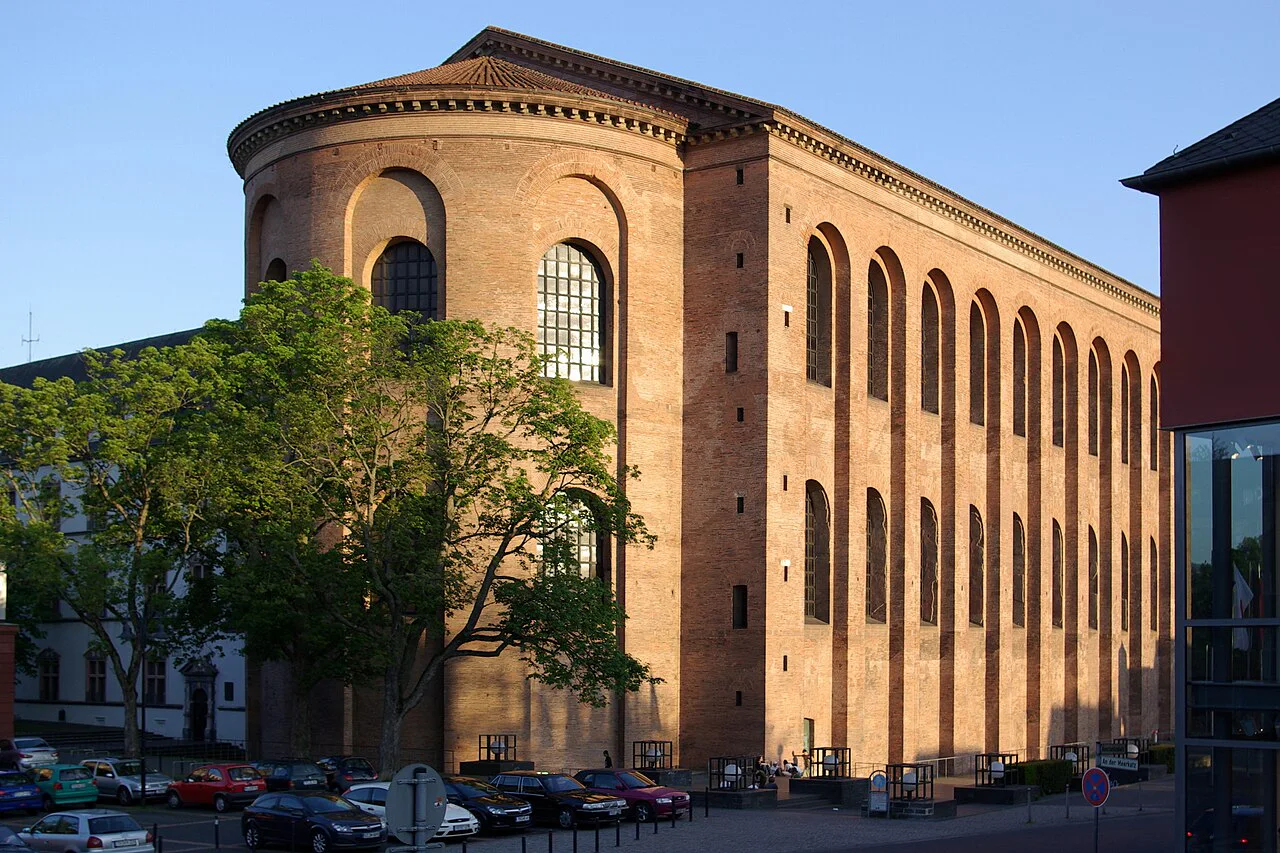
Trier · 1 km
Konstantinbasilika
Content & sources
Photo: Berthold Werner · Public domain
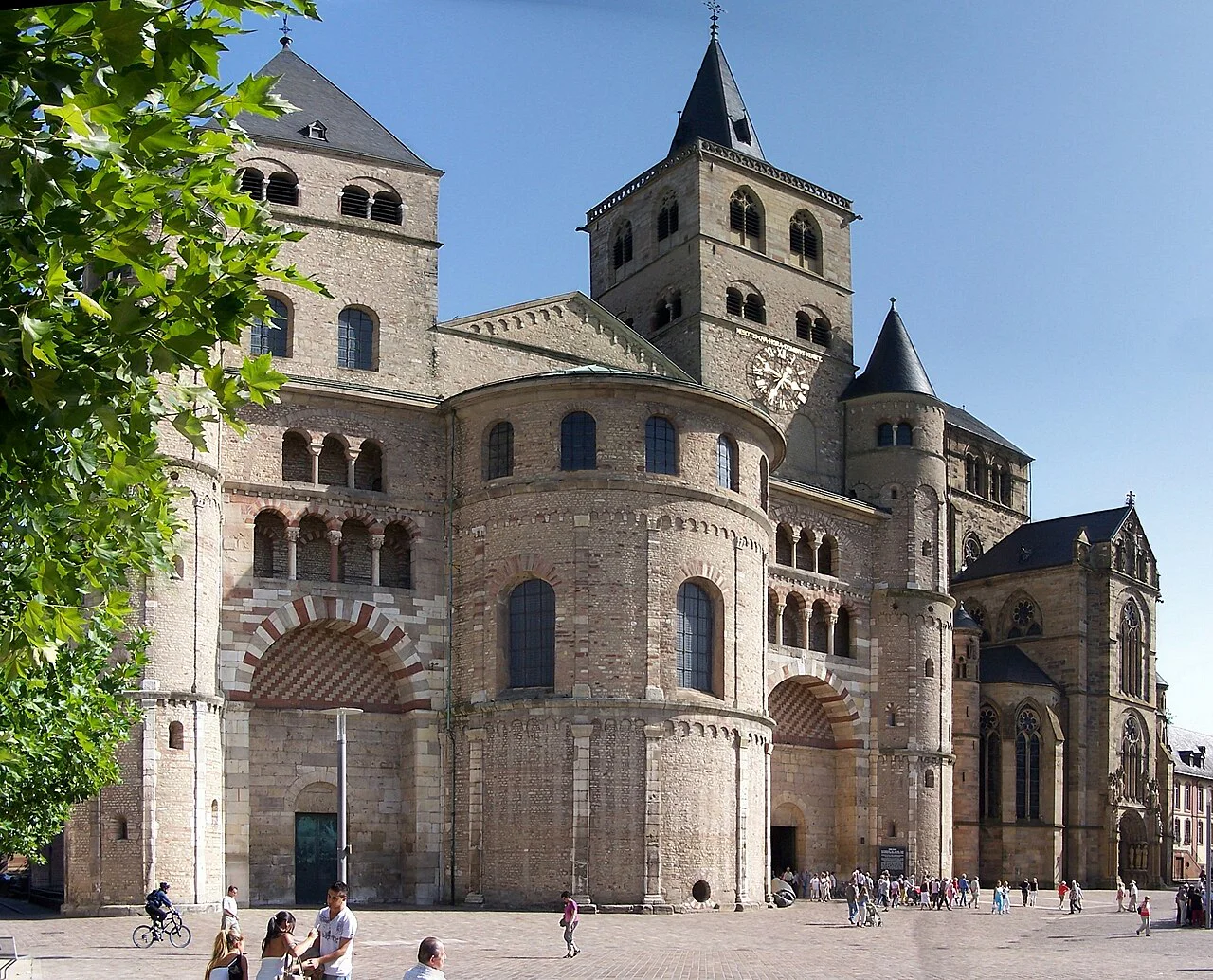
Trier · 1 km
Trierer Dom
Content & sources
Photo: Berthold Werner · CC BY-SA 3.0
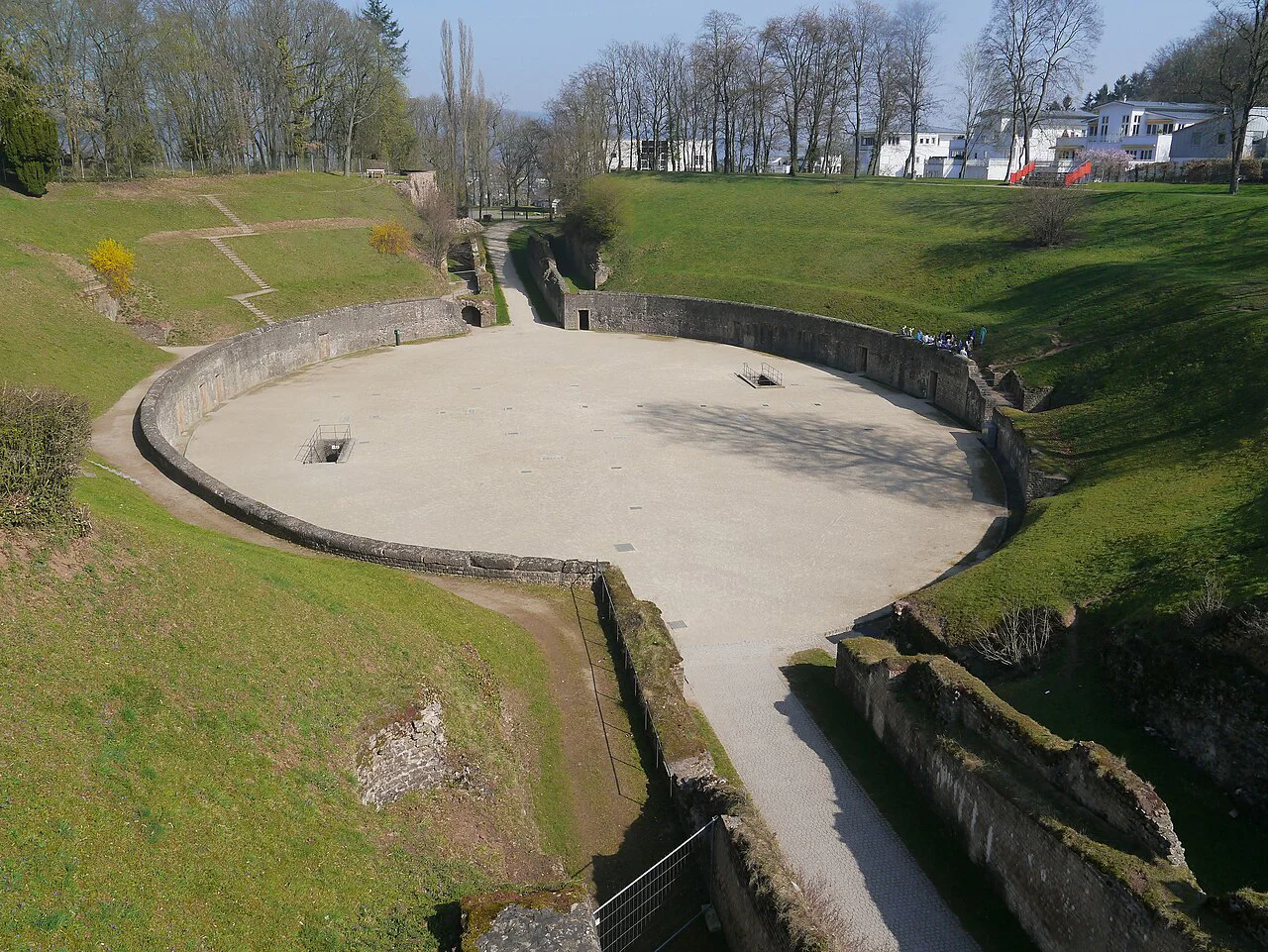
Trier · 1 km
Amphitheater
Content & sources
Photo: Zairon · CC BY-SA 3.0