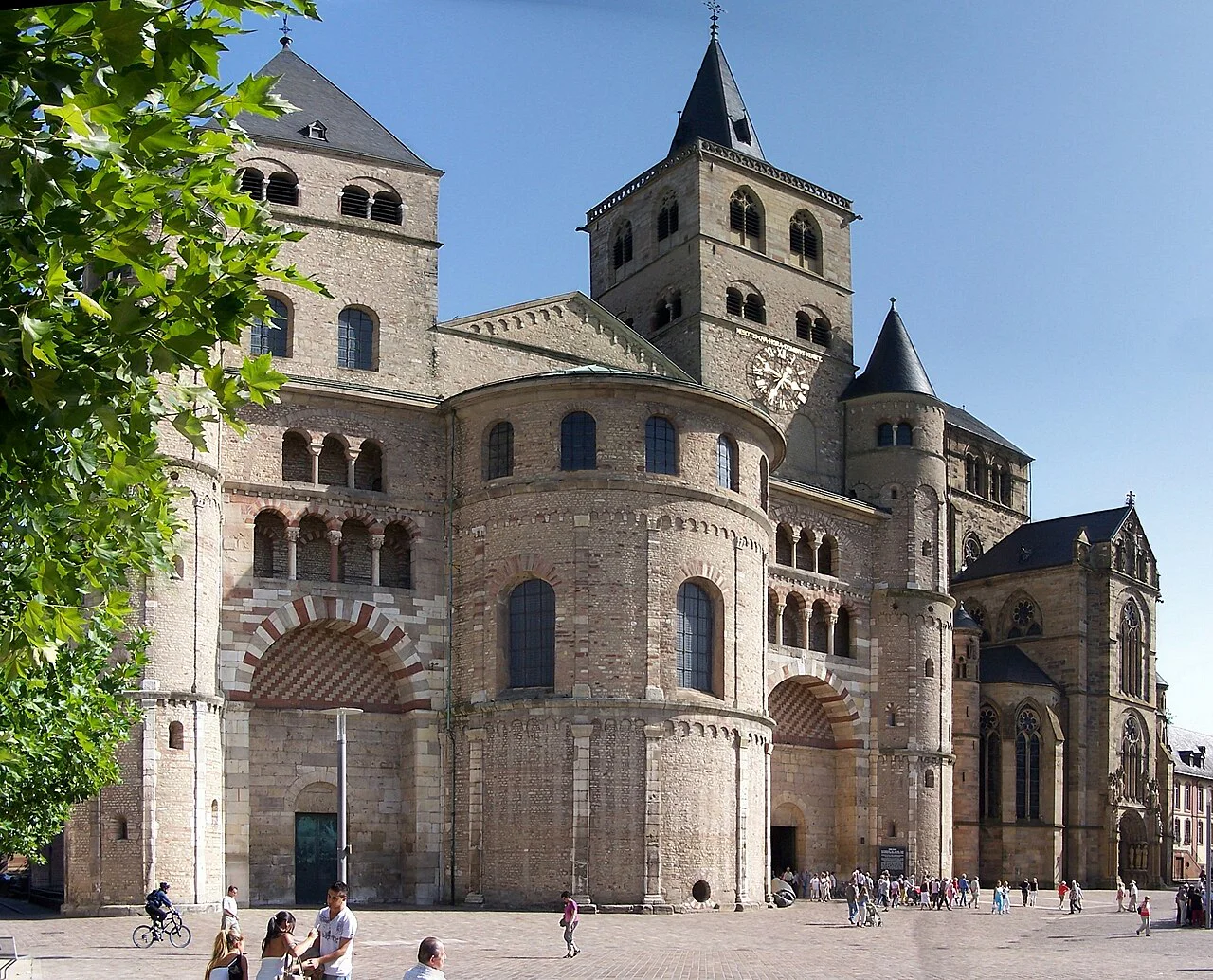
Stanza · Audio guide
Trierer Dom Audio Guide
A place to remember. A story to take with you.
Trier Cathedral is a Roman Catholic cathedral located in Trier, Germany. It is the oldest cathedral in Germany and is recognized as a UNESCO World Heritage Site.
Download Stanza, then search for “Trierer Dom”.
About the tour
One guide. Your kind of visit.
Trier Cathedral is a Roman Catholic cathedral located in Trier, Germany. It is the oldest cathedral in Germany and is recognized as a UNESCO World Heritage Site.
Ready when you are.
- 01Get the free Stanza app.
iOS & Android
- 02Find your guide.
“Trierer Dom”
- 03Download before you go.
Works offline
Audio guide / 15 narrated stops
Inside the guide
Get to know a few of the stories before you go. Open a stop to read more.
01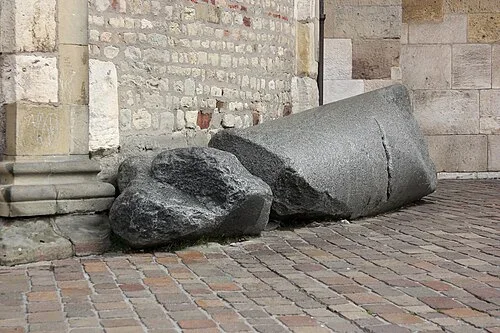 Domfreihof Square and the Domstein
The Domstein at the Entrance
Welcome to Trier Cathedral. Before the main entrance lies a grey column, about four meters long, leaning against the wall. It is called the Domstein, the cathedral stone. The legend says the devil was tricked into helping build the church. When the work was finished, he realized he had been cheated. In his anger, the story goes, he hurled this stone at the cathedral walls. The stone itself is more patient than its legend. It is a fragment of an ancient column, its dark stone described sometimes as diorite, sometimes as granite. Where it once stood, and what it carried in Roman times, nobody knows.
Lothar Spurzem · CC BY-SA 2.0 de
02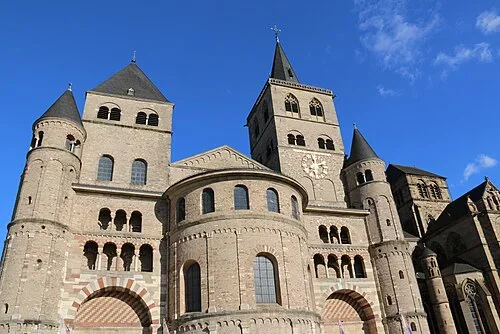 Domfreihof Square and the Domstein
Trier Cathedral from the Domfreihof
High Cathedral of Saint Peter — that is the full name of the church on the Domfreihof. It is the oldest bishop's church in Germany, and it has served as a cathedral without a break since late antiquity. The interior measures about a hundred and twelve meters in length. At forty-one meters wide, it is the largest church building in Trier. In 1986 it joined the UNESCO World Heritage list, together with the Roman monuments and the neighboring Church of Our Lady. The towers seem to come from different centuries, because they do. A Roman core wears Romanesque stonework, with Gothic and Baroque additions layered on top.
Photo: FrDr · CC BY-SA 4.0
03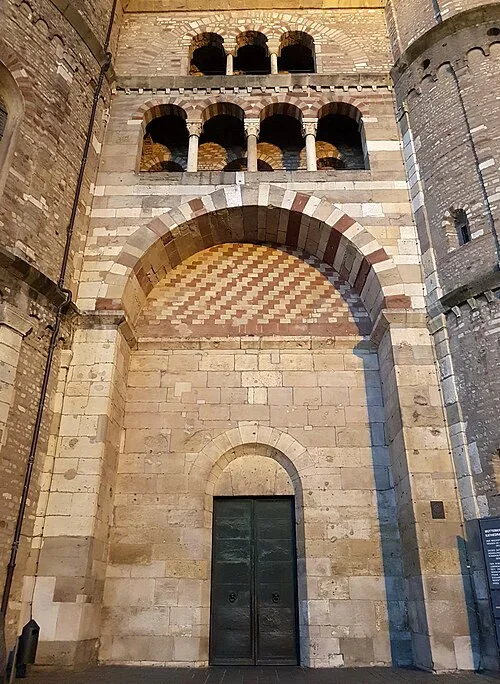 The Salian Westwork and Roman Foundations
The Salian Westwork Facade
The face Trier Cathedral shows to the west was built in the eleventh century, in the style of the Salian emperors. Archbishop Poppo von Babenberg began the westwork, and Eberhard completed it. Four towers stand more or less symmetrically around the western apse. Churches across the Rhine and Meuse region copied the arrangement, which made this facade a model far beyond Trier. Inside, at the doorway from the south aisle to the Church of Our Lady, a Romanesque tympanum shows Christ with the Virgin Mary and Saint Peter; it may be the oldest surviving image in the cathedral. On the tallest tower, above the clock, a Latin inscription keeps its warning: NESCITIS QVA HORA DOMINVS VENIET — you do not know what time the Lord is coming.
Listen in the appPhoto: Kleon3 · CC BY-SA 4.0
04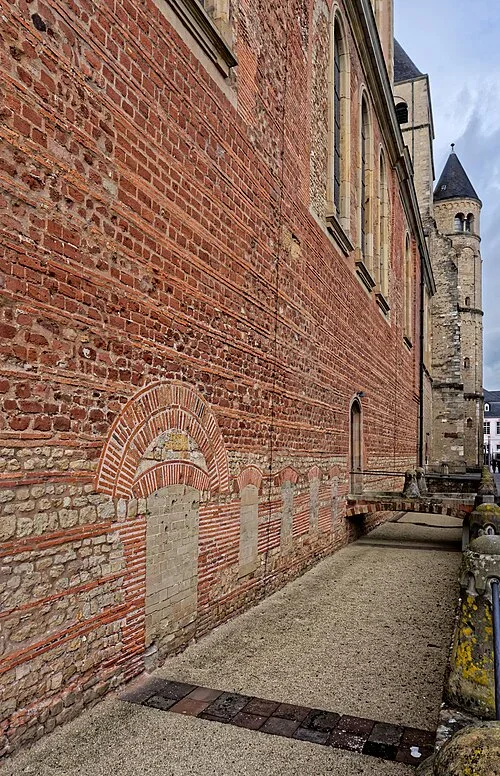 The Salian Westwork and Roman Foundations
Roman Brickwork on the North Wall
The red brick on the north wall is the oldest fabric in the building. It belongs to the square core church of around 340, and it makes this the oldest church building still in use in Germany. Archaeology confirms that the cathedral, the cloisters and the Church of Our Lady all stand on Roman foundations of Augusta Treverorum. Tradition credits Bishop Maximin, who led the see from 329, with coordinating the great late-Roman construction. Hard times followed. The Franks left the fourth-century church in ruins, keeping only the outer walls. In 882 the Vikings destroyed it again. Rebuilding began under Archbishop Egbert, who died in 993, and was completed under Poppo of Babenberg.
Listen in the appPhoto: Holger Uwe Schmitt · CC BY-SA 4.0
05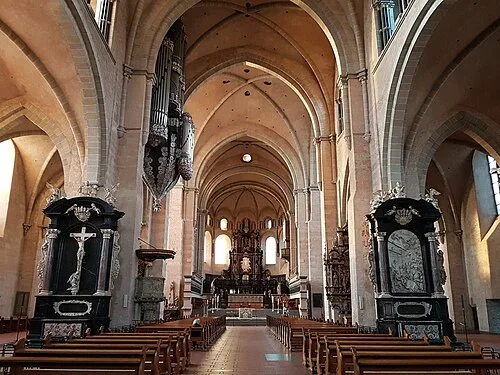 The Nave and Roman Core
Inside the Nave
Inside, the layers are easier to read than the outside suggests. Three naves, largely Romanesque, carry Gothic vaulting. In the three easternmost bays, the rectangular form of the Roman core still shows through. There the four original Roman columns were reused in the eleventh century, reshaped into cruciform piers. The thirteenth century brought a thorough renewal in the late-Romanesque style of the Rhine and Meuse. Cross-rib vaults replaced the older ceiling, galleries were built in, and the east choir was redesigned. Those vaults and galleries still define the nave today, a room shaped for worship in the thirteenth century and used for worship now.
Listen in the appPhoto: Kleon3 · CC BY-SA 4.0
06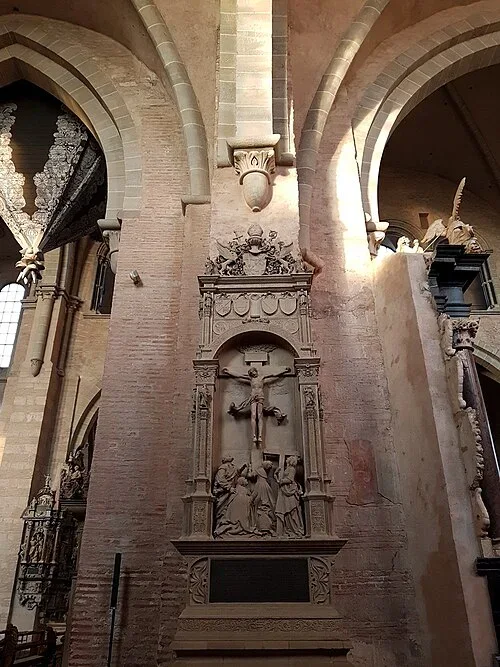 The Nave and Roman Core
The Tomb Altar of Richard von Greiffenklau
Richard von Greiffenklau, archbishop-elector of Trier, died in 1531, and his tomb altar stands against a brick pillar of the nave. It is a Renaissance monument, and like several tombs of the sixteenth and seventeenth centuries here, it served as an altar where masses were read. Richard also changed the skyline. The tower of St. Gangolf, the citizens' church, had grown taller than the cathedral towers. After 1512, Richard had the southwest tower raised to seventy-six meters, and the cathedral ruled the city's roofline again. For centuries the archbishops of Trier preferred to be buried here, and their monuments line the interior.
Listen in the appPhoto: Kleon3 · CC BY-SA 4.0
07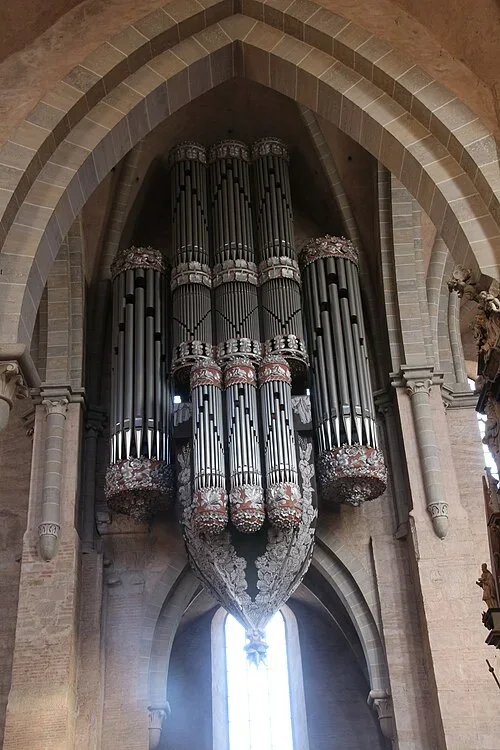 The Swallow's Nest Organ
Hanging from the north wall of the nave, high in the vault, sits the main organ. Organ builders call this arrangement a swallow's nest. The Klais workshop of Bonn built it, and it was consecrated on the first of May 1974, together with the restored cathedral. The instrument is about sixteen meters tall. All told, it weighs roughly thirty tonnes. Wolfgang Oehms, the cathedral organist, planned its sixty-seven registers. With its pipes, more than five thousand of them, it can play the whole organ repertoire, up to the avant-garde. The largest single pipe alone weighs a hundred and twenty-five kilograms.
Listen in the appde:User:Gerold Rosenberg · CC BY-SA 4.0
08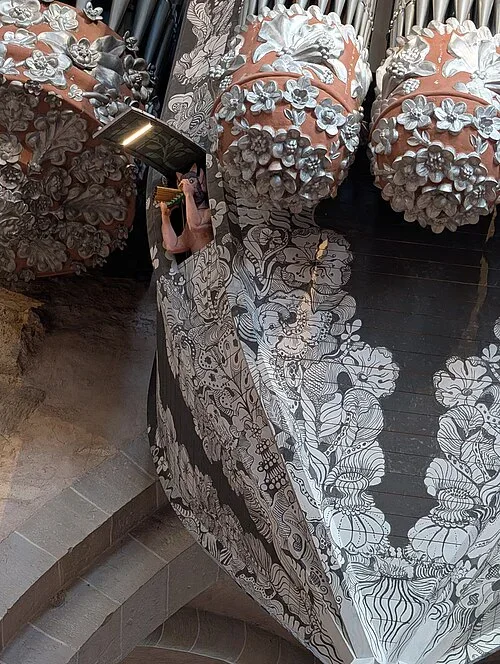 The Swallow's Nest Organ
The Figure in the Organ Case
At the foot of the swallow's nest, a carved figure peeks out of the casing. It shows Pan, the shepherd god, presented as the father of the pan flute. Because of its horns, many read it as a devil instead. The organist can move the figure out of its housing with a lever beside the console, while five panpipe notes sound. Those five pipes are deliberately detuned, so the music can never come out sweet. The builders' joke writes itself: the devil is made to play for the glory of God, and made to play badly. It echoes, in its own way, the devil legend at the cathedral's door.
Listen in the appPhoto: Phoebe · CC0
09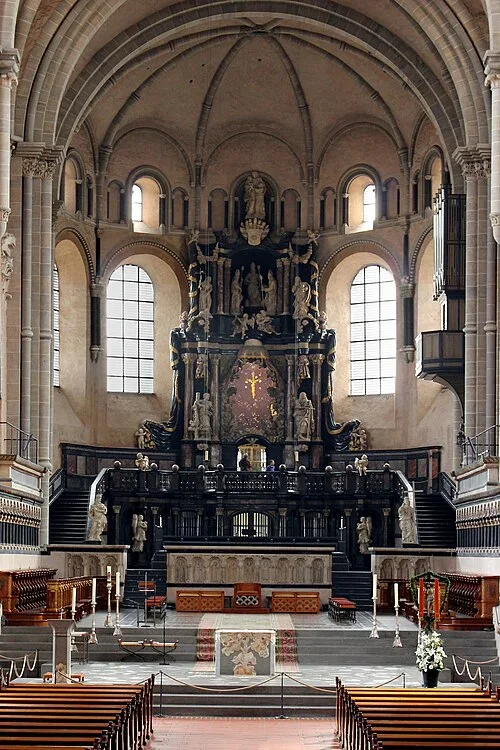 The East Choir and Holy Tunic Chapel
The East Choir and High Altar
The east end of the cathedral is where the bishop's church is most visibly itself. In the crossing stands a modern altar island of dark grey Peperino stone, set against the sober Romanesque walls. Much of the rest wears the dress of the German Baroque: the west choir, the side chapels and most of the altars. Behind the east choir, an opening in the wall reveals a Baroque annex chapel, added for the cathedral's most famous relic, the Holy Tunic.
Listen in the appLothar Spurzem · CC BY-SA 2.0 de
10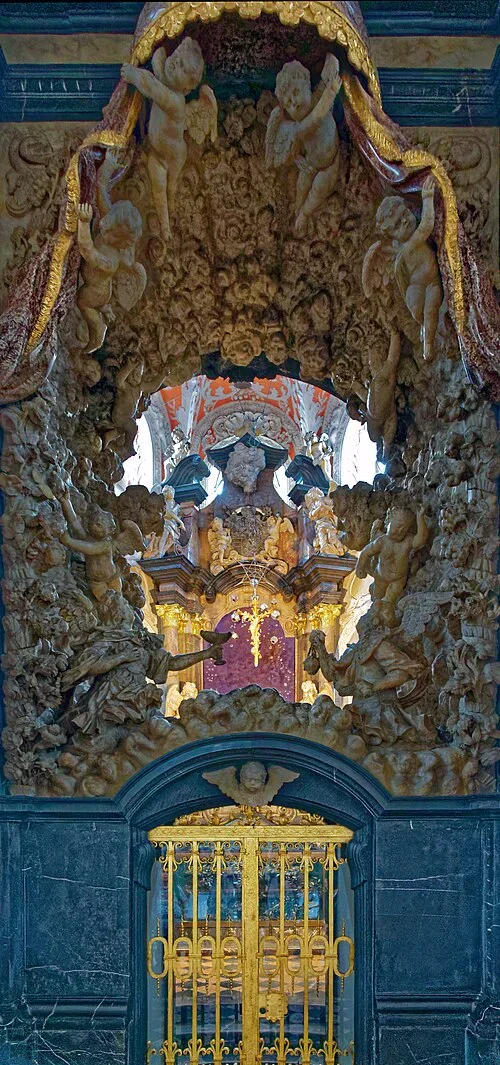 The East Choir and Holy Tunic Chapel
The Chapel of the Holy Tunic
The Holy Tunic is the cathedral's best-known relic, the robe said to have been worn by Jesus shortly before his crucifixion. Tradition adds that Empress Helena brought it to Trier from Jerusalem. It was recovered from the previous main altar in 1512. That Baroque chapel dates from the early eighteenth century. The robe lies under protective glass in a wooden container, behind a front framed by dense Baroque sculpture. It is shown to the public only rarely, most recently in 2012. That rarity is often compared with the Shroud of Turin. Pilgrims have come to Trier for it across the centuries.
Listen in the appPhoto: Holger Uwe Schmitt · CC BY-SA 4.0
- 11
St. Helena in the East Crypt
The gilded bust in the crypt that holds the skull of Constantine's mother, patroness of Trier.
- 12
The Gothic Cloisters
The thirteenth-century cloister where canons were buried, students studied, and bread was handed out to the poor.
- 13
Three Angels in the Cloister Garden
Three bronze angels bowing in the cloister garden, placed there in 1993.
- 14
The Cathedral Treasury
The treasury's vaulted rooms, and the small drinking cup that once belonged to Empress Helena.
- 15
The Egbert Shrine
The Egbert Shrine and the Holy Nail reliquary, Ottonian gold at its finest, and what they say about this church.
Trierer Dom
Frequently asked questions
How much does the guide cost?
Free app download. Listed guide price: $1.99. Guide price shown in the app. Audio guide only. Venue admission is separate.
Can I listen without internet?
Yes. Download the guide’s audio, images, and maps in the app before your visit. Your downloaded content is then available offline.
Can I listen in my language?
This audio guide is available in 15 languages, including English.
Do I need to follow a schedule?
No. This is a self-guided experience. Choose your stops, pause whenever you like, and return to a story at your own pace.
At your own pace
Explore Trierer Dom.
Download Stanza, then search for “Trierer Dom”.
Free app download · Guide price shown in the app
Keep exploring
Nearby audio guides
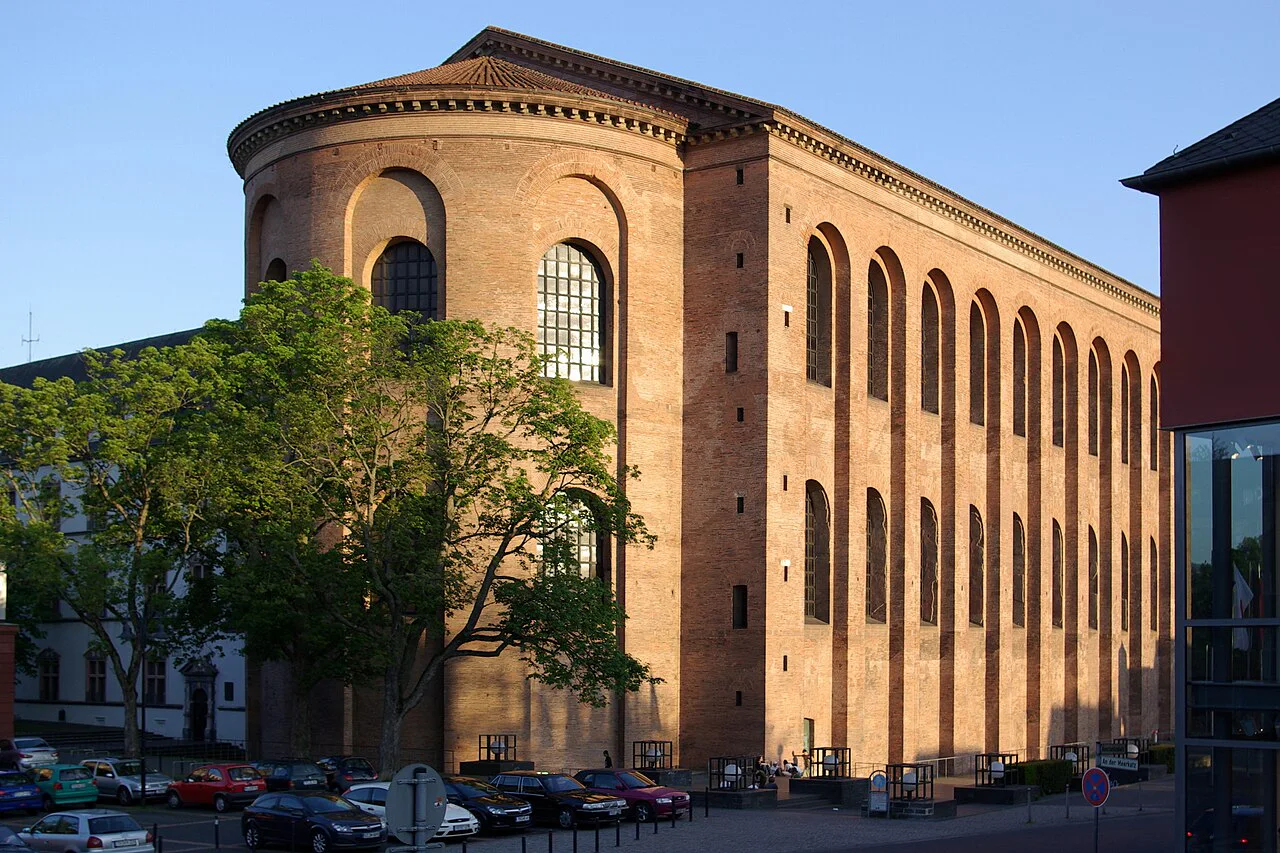
Trier · 1 km
Konstantinbasilika
Content & sources
Photo: Berthold Werner · Public domain
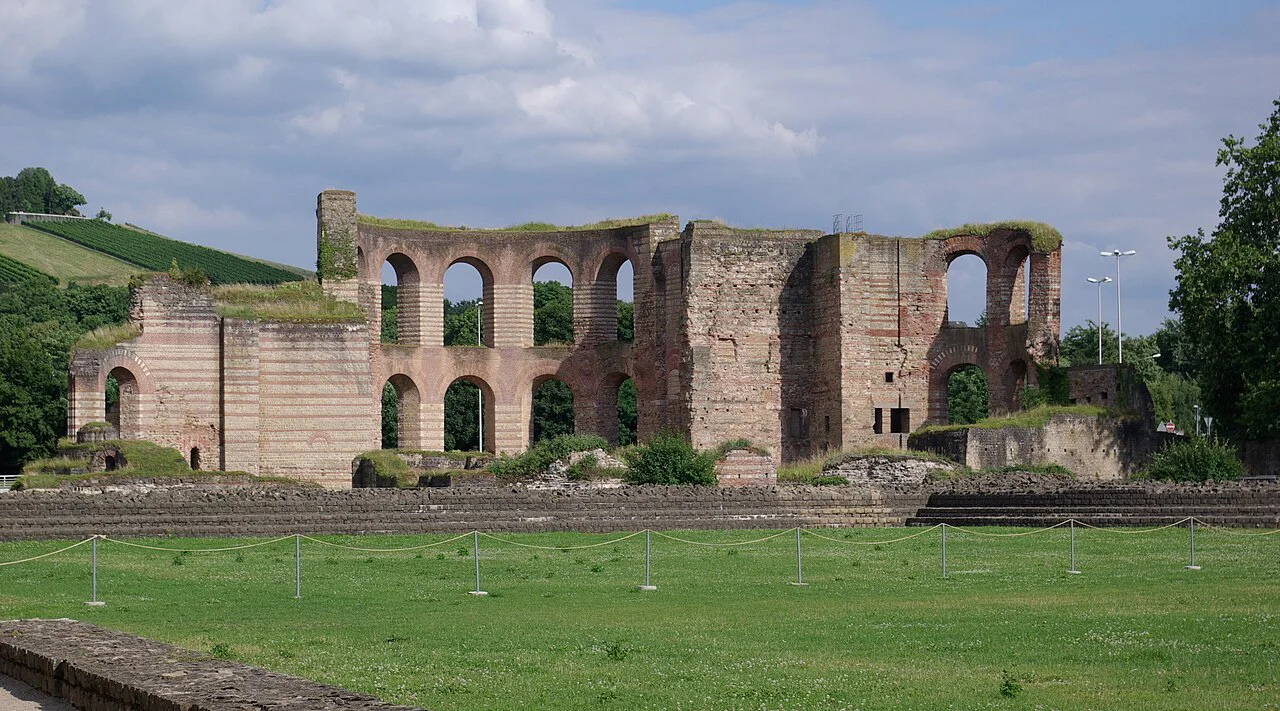
Trier · 1 km
Kaiserthermen
Content & sources
Photo: Berthold Werner · Public domain
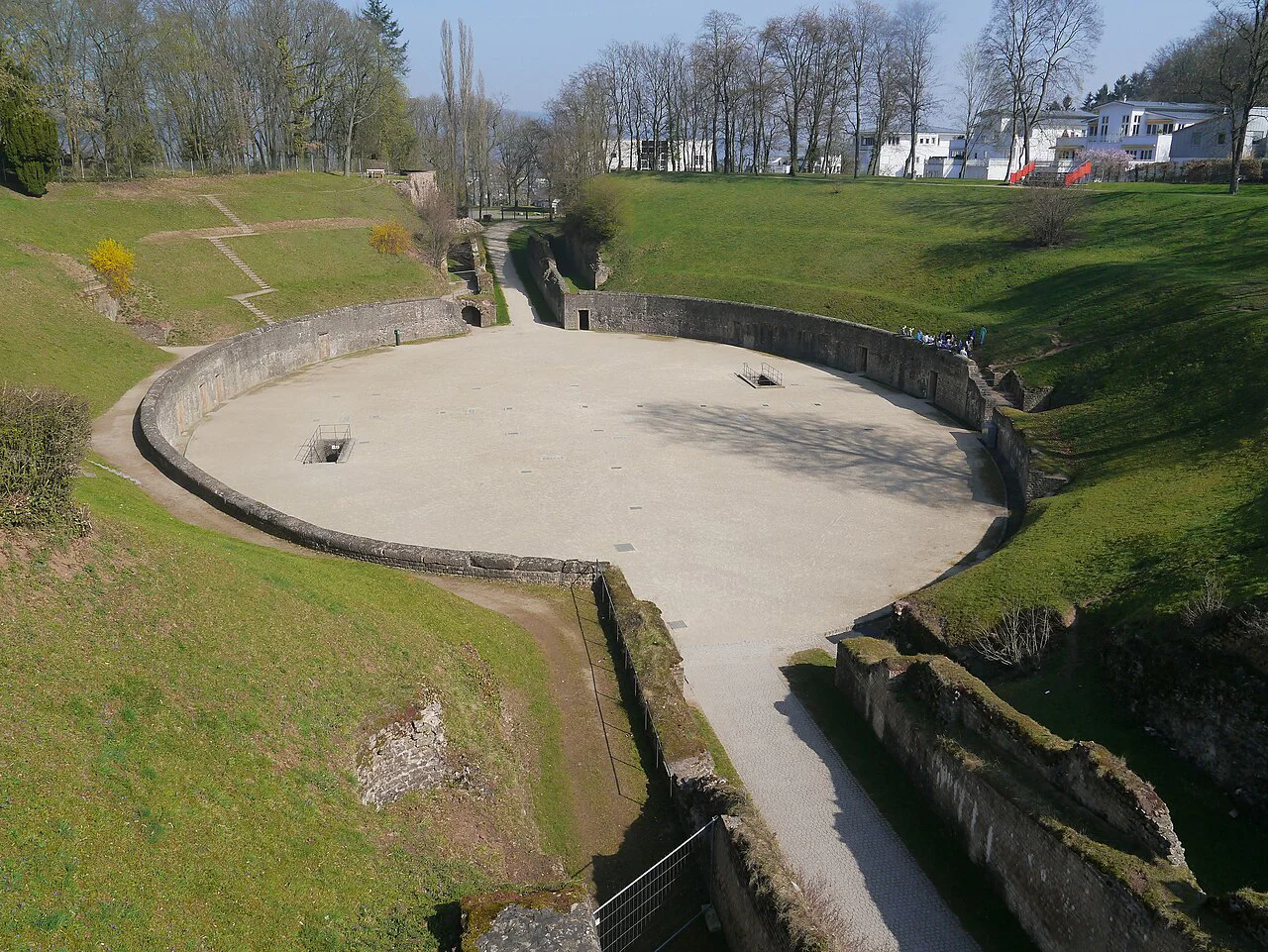
Trier · 1 km
Amphitheater
Content & sources
Photo: Zairon · CC BY-SA 3.0
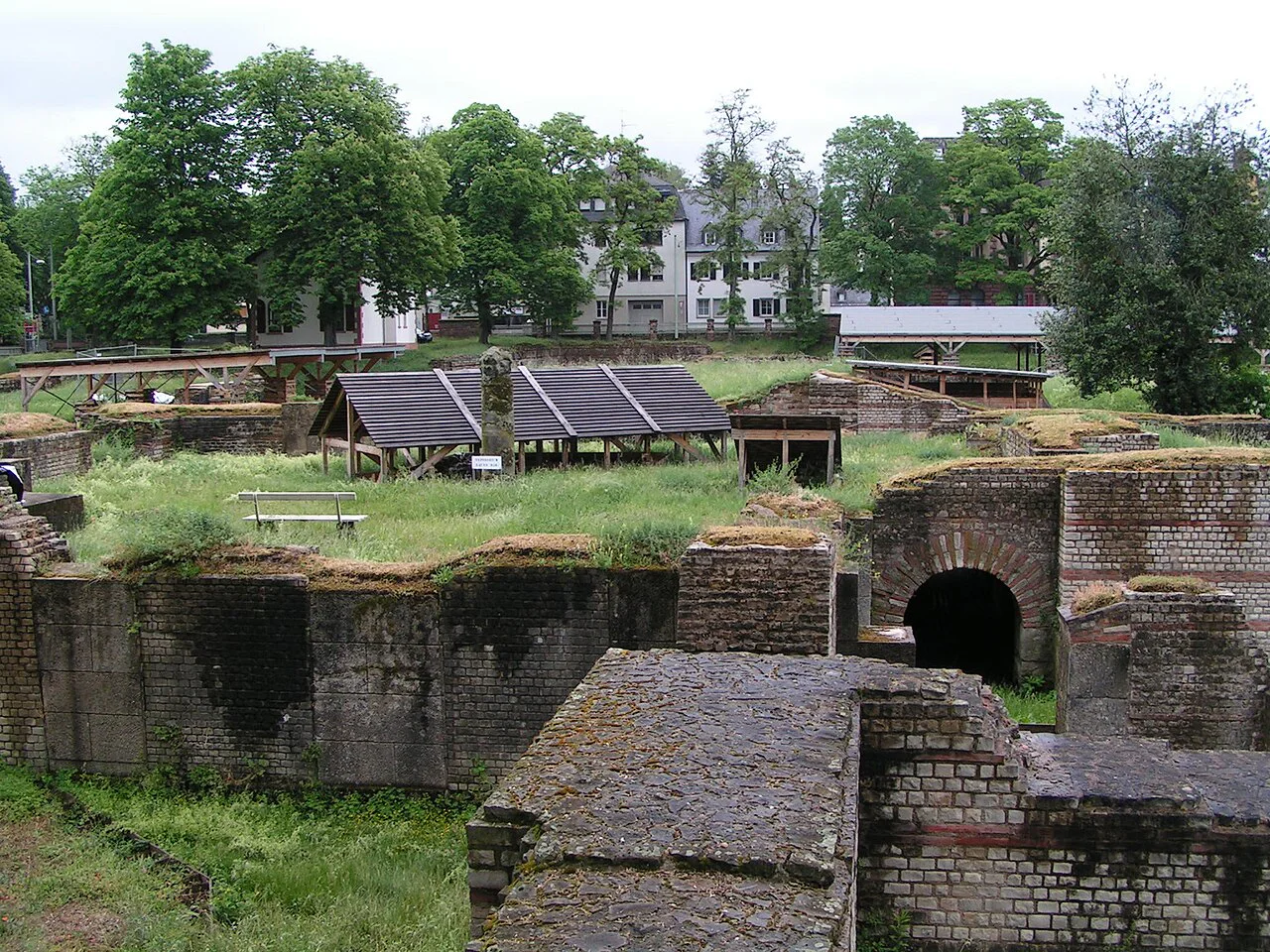
Trier · 1 km
Barbarathermen
Content & sources
Photo: Stefan Kühn · CC BY-SA 3.0