Stanza · Audio guide
Konstantinbasilika Audio Guide
A place to remember. A story to take with you.
The Aula Palatina is a Roman palace basilica located in Trier, Germany. It is an early Christian structure built between AD 300 and 310 during the reigns of Constantius Chlorus and Constantine the Great.
Download Stanza, then search for “Konstantinbasilika”.
About the tour
One guide. Your kind of visit.
The Aula Palatina is a Roman palace basilica located in Trier, Germany. It is an early Christian structure built between AD 300 and 310 during the reigns of Constantius Chlorus and Constantine the Great.
Ready when you are.
- 01Get the free Stanza app.
iOS & Android
- 02Find your guide.
“Konstantinbasilika”
- 03Download before you go.
Works offline
Audio guide / 9 narrated stops
Inside the guide
Get to know a few of the stories before you go. Open a stop to read more.
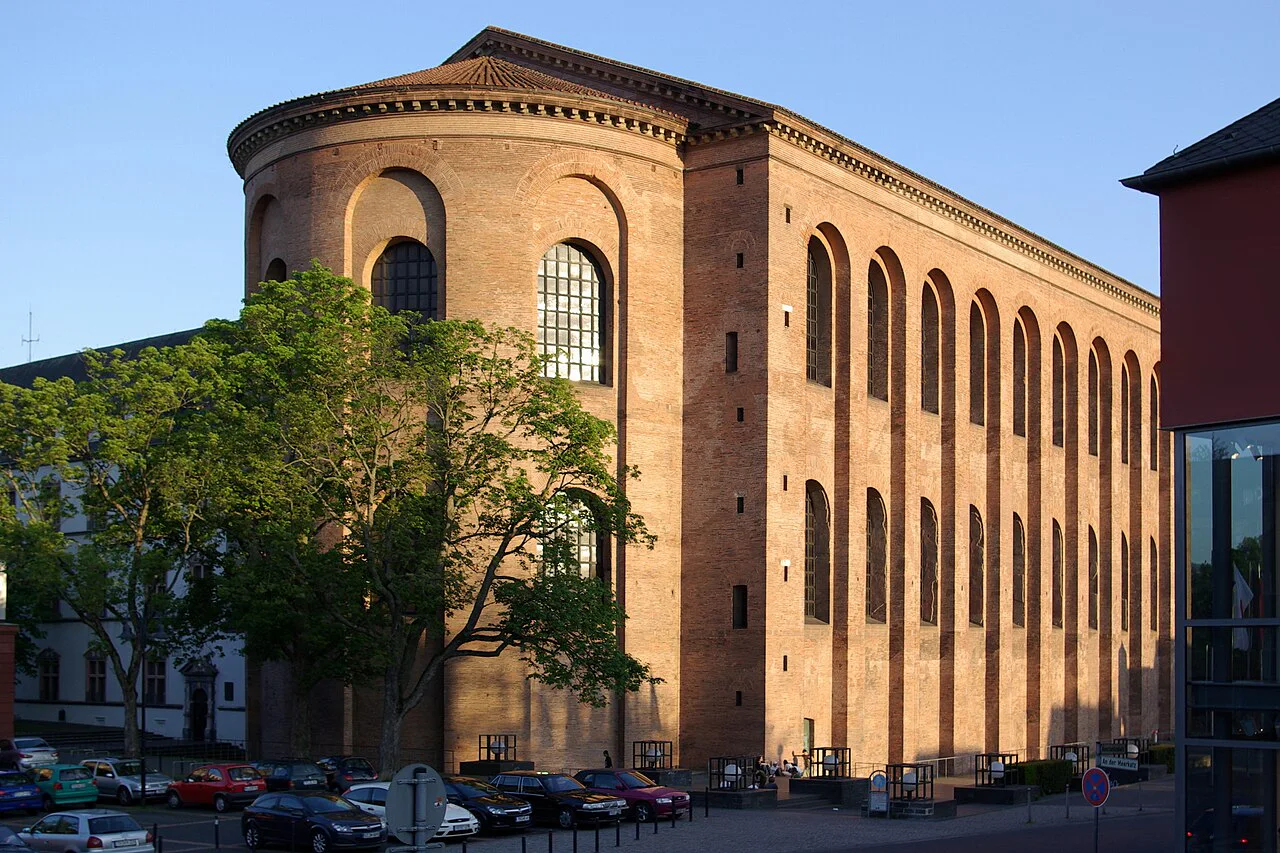
01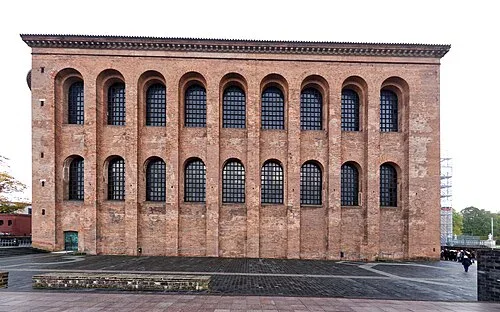 Martin-Luther-Platz & Roman Exterior
The Basilica from Martin-Luther-Platz
Welcome to the Konstantinbasilika in Trier, one of the most remarkable Roman buildings anywhere north of the Alps. Work began around the year 300 and finished about a decade later, under Constantius Chlorus and then his son Constantine the Great. It was never meant to be a church, despite the name. This was an imperial audience hall, the stage on which an emperor received envoys and held court. The scale alone tells you that. The building stretches roughly seventy meters along this side, and its brick walls are nearly three meters thick. Rows of tall arched windows climb the facade, letting light into one enormous room. Since 1986 it has belonged to Trier's UNESCO World Heritage site, and today it serves the Protestant Church of the Redeemer. This tour follows the building through all its lives, from imperial throne room to fortress, palace wing, and church.
Photo: Holger Uwe Schmitt · CC BY-SA 4.0
02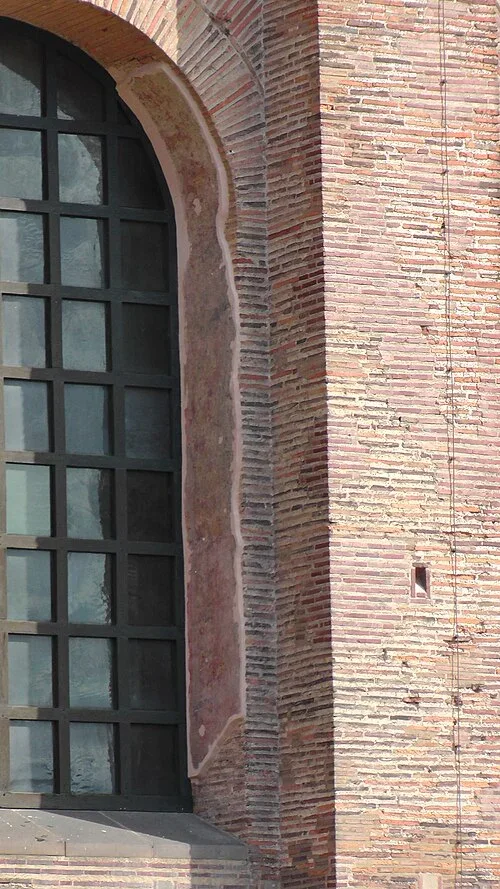 Martin-Luther-Platz & Roman Exterior
Traces of Roman Plaster
Here is a detail that changes how the whole building reads. The Romans never intended these walls to show bare brick. They rendered the exterior with plaster, smooth and probably painted, the way a modern wall gets a finish coat. Traces of that original rendering still survive, and patches of it cling to the brickwork around this window arch, pale against the red masonry. Once you notice them, you can spot more along the facade. So the raw, rugged brick look we associate with the building is really a product of loss, not of Roman taste. One caution as you study the walls: some of the red sandstone elements on the exterior are modern additions, not ancient fabric.
Helge Klaus Rieder · CC BY-SA 3.0
03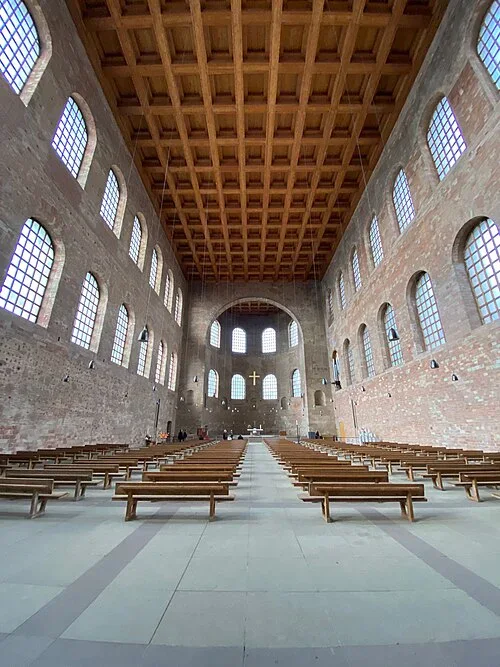 The Great Imperial Hall & Coffered Ceiling
Inside the Imperial Audience Hall
Step inside, in person or in your mind, and the purpose becomes obvious. This was the Aula Regia, the great hall of the imperial residence at Augusta Treverorum, the Roman city that became Trier. Emperors resided here in the early fourth century. There are no columns inside, no aisles, no divisions. Just one box-like volume of air, about sixty-seven meters long and thirty-three meters high, with roughly sixteen hundred square meters of unbroken floor. That makes it the largest surviving hall from classical antiquity. It was never a free-standing building either. A forehall, a vestibule, and various service buildings were attached to it as part of a larger palace complex. The name Basilika comes from a nineteenth-century local scholar, Johannes Steiner, who took it from an ancient speech in praise of Constantine. Strictly speaking it fits poorly, since the building is really a hall, and Palastaula, palace hall, describes it better.
Listen in the appPhoto: Chris 73 · CC BY-SA 3.0
04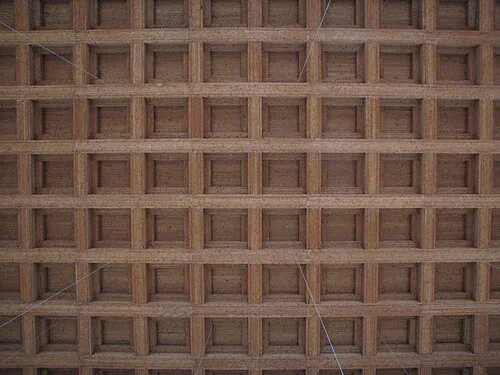 The Great Imperial Hall & Coffered Ceiling
Coffer'd Ceiling over Roman Luxury
Nothing about this room today looks luxurious, but the Roman original was a different world. In Roman times the floors were of black-and-white marble. The walls carried a hypocaust, the same floor and wall heating system used in Roman baths, so the hall stayed warm even in a Trier winter. In antiquity the space rose about thirty meters to the top of its walls. The coffered ceiling overhead belongs to our own era. It is made of spruce planks, each coffer about a meter deep, and it hangs from a concrete structure installed in the 1950s. Its grid of recessed squares probably echoes what Roman craftsmen once built here, in wood, to close off that enormous height. So while the ceiling is original in spirit, it is a modern answer to an ancient effect.
Listen in the appPhoto: Chris 73 · CC BY-SA 3.0
05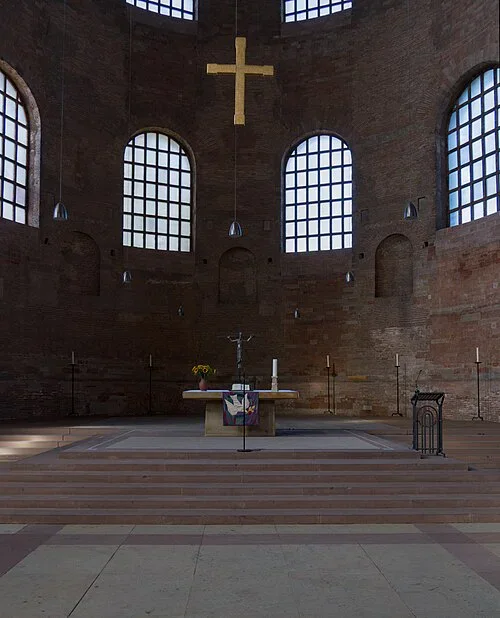 The Northern Apse & Imperial Throne
The Apse: Stage of the Emperor
At the north end, the hall gathers itself into a great semicircular apse, and this was the point of the whole building. Researchers assume the imperial throne stood here, raised and canopied, with the emperor seated in full regalia. Anyone granted an audience would advance down sixty-some meters of polished marble, dwarfed by the height around them, toward the seated figure waiting in the half-dome. Roman palace halls routinely used architecture this way, as a stage set for the ruler, and this apse is one of the strongest surviving expressions of the idea. The platform is still elevated, and it still holds the focus of the room. But the occupant has changed: the altar now stands where the throne once stood, and worship has taken over the emperor's old stage.
Listen in the appPhoto: Polibil · CC BY-SA 4.0
06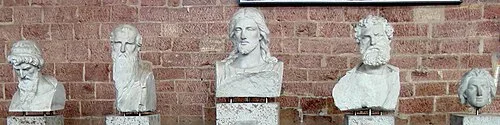 The Salvaged Evangelists of the East Wall
The Charred Evangelists and the Naked Brick Decision
On the fourteenth of August 1944, an American air raid set the basilica alight. Roughly a hundred incendiary bombs struck the building, and fire crews could not fight flames so far up, on a roof thirty-three meters above the ground. The interior burned out completely. In the 1870s and 1880s, the Frankfurt sculptor Gustav Kaupert had created five over-life-size marble figures for the church, Christ and the Evangelists. The flames did not destroy them, but the rebuilding did. When the architect Heinrich Otto Vogel rebuilt the hall in the 1950s, he made a deliberate choice. The old window divisions were removed, the surviving furnishings stripped away, the marble figures largely destroyed, and the Roman masonry left bare inside and out. Only the heads of Kaupert's figures were saved. They were restored in 2001 and set out along the east wall in 2006, which is where they stand now, survivors against raw brick. That decision is why the room looks the way it does.
Listen in the appHelge Klaus Rieder · CC BY-SA 3.0
07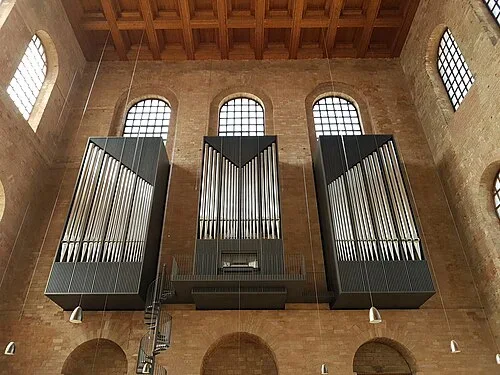 The Symphonic Eule Organ
The Symphonic Organ of 2014
Music fills this hall again, on a scale the Romans could never have imagined. In 2014 the organ-building firm Eule of Bautzen consecrated a new main organ here, hung high on the south wall. It is a symphonic instrument, with eighty-seven registers and more than six thousand pipes, spread across four manuals and pedal. That makes it the largest organ in Trier. Its pipes sit in three separate cases, each one fitted into one of the great window niches of the Roman wall, so the ancient architecture carries the music. Two identical consoles control it, and one of them is mobile, wheeled into the hall for concerts. Congregations still sing here week by week, in a tradition of church music that has run in this building since the eighteen-fifties.
Listen in the appPhoto: Kleon3 · CC BY-SA 4.0
08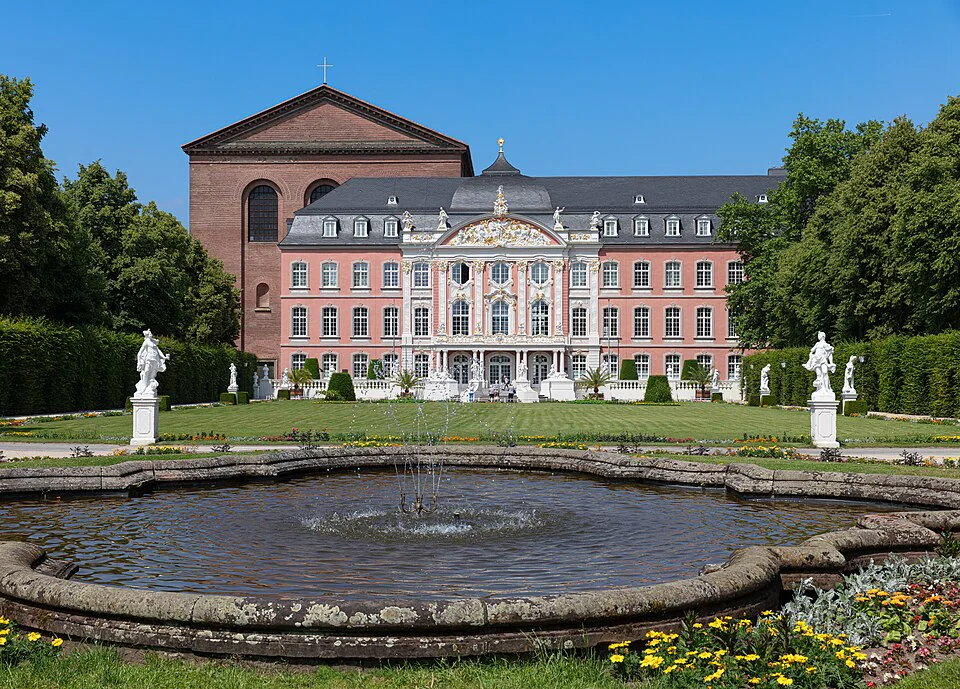 Electoral Palace Junction & Palastgarten
Fortress of the Bishops, Wing of a Palace
After Rome fell, the hall burned and passed to the bishops of Trier, who rebuilt it as a fortified residence. The apse became a kind of dwelling tower, and pinnacles crowned the old Roman walls. Those walls proved their worth in the summer of 1008. Emperor Henry II tried to install his own candidate as bishop, but the anti-bishop Adalbero of Luxembourg held out inside the fortress. Henry captured the city, yet even a sixteen-week siege that the emperor directed in person could not force a surrender. The building's second great transformation came in 1614, under Elector Lothar von Metternich. He had the south and east walls torn down and absorbed the remainder into his new residence, the Electoral Palace. The Roman hall became the west wing of a baroque palace, its brick bulk rising behind the elegant facades.
Listen in the appPhoto: Optimi4 · CC BY 4.0
09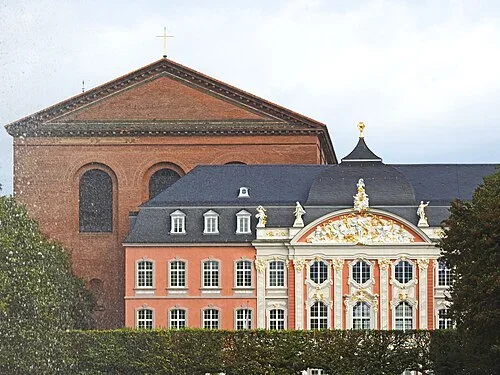 Electoral Palace Junction & Palastgarten
Rescue, Rebirth and a Gift in Perpetuity
By the nineteenth century the old hall had become a tangled appendage of the palace, and its future was uncertain. Then a scholarly error changed everything. The researchers Johann Steininger and Christian Wilhelm Schmidt promoted the idea that Constantine had built this as a Christian basilica, an early imperial church. That was wrong, but it caught the imagination of King Frederick William IV of Prussia, who had a passion for early Christian buildings and paid for the restoration. Between 1844 and 1856, the architect Carl Schnitzler, with Friedrich August Stüler designing the new interior, stripped away the medieval and baroque additions and brought the Roman hall back into view. On the twenty-eighth of September 1856, the building was consecrated and handed over to Trier's Protestant congregation for all time. It remains the oldest building in use as a church in Germany. A throne room, a fortress, a palace wing, and now a church: seventeen centuries of use, and the hall has carried them all.
Listen in the appPhoto: Optimi4 · CC BY 4.0
Konstantinbasilika
Frequently asked questions
How much does the guide cost?
Free app download. Listed guide price: $0.99. Guide price shown in the app. Audio guide only. Venue admission is separate.
Can I listen without internet?
Yes. Download the guide’s audio, images, and maps in the app before your visit. Your downloaded content is then available offline.
Can I listen in my language?
This audio guide is available in 15 languages, including English.
Do I need to follow a schedule?
No. This is a self-guided experience. Choose your stops, pause whenever you like, and return to a story at your own pace.
At your own pace
Explore Konstantinbasilika.
Download Stanza, then search for “Konstantinbasilika”.
Free app download · Guide price shown in the app
Keep exploring
Nearby audio guides
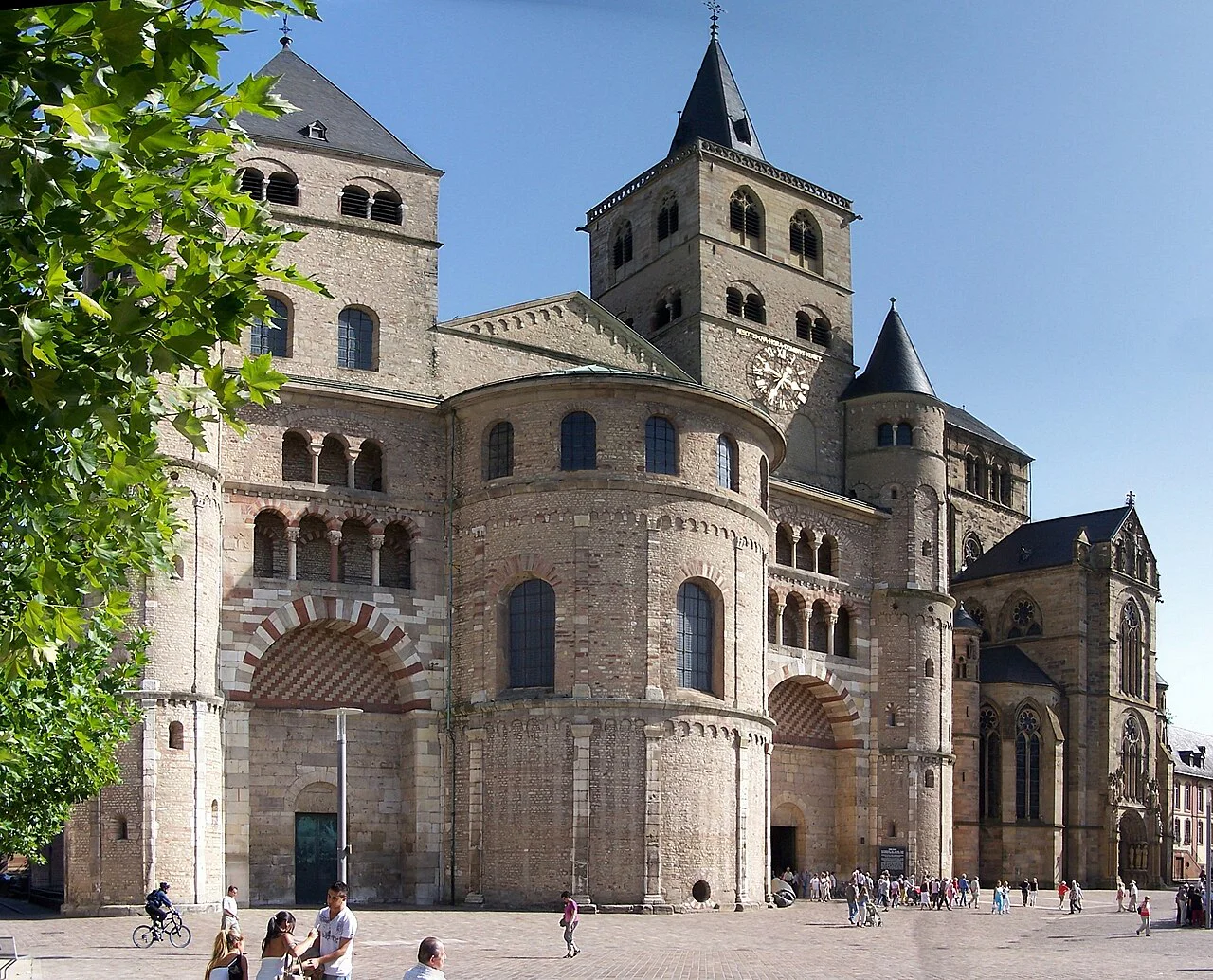
Trier · 1 km
Trierer Dom
Content & sources
Photo: Berthold Werner · CC BY-SA 3.0
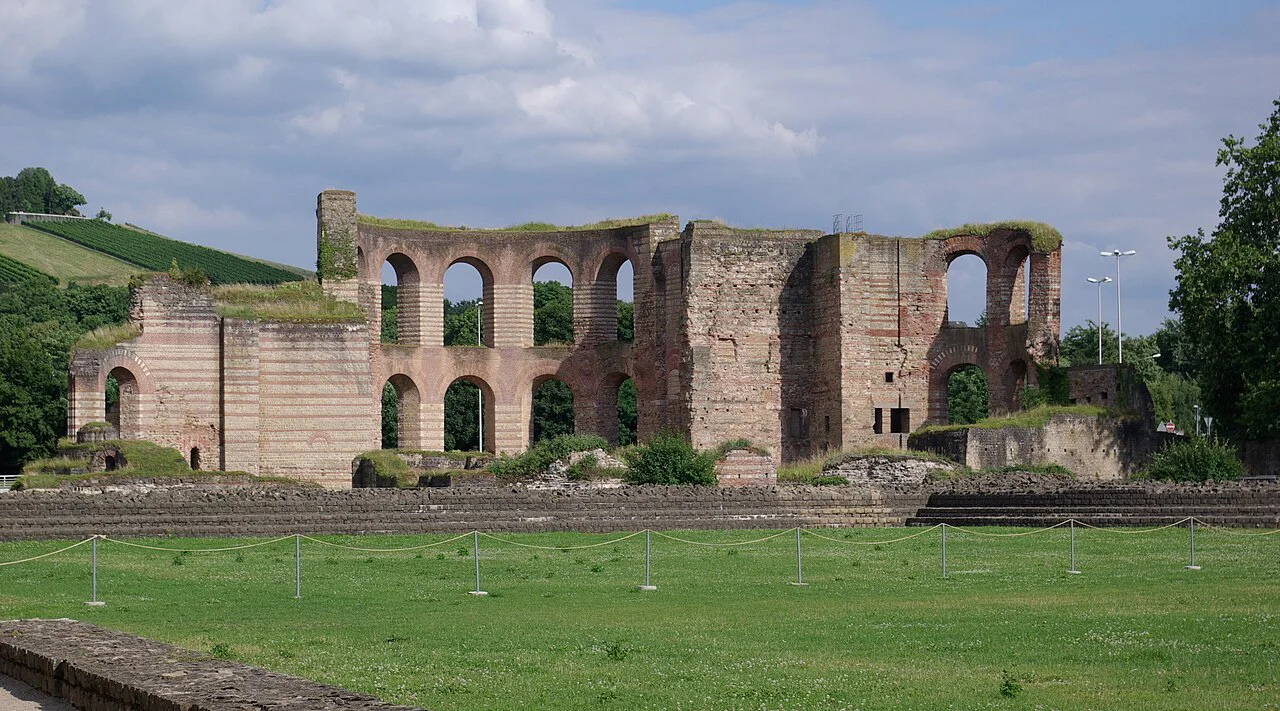
Trier · 1 km
Kaiserthermen
Content & sources
Photo: Berthold Werner · Public domain
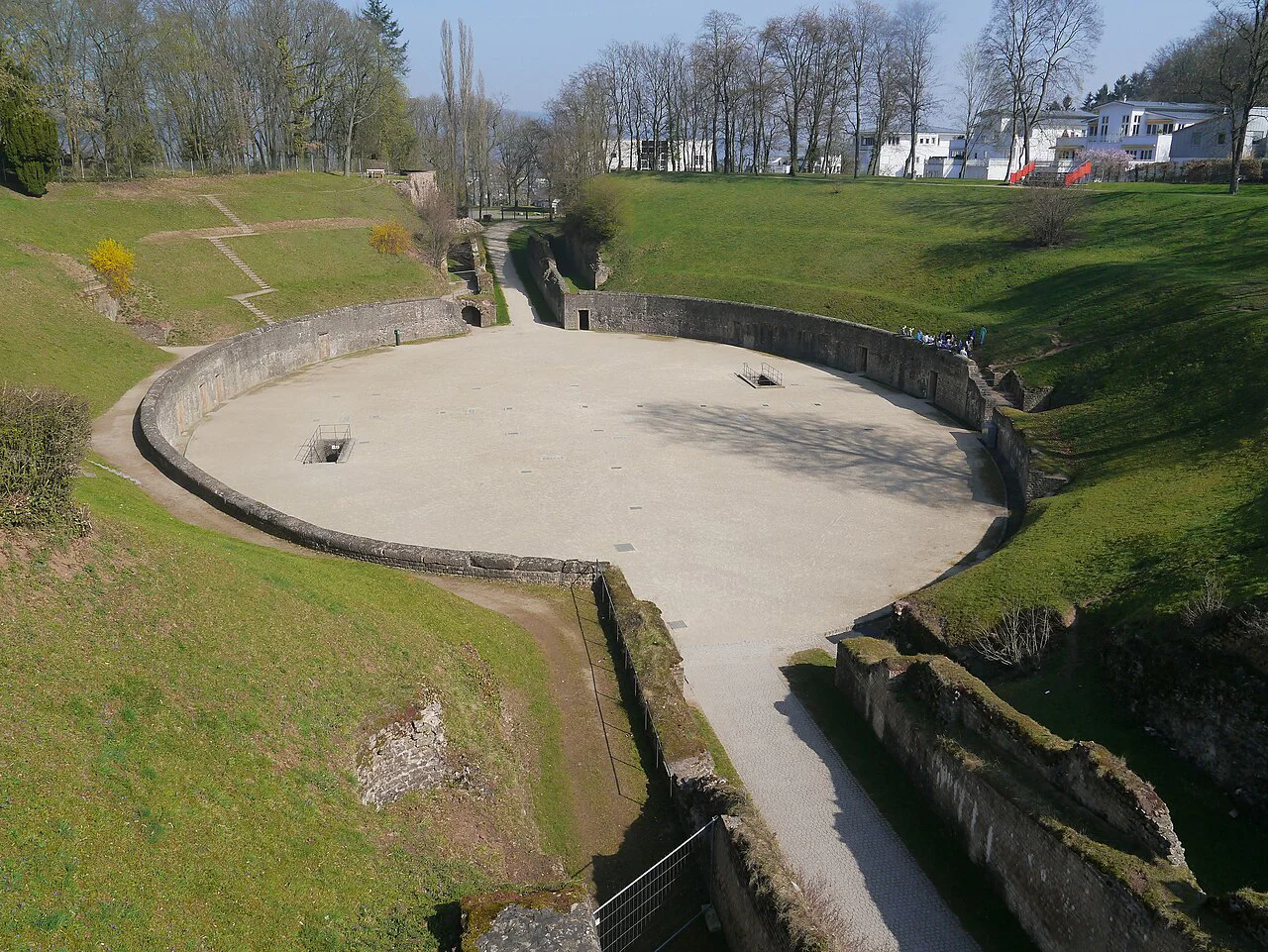
Trier · 1 km
Amphitheater
Content & sources
Photo: Zairon · CC BY-SA 3.0
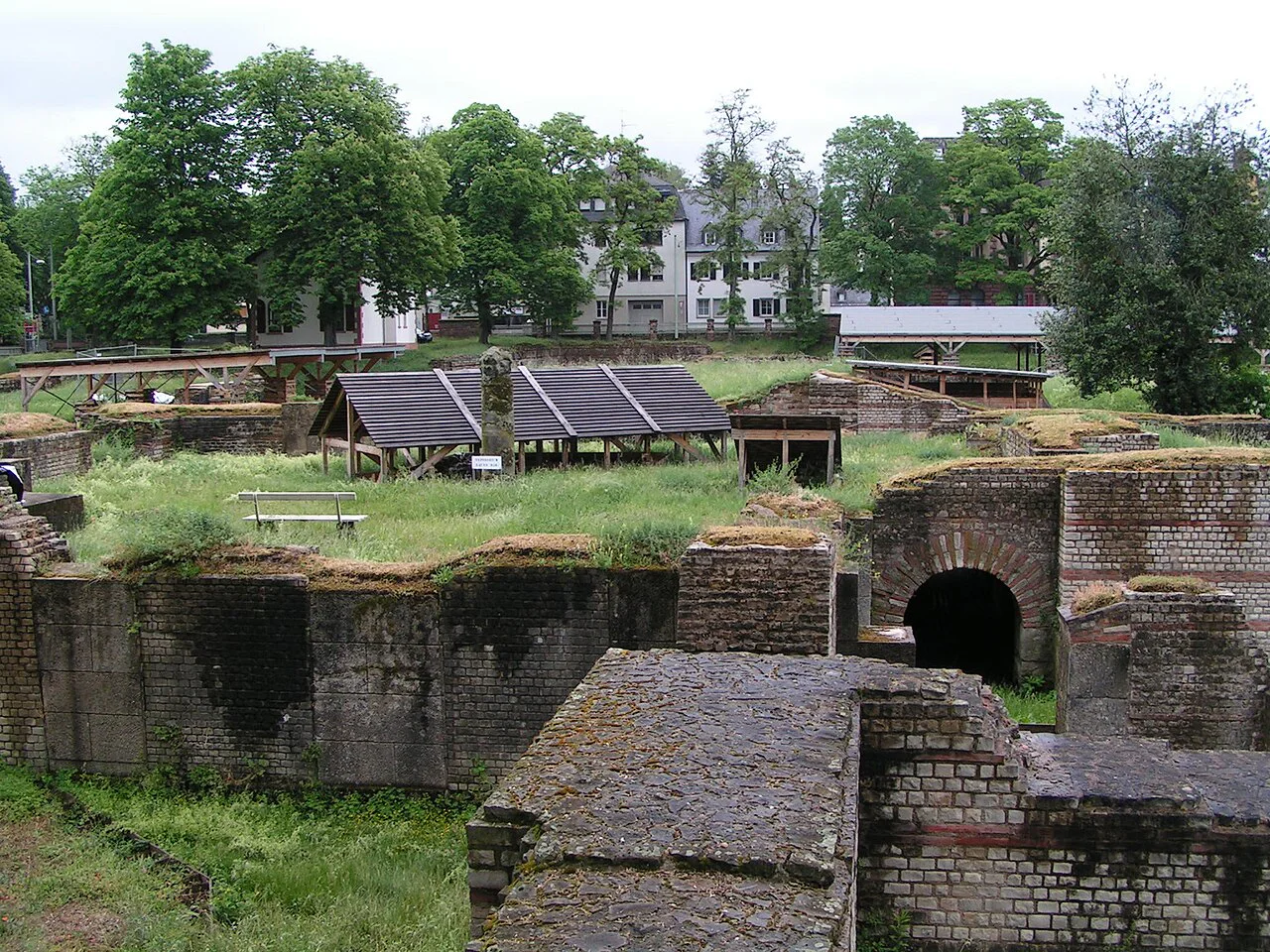
Trier · 1 km
Barbarathermen
Content & sources
Photo: Stefan Kühn · CC BY-SA 3.0