Languages
15Knossos Audio Guide
Knossos is an archaeological site in Heraklion Municipal Unit, Greece. Explore it with Stanza's guided offline audio tour — narrated in 15 languages.
Quick Facts
32
Stops
15
Languages
100%
Offline
📍 Heraklion Municipal Unit, Greece · 35.2980°N, 25.1632°E
About Knossos
Knossos is an ancient Minoan through Roman administrative center and city on the island of Crete. It is renowned as a major organized archaeological site and tourist attraction.
This self-guided audio tour features 32 narrated stops organized across 7 sections. As a archaeological site, Knossos offers a unique cultural experience in the heart of Heraklion Municipal Unit, Greece.
The Stanza audio guide is available in 15 languages and works entirely offline — download the complete tour including audio narration, maps, and images before your visit. As you walk through Knossos, GPS-triggered narration plays automatically at each point of interest.
Last updated:
What you will hear
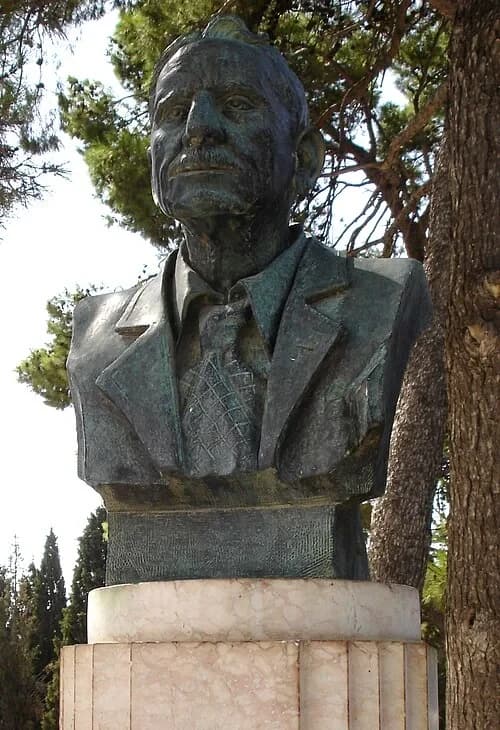
Bust of Arthur Evans
A tribute to the British archaeologist who dedicated his life and fortune to excavating and controversially reconstructing Knossos.
Bust of Arthur Evans
Arthur Evans was the man who 'found' Knossos, though he was not the first to excavate here. Starting in 1900, he spent a significant portion of his personal fortune to purchase the site and fund decades of excavation work. As you look at the ruins around you, you are seeing Evans’ specific interpretation of the past. He made the bold decision to use reinforced concrete to rebuild parts of the palace. This was done to preserve the site's verticality and prevent the fragile ruins from collapsing further under their own weight. However, this move horrified many purists who felt he overstepped the bounds of archaeology, essentially creating a reimagined version of the ancient world. Some critics argue his work reflects early 20th-century aesthetic preferences more than Minoan reality. Regardless of the debate, his efforts ensured that Knossos remains a tangible, three-dimensional experience today. Without his intervention, the palace might have remained a series of flat stone foundations. His legacy is etched into every concrete beam and painted column you encounter on this site.
South Propylaeum
A grand ceremonial gateway featuring the famous 'Prince of the Lilies' and 'Procession' frescoes.
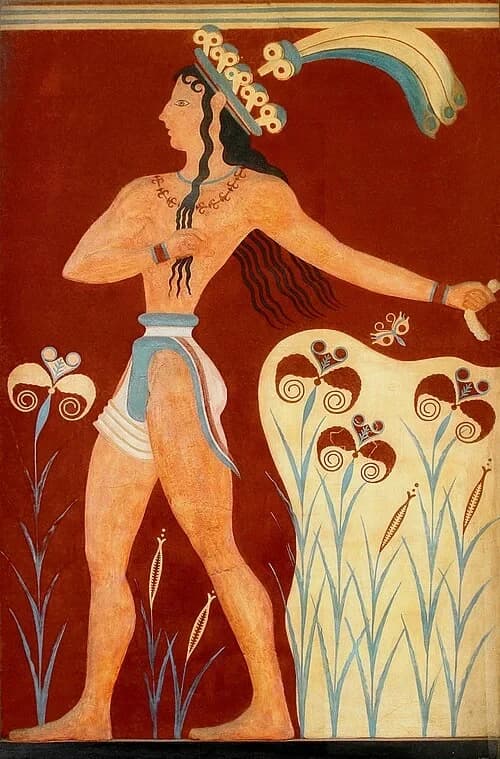
The Prince of the Lilies
The figure before you is a centerpiece of Minoan art, but what you see is largely a modern reconstruction. When Arthur Evans' team excavated the palace, they found only a few small, disconnected fragments of painted plaster in this area. To create this complete 'heroic' figure, the team combined those fragments—a crown, a torso, and a leg—from different spots. Many modern archaeologists are skeptical of this assembly, believing these pieces may have actually belonged to three entirely different people: perhaps a priest, a boxer, and a king. This composite creation reflects the desire of early excavators to find a single, powerful 'ruler' figure within the ruins. Despite the controversy over its accuracy, the image captures several Minoan ideals, such as the elaborate lily crown and the athletic physique. The background is filled with stylized lilies and butterflies, common motifs in their nature-oriented art. It stands as a reminder that our understanding of the ancient world is often filtered through the interpretations and reconstructions of the people who first uncovered it.
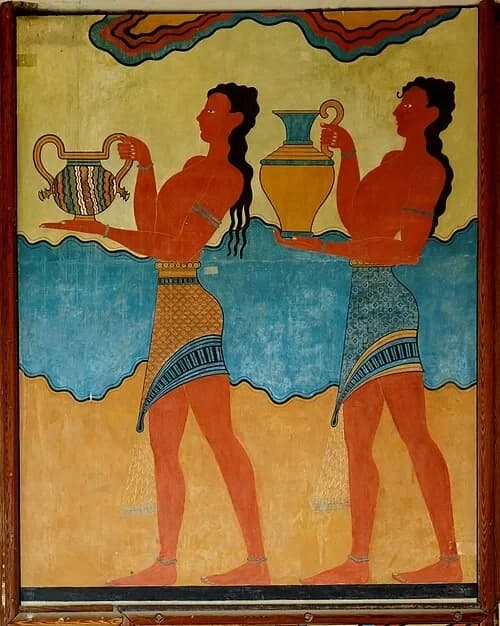
The Cup Bearers
Examine the physical forms of these participants. The extremely narrow 'wasp-waists' are a hallmark of Minoan artistic ideals, emphasizing a lithe, athletic grace. This fresco depicts a formal ritual procession, with figures carefully carrying silver and gold vessels, likely intended for libations or palace banquets. Every detail, from the elaborate jewelry around their necks and wrists to the intricately embroidered kilts, signals the high social status of these individuals. They were likely high-ranking members of the court participating in a sacred or official palace ceremony rather than simple servants. The vibrant colors and steady profile view reflect a style that shares similarities with contemporary Egyptian art, yet remains uniquely Cretan in its execution. By painting these processions directly onto the walls of the palace's corridors, the Minoans created a permanent, visual record of the ceremonies that once filled these spaces. You are seeing a snapshot of the luxury and ritualized life that defined the height of the Minoan civilization before its sudden decline.
Central Court
The vast open heart of the palace, used for major social gatherings and possibly the legendary bull-leaping rituals.
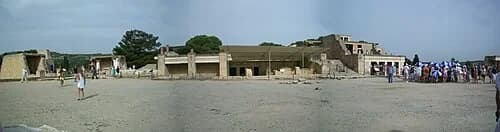
Central Court
Spanning approximately 50 meters in length, this courtyard is the central hub of the entire site. Almost every major room and corridor in the palace opens onto this open-air space. Because of its central location, many archaeologists believe it was the primary stage for public spectacles, including the legendary bull-leaping rituals depicted in Minoan art. Athletes would have faced charging bulls here, performing acrobatic feats for the assembled court. One of the most striking things about this palace is the total lack of defensive walls. Unlike the fortified citadels of mainland Greece, Knossos is open and exposed. This suggests that the Minoans felt secure, likely because of their dominant navy. Historians refer to this as a 'Thalassocracy,' or sea empire. Their power was not based on stone walls, but on their control of the Mediterranean trade routes. This courtyard, therefore, represents a civilization at its peak—wealthy, confident, and deeply focused on internal ritual and administrative life rather than defense against invaders.
Labyrinth of Knossos
The complex, multi-story layout of the palace likely inspired the Greek myth of the Minotaur's Labyrinth.
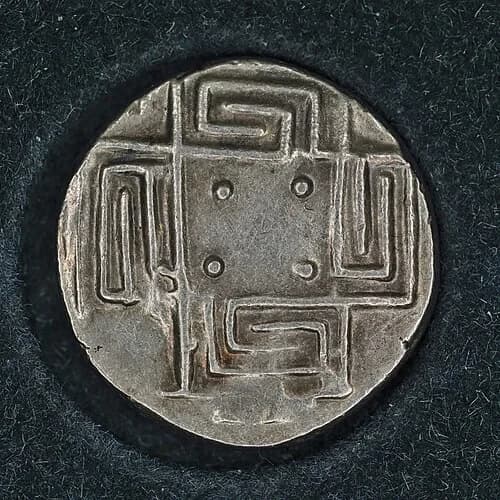
The Silver Labyrinth Coin
This artifact was created in Knossos long after the original Minoan civilization had vanished. The presence of the maze-like pattern on the coin's surface is a fascinating piece of evidence. It shows that the stories of a great labyrinth and the monstrous Minotaur remained a central part of the local identity for centuries. To a Greek visitor arriving in 500 BC, the sprawling, multi-story ruins of the ancient palace must have seemed utterly incomprehensible. Without the knowledge of Minoan architectural conventions, the complex ruins would have looked exactly like an impossible, man-made maze. This physical environment likely gave birth to the myth of King Minos and his hidden Labyrinth. The coin served as a portable reminder of this local legend, which had become famous throughout the entire Greek world. It demonstrates how historical reality can be transformed over time into mythology, with the crumbling walls of a sophisticated administrative center becoming the setting for a story of heroes and monsters that continues to capture imaginations.
North Lustral Basin
A sunken chamber used for ritual purification before entering the more sacred areas of the palace.
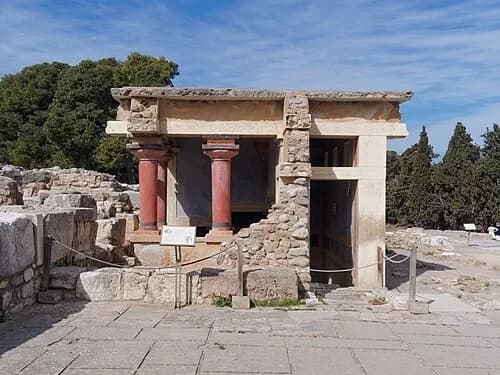
North Lustral Basin
As visitors approached from the harbor, this was one of the first significant structures they would encounter. Lined with gypsum and alabaster, this lustral basin functioned as a ritual 'cleansing station.' Before being allowed into the sacred or administrative heart of the palace, individuals likely underwent a purification ceremony here. Notice the specific design of the steps, which turn at a sharp 90-degree angle. This is what architects call a 'bent-axis' approach. It was a common Minoan technique used to create a sense of mystery and transition between spaces. By forcing a change in direction, the architecture signaled that the visitor was leaving the mundane world and entering a sacred, high-status area. The use of fine, reflective stone for the basin's interior would have enhanced the solemnity of the ritual. This basin is a testament to the Minoan obsession with ritual order; even the act of entering the building was a structured, religious experience. It ensured that everyone who passed through the north gate was spiritually prepared for their time within.
North Entrance
The main portico for visitors arriving from the sea, famous for the reconstructed charging bull relief.
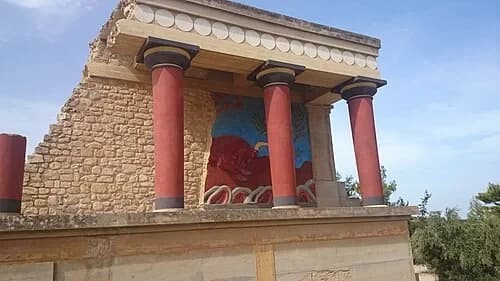
North Entrance
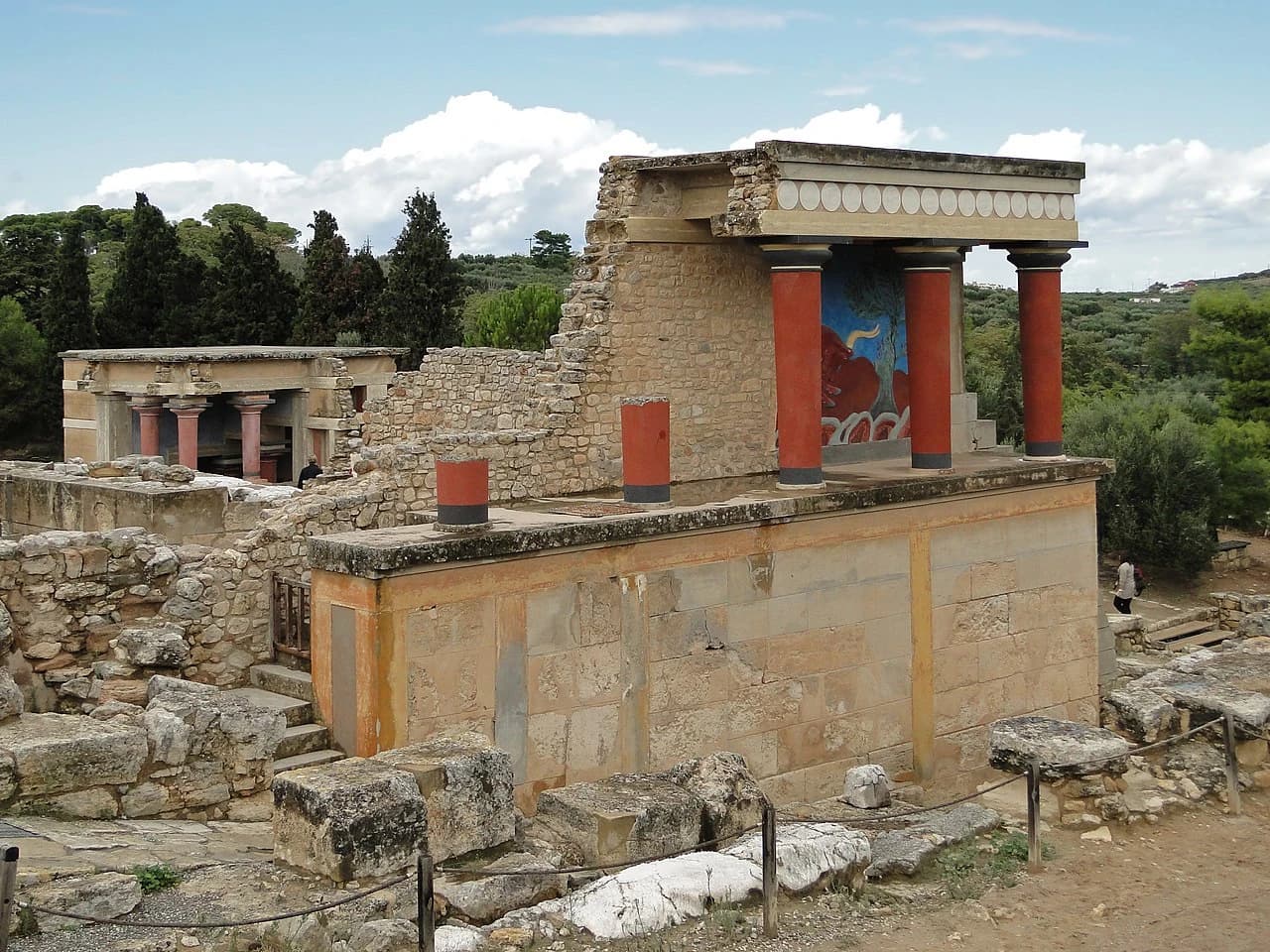
This is one of the most recognizable views in Knossos, standing prominently over the main ancient road that led from the sea. What you see today is a concrete reconstruction from the 1930s, based on the findings of Arthur Evans. He chose to rebuild this portico to demonstrate the likely appearance of the palace to someone approaching from the harbor. The vibrant red columns and the famous relief of a charging bull were placed here to recreate the original visual impact of the entrance. This gateway was designed to be seen from a distance, acting as a massive billboard for the power and religious identity of the Minoans. The bull was their most sacred animal, and its image here served as a symbol of strength and protection. While the materials used for the reconstruction are modern concrete, the work follows the footprints of the original stone foundations. It provides a rare opportunity to see the palace in three dimensions, helping visitors grasp the scale and decorative ambition of the Minoan world.
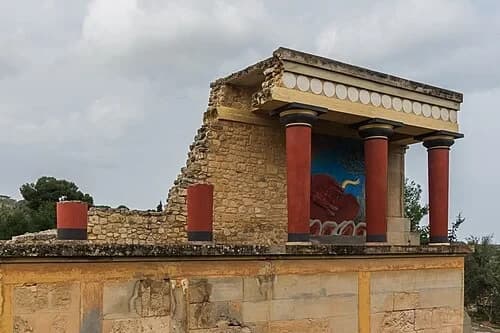
Relief of the Charging Bull
As you look at this vibrant scene, you'll see it is more than a simple flat painting. This is a plaster relief, a technique where the bull's muscular body is built up from the wall to create a physical, three-dimensional effect. The bull was far more than livestock to the Minoans; it was a powerful symbol of strength, fertility, and divinity. This specific animal was the centerpiece of the famous and perilous bull-leaping games. In these spectacular events, young athletes would wait for a bull to charge before grabbing its horns and somersaulting over its back. This relief served as a constant reminder of these displays of bravery and skill that took place within the palace grounds. Artists captured the animal's explosive energy through its tensed muscles and forward-leaning posture. This artwork provides a direct link to the athletic traditions that once pulsated through the heart of the palace thousands of years ago, marking it as one of the most significant symbolic motifs of the entire civilization.
Grand Staircase
An architectural masterpiece of the ancient world, using light wells to illuminate four levels of royal apartments.
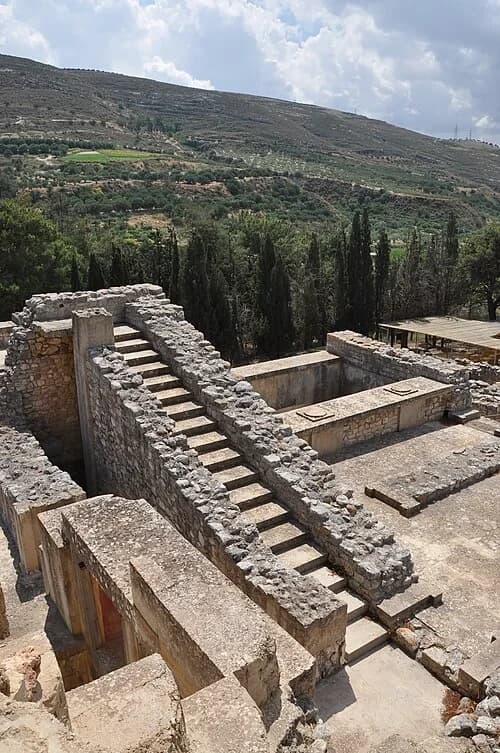
Engineering the Staircase
The construction of this massive staircase reveals a mastery of seismic engineering. Unlike many other ancient civilizations, the Minoans didn't rely on mortar to hold their stones together. Instead, they used large, precision-cut blocks reinforced with a framework of wooden beams. This design provided a crucial level of flexibility, allowing the structure to sway and absorb the shock of an earthquake rather than cracking and collapsing. It is this specific innovation that has allowed sections of the staircase to endure for over 3,500 years in one of the world's most seismically active regions. When Sir Arthur Evans excavated the site in the early 20th century, he introduced massive steel girders to ensure the original ancient stones remained securely in place. You can see where the original masonry meets these modern interventions. This blend of ancient ingenuity and early 20th-century conservation work preserves the structural integrity of the palace's heart, illustrating the long history of human efforts to build lasting structures against the forces of nature.
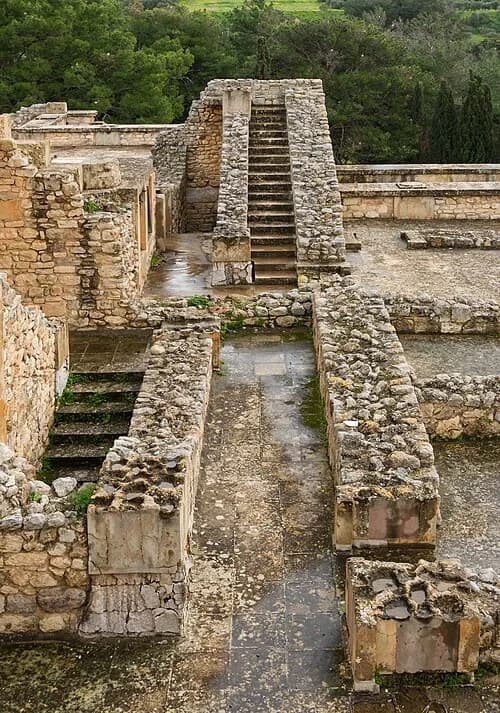
Steps of the Royals
Examine the unique proportions of these steps; they are notably wide and shallow compared to modern stairs. This wasn't an accident of design. These stairs were built specifically to accommodate slow, dignified royal processions rather than quick, everyday movement. Walking here was meant to be a deliberate and grand act, fitting for the rulers of a vast sea empire. Beyond their ceremonial function, the steps also showcase the Minoans' remarkable attention to water management. If you look closely, you’ll see each step has a slight, deliberate incline. This subtle slope allowed rainwater to run off efficiently, preventing puddles from forming even in the most protected parts of the building. This obsession with drainage is a recurring theme throughout Knossos. Even here, in the heart of the royal living quarters, the engineers ensured that water was channeled away with precision. This focus on sanitation and maintenance helped the palace function as a clean, habitable environment for the thousands of residents who once called this complex home.
Want to hear the rest?
Download the Stanza app to unlock all 32 stops and the complete guided audio tour.
Frequently Asked Questions
How long does the Knossos audio tour take?
The Knossos audio guide includes 32 narrated stops. Most visitors spend 45 minutes to 1.5 hours exploring the complete tour, though you can listen at your own pace and skip or revisit any stop.
Is the Knossos audio guide available in my language?
Stanza supports 15 languages: English, Spanish, French, German, Italian, Portuguese, Russian, Japanese, Chinese, Korean, Arabic, Hindi, Polish, Dutch, Hebrew. Check the guide in the app to confirm the languages currently available for this tour.
Can I use the audio guide offline at Knossos?
Yes! Download the complete Knossos tour — including all audio, maps, and images — before your visit. The Stanza app works completely offline, so you don't need WiFi or mobile data at the venue.
How much does the Knossos audio guide cost?
The Stanza app is free to download. The current listed price for the Knossos audio guide is $5.99; app-store region and currency may affect the final price.
How do I use the Stanza audio guide at Knossos?
Download the free Stanza app, search for "Knossos", and download the tour. When you arrive at the venue, the app uses GPS to detect your location and automatically plays the relevant narration as you move between points of interest — completely hands-free.
What makes the Stanza audio guide different from other Knossos tours?
Stanza offers GPS-triggered narration that plays automatically as you walk through Knossos — no need to manually select stops. The tour is available in 15 languages, works fully offline, and includes 32 expertly narrated stops with images and historical context.
What other audio guides are available near Knossos?
Stanza offers multiple audio guides in Heraklion Municipal Unit, Greece and nearby areas. After downloading the app, browse the map to discover all available tours near Knossos. Each guide can be downloaded for offline use.