Languages
15Ancient Corinth Audio Guide
Ancient Corinth is an archaeological site in Municipal Unit of Corinth, Greece. Explore it with Stanza's guided offline audio tour — narrated in 15 languages.
Quick Facts
31
Stops
15
Languages
100%
Offline
📍 Municipal Unit of Corinth, Greece · 37.9058°N, 22.8787°E
About Ancient Corinth
Ancient Corinth was a powerful city-state located on the Isthmus of Corinth, serving as a major center of trade and culture in the ancient world. The site features extensive ruins, including the 6th-century BC Temple of Apollo and the Roman-era forum.
This self-guided audio tour features 31 narrated stops organized across 8 sections. As a archaeological site, Ancient Corinth offers a unique cultural experience in the heart of Municipal Unit of Corinth, Greece.
The Stanza audio guide is available in 15 languages and works entirely offline — download the complete tour including audio narration, maps, and images before your visit. As you walk through Ancient Corinth, GPS-triggered narration plays automatically at each point of interest.
Last updated:
What you will hear
Archaeological Museum of Ancient Corinth
The essential starting point to see the artifacts found on-site, including world-famous Corinthian pottery and Roman mosaics.
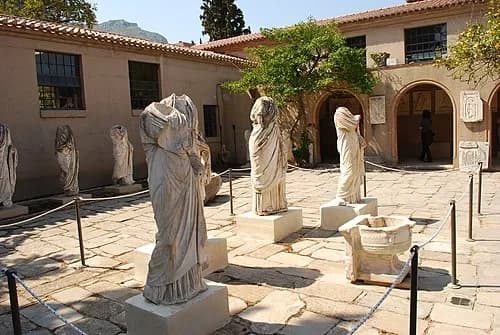
Archaeological Museum of Ancient Corinth
Welcome to the Archaeological Museum of Ancient Corinth, where we begin our journey into the heart of a city that once rivaled Rome in power and wealth. As you look around this courtyard, you may notice something striking: many of the statues are missing their heads. Far from being the result of random vandalism, this was actually a clever and efficient Roman business practice. These figures were effectively the public PR of the ancient world. Workshops mass-produced generic bodies draped in formal togas, ready and waiting in inventory. When a new emperor ascended the throne or a local official was elected, a sculptor would simply carve a specific portrait head and attach it to one of these pre-made bodies. This 'heads for hire' approach allowed leaders to quickly establish a visual presence across the empire. Observe the intricate, heavy folds carved into the togas, designed to convey a sense of dignity, tradition, and eternal authority. While the leaders themselves might only hold office for a single year, their stone likenesses were meant to look permanent and immovable. The smooth surfaces where the necks would join indicate the intentional slots made for these interchangeable portrait heads.
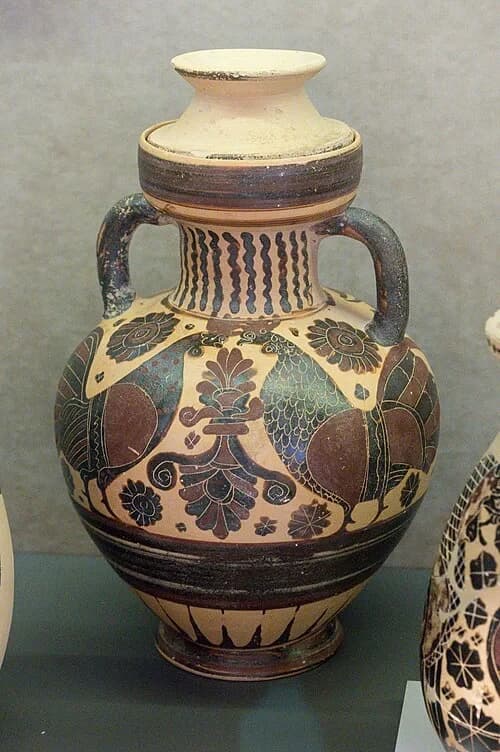
The Perfume Jar
The pottery before you features the distinctive 'black-figure' style that made Corinth a global trade powerhouse in the 7th and 6th centuries BC. Notice the two large roosters facing a central floral motif. This highly detailed, miniaturized style was a Corinthian specialty, long before Athens became the dominant pottery center of the Greek world. These specific jars were more than just decorative; they were the standard packaging for one of the city's most profitable exports: high-end scented oils and perfumes. Corinthian merchants shipped these luxury goods to ports as distant as Italy and Egypt, where they were highly prized by the ancient elite. The dark figures were created by applying a clay slip that turned black during a specific firing process, while the fine details were incised through the slip with a sharp tool to reveal the lighter clay beneath. The small size and narrow neck of the vessel were practical, designed to dispense the expensive oil drop by drop. This jar stands as evidence of the city's early economic dominance and its role as a trendsetter in ancient Mediterranean luxury markets.
Ancient Theatre of Corinth
One of the largest theaters in Greece, it could once seat 18,000 spectators and was later converted into a gladiatorial arena by the Romans.
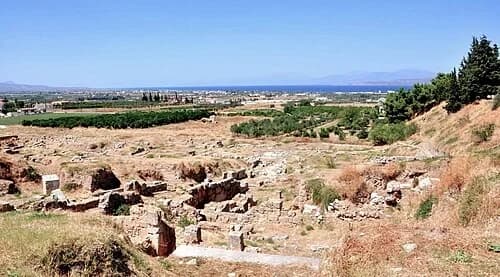
The Theater
The sheer scale of these ruins suggests the immense size of the original Theater of Corinth, which could accommodate roughly 18,000 spectators. Originally built by the Greeks for the performance of classical plays, the theater underwent a dramatic transformation when the Romans took control of the city. To satisfy the Roman appetite for more violent entertainment, the lower rows of seating were removed and a high protective wall was constructed. This allowed the stage area to be safely converted into a gladiatorial arena. Engineers even installed a sophisticated system of waterproof basins and pipes, enabling the floor to be flooded for 'naumachia,' or mock naval battles. This was an incredible technical achievement for the time, turning a place of drama into a multifunctional stadium. As the audience sat in these tiered rows, they would have looked past the performers toward a spectacular view of the sea in the distance. The theater served as a focal point for the city’s public life, evolving over centuries from a venue for Sophocles and Euripides into a place of Roman spectacle and imperial celebration.
West Shops
A row of Roman-era commercial spaces that once bustling with merchants and shoppers at the edge of the forum.
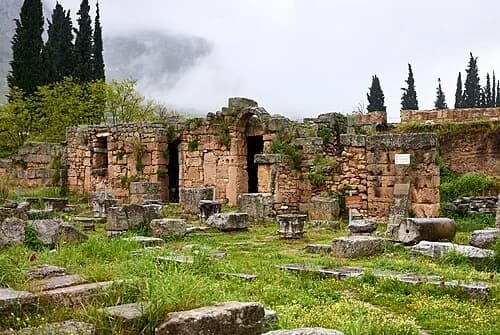
West Shops
The row of stone enclosures you see here served as the premier commercial strip of Roman Corinth. These were the 'West Shops,' a collection of high-end retail spaces that functioned much like a modern luxury mall. Merchants here specialized in expensive, imported goods that were shipped into Corinth’s two busy ports. Shoppers could find fine silks from the East, rare purple dyes, exotic spices, and intricate jewelry. Each shop followed a standard layout: a front room for displaying merchandise to passersby in the forum, and a back room or a wooden loft used for secure storage and administrative work. Because Corinth was a major crossroads of trade between Italy and Asia, this area was constantly packed with travelers and wealthy citizens from across the Mediterranean. The prosperity of these shops was a direct reflection of the city's economic health. Standing in the shadow of the nearby Temple of Apollo, these commercial stalls were at the center of the daily hustle and bustle, where the sounds of bargaining in multiple languages would have filled the air as the city’s elite browsed the latest trends.
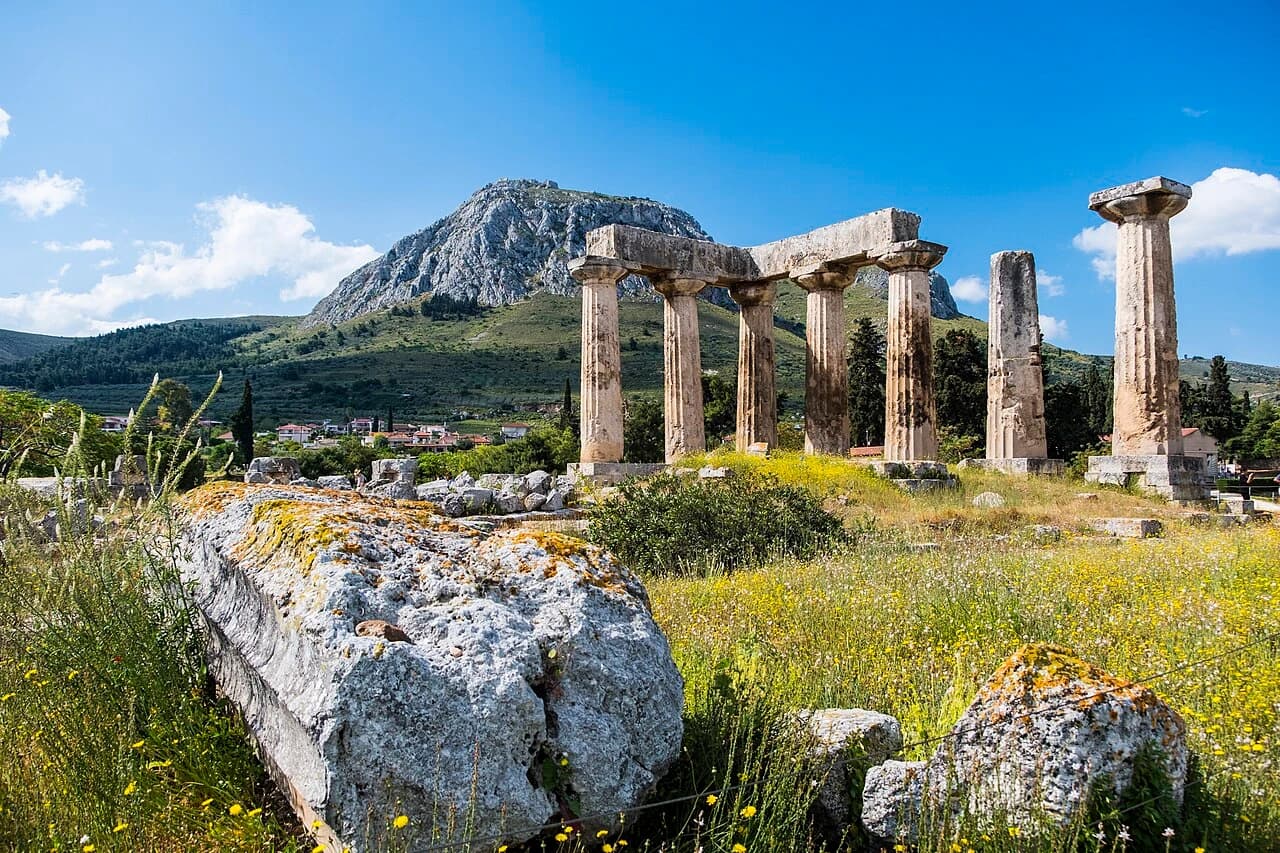
Temple of Apollo
The most iconic landmark of the site, this 6th-century BC Doric temple is one of the few Greek structures that survived the Roman destruction of the city.
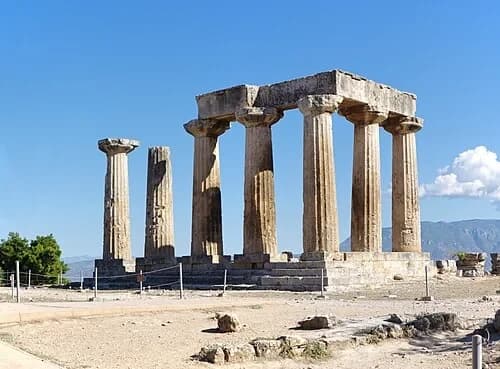
Temple of Apollo
The seven monolithic columns of the Temple of Apollo are among the most iconic sights in Corinth. Dating back to the 6th century BC, this is one of the oldest surviving Doric temples in all of Greece. Its survival is remarkable; in 146 BC, the Roman army completely destroyed and leveled the rest of Corinth to serve as a warning to other rebellious Greek cities. However, the Roman generals ordered that this temple be left untouched because of its extreme age and the respect it commanded. Each of these columns is a 'monolith,' meaning it was carved from a single, massive piece of stone rather than being stacked in drums. This was an immense engineering challenge 2,500 years ago, requiring the transport and uprighting of stones weighing many tons. The rugged, heavy appearance of the pillars is a classic characteristic of the early Doric style. Originally, there would have been 38 columns surrounding the central sanctuary. These seven survivors have stood through earthquakes, wars, and the rise and fall of empires, remaining as a testament to the city’s archaic Greek roots long after it became a Roman capital.
The Bema
The raised orator's platform where the Apostle Paul was brought before the Roman Proconsul Gallio for trial.
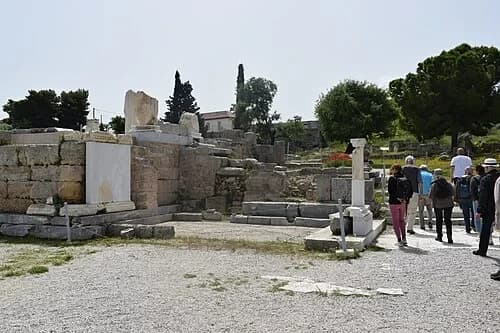
The Bema
Standing in this corner of the vast forum, you are looking at the location where Roman legal authority and early Christianity famously intersected. In 51 AD, this was the site of a public audience held by the Proconsul Gallio. Critics of the Apostle Paul brought him here, accusing him of persuading people to worship God in ways that violated Roman law. Gallio, however, proved indifferent to what he viewed as an internal religious dispute. He famously dismissed the case, refusing to sit in judgment over matters of Jewish law and terminology. This decision allowed Paul to continue his ministry in Corinth for several more months. Today, you can still see the white marble remains that distinguish this area from the rest of the plaza. These stones mark the exact spot where the Roman tribunal once sat elevated above the gathered crowd. The dismissal here was more than a local legal victory; it set a precedent for Roman tolerance toward the burgeoning Christian movement in the region. Look for the distinct patches of white stone that serve as a permanent marker for the location of the Roman tribunal.
Julian Basilica
A grand Roman administrative building that once housed statues of the imperial family, including Augustus and his grandsons.
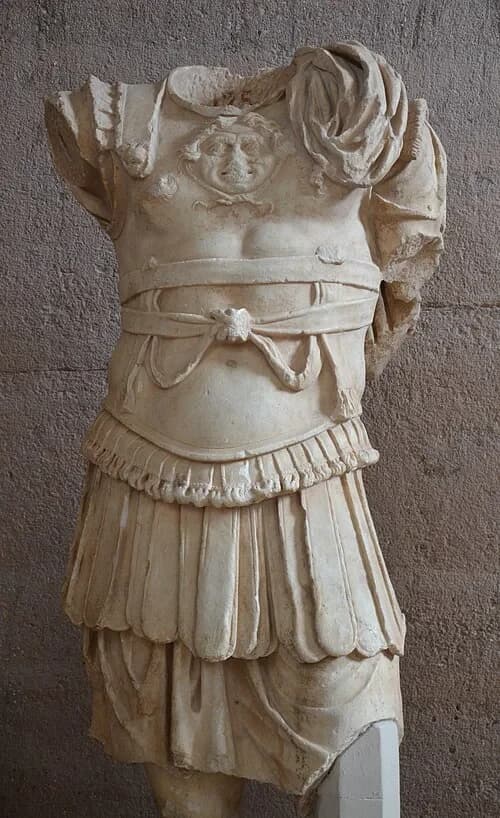
Statue of a Roman Commander
This striking torso highlights the intersection of military equipment and political propaganda in the Roman world. The figure wears a style of armor known as a 'musculata,' which was meticulously carved to mimic the idealized physique of a powerful athlete or even a deity. This wasn't just for protection; it was a visual tool used to project an image of absolute strength and military competence. If you look closely at the center of the chest, you can see a small, carved Medusa head, also known as a gorgoneion. In ancient belief, this image was intended to act as a protective charm, warding off evil while simultaneously striking fear into the hearts of enemies on the battlefield. This specific statue was originally displayed in the nearby Julian Basilica. Its presence in a courthouse served as a constant reminder of the military power that backed the Roman legal system. Notice the intricate detail of the leather-like straps and the fine drapery carved around the shoulders. Even without its head and limbs, the figure retains a sense of imposing dignity, standing as a silent representative of the imperial might that once governed every aspect of life in Corinth.
Lechaion Road
The main paved thoroughfare of Corinth, which connected the city center directly to its northern port at Lechaion.
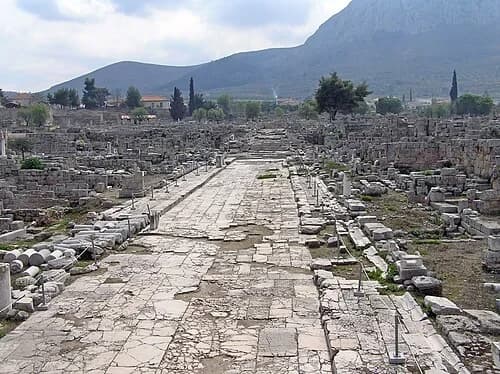
Lechaion Road
This grand limestone thoroughfare was the commercial backbone of Corinth. Known as the Lechaion Road, it stretched three kilometers from this point all the way to the city's northern harbor. As you look at the surface of the paving stones, notice the deep ruts worn into the hard rock. These weren't carved by stonemasons; they are the permanent physical evidence of thousands of heavy carts and wagons that rumbled over this road for centuries, carrying goods from the ships to the central markets. In its prime, the road offered a spectacular entrance to the city. It was lined on both sides by tall, covered porticos and countless statues of heroes and emperors, providing shade for pedestrians and a sense of grandeur for arriving travelers. This was the place to see and be seen, bustling with merchants, sailors, and citizens from every corner of the Mediterranean. The sophisticated drainage system and the high quality of the stone paving are testaments to the Roman commitment to infrastructure. Walking along these stones, you are following the same path taken by everyone from humble laborers to high-ranking officials entering the capital of Roman Greece.
Ahmed III Mosque
A remnant of the Ottoman period on Acrocorinth, this mosque was built in 1715 on the site of an earlier Byzantine church.
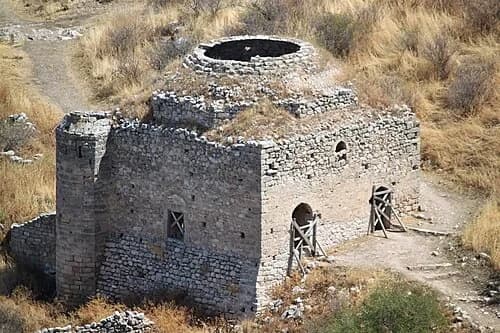
Ahmed III Mosque
Located on the lower levels of the formidable Acrocorinth fortress, this building marks a significant shift in the city's cultural landscape. Constructed in 1715 during the reign of Sultan Ahmed III, it stands as a reminder of the Ottoman Empire's long presence in the region. The mosque was built on the site of an earlier Byzantine church, following a common practice of repurposing strategic sacred spaces. Its architectural form is a classic 'cube and dome' design, typical of Ottoman religious buildings of that period. This structure is a physical testament to the fact that Corinth’s history did not end with the fall of Rome. For thousands of years, this massive rock remained a highly contested prize, fought over and fortified by Byzantines, Frankish Crusaders, Venetians, and Turks. Each group left their mark on the fortifications and buildings within these walls. The mosque’s simple, sturdy stone construction was designed to withstand the harsh conditions of this elevated military outpost. While its function has changed over the centuries, it remains a vital part of the layers of history that make up the site.
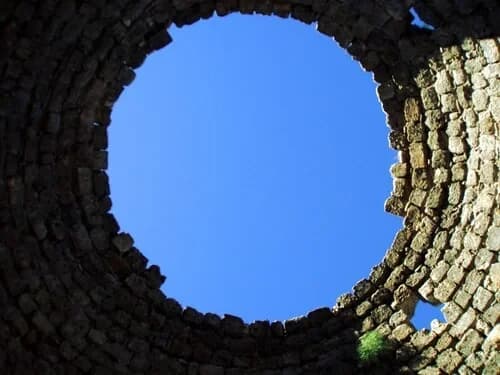
The Open Dome
Looking upward through the center of the structure, you can see a large, circular void where the peak of the dome once stood. This opening was not part of the original design; rather, it is the result of the elements slowly wearing away the roof's outer layers until the central section finally collapsed. You can see how the dome was constructed from roughly-hewn blocks of local stone, which contrasts sharply with the precisely finished stone found in the Roman city at the base of the mountain. This choice of material reflects the practicalities of building a fortress high on a limestone peak, where transporting fine materials was difficult. Today, this unintended skylight provides a natural frame for the sky above, changing with the light and weather. It illustrates the inevitable process of decay that affects even the most solid military structures. The way the stones are wedged together to form the curve of the dome is still visible around the edges of the opening, showing the masonry techniques used by the builders to span this large interior space.
Want to hear the rest?
Download the Stanza app to unlock all 31 stops and the complete guided audio tour.
Frequently Asked Questions
How long does the Ancient Corinth audio tour take?
The Ancient Corinth audio guide includes 31 narrated stops. Most visitors spend 45 minutes to 1.5 hours exploring the complete tour, though you can listen at your own pace and skip or revisit any stop.
Is the Ancient Corinth audio guide available in my language?
Stanza supports 15 languages: English, Spanish, French, German, Italian, Portuguese, Russian, Japanese, Chinese, Korean, Arabic, Hindi, Polish, Dutch, Hebrew. Check the guide in the app to confirm the languages currently available for this tour.
Can I use the audio guide offline at Ancient Corinth?
Yes! Download the complete Ancient Corinth tour — including all audio, maps, and images — before your visit. The Stanza app works completely offline, so you don't need WiFi or mobile data at the venue.
How much does the Ancient Corinth audio guide cost?
The Stanza app is free to download. Free and paid audio guides are available; current prices are shown in the app.
How do I use the Stanza audio guide at Ancient Corinth?
Download the free Stanza app, search for "Ancient Corinth", and download the tour. When you arrive at the venue, the app uses GPS to detect your location and automatically plays the relevant narration as you move between points of interest — completely hands-free.
What makes the Stanza audio guide different from other Ancient Corinth tours?
Stanza offers GPS-triggered narration that plays automatically as you walk through Ancient Corinth — no need to manually select stops. The tour is available in 15 languages, works fully offline, and includes 31 expertly narrated stops with images and historical context.
What other audio guides are available near Ancient Corinth?
Stanza offers multiple audio guides in Municipal Unit of Corinth, Greece and nearby areas. After downloading the app, browse the map to discover all available tours near Ancient Corinth. Each guide can be downloaded for offline use.
Nearby Audio Guides
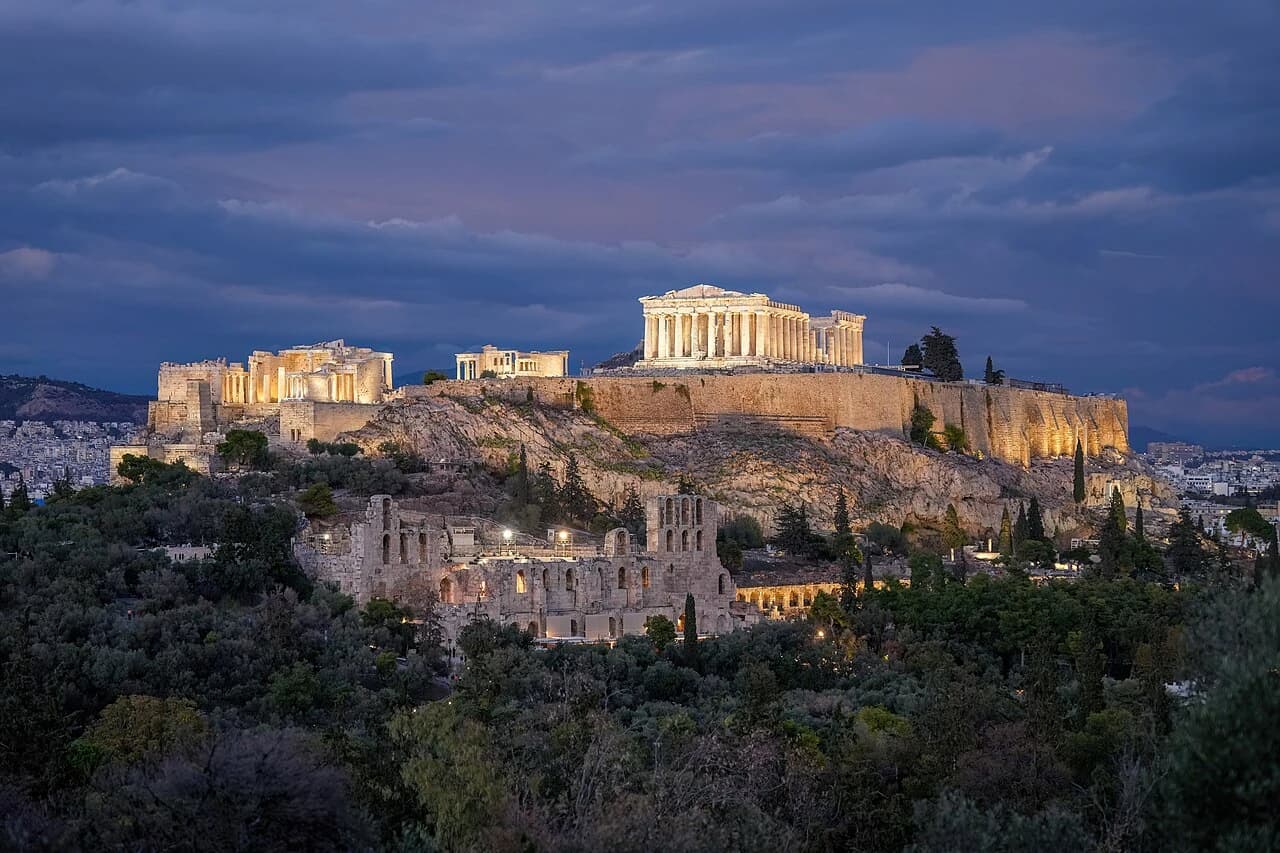
Acropolis of Athens
Athens, Greece
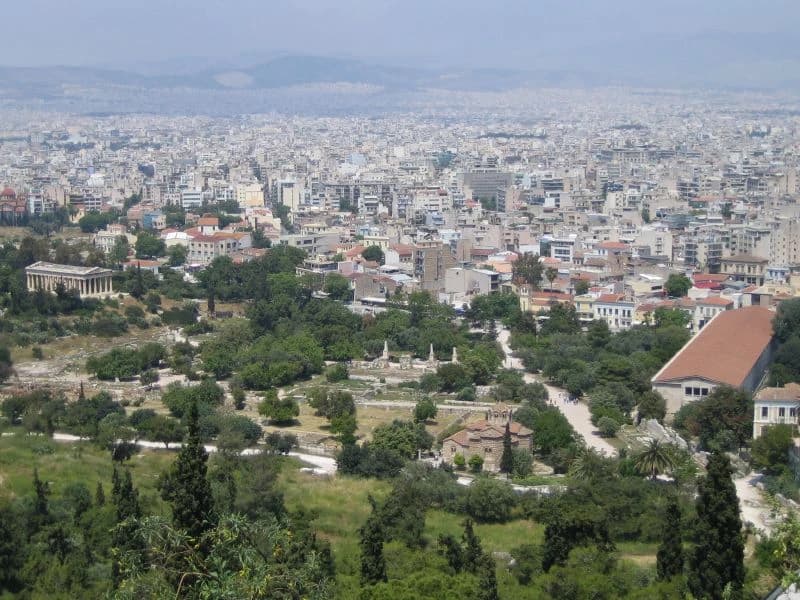
Ancient Agora of Athens
Athens, Greece
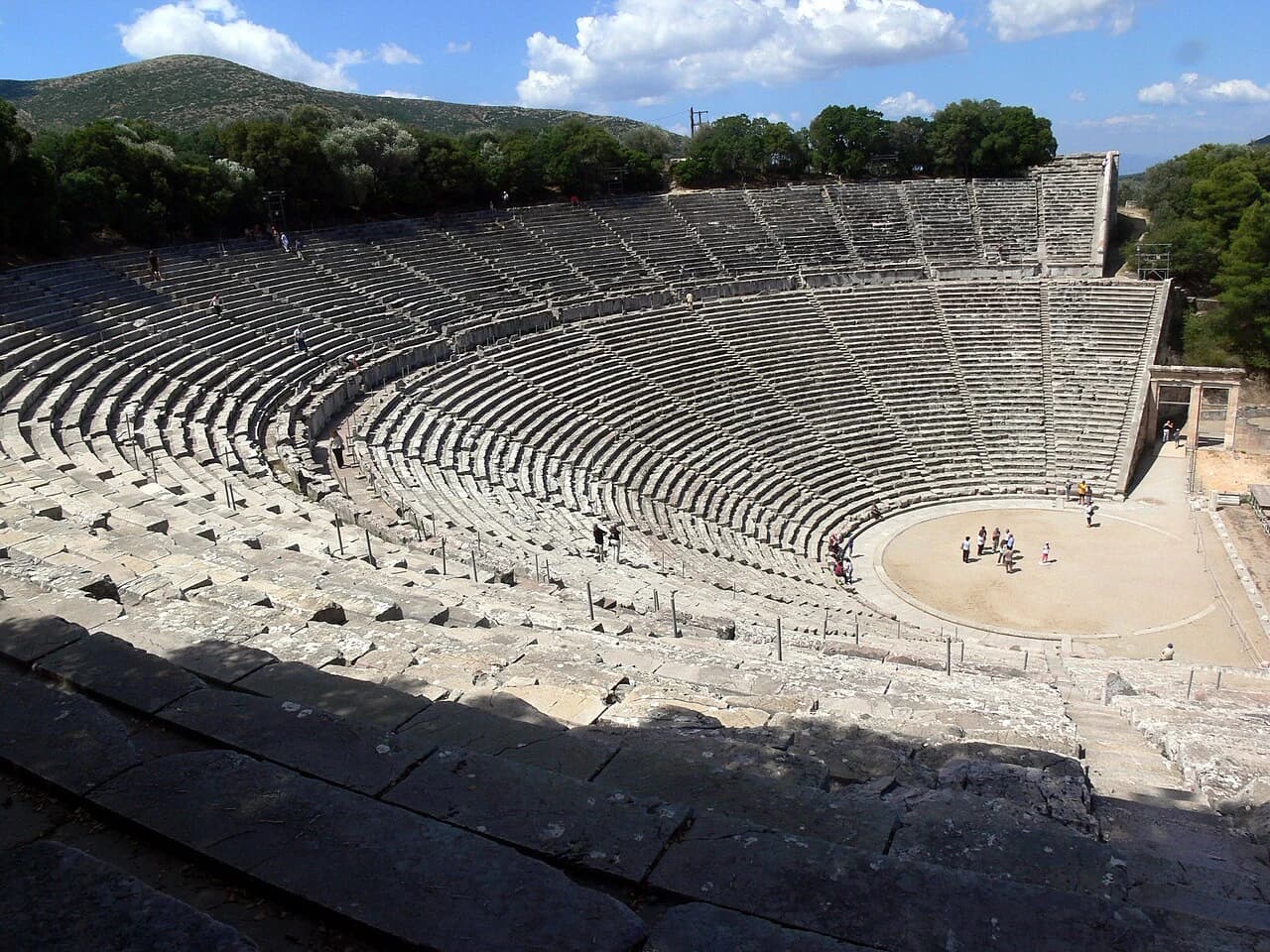
Ancient Epidaurus
Municipal Unit of Asklipieio, Greece
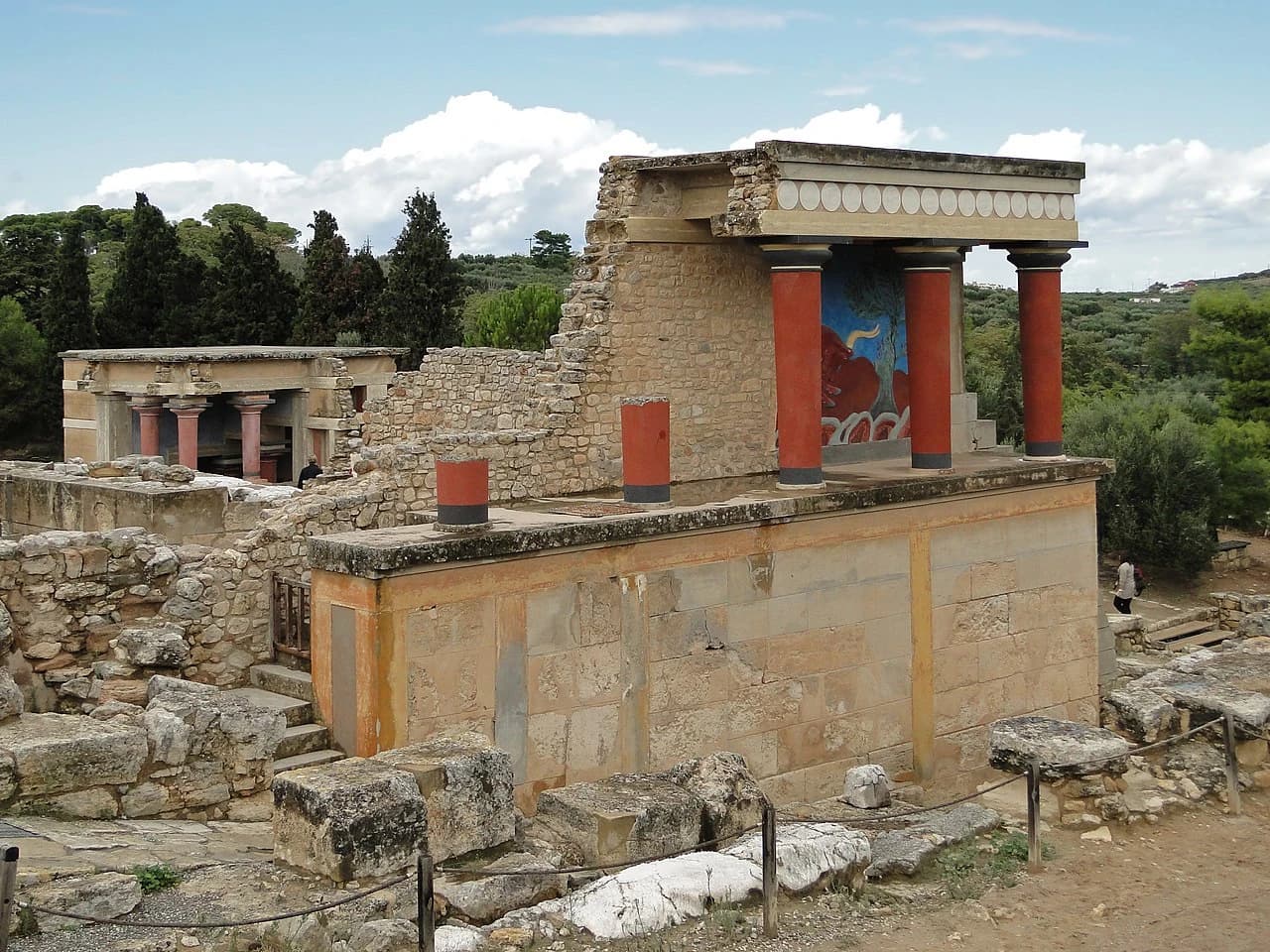
Knossos
Heraklion Municipal Unit, Greece
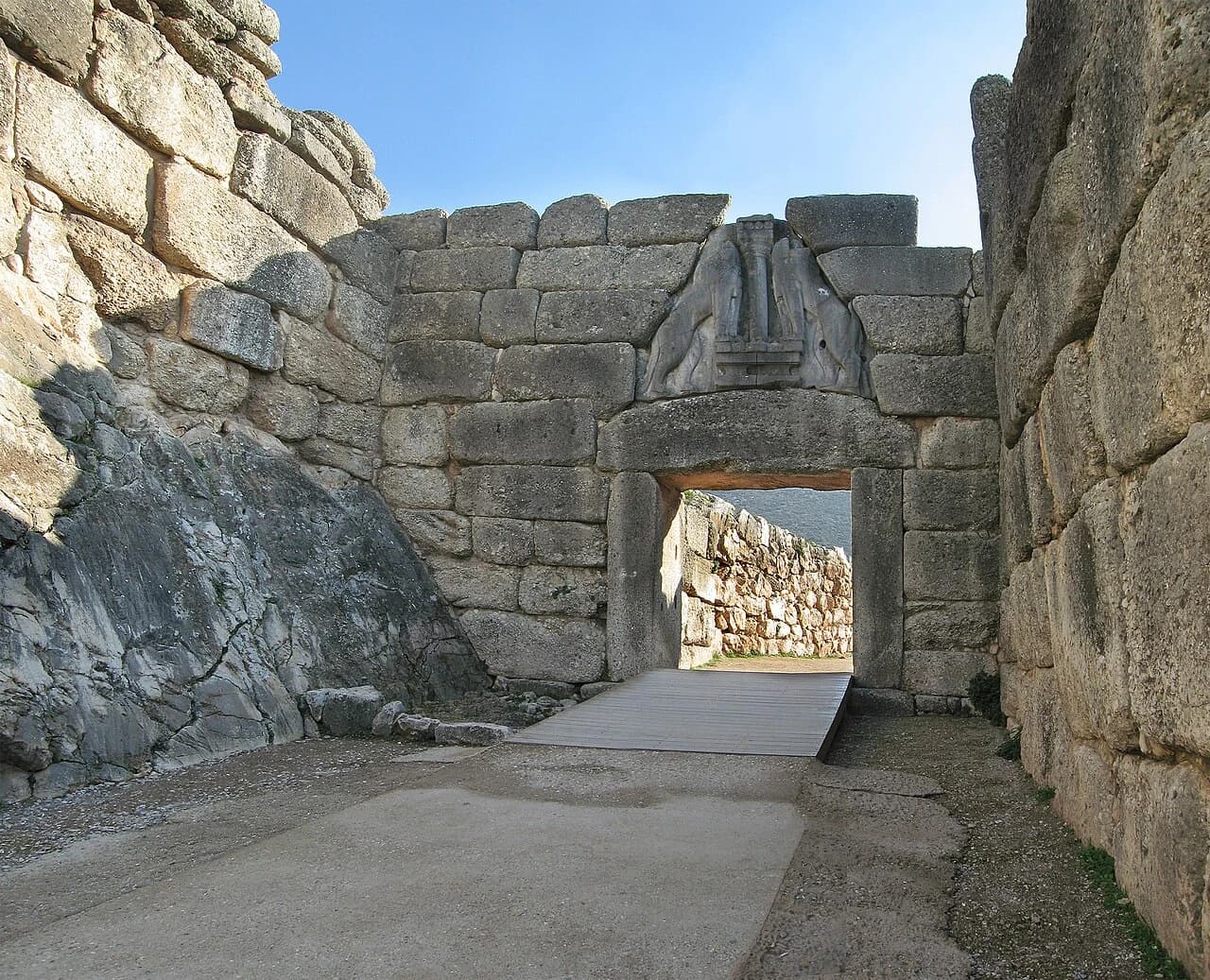
Mycenae Archaeological Site
Municipal Unit of Mykines, Greece
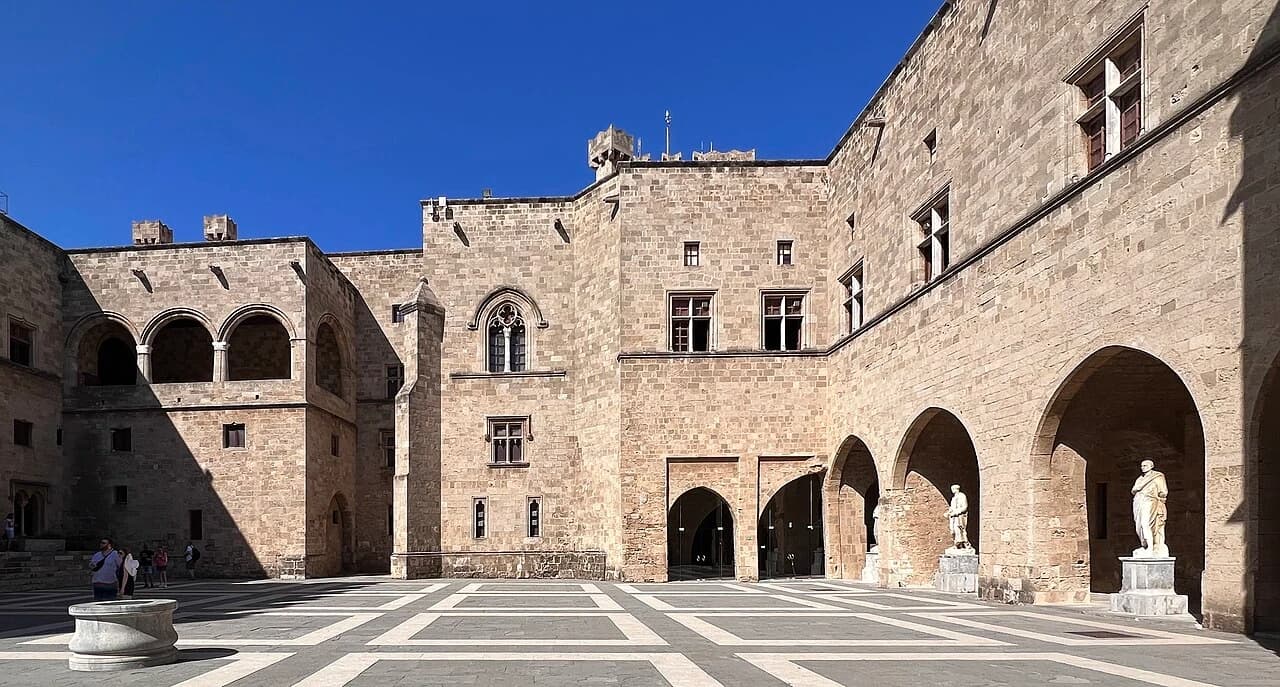
Palace of the Grand Master of the Knights of Rhodes
Municipal Unit of Rhodes, Greece