Languages
15Mycenae Archaeological Site Audio Guide
Mycenae Archaeological Site is an archaeological site in Municipal Unit of Mykines, Greece. Explore it with Stanza's guided offline audio tour — narrated in 15 languages.
Quick Facts
32
Stops
15
Languages
100%
Offline
📍 Municipal Unit of Mykines, Greece · 37.7308°N, 22.7561°E
About Mycenae Archaeological Site
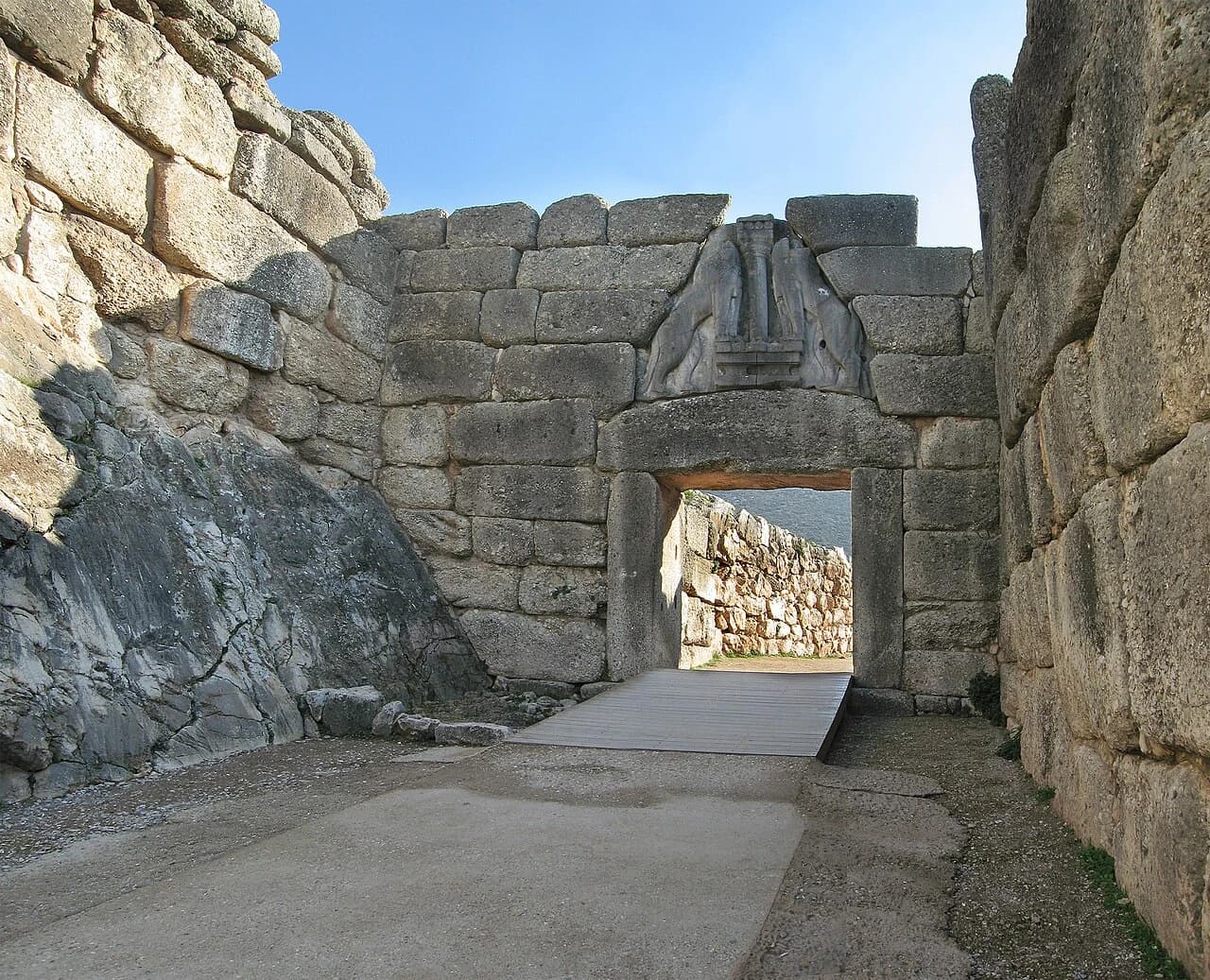
Mycenae is an ancient city, now an archaeological site in Argolis, Greece. It was a major centre of Mycenaean civilization, a Late Bronze Age civilization that flourished in southern Greece.
This self-guided audio tour features 32 narrated stops organized across 7 sections. As a archaeological site, Mycenae Archaeological Site offers a unique cultural experience in the heart of Municipal Unit of Mykines, Greece.
The Stanza audio guide is available in 15 languages and works entirely offline — download the complete tour including audio narration, maps, and images before your visit. As you walk through Mycenae Archaeological Site, GPS-triggered narration plays automatically at each point of interest.
Last updated:
What you will hear
Treasury of Atreus
The most impressive of the nine tholos tombs at Mycenae, often attributed to the legendary King Agamemnon or his father Atreus.
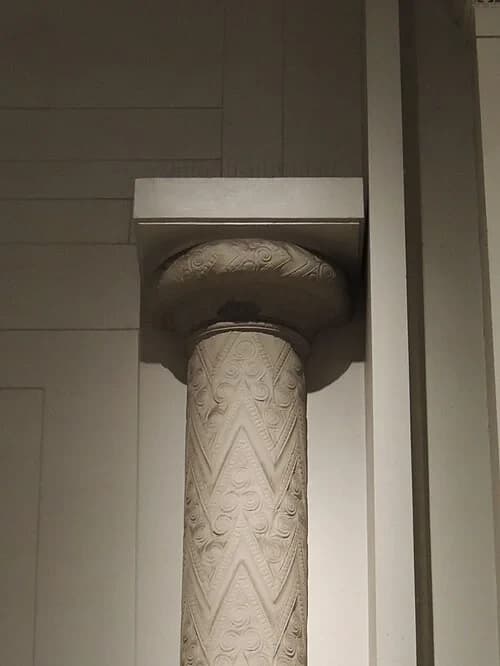
The Decorative Entrance Columns
The intricate zig-zag and spiral patterns on this column fragment suggest that the tomb’s entrance was far more decorative than the bare stone we see today. It is important to note that the pieces here are replicas. The original columns, carved from green limestone, were removed in the early 1800s and are now housed in the British Museum. Originally, a pair of these tall, tapered pillars flanked the doorway, supporting a red marble facade above the lintel. This use of contrasting colors and complex geometric designs transformed the entrance into something resembling a magnificent palace rather than a simple cave or earth mound. The architectural style here is distinctly Mycenaean, characterized by a love for bold patterns and imported, high-quality stone. By framing the tomb in this way, the builders signaled that the occupant inside was not merely a leader, but a figure of immense status. The decoration served as a transition point, marking the boundary between the world of the living and the eternal, regal realm of the deceased. The use of red and green would have been a striking contrast against the pale limestone of the walls.
Grave Circle B
An older burial complex located outside the citadel walls, containing shaft graves that predated the more famous Grave Circle A.
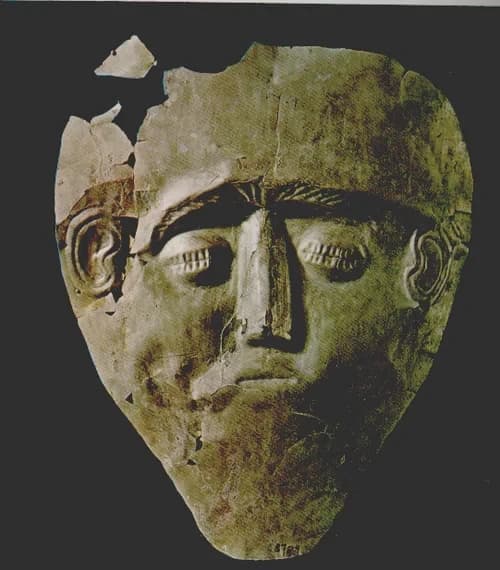
Grave Circle B, Mycenae
This mask was discovered in Grave Circle B and is significantly older than the more famous gold masks found elsewhere on the site. It is made of electrum, which is a natural blend of silver and gold. Notice the almond-shaped eyes and the faint, mysterious smile that crosses the figure's lips. Because it is made of electrum, the color is paler and the metal is much thinner and more fragile than later funerary artifacts. This piece marks a critical moment in the development of Mycenaean art, where the elite began the tradition of giving the dead a permanent, metallic face for the afterlife. The mask was likely hammered into shape over a wooden mold to create its features. It reveals a society that was just beginning to accumulate the vast wealth it would later become famous for. While it lacks the heavy, solid feel of the later gold masks, its delicate features offer a more intimate look at the funerary customs of the early warrior class. This mask helped preserve the identity of the deceased for eternity, long after the physical body had returned to the earth.
Tomb of Aegisthus
One of the earliest and largest tholos tombs, built with massive limestone blocks around 1500-1450 BC.
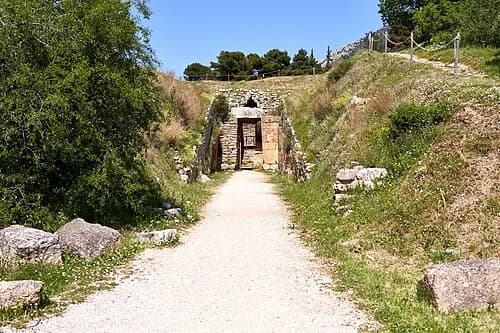
The Fallen Dome of Aegisthus
Contrast the masonry here with the massive, perfectly cut blocks you saw at the Treasury of Atreus. The stones used for this entrance are noticeably smaller and lack the same level of precise finishing. This indicates that the Tomb of Aegisthus was part of an earlier, pioneering effort to master the tholos design. The entrance passage, or dromos, is carved directly into the natural slope of the hill rather than being lined with high, freestanding walls. This simpler approach suggests that the architects were still refining the techniques needed to manage massive stone loads. The collapse of the roof occurred long ago, likely due to a powerful earthquake, which was a frequent threat to stone structures in this region of Greece. Because this tomb was built at the dawn of the tholos era, it lacks some of the more advanced structural reinforcements seen in later centuries. Nevertheless, it served as the essential prototype for the grander monuments that followed, proving that the concept of a vaulted stone chamber was both possible and suitably impressive for the ruling family. The weathered stones show the passage of thirty-five centuries.
Cyclopean Fortifications
The massive defensive walls built of boulders so large that later Greeks believed they were constructed by the Cyclopes.
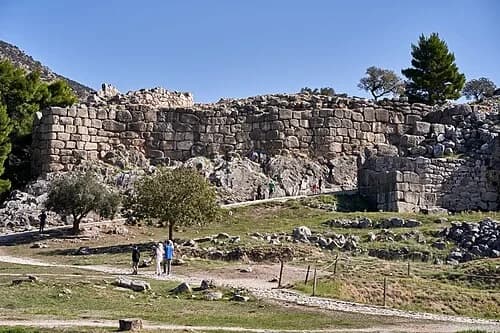
Fortifications of Mycenae
The walls surrounding the citadel of Mycenae are a feat of sheer military power. Standing over 13 meters high and reaching thicknesses of up to 7 meters, they were built to withstand any siege. The layout of the wall was carefully planned to follow the natural ridges of the bedrock, making the climb even steeper and more difficult for potential attackers. One of the most remarkable features of this masonry is the tight fit of the stones. In many places, the blocks are positioned so precisely that you cannot even slide a thin card between them. This construction style is often called Cyclopean because later generations believed only mythical giants could have handled such immense boulders. However, these walls served a purpose beyond simple defense. They were a visible statement of the kingdom's immense wealth and organizational ability, looming over the Argive plain for miles. From far away, the sun-bleached stone would have signaled to travelers and enemies alike that they were approaching the heart of a powerful and highly disciplined empire. The fortification walls were the first and most enduring line of defense for the royal family living on the summit.
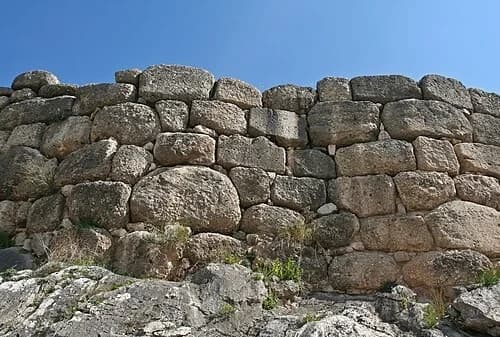
Close-up of the Giant Boulders
If you look closely at the gaps between these enormous boulders, you will see smaller stones, known as chinking stones, stuffed into the cracks. This was not an accident or a sign of poor craftsmanship. Instead, it was a vital engineering feature. These smaller stones helped distribute the immense weight of the wall evenly and allowed the structure to flex slightly during the frequent earthquakes that strike this region. This flexibility prevented the rigid blocks from cracking or tumbling down. The boulders themselves are made of a local conglomerate stone, which was quarried from the surrounding hills. To move these massive pieces into place, workers used long ramps constructed of earth and timber, slowly hauling the stones upward using ropes and sheer human power. The presence of these chinking stones shows that the Mycenaeans were not just builders of scale, but also keen observers of their environment. They adapted their construction techniques to ensure that their defensive works would remain stable for centuries. Even today, you can see how the smaller stones have remained lodged in place, continuing to support the weight of the massive boulders above them.
Temple of Athena
An Archaic-era temple built over the ruins of the Bronze Age palace, dedicated to the patron goddess of wisdom.
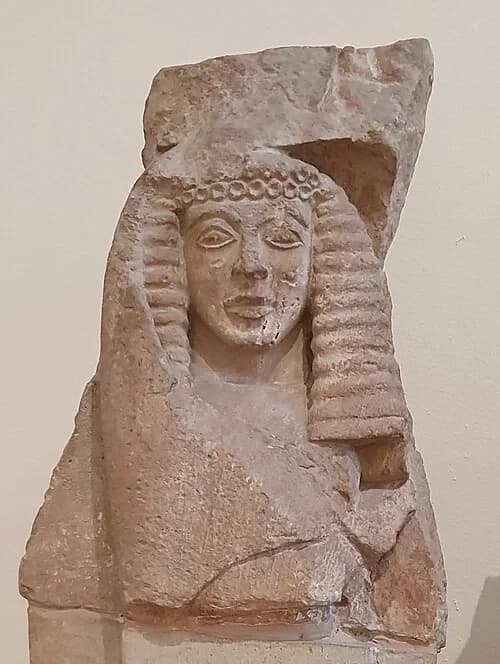
Temple of Athena, Mycenae
Among the artifacts found here is a striking stone relief depicting a woman's face with large, expressive eyes and carefully braided hair. Interestingly, this piece doesn't date to the time of the great kings; it was crafted in the 7th century BC, hundreds of years after the fall of the Mycenaean palace. It was discovered within the ruins of a temple built directly on top of the old royal structures. This suggests that even after the citadel had lost its political power, the site itself remained deeply sacred to the local population. The relief likely represents a goddess, possibly Hera or Athena, who was worshipped in this new sanctuary. The continuity of worship in this location shows how the memory of Mycenae's ancient glory persisted into the classical era. The people who lived nearby in the centuries following the collapse of the Bronze Age kingdoms clearly felt a powerful connection to these ruins, choosing to build their most important temples on the same ground where the legendary kings once ruled. The expressive features of the carving offer a beautiful example of early archaic Greek art.
North Gate
The secondary entrance to the citadel, used primarily for administrative and domestic traffic.
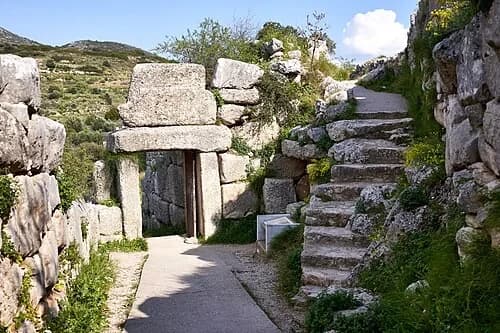
North gate
While the Lion Gate was the grand entrance for kings and dignitaries, the North Gate served a more everyday purpose. This secondary entrance was likely used by servants and for bringing in essential supplies from the nearby farms. Despite its more practical role, it was no less secure than the main gate. Notice the distinct "L-shaped" layout of the entrance. This was a deliberate defensive trick designed by Mycenaean military engineers. If attackers managed to break through the outer doors, they would immediately be forced to turn a sharp corner. This maneuver would not only slow their momentum but also expose their unshielded right side to defenders stationed on the massive walls above. It forced intruders into a tactical disadvantage where they could be easily targeted. This gate is essentially a smaller, more utilitarian version of the famous Lion Gate, proving that even the most mundane parts of the city's design were heavily influenced by the constant need for protection. The tight masonry and strategic placement on the northern slope made it a formidable obstacle for any enemy.
Archaeological Museum of Mycenae
A modern facility housing the most important finds from the site, including replicas of the gold masks and original pottery.
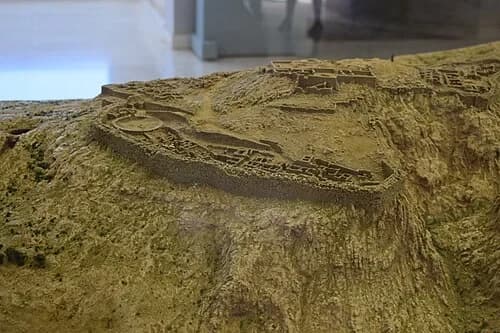
Model of the Ancient Citadel
Use this scale model to visualize what Mycenae looked like three thousand three hundred years ago. It brings to life the complex layout of the site, showing the palace perched at the highest point, surrounded by massive walls encircling the entire hill. Notice how much of the city was actually built on steep terraces carved directly into the rock. This was truly a vertical city, designed to maximize both space and defense. Below the main citadel, you can see the lower town where ordinary people lived in houses outside the protection of the great walls. The model highlights the sheer scale of the fortification project and illustrates how the city was designed to impress anyone approaching from the valley below. By comparing the model to the ruins around you today, you can begin to appreciate the immense engineering effort required to transform this rugged terrain into a world-class capital. The terraces you walk on today once supported rows of buildings, creating a densely packed and imposing urban center at the heart of a mini-empire.
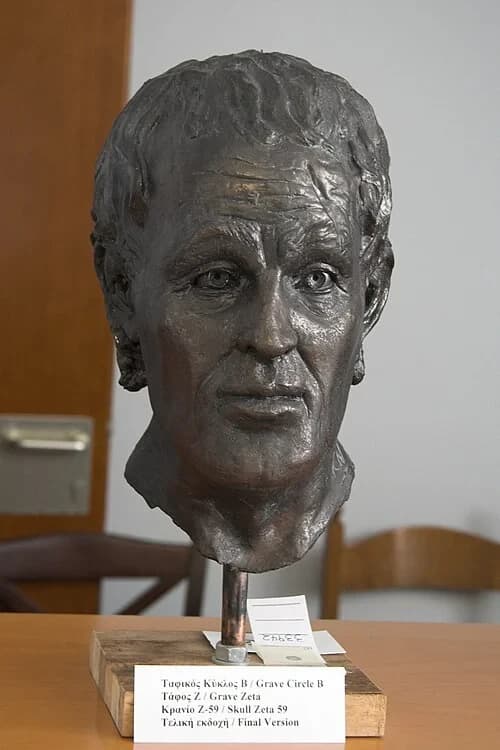
The Face of a Mycenaean
This detailed bust is a scientific facial reconstruction based on a skull unearthed in Grave Circle B. It provides a rare opportunity to look into the eyes of a man who lived 3,500 years ago, moving beyond the legends of Homer to meet a real individual who once walked these very paths. He was not a mythical hero or a character from an epic poem, but a living, breathing member of the Mycenaean community. Forensic analysis of his remains tells a specific story of his life. He was a high-ranking male who lived into his late 50s, which was a significant age for the Bronze Age. While his bones show signs that he suffered from arthritis—likely a result of his long life—they also reveal that he was well-nourished and physically robust. This suggests he belonged to the city's ruling class, enjoying a diet and lifestyle far superior to the average citizen. The reconstruction captures the weathered features of an older man, from the lines around his eyes to the set of his jaw. It serves as a bridge across three millennia, humanizing a civilization often defined only by its massive walls and golden treasures. Notice the texture of the skin and the structure of the brow, which were meticulously modeled based on the underlying bone architecture.
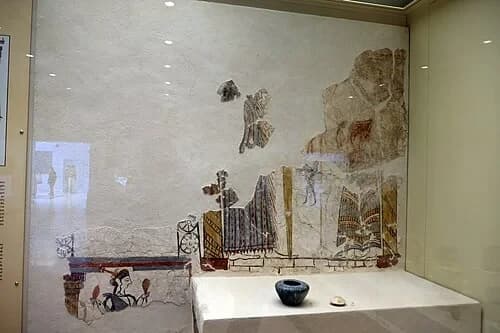
Royal Palace Frescoes
Look closely at these fragments of wall painting to see the vivid palette that once decorated the royal palace. While the citadel today appears as a landscape of weathered stone, these frescoes prove that the interiors were once exceptionally bright and luxurious. Artists created these works by applying pigments made from ground minerals directly onto wet plaster, a technique that allowed the colors—deep reds, brilliant blues, and sunny yellows—to bond permanently with the walls. In the lower section, you can distinguish the profile of a woman. Pay attention to her elaborate hairstyle, composed of intricate braids and ribbons, and the jewelry adorning her neck. These details provide invaluable evidence of Mycenaean fashion and social status. Such images didn't just decorate a room; they projected the wealth and sophistication of the people living within the citadel. This artistic tradition suggests a culture that valued beauty and display as much as it did the massive fortifications outside. The presence of these refined paintings in the heart of a mountain fortress creates a striking contrast between the rugged exterior and the sophisticated, colorful life of the royal court. You can see the fine brushstrokes where the artist carefully outlined the woman’s profile against the pale background.
Want to hear the rest?
Download the Stanza app to unlock all 32 stops and the complete guided audio tour.
Frequently Asked Questions
How long does the Mycenae Archaeological Site audio tour take?
The Mycenae Archaeological Site audio guide includes 32 narrated stops. Most visitors spend 45 minutes to 1.5 hours exploring the complete tour, though you can listen at your own pace and skip or revisit any stop.
Is the Mycenae Archaeological Site audio guide available in my language?
Stanza supports 15 languages: English, Spanish, French, German, Italian, Portuguese, Russian, Japanese, Chinese, Korean, Arabic, Hindi, Polish, Dutch, Hebrew. Check the guide in the app to confirm the languages currently available for this tour.
Can I use the audio guide offline at Mycenae Archaeological Site?
Yes! Download the complete Mycenae Archaeological Site tour — including all audio, maps, and images — before your visit. The Stanza app works completely offline, so you don't need WiFi or mobile data at the venue.
How much does the Mycenae Archaeological Site audio guide cost?
The Stanza app is free to download. The current listed price for the Mycenae Archaeological Site audio guide is $4.99; app-store region and currency may affect the final price.
How do I use the Stanza audio guide at Mycenae Archaeological Site?
Download the free Stanza app, search for "Mycenae Archaeological Site", and download the tour. When you arrive at the venue, the app uses GPS to detect your location and automatically plays the relevant narration as you move between points of interest — completely hands-free.
What makes the Stanza audio guide different from other Mycenae Archaeological Site tours?
Stanza offers GPS-triggered narration that plays automatically as you walk through Mycenae Archaeological Site — no need to manually select stops. The tour is available in 15 languages, works fully offline, and includes 32 expertly narrated stops with images and historical context.
What other audio guides are available near Mycenae Archaeological Site?
Stanza offers multiple audio guides in Municipal Unit of Mykines, Greece and nearby areas. After downloading the app, browse the map to discover all available tours near Mycenae Archaeological Site. Each guide can be downloaded for offline use.