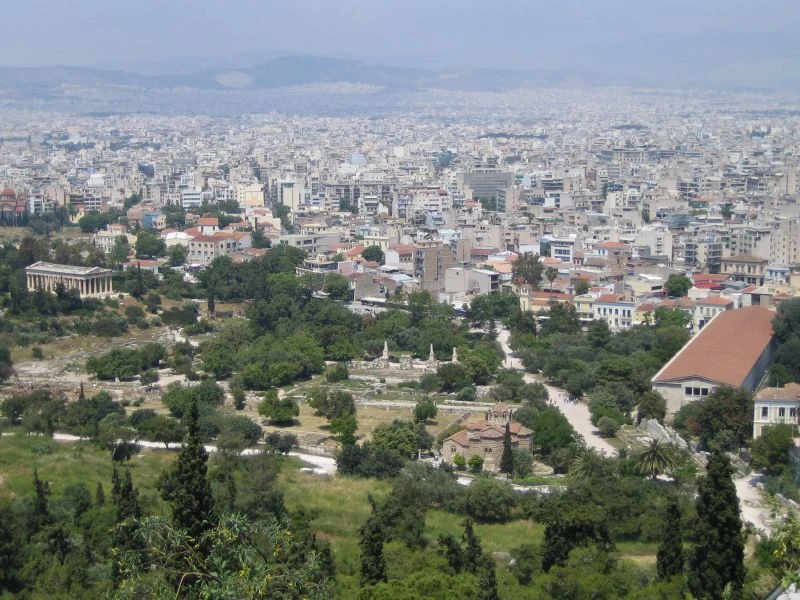
 Stanza / Audio guide
Content & sources
Stanza · Audio guide
Ancient Agora of AthensAudio guide
A place to remember. A story to take with you.
The Ancient Agora of Athens is a major archaeological site and a significant historical center of ancient Athens. It served as a public gathering place, market, and civic hub.
Download Stanza, then search for “Ancient Agora of Athens”.
About the tour
One guide. Your kind of visit.
The Ancient Agora of Athens is a major archaeological site and a significant historical center of ancient Athens. It served as a public gathering place, market, and civic hub.
Ready when you are.
- 01Get the free Stanza app.
iOS & Android
- 02Find your guide.
“Ancient Agora of Athens”
- 03Download before you go.
Works offline
Audio guide / 39 narrated stops
Inside the guide
Get to know a few of the stories before you go. Open a stop to read more.
01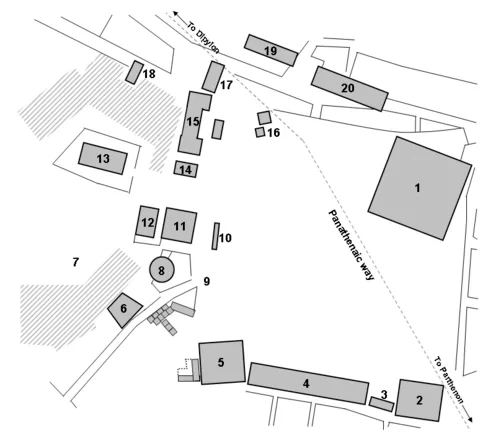 Altar of the Twelve GodsAltar of the Twelve Gods
Welcome to the Ancient Agora of Athens, essentially the downtown of one of history’s most influential cities. Using this map, you can orient yourself within a space that served as a shopping mall, government headquarters, and sacred precinct all at once. The wide diagonal path cutting through the center is the Panathenaic Way, which acted as the city’s main artery. Most of the critical administrative buildings, where the world's first democracy was managed, were clustered on the west side, to your left. Meanwhile, the large rectangular structures known as stoas eventually dominated the eastern and southern edges, housing shops and offices. This area was not just a marketplace for goods, but a marketplace for ideas. As you move through the site, imagine the noise of legal debates, the scent of spices from the stalls, and the crowds of citizens gathering to discuss the latest news. It was here that the daily life of an Athenian truly happened, from the mundane business of buying pottery to the high-stakes trials that shaped Western thought. In this environment, philosophy and trade were inseparable.
User:Madmedea, key corrected by User:LlywelynII · CC BY-SA 2.0
02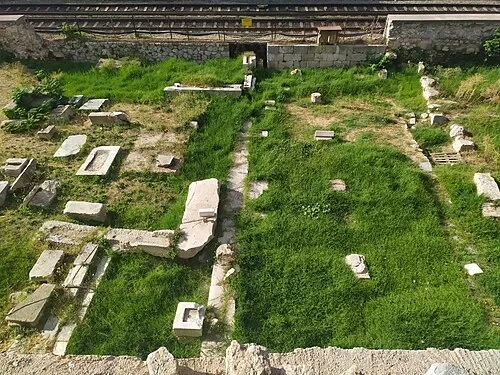 Royal Stoa (Stoa Basileios)Royal Stoa
The foundation here belonged to the Royal Stoa, a building of immense legal and religious significance. This was the primary office of the King Archon, a high-ranking official who oversaw state religious festivals and complex legal cases involving impiety. In 399 BC, the philosopher Socrates walked to this very spot to answer preliminary charges that he was corrupting the youth and failing to honor the city’s gods. It was a moment that would lead to one of history's most famous trials. Beyond high-profile cases, the Royal Stoa served a vital role in government transparency. The laws of Athens were literally carved into large stone slabs and set up here so that any literate citizen could read them. By making the laws public and accessible, the city ensured that justice wasn't a secret kept by the elite. Standing before these ruins, you are at the place where the rule of law was made visible to the people, ensuring that every Athenian knew exactly what was expected of them and their fellow citizens. It represents a physical commitment to the transparency of the democratic process.
Photo: Vanbasten 23 · CC BY-SA 3.0
03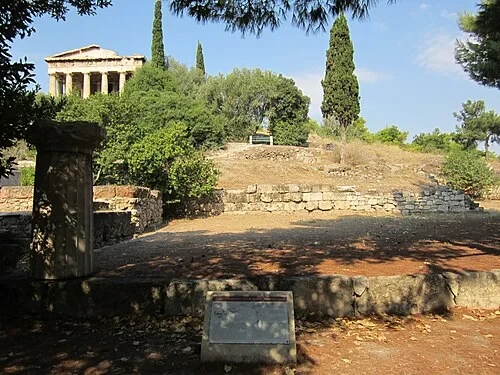 Stoa of Zeus EleutheriosStoa of Zeus
This area was once occupied by the Stoa of Zeus Eleutherios, dedicated to Zeus as the "God of Freedom" following the Greek victory in the Persian Wars. Think of this double-colonnaded porch as the ancient Athenian equivalent of a high-end social club or coffee shop. Unlike the more formal administrative buildings nearby, this stoa was designed specifically for leisure. It was open to everyone, offering a cool, shaded place to escape the intense Mediterranean sun while lounging or debating the issues of the day. This was famously Socrates’ favorite place to hold court. He spent countless hours sitting here, questioning his friends and fellow citizens on everything from the nature of virtue to the structure of the universe. The stoa’s open-air design reflected the Athenian value of free speech and public discourse. While the building's roof and columns are long gone, the stone foundations remind us of a time when the most sophisticated philosophical ideas in history were hashed out in a casual public porch overlooking the marketplace, available for any passerby to overhear.
Listen in the appPhoto: Tomisti · CC BY-SA 4.0
04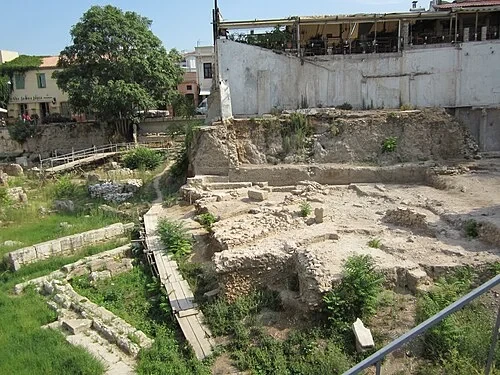 The Painted Stoa (Stoa Poikile)Painted Stoa
The ruins here belonged to the Stoa Poikile, or the "Painted Stoa." In antiquity, this wall was one of the city's most impressive sights, decorated with massive, colorful murals depicting legendary Athenian battles, such as the victory at Marathon. These paintings weren't just art; they were a source of immense civic pride. However, the building is perhaps most famous for what happened in its shade. Zeno of Citium chose this public space to teach his students, who eventually became known as "Stoics" because they met right here in this particular "stoa." This school of thought, emphasizing reason and resilience, would go on to influence the Roman emperors and modern psychology. Today, the ancient site meets the modern world in a jarring way, as the Athens railway now cuts directly through the northern edge of the Agora, just inches from where these great murals once stood. While the colors have faded and the walls have crumbled, the intellectual legacy born on this porch remains a cornerstone of Western philosophy, reminding us that ideas can outlast even the most celebrated stone monuments.
Listen in the appPhoto: Tomisti · CC BY-SA 4.0
05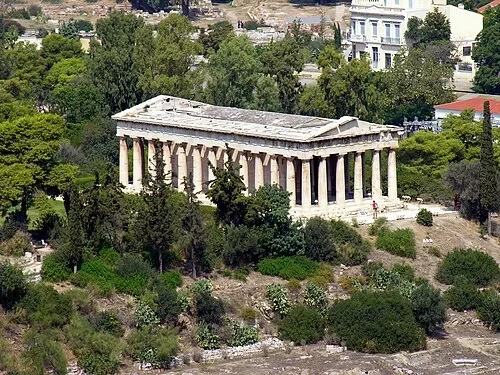 Temple of HephaestusTemple of Hephaestus
Sitting prominently on the hill overlooking the marketplace is the Temple of Hephaestus, the most complete Doric temple surviving in Greece. You might wonder why this structure stands so intact while the Parthenon on the Acropolis is in ruins. The answer lies in its long history of continuous use. In the 7th century AD, it was converted into a Christian church, which protected it from being used as a stone quarry or looted by builders over the centuries. Dedicated to Hephaestus, the god of fire and metalworking, the temple's location was highly symbolic. This hill was the center of the city’s industrial district, where blacksmiths, metal casters, and potters operated their workshops. They honored their patron god with this magnificent structure, ensuring their neighborhood was overlooked by his divine presence. The heavy, fluted columns and the solid stone foundations provide a clear picture of 5th-century BC architecture at its peak. It remains a rare opportunity to see an ancient Greek sacred space much as it would have appeared to the citizens of the classical era, standing firm against the passage of time.
Listen in the appDennis G. Jarvis · CC BY-SA 2.0
06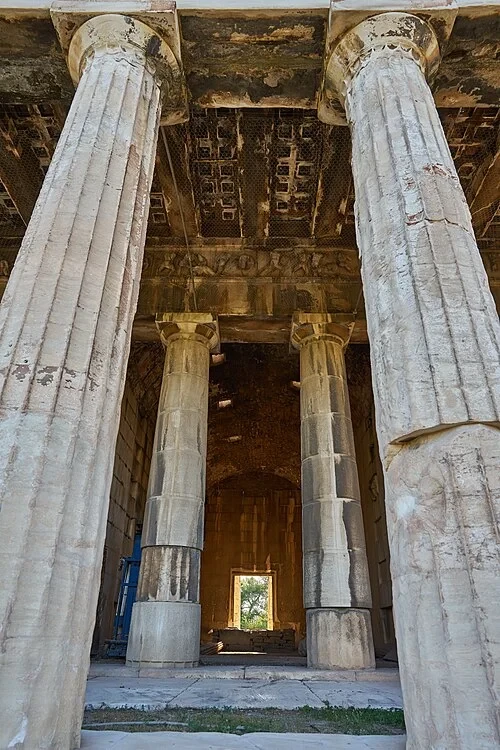 Temple of HephaestusInside the Temple Nave
Peering through the columns into the inner chamber, or cella, you can see how the building’s function shifted over time. When the temple was repurposed as a church, several significant structural changes were made to accommodate Christian liturgy. The original ancient entrance was walled up, and a new doorway was cut into the opposite end to suit the new orientation of the altar. Above, the barrel-vaulted ceiling you see is a later addition from the Byzantine era, designed to create a more traditional ecclesiastical space. Despite these modifications, the massive stone walls themselves are original works from the mid-5th century BC. This interior space would have originally housed a monumental statue of Hephaestus and Athena, the patrons of the local craftsmen. The transition from a place of pagan sacrifice to a house of Christian worship is written into the very stone. Notice the marks where screens or icons might have once stood, illustrating how one culture built upon the foundations of another to preserve this remarkable structure through the ages, changing its soul while keeping its shell.
Listen in the appPhoto: George E. Koronaios · CC0
07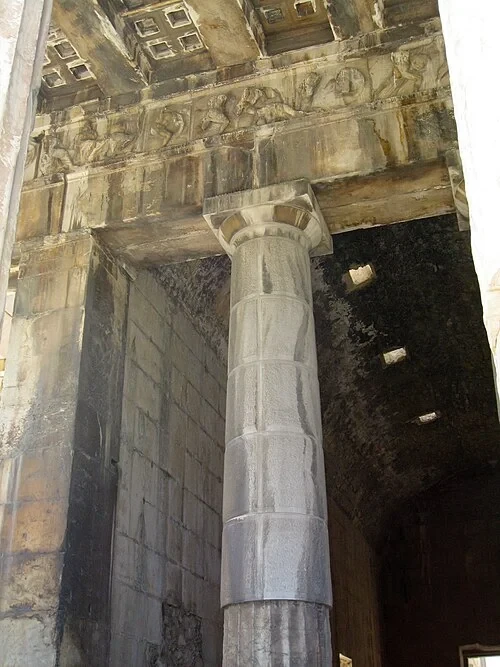 Temple of HephaestusThe Temple Ceiling
Looking up at the ceiling of the porch, you’ll notice a grid-like pattern of recessed stone squares. This is known as a coffered ceiling, and it was a brilliant solution to a difficult engineering problem. In ancient Greek architecture, stone roofs were incredibly heavy. By carving out these deep squares, the architects significantly reduced the overall weight of the stone slabs without sacrificing structural integrity. While they are fascinating for their engineering, they were also highly decorative. In antiquity, these coffers wouldn't have looked like the weathered stone you see today. Instead, they were vibrant and colorful; evidence suggests they were painted with deep blue backgrounds and adorned with bright gold stars to mimic the night sky. Imagine the effect as the sun reflected off the floor and lit up the ceiling, creating a shimmering celestial canopy for visitors walking between the columns. This detail highlights the Greek desire to blend practical necessity with aesthetic beauty, ensuring that even the underside of a roof contributed to the temple’s overall grandeur and religious atmosphere.
Listen in the appNicholas Hartmann · CC BY-SA 4.0
08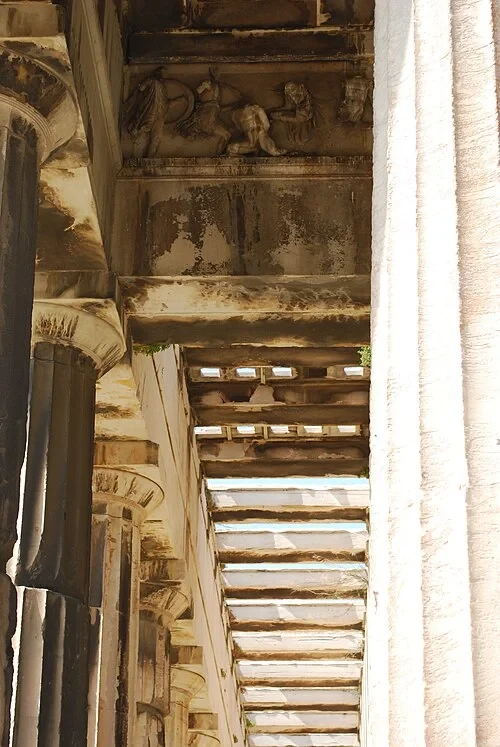 Temple of HephaestusThe Sculpted Frieze
Above the inner row of columns, look for the frieze—a continuous band of sculpted figures. This particular relief depicts the adventures and battles of Theseus, the legendary founder-hero of Athens. Theseus was a central figure in the Athenian identity, credited with unifying the various communities of Attica into a single city-state. The artists carved these figures in high relief, meaning they stand out prominently from the background. This was a deliberate choice to ensure that even from your vantage point on the ground, the scenes would remain clear and dynamic despite being high above. The play of light and shadow on the deep carvings would have brought the battle scenes to life throughout the day. As you observe the movement and energy of the stone warriors, consider that these stories were once as familiar to the average Athenian as modern movies are to us. The frieze served as both a religious offering and a public reminder of the city's heroic origins, reinforcing the connection between the gods and the founding fathers of the democracy.
Listen in the appJean Housen · CC BY 3.0
09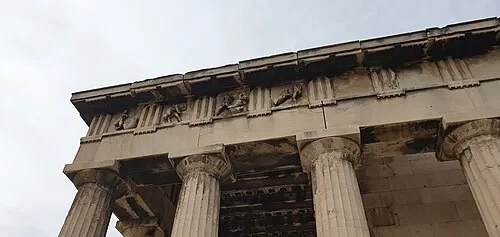 Temple of HephaestusThe Labors of Hercules
On the exterior of the temple, focus on the metopes—the square panels located just above the outer colonnade. These panels tell two distinct sets of stories. Some depict the famous twelve labors of Hercules, a hero celebrated throughout all of Greece. Others show the local exploits of Theseus, the Athenian hero. By placing Theseus side-by-side with the legendary Hercules, the builders were making a bold political and cultural statement. They were effectively claiming that their local champion was just as significant as the most famous demigod in the Greek world. It was a way for Athens to assert its own importance on a larger stage. These carvings would have been highly detailed and originally finished with bright paint to make them stand out against the light-colored stone. As you look at the worn figures today, you can still catch the sense of action—heroic struggles against monsters and villains that defined the moral and mythological landscape for the people who gathered in the marketplace below. They represent the victory of civilization over chaos.
Listen in the appPhoto: Yair-haklai · CC BY-SA 4.0
10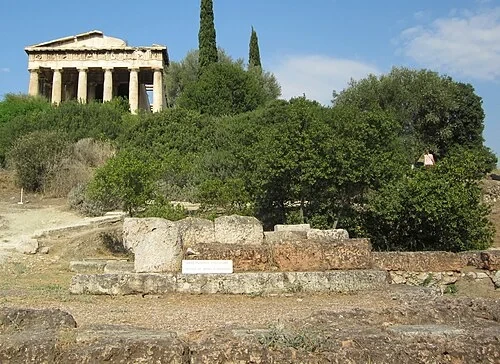 Temple of Apollo PatroosTemple of Apollo Patroos
The remains here belong to the Temple of Apollo Patroos, a title meaning "Apollo the Father." This site was fundamental to the identity of every Athenian citizen. In ancient Athens, family and tribal connections were everything. Every citizen belonged to a "phratry," a type of religious brotherhood. To officially prove your status as a citizen, you were required to demonstrate that your family worshipped Apollo at this very sanctuary. It was, in a sense, the city's central registry of legitimate birth. While only the low stone foundations of the small temple remain today, it once housed a massive and impressive cult statue of the god. If you visit the Agora museum later, you can see that very statue; its scale and style suggest the importance the city placed on this specific aspect of Apollo. Standing here, you are at a place that tied personal ancestry directly to the state, where the gods weren't just remote figures in myths but were considered the literal ancestors of the people walking the marketplace, providing a divine foundation for civic life.
Listen in the appPhoto: Tomisti · CC BY-SA 4.0
Ancient Agora of Athens
Frequently asked questions
How much does the guide cost?
Free app download. Listed guide price: $2.99. Guide price shown in the app. Audio guide only. Venue admission is separate.
Can I listen without internet?
Yes. Download the guide’s audio, images, and maps in the app before your visit. Your downloaded content is then available offline.
Can I listen in my language?
Stanza supports 15 languages. Check the app for the languages available for this guide.
Do I need to follow a schedule?
No. This is a self-guided experience. Choose your stops, pause whenever you like, and return to a story at your own pace.
At your own pace
Explore Ancient Agora of Athens.
Download Stanza, then search for “Ancient Agora of Athens”.
Free app download · Guide price shown in the app
Keep exploring
Nearby audio guides
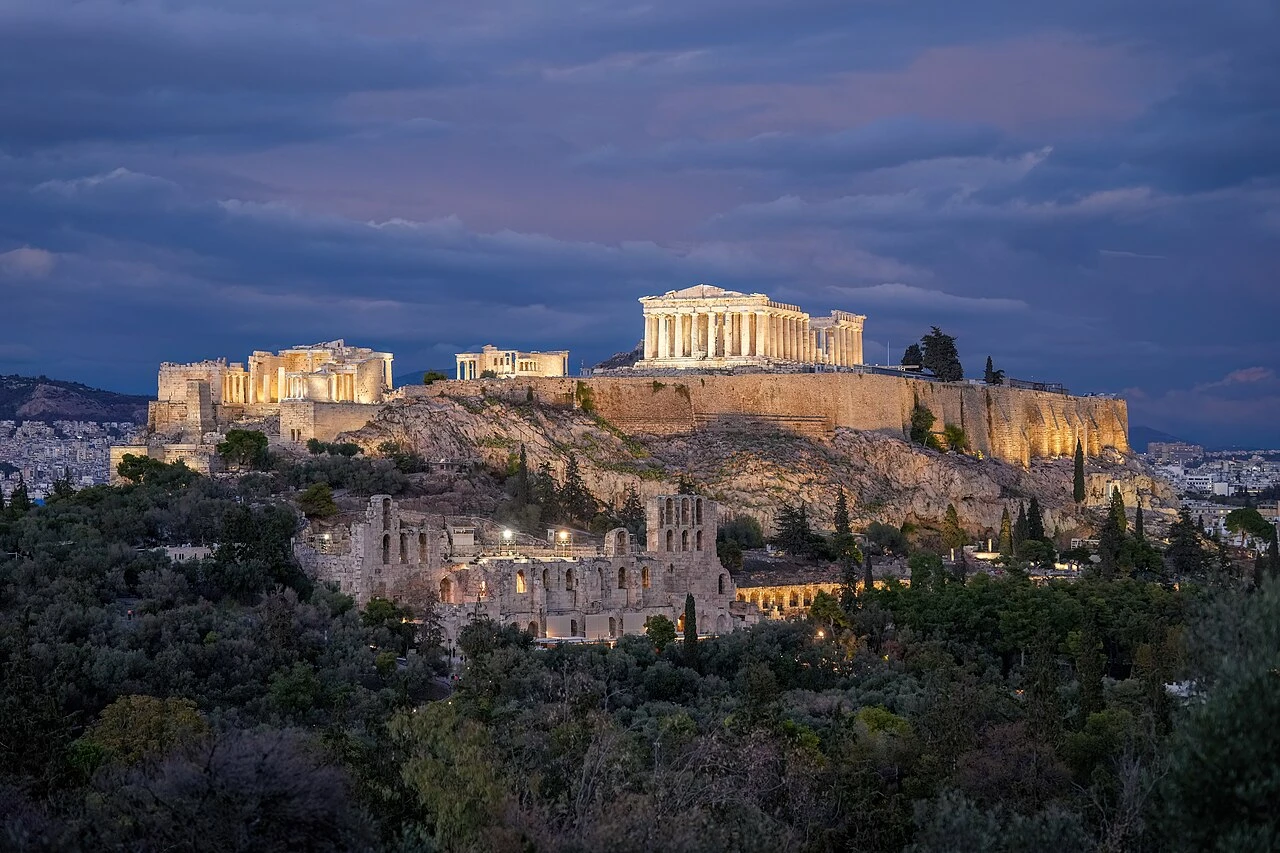
Athens
Acropolis of Athens
Content & sources
Photo: Giles Laurent · CC BY-SA 4.0
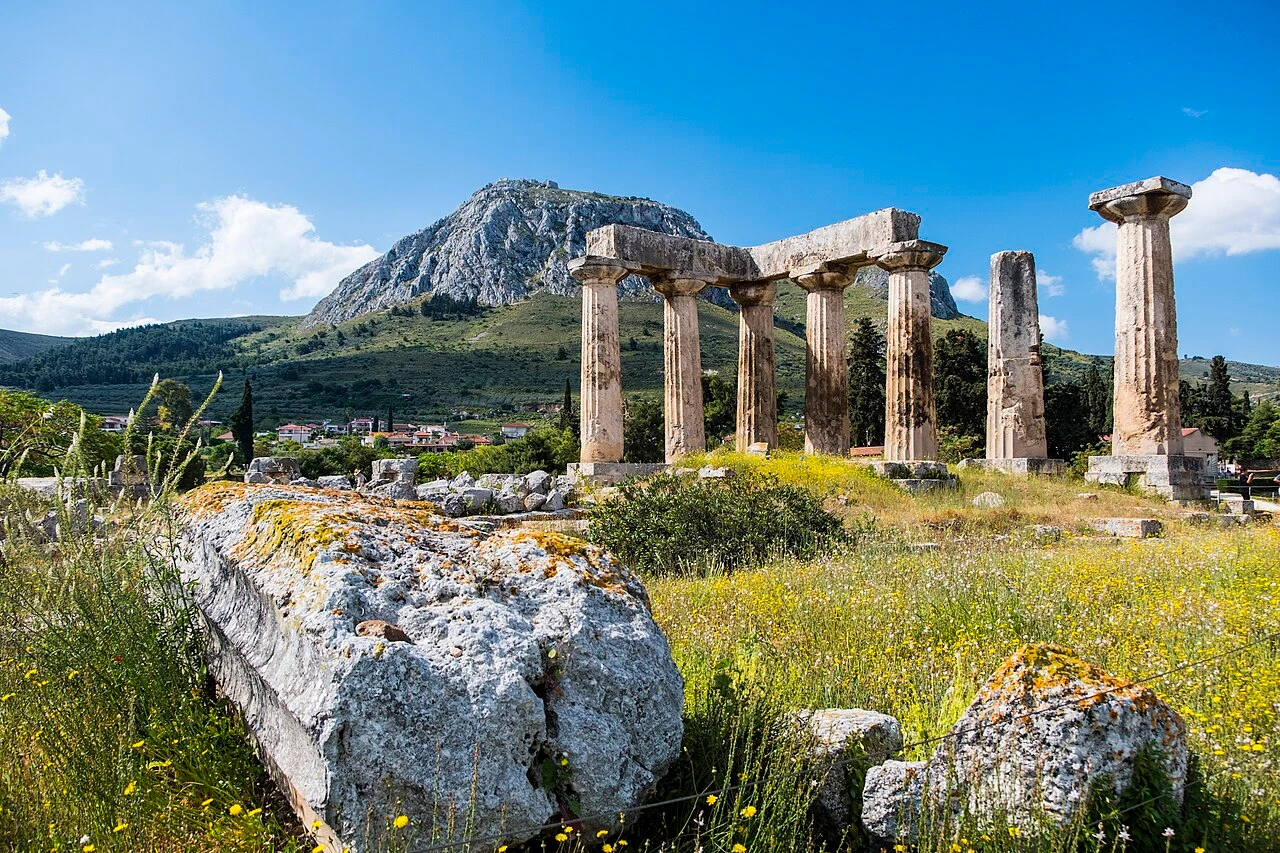
Municipal Unit of Corinth
Ancient Corinth
Content & sources
Davide Mauro · CC BY-SA 4.0
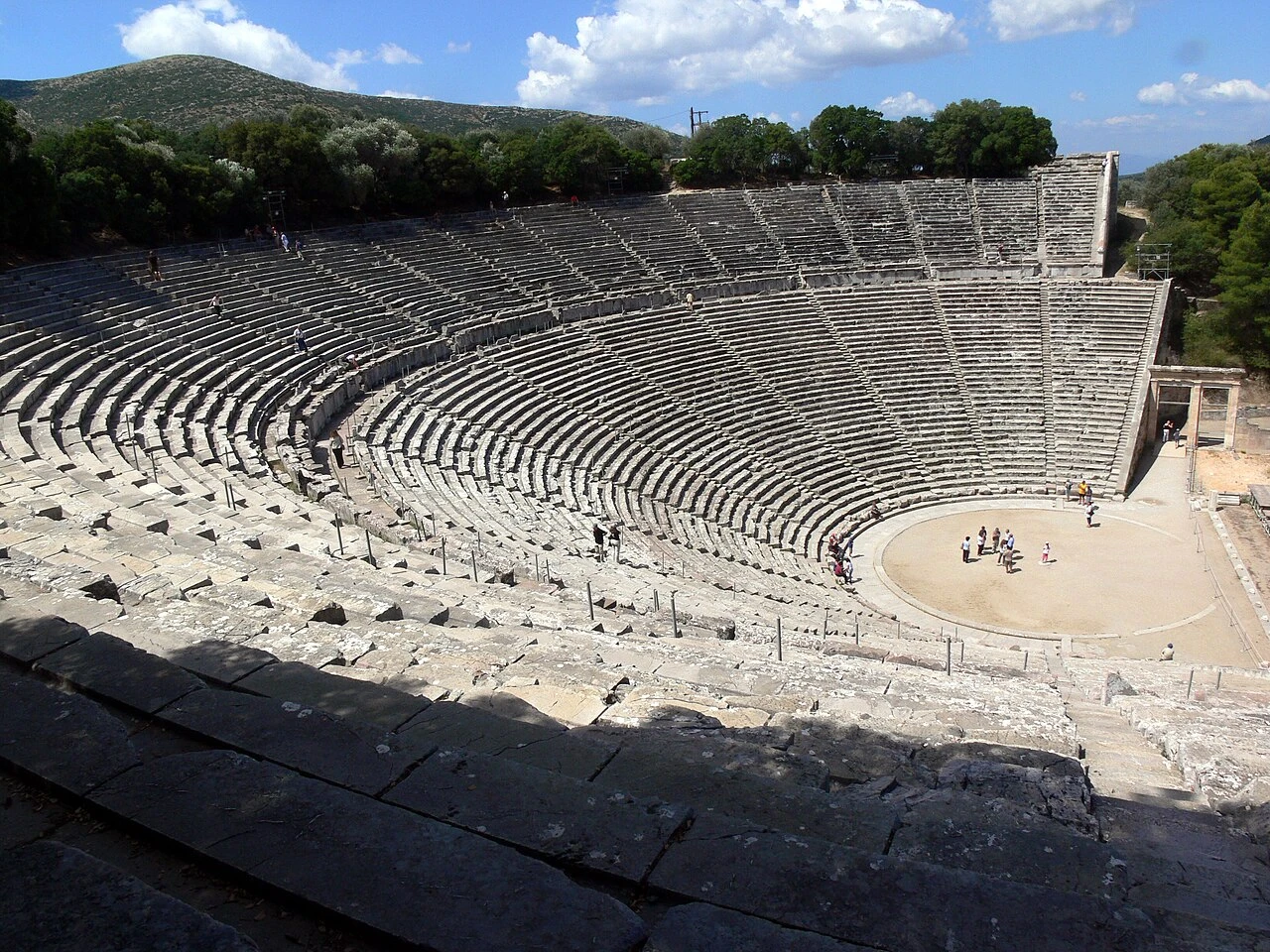
Municipal Unit of Asklipieio
Ancient Epidaurus
Content & sources
Photo: Fingalo · CC BY-SA 2.0 de
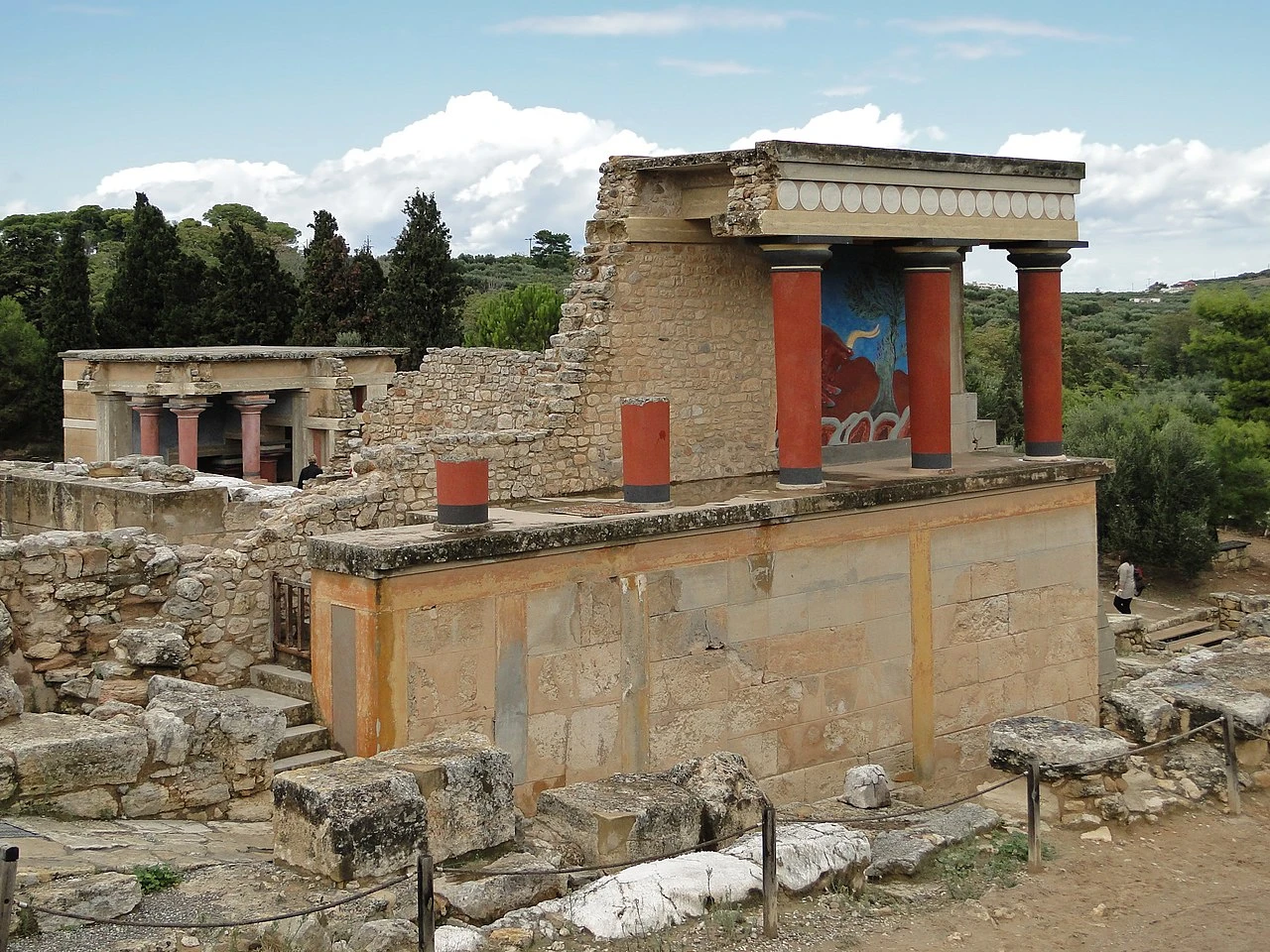
Heraklion Municipal Unit
Knossos
Content & sources
Bernard Gagnon · CC BY-SA 3.0