 Stanza / Audio guide
Stanza · Audio guide
Αρχαία Νικόπολη Audio Guide
A place to remember. A story to take with you.
Nicopolis was the capital city of the Roman province of Epirus. The city was founded in 29 BC by Octavian to commemorate his victory at the Battle of Actium.
Download Stanza, then search for “Αρχαία Νικόπολη”.
About the tour
One guide. Your kind of visit.
Nicopolis was the capital city of the Roman province of Epirus. The city was founded in 29 BC by Octavian to commemorate his victory at the Battle of Actium.
Ready when you are.
- 01Get the free Stanza app.
iOS & Android
- 02Find your guide.
“Αρχαία Νικόπολη”
- 03Download before you go.
Works offline
Audio guide / 10 narrated stops
Inside the guide
Get to know a few of the stories before you go. Open a stop to read more.
01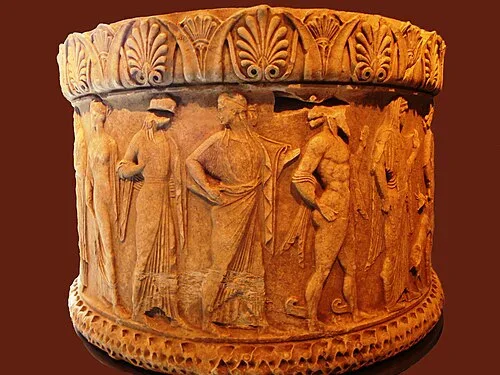 Archaeological Museum of Nicopolis
The Museum's Pedestal of Gods and Heroes
A semicircular band of marble, carved with gods and heroes of the Greek pantheon in a deliberately old-fashioned style. It probably belonged to the altar of Apollo at Augustus's victory monument, and it opens the story of the city called Nicopolis, the City of Victory. Octavian founded it in 29 BC, on the isthmus near Preveza, after his naval triumph at Actium two years earlier. It grew into the capital of a Roman province, and later into a fortified early Christian city. Victory gave the new city unusual religious weight. Augustus took over the local Actia, an old festival of Apollo Actius, and reshaped the Delphic Amphictyony, the sacred council that managed Greece's holy places. Nicopolis entered that council with ten of its twenty-four sacred representatives, more than any ancient member had ever held. For a while, this young city on the Ionian shore stood at the heart of mainland Greece's religious life.
Χαράλαμπος Γκούβας (Harry Gouvas) · CC BY-SA 4.0
02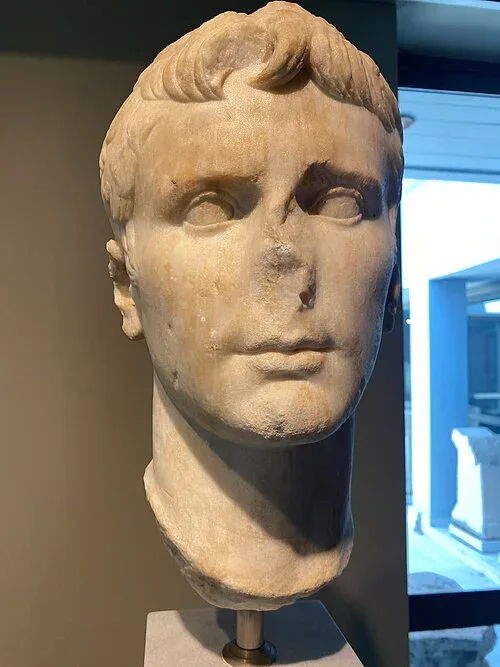 Archaeological Museum of Nicopolis
Marble Bust of Augustus
A marble portrait of the man who founded this city, Augustus, carved in the late first century BC or the first century AD. On the second of September, 31 BC, his fleet defeated Antony and Cleopatra at Actium, in the waters just across the gulf. The battle left Octavian sole master of the Roman world. The story goes that on the eve of the fighting, a peasant and his donkey crossed Octavian's path, one named Nikon, Victory, and the other Eutychios, Fortunate. Octavian took it as a sign from the gods, and later honoured both man and beast with bronze statues at his victory monument. The city was more than a memorial. It anchored Roman control of western Greece and revived a region ravaged by earlier wars. People from Kassopaia, Ambracia, Acarnania and western Aetolia were moved into it, granted freedom from taxes and citizenship equal to Rome's.
Listen in the appPhoto: Melissopetra · CC BY-SA 4.0
03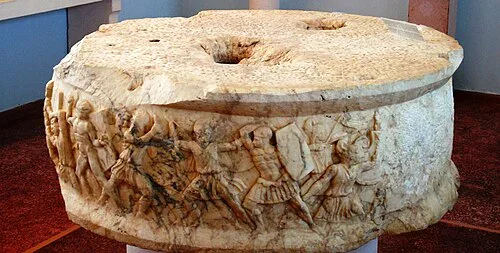 Archaeological Museum of Nicopolis
Pedestal with Amazonomachy Relief
Figures lock in combat around this cylindrical marble pedestal, in the style Romans loved for monuments: Greeks fighting Amazons, the mythic battle called the Amazonomachy. The stone itself had a long afterlife, later serving as the base for a Christian mosaic from the Alkysson Basilica. The geographer Strabo wrote that Nicopolis was flourishing and gaining people every day. Older historians claimed a population of up to three hundred thousand. Archaeologists, working from the city's street plan, put it far lower, at sixty to a hundred thousand, still a vast city for its age. From the time of Augustus, Nicopolis minted its own copper coins of fine quality, and kept doing so until 268. In the early second century, under Trajan, it became the capital of the new province of Epirus.
Listen in the appΧαράλαμπος Γκούβας (Harry Gouvas) · CC BY-SA 4.0
04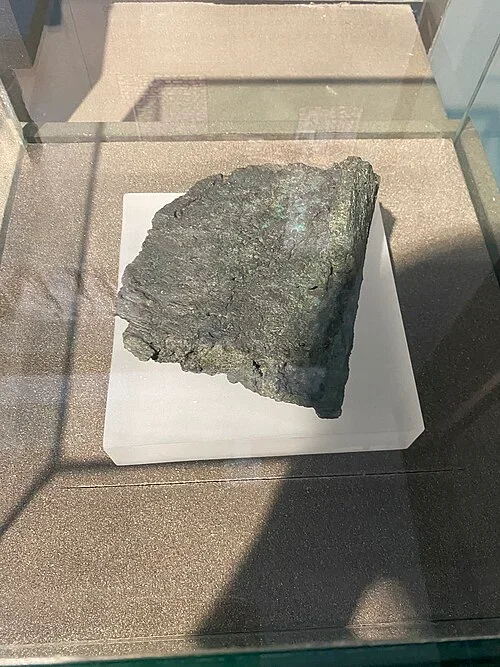 Archaeological Museum of Nicopolis
Bronze Ram from the Battle Fleets
A single corroded lump of bronze, and yet a weapon that once struck fear into a battle line. This is a ship ram, the bronze beak fitted to a warship's bow to punch through an enemy hull. The museum presents it as coming from the fleet of Antony and Cleopatra, the losing side at Actium. On the hill north of the city, where his own tent had stood during the battle, Octavian built a terraced monument and sanctuary to Apollo, his patron god, with trophies to Neptune and Mars as well. Its facade was studded with the rams of captured galleys, cut from the defeated warships, echoing the display of spoils on the speakers' platform in the Roman Forum.
Listen in the appPhoto: Melissopetra · CC BY-SA 4.0
05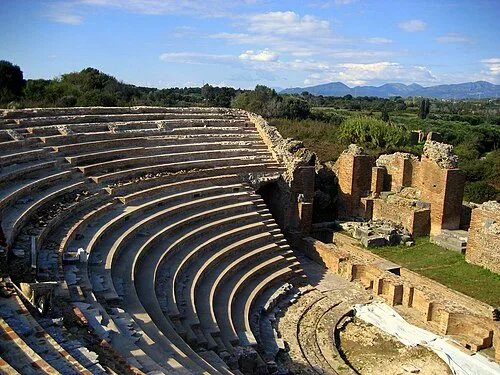 Roman Odeon of Nicopolis
A theatre built for the voice rather than the crowd. This Roman odeion held roughly a thousand spectators on its stone benches, sheltered for musical recitals, recitations of poetry and the city's civic assemblies. It belongs to a city that became a place for words of another kind too. Around the year 94, Emperor Domitian banished the philosophers from Rome. Among them was Epictetus, a former slave who had become the leading Stoic teacher of his age. He came to Nicopolis and founded his own school here. He taught that freedom is an inner state, beyond the reach of any emperor. His student Arrian wrote down his teachings, which is the main reason Epictetus's words survive. The philosopher died in Nicopolis around the year 135. The link between his school and this particular building is a tradition rather than a certainty, but the odeion embodies the city's life of speech and debate.
Listen in the appVassiliki Feidopoulou · CC BY-SA 4.0
06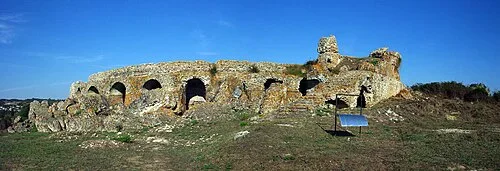 Roman Odeon of Nicopolis
Odeon Outer Wall and Arcades
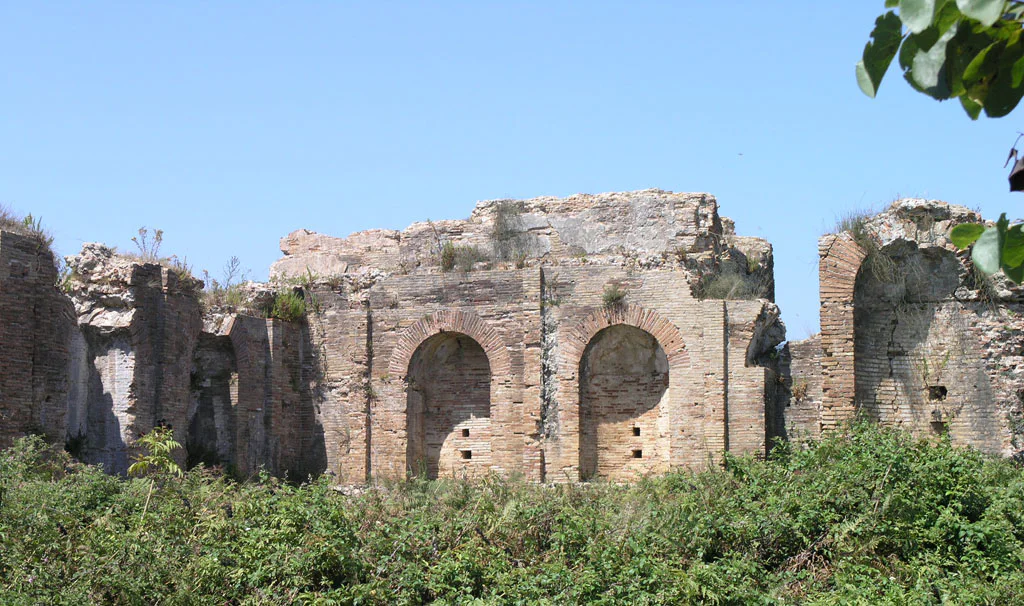
A long arcaded wall of brick and stone, holding up the hillside that carries the odeion's seats. Theaters of this kind were built into slopes, and a supporting structure like this one took the weight and enclosed the building. The ruins around it were known for centuries as Palaea Preveza, Old Preveza, about five kilometres north of the modern town. The first excavation came in 1940, when the archaeologist John Papadimitriou opened trenches here. War stopped the work almost at once. Systematic digging resumed only in recent decades, with new campaigns at ancient Nicopolis between 1997 and 2005, and much of what is visible has come to light slowly, campaign by campaign.
Listen in the appBgabel · CC BY-SA 3.0
07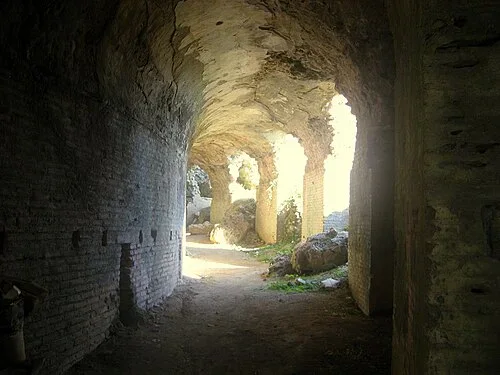 Roman Odeon of Nicopolis
Vaulted Passage of the Odeon
Overhead, the ceiling curves in a smooth continuous arch: a barrel vault, the Roman answer to covering a wide space without wooden beams. The builders raised it from bricks and rubble, courses of brick binding a core of mortar and stone. Once the brickwork was laid on its curved wooden frame and the mortar set, the arch carried itself, channelling the weight down into the side walls. The same technique runs through the city's theatres, baths and public buildings, and it is why passages like this one have held their shape for so many centuries.
Listen in the appVassiliki Feidopoulou · CC BY-SA 4.0
08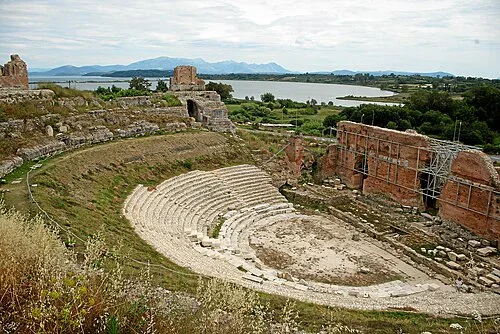 Ancient Theater of Nicopolis
Every four years, this hillside filled with spectators for the Nea Actia, the New Actian Games. Augustus made the Actia into quadrennial crown games, rated as isolympic, a rank shared with only the most prestigious contests of the Roman world. They were meant to stand beside the Olympics themselves. The games were staged here, in a theatre built for the purpose in the Proasteion, the sacred grove that lay between the city and the new sanctuary of Apollo. An inscription from the middle of the third century, now in the museum at Ioannina, shows the games were still being celebrated then, nearly three hundred years after their founding. From the upper rows, the view runs across the gulf toward Actium, the water where the victory was won.
Listen in the appPhoto: Mboesch · CC BY-SA 4.0
09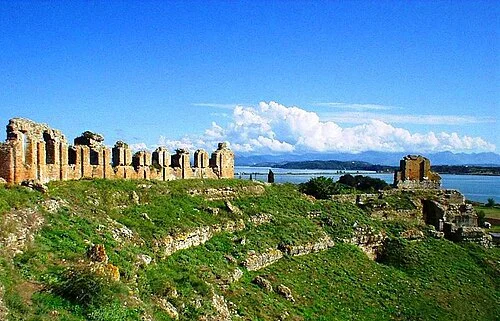 Ancient Theater of Nicopolis
Panorama over the Shrinking City
Ruins run down the hill toward the water, and the view tells what became of the victory city. From the third century onward, raiders shook the metropolis. Goths and Heruli attacked in 268, and the city escaped looting only with makeshift fortifications. In 474 the Vandals took it outright. Its people withdrew into the north-eastern quarter, around the old citadel, an area of roughly one-sixth of the original city, and enclosed it with thick new walls of brick, mortar and rubble. Around 555, the historian Procopius records, Emperor Justinian renovated those defences. In those same centuries the city turned Christian. Paul's letter to Titus urges him to come to Nicopolis for the winter, a tradition of the apostle's presence rather than a proven event. By the fifth century Nicopolis was a metropolitan see, and its bishop Eugenius wrote to Pope Leo the First in Rome, with nine bishops of Epirus signing alongside him.
Listen in the appΧαράλαμπος Γκούβας ( Harrygouvas) · Attribution
10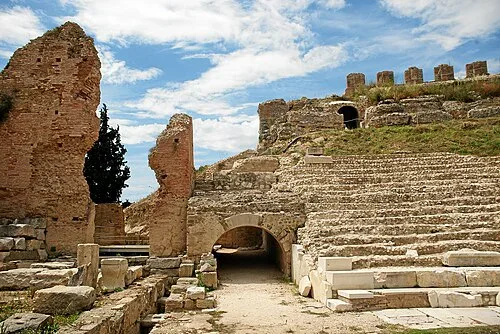 Ancient Theater of Nicopolis
Theatre Entrance and the Proasteion Complex
The arched tunnel leads into the seating of the ancient theatre, and the brick ruins around it belong to the Proasteion, the sacred grove that was built up for spectacle. Stadium, gymnasium, theatre and hippodrome stood here together. The stadium alone seated at least ten thousand spectators, with the two rounded ends typical of the Roman type. Apsidal openings on its west side led to the gymnasium, and passages at the east end connected straight to this theatre. The stadium's south end held rooms and lodgings for athletes and spectators, inns and shops among them. In the year 66, Emperor Nero came here on his tour of Greece and competed in the chariot races at the Actian Games. He was crowned the winner, and the city struck coins in his honour to say so. A city built to stage a victory, still drawing emperors to its tracks and stages a century after its founding.
Listen in the appPhoto: Mboesch · CC BY-SA 4.0
Αρχαία Νικόπολη
Frequently asked questions
How much does the guide cost?
Free app download. Listed guide price: $1.99. Guide price shown in the app. Audio guide only. Venue admission is separate.
Can I listen without internet?
Yes. Download the guide’s audio, images, and maps in the app before your visit. Your downloaded content is then available offline.
Can I listen in my language?
This audio guide is available in 15 languages, including English.
Do I need to follow a schedule?
No. This is a self-guided experience. Choose your stops, pause whenever you like, and return to a story at your own pace.
At your own pace
Explore Αρχαία Νικόπολη.
Download Stanza, then search for “Αρχαία Νικόπολη”.
Free app download · Guide price shown in the app
Keep exploring
Audio guides — Greece
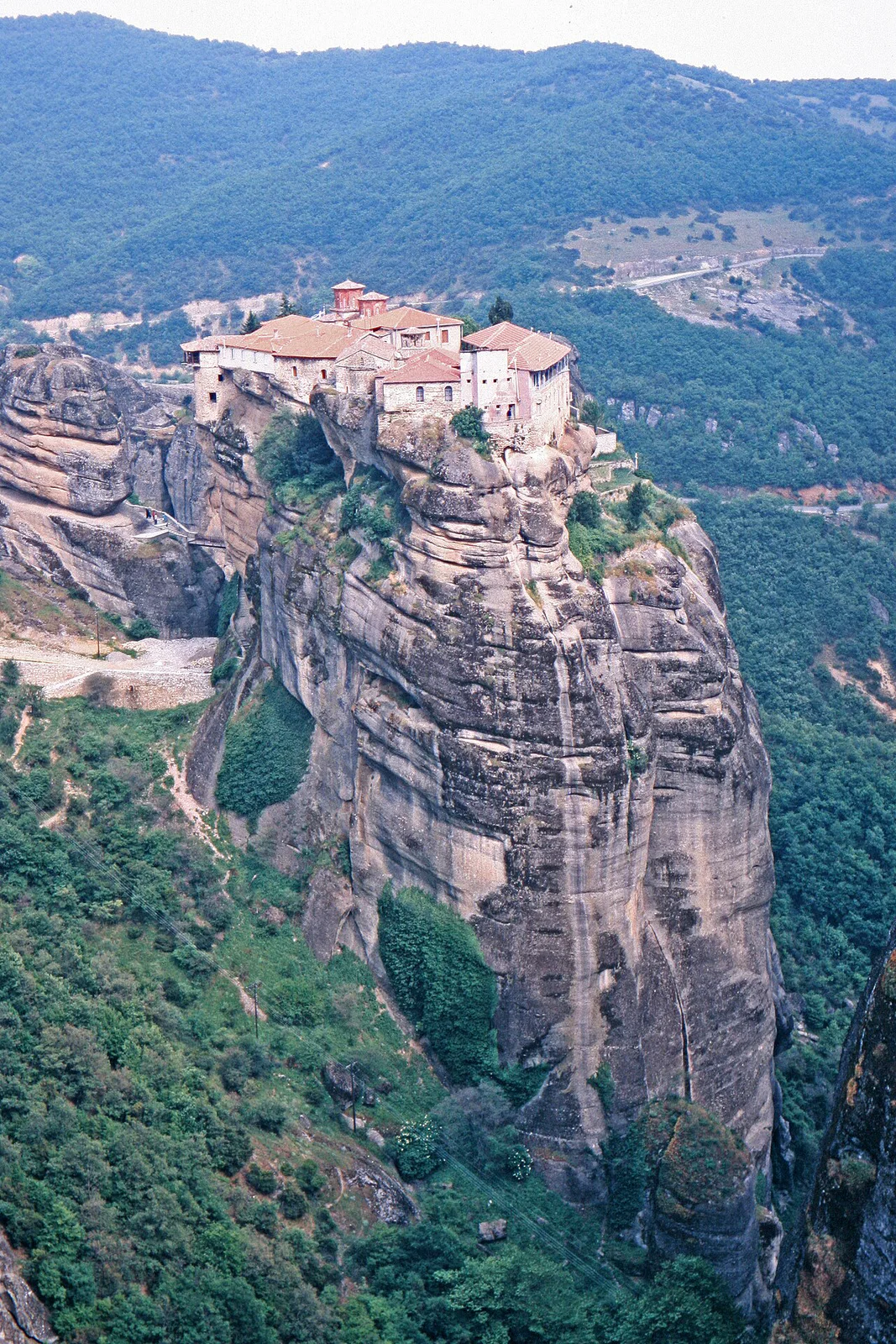
Kalambaka · 110 km
Μετέωρα
Content & sources
Photo: W. Bulach · CC BY-SA 4.0
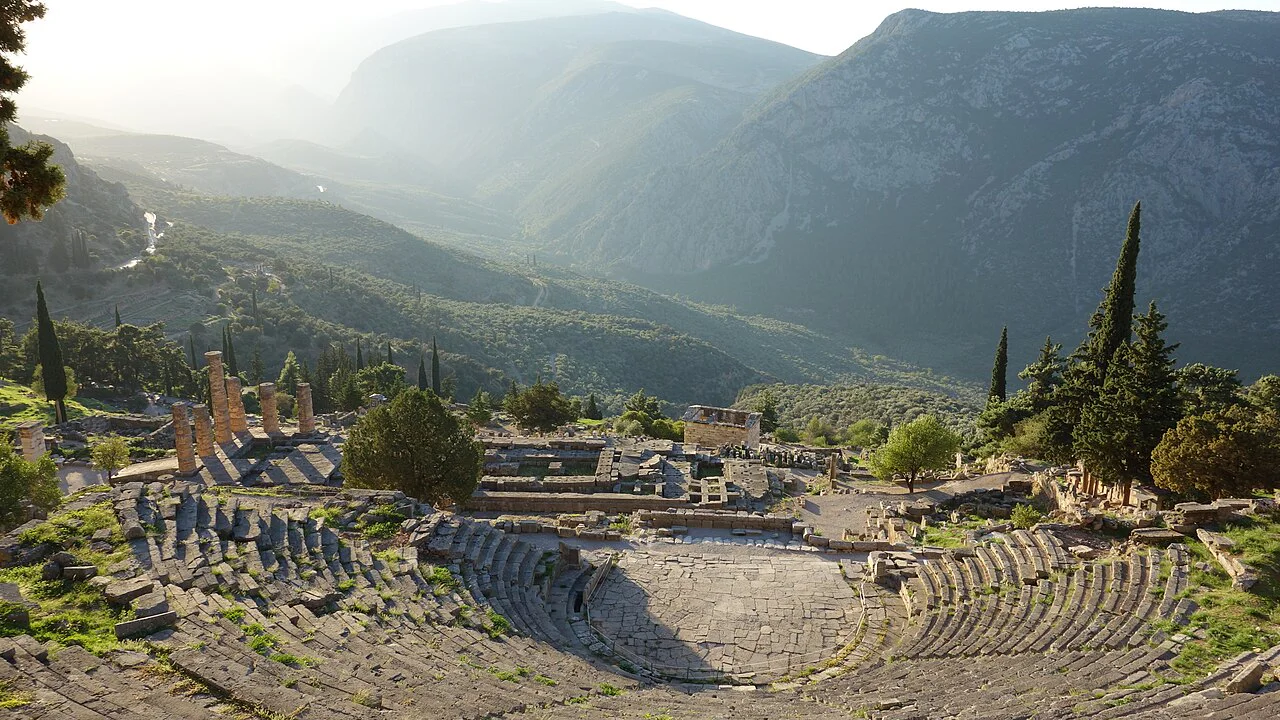
Municipal Unit of Delphi
Αρχαιολογικός Χώρος Δελφών
Content & sources
F. Harbin · CC BY 3.0
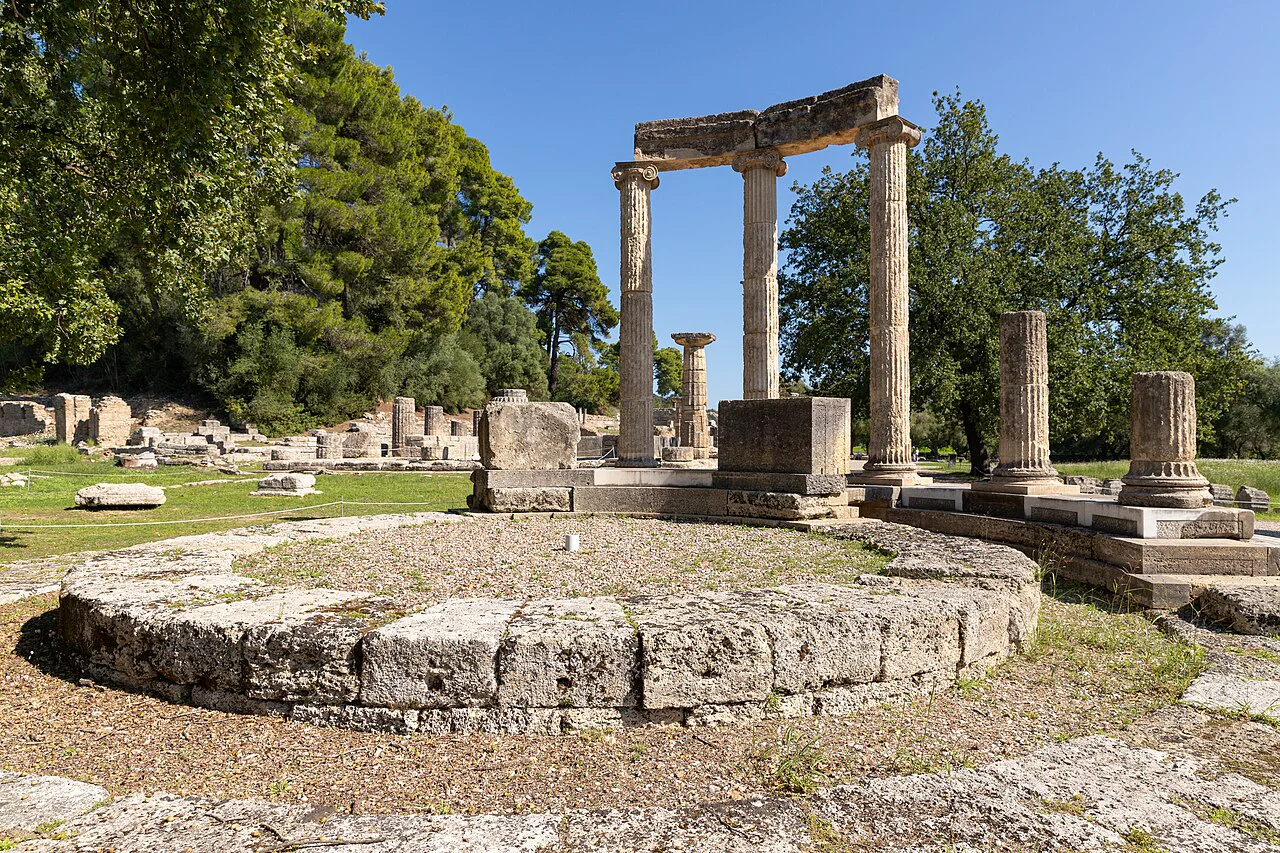
Municipal Unit of Archea Olympia
Αρχαιολογικός Χώρος Ολυμπίας
Content & sources
Photo: Dronepicr · CC BY 2.0
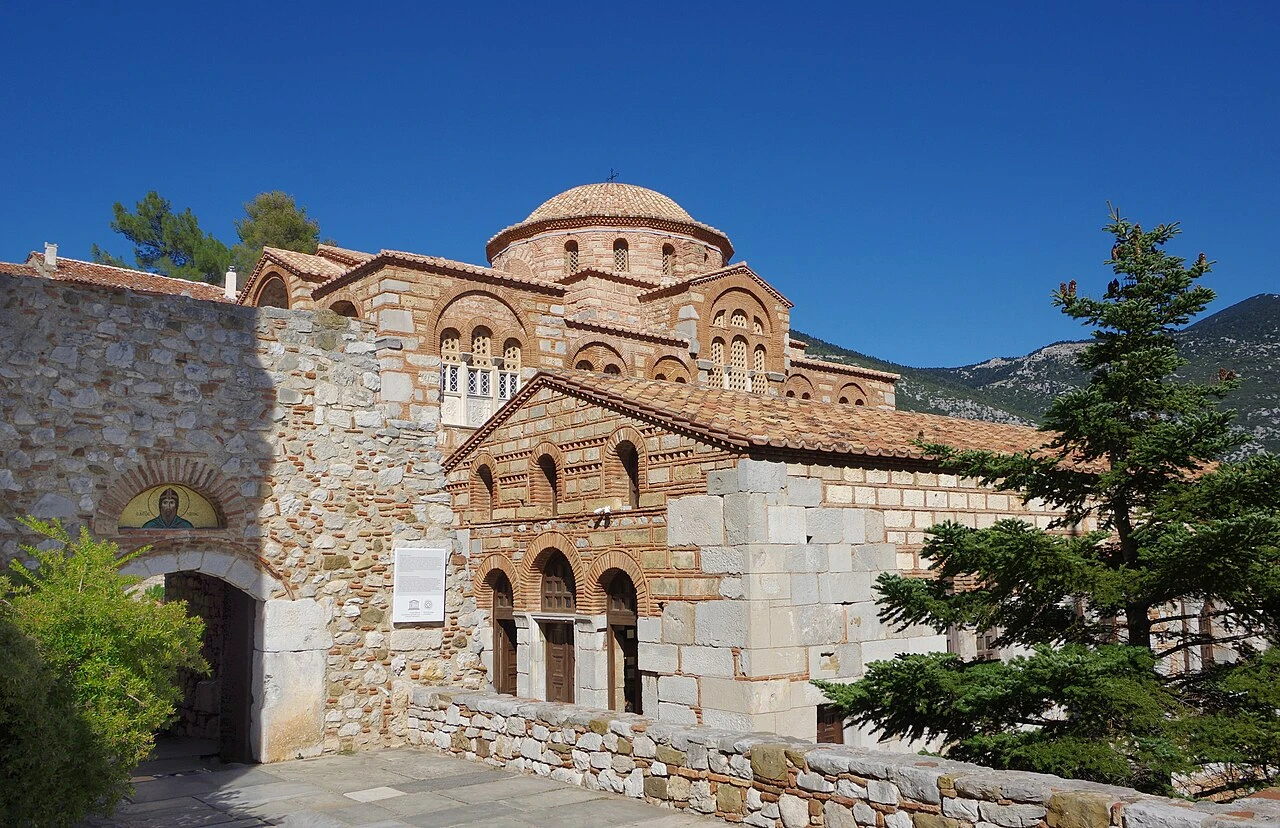
Distomo
Hosios Loukas Monastery
Content & sources
Photo: Berthold Werner · CC BY-SA 3.0