Stanza · Audio guide
Μονή Αρκαδίου Audio Guide
A place to remember. A story to take with you.
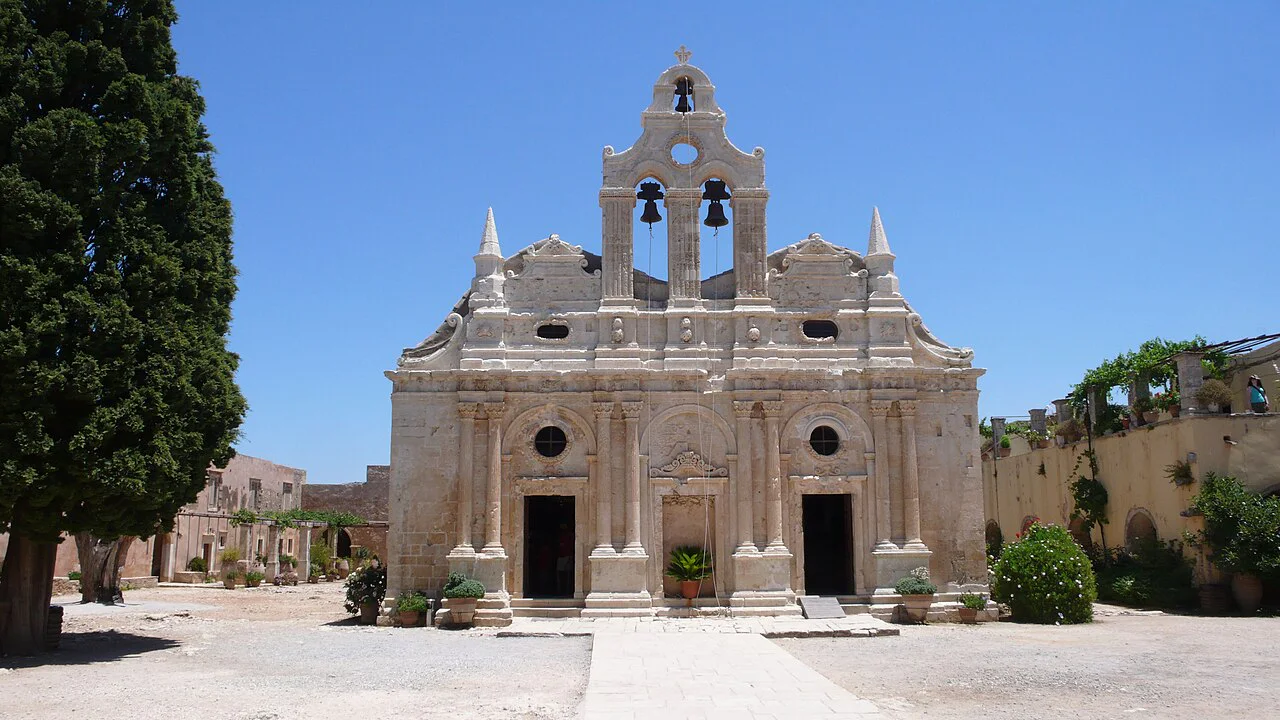
The Arkadi Monastery is a Greek Orthodox monastery situated on a fertile plateau on the island of Crete. It is historically significant as a 16th-century center of science and art that housed a school and a…
Download Stanza, then search for “Μονή Αρκαδίου”.
About the tour
One guide. Your kind of visit.
The Arkadi Monastery is a Greek Orthodox monastery situated on a fertile plateau on the island of Crete. It is historically significant as a 16th-century center of science and art that housed a school and a rich library.
Ready when you are.
- 01Get the free Stanza app.
iOS & Android
- 02Find your guide.
“Μονή Αρκαδίου”
- 03Download before you go.
Works offline
Audio guide / 11 narrated stops
Inside the guide
Get to know a few of the stories before you go. Open a stop to read more.
01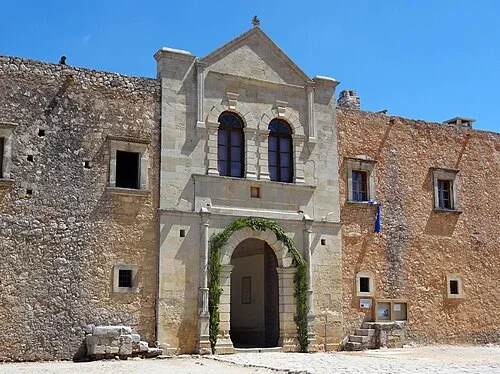 Western Gate (Rethemniotiki Door)
The Western Gate (Rethemniotiki Door)
Welcome to Arkadi, a Greek Orthodox monastery on a plateau about twenty-three kilometres southeast of Rethymno in Crete. It looks like a monastery, but the thick, high wall around it makes it a fortress as well. The main gate is the door on the western side, called Rethemniotiki after the road towards Rethymno, though some also name it Haniotiki. The first door here was built in 1693 under Hegumen Neophytos Drossas. A manuscript kept at the monastery describes it in detail: square stones, two windows upstairs with pyramid-shaped pediments, and ribbed columns carved with lions. Over the pediment ran a prayer asking the Lord to watch over the soul of Drossas and of all Christian brothers. That door was the Ottoman army's primary objective when they assaulted the monastery in November 1866, and it was destroyed in the fighting. The door standing now dates from 1870. Its builders kept the general shape, two windows framed by columns, but the lions, the pediments and Drossas's inscription were never replaced. The eastern gate, destroyed in the same assault, was rebuilt that year too.
Olaf Tausch · CC BY 3.0
02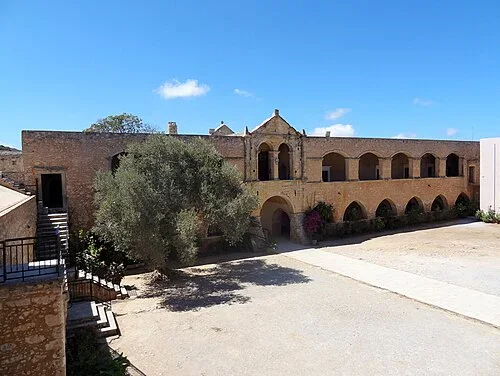 The Central Courtyard and Cloisters
Inside the walls, life went on for centuries around this arcaded courtyard. The enclosure forms a nearly rectangular quadrangle of five thousand two hundred square metres. Around it stood everything a self-contained community needed: monks' cells and workrooms, kitchens, a wine cellar, an oil cellar, storerooms and a hospice for visitors. As early as the sixteenth century, Arkadi was known as a place of science and art, with a school and a rich library. Under its first three hegumens, into the early seventeenth century, it became a great centre for copying manuscripts. Most of those manuscripts were lost in the destruction of 1866, though some survive in foreign libraries. The Ottomans had captured Rethymno in 1648 and pillaged the monastery soon after. The monks fled, then were allowed back under Hussein Pasha, on condition they swore allegiance. He also granted them the right to ring their bell, which earned the monastery its Turkish name, Çanlı Manastır, the monastery where the bell rings. An imperial firman allowed the monks to rebuild what had been destroyed, strictly to the original plans. Arkadi also quietly added a few new buildings of its own.
Listen in the appOlaf Tausch · CC BY 3.0
03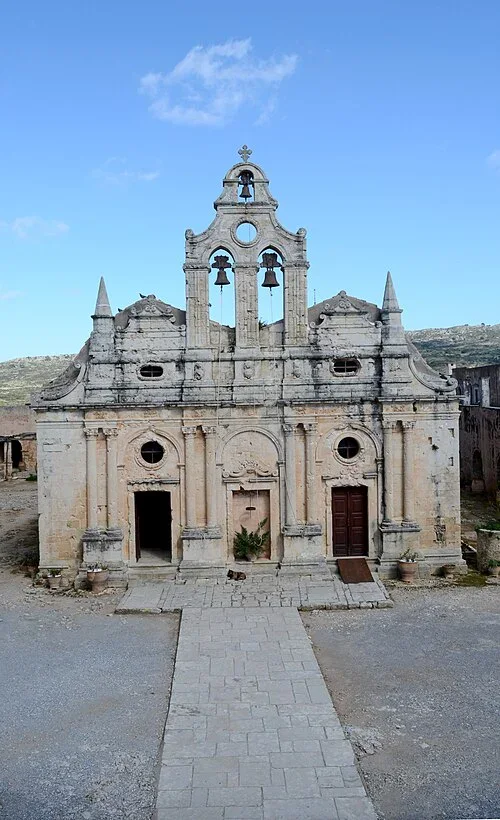 The Katholikon (Main Church)
The Katholikon: Venetian Renaissance Facade
The church at the centre of the monastery is a basilica with two naves. The northern nave is dedicated to the Transfiguration of Christ, the southern one to Saints Constantine and Helen. The building is believed to have begun in 1562, under Hegumen Klimis Chortatsis, and it took some twenty-five years to complete. The facade and both naves were finished in 1586. An inscription on the face of the clock dates the church to 1587. The style is Renaissance Revival, from the years when Crete was a colony of the Republic of Venice, mixing Roman and Baroque elements. Klimis probably died soon after his church was complete. A letter from Mélétios Pigas, Patriarch of Alexandria, says the inauguration was entrusted to Klimis's successor, the hegumen Mitrofanis Tsyrigos. That ceremony took place sometime between 1590 and 1596. There was a church here before all this, too. In 1951 the professor K. Kalokyris published an inscription found over the entrance door of an earlier church on the site. It dated to the fourteenth century and was dedicated to Saint Constantine.
Listen in the appGeorge Navro · CC BY-SA 4.0
04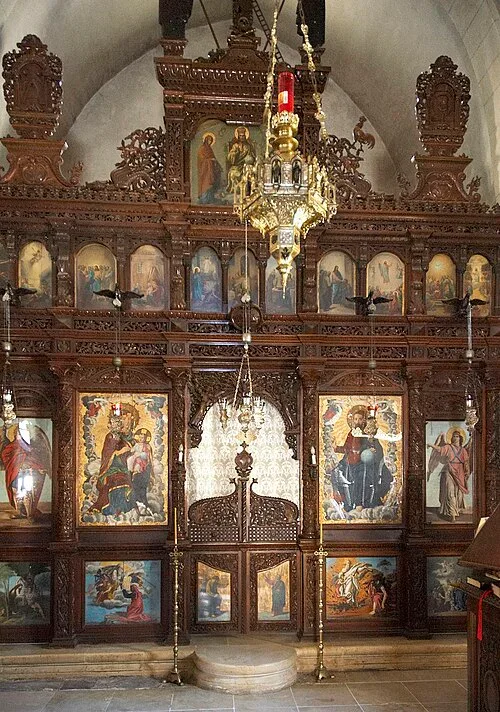 The Katholikon (Main Church)
Inside the Katholikon: Iconostasis and Restoration
Inside the church, the carved wooden screen before the altar is the iconostasis, covered in painted icons. The present one is made of cypress wood and was erected in 1902, thirty-six years after the disaster of 1866. The church had paid heavily in that year. It was torched, and the icons were entirely destroyed. Only a cross, two wooden angels and a passage showing the resurrection of Christ were saved from the flames. The apses were destroyed as well. Restoration came slowly. Between 1924 and 1927, at the initiative of Archbishop Timotheos Veneris, the apses and the clock were strengthened and repaired. In 1933 the interior tiles were replaced entirely. Veneris also set a commemorative inscription into the eastern wall in 1930, in remembrance of 1866. And the church never closed. Arkadi remains an active monastery, holding services still.
Listen in the appWouter Hagens · CC BY-SA 3.0
05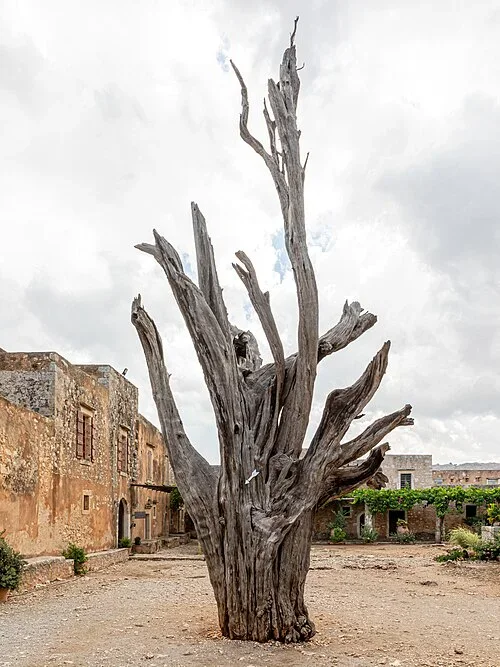 The Burnt Cypress Tree
This dead cypress in the courtyard is one of the oldest witnesses on the plateau. By the autumn of 1866 it looked out on a monastery filling with refugees. Isma'il Pasha had already sent his warning through the Bishop of Rethymno, Kallinikos Nikoletakis: dismiss the revolutionary assembly, or the monastery would be destroyed. In September, Panos Koronaios landed in Crete and was made commander-in-chief for the Rethymno region. A career soldier, he judged the monastery indefensible. The hegumen and the monks disagreed, and Koronaios conceded to them. He named Ioannis Dimakopoulos commander of the garrison and left. Local families then took refuge inside the walls, bringing their valuables in hopes of saving them from the Turks. By 7 November 1866 the monastery sheltered 964 people. Of these, 325 were men. 259 of the men carried arms. The rest were women and children. They lived out the last days in the cells and courtyards where the monks had lived for centuries.
Listen in the appDietmar Rabich · CC BY-SA 4.0
06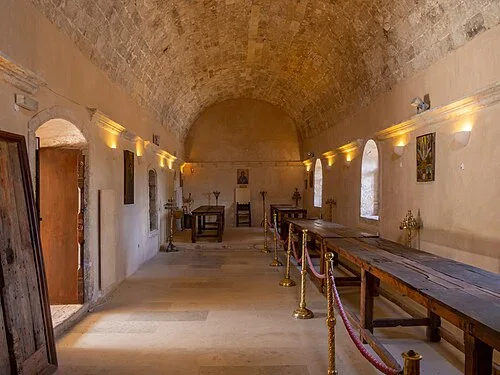 The Monastic Refectory (Trapeza)
The Refectory (Trapeza)
The long vaulted hall on the northern side is the refectory, where the monks took their meals. An inscription by the courtyard door records that it was built in 1687, and names Neophytos Drossas, the same hegumen who raised the western gate. The room runs about eighteen metres, covered by a vault, with the kitchens at its eastern end. It has not changed since it was built. In November 1866 it became the scene of the assault's last fighting. Here the final defenders made their stand. Thirty-six insurgents, out of ammunition, were discovered in the hall. When the Ottomans forced the door, they were killed. The marks are still in the wood of the tables and chairs: traces of bullets and swords.
Listen in the appPhoto: C messier · CC BY-SA 4.0
07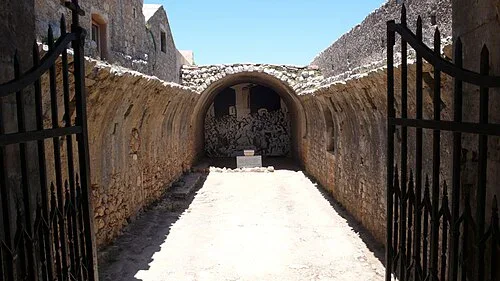 The Powder Magazine (Poudrière)
This roofless vaulted passage was once the powder magazine, an oblong chamber twenty-one metres long. Before the attack, fearing the magazine could easily be broken into, the munitions were moved down to a cellar, just under a metre lower. It made no difference in the end. On 9 November 1866 the Ottomans broke into the monastery. Most of the women and children were hiding in the powder room. Konstantinos Giaboudakis called the people hiding in the neighbouring rooms to join them there. When the Turks reached the door of the powder room, he set the barrels of powder alight. The explosion killed those inside and many of the attackers with them. Of those within the walls, 846 died in the fighting or in the blast. 114 were taken prisoner to Rethymno. Three or four slipped away, among them one of the messengers sent for help. The chamber itself was destroyed entirely, apart from a small piece of the western vault. The remains of the Cretan dead were later gathered at the memorial ossuary outside the walls.
Listen in the appPhoto: Prekario · CC BY-SA 3.0
08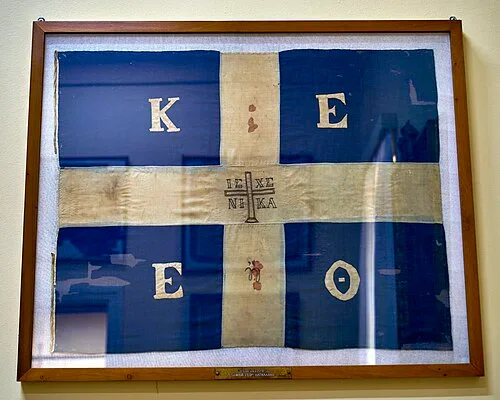 The Monastery Museum & Sacred Relics
The Insurgent Flag in the Museum
Among the relics in the monastery museum hangs this flag. It is blue and white, with the Greek letters K, E, E and O set around a cross bearing the inscription Ichthys Nika. After the events of 1866, the story of Arkadi travelled far beyond Crete. The explosion did not end the insurrection, but it changed how the world saw the conflict. Victor Hugo's letters, published in the newspaper Kleio in Trieste, placed Arkadi alongside Psara and Missolonghi. He encouraged the Cretans and told them their cause would succeed. Giuseppe Garibaldi praised the patriotism of the Cretans in his own letters. Volunteers from Serbia, Hungary and Italy came to the island. The monastery's name even went to sea. A ship called Arkadi ran munitions to the insurgents from Greece. It made twenty-three voyages in all. The Turks finally sank it in 1868.
Listen in the appPhoto: George E. Koronaios · CC BY-SA 4.0
09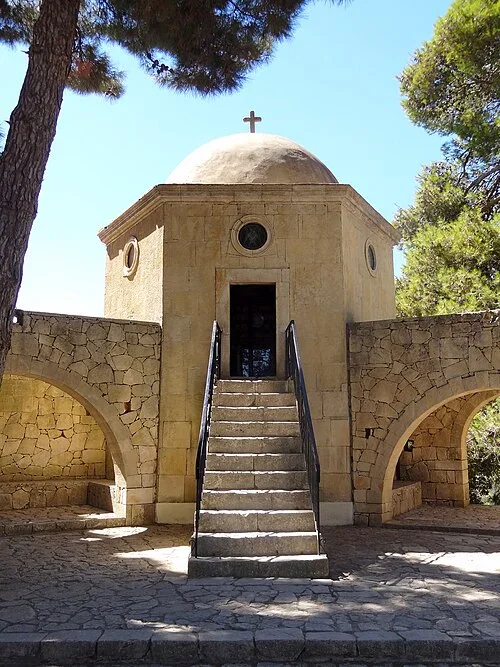 The Memorial Heroon & Ossuary
The Memorial Ossuary (Heroon)
About sixty metres west of the walls stands the octagonal domed building of the Heroon, the monastery's memorial. It began life as a windmill, and later served as a storeroom. In 1910, at the initiative of Dionyssios, then Bishop of Rethymnon, it took the shape it has now. Inside, behind glass, lie the remains of those who died in 1866. The bones carry the marks of the battle, pierced by bullets and cut by swords. Above them an inscription commemorates the sacrifice of the fallen Cretans. The building sits on the open plateau and looks out over the gorges below.
Listen in the appOlaf Tausch · CC BY 3.0
10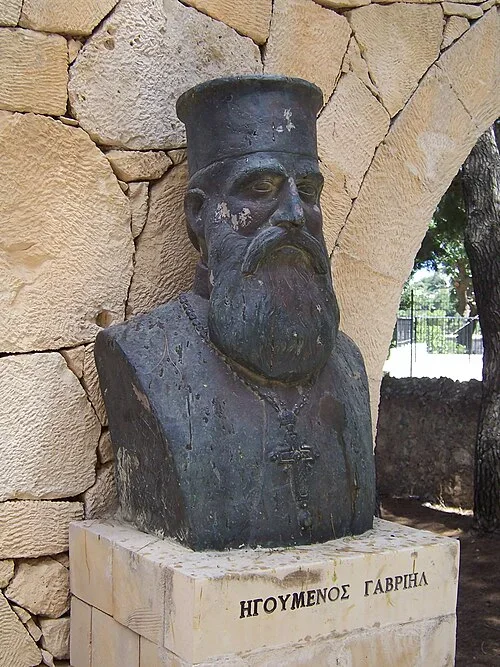 The Memorial Heroon & Ossuary
Bust of Hegumen Gabriel
The bronze bust here is labelled Hegoumenos Gabriila, Hegumen Gabriel. He was the abbot of Arkadi in 1866, and bore responsibility for the decision to stand rather than surrender. When the assault came, he remained inside the walls with the refugees. Gabriel was among the victims of the siege. How he died is not settled. Tradition holds that he perished in the explosion of the powder barrels. It is more likely that he was killed on the first day of combat. Either way, the man who would not yield the monastery is honoured here in bronze, among the dead he led.
Listen in the appPhoto: Aeleftherios · CC BY-SA 3.0
- 11
Bust of Konstantinos Giaboudakis
The bust of Konstantinos Giaboudakis, and what Arkadi has come to mean, commemorated every year on the eighth of November.
Μονή Αρκαδίου
Frequently asked questions
How much does the guide cost?
Free app download. Listed guide price: $0.99. Guide price shown in the app. Audio guide only. Venue admission is separate.
Can I listen without internet?
Yes. Download the guide’s audio, images, and maps in the app before your visit. Your downloaded content is then available offline.
Can I listen in my language?
This audio guide is available in 15 languages, including English.
Do I need to follow a schedule?
No. This is a self-guided experience. Choose your stops, pause whenever you like, and return to a story at your own pace.
At your own pace
Explore Μονή Αρκαδίου.
Download Stanza, then search for “Μονή Αρκαδίου”.
Free app download · Guide price shown in the app
Keep exploring
Nearby audio guides
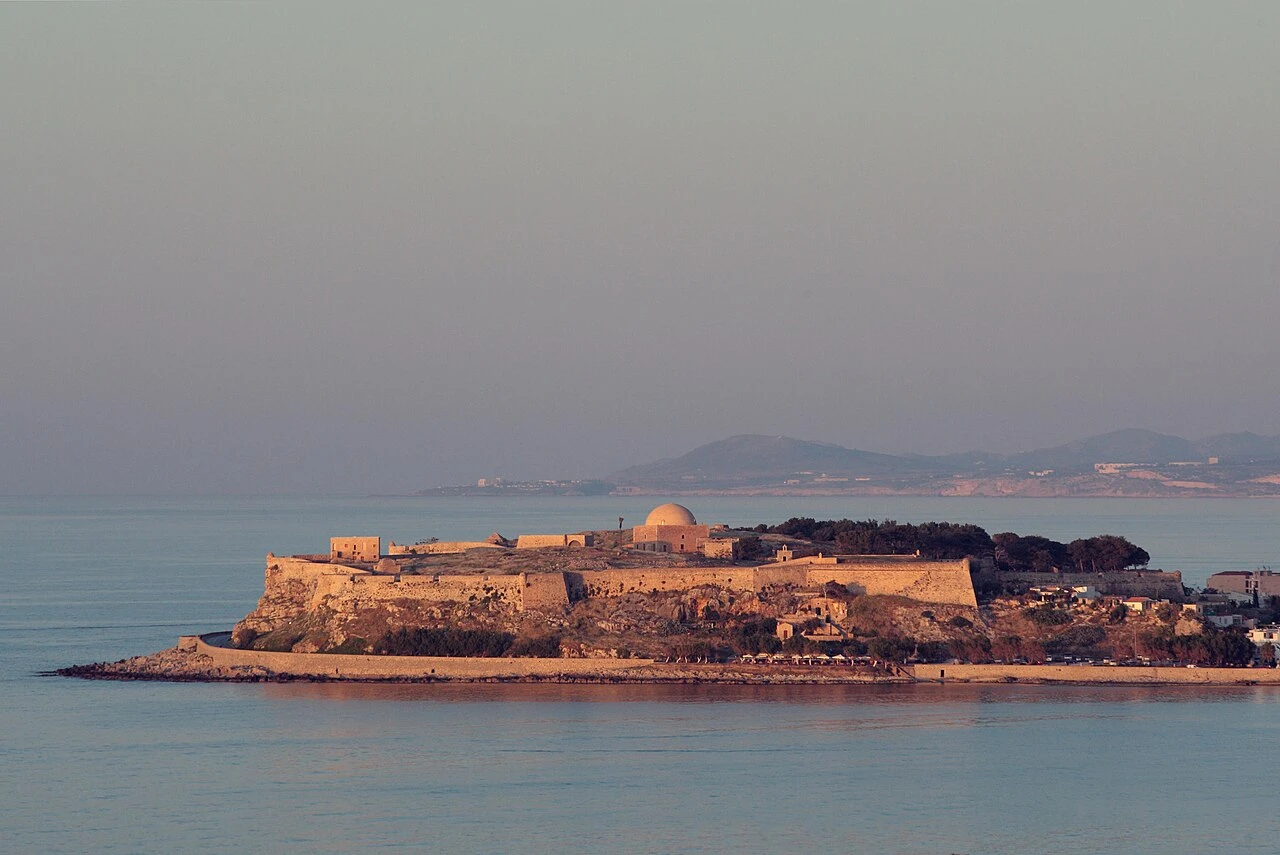
Rethymno · 16 km
Fortezza of Rethymno
Content & sources
Jerzy Strzelecki · CC BY 3.0
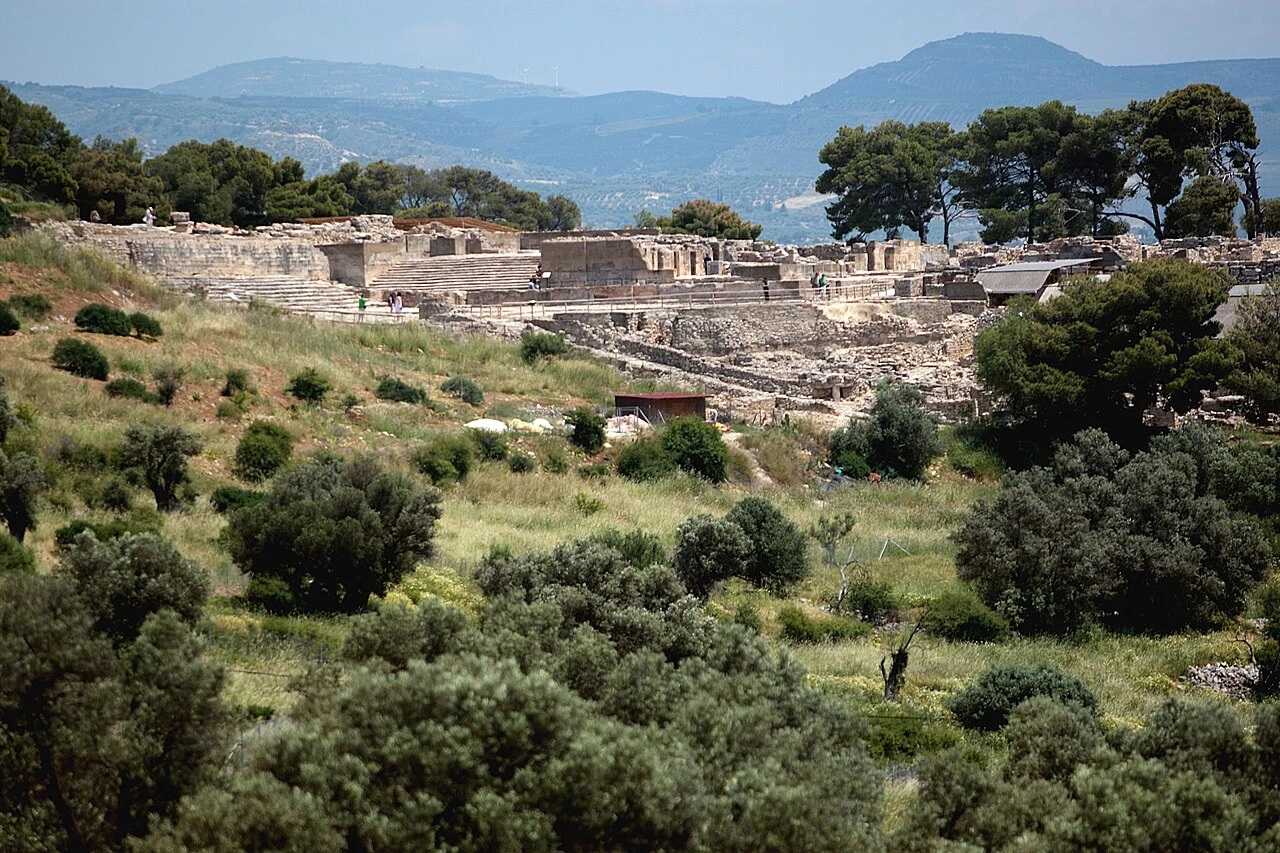
Phaistos · 33 km
Phaistos
Content & sources
Jerzy Strzelecki · CC BY-SA 3.0
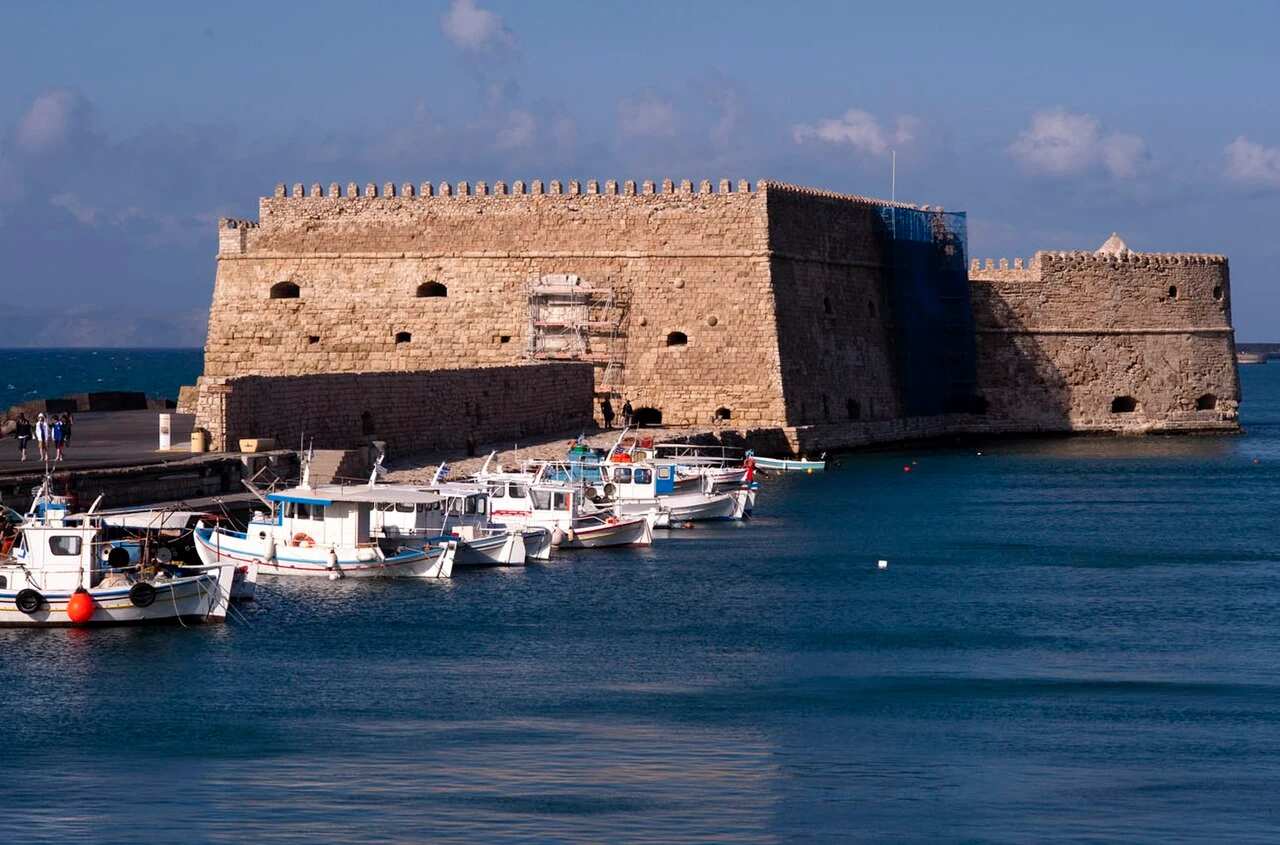
Heraklion · 46 km
Rocca a Mare
Content & sources
Γεώργιος Γιαννόπουλος · CC BY-SA 3.0
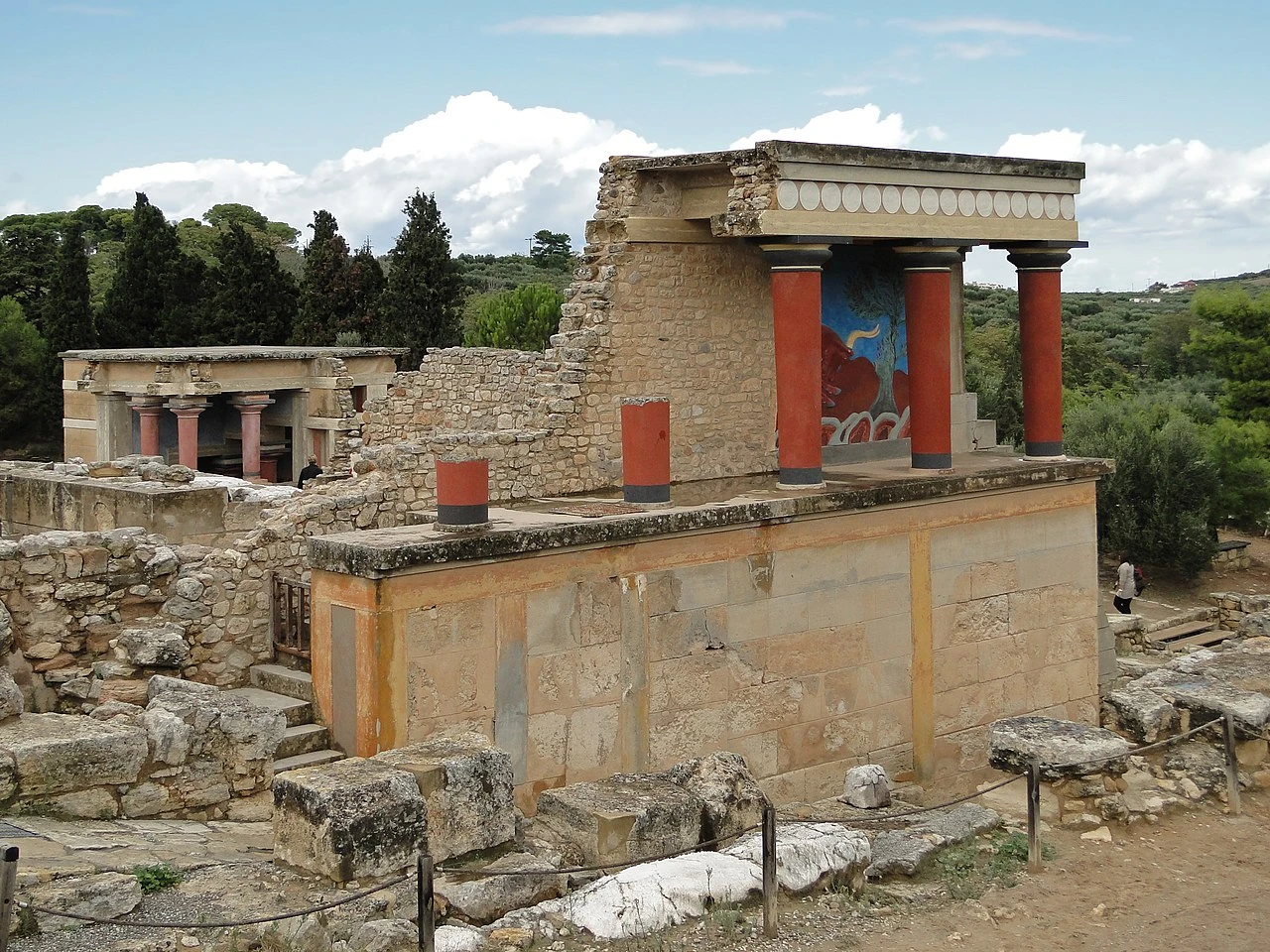
Heraklion · 48 km
Knossos
Content & sources
Bernard Gagnon · CC BY-SA 3.0