Stanza · Audio guide
Ιερός Ναός Αγίου Δημητρίου Θεσσαλονίκης Audio Guide
A place to remember. A story to take with you.
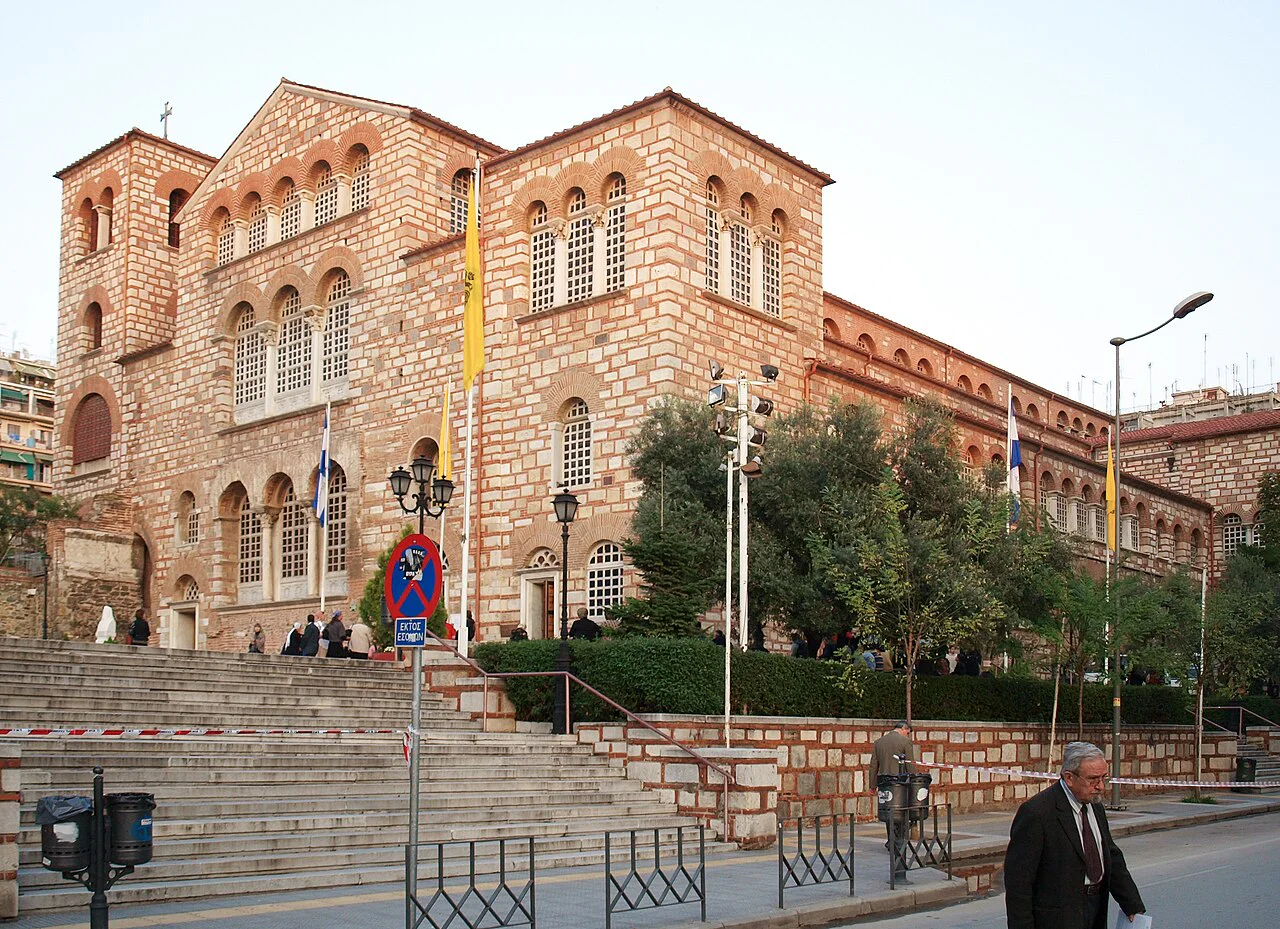
The Church of Saint Demetrius is the main sanctuary dedicated to the patron saint of Thessaloniki. It has been on the UNESCO World Heritage List since 1988 as part of the Paleochristian and Byzantine…
Download Stanza, then search for “Ιερός Ναός Αγίου Δημητρίου Θεσσαλονίκης”.
About the tour
One guide. Your kind of visit.
The Church of Saint Demetrius is the main sanctuary dedicated to the patron saint of Thessaloniki. It has been on the UNESCO World Heritage List since 1988 as part of the Paleochristian and Byzantine monuments of Thessaloniki.
Ready when you are.
- 01Get the free Stanza app.
iOS & Android
- 02Find your guide.
“Ιερός Ναός Αγίου Δημητρίου Θεσσαλονίκης”
- 03Download before you go.
Works offline
Audio guide / 12 narrated stops
Inside the guide
Get to know a few of the stories before you go. Open a stop to read more.
01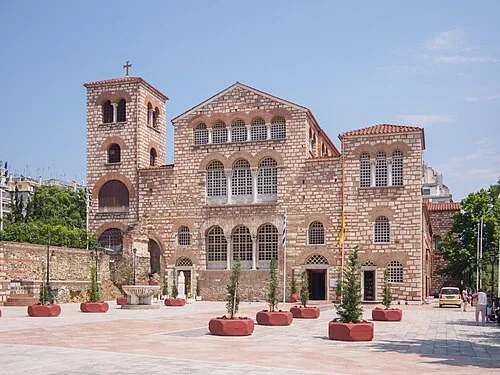 Basilica Forecourt and the Byzantine Phiale
Western Facade and Forecourt of the Basilica of Saint Demetrios
Saint Demetrios is the patron saint of Thessaloniki, and this basilica is his main sanctuary. This tour covers the church's history, its mosaics and relics, and the crypt below it. In its time it was the most important shrine in the city. The church dates from a time when Thessaloniki was the second largest city in the Byzantine Empire. Its broad front has rows of tall arched windows and a steep gable roof. A tower topped by a small cross rises at one end. Red planters with young trees line the paved forecourt. The church is still an active Orthodox place of worship. UNESCO listed it in 1988 as part of the early Christian and Byzantine monuments of Thessaloniki.
Listen in the appPhoto: C messier · CC BY-SA 4.0
02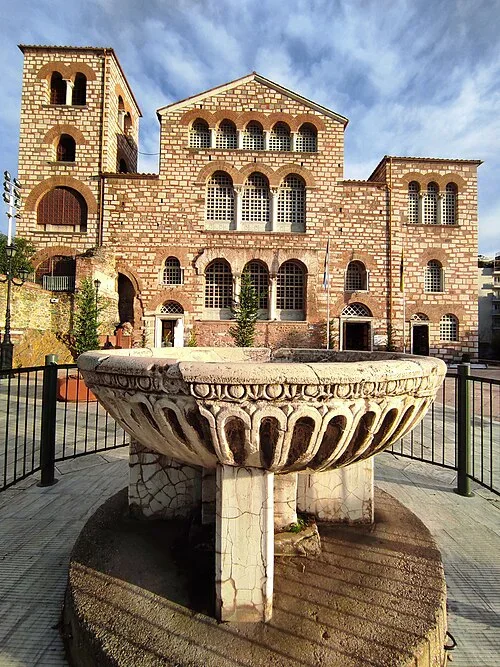 Basilica Forecourt and the Byzantine Phiale
Forecourt Basin and the Architect's Monogram
This round marble bowl in the forecourt is a Byzantine holy-water basin. Its Greek name, phiale, is the word for the vessel that holds blessed water. Look at the west front behind it. Carved into the stone of one of its windows is the monogram of Aristotelis Zachos, the architect who directed the rebuilding of the church, together with the date 1927. Zachos had kept notes, drawings and photographs of the building before it burned. With those, and with a team that included the archaeologist Georgios Sotiriou and the French planner Ernest Hébrard, the church was rebuilt from the foundations. It was given back to worship on the saint's feast day, the twenty-sixth of October.
Listen in the appPhoto: PLAKLE · CC BY-SA 4.0
03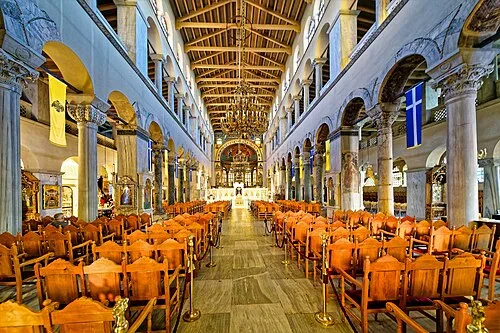 The Five-Aisled Nave and Byzantine Colonnades
Interior of the Five-Aisled Nave
The first church on this spot was a small oratory, built where an old Roman bath had stood. Later, a prefect named Leontios replaced it with a larger church with three aisles. Fires gutted the church more than once. In 629, the church was rebuilt. The work ran on until 634. It became a basilica with five aisles, the form it has today. The church is a little over forty-three metres long, counting the altar. It is thirty-three metres wide, and it is the largest church in the city. Rows of columns with carved tops line the central aisle, and wooden chairs fill the floor. A pitched ceiling with long beams runs overhead. At the far end, icons fill the sanctuary beneath a hanging chandelier. Then came the fire of 1917. It destroyed much of the city, and it took the church's roof and upper walls. Restoration took decades. In the 1940s, restorers used tombstones from the city's Jewish cemetery as building material. That cemetery was destroyed by Greek and Nazi German authorities. After restoration, the church was reconsecrated in 1949.
Listen in the appPhoto: Holger Uwe Schmitt · CC BY-SA 4.0
04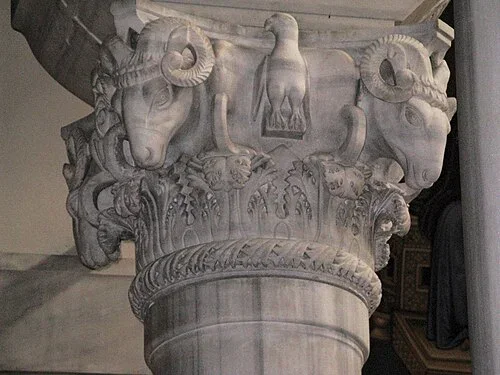 The Five-Aisled Nave and Byzantine Colonnades
Carved Capital with Rams and a Bird
Two ram heads with curled horns sit at the upper corners of this carved capital. Between them a small bird sits with its wings folded. Below the animals, deeply cut leaves rise in layers, in the style known as acanthus. Beneath the leaves, a plain round shaft carries the column down. A capital crowns the top of a column and gives the arch above it a place to rest. Nothing in the carving itself explains what the rams and the bird meant. Capitals like this one stand along the nave, and birds appear in other marble carving in the church too.
Listen in the appPhoto: Yair-haklai · CC BY-SA 4.0
05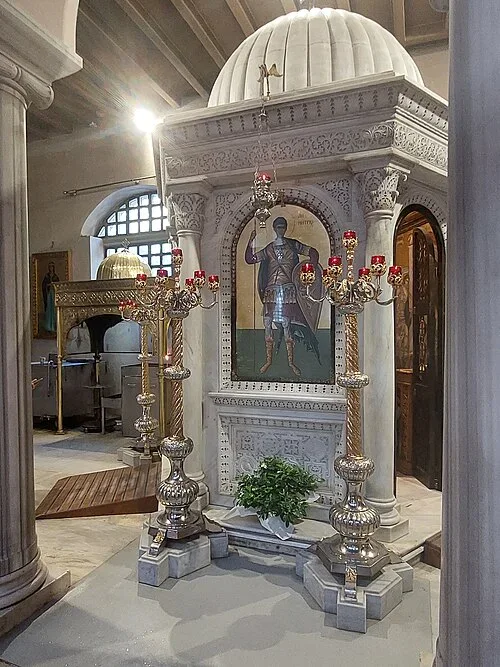 North Aisle: The Saint's Ciborium and Spantounis Tomb
North Aisle Marble Ciborium and Relic Shrine
The relics of Saint Demetrios rest in a white marble canopy in the north aisle. A structure like this is called a ciborium, a canopy set over a holy object. Its domed top is crowned with a cross, and an icon of a standing saint in armour fills the niche. An earlier ciborium, made of silver, was lost in a fire in the seventh century. A marble one was made to replace it. That first marble ciborium was destroyed in 1430, when the Ottomans took the city, so the one here is the second. Probably around the turn of the thirteenth century, some of the relics were taken to Italy. That may have happened under the Latin rulers of Thessaloniki. The relics were found again in 1520 at the abbey of San Lorenzo in Campo, in Italy. The head came back to Thessaloniki in 1978. Most of the relics returned in 1980. Six large fragments stayed in Italy.
Listen in the appPhoto: Kajmakcalan1916 · CC0
06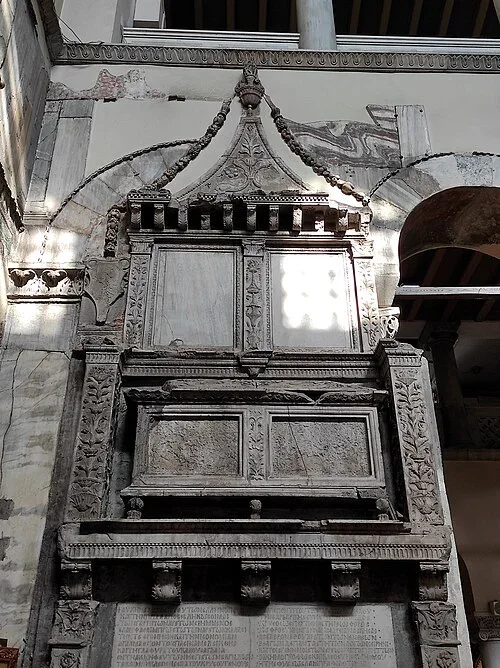 North Aisle: The Saint's Ciborium and Spantounis Tomb
Tomb of Loukas Spantounis (1481)
Loukas Spantounis, a lord of Thessaloniki, was buried inside this church in 1481. His tomb stands in the north-west corner of the central aisle, between a pier and the first column of the colonnade. The city had been under Ottoman rule for more than fifty years by then. The carving has features of the Italian Renaissance, and the tomb was probably made in Italy. Carved chains that look like garlands hang from its pointed top. Vine-like flowers twine up its side pillars. A Greek inscription of twenty-two lines of verse honours him.
Listen in the appPhoto: PLAKLE · CC BY-SA 4.0
07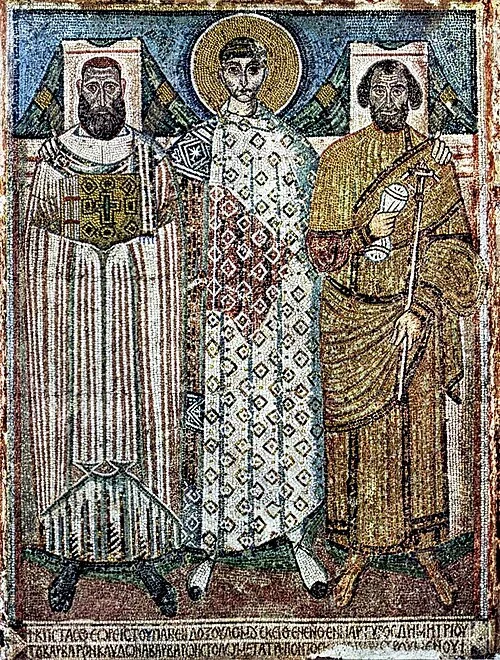 Sanctuary Piers and Pre-Iconoclastic Mosaics
Saint Demetrios between the Bishop and the Eparch (Mosaic)
Saint Demetrios stands at the centre of this mosaic, flanked by two men who restored the church. He wears a halo and a tunic with a patterned design. The bishop wears a vestment marked with a cross. The eparch, the city's prefect, wears a gold cloak and holds a long staff. The Greek term for such men is ktetors, which means founders. Six mosaic panels survive from the period between the church's last rebuilding and the start of Iconoclasm. Iconoclasm was a movement against religious images, and it began in 730. The date of this panel is disputed. Proposals range from the fifth century to the eighth.
Listen in the appUnknown author · Public domain
08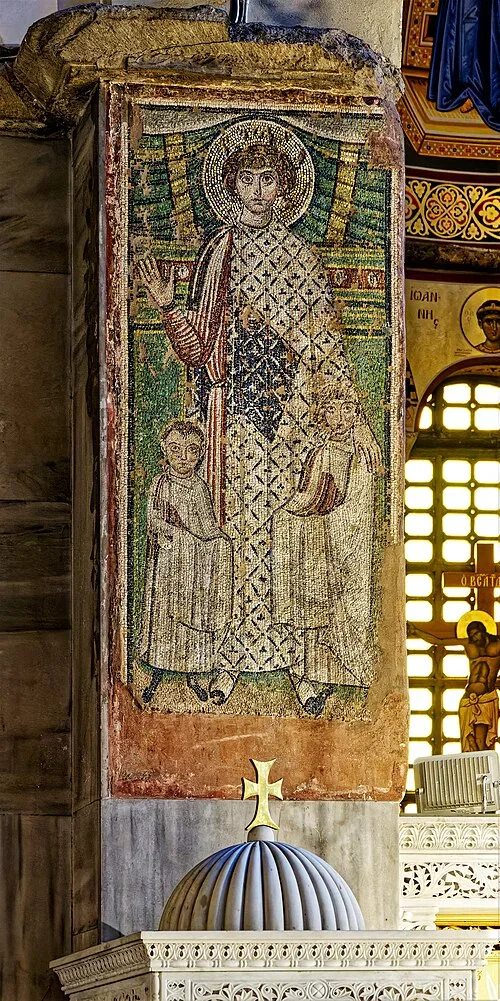 Sanctuary Piers and Pre-Iconoclastic Mosaics
Pier Mosaic with a Haloed Saint and Two Children
When the church became a mosque in 1493, its mosaics and frescoes were covered with plaster and new walls. The building was called the Kasimiye, and it stayed a mosque until 1912. Christians could still reach the saint's symbolic tomb, which was kept open to them. On this tall, narrow panel a haloed saint raises one hand, and two children stand at his sides. The figure is now identified as Saint George. Other mosaics were lost during the mosque years, and more were destroyed later. Old watercolours give some idea of the craftsmanship that was lost.
Listen in the appPhoto: Holger Uwe Schmitt · CC BY-SA 4.0
09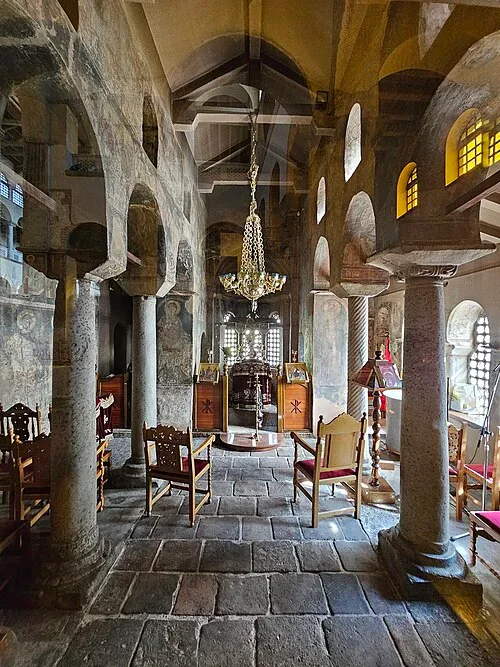 Chapel of Saint Euthymios
: Interior
This chapel stands on the east side of the basilica, to the right of the main altar, and it was added at the end of the thirteenth century. It is a small basilica of its own, built against the larger church and dedicated to Saint Euthymios of Thessalonica. Euthymios was a monk, born around 823 in Galatia, in what is now Turkey. He lived on Mount Olympus in Bithynia and then on Mount Athos, and he founded a double monastery on Mount Chortiatis, near Thessaloniki. He died in 898, living alone on the island of Hiera. The chapel was decorated with frescoes in 1303. Slender columns carry its arches, and a lamp hangs from a chain near the middle of the room.
Listen in the appPhoto: PLAKLE · CC BY-SA 4.0
10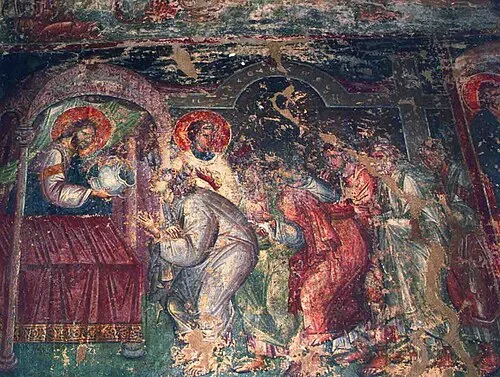 Chapel of Saint Euthymios
Fresco Fragment in the Chapel of Saint Euthymios
Painted figures crowd this fresco, many of them with haloes, and much of the paint has flaked away. Their robes are mostly red and white. A figure under a red-draped arch holds up a pale vessel, while others lean toward one another. Cracks run across the surface, and the colours have faded in patches. Research from the early twenty-first century argues that Manuel Panselinos was one of the painters of the church's frescoes. He was a well-known Greek painter of holy images. Some link this chapel fresco to his name. He is thought to have been active from the late thirteenth century, and into the century that followed.
Listen in the appManuel Panselinos · Public domain
- 11
Marble-Arched Enclosure in the Underground Crypt
Tradition places the saint's imprisonment in an old bath, and later basins here held holy oil.
- 12
Vaulted Passage in the Underground Crypt
A brick-vaulted crypt passage, its long burial under earth, and the digs that brought it back.
Ιερός Ναός Αγίου Δημητρίου Θεσσαλονίκης
Frequently asked questions
How much does the guide cost?
Free app download. Listed guide price: $0.99. Guide price shown in the app. Audio guide only. Venue admission is separate.
Can I listen without internet?
Yes. Download the guide’s audio, images, and maps in the app before your visit. Your downloaded content is then available offline.
Can I listen in my language?
This audio guide is available in 15 languages, including English.
Do I need to follow a schedule?
No. This is a self-guided experience. Choose your stops, pause whenever you like, and return to a story at your own pace.
At your own pace
Explore Ιερός Ναός Αγίου Δημητρίου Θεσσαλονίκης.
Download Stanza, then search for “Ιερός Ναός Αγίου Δημητρίου Θεσσαλονίκης”.
Free app download · Guide price shown in the app
Keep exploring
Nearby audio guides
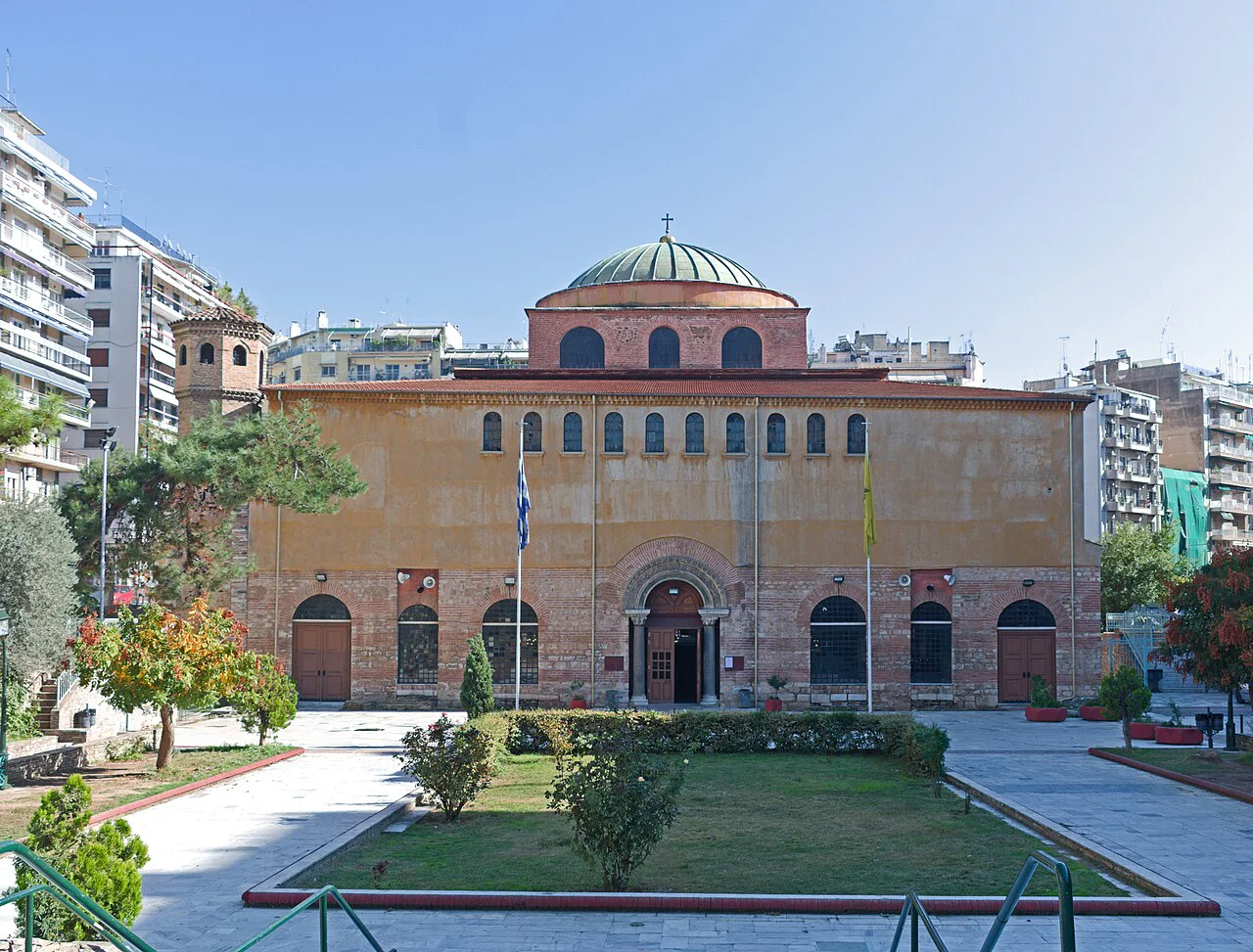
Thessaloniki · 1 km
Αγία Σοφία
Content & sources
Photo: Ymblanter · CC BY-SA 4.0
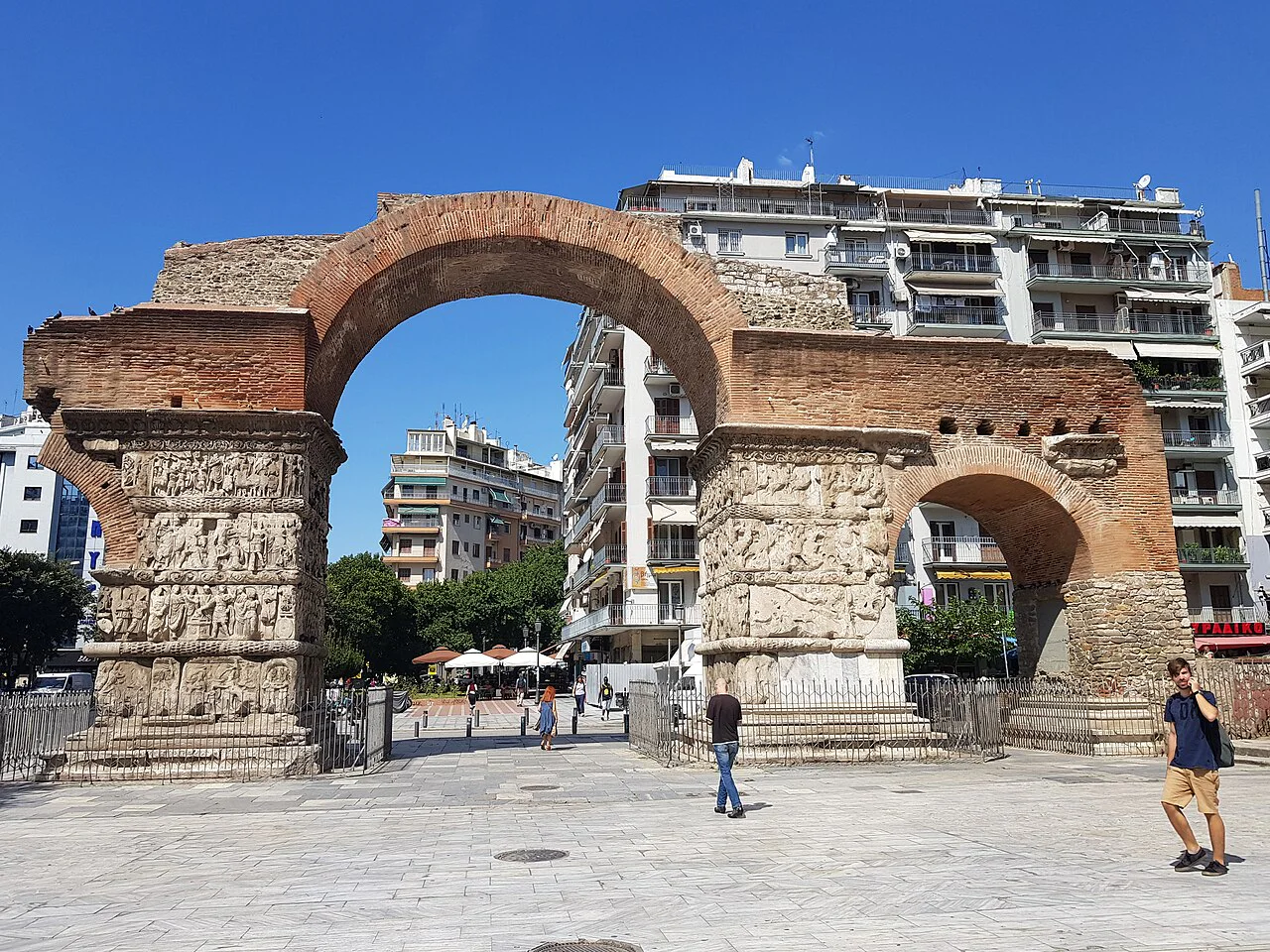
Thessaloniki Municipality · 1 km
Αψίδα του Γαλερίου
Content & sources
Photo: Armineaghayan · CC BY-SA 4.0
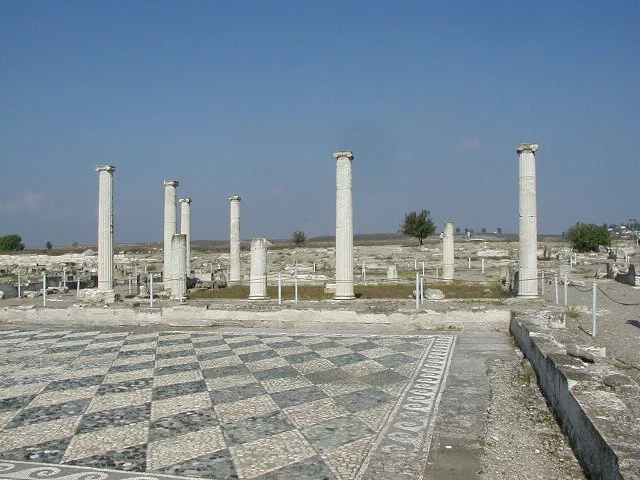
Pella · 38 km
Αρχαία Πέλλα
Content & sources
Brian Donovan · Public domain
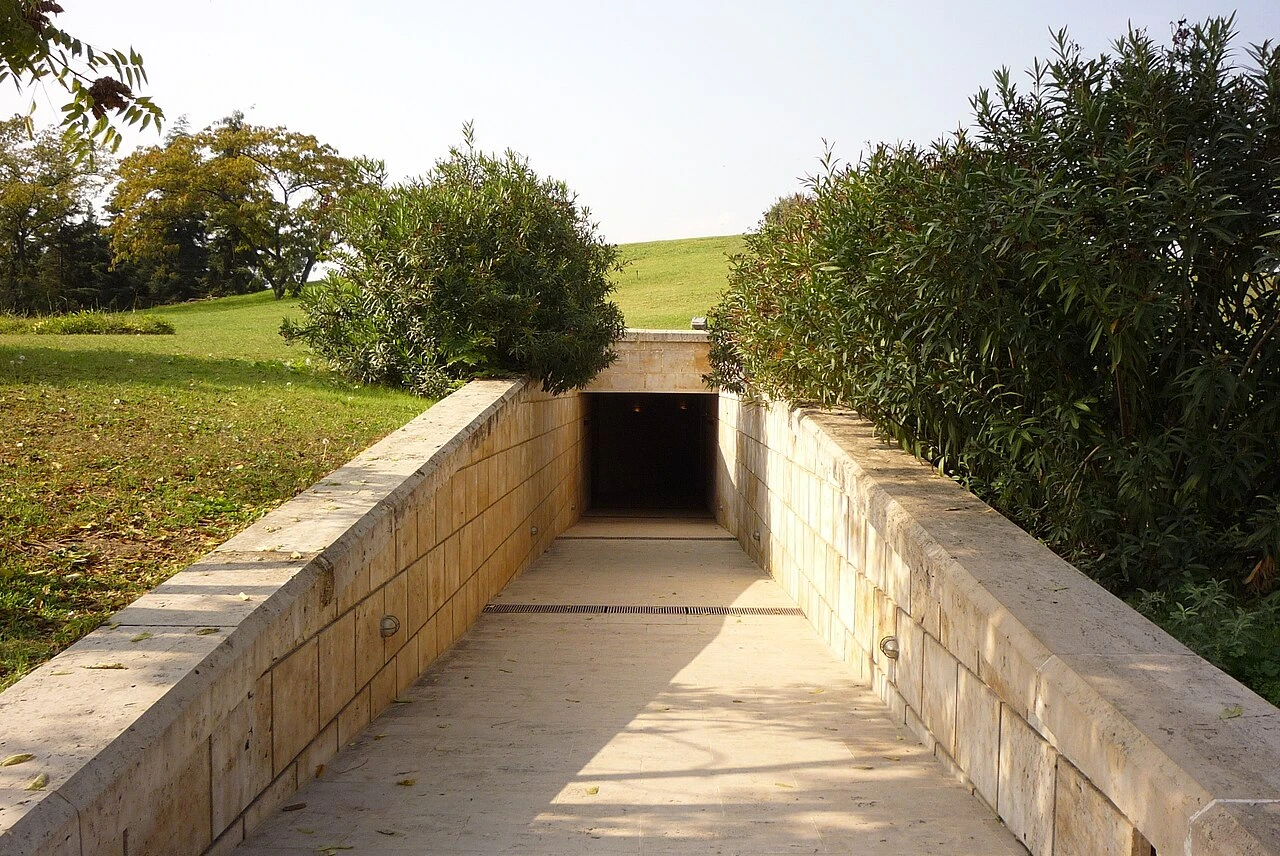
Vergina · 56 km
Royal Tombs of Vergina
Content & sources
Colin W · CC BY-SA 3.0