Stanza · Audio guide
Αγία Σοφία Audio Guide
A place to remember. A story to take with you.
The Hagia Sophia is a church located in Thessaloniki, Greece. It is one of the oldest churches in the city and is listed as a UNESCO World Heritage Site due to its Byzantine art and architecture.
Download Stanza, then search for “Αγία Σοφία”.
About the tour
One guide. Your kind of visit.
The Hagia Sophia is a church located in Thessaloniki, Greece. It is one of the oldest churches in the city and is listed as a UNESCO World Heritage Site due to its Byzantine art and architecture.
Ready when you are.
- 01Get the free Stanza app.
iOS & Android
- 02Find your guide.
“Αγία Σοφία”
- 03Download before you go.
Works offline
Audio guide / 8 narrated stops
Inside the guide
Get to know a few of the stories before you go. Open a stop to read more.
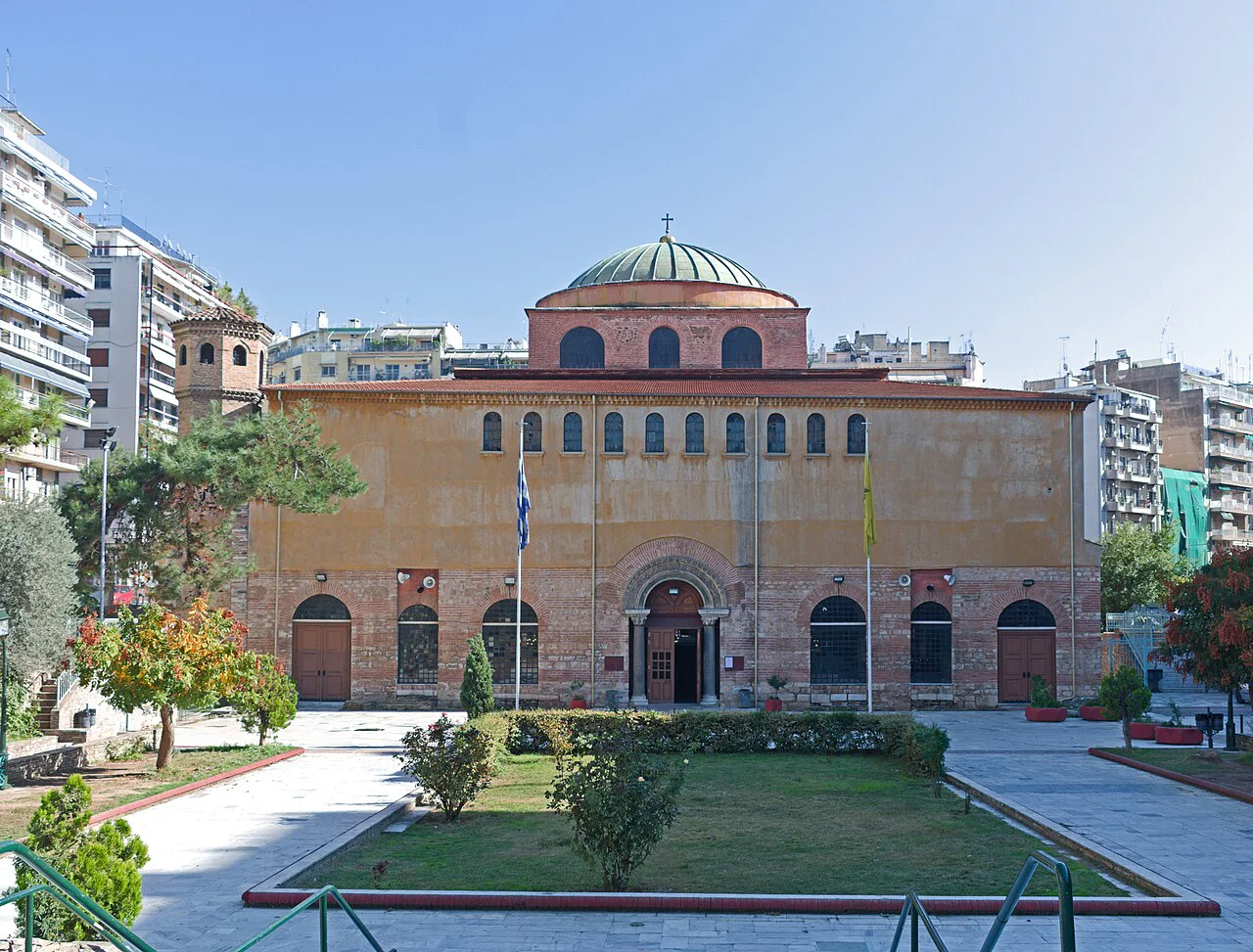
01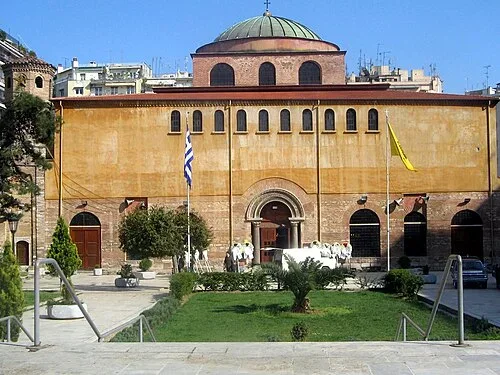 Exterior Facade and Main Portal
The Cathedral of Holy Wisdom from the Square
Welcome to the church of Holy Wisdom, the Agia Sophia of Thessaloniki. This is one of the oldest churches in the city still standing, and its story begins long before the building itself. A church has stood on this spot since the third century. That earlier building collapsed in 620, most likely in an earthquake, and the church you see was raised in its place in the seventh century. Since then it has changed faith more than once. Crusaders from the Fourth Crusade made it their Latin cathedral for about two decades, from 1205 to 1224. After the Ottoman conquest of the city it served as a mosque, keeping its old name, Ayasofya Camii. When Thessaloniki passed to Greece in 1912, it became a church again. In 1988 its Byzantine art and architecture earned it a place on the UNESCO World Heritage list. How one building carried all of these identities is the story of the stops ahead.
Ian Kehoe · Public domain
02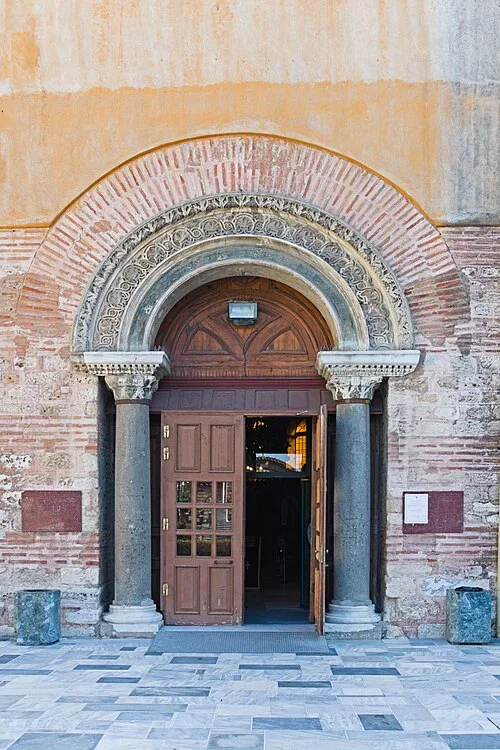 Exterior Facade and Main Portal
The Main Portal and the Plaster That Saved the Mosaics
The doorway is framed in finely carved marble, a sign of the dignity this church held from the start. Above the arch, the ornament runs in bands of foliage and scrollwork around the wooden doors. The reason the mosaics inside still exist is a strange one. When the building served as a mosque, its figural images were not destroyed. They were covered over with plaster, and that plaster protected them for centuries. Then came harder blows. A fire in 1890 left the building badly damaged, while it was still a mosque. Between 1907 and 1909 the Byzantine historian Charles Diehl directed the restoration of the whole structure. It was during that campaign that the mosaics were uncovered again, and the dome mosaic came back into the light. Diehl also guided the decoration of the remaining surfaces, and that decoration is what the interior still wears.
Photo: Ymblanter · CC BY-SA 4.0
03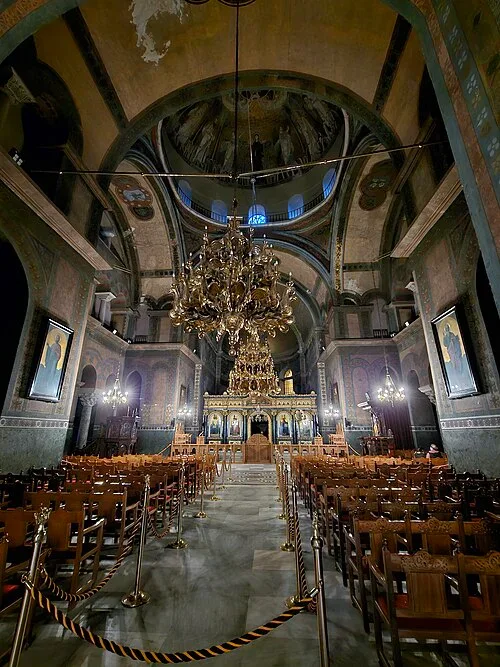 Central Nave and Early Christian Columns
The Nave: A Bridge Between Two Architectural Worlds
Inside, the central space opens up beneath the dome, with a chandelier hanging almost to the floor. The plan measures about forty-two metres long and thirty-five wide. The building is a domed basilica, but with a twist. The columns of the central nave are pulled to the sides, so the central space takes the shape of an equal-armed cross under the dome. That makes it a transitional form. It stands between the early domed basilica and the inscribed-cross church, the type that dominated Byzantine architecture from the tenth century onward. Together with a handful of other buildings, it counts as one of the main surviving examples of this kind.
Listen in the appPhoto: PLAKLE · CC BY-SA 4.0
04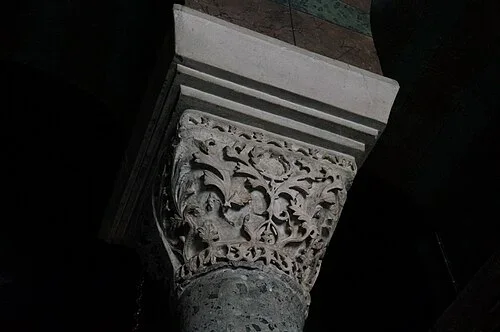 Central Nave and Early Christian Columns
A Capital from the Earlier Basilica
Carving like this acanthus capital, with its deep-cut leaves, belongs to the early Christian tradition of sculpture. It recalls what stood here before. By the first half of the fifth century, the church on this ground was a large early Christian basilica dedicated to Saint Mark. Together with its surrounding buildings it formed a religious complex of more than eight thousand square metres. This is the building whose fall, around 618 to 620, you heard about at the start. The present church was built on part of its site, taking up only a fraction of the old complex. The finely worked capitals along the nave carry something of that older building tradition into the new church.
Listen in the appG.Garitan · CC BY-SA 4.0
05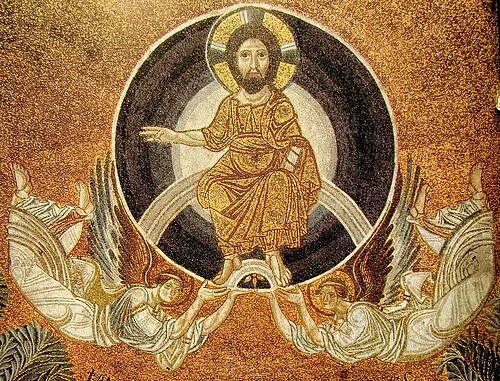 Under the Central Dome
The Dome Mosaic: The Ascension
The dome shows the Ascension of Christ. He sits within a circle of light carried by angels, and around him stand the Twelve Apostles with the Virgin Mary and two more angels. Below the dome, twelve arched windows pierce the drum and light the scene. Around it runs a line from the Acts of the Apostles: Ye men of Galilee, why stand ye gazing up into heaven? When the mosaic was made is debated. Most scholars date it to the period after the restoration of icons. The art historian Viktor Lazarev placed it in the ninth century, partly on the strength of an inscription in the dome naming Archbishop Paul of Thessaloniki, who held the see from 880 to 885. Greek scholarship has suggested it could go back as far as the seventh century, so the question stays open.
Listen in the appUnknown author · Public domain
06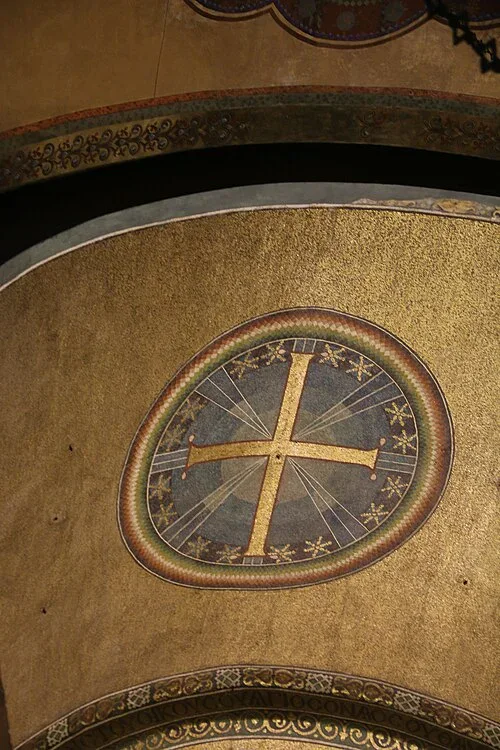 Sanctuary Vault and Iconoclastic Cross
The Iconoclastic Vault: Crosses and Imperial Monograms
The vault before the apse glitters with gold and crosses, and no figures at all. This is the decoration of the Iconoclastic era, when images of people were forbidden and church interiors received crosses instead. A great equal-armed cross fills a medallion here, set among smaller crosses, a scheme much like the one still visible in Hagia Irene in Constantinople. But the vault also holds names. The monograms of the emperor Constantine the Sixth and his mother, the empress Irene, appear here, which dates the work to the 780s, around the first restoration of icon veneration. There is an inscription too, naming Bishop Theophilos, who took part in the Seventh Ecumenical Council in 787. That council restored the veneration of icons, and the inscription naming him sits in this vault.
Listen in the appGiovanni Dall'Orto · Attribution
07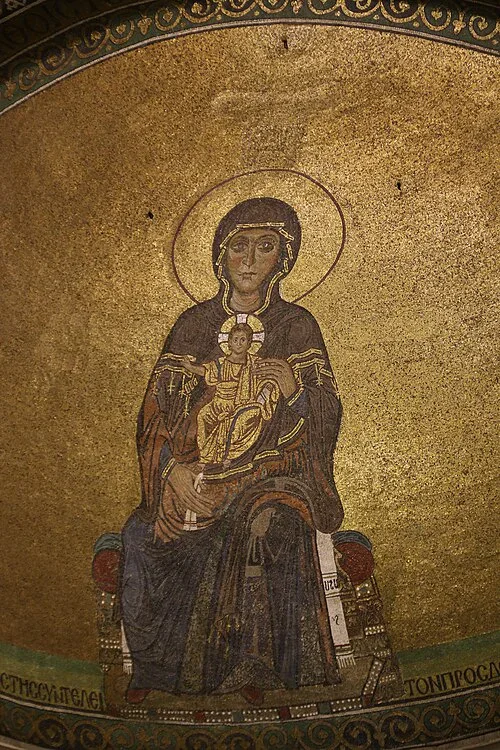 Apse Semi-Dome
The Apse Mosaic: The Enthroned Virgin and the Shadow of the Cross
In the apse, the Virgin sits enthroned on a golden ground with the Christ Child on her lap, set in place after the victory of the icon venerators: between 787 and 797 by one dating, soon after 843 by another. She replaced something. The broad outlines of the great Iconoclastic cross can still be read behind her shoulders, so one image lies layered over the other, the whole argument over images visible in a single surface. The mosaicist left a human trace as well. Working on the curved surface of the apse, he was not used to correcting for perspective distortion. The result is a Virgin who is broad and heavy, and a Christ Child who is noticeably small for his seat.
Listen in the appGiovanni Dall'Orto · Attribution
08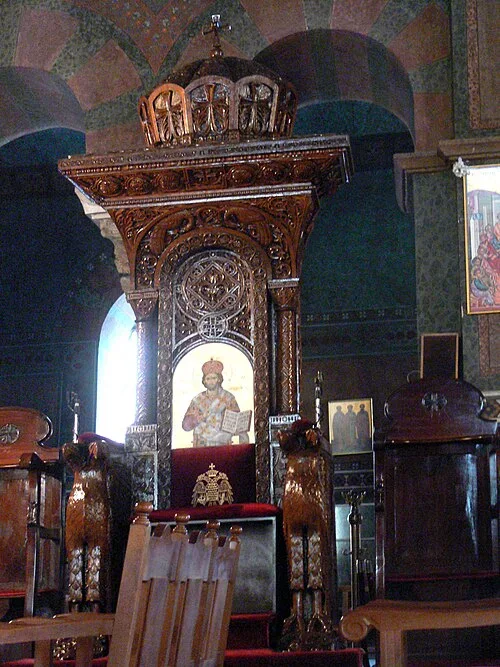 Choir Stalls and Episcopal Throne
The Bishop's Throne and the Relics of Archbishop Basil
Near the sanctuary stands the carved wooden throne of the bishop, richly worked with figures and crowned panels, set among the choir stalls. It was the custom to bury bishops within cathedral churches, and this one held its own. In 1981, behind the stalls of the right choir, the relics of Archbishop Basil of Thessaloniki were found. He led the city's church in the ninth and tenth centuries, and he had waited there, in the building he served, until the twentieth century. From the third-century church on this spot to the archbishop resting behind the choir, the same ground has been a place of worship for well over a thousand years.
Listen in the appPhoto: Fingalo · CC BY-SA 2.0 de
Αγία Σοφία
Frequently asked questions
How much does the guide cost?
Free app download. Listed guide price: $0.99. Guide price shown in the app. Audio guide only. Venue admission is separate.
Can I listen without internet?
Yes. Download the guide’s audio, images, and maps in the app before your visit. Your downloaded content is then available offline.
Can I listen in my language?
This audio guide is available in 15 languages, including English.
Do I need to follow a schedule?
No. This is a self-guided experience. Choose your stops, pause whenever you like, and return to a story at your own pace.
At your own pace
Explore Αγία Σοφία.
Download Stanza, then search for “Αγία Σοφία”.
Free app download · Guide price shown in the app
Keep exploring
Nearby audio guides
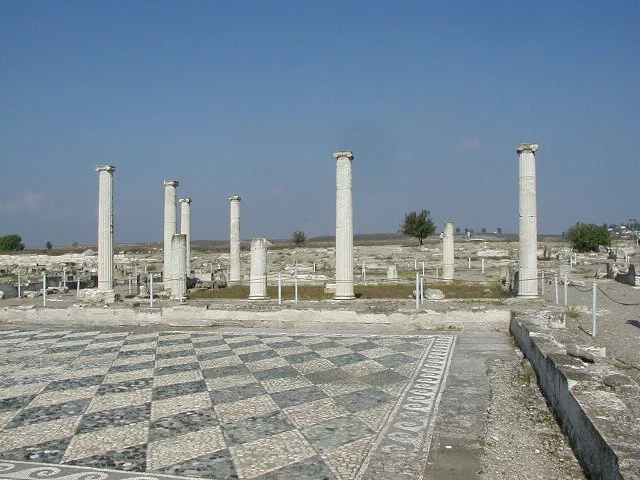
Pella · 38 km
Αρχαία Πέλλα
Content & sources
Brian Donovan · Public domain
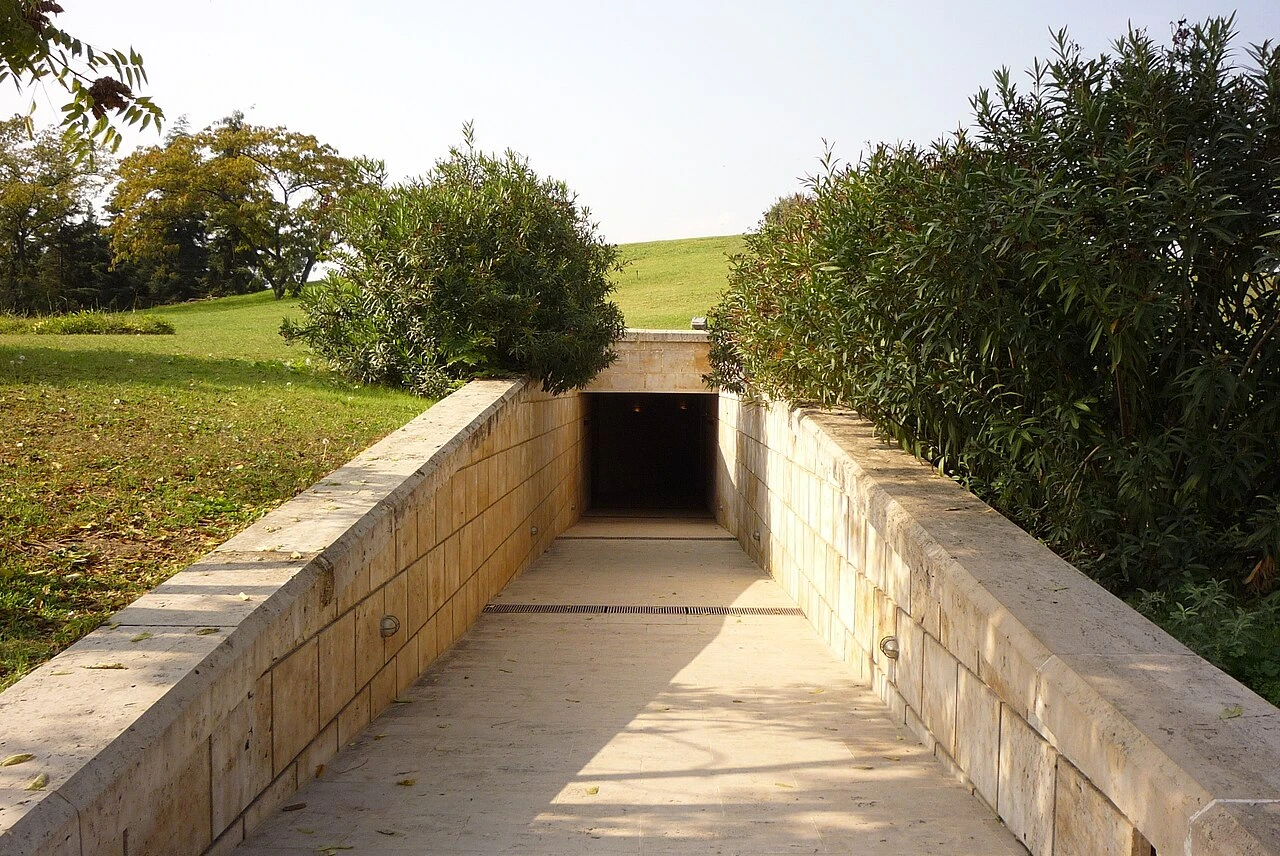
Vergina · 55 km
Royal Tombs of Vergina
Content & sources
Colin W · CC BY-SA 3.0
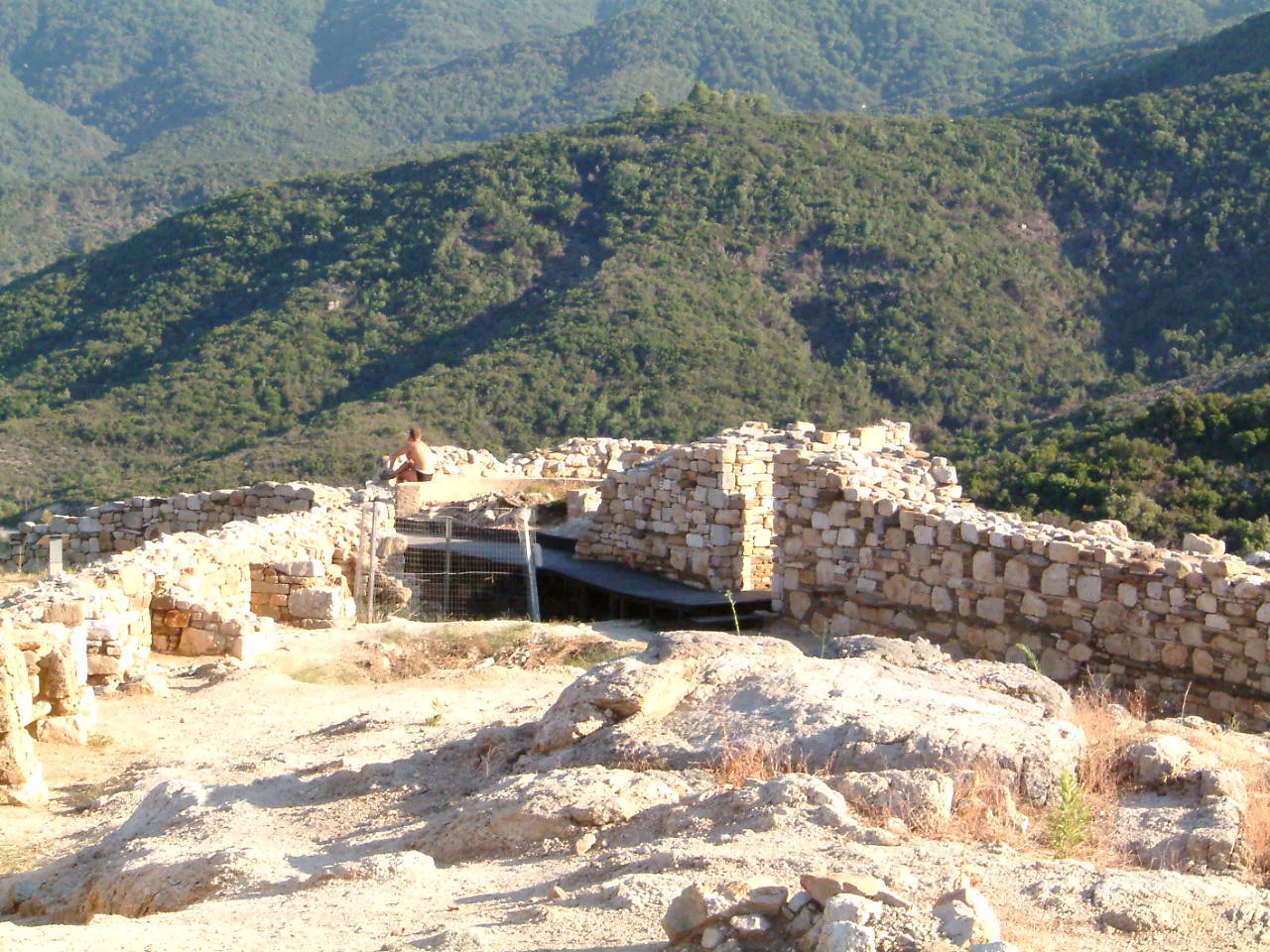
Ολυμπιάδα · 72 km
Αρχαία Στάγειρα
Content & sources
Christaras A · Copyrighted free use
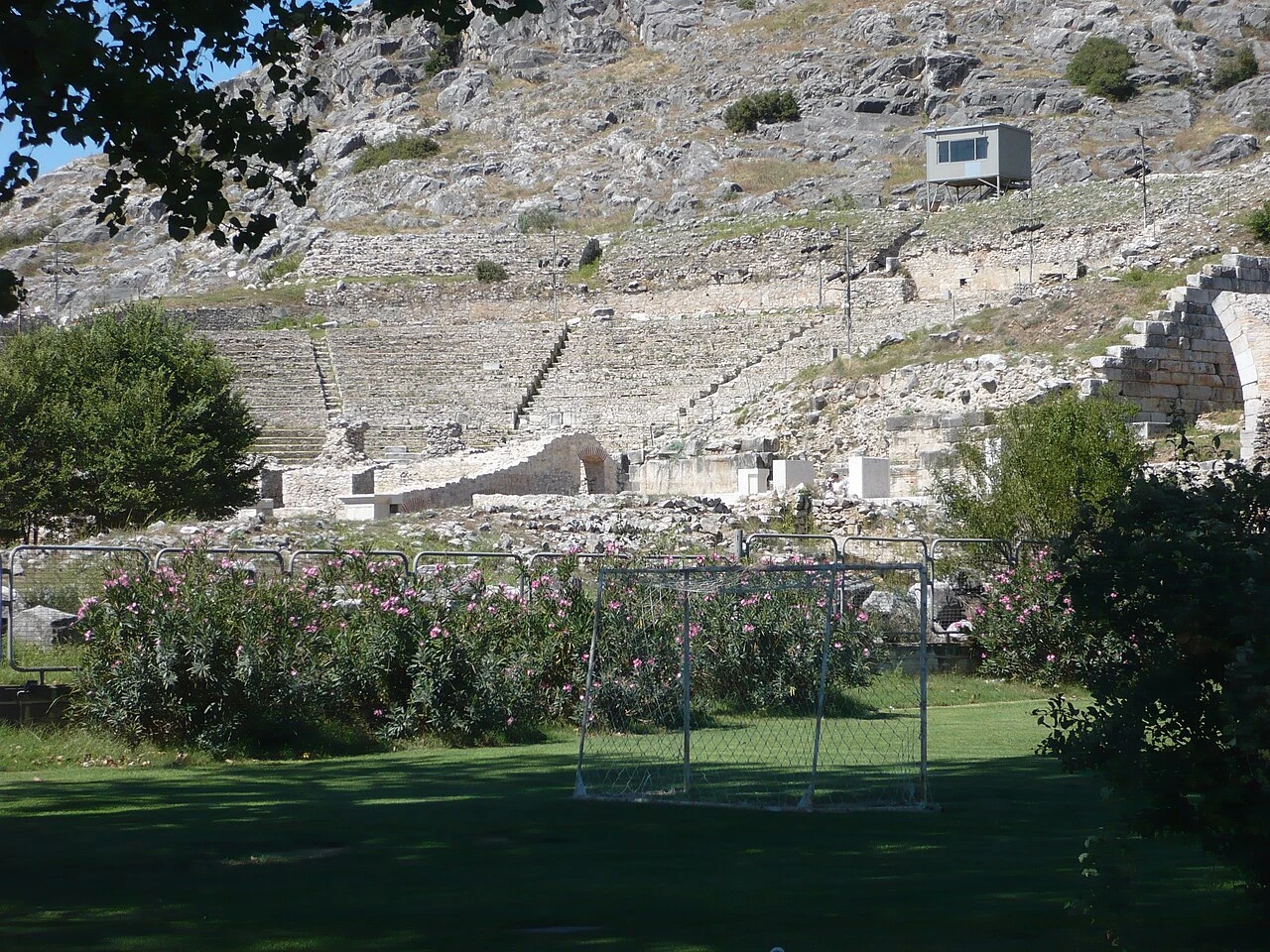
Philippi · 120 km
Philippi
Content & sources
Photo: Batr41 · CC BY-SA 4.0