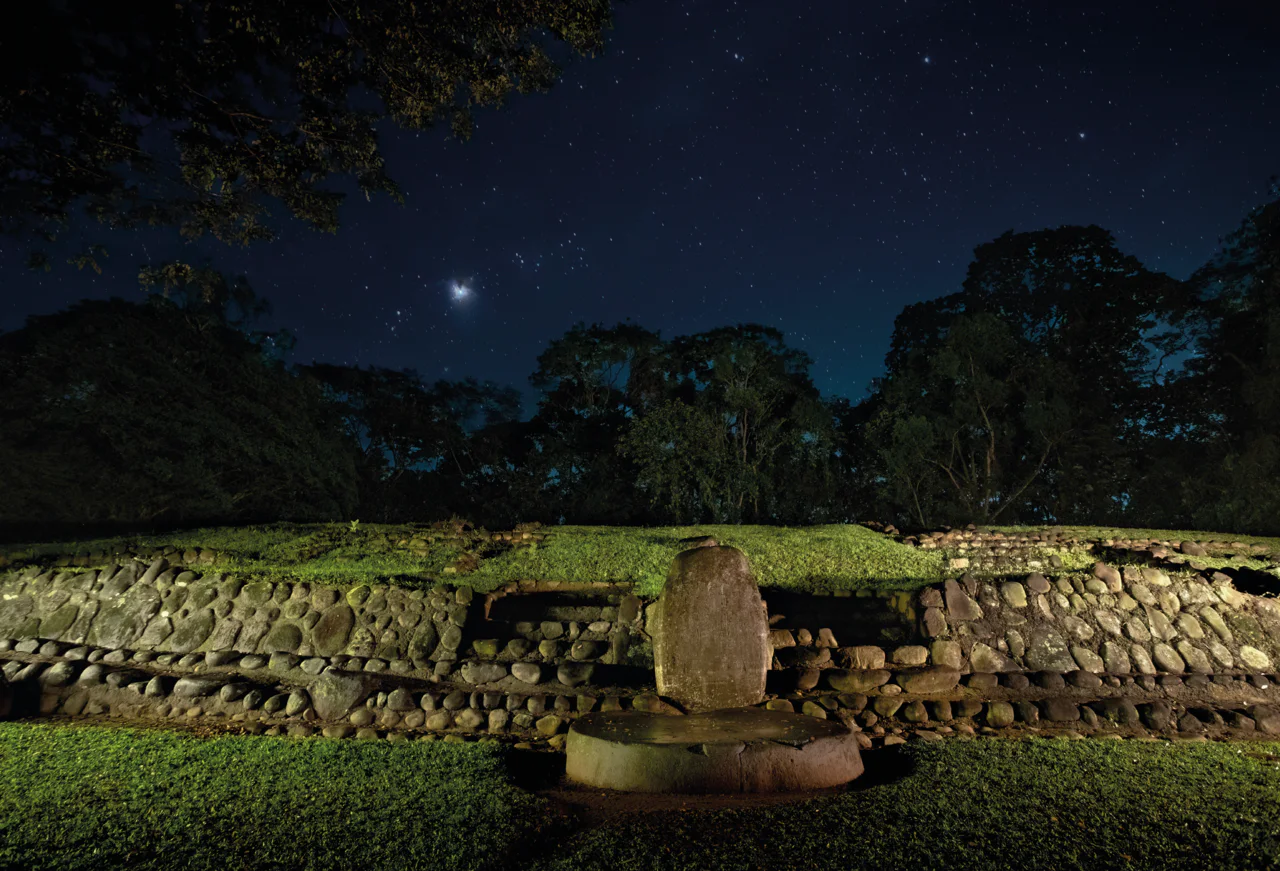
Stanza · Audio guide
Takalik Abaj Audio Guide
A place to remember. A story to take with you.
Tak'alik Ab'aj is a pre-Columbian archaeological site in Guatemala. It is significant for containing one of the largest concentrations of Olmec-style sculpture outside of the Gulf of Mexico.
Download Stanza, then search for “Takalik Abaj”.
About the tour
One guide. Your kind of visit.
Tak'alik Ab'aj is a pre-Columbian archaeological site in Guatemala. It is significant for containing one of the largest concentrations of Olmec-style sculpture outside of the Gulf of Mexico.
Ready when you are.
- 01Get the free Stanza app.
iOS & Android
- 02Find your guide.
“Takalik Abaj”
- 03Download before you go.
Works offline
Audio guide / 14 narrated stops
Inside the guide
Get to know a few of the stories before you go. Open a stop to read more.
01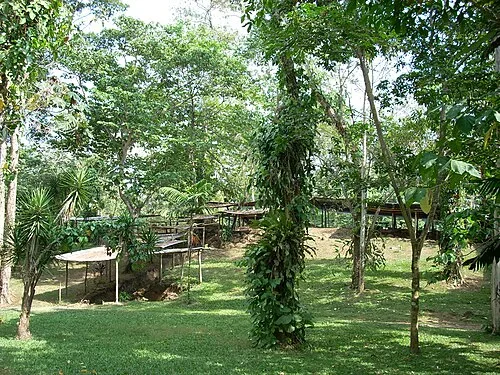 The Subtropical Entrance and Forest Trails
Arrival: A Standing Stone City in the Forest
Welcome to Takalik Abaj, an ancient city set among five coffee plantations in the lower foothills of the Sierra Madre. For nearly two thousand years this was a busy place, at once a market, a shrine and a seat of power. The name means 'standing stone' in local Maya tradition, though the ancient inhabitants may have called the city Kooja. People lived here from the ninth century before Christ. The city was still occupied at least into the tenth century after. The heart of the site covers about six and a half square kilometres. Within that area stand the remains of some seventy monumental structures. They are arranged around a dozen plazas. More than three hundred stone monuments have come to light so far, many of them carved. Both Olmec and early Maya artists worked here, a combination few places can claim. In 2023 the site was inscribed as a World Heritage Site, honoured for its long, unbroken history of occupation.
Photo: Simon Burchell · CC BY-SA 3.0
02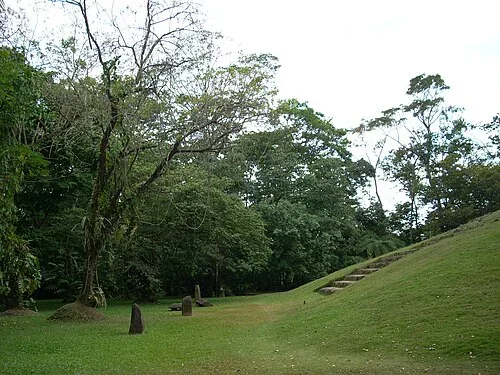 The Subtropical Entrance and Forest Trails
First Settlers on the El Chorro Stream
The story of this place begins at the very end of the Early Preclassic period, nearly three thousand years ago. West of the ceremonial centre, on the bank of a stream called El Chorro, archaeologists found the earliest houses. Their floors were made from river cobbles, and their roofs were thatched reeds held up on timber poles. Pollen preserved in the soil shows what the first settlers found: thick forest. They began clearing it to plant maize and other crops. Even at this early stage, the settlers were trading far afield. More than a hundred and fifty pieces of obsidian turned up in this area, known as El Escondite. Most of it came from two sources in the Guatemalan highlands, San Martín Jilotepeque and El Chayal. Obsidian is a natural volcanic glass, sharp enough to serve as the steel of its day. Most pieces had to be carried down from the highlands by trade.
Photo: Simon Burchell · CC BY-SA 3.0
03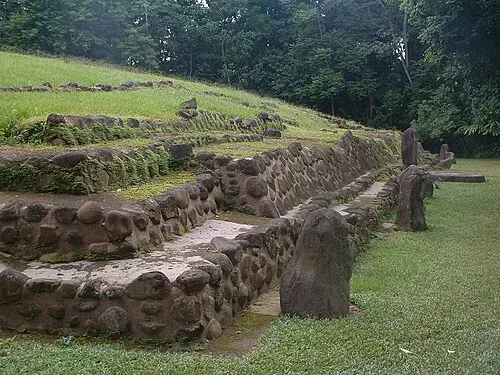 Terrace 3: The Sacred Plaza of Tanmi T'nam
The Middle Preclassic Ballcourt
Competition was already part of ceremony very early in the life of this city. On Terrace 2, in its southwest corner, lies a ballcourt dating to the Middle Preclassic, an early example of a formal ballcourt. It runs north to south, with the playing alley formed by two structures called Sub-2 and Sub-4. The alley stretches just over twenty-two metres. Its playing surface is about four and a half metres wide. A third structure, Sub-1, stands just over eleven metres to the south and forms an end zone for the game. Everything was built the local way, of compacted clay and river cobbles, the same material that faces so many terraces here. A court this old shows that organised ritual competition was already institutionalised centuries before the city's greatest buildings rose.
Listen in the appnmarritz · CC BY 2.0
04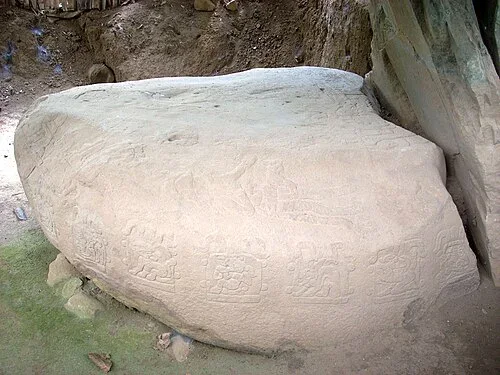 Terrace 3: The Sacred Plaza of Tanmi T'nam
Tanmi T'nam, Heart of the People
Terrace 3 held the spiritual centre of the city, and its southeastern corner was the most sacred plaza of all. Archaeologists judge that from the sheer concentration of sculpture here, and from the great platform of Structure 7 closing the plaza's east side. Today this corner carries a Mam Maya name, Tanmi T'nam, meaning 'Heart of the People'. It was given by the mayor of the nearby town of El Asintal. The monuments stood in deliberate rows. Five of them lined up north to south at the base of Structure 8, on the plaza's southwest side. Another five ran east to west along the southern edge of the terrace, with two more standing a little south of them. The carved altar with its figures and columns of glyphs belongs to that formal sculptural furniture of the plaza.
Listen in the appPhoto: Simon Burchell · CC BY-SA 3.0
05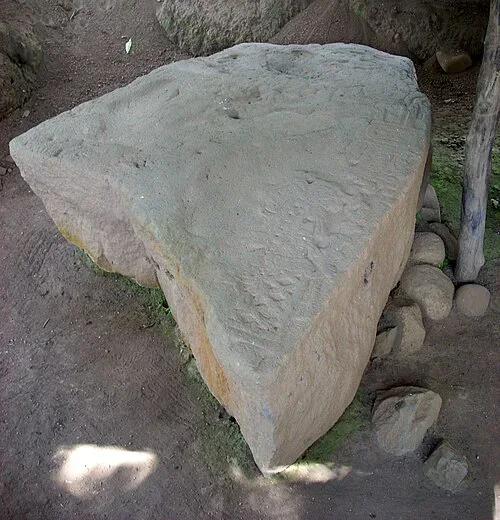 Terrace 3: The Sacred Plaza of Tanmi T'nam
Cacao, Trade Routes and a Distant Conquest
Cacao made this city rich. Takalik Abaj prospered from cacao production and from the trade routes crossing the coastal plain, linking the Guatemalan highlands with a network that ran from Mexico all the way to El Salvador. Cacao remained the area's great crop even when the Spanish arrived in the sixteenth century. But the city's independence ended at the hands of a distant power. Monuments were destroyed and new construction stopped, exactly when a new pottery style appeared: Naranjo ceramics, linked to the great metropolis of Teotihuacan in the Valley of Mexico. That points to conquerors who exerted long-distance control, replacing local rulers with their own governors while leaving the population in place. The conquest broke the ancient trade route along the coast. Traffic shifted to a new route running up the Sierra Madre and into the northwestern highlands. Many monuments here, including altars like this one, were found out of their original positions, moved and reset in later times.
Listen in the appPhoto: Simon Burchell · CC BY-SA 3.0
06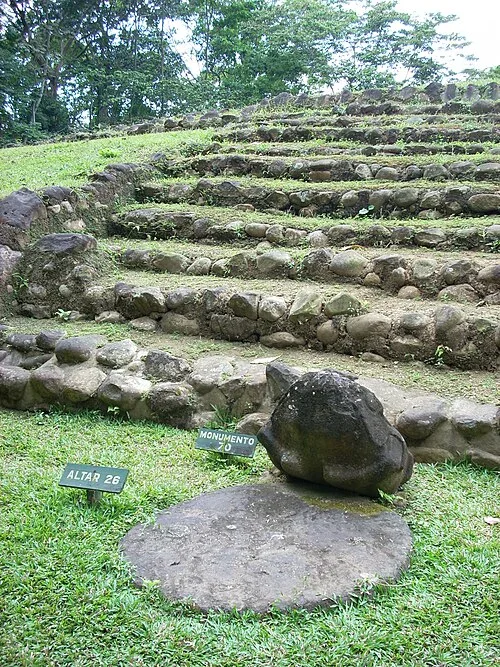 Structure 7 and the Astronomical Observatory
Structure 7 and the Sky Watchers
Structure 7, east of the plaza, was among the most sacred buildings in the city. It is a vast platform, about a hundred and twelve metres long. From side to side it measures some seventy-nine metres. Begun in the Middle Preclassic, it took its final form in the Late Preclassic, and was later refaced with stone in the Late Classic. On its summit stand three rows of monuments, all aligned north to south. Scholars think they may have served as an astronomical observatory. One row tracked the constellation Ursa Major in the Middle Preclassic. Another, raised later, tracked Draco, the dragon. The middle row lines up with the smaller structure known as 7A. Monument 70 and Altar 26, posed before a stepped stone face elsewhere on the site, give a feel for how sculpture and architecture met in such arrangements.
Listen in the appPhoto: Simon Burchell · CC BY-SA 3.0
07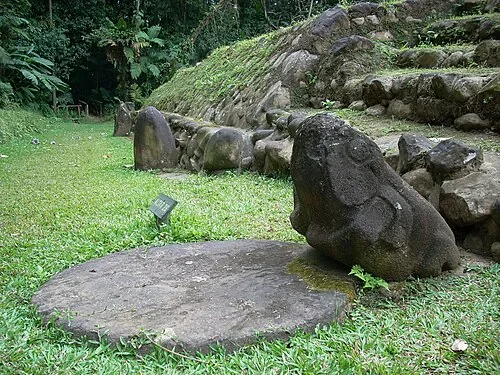 Structure 7 and the Astronomical Observatory
The Royal Crypts of Structure 7A
Structure 7 kept its greatest secrets underground. Digging into Structure 7A, the smaller building on its north side, archaeologists came upon Burial 1, a royal tomb of the Late Preclassic, inserted into the centre of a much older structure. No human remains survived. But the grave goods left no doubt about the rank of whoever lay here. The body was apparently placed on a wooden litter coated in red cinnabar dust, about a metre by two. With it went an eighteen-piece jade necklace, a jade mosaic mask, and mirrors of polished iron pyrite. One mirror was assembled from more than eight hundred pieces. At the base of the structure lay an offering of hundreds of ceramic vessels. The ceramics date the burial to around AD 100 to 200. Later digging brought an even older claim. In 2012, archaeologists reported a tomb carbon-dated between 700 and 400 BC. Its occupant was nicknamed K'utz Chman, 'Grandfather Vulture' in Mam. Researchers suggested it may be the oldest Maya royal burial yet found, belonging to a sacred king who, in their words, bridged the gap between the Olmec and Maya worlds.
Listen in the appPhoto: Simon Burchell · CC BY-SA 3.0
08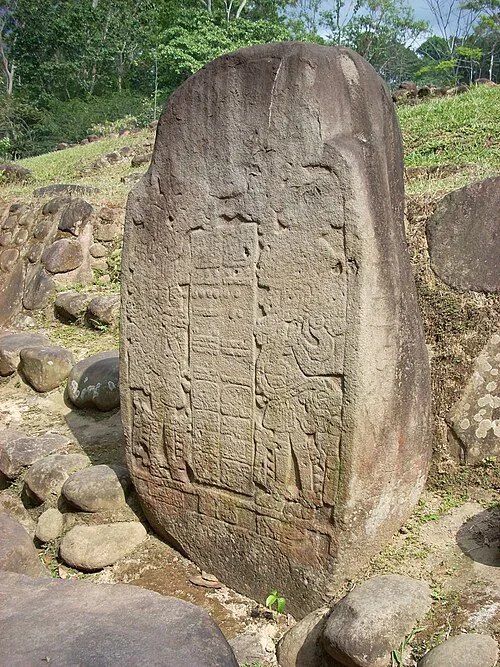 The Masterpieces of early Maya Art and Kingship
Stela 5: The Calendar Comes to the Coast
Stela 5 is one of the reasons this site matters to Maya scholars. It is reasonably well preserved, and it carries two Long Count dates, the calendar of the Classic Maya kings. The later of the two dates corresponds to AD 126. Flanking the inscription stand two figures portraying rulers. The right-hand figure holds a snake. The left holds what is probably a jaguar. The scene most likely shows one ruler passing power to the next. Small seated figures are carved on each side of the stela, beside a hieroglyphic text now badly eroded. The style is early Maya, with close affinities to the sculpture of Izapa. Together with the damaged date on Stela 2, these inscriptions place Takalik Abaj among the early centres of Maya writing and the Long Count calendar. The instruments of Classic Maya kingship were being invented here, on the Pacific piedmont.
Listen in the appPhoto: Simon Burchell · CC BY-SA 3.0
09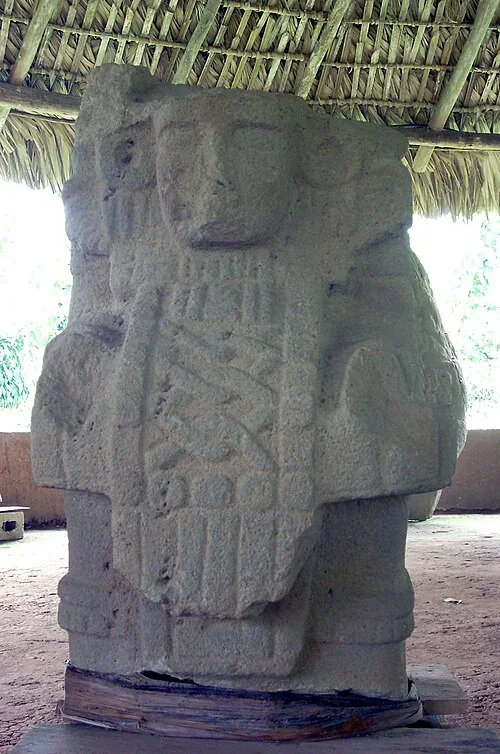 The Masterpieces of early Maya Art and Kingship
El Cargador del Ancestro: Carrying the Ancestors
One sculpture here tells the story of the city's cultural change in a single image. It is known as El Cargador del Ancestro, the Ancestor Carrier. Its hieroglyphic text is so archaic that the sculpture must predate 300 BC. Archaeologists read it as an Early Maya monument. At the base stands an Early Maya ruler carrying the underworld, in the form of a bat. Above him, the main figure carries a smaller figure on its back, his ancestors. What makes the piece extraordinary is its style. The Maya sculptor dressed the ancestor figure in half-remembered Olmec elements, a deliberate blending of the two traditions. The people here had not forgotten the Olmecs. They revered them as powerful ancestors, and carved that reverence into stone at the very moment one cultural phase was giving way to the next.
Listen in the appPhoto: Simon Burchell · CC BY-SA 3.0
10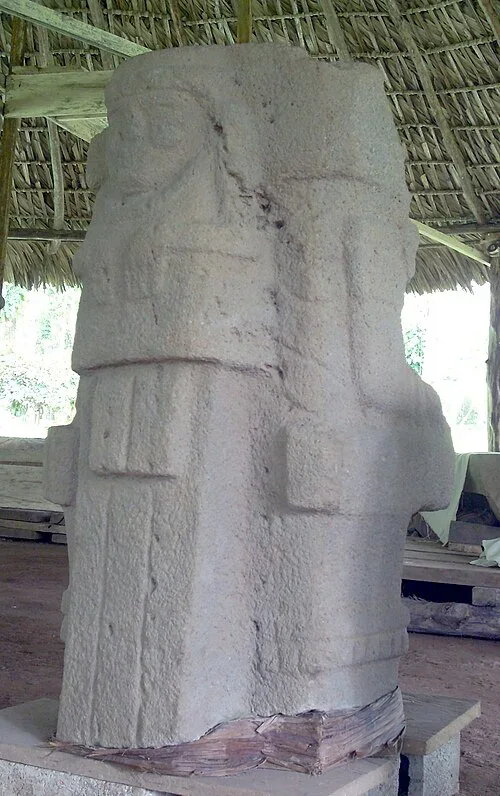 The Masterpieces of early Maya Art and Kingship
Reassembling a Broken King
The Ancestor Carrier nearly stayed lost. It survives in four fragments, and for a long time nobody knew they belonged together. Two of them, Monuments 215 and 217, came to light in 2008, during excavations of Structure 7A. Their themes and styles looked different. Yet laid side by side, they fitted together perfectly, forming part of a single sculpture that was still incomplete. That discovery sent archaeologists back through every fragment the site had given up before. Two more pieces turned up, originally unearthed in Structures 12 and 74. Joined, the four fragments restored the standing column of the figure carrying his ancestor. From behind, the construction is easiest to follow. Two bands cross on the back of the main figure and support the small ancestor riding backwards. One puzzle remains: the 'face' is not anatomically right, so archaeologists conclude it is really a chest ornament, and the true head of the figure is missing.
Listen in the appPhoto: Simon Burchell · CC BY-SA 3.0
- 11
Structure 12: Building with River Boulders
River boulders, clay and colossal labour: how the terraced city was built.
- 12
The Hidden Rivers: Stone Drainage Channels
Stone-roofed canals under the plazas that carried away the tropical storms.
- 13
The Potbellies of the Pacific Coast
The rotund potbelly figures, a sculptural tradition all its own on the Pacific coast.
- 14
The Olmec Enigma: Monument 23 and a Recarved Colossal Head
A colossal head recarved into something new, and the scholarly argument it still sparks.
Takalik Abaj
Frequently asked questions
How much does the guide cost?
Free app download. Listed guide price: $0.99. Guide price shown in the app. Audio guide only. Venue admission is separate.
Can I listen without internet?
Yes. Download the guide’s audio, images, and maps in the app before your visit. Your downloaded content is then available offline.
Can I listen in my language?
This audio guide is available in 15 languages, including English.
Do I need to follow a schedule?
No. This is a self-guided experience. Choose your stops, pause whenever you like, and return to a story at your own pace.
At your own pace
Explore Takalik Abaj.
Download Stanza, then search for “Takalik Abaj”.
Free app download · Guide price shown in the app
Keep exploring
Audio guides — Guatemala
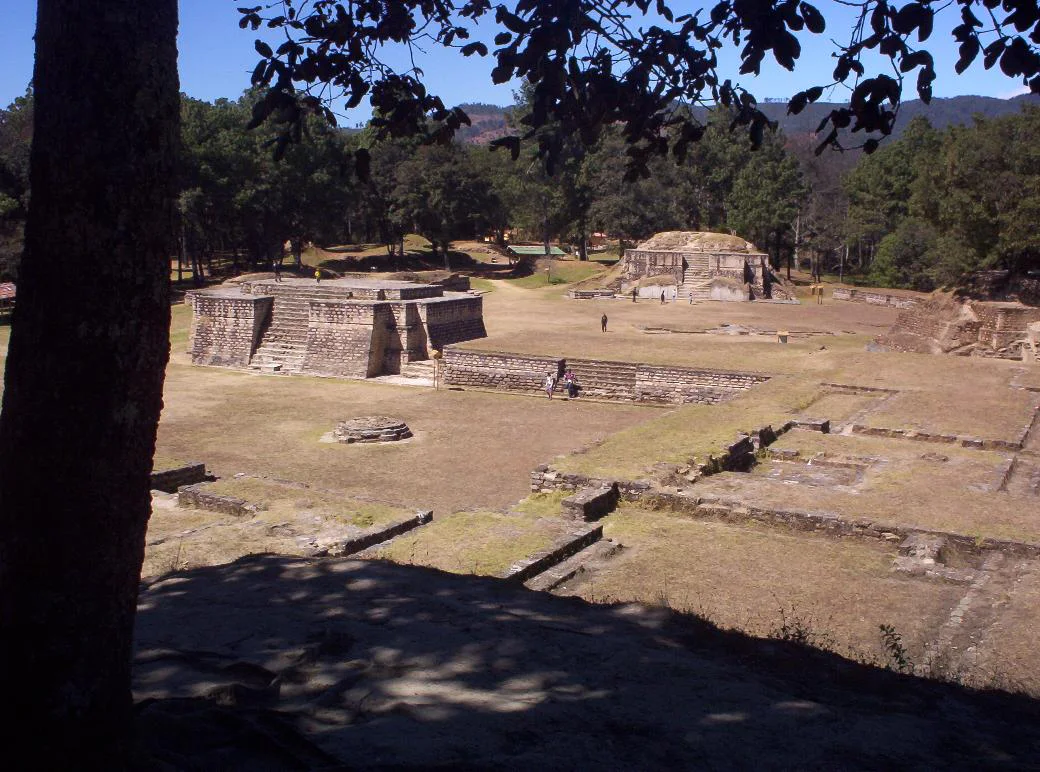
Tecpán Guatemala · 80 km
Iximche
Content & sources
Colocho · Public domain
Huehuetenango · 81 km
Zaculeu
Content & sources
Infrogmation of New Orleans · CC BY-SA 3.0
Río Santiago · 83 km
El Baúl
Content & sources
Photo: Simon Burchell · CC BY-SA 3.0
Quiriguá
Quiriguá
Content & sources
S2RD2 · CC BY 2.0