 Stanza / Audio guide
Content & sources
Stanza · Audio guide
Zaculeu Audio Guide
A place to remember. A story to take with you.
Zaculeu is a pre-Columbian Maya archaeological site located in the highlands of western Guatemala. It served as the capital of the Postclassic Mam kingdom and features a mixture of Mam and Kʼicheʼ style…
Download Stanza, then search for “Zaculeu”.
About the tour
One guide. Your kind of visit.
Zaculeu is a pre-Columbian Maya archaeological site located in the highlands of western Guatemala. It served as the capital of the Postclassic Mam kingdom and features a mixture of Mam and Kʼicheʼ style architecture.
Ready when you are.
- 01Get the free Stanza app.
iOS & Android
- 02Find your guide.
“Zaculeu”
- 03Download before you go.
Works offline
Audio guide / 14 narrated stops
Inside the guide
Get to know a few of the stories before you go. Open a stop to read more.
01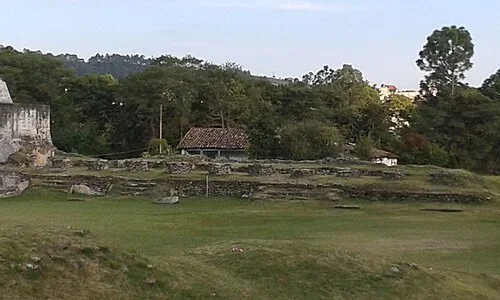 Northern Defensive Entrance and Site Museum
The Ruins Stephens and Catherwood Saw
In 1840, the American explorer John Lloyd Stephens and the English architect Frederick Catherwood visited Zaculeu. They found a tangle of ruins, overgrown with plants. The remains were in such poor condition that Catherwood drew none of the buildings. The two men did dig into one of the mounds. From it they recovered some pottery vessels, and Catherwood drew those. A year later, Stephens published a description of the ruins.
Photo: Simon Burchell · CC BY-SA 4.0
02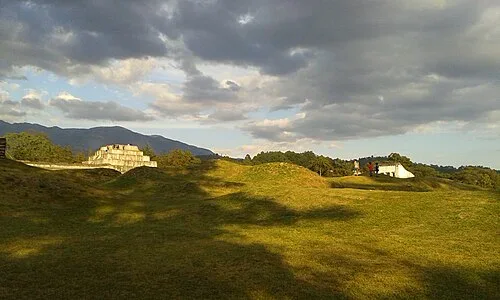 Northern Defensive Entrance and Site Museum
The Plateau of Zaculeu
Zaculeu was the capital of the Mam kingdom in the Postclassic period, the last era before the Spanish arrived. The site sits on a plateau in the highlands of western Guatemala, outside the modern city of Huehuetenango. Its ceremonial centre held forty-three buildings. They were grouped around eight plazas. The name means white earth in Mam, K'iche' and Q'anjob'al. It is made of saq, meaning white, and ulew, meaning earth. Today the site is open to visitors, and it has a small museum. Its days as a capital ended in 1525, when Spanish-led forces took it.
Photo: Simon Burchell · CC BY-SA 4.0
03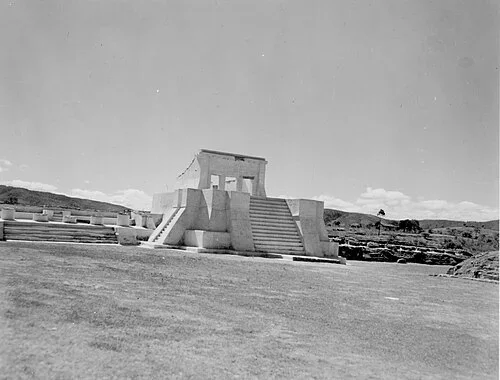 Plaza 1 and the White Plaster Controversy
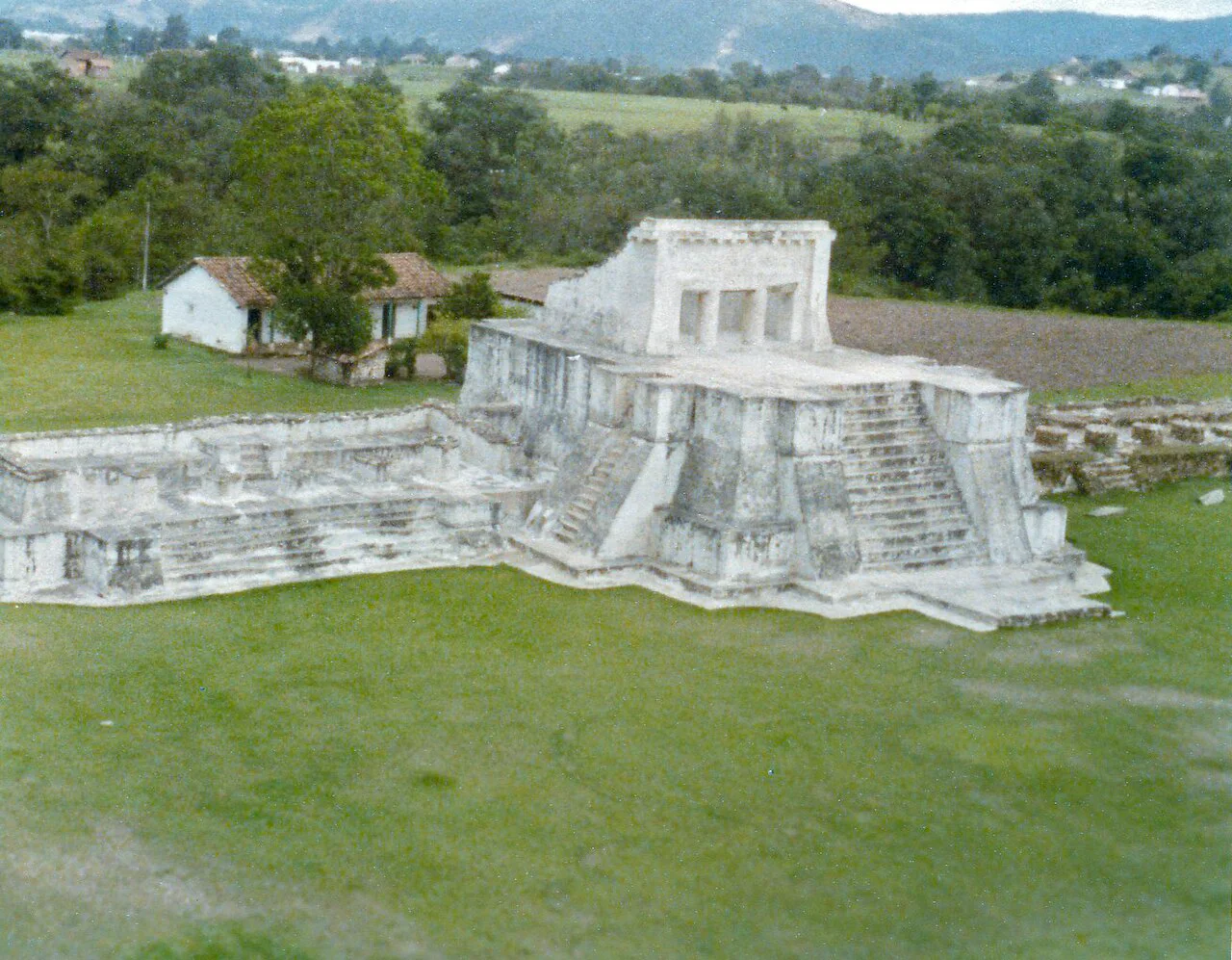
The White-Plastered Restoration
Guatemala declared the site a National Monument in 1931, under the name Tzaculeu. The name was changed to Zaculeu in 1946. The government then gave the United Fruit Company a licence to excavate. The company's work was directed by the archaeologist John M. Dimick. Another American archaeologist, Richard B. Woodbury, reported on progress in academic journals. The restoration took place in the late 1940s, and most of the restored buildings border Plazas One and Two. The team then coated a number of the buildings with white plaster. It was known that many had originally been finished that way. Few other restorations of pre-Columbian buildings have done the same.
Listen in the appT. W. Kines · Public domain
04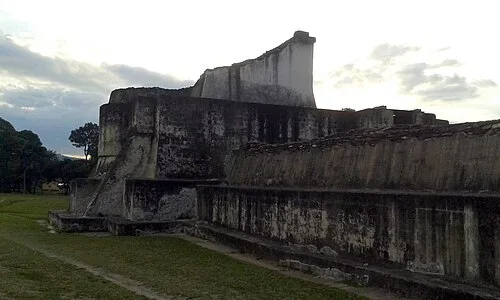 Plaza 1 and the White Plaster Controversy
The Siege of 1525
Gonzalo de Alvarado y Contreras led an attack on Zaculeu in 1525. He was the brother of the conquistador Pedro de Alvarado. He had one hundred and twenty soldiers. About two thousand Mexican and K'iche' allies came with him. The Mam had retreated to Zaculeu as a refuge, because its fortifications were strong. The only land route in was a narrow neck of land to the north. A fortified structure filled about three-quarters of its width. Kayb'il B'alam defended the city. The chronicles give about five thousand people under his command, though they do not say whether all were soldiers. The siege lasted several months, and the defenders were reduced to starvation. In October 1525, Kayb'il B'alam, the city's last ruler, surrendered. When the Spanish entered, they found eighteen hundred dead inside Zaculeu. After founding the new city of Huehuetenango nearby, the Spanish forced Zaculeu to be abandoned.
Listen in the appPhoto: Simon Burchell · CC BY-SA 4.0
05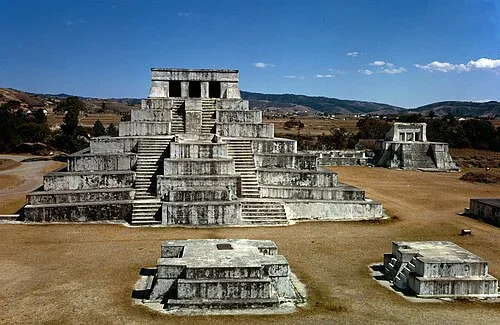 Structure 1 and the Royal Ash Tomb
Structure 1, the Main Pyramid
The main pyramid stands twelve meters tall, in eight stepped sections, with a shrine at the top. Beneath it lies an Early Classic tomb, from the period when most of the site was built. The tomb was made by tunnelling into the volcanic ash under the pyramid. A broad stairway led down to it from the main plaza. Its inside was painted red. When the roof fell in, it crushed more than one hundred clay vessels on the floor. The tomb also had thirty-four mirrors of pyrite, a shiny mineral. Similar mirrors have been found at Kaminaljuyu. There was a sizeable amount of jade too, including beads and earplugs. Some jade beads were carved into human and parrot faces.
Listen in the appHJPD · CC BY 3.0
06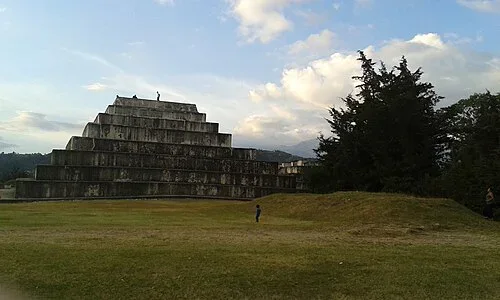 Structure 1 and the Royal Ash Tomb
Stepped Pyramid above a Grassy Plaza
The Early Classic period ran from about the year 250 to about the year 600. The buildings from that time show the influence of Teotihuacán, a large city in the Valley of Mexico. The pyramids here use the talud-tablero style, with a sloping base topped by a vertical panel. Later changes to the buildings were mostly minor, though the main pyramid was rebuilt seven times. Its visible remains date to the Early Postclassic period, between the years 900 and 1200.
Listen in the appPhoto: Simon Burchell · CC BY-SA 4.0
07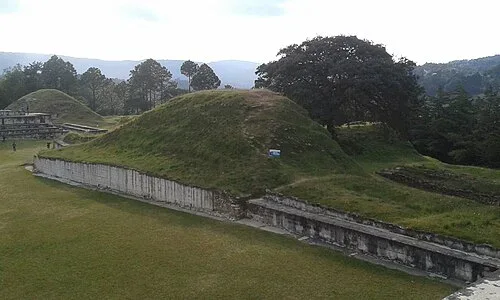 Structure 9 and Structure 6: The Frozen Conquest
Structure 9, the Unfinished Mound
Structure Nine is a large mound on the northwest side of Plaza One. Its last building phase was cut short by the Spanish Conquest. Three of its sides have no terraces at all. Only the lowest of its stepped levels was built, on the remaining side. Beneath the mound, archaeologists found hidden groups of pottery from the Early Classic period.
Listen in the appPhoto: Simon Burchell · CC BY-SA 4.0
08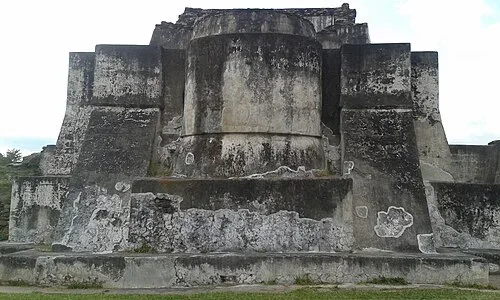 Structure 9 and Structure 6: The Frozen Conquest
Traces of Painted Plaster
The buildings here were generally coated in a thick layer of plaster. Fragments of it still carry floral and geometric designs. That suggests the buildings were once brightly painted. Today the coating has flaked away in patches.
Listen in the appPhoto: Simon Burchell · CC BY-SA 4.0
09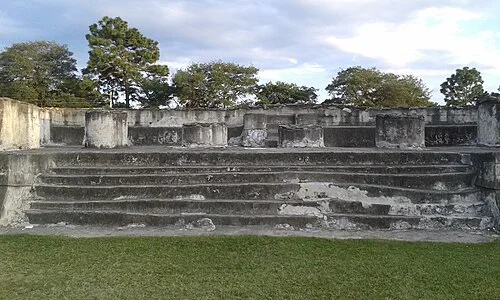 Plaza 2 and Structure 4: K'iche' Palace-Temple
A Late Plaza Platform
The small platforms in the plazas were added late, and their style points to central Mexico. Zaculeu had come under central Mexican influence again in the Late Classic period. That influence is so distinct that it may suggest a foreign Mexican elite settled here. Whether that happened is not known.
Listen in the appPhoto: Simon Burchell · CC BY-SA 4.0
10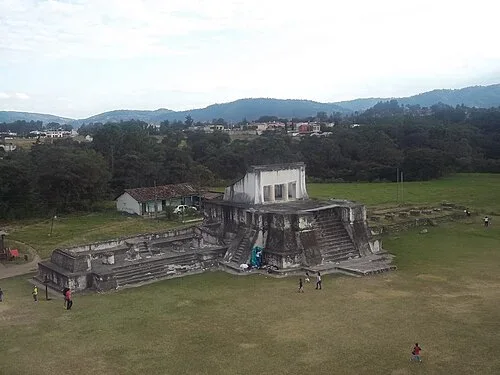 Plaza 2 and Structure 4: K'iche' Palace-Temple
Structure 4, the Palace-Temple
This is Structure Four, the palace-temple, and it belongs to the K'iche' conquest of Zaculeu. For a long time, that conquest was dated to the fifteenth century, based on historical accounts. Radiocarbon dating has since pushed those dates back by three centuries. Some researchers now say the K'iche' conquest of the Mam kingdoms may have begun as early as the twelfth century. The K'iche' king Q'uq'umatz died in battle against the northern Mam. His son K'iq'ab carried on, and under him Zaculeu fell to the K'iche'. It appears to have been a second conquest, because the city had fallen once before, some time earlier. The K'iche' practice was to place a conquered kingdom under one of their noble lineages. The building here, called Structure Four, is an unusual blend of temple and palace. Its front follows the talud-tablero pattern. Its central base has three steep stairways, each with railings along the sides. A shrine of three rooms crowns it, and the last room is circular. Two long buildings flank the base, unequal in size. Archaeologists believe Zaculeu was likely controlled by the Nija'ib' lineage, based on the style of this building. It was likely a temple to Awilix, the patron goddess of that lineage. A very similar temple stood at Q'umarkaj, the K'iche' capital. The K'iche' built over older Mam buildings, so two layouts sit side by side. Many of the original Mam people stayed on the plateau.
Listen in the appPhoto: Simon Burchell · CC BY-SA 4.0
- 11
The Sunken Ballcourt (Structures 22 and 23)
A sunken court shaped like the letter I, forty-eight meters long, used for the Mesoamerican ballgame.
- 12
Structure 37, Left Unrestored
A grassy mound left as it was found, beside platforms that were restored, showing the choices made on site.
- 13
View from the Plateau Edge
Why a plateau above a river, with ravines on two sides and one narrow land bridge, made a strong site.
- 14
Circular Stone Feature
A round stone feature of unclear purpose, at a site used for ceremonies for centuries.
Zaculeu
Frequently asked questions
How much does the guide cost?
Free app download. Listed guide price: $0.99. Guide price shown in the app. Audio guide only. Venue admission is separate.
Can I listen without internet?
Yes. Download the guide’s audio, images, and maps in the app before your visit. Your downloaded content is then available offline.
Can I listen in my language?
This audio guide is available in 15 languages, including English.
Do I need to follow a schedule?
No. This is a self-guided experience. Choose your stops, pause whenever you like, and return to a story at your own pace.
At your own pace
Explore Zaculeu.
Download Stanza, then search for “Zaculeu”.
Free app download · Guide price shown in the app
Keep exploring
Audio guides — Guatemala
El Asintal · 81 km
Takalik Abaj
Content & sources
Gobierno de Guatemala · Public domain
Tecpán Guatemala · 85 km
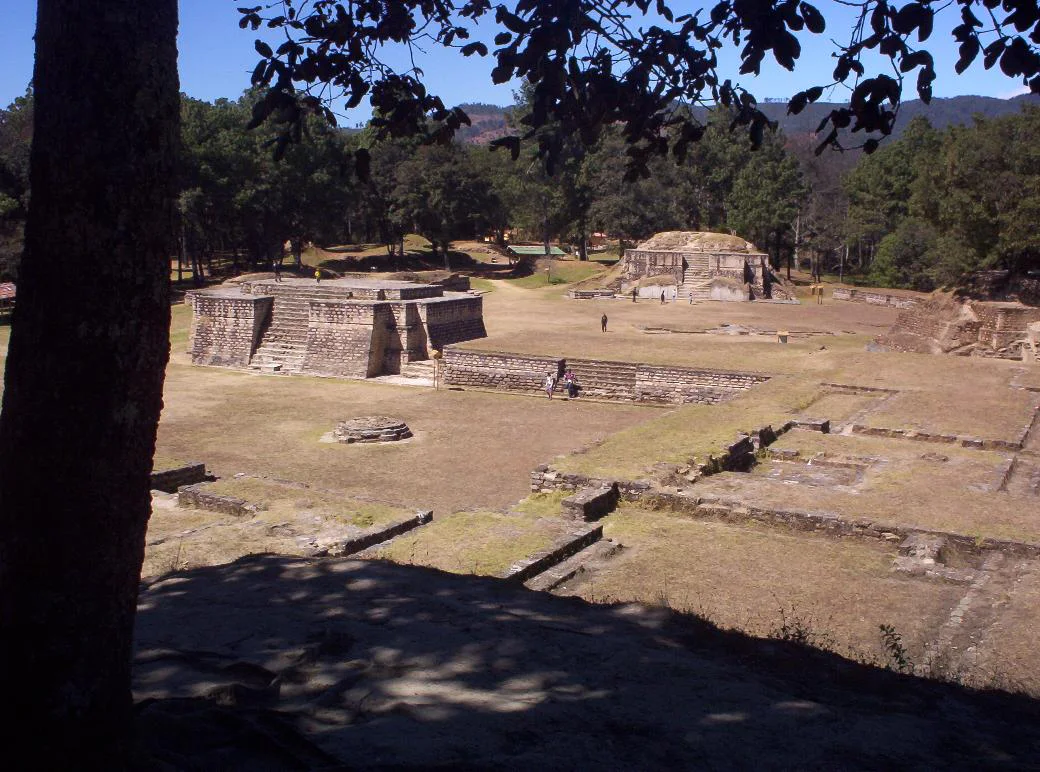
Iximche
Content & sources
Colocho · Public domain
Río Santiago · 120 km
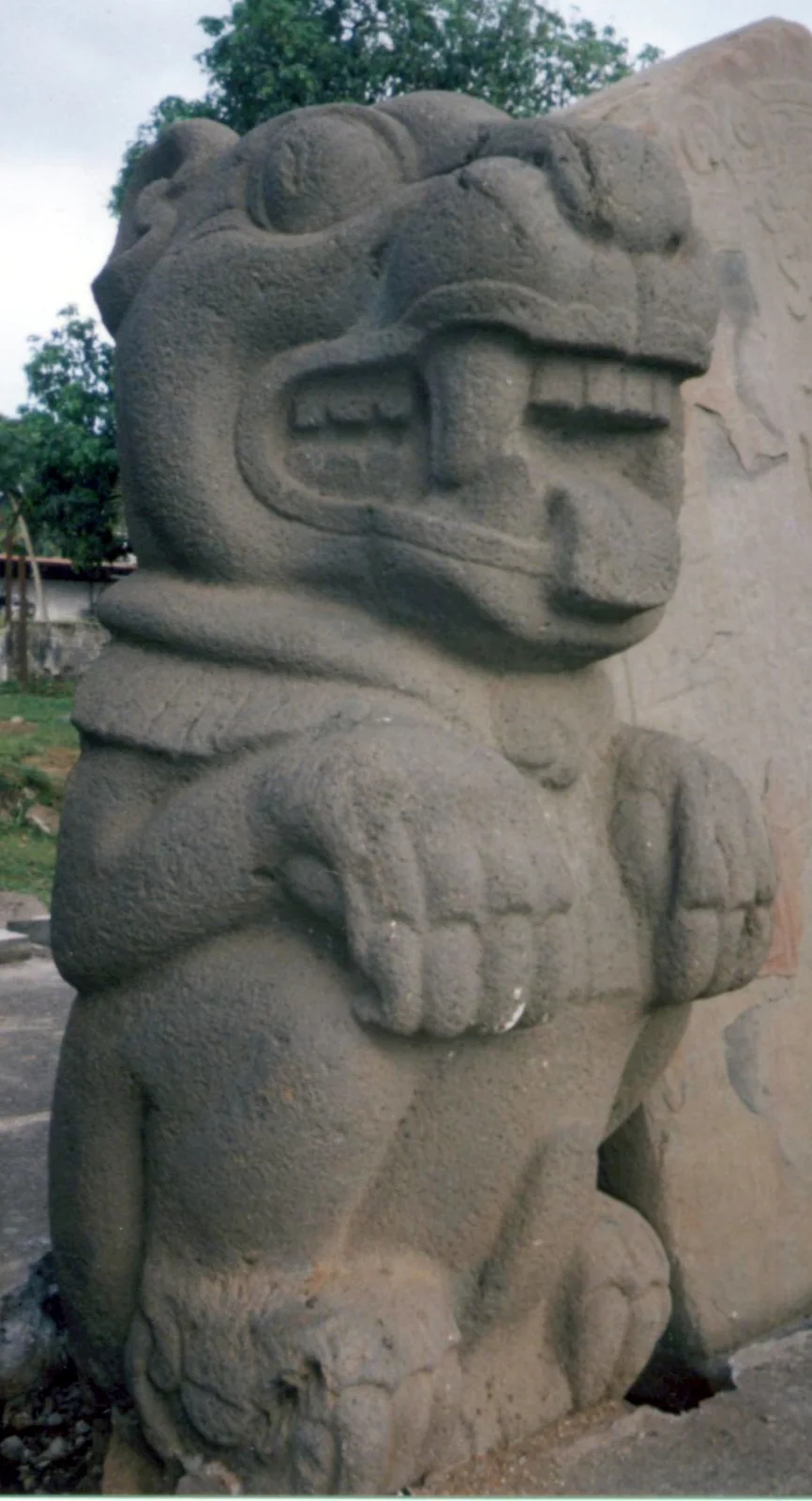
El Baúl
Content & sources
Photo: Simon Burchell · CC BY-SA 3.0
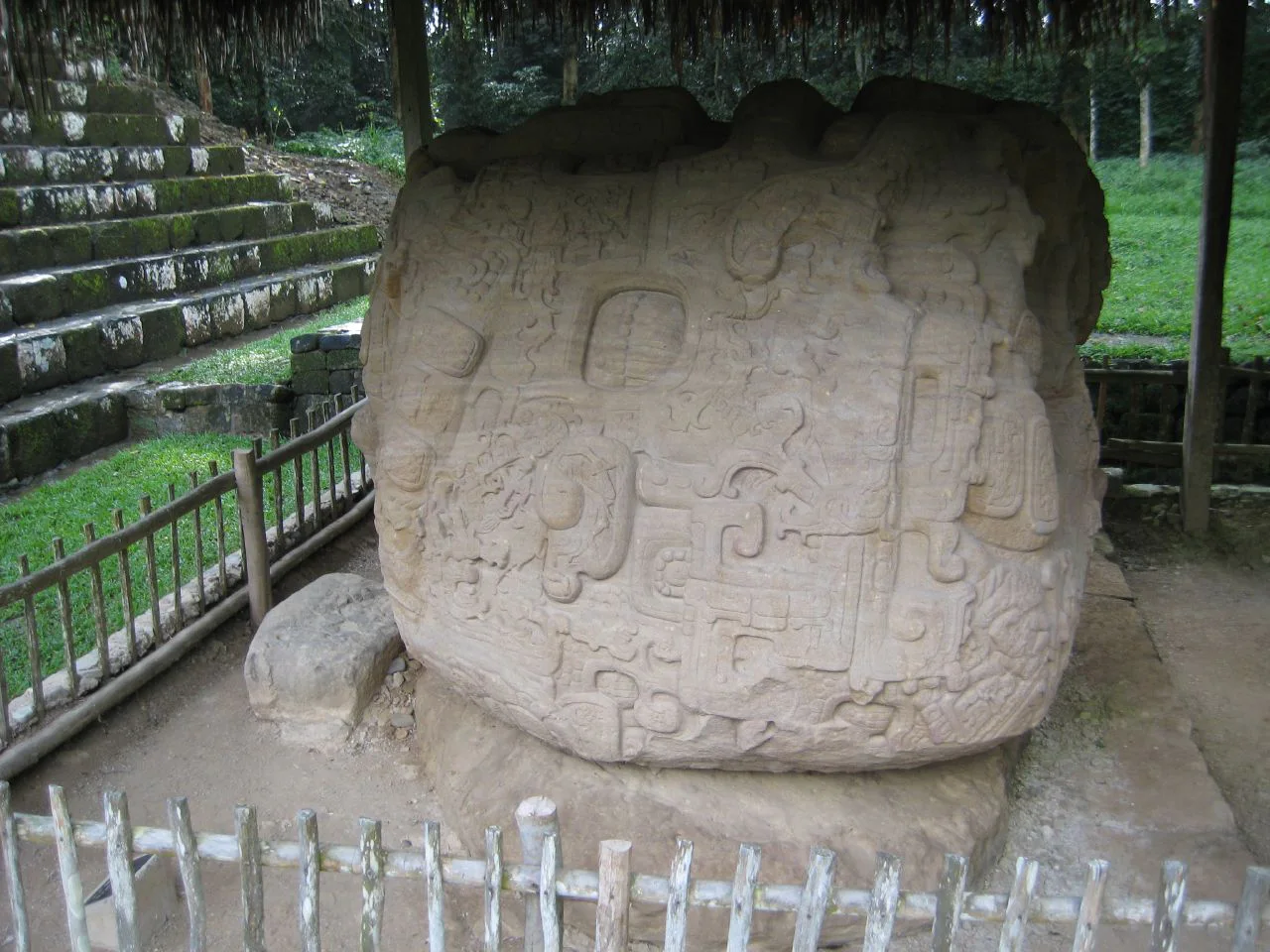
Quiriguá
Quiriguá
Content & sources
S2RD2 · CC BY 2.0